A strong IELTS Speaking answer is not simply a long answer. You can use advanced vocabulary, complex grammar and impressive expressions, yet still lose effectiveness if your ideas are difficult to follow.
The real difference often comes from how well you organise your answer.
Learning to give well organized answers in IELTS Speaking helps you respond more naturally, develop your ideas, explain your opinions and keep your speech easy to follow. This matters particularly because IELTS assesses Fluency and Coherence as one of its four Speaking criteria, alongside Lexical Resource, Grammatical Range and Accuracy, and Pronunciation.
The good news is that you do not need to memorise complicated speeches. You need a simple structure that allows your ideas to move logically from one point to the next.
This guide explains seven practical ways to organise your IELTS Speaking answers, with examples for Parts 1, 2 and 3.
Table of Contents
What Does a Well-Organized IELTS Speaking Answer Look Like?
A well-organised answer has a clear progression.
The examiner should be able to understand:
- What your main answer is
- Why you think that
- What example or explanation supports it
- What result, detail or conclusion follows
You do not need to announce these stages every time. Good organisation should sound conversational rather than rehearsed.
For example, consider this Part 1 question:
Do you enjoy reading?
A weak answer might be:
Yes, I like reading. I read books sometimes. I like different books. I used to read more when I was younger. Now I am busy with work.
The information is understandable, but the ideas are loosely connected.
A more organised answer could be:
Yes, I really enjoy reading, particularly non-fiction. I find it useful because I can learn something new while relaxing at the same time. For example, I often read books about psychology and communication in the evening. I don’t read as much as I used to, but I still try to read for at least twenty minutes a day.
The second response has a clear direction:
Answer → reason → example → additional detail
That simple progression makes the response easier to follow.
Why Organisation Matters in IELTS Speaking
IELTS Speaking is designed to assess your ability to communicate in spoken English. The test lasts 11–14 minutes and has three parts. Part 1 focuses on familiar topics, Part 2 requires a longer individual response, and Part 3 involves a more general and abstract discussion.
Organisation becomes increasingly important as the questions become more demanding.
In Part 1, you need to answer directly and develop your response without becoming unnecessarily long.
In Part 2, you need to speak at length and organise information logically. The official IELTS description specifically identifies logical organisation as an important skill in the long turn.
In Part 3, you need to explain and justify opinions, analyse issues and discuss more abstract ideas. A clear structure helps prevent your answer from becoming a collection of disconnected thoughts.
This is why organisation should not be treated as a separate trick. It is part of communicating effectively.
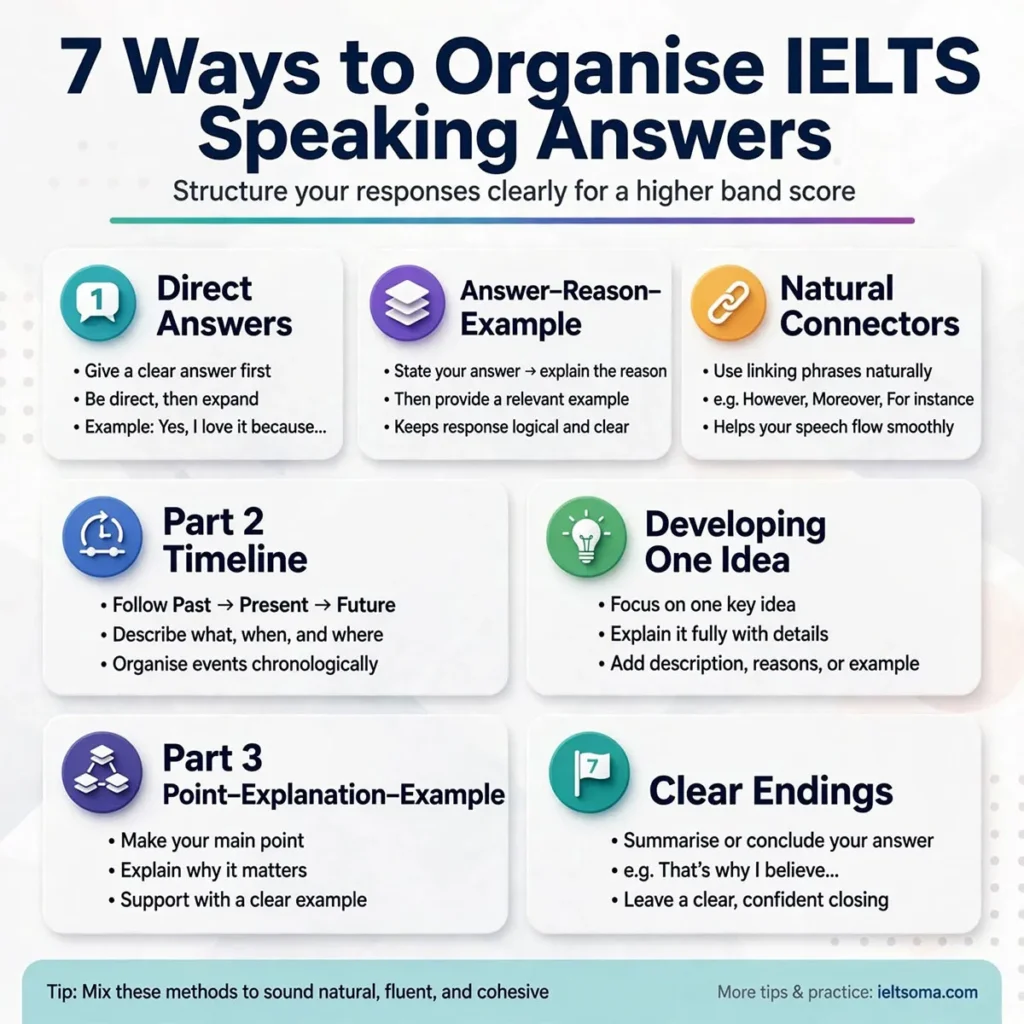
7 Ways to Give Well Organized Answers in IELTS Speaking
1. Answer the Question Immediately
One of the most useful habits is to answer the question before giving supporting information.
Do not make the examiner wait through a long introduction before discovering your actual answer.
For example:
Question: Do you prefer studying alone or with other people?
Instead of:
Well, I suppose there are different situations where people might choose different methods of studying, and I think both options can have advantages…
Start with:
I generally prefer studying alone because I can concentrate much better.
Then develop the idea.
I generally prefer studying alone because I can concentrate much better. When I’m working with other people, we sometimes start discussing things that aren’t directly related to the task. When I study alone, I can organise my time and work at my own pace.
The structure is immediately clear:
Direct answer → reason → explanation
This approach is especially useful in Part 1.
2. Use the Answer–Reason–Example Structure
A simple structure that works across many IELTS Speaking questions is:
Answer → Reason → Example
For example:
Question: Do you like cooking?
Yes, I do. I enjoy cooking because it allows me to experiment with different flavours and prepare exactly what I want. For example, I often try making different rice dishes at weekends, especially when I have more time.
This structure is effective because each sentence has a purpose.
The first sentence answers the question.
The second explains the reason.
The third makes the response more specific.
You can extend it when necessary:
Answer → Reason → Example → Result
For instance:
Yes, I do. I enjoy cooking because it allows me to experiment with different flavours. For example, I often try making different rice dishes at weekends. When a recipe works particularly well, I usually write it down so I can make it again.
You don’t need to force four sentences into every response. The structure is a guide, not a formula.
3. Connect Your Ideas Naturally
Well organised answers need connections between ideas.
However, this does not mean inserting a linking phrase into every sentence.
Useful spoken connectors include:
- because
- so
- although
- for example
- actually
- in particular
- as a result
- on the other hand
- compared with
- in my experience
Consider this answer:
I enjoy living in a large city. There are many things to do. Public transport is convenient. I can meet people from different backgrounds.
The ideas are relevant, but they sound like a list.
A more connected version is:
I enjoy living in a large city because there are so many things to do. Public transport is also relatively convenient, so I can easily move around without a car. Another advantage, at least in my experience, is that I can meet people from very different backgrounds.
The connectors help the examiner understand the relationship between the ideas.
The official IELTS Speaking criteria describe coherence in terms of logical sequencing, relevant ideas and appropriate cohesive devices such as logical connectors, pronouns and conjunctions.
4. Build Part 2 Answers Around a Simple Timeline
Part 2 is where many candidates struggle with organisation.
You have one minute to prepare and then speak for up to two minutes. The task card provides points that you should cover, and you are expected to speak at length about the topic.
The easiest way to organise many Part 2 topics is through a logical sequence.
For an experience, use:
Background → What happened → Details → Result → Reflection
For example, suppose the cue card asks:
Describe a memorable trip you took.
Your notes could be:
- Where: northern area
- When: last summer
- Who: two friends
- What happened: unexpected weather
- Best part: mountain walk
- Result: memorable experience
You could then speak in this order:
I’d like to talk about a trip I took with two close friends last summer. We travelled to a mountainous area for a few days because we wanted to escape the busy routine of work and spend some time outdoors.
On the first day, the weather was much worse than we expected, so our original plan had to change. Instead of going on a long hike, we explored a small town nearby and spent the afternoon in a local café.
The weather improved the following morning, so we finally went for the mountain walk we’d planned. The views were incredible, and that was probably the highlight of the whole trip.
Looking back, I think the unexpected change actually made the experience more memorable because we had to be flexible and make new plans.
Notice how the answer moves naturally through time.
You do not need to memorise this wording. You need to practise organising your notes into a sequence.
5. Develop One Idea Instead of Listing Five
A common mistake is trying to demonstrate knowledge by giving too many ideas.
Suppose the question is:
Why do people enjoy travelling?
A disorganised response might mention:
relaxation, culture, food, friends, photography, shopping, history, nature, exercise and social media.
That creates a long list but very little development.
A better response chooses two or three relevant ideas and develops them:
I think people travel mainly for two reasons. First, it gives them a break from their normal routine, which can be especially valuable for people with demanding jobs. Second, travelling allows people to experience different cultures. For example, visiting another country can expose you to different food, traditions and ways of communicating.
Depth is usually more useful than simply accumulating ideas.
If the examiner asks a follow-up question, you can then develop another aspect.
6. Use the “Point–Explain–Example” Pattern for Part 3
Part 3 requires more abstract discussion, so your answers often need more reasoning.
A useful structure is:
Point → Explanation → Example
For example:
Question: Why do some people prefer working from home?
I think flexibility is probably the main reason. Working from home can give employees greater control over their daily schedules, particularly if they have family responsibilities. For example, someone with young children may find it easier to organise their working hours around school or childcare.
You can extend this with a contrast:
However, I don’t think it works equally well for everyone. Some people need regular interaction with colleagues, and they may find working alone less motivating.
This creates a logical progression rather than a collection of unrelated observations.
7. Finish Longer Answers Clearly
A strong answer does not always need a dramatic conclusion, but longer responses can benefit from a clear final thought.
This is particularly useful in Part 2 and Part 3.
For example:
Overall, I think technology has made communication much easier, although it has also reduced some face-to-face interaction. So, in my view, the effect depends largely on how people choose to use it.
The final sentence gives the examiner a clear sense of where your argument has arrived.
Use phrases naturally, such as:
- Overall, I think…
- So, in my experience…
- That’s probably why…
- For that reason…
- Looking back…
- In the long term…
Do not use a conclusion after every short Part 1 answer. Organisation should match the length and purpose of the response.
A Simple Structure for Each IELTS Speaking Part
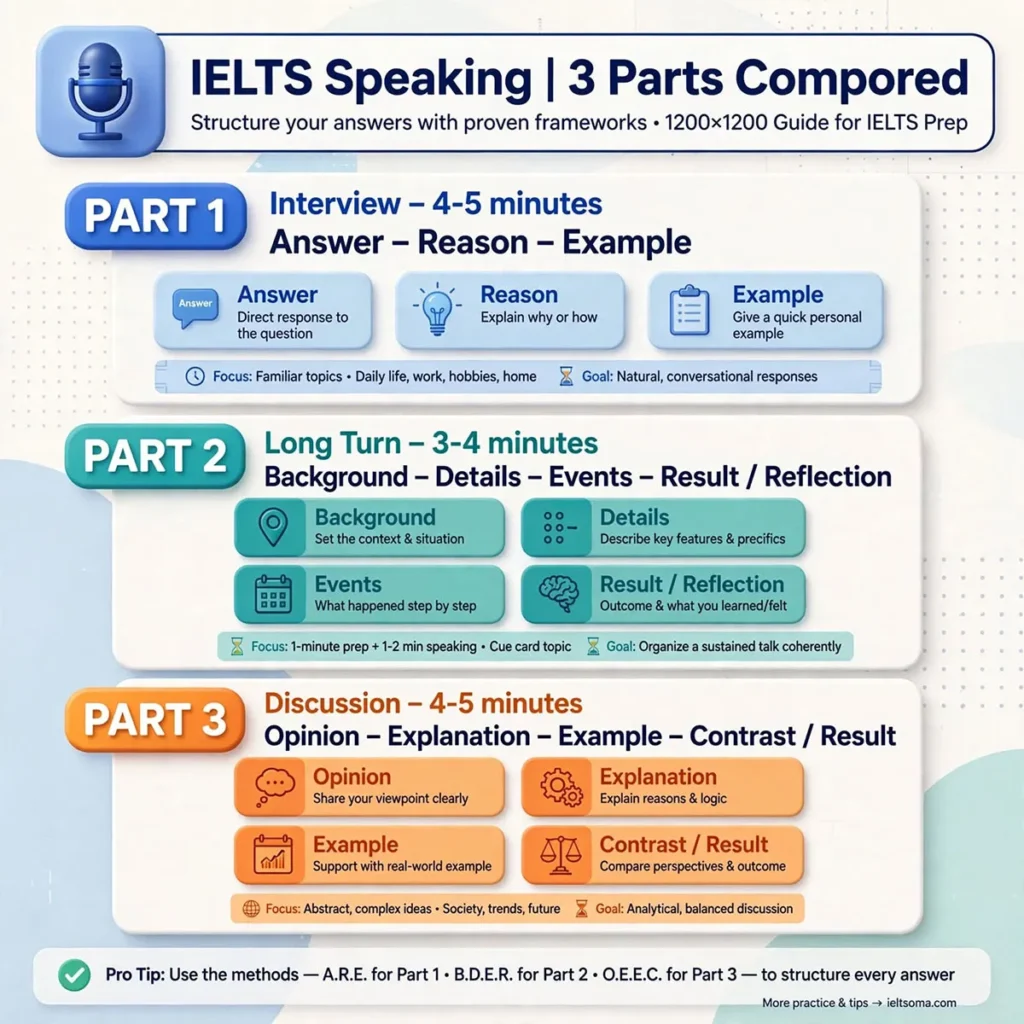
| Speaking Part | Useful Structure | Main Goal |
|---|---|---|
| Part 1 | Answer → Reason → Example | Give a direct, developed response |
| Part 2 | Background → Details → Events → Result/Reflection | Speak at length logically |
| Part 3 | Opinion → Explanation → Example → Contrast/Result | Develop and justify ideas |
These structures are not scripts.
They are frameworks that help you think while speaking.
That distinction is important because IELTS Speaking is intended to assess natural spoken production rather than rehearsed responses.
How to Organise Your One-Minute Part 2 Preparation
The one-minute preparation period can make a major difference.
Do not try to write complete sentences.
Instead, write keywords.
For example:
Describe a person who influenced you
Write:
- uncle
- childhood
- encouraged reading
- practical advice
- university choice
- still talk today
Then organise those notes:
1. Who → uncle
2. Background → childhood
3. Influence → reading and education
4. Example → university decision
5. Reflection → still important today
This gives you a mental map.
The official IELTS guidance confirms that candidates receive one minute to prepare and are provided with paper and pencil for notes.
Your notes should remind you what to say, not tell you exactly what to say.
Useful Phrases for Organising Spoken Ideas
You can improve clarity with natural discourse markers.
To introduce an idea
- I think the main reason is…
- Personally, I would say…
- From my experience…
- One important factor is…
To explain
- The reason for this is…
- This is mainly because…
- What I mean is…
- In other words…
To give an example
- For example…
- For instance…
- A good example would be…
- In my own experience…
To add another point
- Another reason is…
- On top of that…
- There’s also the fact that…
- Another thing worth mentioning is…
To contrast
- However…
- On the other hand…
- Having said that…
- That said…
To conclude an idea
- Overall…
- So, I would say…
- That’s probably why…
- For that reason…
Use these expressions because they help you communicate relationships between ideas—not simply because they sound advanced.
Common Organisation Mistakes in IELTS Speaking
Giving memorised answers
Memorised answers can sound unnatural and may not fit the actual question.
Prepare ideas and structures rather than complete speeches.
Speaking without answering the question
Some candidates start talking about a related topic but never clearly answer what the examiner asked.
Always identify the question type first.
Giving too many ideas
Five undeveloped ideas are usually less effective than two well-explained ones.
Using too many linking words
If every sentence starts with “Firstly”, “Secondly”, “Moreover” and “Furthermore”, your speech may sound like an essay.
IELTS Speaking is a conversation, not a written report.
Repeating the same idea
Repetition often happens when candidates have not planned the direction of their response.
Ask yourself:
Have I added a new detail, explanation or example?
If not, move forward.
Trying to sound too sophisticated
Complex vocabulary does not compensate for unclear ideas.
The official assessment criteria evaluate vocabulary, grammar, pronunciation and fluency/coherence separately.
Your goal is not to make every sentence complicated. Your goal is to communicate your meaning clearly and appropriately.
How to Practise Well Organized Answers in IELTS Speaking
You can train organisation without spending hours memorising model answers.
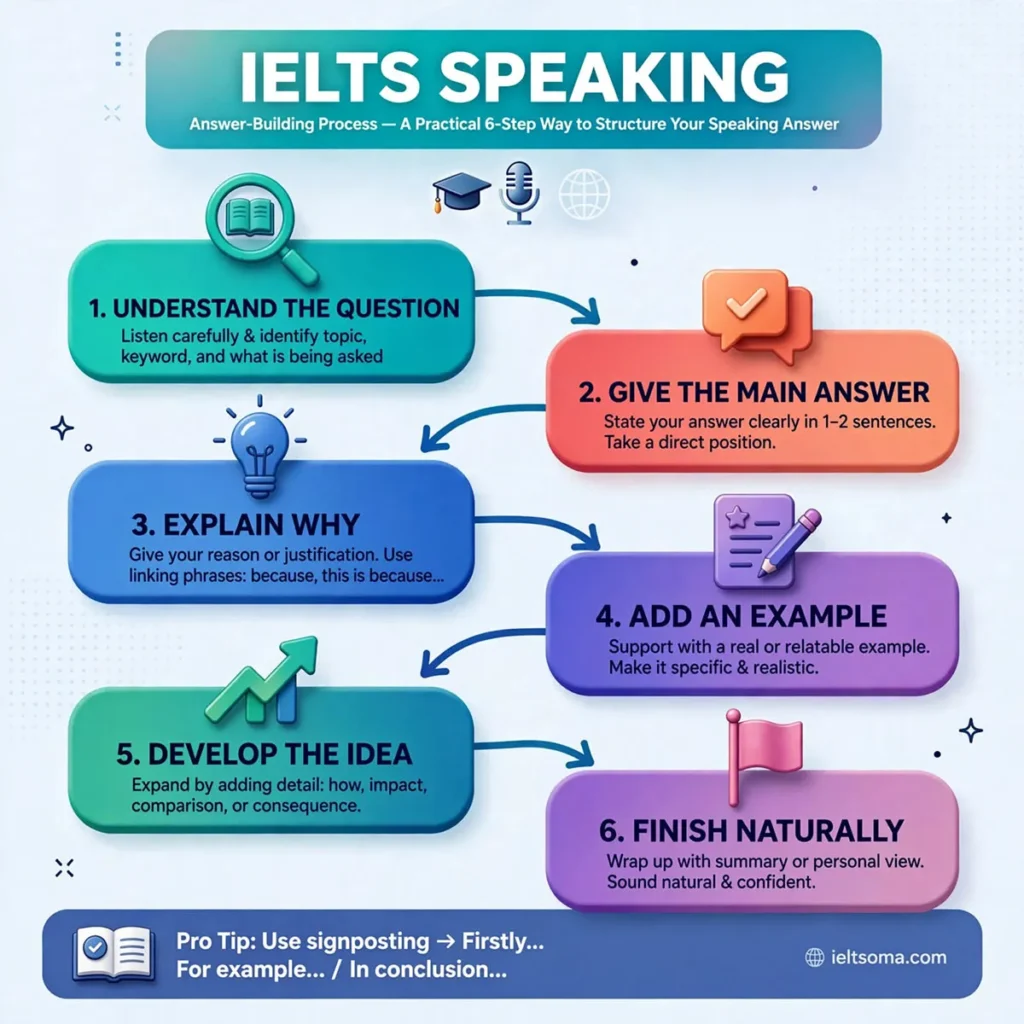
Try this five-step practice routine.
Step 1: Choose a question.
Pick one IELTS Speaking Part 1 or Part 3 question.
Step 2: Answer in one sentence.
Give your direct answer immediately.
Step 3: Add one reason.
Explain why you think that way.
Step 4: Add an example.
Make your answer specific.
Step 5: Record yourself.
Listen to the recording and ask:
- Did I answer the question directly?
- Was my main idea obvious?
- Did my ideas follow a logical order?
- Did I explain rather than simply list?
- Did I use linking language naturally?
- Did I repeat myself?
- Did I finish the idea clearly?
This type of self-analysis is more useful than repeatedly reading model answers.
A 10-Minute Daily Organisation Drill
If you have limited preparation time, try this routine:
Minutes 1–2: Choose two Part 1 questions.
Minutes 3–4: Answer each using Answer → Reason → Example.
Minutes 5–7: Choose one Part 3 question and develop two reasons.
Minutes 8–10: Record a one-minute response and listen for gaps in organisation.
Repeat this regularly with different topics.
Over time, the structure becomes automatic.
The Key Principle: Structure Your Thinking, Not Your Speech
The best well organized answers in IELTS Speaking do not sound like memorised templates.
They sound spontaneous because the speaker knows where the answer is going.
Think of organisation as a mental map:
Main idea → Support → Example → Further development
For Part 2, the map may become:
Background → Events → Details → Result → Reflection
For Part 3:
Opinion → Reason → Example → Contrast → Conclusion
Once these patterns become familiar, you can adapt them to hundreds of IELTS questions.
You will not need to memorise hundreds of answers.
You will simply have a reliable way to build answers when the examiner asks something unexpected.
Final Checklist for Well Organized IELTS Speaking Answers
Before your test, make sure you can:
- Answer questions directly.
- Develop your main idea instead of listing information.
- Give relevant examples.
- Use linking expressions naturally.
- Organise Part 2 responses in a logical sequence.
- Explain and justify opinions in Part 3.
- Use keywords rather than complete sentences when preparing.
- Avoid memorised speeches.
- Avoid unnecessary repetition.
- Finish longer answers with a clear final thought.
- Keep your organisation natural and conversational.
Remember that organisation is only one part of successful IELTS Speaking performance. You also need appropriate vocabulary, grammatical range and accuracy, and clear pronunciation. IELTS awards Speaking performance across all four criteria.
The objective is therefore not to produce perfectly structured speeches.
It is to make your ideas clear, connected and easy to follow.
When that becomes a natural part of your speaking, you can respond with greater confidence—even when the question is unfamiliar.
Frequently Asked Questions
How can I organise my IELTS Speaking answers?
Start with a direct answer, then give a reason and an example. For longer responses, add further explanation, contrast or a final reflection. The structure should support natural communication rather than sound memorised.
How long should my IELTS Speaking answers be?
There is no single ideal length for every question. Part 1 answers should generally be developed beyond a one-word response, while Part 2 requires a sustained long turn of up to two minutes. Part 3 responses usually require more explanation and justification because the questions are more abstract.
Should I memorise IELTS Speaking answers?
No. Memorising complete answers is risky because the actual questions may be different and the response may sound unnatural. It is better to practise ideas, vocabulary and flexible structures that you can adapt.
What is the best structure for IELTS Speaking Part 3?
A useful structure is Point → Explanation → Example. You can then add a contrast, consequence or concluding thought when appropriate.
Do I need linking words to get a high IELTS Speaking score?
Linking words can help show relationships between ideas, but using more linking words does not automatically produce a higher score. IELTS assesses how appropriately you organise and connect your spoken ideas.
Can I use the same structure for every IELTS Speaking question?
You can use the same basic thinking patterns, but you should adapt them to the question. A Part 1 question may only need an answer, reason and example, whereas Part 3 may require comparison, explanation or evaluation.
What is the biggest mistake when organising IELTS Speaking answers?
One of the biggest mistakes is trying to include too many ideas without developing any of them. Choose relevant points, explain them clearly and support them with specific examples.
Further Reading:
- Pronunciation for IELTS Speaking: 7 Powerful Tips
- Model Answers for IELTS Speaking: 10 Powerful Examples
- IELTS Speaking Fluency and Confidence: 9 Proven Ways to Improve
- IELTS Speaking Accuracy and Fluency: 7 Smart Ways to Improve
- IELTS Speaking Practice Tips: 15 Powerful Ways to Improve
- Official IELTS Speaking assessment criteria