A strong IELTS General Training Letter is not about filling a page with impressive vocabulary. It is about doing something much more precise: understanding the situation, answering every part of the task, choosing the right tone, and communicating your message clearly.
In General Training Writing Task 1, you are given a situation and asked to write a letter. You must write at least 150 words, and you should spend about 20 minutes on the task. The letter may be personal, semi-formal or formal, depending on the person you are writing to and the purpose of the letter.
That sounds straightforward.
Yet many candidates lose marks because they use the wrong tone, ignore one of the bullet points, write a memorised template that does not fit the situation, or spend too much time trying to use complicated vocabulary.
The good news is that these problems are avoidable.
This guide explains how to write an IELTS General Training Letter that is clear, well organised, appropriately formal and responsive to the task.
Table of Contents
What Is an IELTS General Training Letter?
An IELTS General Training Letter is the response required for Writing Task 1 of the General Training test.
You receive a situation and three bullet points telling you what information, explanation or action your letter needs to contain. The task may ask you to request information, explain a problem, make a complaint, apologise, invite someone, give advice or provide information.
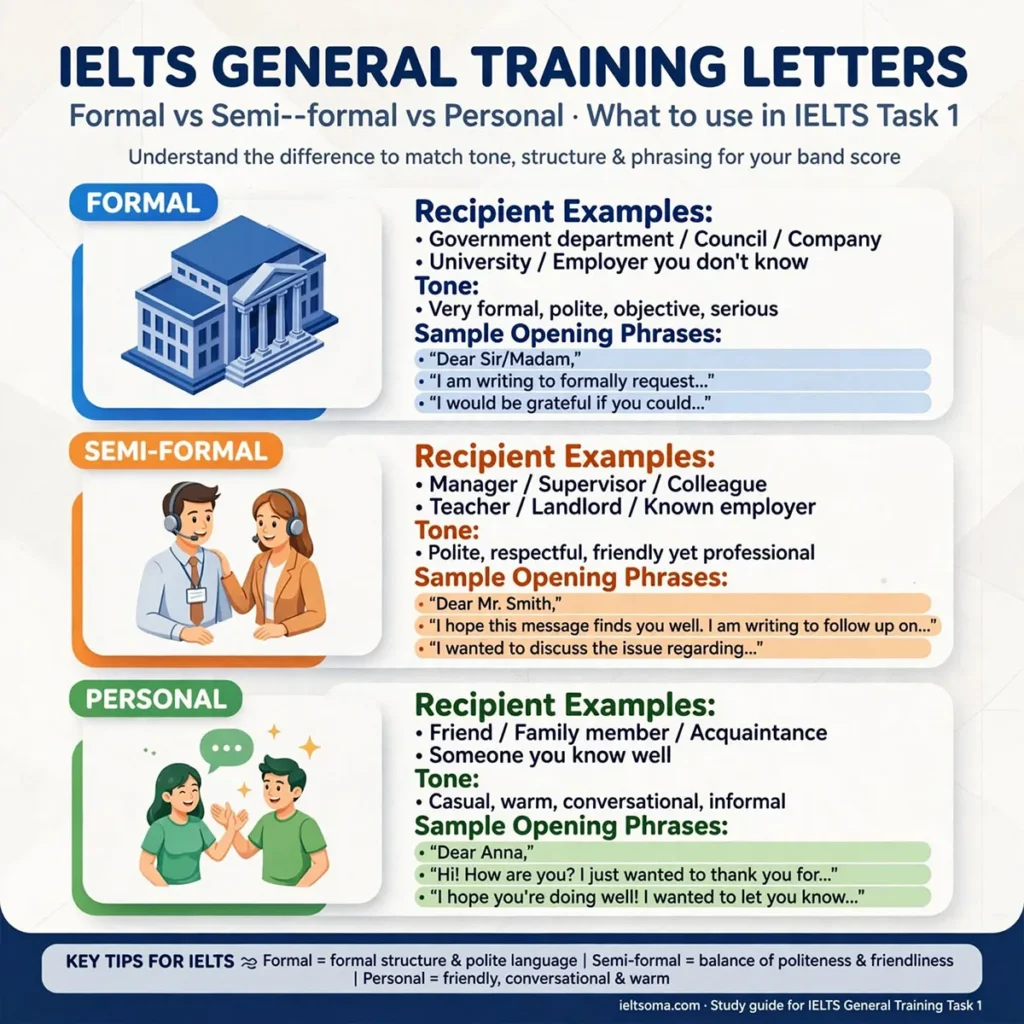
The three main styles are:
| Letter type | Typical recipient | Appropriate style |
|---|---|---|
| Formal | Someone you do not know personally | Formal and professional |
| Semi-formal | A manager, colleague, landlord or someone you know in a professional context | Polite and moderately formal |
| Personal | A friend or family member | Friendly and natural |
The key is not simply identifying whether the letter is “formal” or “informal”.
You need to understand who you are writing to, why you are writing, and what relationship you have with that person.
That relationship determines your register.
How Is an IELTS General Training Letter Scored?
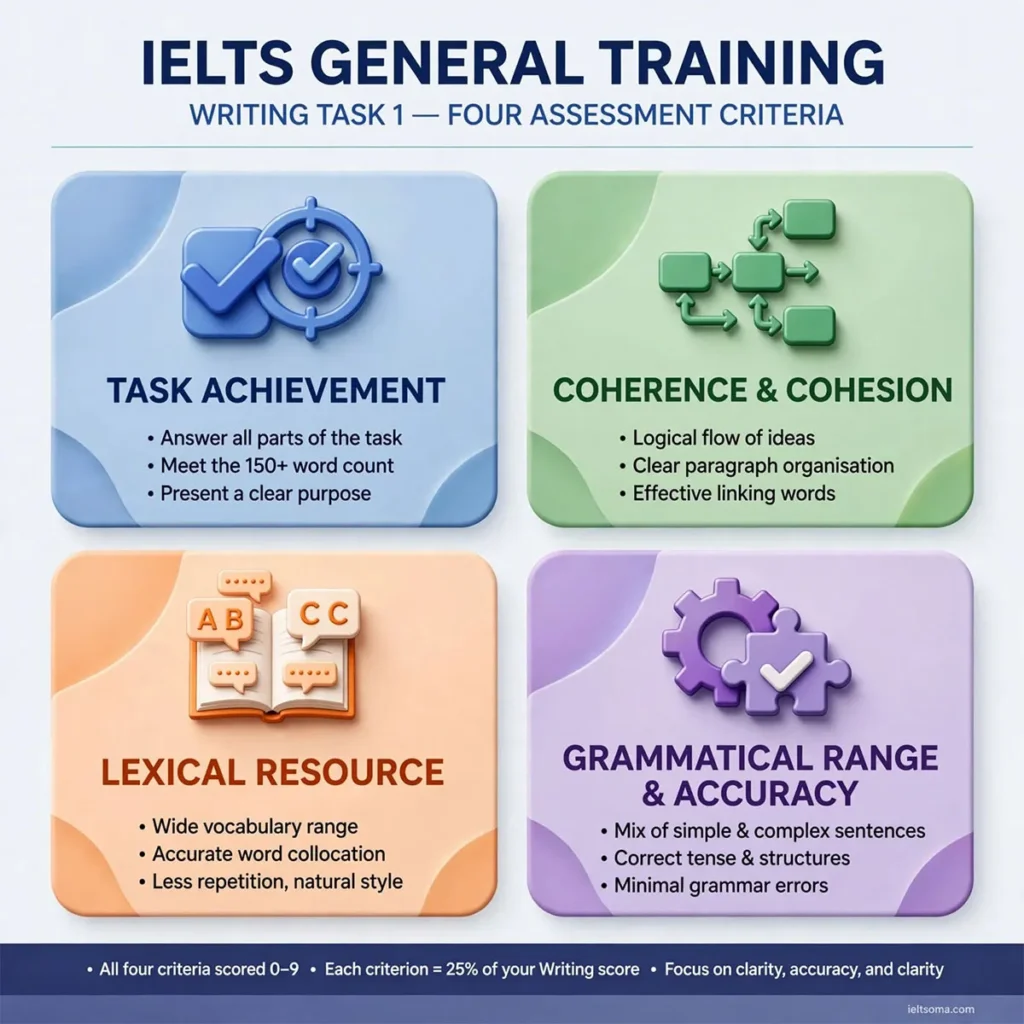
Your IELTS General Training Letter is assessed using four criteria:
- Task Achievement
- Coherence and Cohesion
- Lexical Resource
- Grammatical Range and Accuracy
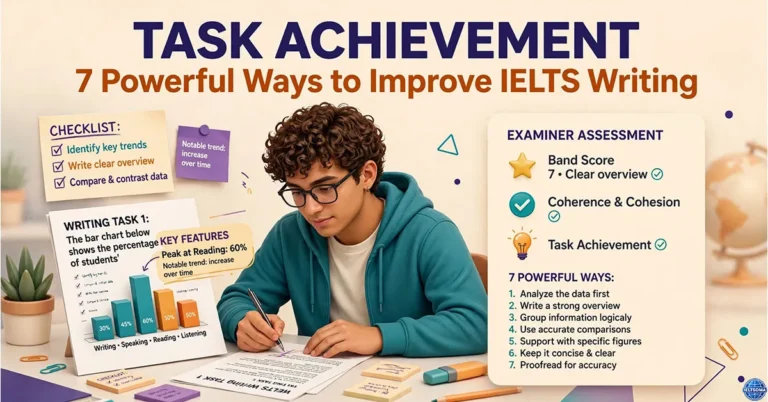
Official IELTS guidance explains that Task Achievement considers how well you fulfil the requirements of the task, including explaining the purpose, addressing the three bullet points, extending them appropriately, using an appropriate format and maintaining a suitable tone.
This means that a letter with sophisticated vocabulary can still perform poorly if it does not answer the actual task.
A useful way to think about the four criteria is:
| Criterion | What your letter needs |
|---|---|
| Task Achievement | Answer every requirement clearly |
| Coherence and Cohesion | Organise information logically |
| Lexical Resource | Use accurate, appropriate vocabulary |
| Grammatical Range and Accuracy | Use varied structures accurately |
You therefore need to improve more than vocabulary.
1. Identify the Purpose Before You Write
The first step in writing a high-scoring IELTS General Training Letter is identifying its purpose.
Do not start writing immediately.
Spend a short amount of time asking:
Why am I writing this letter?
For example:
- to complain about a service
- to request information
- to apologise
- to invite someone
- to thank someone
- to give advice
- to explain a problem
- to ask for help
- to recommend something
- to provide information
The purpose should control the rest of your response.
For example, imagine the task says:
You recently stayed at a hotel and were unhappy with the service. Write a letter to the hotel manager.
Your purpose is not simply “write about a hotel”.
Your purpose is to complain and seek an appropriate response.
That should immediately influence your opening:
Dear Sir or Madam,
I am writing to express my dissatisfaction with the service I received during my recent stay at your hotel.
The reader immediately understands why the letter has been written.
That clarity is much more valuable than an unnecessarily complicated opening.
2. Address All Three Bullet Points
This is one of the most important rules for an IELTS General Training Letter.
The task normally gives you three points that need to be covered. Official IELTS guidance specifically states that Task Achievement assesses how fully you address these requirements and whether you extend the functions appropriately and relevantly.
Treat the three bullet points as a checklist.
Suppose the task asks you to:
- explain what happened
- describe how the problem affected you
- suggest what the company should do
A weak candidate might write extensively about what happened but barely mention the solution.
A stronger candidate gives each point sufficient attention.
A simple planning method
Before writing, make three quick notes:
Point 1: What happened?
Point 2: Why was it a problem?
Point 3: What action do I want?
Then turn those notes into connected paragraphs.
You do not need to give every bullet point exactly the same number of words.
Instead, make sure each one is clearly answered and appropriately developed.
3. Choose the Correct Tone
Tone is one of the easiest ways to distinguish a competent letter from a high-scoring one.
Imagine writing a complaint to a close friend:
Hey Sam,
I can’t believe what happened yesterday!
That could be perfectly natural for a friend.
But it would be inappropriate when writing to a company manager.
You might instead write:
Dear Sir or Madam,
I am writing to express my concern regarding the service I received during my recent visit.
The message is similar, but the relationship is different.
Formal tone
Use formal language when writing to someone you do not know personally.
Useful expressions include:
- I am writing to enquire about…
- I would be grateful if you could…
- I am writing to express my concern regarding…
- I would appreciate it if you could…
- I look forward to hearing from you.
Semi-formal tone
Semi-formal writing is appropriate when the recipient is someone you know but with whom you maintain a professional relationship.
For example:
I am writing to ask whether it would be possible to change my working hours next month.
This is polite without sounding excessively distant.
Personal tone
When writing to a friend, your language can be more relaxed:
I was really pleased to hear from you.
It would be great if you could come and stay with us.
I just wanted to let you know about the changes.
The objective is not to make every sentence informal.
The objective is to make the language appropriate to the relationship.
4. Use a Clear Four-Part Structure
A reliable structure makes it much easier to produce a well-organised IELTS General Training Letter under time pressure.
A practical structure is:
Paragraph 1: Purpose
Explain why you are writing.
Paragraph 2: First bullet point
Address the first required piece of information.
Paragraph 3: Second bullet point
Develop the second requirement.
Paragraph 4: Third bullet point and closing
Complete the final requirement and explain what you expect or hope will happen next.
For example:
Paragraph 1: Why are you writing?
Paragraph 2: What happened?
Paragraph 3: How did it affect you?
Paragraph 4: What would you like the recipient to do?
This structure is not a rigid template.
Some tasks may be better handled with three body paragraphs. Others may require two.
The important principle is logical organisation.
Your reader should never have to search through the letter to understand which ideas belong together.
5. Make Your Opening Direct and Purposeful
A common mistake is writing a long introduction that delays the main message.
You usually need only one or two sentences.
For example:
I am writing to complain about the poor service I received at your restaurant last Friday.
This is direct.
Compare it with:
I have always been interested in visiting restaurants in different parts of the city, and recently I had the opportunity to visit your restaurant with some friends.
The second version may be grammatically correct, but it wastes valuable words and delays the purpose.
In Task 1, clarity matters.
The examiner should understand the purpose of your letter immediately.
6. Develop Each Point With Specific Details
Simply mentioning a bullet point is not enough.
You should develop it with relevant information.
For example, suppose the task asks you to explain why you were unhappy with a hotel room.
Weak:
The room was not good.
Stronger:
Unfortunately, the room was considerably smaller than I expected, and the heating system stopped working on the second evening of my stay.
The second version gives the reader something concrete.
You can develop ideas by explaining:
- what happened
- when it happened
- where it happened
- why it mattered
- what the consequence was
- what you would like the recipient to do
For example:
As a result, I was unable to sleep comfortably and had to spend most of the night in the hotel lobby, where the temperature was considerably warmer.
Now the problem has been explained rather than merely mentioned.
7. Use Vocabulary That Fits the Situation
High-scoring vocabulary does not mean using the longest or most unusual words you know.
It means selecting words accurately.
For a formal complaint, you might use:
- dissatisfaction
- inconvenience
- inadequate
- unacceptable
- resolve
- compensation
- replacement
- request
- concern
But vocabulary must fit the sentence.
For example:
I would appreciate it if you could investigate the matter and provide an appropriate solution.
This sounds natural.
Trying to force five “advanced” words into every sentence would probably make the letter less effective.
IELTSOMA’s wider IELTS Writing vocabulary guidance also emphasises using vocabulary naturally and choosing expressions according to the relationship with the recipient.
Compare these examples
Overcomplicated:
I am writing to vociferously articulate my profound dissatisfaction regarding the extraordinarily deplorable service.
Natural and effective:
I am writing to express my dissatisfaction with the service I received.
The second version is much more appropriate.
8. Connect Ideas Naturally
Your paragraphs should not feel like a list of disconnected sentences.
Use cohesive devices when they genuinely help the reader follow your message.
Useful expressions include:
- However
- Therefore
- As a result
- In addition
- Furthermore
- For this reason
- Unfortunately
- Consequently
- In particular
- For example
But avoid inserting linking words into every sentence.
For example:
Firstly, I arrived at the hotel at 6 p.m. Furthermore, I checked in at the reception. Moreover, I went to my room. In addition, I unpacked my luggage.
This sounds mechanical.
Instead:
I arrived at the hotel at around 6 p.m. and checked in without any problems. However, when I entered my room, I immediately noticed that the heating was not working.
The relationship between the ideas is clear without excessive linking expressions.
Strong coherence is about logical progression, not the number of linking words you can use. The official assessment criteria also consider how logically ideas are organised and how cohesive devices are used.
9. Leave Time to Check Your Letter
Do not use all 20 minutes for writing.
A useful approach is:
3–4 minutes: Read, analyse and plan
13–14 minutes: Write
2–3 minutes: Check
During the final check, look specifically for:
- missing words
- spelling errors
- incorrect verb tenses
- subject-verb agreement
- articles
- singular/plural nouns
- punctuation
- repeated vocabulary
- inappropriate tone
- missing bullet points
Do not simply read the letter from beginning to end.
Use a checklist.
For example:
Task: Did I answer all three bullet points?
Tone: Is my language suitable for the recipient?
Grammar: Are my common mistakes present?
Vocabulary: Are my word choices accurate?
Organisation: Can the reader follow my ideas easily?
This targeted approach is more useful than passively rereading the same sentences.
A High-Scoring IELTS General Training Letter Example
Consider this task:
You recently bought a piece of furniture from a local shop, but it arrived damaged. Write a letter to the shop manager.
In your letter:
- describe the problem
- explain what you would like the shop to do
- say when you are available for the matter to be resolved.
A strong response might look like this:
Dear Sir or Madam,
I am writing regarding a desk I purchased from your shop last week. Unfortunately, the item arrived with significant damage, and I would like to request a replacement.
When the desk was delivered on Monday afternoon, I noticed that one of the drawers was cracked and that the surface had several deep scratches. Although the packaging appeared slightly damaged, I did not expect the furniture itself to be in such poor condition.
I would therefore appreciate it if you could arrange for the damaged desk to be collected and replaced with a new one. I have kept the original packaging and can provide photographs of the damage if required.
I am generally available after 5 p.m. on weekdays, although I can also arrange for someone to be at home on Saturday morning if this is more convenient for your delivery team.
I look forward to hearing from you and hope that the matter can be resolved promptly.
Yours faithfully,
[Name]
Why does this work?
The response:
- clearly explains its purpose
- addresses all three bullet points
- uses an appropriate formal tone
- organises information logically
- provides specific details
- makes a clear request
- uses natural vocabulary
- contains varied sentence structures
- ends appropriately
Notice that it does not try to sound excessively academic.
That is an important lesson.
A General Training letter is not an essay.
Common IELTS General Training Letter Mistakes
1. Writing an essay instead of a letter
A letter should respond directly to a situation and communicate with a specific recipient.
Do not write a generic introduction followed by unrelated arguments.
2. Ignoring the recipient
Always consider who will read your letter.
A friend, manager and company director do not require exactly the same language.
3. Missing a bullet point
This can seriously affect Task Achievement.
Before submitting your answer, check each requirement individually.
4. Memorising an entire template
Templates can be useful for understanding organisation, but memorising complete answers is risky.
The situation may require a different purpose, tone or structure.
Learn flexible phrases rather than entire paragraphs.
5. Using overly advanced vocabulary
A complicated word used incorrectly is worse than a simple word used precisely.
Prioritise accuracy and appropriateness.
6. Writing too little
You must write at least 150 words. Official IELTS guidance notes that writing below the minimum may leave insufficient evidence for higher performance.
7. Writing far too much
There is no need to produce a very long letter.
Task 2 carries twice the weight of Task 1 in the Writing score, so spending excessive time on Task 1 can hurt your overall performance.
8. Using bullet points in the answer
The actual response should be written as connected text rather than notes or bullet points.
9. Forgetting the closing
Your ending should match the level of formality.
For example:
Formal:
Yours faithfully,
Semi-formal:
Yours sincerely,
Personal:
Best wishes,
The exact closing should also fit the salutation and relationship.
A 10-Minute Practice Method for IELTS General Training Letters
If you want to improve quickly, do not simply write full letters every day.
Use targeted practice.
Step 1: Analyse a task
Take two minutes to identify:
- recipient
- purpose
- tone
- three bullet points
Step 2: Create a mini-plan
Write one or two ideas for each bullet point.
Step 3: Write the opening
Practise explaining the purpose in one or two sentences.
Step 4: Develop the body
Add specific details instead of repeating the bullet point.
Step 5: Check your language
Look for your most common grammar and vocabulary errors.
Step 6: Rewrite weak sentences
Take two or three sentences that sound unnatural and improve them.
This is more productive than writing the same type of letter repeatedly without analysing your mistakes.
IELTS General Training Letter Checklist
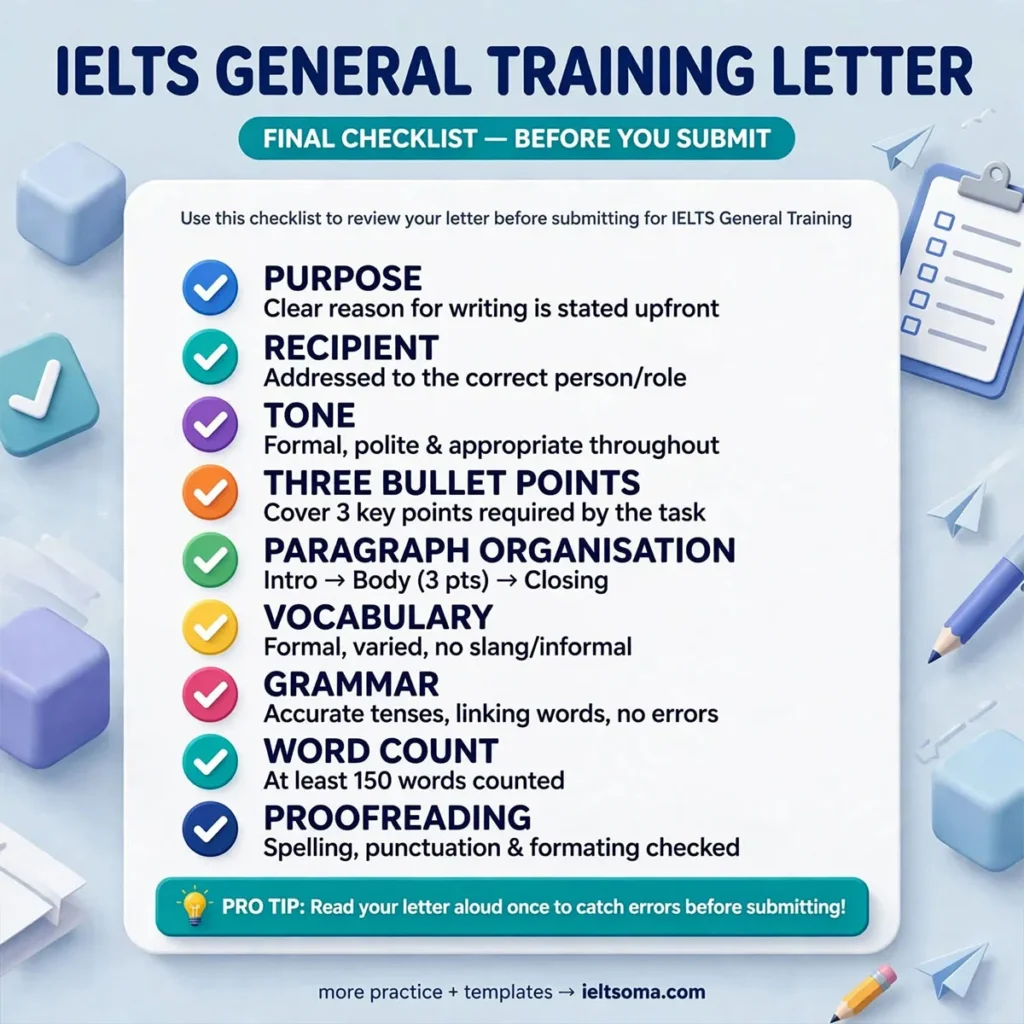
Before you finish, ask yourself:
- Did I understand the situation?
- Did I identify the recipient?
- Did I choose the correct tone?
- Did I clearly state the purpose?
- Did I answer all three bullet points?
- Did I develop each point with relevant details?
- Is the information logically organised?
- Did I use vocabulary accurately?
- Did I use a mixture of sentence structures?
- Did I check grammar and spelling?
- Did I write at least 150 words?
- Did I use an appropriate opening and closing?
- Did I avoid memorised language that does not fit the situation?
If you can consistently answer “yes”, your response is much more likely to meet the requirements of a strong IELTS General Training Letter.
Frequently Asked Questions About IELTS General Training Letters
How many words should an IELTS General Training Letter contain?
You must write at least 150 words for General Training Writing Task 1. You should normally aim for a controlled response that gives enough detail without taking excessive time away from Task 2.
How long should I spend on the IELTS General Training Letter?
You should spend approximately 20 minutes on Task 1. A useful strategy is to spend a few minutes planning, most of the time writing, and the final few minutes checking your response.
What types of letters can appear in IELTS General Training?
The letter may be personal, semi-formal or formal. The appropriate style depends on the recipient and the situation described in the task.
Do I need to write an address at the top of my IELTS letter?
No. Official IELTS guidance states that you do not need to write addresses at the top of the letter.
Can I use memorised phrases in my IELTS General Training Letter?
You can learn useful expressions, but they should be adapted to the specific situation. Memorised sentences that do not fit the task can make your writing unnatural and may prevent you from answering the question effectively.
How can I get a Band 7 or higher in General Training Writing Task 1?
Focus on fulfilling the task completely, organising information logically, using appropriate vocabulary, maintaining the correct tone and controlling grammar accurately. A high score does not depend on using complicated vocabulary in every sentence.
Is IELTS General Training Task 1 easier than Academic Task 1?
The tasks are different rather than simply easier or harder. General Training Task 1 requires a letter, while Academic Task 1 requires a response to visual information. Both require at least 150 words.
Final Strategy: Write for the Reader, Not the Score
The best way to approach an IELTS General Training Letter is to stop thinking about it as a vocabulary competition.
Imagine that you are genuinely writing to the person described in the task.
What do they need to know?
Why are you contacting them?
What action do you want them to take?
What information will make your message clear?
Once you answer those questions, your writing becomes much more natural.
A high-scoring letter is clear, relevant, organised and appropriately written for its audience. It does not need to sound like a university essay.
Before your next practice task, remember these nine principles:
- Identify the purpose.
- Understand the recipient.
- Choose the correct tone.
- Address every bullet point.
- Develop your ideas with specific details.
- Use accurate and natural vocabulary.
- Organise your paragraphs logically.
- Use varied grammar without forcing complexity.
- Reserve time to check your work.
Master those habits, and you will have a reliable system for producing a stronger IELTS General Training Letter under exam conditions.
Further Reading:
- Idiomatic Expressions for IELTS Writing: 25 Smart Choices
- Critical Thinking for IELTS Writing: 7 Powerful Strategies
- Matching Vocabulary to Writing: 9 Smart Ways to Improve IELTS
- Task Achievement in IELTS Writing: 7 Powerful Ways to Improve
- IELTS Exam Stress: 9 Powerful Ways to Stay Calm and Perform Better
- IELTS General Training Writing test format