You have probably heard two completely different pieces of advice about IELTS Speaking.
“Speak as fluently as possible.”
Then someone else tells you:
“Slow down and focus on grammar accuracy.”
So which one should you actually prioritise?
The answer is more nuanced than simply choosing fluency or accuracy. In Fluency vs Accuracy in IELTS Speaking, the real goal is to communicate smoothly while maintaining enough grammatical control to make your meaning clear.
A candidate who speaks extremely quickly but makes constant errors is not automatically a high-band speaker. Likewise, a candidate who produces grammatically perfect sentences but pauses for several seconds before every idea may struggle to demonstrate strong fluency.
IELTS Speaking is designed to assess your ability to communicate in English, not your ability to speak like a perfect native speaker.
This guide explains exactly how fluency and accuracy interact, what IELTS examiners look for, why speaking faster can sometimes hurt your score, and how you can develop both skills without sounding rehearsed.
Table of Contents
Fluency vs Accuracy in IELTS Speaking: Which Is More Important?
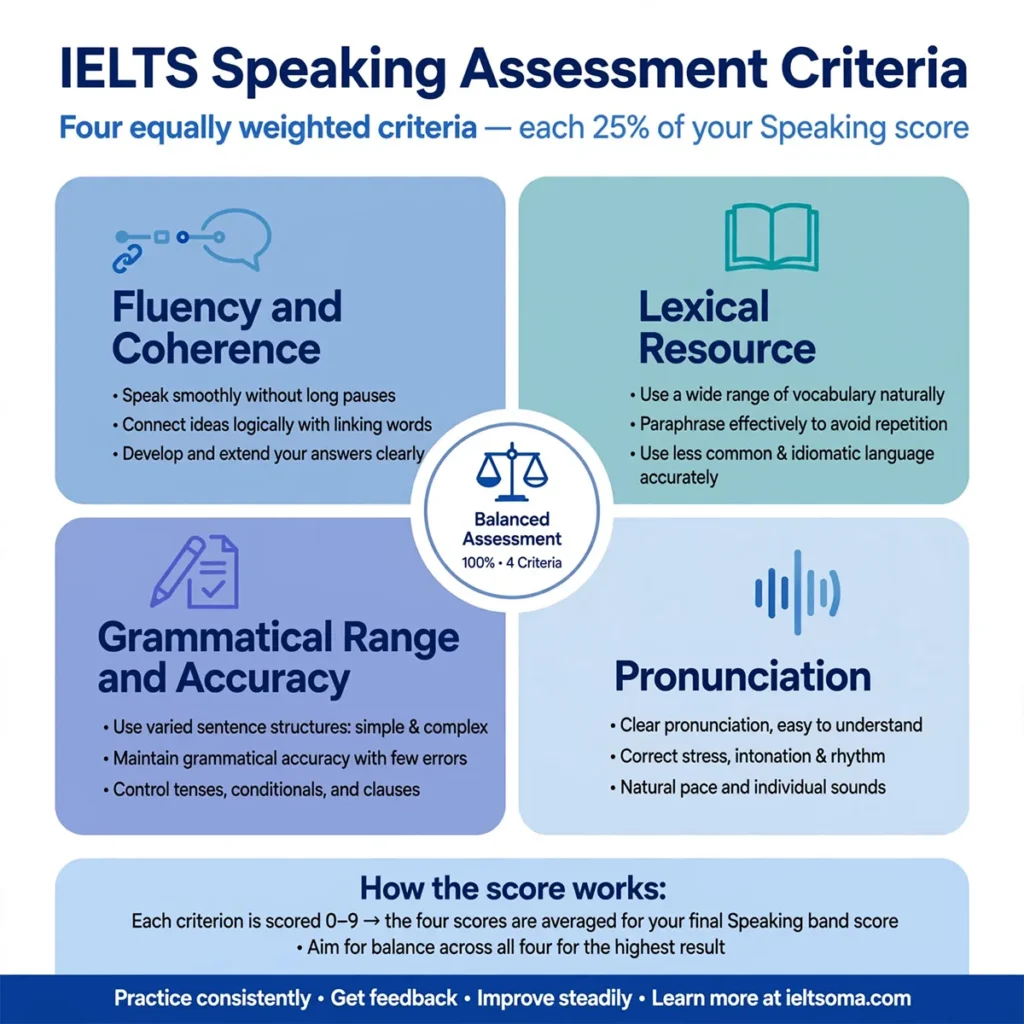
Neither fluency nor accuracy is simply “more important” because IELTS Speaking is assessed using four equally weighted criteria:
- Fluency and Coherence
- Lexical Resource
- Grammatical Range and Accuracy
- Pronunciation
The official IELTS assessment criteria state that each criterion carries equal weighting when calculating the Speaking score.
This means you should not think of the test as a competition between fluency and grammar.
Instead, think of them as two parts of effective spoken communication.
Fluency is your ability to keep speaking at a natural rate, develop your ideas and avoid excessive hesitation, repetition and unnecessary stopping.
Accuracy refers primarily to how correctly and appropriately you use grammatical structures.
For example:
“I enjoy living in my city because there are many facilities, and although it can be quite crowded, I think the advantages outweigh the disadvantages.”
This response is not grammatically perfect in some absolute sense, but it communicates a clear, developed idea with reasonable control.
Compare it with:
“I… I… like… um… my city because… because there are many… facilities. It is… actually… very… very crowded…”
The second candidate may know a great deal of grammar, but excessive hesitation makes it harder to demonstrate fluent communication.
Now consider the opposite:
“I enjoy my city because it have many facilities and people is very friendly. I am live there since five years and I very like it.”
The speaker keeps going, but repeated grammatical problems affect accuracy.
The strongest performance sits between these extremes.
What Does IELTS Mean by Fluency?
Many IELTS candidates misunderstand fluency.
Fluency does not mean speaking as quickly as possible.
The official IELTS criteria describe fluency and coherence in terms of continuity, rate, effort, logical sequencing and the ability to link ideas into connected speech.
In practical terms, a fluent IELTS speaker should be able to:
- keep speaking without excessive searching for words or grammar;
- produce reasonably long turns;
- connect ideas logically;
- use discourse markers naturally;
- pause when thinking about content;
- avoid unnecessary repetition;
- recover when making an occasional mistake.
This distinction is extremely important.
Fast speech is not the same as fluent speech
Imagine two candidates answering the question:
“Do you enjoy travelling?”
Candidate A:
“Yes, definitely, I love travelling because it gives me an opportunity to experience different cultures, and whenever I visit a new place, I usually try the local food and talk to people because I think that is the best way to understand how they live.”
Candidate B:
“Yes, I really, really, really love travelling because, you know, travelling is, um, very good and I… I mean… I travel… I travel very fast because I like travelling…”
Candidate B may speak rapidly, but rapid delivery does not automatically create fluency.
Candidate A demonstrates a much more controlled flow.
The objective is natural continuity, not maximum speed.
What Does Accuracy Mean in IELTS Speaking?
Accuracy is mainly connected with the Grammatical Range and Accuracy criterion.
IELTS does not expect every sentence to be perfect. In fact, the official band descriptors explicitly allow some errors at higher bands.
At Band 7, for example, candidates can use a range of structures effectively even though some grammatical mistakes persist.
At Band 8, the majority of sentences are expected to be error-free, although occasional inaccuracies can still occur.
This gives us an important lesson:
Making a mistake does not automatically mean you have poor accuracy.
The examiner considers the overall pattern of your performance.
For example:
“If I have more free time, I would probably take up photography.”
This contains a grammatical problem because the conditional structure is inconsistent.
A better version would be:
“If I had more free time, I would probably take up photography.”
But if you make one such mistake during a long, otherwise controlled response, it does not mean your entire Speaking performance has failed.
The problem becomes more serious when errors are frequent, systematic and interfere with communication.
The 7 Powerful Rules for Balancing Fluency and Accuracy
1. Never sacrifice clarity just to speak faster
One of the most damaging IELTS Speaking myths is that speaking quickly automatically increases your band score.
It does not.
If increasing your speed causes you to swallow sounds, lose grammatical control or become difficult to understand, slow down slightly.
Your target should be a comfortable, controlled speaking rate.
Imagine that you are having a serious conversation with an educated person—not trying to win a race.
A natural speaking rhythm is more valuable than an unnecessarily fast delivery.
2. Build answers around ideas, not memorised sentences
Memorised answers create a difficult fluency-versus-accuracy problem.
When candidates memorise complete answers, they often try to reproduce every word exactly. If the examiner asks the question differently, the memorised structure may suddenly become difficult to use.
Instead, prepare:
- ideas;
- examples;
- useful vocabulary;
- common grammatical structures;
- personal experiences;
- reasons and explanations.
For example, if the topic is hobbies, prepare ideas about:
- what you enjoy doing;
- when you started;
- why you enjoy it;
- how often you do it;
- whether your interests have changed.
Then build the answer naturally during the test.
This makes it much easier to remain fluent while adapting your grammar to the actual question.
3. Use simple grammar accurately before adding complexity
A common mistake among Band 5 and Band 6 candidates is trying to use advanced grammar in every sentence.
That strategy often produces more mistakes, not a higher score.
Suppose you want to describe your hometown.
Start with controlled structures:
“I live in a fairly busy city. It has grown rapidly over the last few years. There are many shops and restaurants, and public transport has improved.”
Then introduce more complex structures where they genuinely help:
“Although the city has become much more convenient, the rapid population growth has also created problems such as traffic congestion.”
This is much better than forcing a complicated structure into every sentence.
Accuracy gives your fluency a stable foundation.
4. Learn to self-correct without destroying your fluency
Self-correction is not automatically bad.
The official IELTS descriptors recognise that higher-band speakers may occasionally repeat or self-correct. At Band 7, some hesitation, repetition and self-correction can occur without affecting coherence.
The key is how you correct yourself.
Weak:
“I have went—no, I mean—I have gone—actually, I went—no…”
This becomes disruptive.
Better:
“I have visited—sorry, I visited the museum last year.”
Then continue.
An occasional natural correction demonstrates awareness.
Constantly monitoring every grammatical detail can destroy your fluency.
5. Pause for ideas, not because you are searching for every word
Pauses are normal in real conversation.
The problem is not simply pausing. The problem is excessive or poorly controlled hesitation.
Compare:
“I think there are several reasons for this. The main one is probably convenience.”
with:
“I think… um… there are… several… um… reasons… because… um…”
The first speaker uses pauses to organise ideas.
The second speaker appears to be searching for basic language.
This distinction matters.
If you need thinking time, use natural expressions such as:
- “That’s an interesting question.”
- “I’ve never really thought about that before.”
- “I suppose the main reason is…”
- “There are probably two reasons for this.”
Do not turn these into memorised fillers that appear in every answer.
6. Practise fluency and accuracy separately before combining them
Trying to improve everything simultaneously can make practice inefficient.
Use two different practice modes.
Fluency practice
Choose a familiar IELTS topic and speak for two minutes without stopping to correct yourself.
Your goal is:
- continuous speech;
- logical development;
- natural linking;
- fewer unnecessary pauses.
Do not interrupt yourself every time you make a grammatical mistake.
Then do a second exercise.
Accuracy practice
Record another answer and analyse:
- verb tenses;
- articles;
- subject–verb agreement;
- prepositions;
- sentence structures;
- countable and uncountable nouns;
- conditionals.
Choose only two or three recurring problems to fix.
Finally, combine the two skills.
Answer the same question again while maintaining the improved grammar without losing your natural flow.
This three-stage process is far more effective than simply speaking randomly for hours.
7. Train for your target band, not an imaginary perfect performance
Your preparation should reflect the level you actually need.
The official IELTS Band 6 descriptor allows frequent errors in complex structures when they rarely impede communication. Band 7 expects a wider range of structures, frequent error-free sentences and effective use of both simple and complex sentences, although some errors persist.
This means a Band 7 candidate does not need perfect grammar.
You need enough grammatical control to communicate complex ideas effectively.
For example, if your target is Band 7, your practice should focus on producing:
“Although working from home can be convenient, I think it may reduce social interaction if people rarely meet their colleagues face to face.”
You do not need to produce extremely sophisticated grammar simply to impress the examiner.
You need to demonstrate range, flexibility and control.
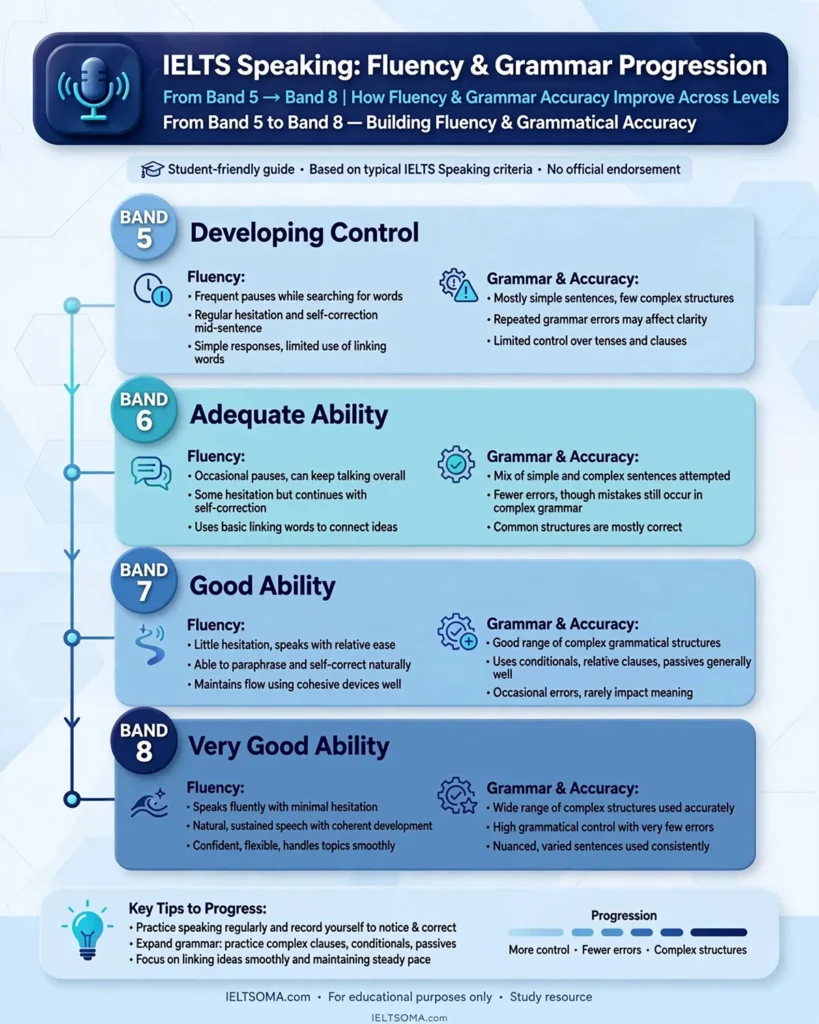
Fluency vs Accuracy in IELTS Speaking: What Happens at Different Bands?
Understanding the band descriptors can make your preparation much more realistic.
Around Band 5
A Band 5 candidate may be able to keep speaking but often relies on repetition, self-correction or slow speech. More complex speech can cause disfluency, while complex grammatical structures may contain frequent errors.
The priority is to establish a reliable foundation.
Work on:
- answering without freezing;
- basic tense control;
- common sentence structures;
- useful vocabulary;
- reducing unnecessary repetition.
Around Band 6
A Band 6 candidate is generally able to speak at length, although hesitation, repetition or self-correction may occasionally affect coherence. Complex grammatical structures may contain frequent mistakes, but these rarely cause major communication problems.
At this stage, you should work on consistency.
Do not simply learn more grammar. Learn to use the grammar you already know more reliably while speaking spontaneously.
Around Band 7
At Band 7, the candidate can speak at length without noticeable effort or loss of coherence. Some hesitation, repetition and self-correction may still occur, but these do not generally damage the organization of the response. Grammatically, a range of structures is used flexibly, with frequent error-free sentences alongside some mistakes.
This is where the fluency-versus-accuracy debate becomes particularly interesting.
You are not trying to eliminate every error.
You are trying to make your speech consistently effective.
Around Band 8
At Band 8, speech is fluent with only occasional repetition or self-correction. The candidate uses a wide range of grammatical structures flexibly, with the majority of sentences being error-free, although occasional inaccuracies remain possible.
This demonstrates why perfection is not the correct target.
Even very strong candidates can make occasional mistakes.
Should You Prioritise Fluency or Accuracy First?
If your speaking is currently very hesitant, I would generally prioritise fluency first, but not at the expense of basic grammatical control.
Why?
Because candidates who stop after every sentence to check grammar often become afraid of speaking.
Start by developing the ability to express a complete thought.
Then improve accuracy systematically.
For example:
Stage 1:
“I like living here because it is convenient and there are many things to do.”
Stage 2:
“I like living here because it is convenient, and there are plenty of things to do, particularly at weekends.”
Stage 3:
“Although the area can be quite crowded at weekends, I still enjoy living here because it offers plenty of facilities within walking distance.”
The progression is important.
You are not replacing fluency with accuracy.
You are adding accuracy to an increasingly fluent performance.
A Practical 15-Minute IELTS Speaking Routine
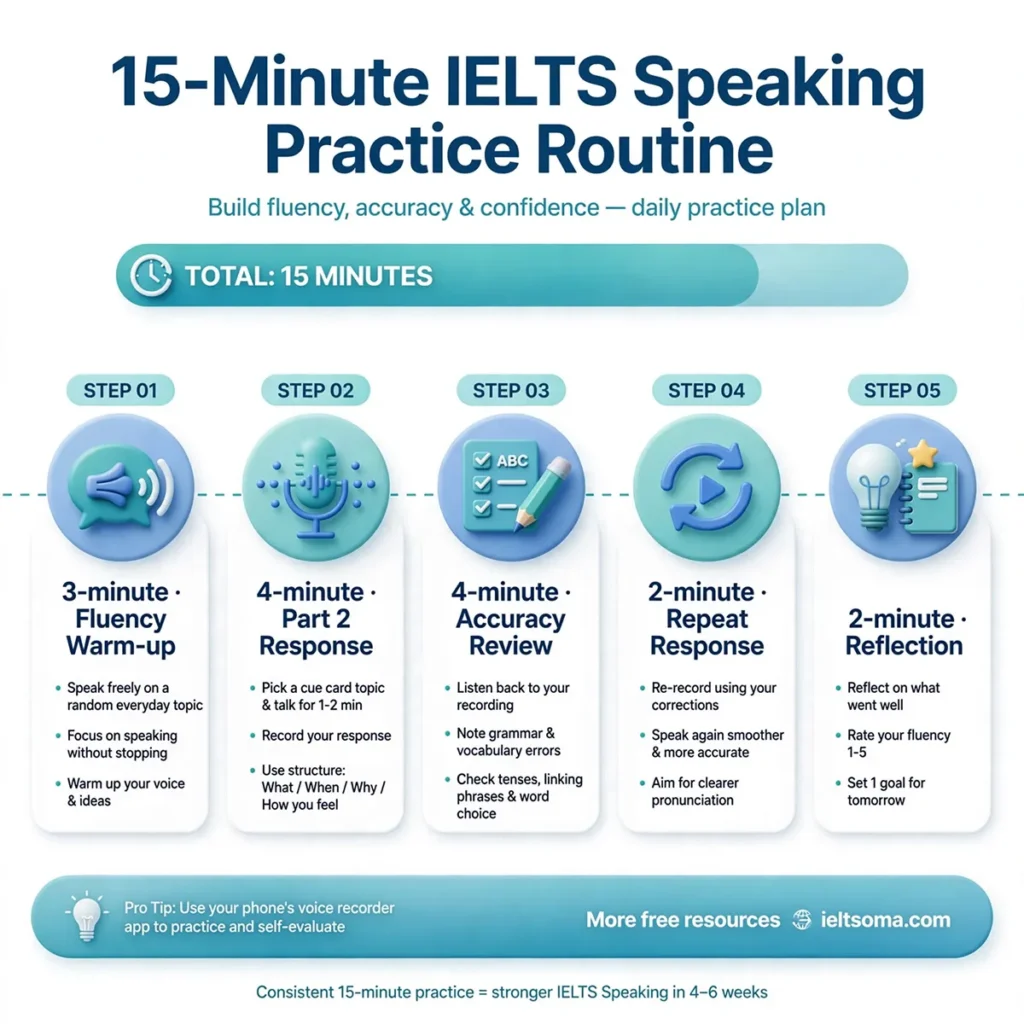
You do not need to spend two hours every day speaking English to make progress.
A focused 15-minute routine can be highly productive.
Minutes 1–3: Fluency warm-up
Answer three simple Part 1 questions without stopping unnecessarily.
Minutes 4–7: One-minute preparation and two-minute response
Choose a Part 2 topic. Make brief notes and speak for up to two minutes.
Focus on maintaining a logical flow.
Minutes 8–11: Accuracy review
Listen to your recording and identify your three most frequent grammar problems.
Do not try to correct everything.
Minutes 12–14: Repeat the answer
Answer the same question again, consciously correcting those three problems.
Minute 15: Reflection
Ask yourself:
- Did I speak continuously?
- Did my ideas connect logically?
- Did I make repeated grammar errors?
- Did I use a mixture of simple and complex structures?
- Did my pauses help me think, or did they show that I was searching for language?
Repeat this process regularly and compare recordings over time.
Common Mistakes Candidates Make
Trying to speak like a native speaker
You do not need to sound like a native speaker.
IELTS assesses your English proficiency using defined criteria. Your accent is not the issue by itself; pronunciation is assessed in terms of how effectively your speech can be understood and how pronunciation features are used.
Correcting every mistake immediately
Constant self-monitoring can make your speech fragmented.
If the mistake does not seriously affect meaning, continue.
Speaking unnaturally slowly
Slow speech can help accuracy temporarily, but speaking far too slowly can damage your fluency and make your responses sound unnatural.
Using memorised fillers
Phrases such as “It is an interesting and thought-provoking question” become obvious when repeated mechanically.
Use natural language instead.
Using advanced grammar without control
A simple sentence that is accurate is often more useful than a complicated sentence containing several errors.
Does Fluency Matter More Than Grammar in IELTS Speaking?
No.
Fluency and grammatical range and accuracy are separate assessment criteria, and both contribute equally to the Speaking score alongside lexical resource and pronunciation.
The better question is:
How effectively can you combine fluency and accuracy?
A candidate who communicates smoothly with reasonable grammatical control is in a much stronger position than one who excels at only one of these skills.
Can You Get Band 7 With Grammar Mistakes?
Yes.
The Band 7 descriptor explicitly allows some grammatical mistakes. What matters is the candidate’s overall ability to use a range of structures effectively, produce frequent error-free sentences and maintain communication despite occasional errors.
Therefore, do not enter the Speaking test believing:
“If I make one grammar mistake, I have lost Band 7.”
That is not how the assessment works.
Instead, aim for a performance in which mistakes are occasional rather than constant and do not prevent you from expressing your ideas clearly.
Does Speaking Faster Give You a Higher IELTS Speaking Score?
No.
Speaking quickly is not the definition of fluency.
The official assessment criteria focus on continuity, appropriate rate, coherence, logical sequencing and the ability to connect ideas.
If speaking faster causes more hesitation, pronunciation problems or grammatical errors, reducing your speed may actually improve the overall quality of your performance.
Aim for natural, controlled speech.
Final Verdict: Fluency vs Accuracy in IELTS Speaking
So, Fluency vs Accuracy in IELTS Speaking: Which Is More Important?
The best answer is: you need both, but they do different jobs.
Fluency helps you keep your ideas moving.
Accuracy helps you express those ideas correctly.
Vocabulary gives you the language to express meaning.
Pronunciation makes that meaning understandable.
Because IELTS Speaking uses four equally weighted criteria, your preparation should not become an attempt to maximise one skill while ignoring the others.
If you currently hesitate a lot, work on keeping your speech going.
If you speak confidently but make repeated grammar mistakes, improve your accuracy.
If you speak accurately but very slowly, practise spontaneous speaking.
And if you already speak fluently and accurately, concentrate on flexibility, precision, vocabulary and natural communication.
The goal is not perfect English.
The goal is clear, coherent, flexible and controlled English under test conditions.
That is the balance that can move your IELTS Speaking performance towards a higher band.
Frequently Asked Questions
Is fluency or accuracy more important in IELTS Speaking?
Neither is more important on its own. Fluency and coherence and grammatical range and accuracy are separate criteria, and each of the four IELTS Speaking criteria carries equal weighting.
Can I get a high IELTS Speaking score if I make grammar mistakes?
Yes. Higher-band candidates can make occasional grammatical mistakes. At Band 7, some errors can persist as long as the candidate demonstrates a range of structures, frequent error-free sentences and effective communication.
Should I speak slowly to improve my IELTS Speaking score?
You should speak at a natural and controlled rate. Speaking too quickly can increase hesitation, pronunciation problems and grammatical errors, while speaking unnaturally slowly can affect fluency.
How can I improve fluency and accuracy together?
Practise them separately first. Do timed speaking exercises without stopping to correct every error, then review your recording for recurring grammar problems. Repeat the same response while correcting those specific problems.
Does self-correction reduce IELTS Speaking fluency?
Not necessarily. Occasional natural self-correction is acceptable. However, frequent corrections, repetitions and backtracking can interrupt your flow and make your speech harder to follow.
Is the IELTS Speaking test different for Academic and General Training?
No. The Speaking test is the same for IELTS Academic and IELTS General Training. The two test types differ in Reading and Writing, while Speaking and Listening are the same.
What should I focus on for Band 7 Speaking?
Aim to speak at length without losing coherence, use vocabulary flexibly, demonstrate a range of grammatical structures, produce frequent error-free sentences and remain understandable throughout. You do not need perfect English.
Recommended Link(s):