If you want to sound more natural and flexible in the IELTS Speaking test, learning idioms and phrasal verbs for IELTS Speaking can be useful—but only when you know how to use them naturally.
Many candidates make the same mistake: they memorise dozens of impressive-looking idioms and try to insert them into every answer. The result can sound forced, unnatural, or simply inappropriate.
The IELTS Speaking test does not reward you for using the largest possible number of idioms. Instead, your Lexical Resource score reflects how effectively, accurately and appropriately you use vocabulary. At Band 7, the official descriptors mention some ability to use less common and idiomatic items, while Band 8 requires skillful use of less common and idiomatic items despite occasional inaccuracies.
So the goal is not to memorise complicated expressions.
The goal is to choose useful expressions, understand their meaning, know their grammar, and use them naturally when the situation calls for them.
This guide gives you 20 practical idioms and phrasal verbs for IELTS Speaking, together with meanings, examples, common mistakes and strategies for using them in Parts 1, 2 and 3.
Table of Contents
Why Use Idioms and Phrasal Verbs in IELTS Speaking?
Idioms and phrasal verbs are part of natural spoken English.
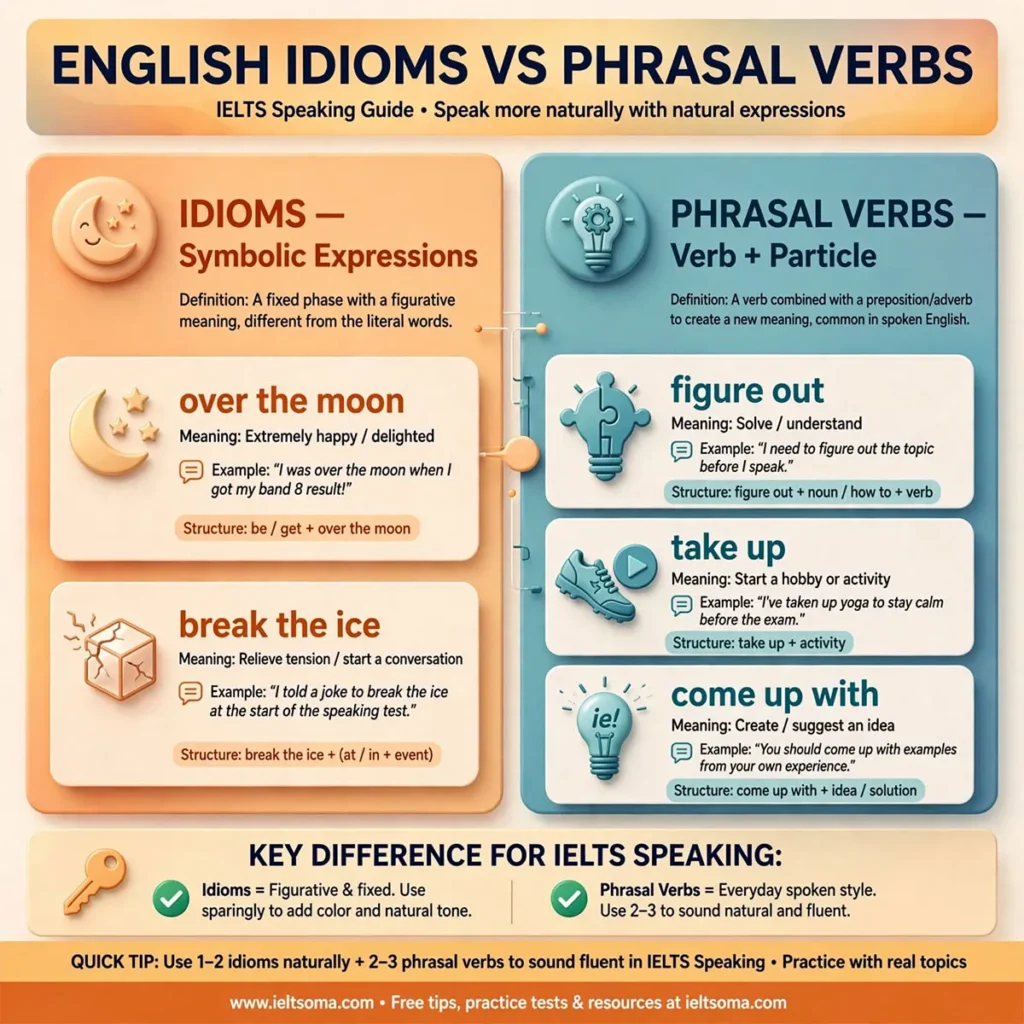
An idiom is an expression whose overall meaning cannot always be understood literally from its individual words. For example, over the moon means extremely happy.
A phrasal verb combines a verb with a particle such as an adverb or preposition. For example, give up means to stop trying, while look after means to take care of someone or something.
Both can help you express ideas more naturally.
However, they are only useful when they are accurate and appropriate to the context.
The IELTS Speaking test assesses four criteria: Fluency and Coherence, Lexical Resource, Grammatical Range and Accuracy, and Pronunciation. Lexical Resource includes the range and appropriacy of vocabulary, collocation, idiomatic expressions and the ability to paraphrase.
That means one perfectly used expression can be more valuable than five expressions that sound memorised.
10 Idioms and Phrasal Verbs for IELTS Speaking
Here are 20 expressions worth learning. Rather than memorising them as isolated vocabulary, learn the meaning, context and example sentence together.
1. Over the moon
Meaning: Extremely happy or delighted.
Example:
“I was over the moon when I found out that I had been accepted into my first-choice university.”
This idiom works particularly well when discussing achievements, good news, celebrations or memorable experiences.
IELTS tip: It is more natural when you are describing a genuinely positive experience rather than simply saying that something was “good”.
2. A breath of fresh air
Meaning: Someone or something pleasantly different or refreshing.
Example:
“After working in a busy office all week, spending the weekend in the countryside was a breath of fresh air.”
This can work well for questions about places, people, holidays, work and lifestyle.
3. Once in a blue moon
Meaning: Very rarely.
Example:
“I eat fast food once in a blue moon because I generally prefer home-cooked meals.”
This is particularly useful for frequency questions in Speaking Part 1.
Instead of repeatedly saying rarely, not often or hardly ever, you can sometimes use this expression naturally.
4. Cost an arm and a leg
Meaning: Be extremely expensive.
Example:
“Eating at some high-end restaurants can cost an arm and a leg, so I usually choose more affordable places.”
This can be useful when discussing shopping, restaurants, travel, technology or housing.
Common mistake: Do not use it simply because the question involves money. Use it when something is genuinely very expensive.
5. Break the ice
Meaning: Start a conversation or make people feel more comfortable in a social situation.
Example:
“At first everyone was quite nervous, so our teacher told a joke to break the ice.”
This is particularly useful for questions about meeting people, parties, school, work or social situations.
6. A piece of cake
Meaning: Something very easy.
Example:
“The first few questions were a piece of cake, but the final section was much more challenging.”
Use this in informal contexts when talking about tasks, activities or experiences.
However, avoid using it repeatedly. Saying very easy or quite straightforward is sometimes more natural.
7. Get the hang of
Meaning: Learn how to do something through practice.
Example:
“It took me a few weeks to get the hang of using the new software.”
This is excellent for questions about learning skills, technology, sports and hobbies.
8. On the same page
Meaning: To have the same understanding, opinion or expectations.
Example:
“Before starting the project, we had a meeting to make sure everyone was on the same page.”
This can be especially useful in Speaking Part 3 when discussing teamwork, education, business or communication.
9. Go the extra mile
Meaning: Make an additional effort beyond what is normally expected.
Example:
“I really appreciate teachers who go the extra mile to help students understand difficult topics.”
This expression is useful when discussing teachers, employees, customer service, education or relationships.
10. In the long run
Meaning: Over a long period of time.
Example:
“Learning to cook at home may take more time initially, but it can save money in the long run.”
This is particularly useful in Speaking Part 3 because it helps you discuss consequences and long-term effects.
10 Useful Phrasal Verbs for IELTS Speaking
Phrasal verbs are especially common in spoken and informal English. They can make your speech sound more natural when you understand their meaning and use them correctly.
11. Bring up
Meaning: Mention a subject or introduce a topic.
Example:
“I remember my teacher bringing up the issue during one of our classes.”
This is useful when discussing conversations, education, relationships, work and social issues.
12. Come across
Meaning: Find or encounter something by chance.
Example:
“I came across an interesting documentary about climate change while browsing online.”
You can also use come across as to describe how someone appears to other people.
Example:
“He comes across as quite confident and approachable.”
13. Figure out
Meaning: Understand or find a solution to something.
Example:
“It took me a while to figure out how the application worked.”
This is one of the most practical phrasal verbs for IELTS Speaking because it can be used across many everyday topics.
14. Give up
Meaning: Stop trying or stop doing something.
Example:
“I wanted to give up learning the guitar at first because I found it difficult.”
It can also describe habits:
“I gave up drinking fizzy drinks last year.”
15. Look after
Meaning: Take care of someone or something.
Example:
“When my parents are away, I usually look after our dog.”
This is useful for questions about family, pets, responsibilities and daily life.
16. Put off
Meaning: Delay doing something.
Example:
“I tend to put off difficult tasks when I have a lot of work to do.”
This is particularly useful for discussing time management, studying, work and personal habits.
17. Take up
Meaning: Start a new activity or hobby.
Example:
“I took up swimming a few years ago because I wanted to become more active.”
This is an excellent choice for questions about hobbies, sports and free-time activities.
18. Turn out
Meaning: Develop or end in a particular way, often unexpectedly.
Example:
“The trip turned out to be much better than I had expected.”
This is useful when describing experiences, holidays, events and unexpected outcomes.
19. Work out
Meaning: Exercise, or find a solution to a problem, depending on context.
Example:
“I try to work out at least three times a week.”
Another example:
“We had a few problems with the plan, but eventually we worked them out.”
Because this expression has multiple meanings, make sure the context makes your intended meaning clear.
20. Come up with
Meaning: Think of or produce an idea, plan or solution.
Example:
“Our teacher asked us to come up with a creative solution to the problem.”
This is particularly useful in Speaking Part 3 when discussing ideas, solutions, innovation and social problems.
How to Use Idioms and Phrasal Verbs in IELTS Speaking
Knowing expressions is only half the job. The bigger challenge is using them naturally.
1. Match the expression to the topic
Do not force an idiom into an answer simply because you memorised it.
For example, if the examiner asks:
“How often do you eat out?”
You could say:
“I eat out once in a blue moon because I usually prefer cooking at home.”
That sounds natural because the expression directly answers the question.
But if you use once in a blue moon in an answer about your favourite teacher, it may sound completely unrelated.
2. Learn expressions in complete sentences
Do not memorise:
“Go the extra mile = make extra effort.”
Instead, learn:
“My teacher always goes the extra mile to help students who are struggling.”
This gives you the meaning, grammar, collocation and context at the same time.
3. Learn fewer expressions but use them well
A list of 100 idioms is not necessarily better than a list of 20 expressions you can actually use.
The official IELTS guidance does not provide a fixed list of idioms candidates must use. The focus is on appropriate, flexible and effective vocabulary.
Choose expressions that fit your own speaking style.
4. Do not replace every simple word
Natural English contains both simple and sophisticated vocabulary.
For example:
“I really enjoyed the trip.”
is perfectly acceptable.
You do not need to turn every answer into:
“The trip was absolutely out of this world and a breath of fresh air.”
The second version could sound exaggerated if the context does not justify it.
5. Pay attention to grammar
Some phrasal verbs have specific grammatical patterns.
For example:
Correct:
“I looked after my younger brother.”
Incorrect:
“I looked my younger brother after.”
Similarly, some phrasal verbs are separable while others are not. Understanding these patterns helps you avoid grammatical errors.
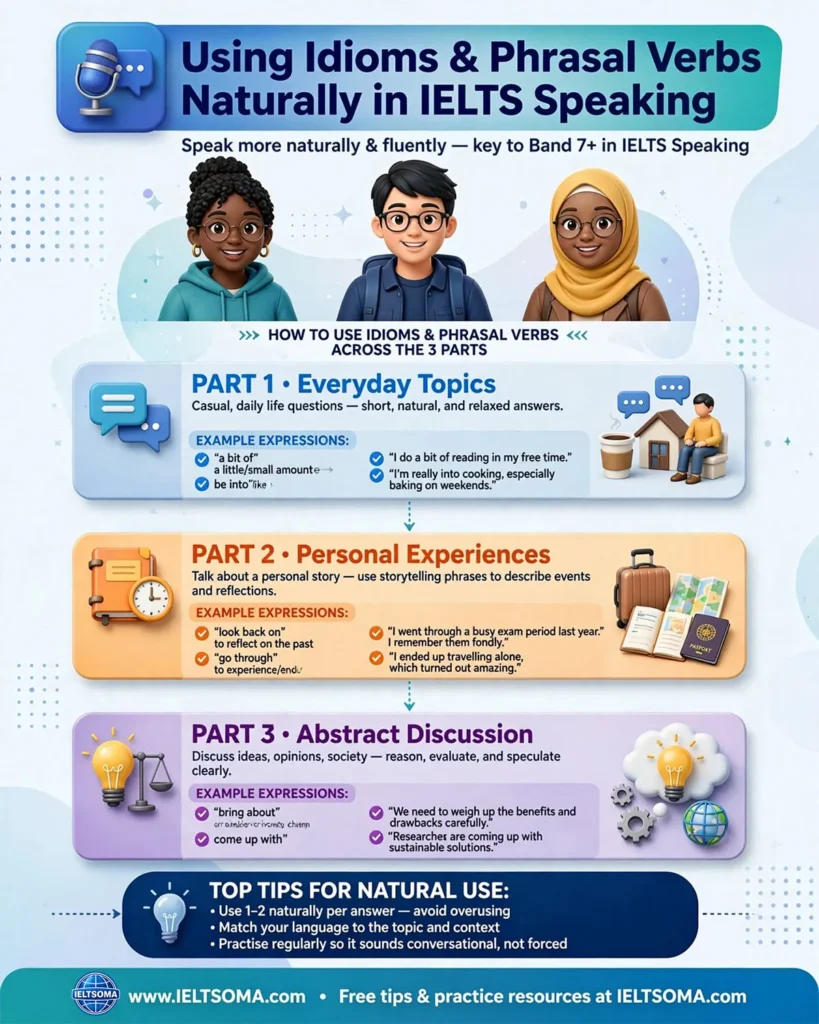
Idioms and Phrasal Verbs for IELTS Speaking Part 1
Part 1 focuses on familiar topics such as your home, studies, work, interests and everyday experiences.
This makes everyday phrasal verbs particularly useful.
Question:
“What do you do in your free time?”
Natural answer:
“I usually work out or meet up with friends. If I have more time, I might take up a new hobby.”
Notice that the answer does not contain an idiom in every sentence. The phrasal verbs fit naturally into the response.
For Part 1, prioritise expressions connected with:
- hobbies
- family
- work
- studies
- food
- travel
- shopping
- exercise
- technology
- daily routines
Idioms and Phrasal Verbs for IELTS Speaking Part 2
Part 2 requires you to speak for up to two minutes about a particular topic. You have one minute to prepare and can make notes before speaking.
This is an excellent opportunity to use one or two well-chosen expressions.
Imagine the cue card asks you to describe a difficult experience that you successfully handled.
You could say:
“At first, I thought about giving up because the situation was quite stressful. However, after a few days, I got the hang of what I needed to do and eventually everything worked out.”
Here, give up, get the hang of and worked out all support the story.
They are not there simply to impress the examiner.
That distinction matters.
Idioms and Phrasal Verbs for IELTS Speaking Part 3
Part 3 involves a broader and more abstract discussion connected with the Part 2 topic. Candidates are expected to explain opinions, analyse issues, discuss ideas and speculate.
Phrasal verbs such as bring up, come up with, figure out and work out can be particularly useful here.
For example:
Question:
“Why do some companies struggle to retain employees?”
Answer:
“I think one reason is that managers sometimes fail to figure out what their employees actually need. If workers bring up problems repeatedly and nothing changes, they may eventually look for another job.”
This answer uses natural spoken vocabulary while still discussing a relatively complex issue.
For Part 3, focus on expressions that help you:
- explain causes
- describe consequences
- discuss solutions
- express opinions
- describe change
- compare situations
- discuss advantages and disadvantages
Common Mistakes When Using Idioms in IELTS Speaking
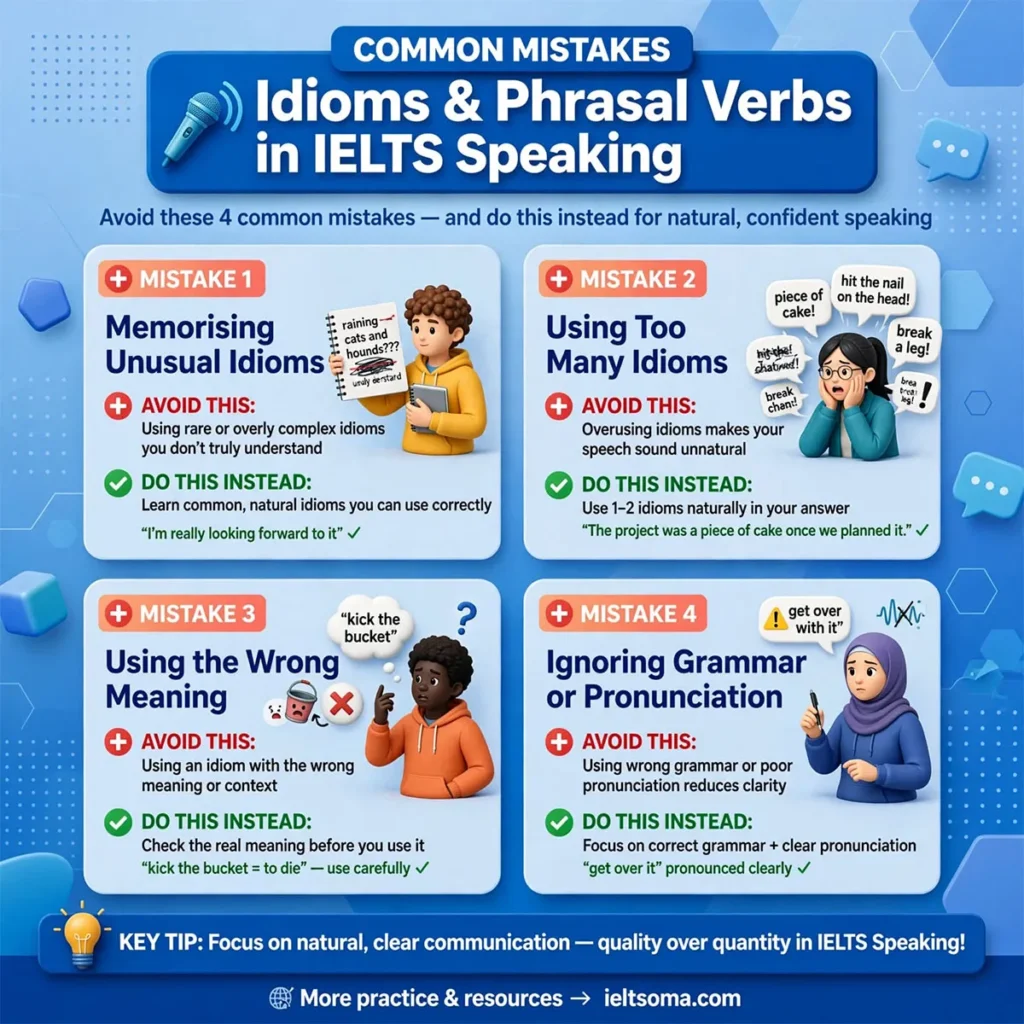
Memorising unusual idioms
Some candidates search for “Band 9 idioms” and memorise expressions they have never heard in normal conversation.
This can create unnatural speech.
Choose expressions that you understand completely and could realistically use outside the exam.
Using too many idioms
One well-placed idiom can strengthen an answer.
Five idioms in a short answer can make it sound rehearsed.
The official IELTS guidance specifically warns candidates to avoid overusing idioms and expressions or choosing expressions that sound forced.
Using the wrong meaning
If you memorise an idiom without understanding its meaning and context, you may accidentally communicate something different from what you intended.
Always learn an expression with several example sentences.
Ignoring pronunciation
Knowing an expression on paper does not mean you can use it confidently in speech.
Practise saying each expression aloud.
Pay attention to:
- word stress
- connected speech
- natural rhythm
- contractions
- sentence stress
Treating idioms as a shortcut to Band 7
Idioms alone cannot guarantee a particular IELTS Speaking band.
Your score is based on four equally weighted assessment criteria, including fluency and coherence, lexical resource, grammatical range and accuracy, and pronunciation. (Read our Pronunciation Tips for IELTS Speaking: 9 Powerful Ways to Speak Clearly)
Idiomatic language is only one part of your overall lexical performance.
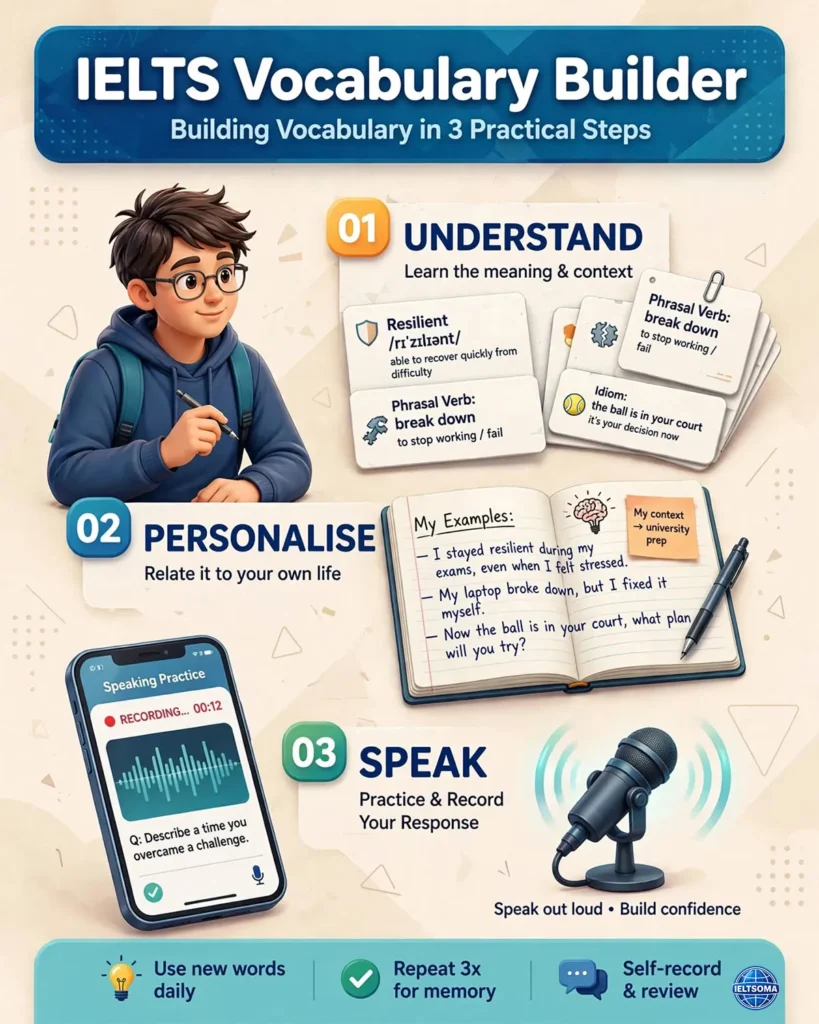
A Better Way to Practise Idioms and Phrasal Verbs
Instead of trying to memorise long vocabulary lists, use a three-stage system.
Stage 1: Understand
Learn:
- meaning
- pronunciation
- grammar
- register
- common collocations
- typical situations
Stage 2: Personalise
Create an example connected to your own life.
For example:
Take up: start a new activity.
Personal example:
“I took up running during university because I wanted to become healthier.”
Personal examples are easier to remember than dictionary sentences.
Stage 3: Speak
Choose an IELTS Speaking question and answer it aloud.
Try to use only one or two target expressions.
Then record yourself and ask:
Did the expression sound natural?
Was it grammatically correct?
Did it actually improve my answer?
Could I have expressed the same idea more naturally with ordinary vocabulary?
If the answer to the final question is yes, that is not necessarily a problem. Simple vocabulary is often the better choice.
Quick Comparison: Idioms vs Phrasal Verbs
| Feature | Idioms | Phrasal verbs |
|---|---|---|
| Basic function | Express an idea in an established expression | Combine a verb with a particle to create a meaning |
| Example | over the moon | figure out |
| Common in speech | Yes | Very common |
| Best use | Adding natural expression and nuance | Describing everyday actions and processes |
| Main risk | Sounding forced or memorised | Using the wrong grammatical pattern |
| Best strategy | Learn meaning and context | Learn meaning, grammar and word order |
Final Strategy for IELTS Candidates
The best way to approach idioms and phrasal verbs for IELTS Speaking is to think in terms of quality rather than quantity.
You do not need to fill every answer with advanced expressions.
Instead:
- Learn expressions you genuinely understand.
- Group them by topic.
- Study complete example sentences.
- Create personal examples.
- Practise them aloud.
- Use them in IELTS Speaking questions.
- Record yourself.
- Check grammar and pronunciation.
- Remove expressions that sound unnatural.
- Keep the expressions that you can use confidently and appropriately.
A candidate who naturally says “I took up swimming a few years ago” is demonstrating useful vocabulary.
A candidate who forces three memorised idioms into the same answer is not necessarily demonstrating better language.
The aim is to make your vocabulary flexible, accurate and natural.
That is the real value of learning idioms and phrasal verbs for IELTS Speaking.
Frequently Asked Questions
Do I need idioms to get Band 7 in IELTS Speaking?
No. There is no requirement to use a specific number of idioms. However, the Band 7 descriptor for Lexical Resource includes some ability to use less common and idiomatic items, with awareness of style and collocation.
How many idioms should I use in IELTS Speaking?
There is no fixed number. One or two naturally used expressions can be enough for an answer. Focus on accurate and appropriate vocabulary rather than trying to reach a particular number.
Are phrasal verbs useful for IELTS Speaking?
Yes. Phrasal verbs are common in spoken English and can help you express everyday ideas naturally. However, you need to learn their meanings and grammatical patterns rather than memorising them as simple word-for-word translations.
Should I use idioms in every IELTS Speaking answer?
No. Use them only when they fit the meaning and context. Forcing idioms into unrelated answers can make your speech sound memorised or unnatural.
Are “Band 9 idioms” necessary for a high IELTS score?
No. IELTS does not provide a required list of Band 9 idioms. Higher-level performance depends on flexible, precise and appropriate language across the assessment criteria, not on memorising impressive expressions.
Should I use idioms in Speaking Part 3?
You can, but they should fit the discussion. Part 3 is more abstract, so expressions that help you explain opinions, causes, consequences and solutions may be more useful than highly informal idioms.
What is the best way to remember phrasal verbs?
Learn each phrasal verb in context. Study its meaning, grammar and a few natural example sentences, then use it in your own speaking practice.
Can phrasal verbs replace advanced vocabulary in IELTS Speaking?
Not necessarily. Phrasal verbs are one part of your vocabulary range. A strong candidate needs to show flexibility across different types of vocabulary, including appropriate collocations, less common words and idiomatic language.
Should I learn idioms by IELTS topic?
Yes. Grouping vocabulary by topics such as education, work, travel, health, technology and relationships can make it easier to retrieve expressions during the test.
What matters more: idioms or fluency?
Neither should be treated as a shortcut. IELTS Speaking is assessed using four criteria, and idiomatic language is only one aspect of Lexical Resource. Your overall performance needs to be clear, coherent, appropriately developed, grammatically controlled and understandable.