
Many IELTS candidates make the same mistake when preparing for Speaking: they try to become more fluent by speaking faster, or they try to become more accurate by mentally checking every sentence before saying it.
Neither approach works particularly well.
You can speak for two minutes without stopping and still make so many grammar mistakes that your performance becomes difficult to follow. On the other hand, you can produce grammatically careful sentences but hesitate so frequently that your ideas never develop naturally.
The real goal is different: IELTS Speaking accuracy and fluency must develop together.
You need enough accuracy to express your meaning clearly, but you also need enough fluency to keep your ideas moving. The strongest candidates do not sound as though they are choosing every word from a grammar textbook. They sound like people communicating naturally, while maintaining good control of English.
This guide explains how to develop that balance, what accuracy and fluency actually mean in IELTS Speaking, the mistakes that hold candidates back, and seven practical ways to improve your performance.
Table of Contents
What Does IELTS Speaking Accuracy and Fluency Mean?
IELTS Speaking is assessed using four criteria:
- Fluency and coherence
- Lexical resource
- Grammatical range and accuracy
- Pronunciation
Each criterion contributes equally to the Speaking score.
This means accuracy and fluency are not simply two informal qualities that an examiner “likes”. They are directly connected to the official assessment criteria.
Fluency is more than speaking quickly
Fluency and coherence involve your ability to speak at a natural rate, maintain continuity, organise your ideas and connect your speech effectively.
The official IELTS criteria specifically consider issues such as hesitation, repetition, false starts, backtracking, logical sequencing and appropriate use of discourse markers.
For example:
“I think… um… my favourite place… actually… I don’t know… because… because there are… there are many things…”
The candidate is producing English, but the flow is repeatedly interrupted.
A more fluent response might be:
“My favourite place is probably the park near my home because it gives me a quiet break from my normal routine. I usually go there in the evening, especially when I need some time to think.”
The second answer is not necessarily perfect English. It is simply easier to follow and more effectively developed.
Accuracy is more than avoiding mistakes
Grammatical range and accuracy refers to the range of grammatical structures you can use and how accurately and appropriately you use them.
Consider these two answers:
“I went there last year. It was good. I enjoy it very much.”
and:
“I went there last year, and although I had initially expected it to be fairly ordinary, I ended up enjoying it much more than I had anticipated.”
The second answer demonstrates greater grammatical control and range.
However, this does not mean you should force complicated grammar into every sentence.
The best approach is to use grammar that helps you communicate your meaning naturally.
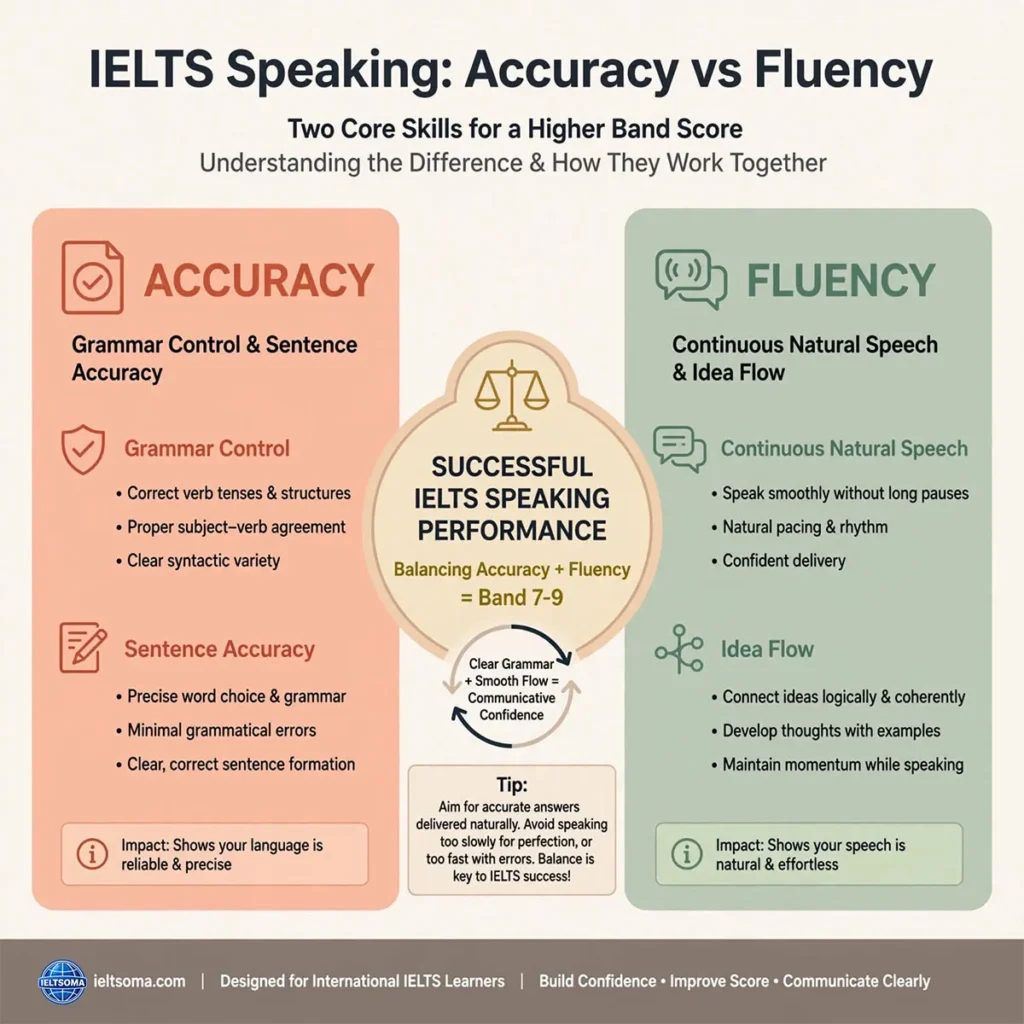
Why Accuracy and Fluency Must Be Balanced
A common misconception is that you must choose between fluency and accuracy.
You do not.
In fact, IELTS research has found that accuracy increases in relation to speaking proficiency, while different clusters of speaking features contribute to differences between band levels rather than one single feature determining the score.
That is important because it changes how you should practise.
Suppose you answer a Part 2 question like this:
“I want to talk about a person who helped me. He was my teacher. He teach me English when I was in school. He always give me advice and I learn many things from him.”
The response is relatively understandable, but several basic grammatical errors occur.
Now imagine another candidate says:
“I want to talk about a teacher who had a major influence on me. He taught me English when I was at school, and he always gave me useful advice. What I particularly appreciated was that he encouraged me to become more confident.”
This candidate is not merely speaking longer. The grammar is more controlled, the ideas are developed more effectively, and the vocabulary is more flexible.
The target is therefore controlled fluency: speaking continuously while maintaining enough accuracy to communicate clearly.
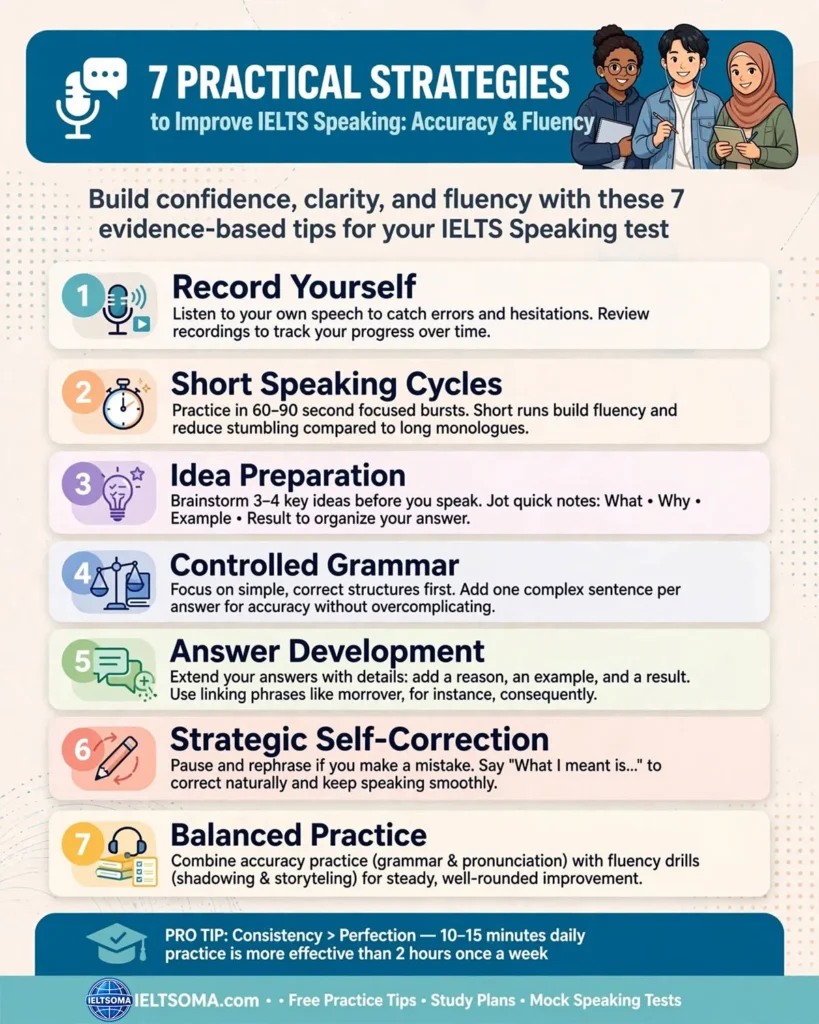
7 Smart Ways to Improve IELTS Speaking Accuracy and Fluency
1. Stop Trying to Make Every Sentence Perfect
One of the biggest obstacles to fluency is over-monitoring.
Some candidates mentally construct a sentence, check the tense, search for a better word, reconsider the sentence structure and only then speak.
By that time, the conversation has effectively stopped.
For example, you might think:
“Should I use present perfect here? Is this adjective correct? Maybe there is a more advanced word…”
Then you finally say:
“I have… um… I have visited this place several times…”
That hesitation can become a habit.
Instead, train yourself to communicate the idea first.
If a simple structure is accurate and natural, use it.
For example:
“I have visited it several times, and I usually go there with my friends.”
You do not need to replace it with something unnecessarily complicated.
Practice rule: prioritise meaning first, then gradually improve accuracy through feedback.
This is particularly important during timed speaking practice. If you stop every few seconds to correct yourself, you are practising hesitation rather than fluency.
2. Record Yourself and Identify Repeated Errors
You cannot improve accuracy effectively if you do not know which errors you repeatedly make.
Recording your answers is one of the most useful ways to discover your personal patterns.
Choose an IELTS Speaking question and speak for one to two minutes. Then listen to the recording and identify:
- verb tense errors
- subject-verb agreement errors
- article errors
- preposition errors
- incorrect plurals
- awkward sentence structures
- unnecessary repetition
- long pauses
- repeated fillers
- unclear pronunciation
Do not try to correct everything at once.
Instead, choose your three most frequent errors.
For example, you may discover that you regularly say:
“He go…”
instead of:
“He goes…”
Or:
“People is…”
instead of:
“People are…”
Or you may notice that you repeatedly use “you know”, “actually” and “like” when you need time to think.
Once you know the pattern, you can deliberately practise it.
3. Practise in Short Speaking Cycles
Long practice sessions are not always necessary.
A better method is to use short cycles:
Speak → listen → identify → correct → repeat
For example:
Round 1: Answer the question naturally.
Round 2: Listen and identify three problems.
Round 3: Answer the same question again, concentrating on those problems.
Round 4: Answer it one final time without deliberately thinking about the corrections.
This technique connects accuracy to actual communication.
Suppose your first response contains:
“If I will have enough money, I will travel more.”
During your review, you notice the conditional error.
You then practise:
“If I have enough money, I will travel more.”
Finally, you use the structure naturally in another response:
“If I have enough money in the future, I will probably travel to several countries in Asia.”
The goal is not simply to memorise the correction. It is to make the correct structure easier to retrieve while speaking.
4. Build Fluency with Ideas, Not Memorised Answers
Memorising complete IELTS answers can create a serious problem.
You may sound fluent while answering a familiar question, but when the examiner changes the wording, your memorised response may no longer fit.
Instead of memorising sentences, prepare ideas and language patterns.
For a question about a memorable journey, you could prepare a simple framework:
- Where you went
- Who went with you
- What happened
- Why it was memorable
- How you felt afterwards
Then practise expressing those ideas differently each time.
For example:
“The trip was memorable because…”
“What made the journey particularly special was…”
“The main reason I still remember it is that…”
This approach develops flexibility.
It also helps fluency because you are not trying to remember one exact paragraph.
5. Use Grammar That You Can Control
Many candidates believe that a higher band requires complicated grammar in every sentence.
That is a dangerous strategy.
The official band descriptors reward a range of structures, but higher-level performance also requires accuracy and appropriate use. Band 7 descriptors, for example, describe frequent error-free sentences alongside effective use of both simple and complex sentences despite some errors.
This means you should develop a reliable grammar toolkit.
Useful structures include:
Past experiences
“I went there when I was studying at university.”
Present habits
“I usually spend my weekends with my family.”
Future plans
“I am hoping to travel abroad next year.”
Conditionals
“If I had more free time, I would probably take up photography.”
Relative clauses
“I have a friend who works in the education sector.”
Comparisons
“Living in a large city is much more convenient than living in a rural area.”
Reason and result
“I enjoy working from home because it gives me greater flexibility.”
You do not need ten different advanced structures in every answer.
You need a range of structures that you can use accurately and naturally.
6. Learn to Extend Answers Without Rambling
Fluency does not mean talking continuously without direction.
A good IELTS response should develop.
For Part 3 especially, a useful pattern is:
Answer → Reason → Example → Result or contrast
For example:
“I think public transport should be improved because it can reduce traffic congestion. For example, if buses and trains were more reliable, more people might leave their cars at home. As a result, cities could become less crowded and polluted.”
Notice what happens here.
The candidate answers the question, explains the idea, provides an example and develops the consequence.
That is much stronger than simply saying:
“Yes, I think public transport is important because it is convenient and cheap.”
The second answer may be accurate, but it is underdeveloped.
Practise extending your ideas rather than simply trying to speak for longer.
7. Make Self-Correction Strategic
Self-correction is not automatically a problem.
The official Band 7 descriptor allows some hesitation, repetition and self-correction, provided these do not affect coherence. At higher bands, occasional self-correction may still occur.
The problem is constant or unnecessary correction.
Compare:
“I went there in 2023—sorry, I mean 2022—and it was…”
with:
“I went there… actually, I mean, I visited the place in 2022…”
The first correction is useful if the date genuinely needs correcting.
But if you repeatedly restart sentences because you are trying to make every grammatical detail perfect, your fluency can suffer.
A useful rule is:
Correct mistakes that change meaning or create a clear grammatical problem. Do not restart every sentence simply because you could have expressed it more elegantly.
Accuracy vs Fluency: What Should You Focus on?
Your priority depends on your current weakness.
| Your main problem | What to practise |
|---|---|
| Frequent long pauses | Timed speaking and idea development |
| Many basic grammar errors | Targeted grammar correction |
| Speaking too slowly | Repeated short-answer practice |
| Repeating the same words | Paraphrasing and vocabulary expansion |
| Constant self-correction | Speaking without stopping |
| Short answers | Reason + example + result |
| Complex grammar with many errors | Simpler structures first |
| Fluent but inaccurate speech | Error recording and correction |
| Accurate but hesitant speech | Fluency drills and spontaneous answers |
The goal is not to spend equal time on everything.
Find your bottleneck and address it first.
How to Improve Accuracy Without Destroying Fluency
A particularly effective approach is to separate accuracy practice from fluency practice.
During an accuracy session, slow down.
Choose one grammatical feature, such as:
- past tense
- articles
- subject-verb agreement
- conditionals
- comparatives
- relative clauses
Then deliberately practise it in spoken answers.
During a fluency session, change the objective.
Do not stop to correct every mistake.
Instead, concentrate on:
- keeping your ideas moving
- reducing unnecessary pauses
- developing answers
- using natural discourse markers
- paraphrasing when necessary
Eventually, combine the two.
This mirrors how speaking ability develops: you first bring attention to a language feature, then practise using it until it becomes easier to retrieve during spontaneous communication.
Common Mistakes That Damage Both Accuracy and Fluency
Memorising complete answers
Memorised responses often collapse when the examiner asks an unexpected follow-up question.
Prepare ideas and useful language instead.
Speaking too quickly
Speed is not the same as fluency.
Speaking extremely fast can reduce intelligibility, increase grammatical errors and make your ideas harder to follow.
Using complicated grammar unnecessarily
An ambitious structure that repeatedly breaks down is less useful than a simpler structure that you control.
Using too many fillers
Words such as “well”, “actually”, “you know” and “I mean” can be natural in moderation.
But relying on them every few seconds can make your speech sound less controlled.
Stopping after one sentence
A grammatically correct sentence is not necessarily a strong IELTS response.
Develop your answer.
Explain why, give an example or add a consequence.
Trying to sound native
You do not need to imitate a British, American or Australian accent.
Pronunciation is assessed partly through how easily you can be understood, not through whether you sound like a native speaker.
Focus on intelligibility, stress, rhythm and clear sounds.
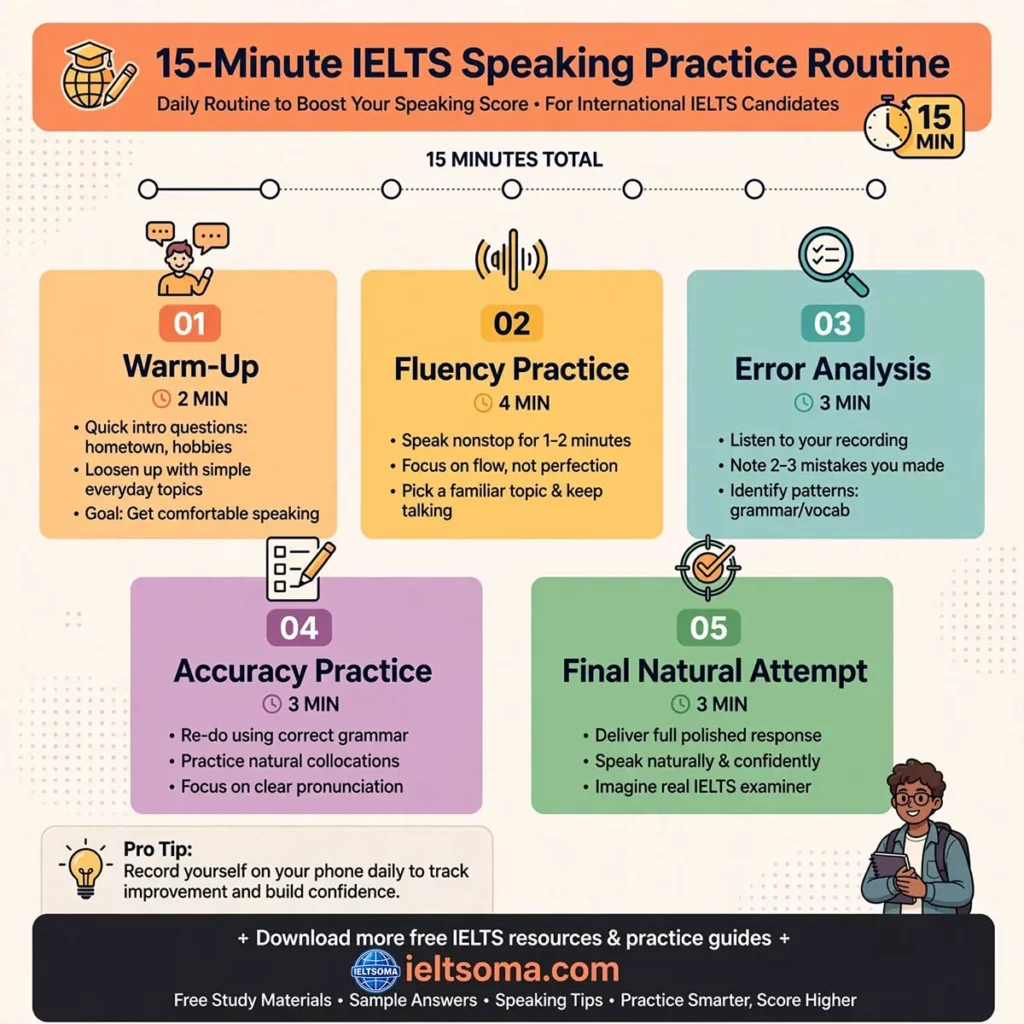
A Simple 15-Minute Daily Practice Routine
You can practise IELTS Speaking accuracy and fluency without spending hours every day.
Minutes 1–3: Warm up
Choose an easy Part 1 topic and answer three questions naturally.
Do not stop to correct yourself.
Minutes 4–7: Fluency practice
Choose a Part 2 topic.
Speak for up to two minutes while concentrating on continuous speech and logical development.
Minutes 8–10: Error analysis
Listen to your recording.
Identify three recurring problems.
Minutes 11–13: Accuracy practice
Answer the same topic again while deliberately correcting those three problems.
Minutes 14–15: Final natural attempt
Answer a related question without consciously thinking about grammar.
This final step is important.
You want the correction to become part of your natural speaking rather than something you can only produce when analysing your English.
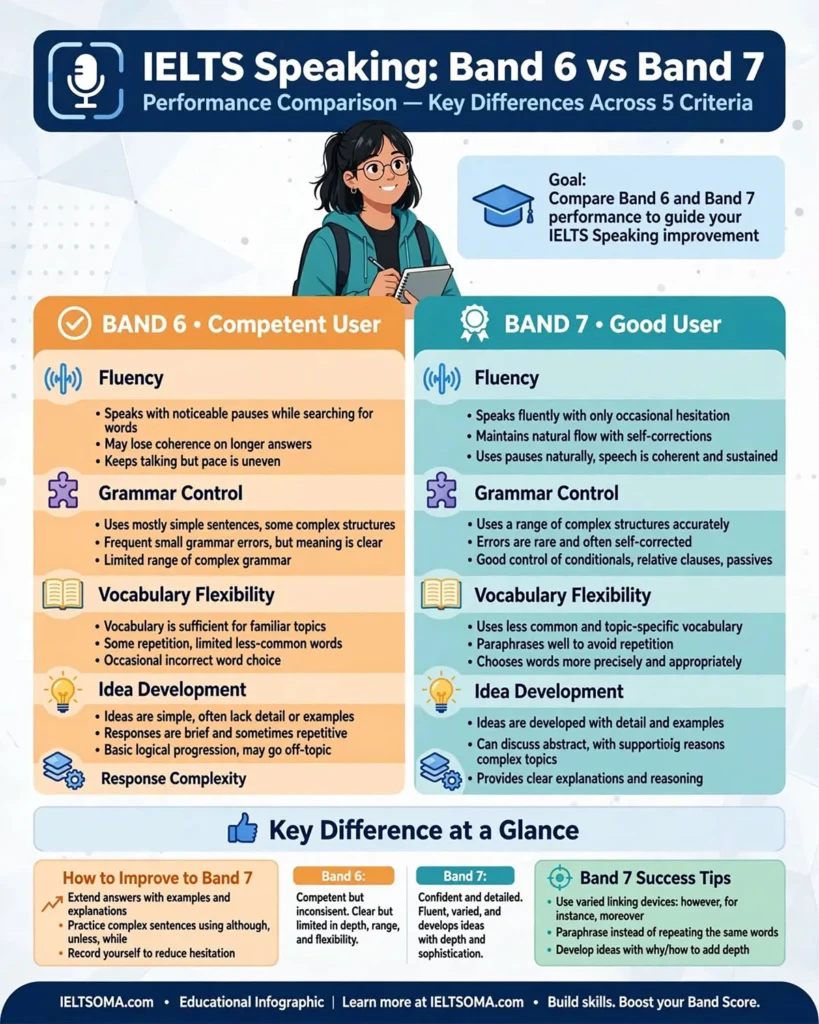
How Band 6 and Band 7 Speaking Differ
The difference between Band 6 and Band 7 is particularly important for candidates aiming to move beyond a competent level.
Official IELTS guidance describes Band 6 speakers as generally able to communicate effectively but with some inaccuracies and difficulty handling more complex language. Band 7 performance involves greater ability to maintain longer turns, use a range of structures effectively and develop ideas with greater flexibility.
Consider this simplified example.
Around Band 6:
“I think working from home is good because it saves time. People don’t need to travel to work, so they can spend more time with their family. But sometimes it can be difficult because they may feel lonely.”
Stronger Band 7-style development:
“I think working from home has several advantages, particularly because it eliminates the need for a daily commute. As a result, employees can save a considerable amount of time and may have a better balance between work and family life. However, one potential drawback is that some people may feel isolated if they rarely interact with colleagues in person.”
The second response is not successful simply because it contains “advanced” vocabulary.
It develops the argument, uses a range of structures, connects ideas clearly and maintains control.
That is the type of balance you should aim for.
The Best Way to Track Your Progress
Do not judge your improvement only by how confident you feel.
Use measurable indicators.
Once a week, record yourself answering:
- one Part 1 question
- one Part 2 task
- one Part 3 discussion question
Then compare your recordings.
Ask:
- Am I pausing less?
- Are my answers better developed?
- Are basic grammar errors becoming less frequent?
- Can I use complex structures without losing control?
- Do I repeat the same vocabulary too often?
- Can I paraphrase when I forget a word?
- Can I correct an important mistake without losing my train of thought?
Keep a simple error log.
For example:
| Error | My version | Correct version |
|---|---|---|
| Third-person -s | “My brother work there.” | “My brother works there.” |
| Past tense | “I go there last year.” | “I went there last year.” |
| Article | “It was very interesting experience.” | “It was a very interesting experience.” |
| Countable noun | “Many student prefer…” | “Many students prefer…” |
After several weeks, you should start seeing patterns.
Those patterns tell you exactly what to practise next.
Final Strategy: Aim for Controlled, Natural English
The best IELTS Speaking performance is not the one with the most complicated vocabulary or the fastest speech.
It is the one in which the candidate can express ideas clearly, develop them naturally, use a useful range of language and maintain reasonable grammatical control.
That is why IELTS Speaking accuracy and fluency should be trained together.
Use fluency practice to learn how to keep your ideas moving.
Use accuracy practice to identify and reduce recurring errors.
Then combine them through realistic speaking tasks.
Remember these seven principles:
- Do not try to make every sentence perfect.
- Record yourself regularly.
- Use short speak-listen-correct-repeat cycles.
- Prepare ideas rather than memorised answers.
- Use grammar that you can control.
- Develop answers instead of simply speaking longer.
- Make self-correction strategic.
If you practise this way consistently, your speaking should become not only more accurate, but also more natural, flexible and confident.
Frequently Asked Questions
Is fluency or accuracy more important in IELTS Speaking?
Neither should be treated as the single most important factor. IELTS Speaking uses four equally weighted criteria: fluency and coherence, lexical resource, grammatical range and accuracy, and pronunciation. Your goal should therefore be balanced performance rather than sacrificing accuracy for speed or fluency for grammatical perfection.
Can I get a high IELTS Speaking score with some grammar mistakes?
Yes. Higher-band candidates can still make occasional errors. The important issue is the overall level of control, range and appropriacy of their language. The Band 7 descriptors, for example, allow some errors while expecting frequent error-free sentences and effective use of both simple and complex structures.
Does speaking faster improve IELTS fluency?
No. Fluency is not simply speaking quickly. IELTS considers continuity, hesitation, repetition, logical development and how effectively your ideas are connected. Speaking too quickly can actually make your speech less clear and increase errors.
Should I correct myself when I make a mistake?
You can correct yourself when it is useful, particularly if the mistake affects meaning. However, repeatedly restarting sentences can damage the flow of your response. Strategic self-correction is better than constant self-monitoring.
How can I improve IELTS Speaking accuracy?
Record your answers, identify recurring grammar errors and practice those specific structures in new speaking contexts. Focus especially on frequent personal errors rather than attempting to revise every grammar rule at once.
How can I become more fluent in IELTS Speaking?
Practice speaking spontaneously, develop answers with reasons and examples, reduce unnecessary pauses and use paraphrasing when you cannot remember a particular word. Regular timed speaking practice can help you become more comfortable maintaining a longer turn.
Should I memorize IELTS Speaking answers?
It is better to prepare ideas, vocabulary and useful grammatical patterns than to memorize complete answers. Memorized responses can sound unnatural and may become difficult to adapt when the examiner changes the question.
How long should I practice IELTS Speaking each day?
Even 15–20 minutes of focused daily practice can be useful if you actively record, review and repeat your answers. The quality of feedback and repetition matters more than simply speaking for a long time.
Is IELTS Speaking accuracy and fluency useful for both Academic and General Training?
Yes. IELTS Speaking is a face-to-face speaking test used for both Academic and General Training candidates, and the Speaking assessment criteria are the same. The test lasts approximately 11–14 minutes and contains three parts.
Further Reading: