IELTS Speaking Part 3 can feel difficult for one simple reason: the questions become less personal and more analytical.
Instead of asking what you like or what you did, the examiner may ask why something happens, whether society should change, how two situations compare, or what might happen in the future.
That means knowing English is only part of the challenge. You also need to develop ideas quickly, explain your reasoning and keep your answer moving.
A strong IELTS Speaking Part 3 strategy is therefore not about memorising long answers. It is about learning how to take a simple opinion and turn it into a clear, developed response.
In this guide, you will learn how to answer IELTS Speaking Part 3 questions, how to develop ideas, which structures work for different question types, and how to avoid the common mistakes that make answers sound short or rehearsed.
Table of Contents
What Is IELTS Speaking Part 3?
IELTS Speaking Part 3 is the discussion section of the Speaking test. It lasts around 4–5 minutes and is connected to the topic discussed in Part 2.
However, the discussion moves from personal experience towards broader, more abstract issues. Official IELTS guidance states that Part 3 tests your ability to explain opinions and to analyse, discuss and speculate about issues.
For example, if Part 2 asks you to describe a teacher who influenced you, Part 3 could move towards questions such as:
- Why are some teachers more influential than others?
- How has education changed in recent years?
- Should schools focus more on practical skills?
- How might technology change education in the future?
Notice the progression.
Part 2: your experience
Part 3: general ideas, reasons, comparisons, effects and predictions
This is why simply repeating your Part 2 story is not an effective strategy.
What Is Assessed in Speaking Part 3?
The examiner assesses your Speaking performance using four criteria:
- Fluency and coherence
- Lexical resource
- Grammatical range and accuracy
- Pronunciation
These criteria are equally weighted in the Speaking score.
Part 3 gives you particularly useful opportunities to demonstrate fluency and coherence because you need to develop ideas rather than give isolated sentences.
For example, compare these responses.
Short response:
I think public transport is important because it is cheap and convenient.
Developed response:
I think public transport is extremely important, particularly in large cities, because it gives people an affordable way to travel without depending on private cars. It can also reduce congestion if enough people choose buses or trains instead of driving. For example, a reliable metro system can allow thousands of people to travel to work without adding more vehicles to already crowded roads.
The second answer is not impressive because it uses complicated vocabulary. It is stronger because the speaker answers, explains and develops the idea.
The Core IELTS Speaking Part 3 Strategy
A reliable approach is:
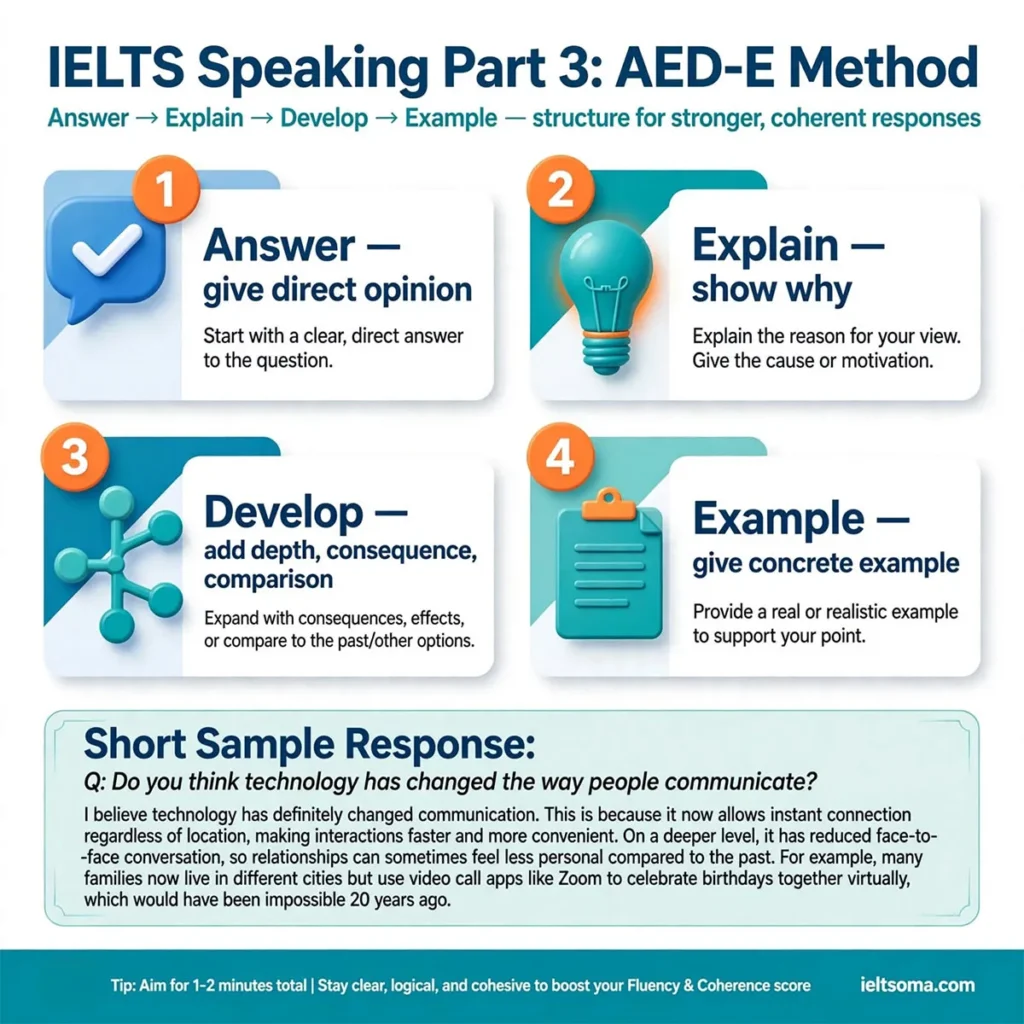
Answer → Explain → Develop → Example
You do not have to use exactly four sentences every time. The structure is a thinking framework rather than a script.
1. Answer the question directly
Start by making your position clear.
I think public transport will become more important in the future.
2. Explain why
Give the main reason.
One reason is that cities are becoming increasingly crowded, so governments need more efficient ways to move large numbers of people.
3. Develop the idea
Show the consequence, contrast, condition or additional reasoning.
If public transport becomes faster and more reliable, people may be less dependent on private cars.
4. Give an example
Make the idea concrete.
For instance, cities that expand metro and rapid bus networks can make commuting easier while reducing the number of cars on the road.
This is a practical way to develop ideas in Part 3 without trying to memorize complete answers.
How to Answer IELTS Speaking Part 3 Questions
The first step is to identify what the question is actually asking.
Part 3 questions can ask you to:
- give an opinion
- explain a reason
- discuss causes
- describe effects
- compare two situations
- discuss advantages and disadvantages
- suggest solutions
- discuss changes
- predict the future
- evaluate different viewpoints
The same answer structure will not work perfectly for every question.
Opinion Questions
These usually contain phrases such as:
- Do you think…?
- In your opinion…?
- Do you agree that…?
- Is it important to…?
Start with a clear position.
Question:
Do you think children should spend less time using technology?
Answer:
Yes, I think children probably should have some limits on their screen time. The main reason is that excessive use of devices can reduce the amount of time they spend on physical activity and face-to-face interaction. However, I would not completely restrict technology because educational apps and online resources can also be extremely useful.
Notice that the speaker does not simply say “yes”. The answer includes a position, reason and qualification.
That final qualification can make the response more natural because real opinions are not always completely black and white.
Why Questions
For questions asking why something happens, use a cause-and-effect chain.
Question:
Why do people prefer shopping online?
Think:
Reason → Explanation → Result → Example
I think convenience is probably the biggest reason. People can compare products and prices without travelling to different shops, which saves both time and effort. This is particularly useful for people who have busy working schedules. For example, someone can order household items online in a few minutes rather than spending an hour visiting several stores.
Comparison Questions
Comparison is common in Part 3, so learn to move beyond simple statements such as “A is better than B”.
Use:
A → B → Difference → Reason
Question:
How is the way young people communicate different from the way older people communicate?
Young people tend to rely much more heavily on digital communication, particularly messaging and social media, whereas older generations may be more comfortable with phone calls or face-to-face conversations. One major difference is the speed and convenience of communication. A young person can send a message to several friends instantly, while older people may place more value on having a longer conversation.
Useful language includes:
- whereas
- while
- compared with
- in contrast
- on the other hand
- similarly
- unlike
Do not use these expressions simply to sound advanced. Use them when you genuinely need to show a relationship between two ideas.
How to Develop Ideas in Part 3
Many candidates know enough English but run out of things to say.
The problem is often not vocabulary. It is idea development.
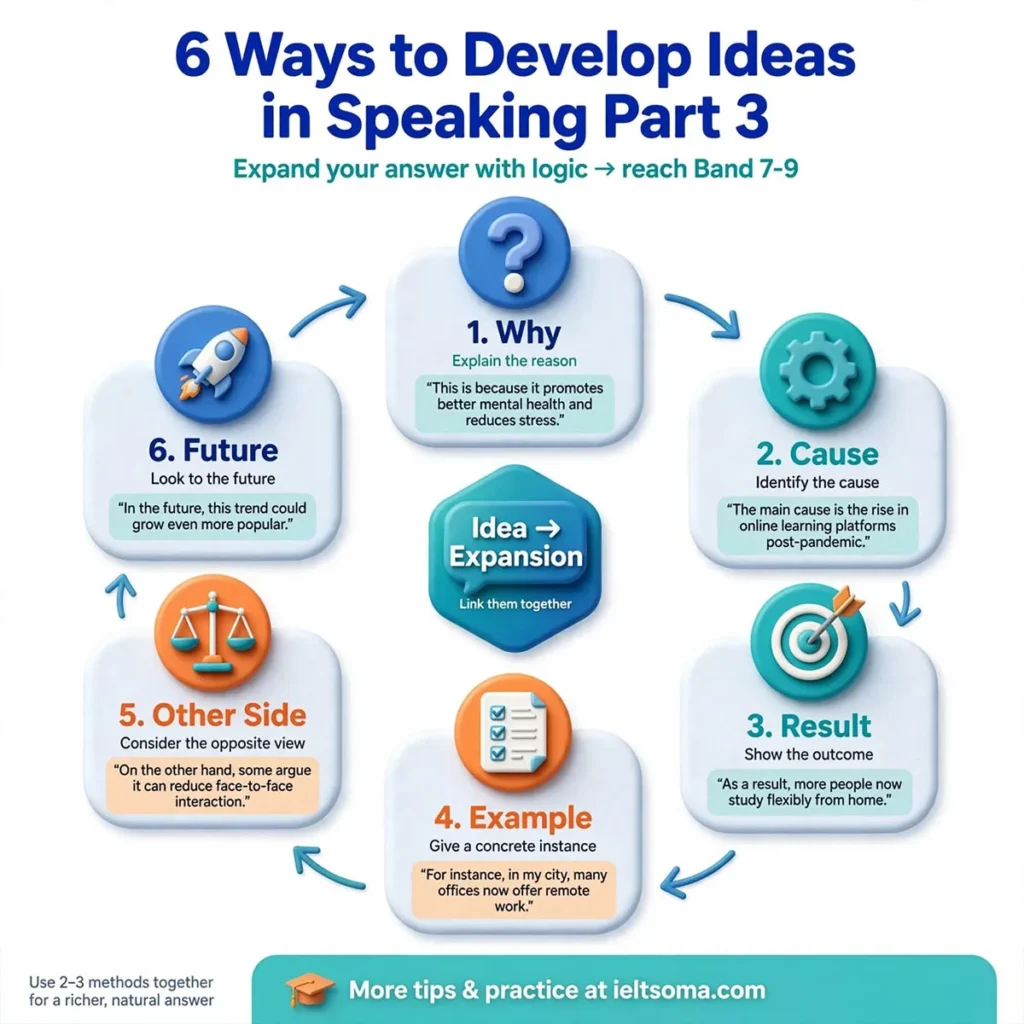
When you give an opinion, ask yourself one of these questions:
Why?
Why do I think this?
What causes it?
What makes this happen?
What happens as a result?
What effect does it have?
Can I give an example?
Where can I see this in real life?
Is there another side?
Are there exceptions or disadvantages?
What could happen later?
What might happen in the future?
These questions create a mental expansion system.
Example: Develop One Simple Idea
Question:
Why do people move from rural areas to cities?
Basic idea:
There are more jobs in cities.
Develop it:
There are generally more employment opportunities in cities, particularly in industries such as technology, finance and professional services. This can attract younger people who want better career prospects. In addition, cities often provide greater access to universities and professional training, so moving to a city can be seen as an investment in someone’s future.
One simple idea has become a developed answer because the speaker added reason + detail + consequence.
A Useful Method: IDEA
If you need a simple mental framework, use IDEA:
I — Identify your answer
State your position or main point.
D — Develop the reason
Explain why you think this.
E — Extend the idea
Add a consequence, comparison, condition or second point.
A — Add an example
Give a realistic example when appropriate.
For example:
Question:
Should governments spend more money on public parks?
IDEA answer:
Yes, I think they should. Public parks give people affordable places to exercise and relax, which can be particularly valuable in crowded cities. They can also create opportunities for communities to spend time together rather than remaining indoors. For example, a well-designed city park might include walking paths, sports facilities and areas where families can meet.
You do not need to announce the four stages. They should simply guide your thinking.
Use General Ideas, Not Only Personal Experiences
A common problem in Part 3 is continuing to answer questions as though they were Part 1.
If the examiner asks:
Why do some people prefer working from home?
Avoid giving a long personal story about your own job.
Instead, discuss people in general:
Many people prefer working from home because it gives them greater flexibility and eliminates commuting time.
You can still use your country or community as an example:
In my country, for example, many employees who live far from major cities now have the option of working remotely.
Official IELTS guidance emphasises that Part 3 moves towards general and abstract discussion rather than the personal topics typical of earlier parts.
How Long Should a Part 3 Answer Be?
There is no official rule saying that every answer must contain a particular number of sentences or last a fixed number of seconds.
A useful target is to give a developed response rather than a one-sentence answer.
For many questions, around 3–6 sentences may be enough if those sentences genuinely answer and develop the question. A more complex question may require more.
Do not try to fill time by repeating yourself.
For example:
Yes, I agree. I think it is important. It is definitely very important because it matters to people. So, yes, I think it is important.
This is longer but not more developed.
A better response adds new information:
Yes, I think it is important because it can influence both individuals and society. When people have access to good education, for example, they are more likely to develop the skills needed to find stable employment. This can benefit the wider economy as well as the individual.
The goal is development, not length for its own sake.
IELTS Speaking Part 3 Strategy for Difficult Questions
Sometimes you will receive a question about a topic you have never considered.
Do not panic.
You do not need expert knowledge.
The examiner is testing your English, not your specialist knowledge. Official IELTS guidance also makes clear that candidates are assessed on how they communicate ideas rather than whether their opinions are correct.
Use a simple thinking sequence:
General reason → consequence → example
Suppose the examiner asks:
Why do some cities have difficulty preserving historic buildings?
You might think:
High maintenance costs.
Then develop it:
Historic buildings can be expensive to maintain because they may require specialist materials and skilled workers. At the same time, city authorities may want to use valuable land for housing or commercial development. As a result, there can be tension between preserving historical sites and meeting modern urban needs.
You did not need detailed historical knowledge. You simply developed a logical explanation.
What If You Need Time to Think?
A short natural pause is completely different from becoming stuck.
You can use natural expressions such as:
- That’s an interesting question.
- I think there are several reasons for this.
- I suppose the main reason is…
- If I look at it more generally…
- It depends on the situation, but…
- I haven’t really thought about that before, but…
Use these sparingly.
Avoid memorised expressions that appear in every answer. British Council guidance recommends speaking naturally and avoiding pre-prepared phrases as a way of improving fluency.
The aim is to buy yourself a moment to organise your thoughts, not to fill every pause with a formula.
Grammar for Developing Part 3 Answers
Part 3 gives you natural opportunities to use a wider range of grammatical structures.
You do not need to force complex grammar into every answer.
Instead, match grammar to the function you need.
| Function | Useful grammar |
|---|---|
| Describe current trends | Present simple / present perfect |
| Discuss past changes | Past simple / used to |
| Discuss the future | Will / may / might |
| Discuss possibilities | Conditionals |
| Compare situations | Comparative structures |
| Explain reasons | Because / since / clauses |
| Discuss consequences | If…then / therefore |
| Suggest solutions | Should / could / would |
For example:
In the past, people used to rely more heavily on local shops, but online shopping has changed consumer behaviour significantly.
Or:
If governments invested more in public transport, fewer people might choose to drive.
The important point is accuracy. A complicated grammatical structure is not useful if you cannot control it.
Vocabulary for IELTS Speaking Part 3
Part 3 covers many broad topics, so topic-specific vocabulary can help.
However, avoid memorising lists of impressive words without learning how to use them.
For the topic of education, useful vocabulary might include:
- access to education
- practical skills
- academic achievement
- vocational training
- educational resources
- equal opportunities
- lifelong learning
But vocabulary needs context.
Instead of:
Education is paramount and indispensable.
Say:
Access to good-quality education is essential because it can improve people’s employment opportunities.
Clear, precise vocabulary is more useful than unnecessarily complicated language.
Common IELTS Speaking Part 3 Mistakes
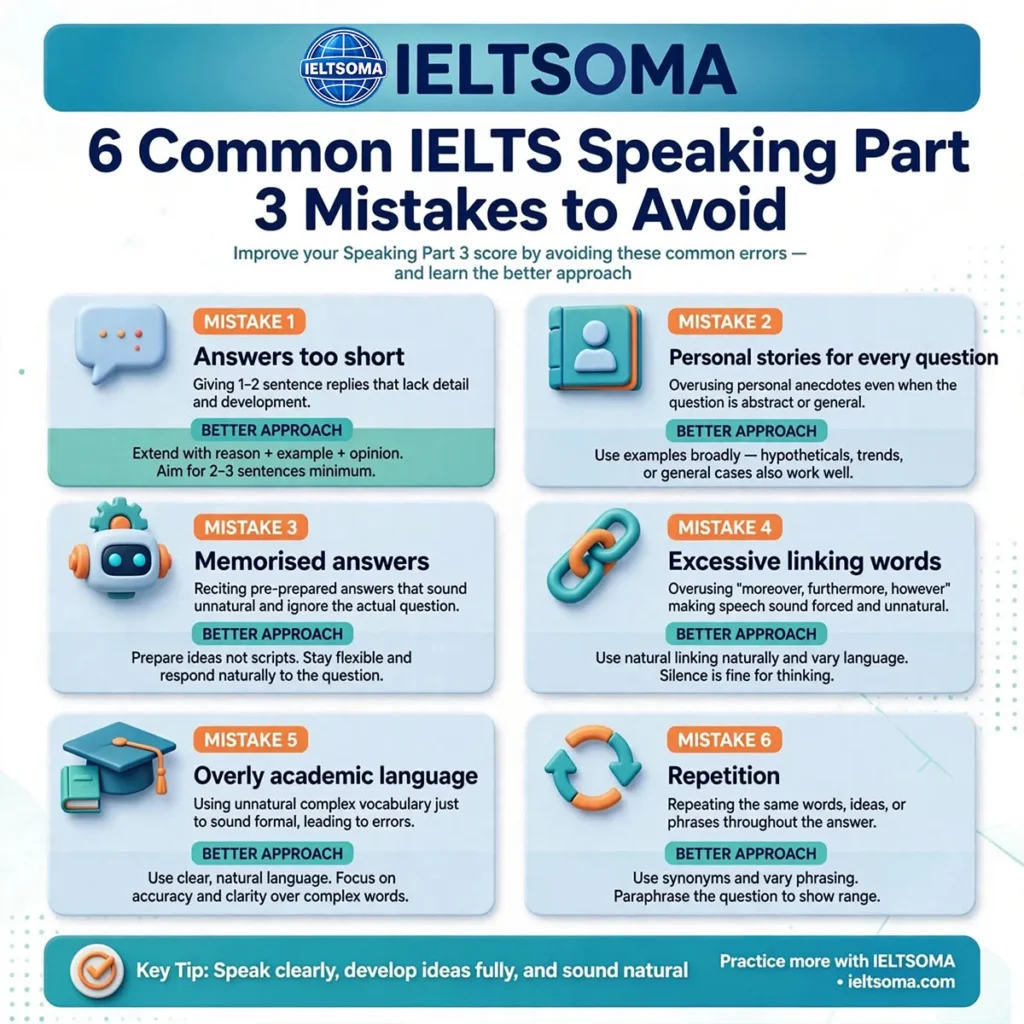
1. Giving very short answers
Do you think public transport is important?
Yes.
This does not give you enough opportunity to demonstrate your ability.
Develop the answer:
Yes, definitely. Public transport is important because it allows large numbers of people to travel efficiently, particularly in crowded cities. It can also reduce dependence on private cars.
2. Giving a personal story for every question
Part 3 is designed to move towards general discussion.
Use personal experience only when it genuinely helps illustrate a broader point.
3. Memorising complete answers
Memorised answers can sound unnatural and may not fit the question.
Prepare ideas, vocabulary and structures, rather than complete paragraphs.
4. Using linking words excessively
Some candidates say:
Firstly, moreover, furthermore, in addition, on the other hand…
But the ideas themselves are weak.
Use linking expressions when they clarify the relationship between ideas.
5. Trying to sound too academic
IELTS Speaking is a spoken test.
You should demonstrate a good range of vocabulary and grammar, but your response should still sound like natural speech.
6. Repeating the same idea
Adding more words does not automatically mean developing an answer.
Instead of repeating:
It is convenient.
Add a consequence:
It is convenient because people can shop from home. This is particularly useful for people who work long hours and have little time to visit physical shops.
Examples: From Basic to Developed Answers
Question 1: Why do people enjoy travelling?
Basic:
People enjoy travelling because it is fun.
Developed:
People enjoy travelling for several reasons, but one of the main ones is that it gives them a break from their normal routine. Visiting a different place can also expose people to new food, cultures and ways of life. For someone who has a stressful job, for example, even a short trip can provide a useful change of environment.
Question 2: Will technology change education in the future?
Developed answer:
Yes, I think technology will continue to change education significantly. Online platforms and artificial intelligence can give students access to learning materials that are tailored to their needs, while teachers can use technology to monitor progress more efficiently. However, I don’t think technology will completely replace teachers because students still need human interaction, guidance and encouragement.
Notice the structure:
Answer → reason → development → contrast
Question 3: Why do some people prefer living in cities?
Developed answer:
One major reason is access to employment and services. Large cities tend to offer a wider range of jobs, universities, hospitals and entertainment, which can make them attractive to younger adults in particular. On the other hand, city life can be expensive and stressful, so some people eventually move to smaller towns when they want a quieter lifestyle.
This answer also demonstrates the ability to introduce a contrasting viewpoint naturally.
A Practical Practice Method
To improve your IELTS Speaking Part 3 strategy, do not practise only by reading model answers.
Instead, take one question and record yourself answering it.
Step 1: Answer immediately
Give your first response without preparation.
Step 2: Listen to the recording
Check:
- Did I answer the actual question?
- Did I explain why?
- Did I develop my main idea?
- Did I give an example where appropriate?
- Did I repeat myself?
- Were my pauses natural?
- Did I use a variety of grammar?
- Could I understand my pronunciation clearly?
Step 3: Improve the same answer
Add one missing element.
For example, if you gave an opinion and reason but no development, add a consequence.
Step 4: Answer again
Try to make the second version clearer rather than simply longer.
This method teaches you to develop ideas in Part 3 under pressure, which is much more useful than memorising dozens of sample answers.
A 5-Minute Part 3 Practice Routine
You can practise effectively even when you have limited time.
Minute 1: Choose one Part 3 topic.
Minute 2: Write five possible questions.
Minute 3: Answer each question using Answer → Explain → Develop → Example.
Minute 4: Record yourself answering two questions without looking at notes.
Minute 5: Identify one weakness and repeat the answers.
For example, if your weakness is giving examples, make your next practice session focus specifically on examples.
This creates targeted improvement rather than simply speaking English for a few minutes every day.
IELTS Speaking Part 3: Quick Strategy Checklist
Before answering a question, mentally ask:
- What exactly is the question asking?
- What is my main answer?
- Why do I think this?
- What happens because of it?
- Can I compare it with something?
- Can I give a realistic example?
- Is there another side to the issue?
You do not need to use every question in every answer.
Choose the ones that help you develop your response naturally.
Frequently Asked Questions About IELTS Speaking Part 3
Is IELTS Speaking Part 3 harder than Part 1?
Part 3 can feel more challenging because the questions become more general and abstract. It requires you to explain, analyze, discuss and speculate rather than simply talk about familiar personal topics.
How should I answer IELTS Speaking Part 3 questions?
Start with a direct answer, explain your main reason, develop the idea with a consequence or additional detail, and give an example when appropriate. The exact structure should change according to the question.
How can I develop ideas in Part 3?
Ask yourself why something happens, what causes it, what its effects are, whether there is another viewpoint, and what might happen in the future. These questions give you several directions for extending an answer.
Should I give personal examples in Part 3?
You can use examples from your country, city or general experience, but Part 3 normally requires a more general discussion. Avoid turning every answer into a personal story.
Should I memorize IELTS Speaking Part 3 answers?
No. It is more useful to prepare common topic ideas, vocabulary and answer-development techniques. Memorized responses may sound unnatural and may not answer the exact question.
How long should my Part 3 answers be?
There is no fixed number of sentences that every answer must contain. Aim for a complete, developed response that answers the question without repeating yourself. Some questions may need only a few sentences, while others naturally require more explanation.
What should I do if I don’t know the answer?
You do not need specialist knowledge. Give a reasonable opinion and explain your reasoning. You can also qualify your answer by saying that the situation depends on the circumstances.
Does Part 3 have a correct answer?
No. IELTS assesses your English-speaking performance rather than whether the examiner agrees with your opinion. The focus is on how clearly and effectively you communicate your ideas.
Final Takeaway
A strong IELTS Speaking Part 3 strategy is built around one central skill: developing an idea clearly.
You do not need to produce a perfect speech or use complicated vocabulary in every sentence.
Instead:
Answer the question.
Explain your reason.
Develop the idea.
Give an example when useful.
Then practise applying that process to opinions, causes, effects, comparisons, solutions and future predictions.
Remember that Part 3 is a discussion, not a memorisation exercise. The examiner wants to hear whether you can explain opinions, analyse issues, discuss ideas and speculate about possibilities.
If you can take one simple idea and develop it logically while maintaining natural fluency, you will be much better prepared for the demands of the discussion.
The goal is not to say more simply for the sake of speaking longer. The goal is to make every additional sentence add meaning.
Further Reading: