If you are preparing for IELTS Speaking, you have probably searched for model answers for IELTS Speaking and wondered: What does a really good answer actually sound like?
That is a useful question—but there is a trap.
Memorising impressive-sounding answers is not the same as learning to speak well.
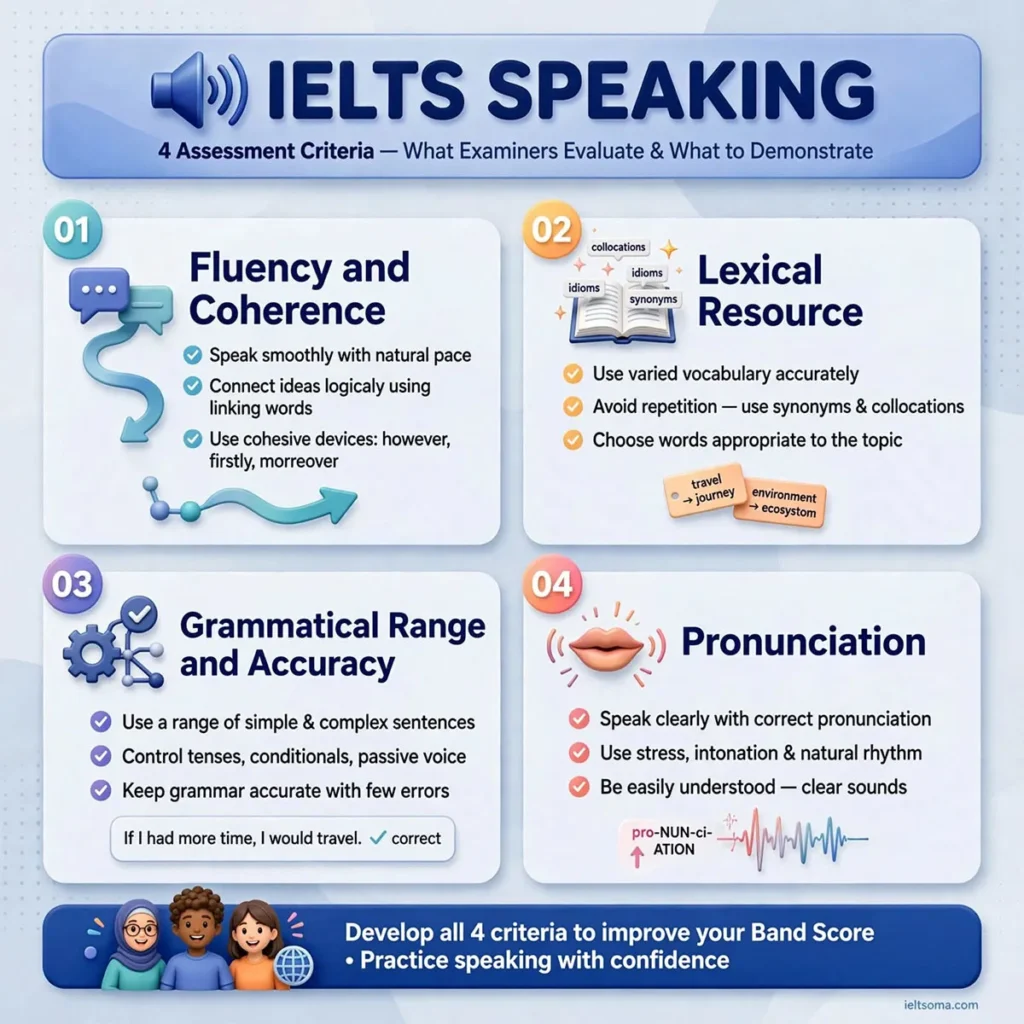
In the IELTS Speaking test, you are not rewarded simply because you use difficult vocabulary or produce a perfectly rehearsed response. You are assessed on four equally weighted areas: fluency and coherence, lexical resource, grammatical range and accuracy, and pronunciation. The Speaking test lasts 11–14 minutes and consists of three parts.
The best model answers therefore do something more valuable than give you words to memorise. They show you how to develop an answer naturally, organise your ideas, extend your responses and use language accurately.
This guide provides practical model answers for IELTS Speaking Parts 1, 2 and 3, explains why they work, and shows you how to turn them into your own responses.
Table of Contents
What Makes a Good IELTS Speaking Model Answer?
A strong model answer should sound like something a real person could say in a conversation—not like a memorised essay.
For example, compare these two responses.
Question: Do you enjoy reading?
Weak memorised-style answer:
Yes, I am extremely passionate about reading because it is an indispensable activity that broadens my intellectual horizons and enhances my cognitive abilities.
The grammar is mostly fine, but the response sounds unnatural and unnecessarily complicated.
More natural answer:
Yes, I do. I usually read in the evening, especially when I have had a busy day. I enjoy novels and books about psychology because they help me relax while also giving me something interesting to think about.
The second answer uses a good range of language, but it remains conversational.
That distinction matters.
IELTS Speaking is designed to assess your ability to communicate naturally and effectively. The official test format includes familiar questions in Part 1, an individual long turn in Part 2, and a more abstract discussion in Part 3.
The four qualities to look for
When studying model answers for IELTS Speaking, ask yourself:
- Is the answer easy to follow?
- Does it contain relevant and varied vocabulary?
- Does it demonstrate grammatical range without sounding forced?
- Is the pronunciation clear enough to understand without excessive effort?
These correspond directly to the four IELTS Speaking assessment criteria.
The goal is not to copy every sentence.
The goal is to understand the construction behind the answer.
Model Answers for IELTS Speaking Part 1
Part 1 lasts approximately 4–5 minutes. The examiner asks questions about familiar subjects such as your home, work, studies, family, interests and everyday experiences.
Answers should normally be concise but developed.
One-word answers are rarely useful for demonstrating your speaking ability, but giving a two-minute speech for every Part 1 question is equally inappropriate.
A useful pattern is:
Direct answer → reason → small detail or example
1. Do you enjoy your hometown?
Model answer:
Yes, I do. I have lived there for quite a long time, so I feel very comfortable there. What I like most is that it has a good mixture of busy areas and quieter neighbourhoods, so there is usually something to do without the city feeling overwhelming.
Why it works:
The speaker answers immediately, gives a reason and adds a specific explanation.
Notice that the vocabulary is varied but not artificial: mixture, quieter neighbourhoods, overwhelming.
2. What do you usually do at weekends?
Model answer:
My weekends are usually fairly relaxed. I normally catch up on things I didn’t have time to do during the week, and I also try to meet a few friends. If the weather is pleasant, we might go somewhere for coffee or take a walk in the evening.
This response demonstrates natural sequencing:
- general statement
- routine
- social activity
- conditional example
It does not need complicated vocabulary to be effective.
3. Do you prefer studying in the morning or evening?
Model answer:
I definitely prefer studying in the morning. I tend to feel more focused after a good night’s sleep, so I can concentrate much better. In the evening, I sometimes find myself getting distracted, particularly if I’ve already had a long day.
This is stronger than simply saying:
I prefer mornings because I feel fresh.
The model answer develops the idea and uses contrast naturally.
4. Do you often use your mobile phone?
Model answer:
Yes, probably more than I should. I use it for practical things such as checking emails, finding information and keeping in touch with friends. I also spend some time watching short videos, although I try to limit that because it can be quite distracting.
This answer demonstrates something important: balanced development.
The speaker does not simply say that phones are useful. They mention several uses and then add a personal qualification.
5. What kind of music do you like?
Model answer:
I listen to quite a wide range of music, but I probably listen to pop and acoustic music most often. It depends on my mood. If I’m working, I prefer something fairly calm, whereas when I’m travelling or exercising, I usually choose something more energetic.
The phrase “It depends on my mood” provides a natural bridge to further explanation.
It is much more useful to learn structures like this than to memorise entire answers.
Model Answers for IELTS Speaking Part 2
Part 2 is the individual long turn. You receive a task card, have one minute to prepare, and then speak for up to two minutes. The examiner may ask one or two follow-up questions afterwards.
The biggest challenge is often not vocabulary.
It is having enough ideas and keeping your speech organised.
A useful structure is:
Introduce the topic → describe it → explain details → give your reaction → finish naturally
6. Describe a person who has influenced you
Model answer:
I would like to talk about a teacher who had a significant influence on me when I was at school. His name was Mr John, and he taught me English for several years.
What I remember most about him was the way he encouraged students to express their own opinions. Instead of simply asking us to memorise information, he would give us a topic and ask us what we thought about it. At first, I found this quite difficult because I wasn’t particularly confident about speaking in front of other people.
However, he was very patient and always gave constructive feedback. He never made students feel embarrassed when they made mistakes, which gradually made me more willing to participate in class.
I think his influence went beyond English. Because of him, I became much more comfortable expressing my ideas, and that has helped me in both my studies and everyday communication. So, although I haven’t seen him for years, I still remember him as one of the teachers who had the greatest impact on me.
Why this answer works
The response does not simply describe the teacher.
It explains why the person was influential.
It also contains a clear progression:
- who the person was
- what he did
- an initial difficulty
- what changed
- why the experience still matters
That gives the examiner evidence of your ability to speak at length and organise ideas logically—skills relevant to Part 2.
7. Describe a memorable journey
Model answer:
One journey I remember particularly well was a road trip I took with two friends a few years ago. We travelled to a mountainous area for a short break, and although the journey itself was quite long, it turned out to be one of the most enjoyable trips I’ve had.
We left early in the morning because we wanted to avoid the traffic. At first, everything went according to plan, but after several hours our car developed a minor problem. Fortunately, we managed to find a mechanic nearby, so the problem was fixed fairly quickly.
What made the journey memorable wasn’t just the destination. We spent several hours talking, listening to music and stopping at different places along the way. We also saw some beautiful scenery that I hadn’t expected to see.
Looking back, I think the unexpected problem actually made the trip more memorable. If everything had gone perfectly, it might not have been nearly as interesting. I’d definitely like to take a similar road trip again.
Notice the use of past tenses, sequencing and reflection.
The speaker is not trying to impress the examiner with obscure words. Instead, they are telling a coherent story.
That is a much more useful model for your own preparation.
Model Answers for IELTS Speaking Part 3
Part 3 lasts approximately 4–5 minutes and involves a discussion connected to the Part 2 topic. The questions become more general, abstract and analytical.
This is where many candidates struggle.
They may have plenty to say about personal experiences but find it difficult to discuss broader issues.
A strong Part 3 answer often follows this pattern:
Opinion → explanation → example → qualification or consequence
8. Why do people enjoy travelling?
Model answer:
I think people travel for several different reasons. One of the main reasons is that travelling gives people a break from their normal routines. If someone spends most of their time working or studying, visiting a different place can help them relax and return with a fresh perspective.
Another reason is curiosity. People naturally want to experience different cultures, food and ways of life. For example, someone who has always lived in a large city might find it fascinating to spend time in a rural community.
That said, I don’t think everyone travels simply for relaxation. Some people travel for work, education or personal development, so the motivation can vary considerably.
This answer is effective because it moves beyond a personal preference.
It presents:
- a main idea
- an explanation
- an example
- another perspective
9. Has technology changed the way people travel?
Model answer:
Yes, technology has changed travelling quite dramatically. In the past, people had to rely much more heavily on guidebooks, maps and information from travel agencies. Now, travellers can research a destination, book accommodation and navigate unfamiliar streets using a smartphone.
Technology has also changed the experience while people are travelling. For instance, translation apps can make communication easier when visitors don’t speak the local language.
However, there is a possible downside. Some travellers spend so much time taking photographs or checking their phones that they may not fully experience the place they are visiting.
The final qualification makes the response more analytical.
That is particularly useful in Part 3, where you may be asked to explain, analyse, discuss or speculate about broader issues.
10. Should young people travel more?
Model answer:
In general, I think travelling can be very beneficial for young people, provided they have the financial means and appropriate support. Visiting different places can expose them to cultures and lifestyles that are very different from their own.
It can also encourage independence. When young people have to organise transport, manage a budget and deal with unexpected situations, they develop practical skills that aren’t always taught in the classroom.
However, I wouldn’t say that travelling is essential for everyone. People can also develop these qualities through education, employment, volunteering or other experiences. So I think travel is valuable, but it is one of several ways young people can broaden their experience.
This is a useful example of a balanced opinion.
The speaker does not blindly argue “yes”.
Instead, they acknowledge an alternative perspective and then explain their position.
How to Use Model Answers Without Memorising Them
This is perhaps the most important part of your preparation.
Do not memorise the ten answers above word for word.
IELTS Speaking is designed to assess spontaneous spoken communication, and official IELTS guidance notes that the test format does not allow candidates to rehearse set responses beforehand.
Instead, use model answers as training material.
Step 1: Study the structure
Take an answer and identify its components.
For example:
I prefer studying in the morning [answer] because I feel more focused [reason]. After a good night’s sleep, I can concentrate better [explanation].
Now create your own version.
I prefer studying in the evening because my house is quieter. During the day, there are usually lots of distractions, whereas at night I can concentrate for longer.
The structure stays similar, but the content becomes yours.
Step 2: Replace the vocabulary
Do not assume that you must use exactly the same words as the model.
For example:
Model:
The city can feel overwhelming.
Your version:
The city can be quite hectic.
Another possibility:
The city can become exhausting at times.
This trains you to paraphrase rather than depend on memorised phrases.
Paraphrasing is itself relevant to lexical resource because candidates may need to express meaning in different ways when they do not know a particular word.
Step 3: Change the personal details
If the model answer talks about a teacher, use:
- a family member
- a colleague
- a friend
- a coach
- a neighbour
If the model talks about travelling to a mountain area, change it to:
- a beach
- a historical city
- a village
- another country
- a memorable local trip
The aim is to build flexibility.
Step 4: Practise without looking
Read the model once.
Then close it.
Speak about the same question using only the main ideas you remember.
This is much closer to the skill required in the actual test.
Model Answers vs Memorised Answers
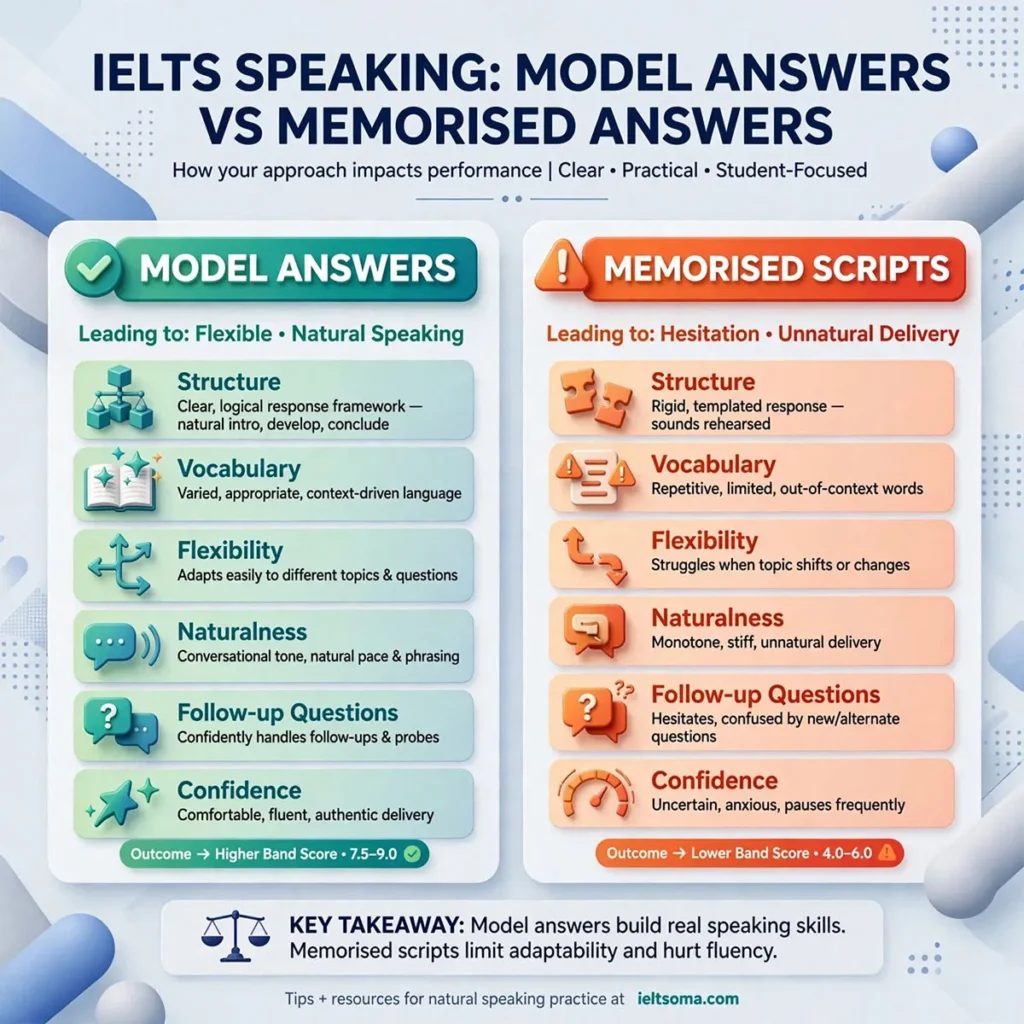
| Model answers | Memorised answers |
|---|---|
| Show how ideas can be developed | Encourage copying |
| Provide useful vocabulary in context | Can produce unnatural language |
| Demonstrate possible structures | May fail when the question changes |
| Encourage flexible speaking | Depend heavily on exact wording |
| Help you generate your own ideas | Can increase hesitation when memory fails |
A model answer should therefore be treated as a map, not a script.
How to Improve Model Answers for a Higher Band
The official IELTS Speaking criteria are equally weighted, so improving vocabulary alone will not automatically produce a higher score.
Work on all four areas.
Improve fluency and coherence
Practise speaking continuously without stopping every few seconds to search for perfect vocabulary.
Useful natural phrases include:
- “I suppose…”
- “I think the main reason is…”
- “For example…”
- “Having said that…”
- “It depends on…”
- “From my perspective…”
Use these to organise ideas, not to fill every silence.
Improve lexical resource
Learn vocabulary in groups and contexts, rather than isolated word lists.
Instead of memorising:
beneficial
Learn expressions such as:
highly beneficial for young people
beneficial in the long term
have a beneficial effect
This makes vocabulary easier to use naturally.
Improve grammatical range and accuracy
You do not need complicated grammar in every sentence.
Instead, combine structures appropriately:
I usually study in the morning because I feel more focused.
Then add a conditional:
If I have an important exam coming up, I sometimes study for several hours before lunch.
Then perhaps use a relative clause:
I usually study in the library, which is much quieter than my home.
The objective is range with control.
Improve pronunciation
Clear pronunciation matters more than trying to imitate a particular accent.
Focus on:
- word stress
- sentence stress
- connected speech
- appropriate pauses
- clear sounds
- natural intonation
The official criteria describe pronunciation in terms of how easily the candidate can be understood, rather than requiring a particular native-speaker accent.
Common Mistakes When Using IELTS Speaking Model Answers
1. Memorising complete answers
This can make your speech sound rehearsed and can leave you stuck if the examiner asks the question differently.
2. Using difficult vocabulary everywhere
Words should be accurate and appropriate. A simple word used correctly is better than an advanced word used incorrectly.
3. Giving extremely short answers
Particularly in Part 1, answer the question and then give a reason, explanation or small example when appropriate.
4. Giving excessively long Part 1 answers
Part 1 is a conversational interview, not a series of mini speeches.
5. Ignoring pronunciation
Knowing sophisticated vocabulary is of limited value if the examiner has difficulty understanding you.
6. Preparing only personal stories
Part 3 requires broader discussion. Practise talking about causes, effects, advantages, disadvantages, changes and future possibilities.
A Simple Practice Routine
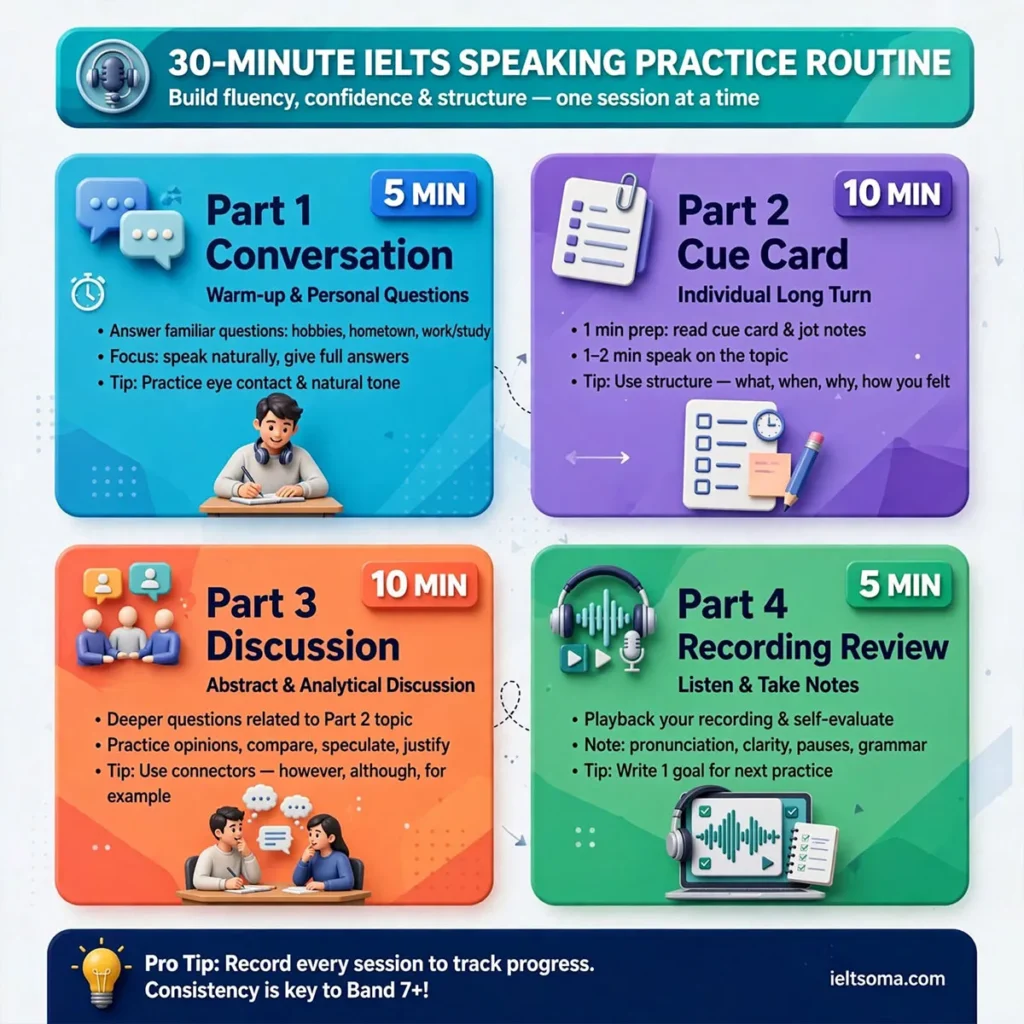
You can turn model answers for IELTS Speaking into a daily exercise with just 20–30 minutes.
First 5 minutes:
Choose one Part 1 topic and answer five questions.
Next 10 minutes:
Practise one Part 2 cue card. Use one minute to prepare and then speak for up to two minutes.
Next 10 minutes:
Answer three Part 3 questions related to the same topic.
Final 5 minutes:
Listen to your recording and identify:
- repeated vocabulary
- long pauses
- grammar errors
- unclear pronunciation
- ideas that needed more explanation
Then repeat the weakest answer.
This final repetition is important. You are not simply checking your mistakes; you are giving yourself an opportunity to produce a better version immediately.
The Best Way to Build Your Own IELTS Speaking Answer Bank
Instead of writing hundreds of complete answers, create a flexible bank of:
Ideas
- personal experiences
- people
- places
- activities
- challenges
- achievements
- opinions
Vocabulary
- useful topic-specific words
- collocations
- natural phrasal verbs
- alternative expressions
Structures
- giving reasons
- comparing
- contrasting
- speculating
- describing change
- giving examples
- expressing uncertainty
For example, if your topic is technology, you could prepare ideas about:
- smartphones
- social media
- online learning
- artificial intelligence
- communication
- work
- entertainment
One well-developed idea can then be adapted to many different questions.
That is far more powerful than memorising 20 unrelated scripts.
Final Checklist for IELTS Speaking Model Answers
Before using a model answer for practice, ask:
- Does it answer the question directly?
- Does it sound natural when spoken aloud?
- Does it develop the main idea?
- Is the vocabulary appropriate?
- Are the grammatical structures accurate?
- Can I explain the same idea using different words?
- Can I change the personal details?
- Can I speak about the topic without looking at the answer?
- Can I handle a follow-up question?
- Can I give an alternative viewpoint if necessary?
If you can answer “yes” to most of these questions, you are using model answers in the right way.
FAQs About Model Answers for IELTS Speaking
Can I memorise IELTS Speaking model answers?
You can study model answers, but memorising complete responses is not a good preparation strategy. Use them to learn ideas, vocabulary, structures and ways of developing an answer, then create your own response.
How long should my IELTS Speaking answers be?
There is no fixed number of words for individual answers. Part 1 should generally be concise and conversational, while Part 2 requires a longer turn of up to two minutes. Part 3 answers normally need enough development to explain and support your ideas.
Are Band 9 model answers necessary for IELTS preparation?
No. The most useful model is one that helps you understand what effective speaking looks like at your current level and how to improve it. You should focus on the four assessment criteria rather than trying to imitate an unrealistic script.
Should I use advanced vocabulary in every answer?
No. IELTS assesses the range, accuracy and appropriacy of your vocabulary. Natural, precise language is more valuable than unnecessarily complicated words.
How can I make my Speaking answers longer?
Do not simply speak more slowly. Add a reason, explanation, example, comparison, personal experience or consequence when appropriate.
For example:
Answer: I enjoy travelling.
Reason: I enjoy travelling because I like seeing new places.
Example: Last year, I visited a city I’d never been to before.
Reflection: It made me realise how different people’s lifestyles can be.
Do Academic and General Training candidates use different Speaking model answers?
No. The IELTS Speaking test is the same for Academic and General Training candidates. The Speaking test lasts 11–14 minutes and has three parts in both versions.
What should I do if I forget a word during the Speaking test?
Do not panic. Try to paraphrase the idea using words you know. Developing this ability is useful because the IELTS Speaking assessment considers your ability to use alternative vocabulary when you do not know a particular word.
Build Your Own Answers, Not Someone Else’s
The strongest way to use model answers for IELTS Speaking is to study the thinking behind them.
Look at how an answer starts.
Notice how the speaker gives a reason.
Study how an example is introduced.
Observe how the response develops and reaches a natural ending.
Then close the model and speak for yourself.
That is the point at which preparation becomes real speaking practice.
Your target should not be to reproduce a perfect answer that somebody else wrote. Your target should be to develop enough fluency, vocabulary, grammar, pronunciation and flexibility to respond confidently when the examiner asks a question you have never seen before.
Use model answers as examples.
Use them to expand your language.
Use them to discover better ways to organise your ideas.
But when the test begins, speak your own answer.
Further Reading:
- IELTS Speaking Accuracy and Fluency: 7 Smart Ways to Improve
- IELTS Speaking Practice Tips: 15 Powerful Ways to Improve
- Fluency vs Accuracy in IELTS Speaking: 7 Powerful Rules
- Well Organized Answers in IELTS Speaking: 7 Powerful Ways to Speak Clearly
- IELTS Preparation: 6 Powerful Ways to Use Real-Life English
- IELTS Academic Speaking test format