Many IELTS Reading mistakes happen before candidates even find the answer.
A question contains a clue, but instead of anticipating what information might appear, the test taker reads every word, searches randomly, and eventually runs out of time.
That is where IELTS Reading prediction skills can make a significant difference.
Prediction does not mean guessing the answer before reading the passage. It means using the information already available to anticipate what you are likely to find next.
You can predict the type of information required, possible keywords, grammatical structure, relationships between ideas, and even the direction of an argument. These predictions give your reading a purpose and make scanning much more efficient.
The IELTS Reading test contains 40 questions and lasts 60 minutes in both Academic and General Training Reading. Academic Reading uses three sections with a total text length of approximately 2,150–2,750 words, while General Training Reading also has three sections, with texts becoming progressively more difficult.
So, if you want to improve your Reading score, do not simply try to read faster.
Learn to predict better.
Table of Contents
What Are IELTS Reading Prediction Skills?
IELTS Reading prediction skills are the techniques you use to anticipate information before locating it in the passage.
For example, suppose a question says:
The main reason for the decline was ______.
Before searching the passage, you can predict that the blank probably requires a noun or noun phrase describing a reason.
You might also predict related ideas such as:
- increased costs
- environmental problems
- lack of demand
- government policy
- technological changes
You are not choosing the answer yet. You are creating a mental search area.
This distinction is important.
Prediction narrows the possibilities; the passage confirms the answer.
Official IELTS materials show that Reading assesses skills including reading for general understanding, identifying main ideas and details, skimming, understanding logical arguments and recognising inferences, opinions, attitudes and purpose.
Prediction supports many of these skills because it helps you approach information with a clear expectation.
Why Prediction Matters in IELTS Reading
IELTS Reading is not simply a vocabulary test.
You need to locate relevant information, understand how ideas connect and distinguish important information from distracting details.
Prediction helps because it allows you to:
- read questions more actively
- identify useful keywords
- anticipate paraphrases
- predict grammatical structures
- locate information faster
- understand paragraph organisation
- reduce unnecessary rereading
- make better decisions under time pressure
Consider two candidates looking for the answer to the same question.
Candidate A reads the entire passage carefully from beginning to end.
Candidate B analyses the question, predicts the information required, identifies likely keywords and then scans for the relevant section.
Candidate B is not necessarily a faster reader.
They are simply searching more intelligently.
1. Predict the Type of Answer
One of the most useful IELTS Reading prediction skills is identifying what kind of answer a question requires.
Look carefully at the words surrounding the gap or question.
For example:
The research was conducted in ______.
The blank is likely to require a place.
Another example:
Researchers discovered that ______ had a significant effect.
The blank may require a noun, person, factor or concept.
You can make similar predictions with questions asking:
- Who? → person or group
- Where? → place
- When? → date, year or period
- Why? → reason or cause
- How? → method, process or manner
- How many? → number or quantity
- What? → object, idea, fact or concept
This technique is particularly useful for sentence completion, summary completion, note completion and short-answer questions.
Official IELTS guidance confirms that completion tasks may require you to identify the type of word that fits a gap, such as a noun or verb, while following the stated word limit.
Example
Question:
The project required ______ years to complete.
Prediction:
Number or quantity.
You can now scan the passage specifically for years, numbers and expressions of duration rather than reading every sentence with equal attention.
2. Predict Keywords and Their Paraphrases
IELTS rarely makes the task as simple as repeating the exact words from the question.
A question might contain:
The number of people using public transport increased significantly.
The passage could say:
There was a substantial rise in the use of buses and trains.
The concepts are similar, but the vocabulary is different.
This is why strong prediction involves more than identifying keywords.
You should predict possible paraphrases.
For example:
| Question language | Possible passage language |
|---|---|
| increased | rose, grew, climbed |
| decreased | declined, fell, dropped |
| important | significant, crucial, major |
| problem | issue, difficulty, challenge |
| reason | cause, explanation, factor |
| changed | altered, transformed, modified |
| result | outcome, consequence, effect |
Do not try to memorise enormous lists of synonyms.
Instead, develop the habit of asking:
“How could the writer express this idea differently?”
That question can dramatically improve your scanning ability.
3. Predict Grammar Before Searching
Grammar provides another powerful clue.
Look at the structure around a blank and ask what grammatical form is required.
For example:
The researchers decided to ______ the experiment.
After to, you expect a base-form verb.
Possible answers might include:
- repeat
- modify
- conduct
- analyse
Another example:
The rapid ______ of technology changed consumer behaviour.
Here, the article the and adjective rapid suggest that a noun is likely to follow.
Possible answers could include:
- development
- expansion
- growth
- advancement
This technique is particularly useful when several words in the passage appear relevant.
Grammar can help you eliminate answers that do not fit the sentence.
A useful prediction checklist
Before looking for an answer, ask:
- Is the answer likely to be a noun?
- Could it be a verb?
- Is an adjective required?
- Is a number expected?
- Is a singular or plural form likely?
- Does the sentence require a person or place?
This takes only a few seconds but can prevent careless errors.
4. Predict the Main Idea of a Paragraph
Prediction is not limited to gap-fill questions.
It is especially useful for Matching Headings.
The purpose of a heading is to summarise the main idea of a paragraph or section, rather than simply identify an interesting detail. Official IELTS guidance specifically distinguishes the main idea from supporting information in this question type.
Before comparing all the headings, read the paragraph quickly and predict its central message.
Ask:
“If I had to explain this paragraph in five or six words, what would I say?”
For example, a paragraph may contain:
- an example of an early invention
- several dates
- the name of an inventor
- details about how the invention worked
But its main idea might be:
The origins of an important technology.
Do not automatically choose a heading because one word appears in the paragraph.
A good heading represents the overall idea.
5. Predict What Will Come Next
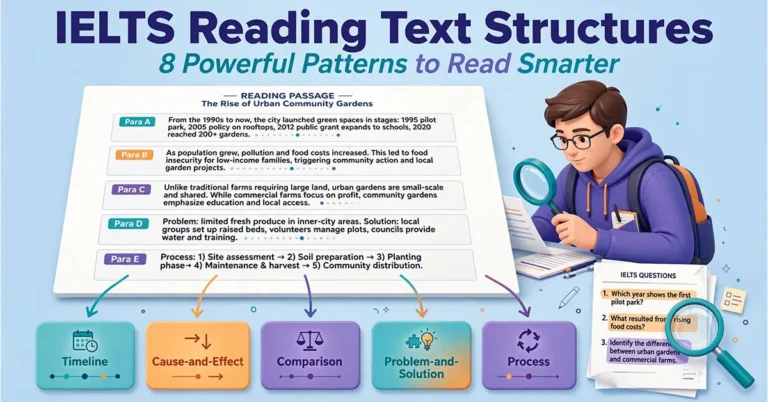
IELTS passages often follow logical patterns.
Once you recognise the relationship between ideas, you can predict what information may come next.
For example:
Problem → Cause → Solution
If a paragraph explains a serious environmental problem, you might expect the next part to discuss:
- why the problem occurred
- its consequences
- possible solutions
Another common structure is:
Claim → Evidence → Example
If the writer introduces a claim, supporting evidence or an example may follow.
Other useful patterns include:
- cause → effect
- past → present
- general idea → specific example
- theory → evidence
- problem → response
- advantage → disadvantage
- old method → new method
- question → explanation
This does not mean the passage must follow the pattern you predict.
Your prediction is a hypothesis.
Keep reading and allow the text to confirm or reject it.
6. Predict the Writer’s Direction
Some IELTS Reading questions require you to understand opinions, claims and relationships between ideas.
Academic Reading, for example, may include questions asking you to identify whether statements agree with the writer’s views or claims.
Prediction can help here too.
Look for words that signal a change in direction:
- however
- although
- nevertheless
- despite
- in contrast
- on the other hand
- therefore
- consequently
- as a result
- for example
- in fact
Suppose the writer says:
Many researchers initially believed that the method was highly effective. However, later studies…
The word however signals a contrast.
You can predict that the writer may now introduce:
- evidence against the earlier belief
- a limitation
- a different conclusion
- contradictory findings
Recognising these signals makes complex paragraphs easier to follow.
7. Predict Answers from the Question Type
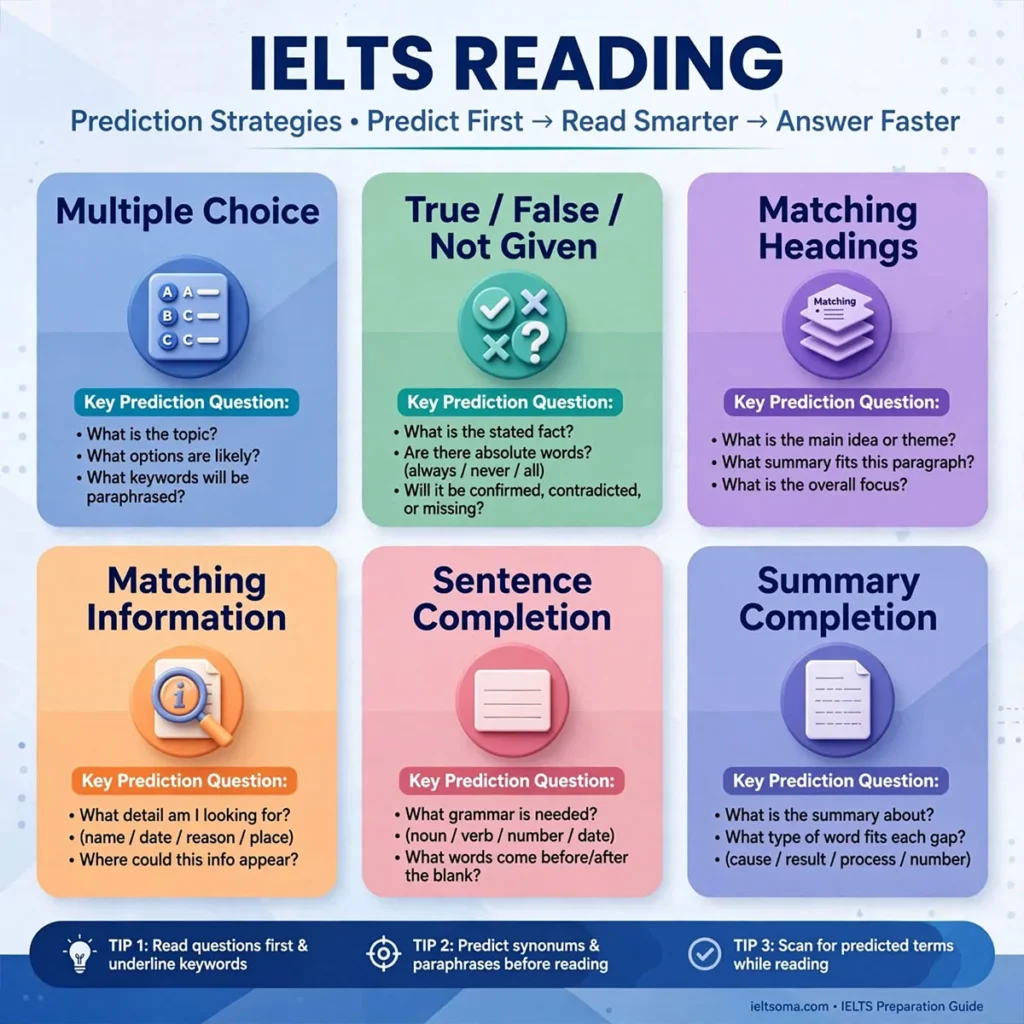
Different IELTS Reading question types encourage different forms of prediction.
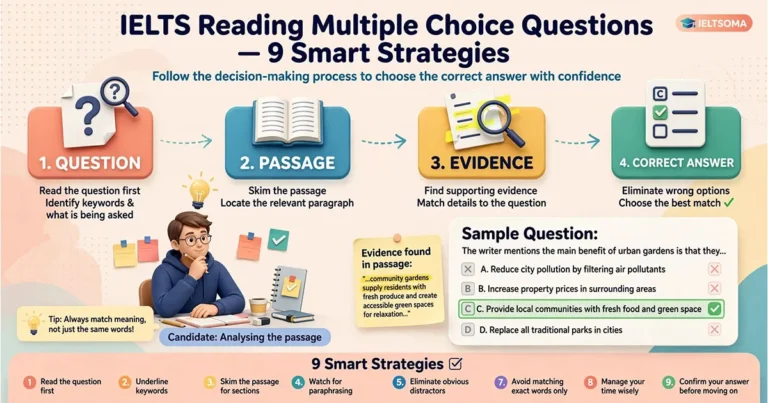
Multiple Choice
Predict the idea being tested before examining the options.
If the question asks:
Why did the researchers change their original method?
Think:
I need a reason.
Then look for cause-and-effect language.
Official IELTS guidance states that multiple-choice questions may test detailed understanding or general understanding of the main points, and the questions are presented in the same order as the relevant information in the text.
True/False/Not Given
Predict the claim you need to verify.
Do not decide based on your own knowledge.
For example:
The study involved more than 500 participants.
You should predict:
I need evidence about participant numbers.
Then find the relevant passage and determine whether the statement is supported, contradicted or not mentioned.
IELTS specifically warns candidates not to use outside knowledge when deciding True, False or Not Given.
Matching Information
Predict the type of information being described.
Is the question asking for:
- an example?
- a reason?
- a comparison?
- a description?
- a specific fact?
- an explanation?
Official IELTS materials describe Matching Information as a task requiring candidates to locate specific information rather than simply identify the paragraph’s main idea.
Sentence Completion
Predict both:
meaning + grammar
For example:
The invention was initially designed to ______.
You should predict a verb.
Then think about what action the passage might describe.
Summary Completion
Predict the relationship between the ideas.
Read the surrounding sentences first.
Ask:
- Is this describing a process?
- Is it explaining a cause?
- Is it comparing two things?
- Is it describing historical development?
This creates a mental framework before you search the passage.
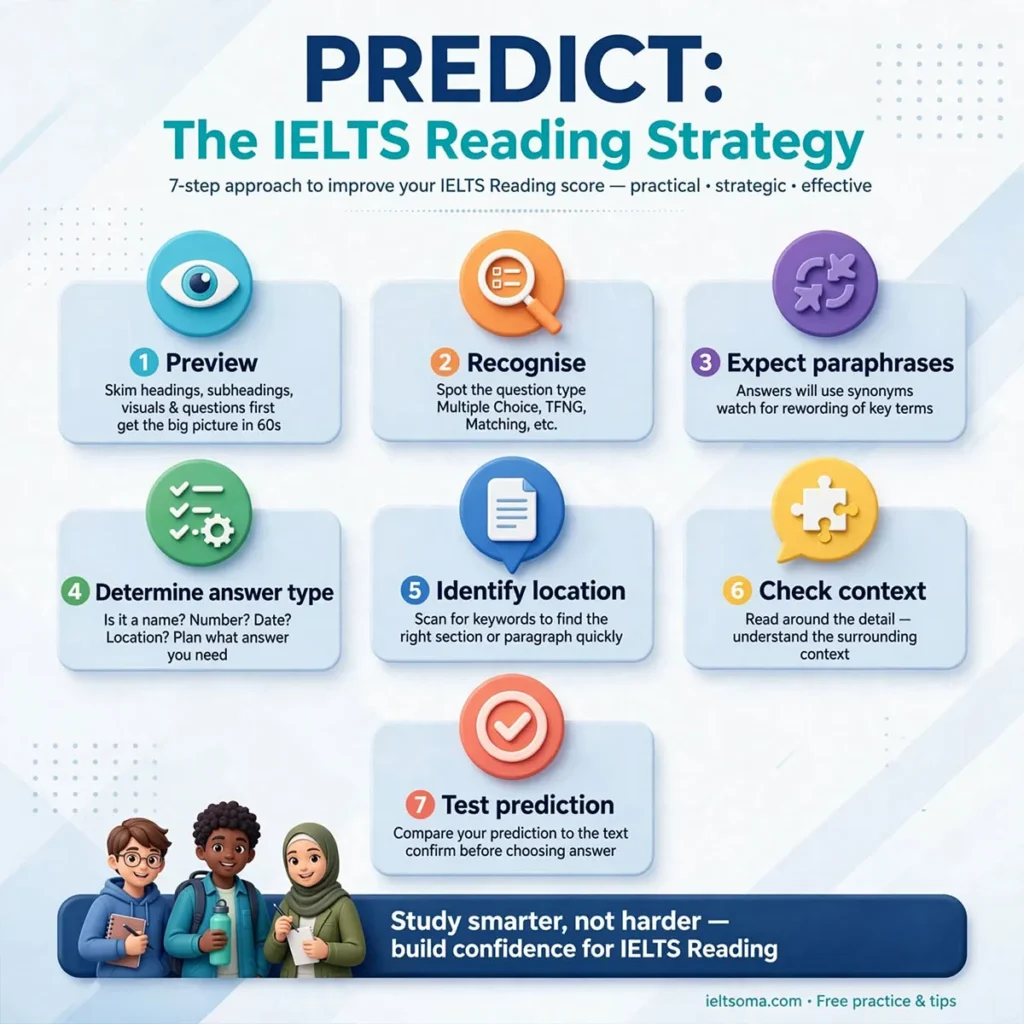
A Simple Prediction Strategy: PREDICT
You can remember the process using the word PREDICT:
P — Preview the question
Understand exactly what you need to find.
R — Recognise keywords
Identify the important concepts rather than every word.
E — Expect paraphrases
Think about how the passage might express the same idea differently.
D — Determine the answer type
Predict whether you need a person, place, number, noun, verb, reason or other information.
I — Identify the likely location
Use question order, paragraph structure and topic clues where appropriate.
C — Check the context
Read enough surrounding information to confirm the answer.
T — Test your prediction
Make sure the answer satisfies meaning, grammar and the question instructions.
This process turns prediction into a repeatable reading strategy rather than a vague technique.
Prediction Does Not Mean Guessing
This is one of the most important distinctions for IELTS candidates.
Bad prediction looks like this:
“I think the answer is probably technology, so I’ll choose it.”
Good prediction looks like this:
“The question asks for a reason. The blank requires a noun phrase. I expect the passage to explain why the change occurred. I’ll search for that information and verify it.”
The first approach is guessing.
The second is strategic reading.
Never allow your prediction to override evidence in the passage.
If the text contradicts your prediction, change your prediction.
That flexibility is part of effective reading.
Common IELTS Reading Prediction Mistakes
Mistake 1: Predicting the Exact Word
You do not need to predict the exact answer.
Predict the category or concept.
If the question asks for a reason, predict possible reasons rather than trying to guess the precise wording.
Mistake 2: Treating Prediction as a Shortcut
Prediction is not a substitute for reading.
You still need to verify the answer against the passage.
Mistake 3: Ignoring Paraphrasing
Searching only for exact words from the question can waste valuable time.
Train yourself to expect synonyms, grammatical changes and completely different expressions of the same idea.
Mistake 4: Using Background Knowledge
Your knowledge of the subject is not evidence.
The answer must come from the passage.
This is particularly important for True/False/Not Given and Yes/No/Not Given questions.
Mistake 5: Overpredicting
Sometimes candidates create complicated theories about what the writer will say.
Keep predictions simple.
Your goal is to make searching easier, not to write the passage in your head.
How to Practise IELTS Reading Prediction Skills
You can develop this skill without completing full IELTS tests every day.
Try this five-minute exercise.
Step 1: Choose a short passage
Use an IELTS-style reading passage.
Step 2: Read only the questions
Do not read the passage yet.
For each question, write down:
- expected answer type
- two or three key concepts
- possible paraphrases
Step 3: Read the passage
Now check whether your predictions were useful.
Step 4: Record successful predictions
If you correctly anticipated a concept, grammar form or paragraph direction, record it.
Step 5: Analyse incorrect predictions
Do not simply mark them wrong.
Ask:
Why did my prediction fail?
Perhaps you:
- misunderstood the question
- focused on an unimportant word
- ignored a contrast marker
- expected the wrong grammatical form
- failed to consider a paraphrase
This type of analysis is more valuable than simply completing another test.
A 10-Minute Daily Prediction Exercise
If you have limited preparation time, try this routine:
| Time | Activity |
|---|---|
| 2 minutes | Read questions and predict answer types |
| 2 minutes | Identify keywords and paraphrases |
| 3 minutes | Scan the passage |
| 2 minutes | Confirm answers in context |
| 1 minute | Review prediction errors |
Do this consistently and prediction becomes automatic.
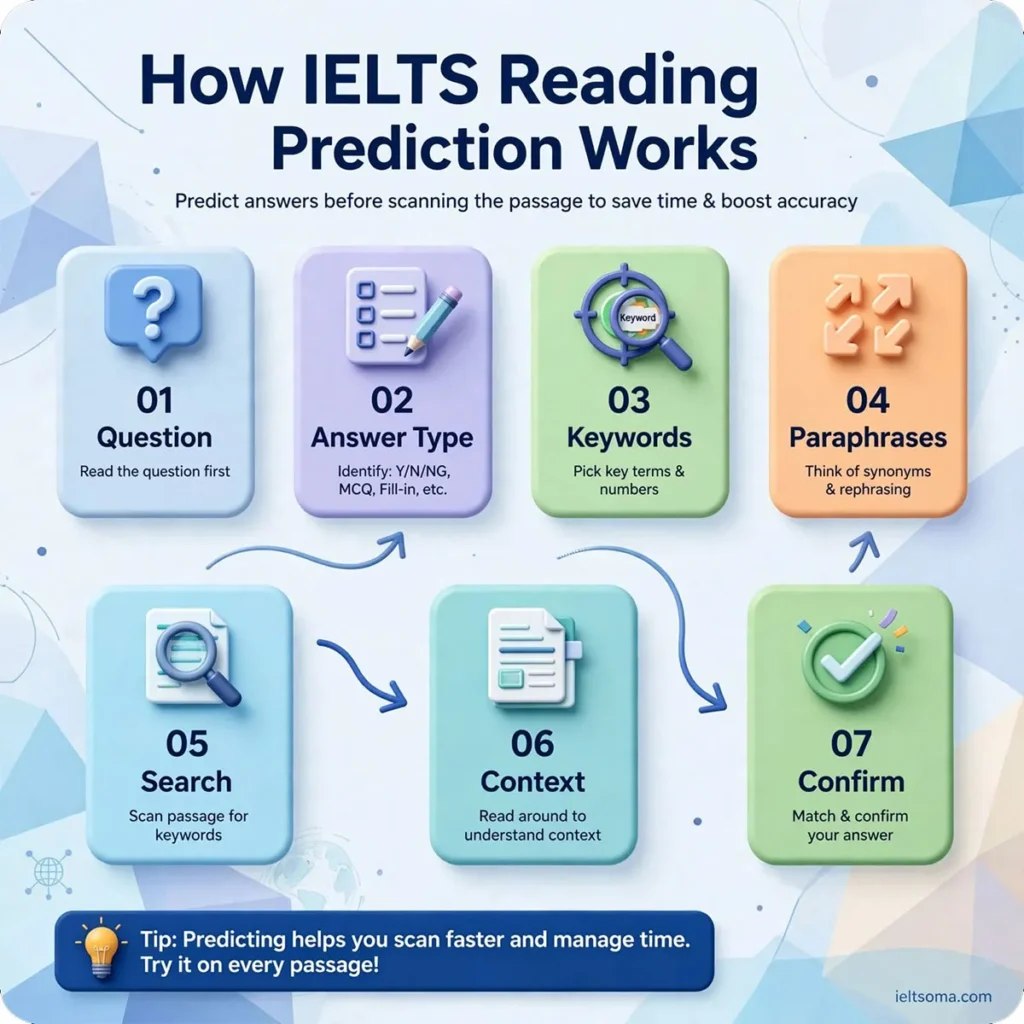
How Prediction Works with Skimming and Scanning
Prediction works best when combined with other Reading skills.
Skimming helps you understand the general structure and topic.
Scanning helps you locate specific information.
Prediction tells you what information to look for.
Think of them as a sequence:
Predict → Skim → Scan → Read closely → Confirm
For example, if a question asks about the year a project began:
- Predict that a number or date is required.
- Skim the relevant section.
- Scan for dates.
- Read the surrounding sentence.
- Confirm that the date answers the exact question.
This is far more efficient than reading the entire passage word by word.
IELTS Reading Prediction Skills: Final Checklist
Before answering a question, ask:
- What exactly am I being asked to find?
- What type of answer should I expect?
- Which words represent the key concepts?
- What paraphrases could appear?
- Does the question suggest a particular relationship?
- Where might this information appear?
- Does my prediction fit the grammar?
- Does the passage actually confirm it?
- Have I followed the word limit?
- Am I using the passage rather than my own knowledge?
If you can answer these questions consistently, your Reading process becomes much more controlled.
Final Takeaway
Strong IELTS Reading performance is not simply about reading quickly.
It is about reading with a purpose.
IELTS Reading prediction skills help you anticipate the information you need, recognise likely paraphrases, understand paragraph direction and search for evidence more efficiently.
The key principle is simple:
Predict before you search, but never answer before you verify.
Use prediction alongside skimming, scanning, paraphrase recognition and careful checking. With regular practice, you can spend less time searching randomly and more time locating the information that actually matters.
For official IELTS preparation materials and current test information, use the official IELTS sample test questions and the official Reading test-format guidance.
Frequently Asked Questions
What are IELTS Reading prediction skills?
IELTS Reading prediction skills are techniques used to anticipate the type, meaning or location of information before searching the passage. They help candidates read more strategically and efficiently.
Is prediction the same as guessing in IELTS Reading?
No. Prediction is an informed expectation based on the question, grammar, keywords and context. The passage must still be used to confirm the answer.
How can I predict answers in IELTS Reading?
Start by identifying the answer type, such as a person, place, number, noun or reason. Then identify key concepts, predict possible paraphrases and search the passage for evidence.
Does prediction help with Matching Headings?
Yes. Before choosing a heading, predict the main idea of each paragraph. This helps you distinguish the central message from examples and supporting details.
Can prediction improve IELTS Reading speed?
It can make searching more efficient because you approach the passage with a specific purpose rather than treating every sentence as equally important.
Should I use my general knowledge when predicting IELTS Reading answers?
No. Prediction can help you anticipate what information to search for, but the final answer must be supported by the passage. This is particularly important for True/False/Not Given and Yes/No/Not Given questions.
How often should I practise prediction?
Short daily practice can be effective. Spend a few minutes predicting answer types, keywords and paraphrases before checking the passage, then review where your predictions succeeded or failed.
Further Reading:
- IELTS Reading Multiple Choice Questions: 9 Smart Strategies
- Yes/No/Not Given Questions in IELTS Reading: 9 Proven Strategies
- IELTS Reading Comprehension Strategies: 9 Powerful Ways to Understand Texts
- IELTS Reading Text Structures: 8 Powerful Patterns to Read Faster
- IELTS Exam Stress: 9 Powerful Ways to Stay Calm and Perform Better