
Good pronunciation does not mean speaking with a British, American or Australian accent.
In IELTS Speaking, your priority is clear, understandable speech. You can keep your natural accent and still achieve a strong pronunciation score if your words, sounds, stress, rhythm and intonation allow the examiner to understand you without unnecessary effort.
That is why effective pronunciation tips for IELTS Speaking should focus on communication rather than accent imitation.
The official IELTS Speaking assessment includes Pronunciation as one of four equally important assessment criteria. The pronunciation descriptors consider features such as individual sounds, stress, rhythm, intonation, chunking and connected speech, together with how easily the listener can understand the candidate.
The good news is that pronunciation is highly trainable.
You do not need to spend hours repeating isolated vocabulary. With focused practice, recording and targeted correction, you can make your speech clearer and more natural.
Table of Contents
What Does Pronunciation Mean in IELTS Speaking?
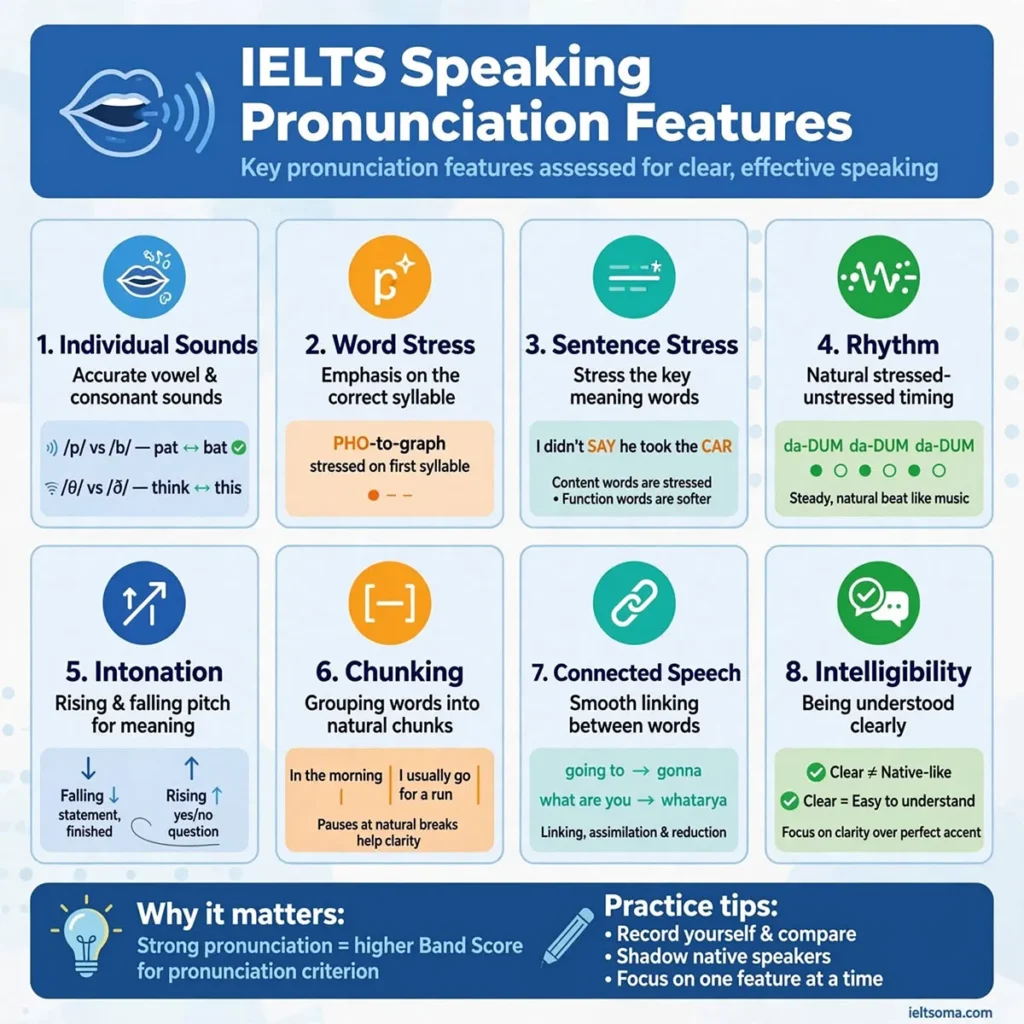
Pronunciation in IELTS Speaking is much more than saying individual words correctly.
It includes several connected skills:
- Individual sounds — producing consonants and vowels clearly
- Word stress — emphasising the correct syllable
- Sentence stress — highlighting important words
- Rhythm — creating a natural pattern of strong and weak sounds
- Intonation — changing pitch appropriately
- Chunking — grouping words into meaningful phrases
- Connected speech — linking sounds naturally when speaking
- Overall intelligibility — making your message easy to understand
This distinction matters because you can pronounce many individual words correctly and still sound difficult to understand if your sentence stress, rhythm or speech grouping is unclear.
For example:
I REALLY wanted to visit the museum.
and:
I really wanted to VISIT the museum.
Both sentences contain the same words, but the emphasis can change the listener’s interpretation.
The goal is therefore not simply correct pronunciation. The goal is effective pronunciation that supports communication.
How Is Pronunciation Scored in IELTS Speaking?
The examiner does not award a pronunciation score simply because you sound like a native speaker.
The official IELTS descriptors show a progression from limited control to increasingly effective use of pronunciation features. At Band 6, for example, candidates can use a range of phonological features, generally appropriate chunking and some effective stress and intonation, although control may vary. Individual mispronunciations may occur but usually cause only occasional lack of clarity.
This gives you an important lesson:
Do not spend your IELTS preparation trying to erase your accent. Spend it making your speech easier to understand.
A useful self-check is:
“If someone who does not know my first language listens to me, can they understand my message without repeatedly asking me to repeat myself?”
If the answer is yes, you are working towards the right pronunciation goal.
9 Powerful Pronunciation Tips for IELTS Speaking
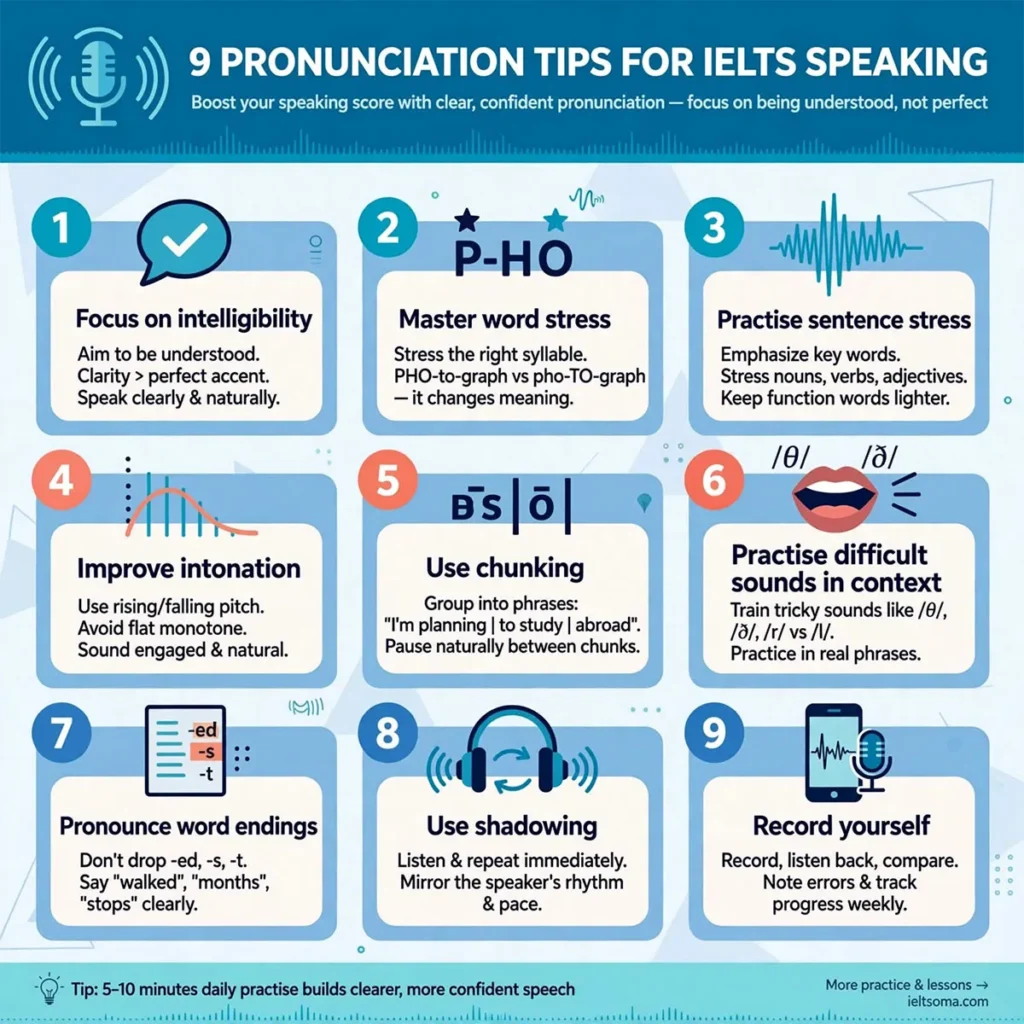
1. Focus on Intelligibility, Not Accent
One of the biggest pronunciation mistakes IELTS candidates make is trying to copy a native-speaker accent.
You may spend weeks trying to sound British or American while ignoring problems that actually affect understanding.
Your accent is part of your speech identity. You do not need to remove it.
Instead, focus on:
- clear consonants
- accurate vowel sounds
- appropriate word stress
- natural sentence stress
- understandable rhythm
- useful intonation
- clear word endings
For example, if you say:
I worked there for three years.
make sure the final sound in worked is sufficiently clear and that the listener can distinguish it from similar forms.
Clarity should always come before accent imitation.
2. Master Word Stress
English is a stress-timed language, so stressing the wrong syllable can make familiar words surprisingly difficult to understand.
Consider:
PHOtograph
phoTOGraphy
photoGRAPHic
The words are related, but their stress patterns differ.
When learning new IELTS vocabulary, do not memorise only the spelling and definition.
Learn:
- the meaning
- the pronunciation
- the stressed syllable
- the word’s common grammatical forms
- an example sentence
This is particularly useful with academic vocabulary that you may use in Part 3.
For instance, if you learn the word environmental, practise it as part of a complete phrase:
environmental problems
rather than repeating the word in isolation.
Your objective is to move from knowing a word to being able to use it naturally in connected speech.
3. Practise Sentence Stress
Sentence stress can make your speech sound clearer and more expressive.
English speakers do not normally give equal emphasis to every word.
Compare:
I REALLY enjoyed the experience.
with:
I really ENJOYED the experience.
The stressed word communicates what the speaker considers important.
During IELTS Speaking practice, underline the words you want to emphasise.
For example:
I think PUBLIC TRANSPORT is particularly important in large cities.
Then say the sentence several times while keeping the important words prominent.
Do not exaggerate every stressed word.
The purpose is to create a natural contrast between important and less important information.
4. Improve Your Intonation
Intonation refers to the movement of your voice’s pitch while speaking.
Flat speech can make even good English sound unnatural or difficult to follow.
You can use intonation to show:
- interest
- certainty
- contrast
- surprise
- continuation
- completion
- attitude
Consider a simple response:
Yes, I think so.
The meaning can feel different depending on the speaker’s pitch movement and emphasis.
You do not need to memorise complicated intonation rules. Instead, listen carefully to natural English and notice how speakers change pitch when expressing different meanings.
A useful exercise is to record yourself answering an IELTS Part 1 question.
Then ask:
- Does my voice remain at almost the same pitch?
- Do I sound interested in what I am saying?
- Can I hear where one idea ends and another begins?
- Do important words stand out?
If your speech sounds completely flat, work on pitch movement before worrying about advanced accent features.
5. Use Chunking to Make Long Answers Easier to Understand
Chunking means grouping words into meaningful units rather than speaking every word separately.
For example, instead of producing a long sentence without pauses:
I think one of the main reasons people prefer living in cities is that they have better access to employment and education.
you can organise it naturally:
I think one of the main reasons / people prefer living in cities / is that they have better access / to employment and education.
The pauses do not need to occur exactly as shown every time. The important point is that your listener should be able to recognise the different ideas.
This is particularly valuable in IELTS Speaking Part 2 and Part 3, where answers can become longer and more complex.
Good chunking can also reduce the pressure to speak continuously without breathing.
6. Practise Difficult Sounds in Context
Some sounds may be particularly difficult depending on your first language.
Common problem areas for IELTS candidates can include:
- /r/ and /l/
- /v/ and /w/
- /θ/ and /t/
- /ð/ and /d/
- /ɪ/ and /iː/
- consonant clusters
- final consonants
Do not practise a difficult sound only as an isolated phoneme.
Put it into words and then sentences.
For example, if you struggle with the difference between live and leave, practise the contrast in meaningful sentences:
I live near the university.
I usually leave home at eight.
Then record yourself.
The aim is to make the sound distinction automatic while communicating meaning.
7. Pay Attention to Word Endings
Word endings are easy to overlook, particularly when speaking quickly.
However, dropping final sounds can sometimes change or obscure meaning.
Compare:
work
worked
or:
want
wanted
The ending carries grammatical information.
This is particularly important with:
- plural -s
- third-person -s
- past -ed
- comparative endings
- word-final consonants
You do not need to pronounce every ending dramatically.
Instead, make sure the ending is present and sufficiently clear.
A useful practice method is to take a short IELTS answer and circle every word ending in -s or -ed.
Read the answer slowly.
Then read it again at a natural speed while maintaining the endings.
8. Use Shadowing to Develop Natural Rhythm
Shadowing is one of the most useful pronunciation exercises for IELTS candidates.
The process is simple:
- Choose a short recording from a reliable English source.
- Listen once without speaking.
- Listen again and notice stress, rhythm and pauses.
- Play a short section.
- Repeat immediately after the speaker.
- Record yourself.
- Compare your version with the original.
- Repeat the difficult section.
Do not choose a five-minute speech at the beginning.
Start with 10–20 seconds.
For example, listen to:
I think the main advantage is that it saves people a considerable amount of time.
Then imitate the speaker’s rhythm and grouping.
The purpose is not to copy every feature of the speaker’s accent.
Instead, concentrate on:
- where the speaker stresses words
- how phrases are grouped
- where the voice rises or falls
- how sounds connect
- how quickly unstressed words are produced
Shadowing is especially useful because it combines listening and speaking rather than treating pronunciation as a purely theoretical subject.
9. Record Yourself and Diagnose One Problem at a Time
Recording yourself is one of the simplest ways to discover pronunciation problems that you do not notice while speaking.
Choose an IELTS question and give a one- to two-minute response.
Then listen without looking at your notes.
Do not try to correct everything at once.
Instead, choose one category.
First recording: individual sounds
Second recording: word stress
Third recording: sentence stress
Fourth recording: rhythm and chunking
Fifth recording: intonation
This makes improvement measurable.
For example, you may discover that your individual sounds are generally clear but that you speak too quickly when giving longer answers.
Your next practice session can then focus specifically on pace and chunking.
This is much more efficient than repeatedly saying, “My pronunciation is bad.”
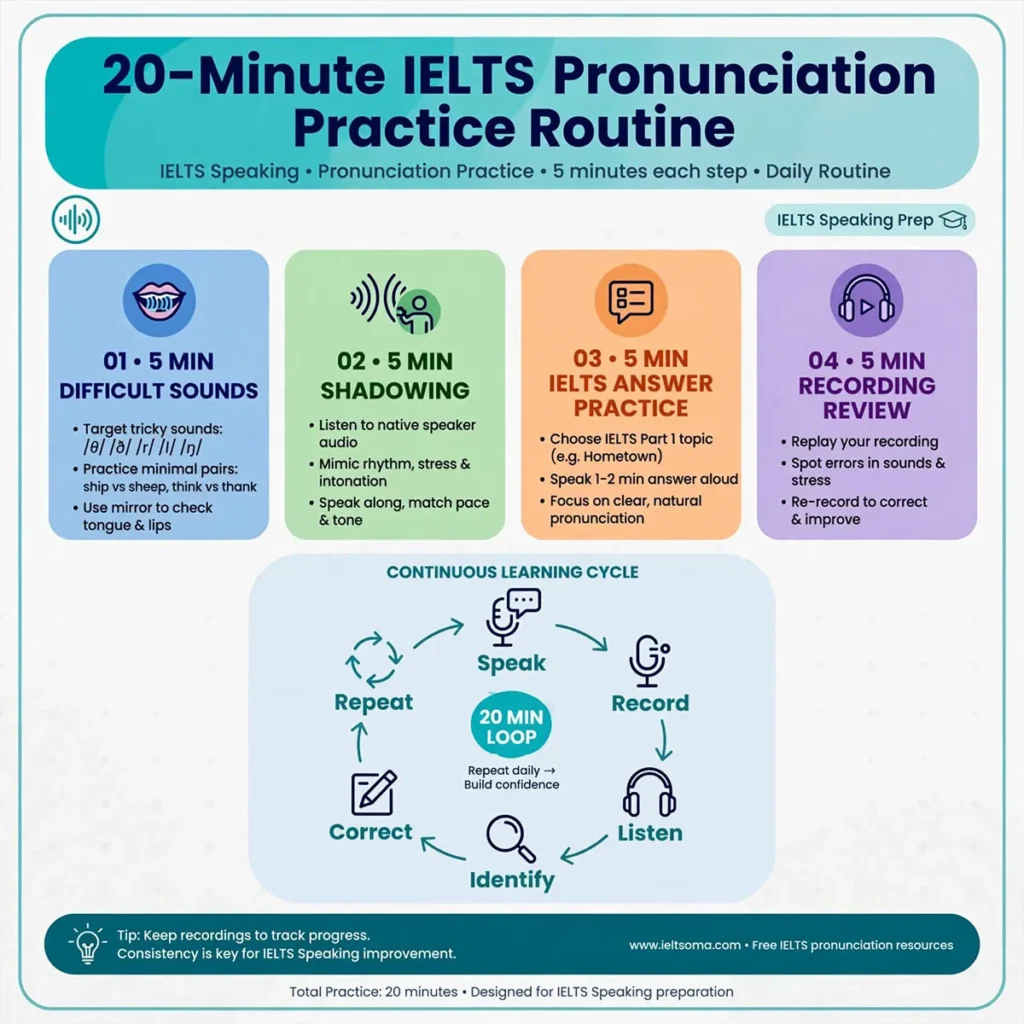
A Simple Pronunciation Practice Routine
You do not need a separate pronunciation class every day.
A focused 20-minute routine can be enough to make consistent progress.
| Time | Practice | Main goal |
|---|---|---|
| 5 minutes | Difficult sounds | Clarity |
| 5 minutes | Shadowing | Rhythm and connected speech |
| 5 minutes | IELTS answer | Applying pronunciation |
| 5 minutes | Recording review | Identify one weakness |
For example, choose a Part 2 topic such as:
Describe a place you would like to visit.
Speak for up to two minutes.
After recording yourself, listen specifically for one issue.
Perhaps you notice that your final consonants disappear when you speak quickly.
Do not immediately start studying five other pronunciation problems.
Repeat the answer while concentrating on final sounds.
Then record it again.
That cycle — speak → listen → identify → correct → repeat — is far more productive than simply speaking more.
Common Pronunciation Mistakes in IELTS Speaking
Trying to Sound Like a Native Speaker
Native-like pronunciation is not the target.
Clear communication is.
Speaking Too Quickly
Some candidates believe fast speech demonstrates fluency.
It can have the opposite effect if speed causes unclear sounds, weak word endings or poor chunking.
A controlled pace is usually more effective.
Stressing Every Word Equally
If every word receives the same emphasis, your speech may sound unnatural and your key ideas may become less obvious.
Ignoring Word Endings
Dropping plural, past-tense or final consonant sounds can affect clarity.
Memorising Pronunciation Instead of Understanding It
Do not memorise complete model answers simply to imitate somebody else’s pronunciation.
Practise pronunciation while expressing your own ideas.
Correcting Yourself Too Often
Constantly stopping to repair a sound can interrupt your fluency.
If a small pronunciation mistake does not affect meaning, continue speaking and address it during later practice.
Pronunciation Practice: What Should You Prioritise?
If you have limited preparation time, work in this order:
- Intelligibility — Can the listener understand you?
- Problem sounds — Are particular sounds repeatedly unclear?
- Word stress — Are important words pronounced with the correct stress?
- Sentence stress — Do key ideas stand out?
- Chunking and rhythm — Are your ideas grouped naturally?
- Intonation — Does your voice communicate meaning effectively?
- Connected speech — Can you link words naturally?
This order prevents you from spending hours on advanced pronunciation details while basic clarity problems remain.
How to Practise Pronunciation for IELTS Part 1, Part 2 and Part 3
Part 1
Part 1 answers are generally shorter and based on familiar topics.
Use them to practise:
- clear individual sounds
- natural word stress
- conversational intonation
- avoiding overly rehearsed answers
For example:
Do you enjoy cooking?
Instead of memorising a sophisticated response, answer naturally:
Yes, I do. I usually cook at weekends because I have more time to try new recipes.
Then review your pronunciation.
Part 2
Part 2 gives you a valuable opportunity to practise longer stretches of speech.
Use your one-minute preparation time to identify your main ideas.
Then speak in meaningful chunks.
Do not try to maintain maximum speed for two minutes.
Instead, use pauses to separate ideas and breathe naturally.
Part 3
Part 3 requires more developed discussion.
This is an excellent opportunity to practise sentence stress and intonation because you are expressing opinions, explaining causes, comparing ideas and discussing broader issues.
For example:
I think the main reason is cost, although convenience is also an important factor.
Stress can help the listener follow your reasoning.
How to Know Whether Your Pronunciation Is Improving
Do not judge progress only by asking whether you sound like a native speaker.
Use measurable questions:
- Can people understand me more easily?
- Are fewer words misunderstood?
- Are my word endings clearer?
- Am I stressing important words naturally?
- Can I maintain understandable rhythm in longer answers?
- Do I pause between ideas rather than in the middle of phrases?
- Is my intonation less flat?
- Can I speak clearly without consciously thinking about every sound?
You can also ask a teacher or competent English speaker to listen to the same recording at different stages of your preparation.
Specific feedback is much more useful than simply receiving a comment such as “Your pronunciation needs work.”
The Best Pronunciation Strategy for a Higher IELTS Speaking Band
There is no single pronunciation trick that guarantees a higher IELTS Speaking score.
The strongest approach is systematic.
Listen carefully.
Notice how proficient speakers use stress, rhythm, intonation and connected speech.
Practise deliberately.
Choose one pronunciation feature and work on it.
Record yourself.
Listen to your own performance objectively.
Correct selectively.
Focus on problems that affect clarity or repeatedly occur.
Use pronunciation in complete answers.
A sound that you can pronounce perfectly in isolation is not necessarily a sound you can produce accurately during spontaneous speaking.
Official IELTS research has also examined pronunciation in relation to intelligibility and the phonological features that contribute to assessment. This reinforces the importance of looking beyond isolated sounds and considering pronunciation as part of effective spoken communication.
Frequently Asked Questions About Pronunciation Tips for IELTS Speaking
Do I need a British accent for IELTS Speaking?
No. IELTS does not require you to speak with a British accent. Your priority should be clear and intelligible communication. Trying to imitate a particular accent can distract you from more important pronunciation problems.
Is pronunciation important in IELTS Speaking?
Yes. Pronunciation is one of the four assessment criteria in IELTS Speaking, alongside Fluency and Coherence, Lexical Resource, and Grammatical Range and Accuracy.
How can I improve my IELTS pronunciation quickly?
Focus on the pronunciation problems that most affect your clarity. Record your answers, identify one recurring weakness, practise it in complete sentences, and record yourself again. Shadowing short sections of natural English can also help develop rhythm and connected speech.
Should I speak slowly in IELTS Speaking?
You should speak at a controlled, comfortable pace. Speaking extremely slowly can make your response sound hesitant, while speaking too quickly can reduce clarity. Aim for a natural pace that allows you to pronounce words and organise your ideas clearly.
Does accent affect my IELTS Speaking score?
Having a particular regional or international accent does not automatically prevent you from achieving a high score. What matters is how effectively your pronunciation features support intelligibility and communication.
How can I practise IELTS pronunciation without a speaking partner?
Record yourself answering IELTS questions. Then listen for individual sounds, stress, rhythm, intonation, word endings and pauses. You can also use shadowing with reliable English audio and compare your recording with the original.
Final Takeaway
The best pronunciation tips for IELTS Speaking are not about transforming yourself into a native speaker.
They are about becoming a clearer speaker.
Work on individual sounds when they cause confusion. Learn the stress patterns of important vocabulary. Use sentence stress to highlight meaning. Group ideas into natural chunks. Control your pace. Practise intonation. Use shadowing to develop rhythm. Most importantly, record yourself and listen critically.
A strong pronunciation routine is simple:
Speak → record → listen → identify one problem → practise → record again.
Do this consistently and your pronunciation can become clearer, more controlled and more effective — without sacrificing your natural accent.
For IELTS Speaking, that is the goal worth practising.
Further Reading:
- Pronunciation for IELTS Speaking: 7 Powerful Tips
- Grammar Rules for IELTS: 9 Powerful Rules for Success
- Model Answers for IELTS Speaking: 10 Powerful Examples
- IELTS Reading Comprehension Strategies: 9 Powerful Ways to Understand Texts
- Active Listening for IELTS: 9 Powerful Ways to Improve
- IELTS Speaking Band Descriptors