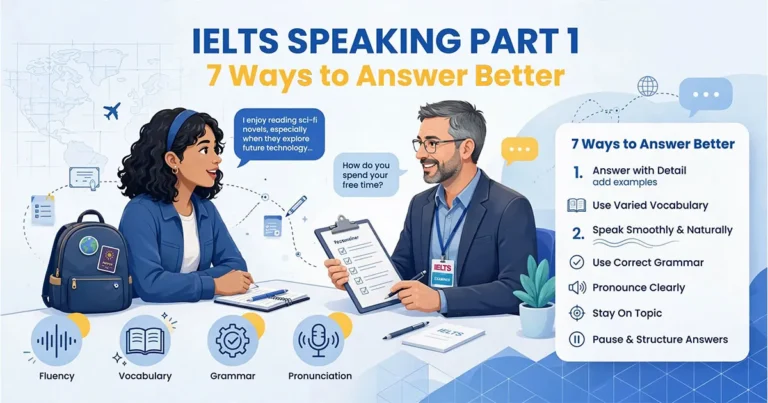
You can have excellent vocabulary and strong grammar, but if the examiner has to work hard to understand you, your Speaking performance can suffer.
That does not mean you need to copy a British or American accent.
For IELTS Speaking, effective pronunciation is about making your speech clear, understandable and natural enough for the listener to follow your ideas. The official IELTS Speaking Band Descriptors assess pronunciation through features such as individual sounds, stress, intonation, rhythm and connected speech.
This makes Pronunciation for IELTS Speaking much broader than simply learning how to pronounce difficult words.
You need to know which sounds cause problems, where to place stress, how to group words, how your voice moves through a sentence and how to make your speech easier to follow.
The good news is that you do not need to change your identity or eliminate your natural accent. You need to make your English pronunciation more effective.
Table of Contents
What Does Pronunciation Mean in IELTS Speaking?
Pronunciation in IELTS Speaking refers to how clearly and effectively you produce English sounds and use features such as word stress, sentence stress, intonation, rhythm and connected speech.
The Speaking test is assessed using four criteria:
- Fluency and Coherence
- Lexical Resource
- Grammatical Range and Accuracy
- Pronunciation
Pronunciation is therefore one of the four equally weighted assessment criteria.
However, pronunciation is not judged simply by asking whether every individual sound is perfect.
The examiner is also listening to whether your speech is easy to understand and whether pronunciation features help you communicate your meaning.
For example, imagine saying:
“I went to the university because I wanted to study engineering.”
If every word is pronounced separately with equal emphasis, the sentence may sound stiff.
If you naturally emphasise the important information and group the words into meaningful phrases, the listener can process the message more easily.
That is why effective pronunciation involves much more than individual sounds.
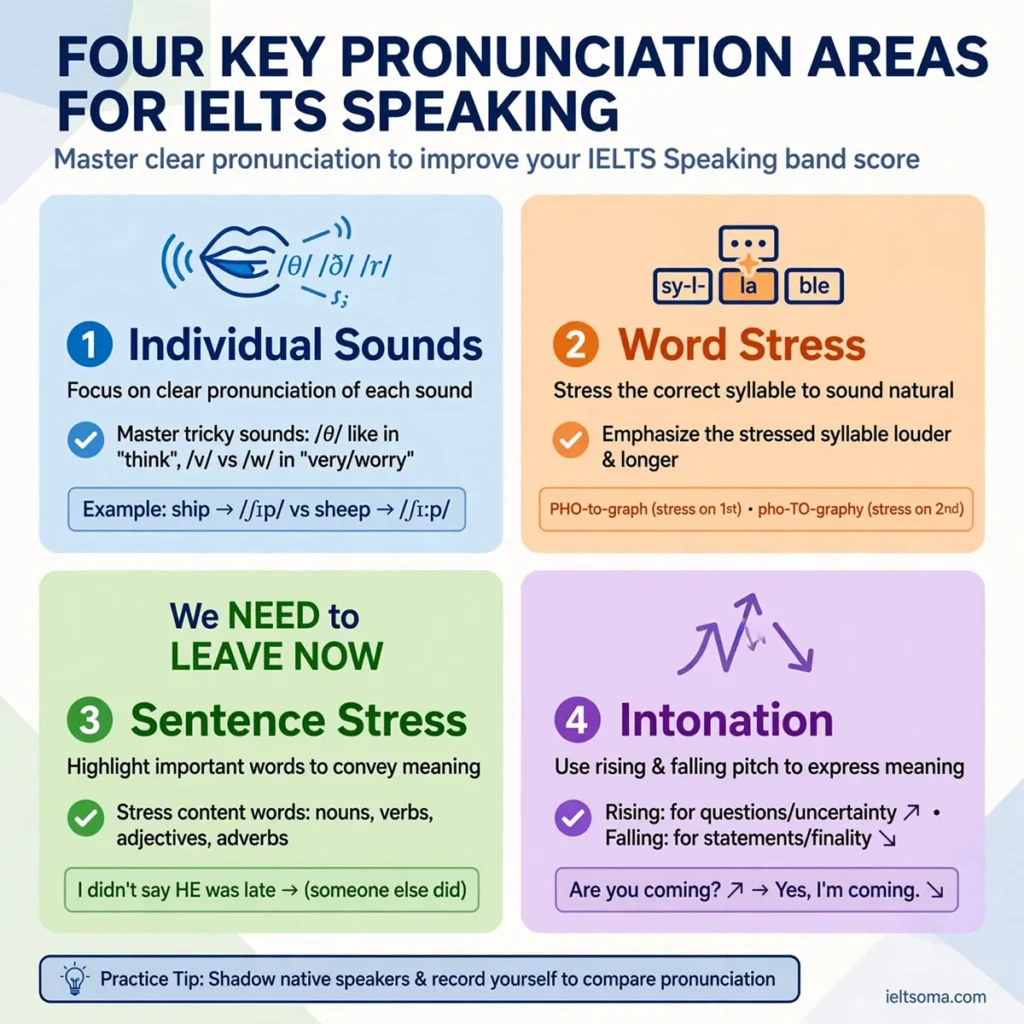
Do You Need a British or American Accent for IELTS?
No.
You do not need to adopt a British, American, Australian or any other native-speaker accent to achieve a high IELTS Speaking score.
IELTS recognises that candidates come from a wide range of linguistic backgrounds. The important issue is whether your pronunciation allows the examiner to understand you consistently.
A strong accent does not automatically mean poor pronunciation.
For example, you might have a noticeable accent but still:
- pronounce important sounds clearly
- use appropriate word stress
- make key words prominent
- use natural intonation
- group words effectively
- maintain understandable rhythm
Conversely, someone may have a relatively neutral accent but still be difficult to understand because of unclear sounds, incorrect word stress or unnatural speech patterns.
So your goal should not be:
“I need to sound British.”
A better goal is:
“I need to make my English easy to understand.”
That shift can save you a great deal of unnecessary preparation.
7 Powerful Ways to Improve Pronunciation for IELTS Speaking
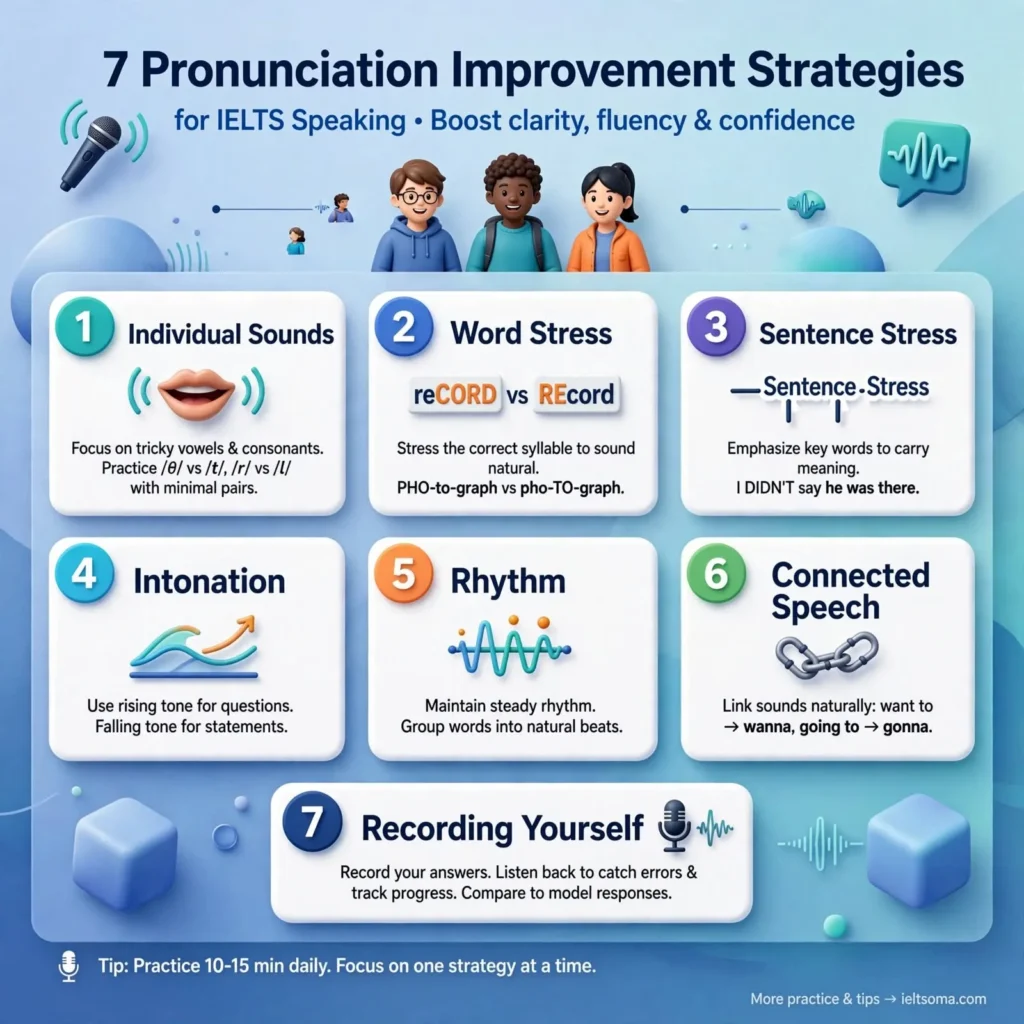
1. Fix the Individual Sounds That Affect Understanding
Start with the sounds that consistently cause problems for you.
English contains sound contrasts that may not exist in your first language. This can make certain words difficult to distinguish or pronounce accurately.
Common examples include:
- /ɪ/ and /iː/, as in ship and sheep
- /æ/ and /e/, as in bad and bed
- /θ/ and /t/, as in think and tink
- /ð/ and /d/, as in this and dis
- /v/ and /w/, as in vest and west
- /r/ and /l/, for learners whose first language does not distinguish them clearly
You do not need to practise every English sound equally.
Identify the contrasts that actually affect your speech.
For example, if you regularly confuse /v/ and /w/, practise pairs such as:
- vest / west
- vine / wine
- veal / wheel
Say each pair slowly first.
Then put the words into short sentences.
“I bought a bottle of wine.”
“I bought a bottle of vinegar.”
Finally, use the words naturally in an IELTS-style answer.
This final stage matters because pronunciation must transfer from isolated practice into spontaneous speech.
2. Master Word Stress
Word stress is one of the most useful areas to improve when working on Pronunciation for IELTS Speaking.
English words with multiple syllables usually have one syllable that receives greater prominence.
Compare:
- PREsent — noun
- preSENT — verb
Or:
- PHOtograph
- phoTOGraphy
- photoGRAPHic
Incorrect stress can make a familiar word surprisingly difficult for a listener to recognise.
When learning new IELTS vocabulary, do not memorise only the spelling and meaning.
Learn:
- How the word is pronounced
- Which syllable is stressed
- How the word sounds inside a sentence
For example, if you learn environmental, do not simply write the word repeatedly.
Listen to it, identify the stressed syllable and then use it in an IELTS response.
“Environmental problems have become more serious in large cities.”
The objective is to make correct stress automatic rather than something you consciously calculate during the test.
3. Use Sentence Stress to Highlight Meaning
Even if every individual word is pronounced correctly, your speech can still sound unnatural if every word receives equal emphasis.
English speakers normally give greater prominence to words that carry the most important information.
Consider:
“I really enjoyed the university because it offered excellent facilities.”
The words carrying the central information might receive more emphasis than grammatical words such as the, because or it.
Sentence stress also helps you change meaning.
Imagine the examiner asks:
“Did you choose the university because of its location?”
You could respond:
“No, I chose it because of the FACILITIES.”
The emphasis helps communicate the contrast.
This is particularly useful in Part 3, where you may need to compare ideas, correct an assumption or emphasise your position.
Do not try to stress every important word equally.
Choose the words that carry the message.
4. Improve Your Intonation
Intonation is the movement of your voice up and down while speaking.
It can help communicate:
- questions
- certainty
- uncertainty
- contrast
- enthusiasm
- surprise
- completion
- continuation
A completely flat delivery can make an otherwise accurate answer sound difficult to follow.
For example:
“I think public transport is useful.”
You can deliver this sentence with natural variation rather than keeping your voice at exactly the same pitch from beginning to end.
The goal is not to exaggerate your voice.
In fact, exaggerated intonation can sound artificial.
Instead, listen to natural English and notice how speakers change pitch to signal meaning.
The British Council specifically recommends working on word stress, sentence stress, intonation and chunking as part of IELTS Speaking pronunciation preparation.
5. Practise Rhythm and Chunking
One of the biggest pronunciation improvements many IELTS candidates can make is learning to speak in meaningful groups rather than individual words.
This is known as chunking.
Compare these approaches:
“I / usually / go / to / the / library / after / work.”
and:
“I usually go to the library / after work.”
The second version gives the listener meaningful groups of information.
Chunking can also help you manage longer Part 2 and Part 3 responses.
For example:
“I decided to study engineering / because I’ve always been interested in technology / and I wanted a career with practical applications.”
The short pauses help separate ideas.
They do not necessarily mean that you are hesitating.
This distinction is important.
A well-placed pause can improve clarity.
An excessive pause caused by searching for vocabulary can damage fluency.
Practise reading short IELTS answers aloud and mark natural phrase boundaries with a slash.
Then gradually stop looking at the markings and reproduce the same grouping naturally.
6. Learn Connected Speech Gradually
In natural English, words do not always sound exactly as they appear in isolation.
Speakers connect sounds, weaken some words and sometimes omit or modify sounds in rapid speech.
This is called connected speech.
Examples include:
- linking sounds between words
- weak forms
- assimilation
- elision
You do not need to force every connected-speech feature into your IELTS answers.
That can actually make your speech sound artificial.
Instead, become familiar with natural connected speech so that your delivery becomes smoother.
For example, common phrases such as:
“want to”
“going to”
“a lot of”
“kind of”
can sound different in natural conversation from how learners sometimes pronounce each word separately.
The key principle is naturalness, not imitation.
If linking makes your speech smoother without reducing clarity, use it.
If deliberately copying fast native-speaker reductions makes you less understandable, do not force them.
7. Record Yourself and Diagnose the Problem
One of the most effective pronunciation techniques is also one of the simplest:
record yourself speaking.
Many pronunciation problems are difficult to notice while you are concentrating on ideas, grammar and vocabulary.
Choose an IELTS Speaking question and record a one- to two-minute response.
Then listen to it carefully.
Ask yourself:
- Can I understand every important word?
- Do I pronounce final consonants clearly?
- Do I stress the correct syllables?
- Do I emphasise important words?
- Does my voice sound completely flat?
- Do I speak in meaningful chunks?
- Do I rush when I become nervous?
- Are my pauses natural?
- Do I swallow word endings?
- Does my pronunciation change when I speak spontaneously?
Do not attempt to correct everything at once.
Choose one or two weaknesses.
For example, if your final consonants are unclear, spend a week concentrating specifically on word endings.
Once that improves, move to another feature.
This creates a much more efficient pronunciation routine than repeatedly saying complete model answers without analysing your performance.
Pronunciation Priorities for Different IELTS Speaking Parts
The pronunciation skills you use are relevant throughout the Speaking test, but your practice can change depending on the part.
| IELTS Speaking Part | Pronunciation Focus |
|---|---|
| Part 1 | Clear individual sounds, natural stress and comfortable pace |
| Part 2 | Chunking, rhythm, connected speech and sustained clarity |
| Part 3 | Sentence stress, intonation, emphasis and precise communication |
Part 1
Part 1 questions are usually familiar, so use them to focus on accuracy.
For example:
“Do you enjoy cooking?”
Instead of worrying about sounding impressive, concentrate on clear sounds and natural stress.
“Yes, I actually enjoy cooking, especially at weekends when I have more time.”
Keep your delivery relaxed.
Part 2
Part 2 requires a longer turn, so rhythm and chunking become particularly useful.
You need to maintain understandable pronunciation while speaking for an extended period.
Do not attempt to pronounce every word with maximum force.
Use natural emphasis and short pauses between ideas.
Part 3
Part 3 often requires more complex ideas.
You may need to compare, evaluate, explain causes or discuss consequences.
Here, sentence stress and intonation can help you make relationships between ideas clearer.
For example:
“I think there are TWO main reasons for this.”
You can then introduce the first and second points clearly.
The purpose of pronunciation is to support your meaning.
Common Pronunciation Mistakes in IELTS Speaking
Trying to Eliminate Your Accent
Your accent is not automatically a problem.
Spend your preparation time improving features that affect intelligibility rather than trying to imitate someone else’s identity.
Speaking Too Quickly
Many candidates believe faster speech sounds more fluent.
It does not.
If speed causes unclear sounds, missing endings or unnatural pauses, reduce your pace.
A controlled speaking rate is usually more effective.
Stressing Every Word
Giving equal emphasis to every word can make your speech sound mechanical.
Learn to distinguish key content from supporting grammatical words.
Ignoring Word Endings
Final consonants can be particularly important for distinguishing words.
Pay attention to endings such as:
- -s
- -ed
- -t
- -d
- -k
- -p
If you regularly omit them, practise them separately and then use the words in complete sentences.
Memorising Pronunciation
Memorising a model answer can create another problem.
You may reproduce someone else’s rhythm or intonation without understanding why it works.
The British Council also warns that memorising long answers can lead to a monotone delivery and recommends practising pronunciation instead.
Learn principles, not performances.
Overusing Native-Speaker Features
Connected speech can make English sound natural, but deliberately adding reductions everywhere can make your speech harder to understand.
Clarity comes first.
A 15-Minute Pronunciation for IELTS Speaking Routine
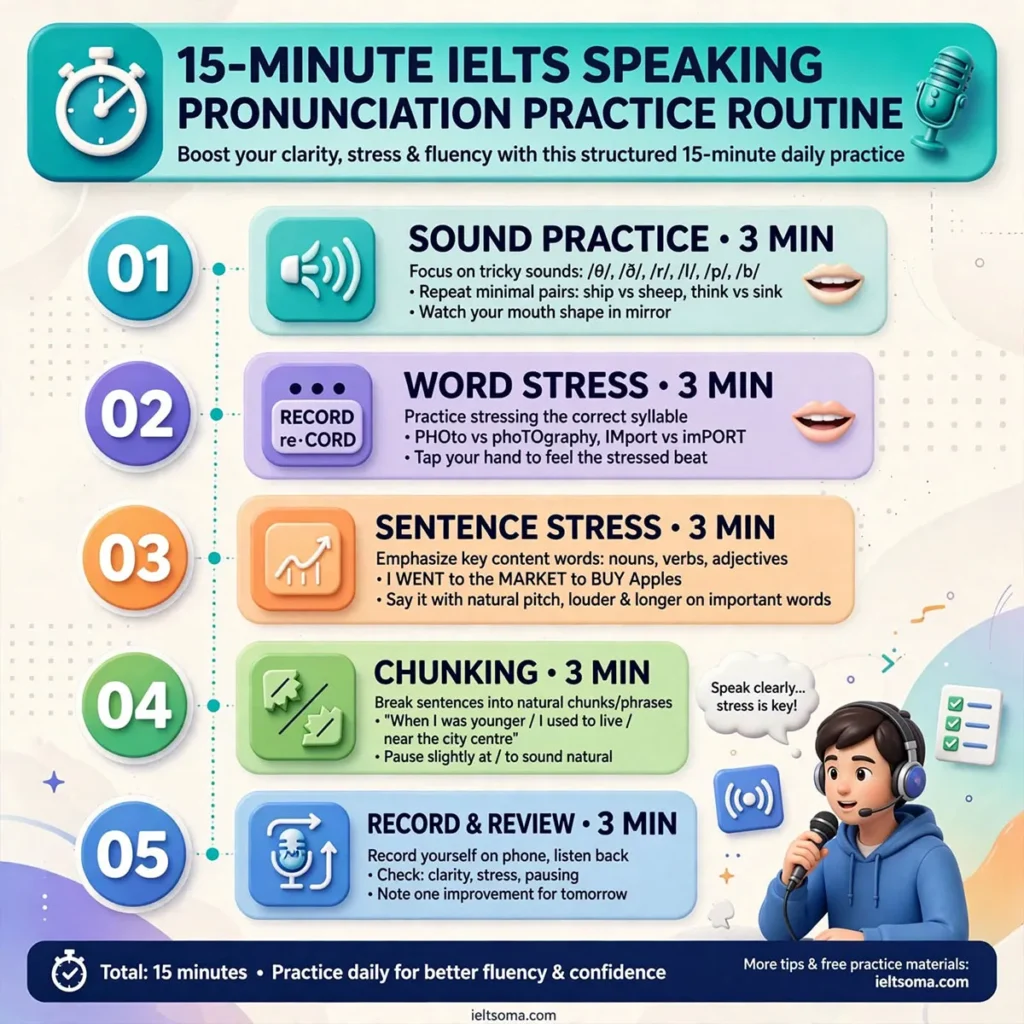
You do not need to spend hours every day practising pronunciation.
Try this focused 15-minute routine.
Minutes 1–3: Sound Practice
Choose one sound contrast that causes difficulty.
Practise five to ten words containing that sound.
Minutes 4–6: Word Stress
Choose five IELTS-related words.
Check the stressed syllable and say each word several times.
Minutes 7–9: Sentence Stress
Take three sentences from an IELTS answer.
Underline the words that carry the most important information.
Read them aloud naturally.
Minutes 10–12: Chunking
Mark phrase boundaries in a short response.
Practise speaking the response in meaningful groups.
Minutes 13–15: Record and Review
Answer one IELTS Speaking question.
Record yourself.
Listen once and identify your biggest pronunciation weakness.
Write down one correction for your next practice session.
This routine is short enough to use consistently and broad enough to cover the main pronunciation features assessed in IELTS.
How to Know Whether Your Pronunciation Is Improving
Do not judge improvement only by whether you sound more like a native speaker.
Use measurable questions instead.
Ask:
Can people understand me without frequently asking me to repeat myself?
Are my important sounds clearer?
Do I stress words correctly?
Can I use sentence stress to show meaning?
Does my speech have natural rhythm?
Can I maintain clear pronunciation during a long answer?
Do my recordings sound easier to follow than they did a month ago?
The official IELTS Band Descriptors show that higher-level pronunciation involves increasingly effective use of phonological features, connected speech, rhythm, stress and intonation, alongside strong intelligibility.
That gives you a much better target than simply trying to acquire a particular accent.
Frequently Asked Questions About Pronunciation for IELTS Speaking
Do I need a native English accent to get Band 7 or higher?
No. You do not need a native-speaker accent. The key issue is whether your pronunciation allows the examiner to understand you easily and whether you can use pronunciation features effectively.
Is pronunciation important in IELTS Speaking?
Yes. Pronunciation is one of the four IELTS Speaking assessment criteria and is equally weighted with Fluency and Coherence, Lexical Resource, and Grammatical Range and Accuracy.
What should I practise first for IELTS pronunciation?
Start with the pronunciation problems that most affect your intelligibility. Then work systematically on word stress, sentence stress, rhythm, intonation and connected speech.
Does speaking faster improve my pronunciation score?
No. Speaking faster is not the objective. If excessive speed makes your pronunciation less clear, slow down and use a controlled, natural pace.
Should I learn IPA for IELTS Speaking?
IPA can be useful for understanding difficult sounds and checking pronunciation, but you do not need to become an IPA expert. Focus on the sounds and pronunciation patterns that cause problems in your own speech.
How can I practise IELTS pronunciation at home?
Record yourself answering IELTS Speaking questions, listen critically, identify one pronunciation weakness and repeat the answer after correcting it. You can also shadow short sections of natural English and practise stress, rhythm and chunking.
Is intonation important for IELTS Speaking?
Yes. Intonation is one of the pronunciation features that can help you communicate meaning, emphasis and attitude. It should sound natural rather than exaggerated.
How long does it take to improve IELTS pronunciation?
It depends on your starting level, first language and the specific problems you have. Consistent, targeted practice is usually more productive than occasional long practice sessions.
Final Thoughts on Pronunciation for IELTS Speaking
Good pronunciation is not about sounding like someone else.
It is about making your own English clearer.
For Pronunciation for IELTS Speaking, focus first on the features that have the greatest effect on understanding. Correct difficult individual sounds, learn accurate word stress, use sentence stress to highlight meaning, develop natural intonation, speak in meaningful chunks and gradually become comfortable with connected speech.
Most importantly, record yourself.
You cannot always hear your own pronunciation problems while speaking, but recordings can reveal patterns that need attention.
Do not try to transform your accent overnight.
Instead, make small, measurable improvements.
Choose one sound.
Then one stress pattern.
Then one rhythm problem.
Then one aspect of intonation.
Over time, these improvements can make your Speaking performance noticeably clearer and more natural.
Your target is not perfect pronunciation.
Your target is clear, confident and effective communication.
Further Useful Links:
- IELTS Speaking Accuracy and Fluency: 7 Smart Ways to Improve
- Well Organized Answers in IELTS Speaking: 7 Powerful Ways to Speak Clearly
- IELTS Speaking Practice Tips: 15 Powerful Ways to Improve
- Idioms and Phrasal Verbs for IELTS Speaking: 20 Tips
- Official IELTS Speaking Band Descriptors
- British Council IELTS pronunciation tips