You may know plenty of English, understand IELTS questions and even write good answers — yet the moment the examiner asks you a question, your mind goes blank.
You hesitate.
You search for words.
You start a sentence, stop, change it and try again.
Then your confidence drops, which makes speaking even harder.
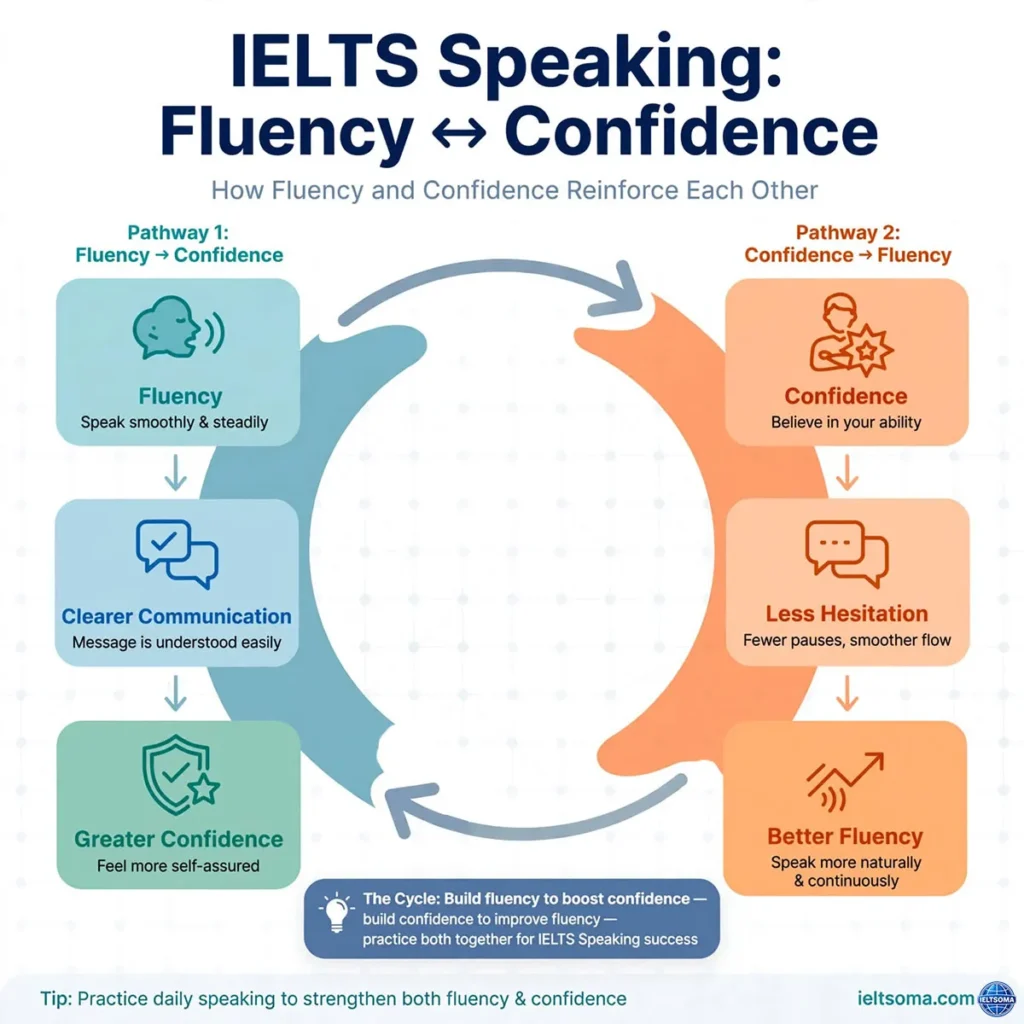
This is why IELTS Speaking fluency and confidence need to be developed together. You do not need to speak like a native speaker or produce perfect sentences without hesitation. What you need is the ability to communicate your ideas clearly, keep your speech moving and respond naturally to questions.
The official IELTS Speaking assessment includes four equally weighted criteria: fluency and coherence, lexical resource, grammatical range and accuracy, and pronunciation. Fluency therefore matters, but it is only one part of your overall Speaking performance.
The good news is that fluency and confidence are skills you can practise.
In this guide, you will learn how to build IELTS Speaking fluency and confidence, reduce unnecessary hesitation, develop longer answers and sound more comfortable in all three parts of the Speaking test.
Table of Contents
What Are IELTS Speaking Fluency and Confidence?
IELTS Speaking fluency is your ability to keep speaking at an appropriate rate with continuity, while connecting your ideas so that your answer is easy to follow.
Confidence is different. It is your ability to speak without allowing fear of mistakes, unfamiliar questions or pressure from the examiner to interrupt your communication.
The two skills are closely connected.
When you lack confidence, you may:
- pause too frequently
- translate sentences from your first language
- worry about grammar while speaking
- repeat the same words
- give extremely short answers
- abandon ideas halfway through
- speak much more slowly than normal
When your confidence improves, you are more likely to concentrate on communicating your meaning rather than monitoring every individual sentence.
However, confidence does not mean speaking quickly or pretending to know everything.
A confident IELTS candidate can say:
“I haven’t really thought about that before, but I suppose one reason could be…”
That response gives the speaker time to think while continuing the conversation naturally.
Why Fluency Matters in the IELTS Speaking Test
The IELTS Speaking test is a face-to-face, recorded interview lasting approximately 11–14 minutes. It has three parts, and the Speaking test is the same for IELTS Academic and IELTS General Training.
The examiner assesses your performance throughout the test using four criteria.
| Assessment criterion | What it broadly measures |
|---|---|
| Fluency and coherence | How continuously and logically you communicate |
| Lexical resource | The range and appropriate use of vocabulary |
| Grammatical range and accuracy | Your ability to use different grammatical structures accurately |
| Pronunciation | How clearly and effectively you communicate through pronunciation |
These criteria carry equal weighting.
The official descriptors make an important point: fluency is not simply about speaking quickly.
For example, at Band 7, a candidate should be able to keep going and produce long turns without noticeable effort. Some hesitation, repetition or self-correction can still occur, provided it does not damage coherence.
That means you should not try to eliminate every pause.
Instead, learn to make your pauses useful.
Fluency Does Not Mean Speaking Fast
One of the most damaging misconceptions about IELTS Speaking is that fluent speakers must speak extremely quickly.
They do not.
Speaking too quickly can actually make your pronunciation less clear and your ideas less organised.
Imagine two candidates answering the same question.
Candidate A:
“WellIthinkthattechnologyhaschangedoureverydaylivesbecause… um… thereare… actually… manyadvantages…”
The candidate is speaking quickly, but the message is difficult to follow.
Candidate B:
“I think technology has changed our everyday lives quite dramatically. For example, we can now communicate with people almost instantly, even when they live on the other side of the world.”
Candidate B speaks at a controlled pace and develops the idea clearly.
For IELTS Speaking, the second approach is much more useful.
The official IELTS guidance describes fluency in terms of continuity, rate and effort, as well as the ability to connect ideas into coherent speech.
Your goal should therefore be:
controlled speech + clear ideas + natural pauses
rather than:
maximum speed + complicated vocabulary + zero pauses
9 Effective Ways to Build IELTS Speaking Fluency and Confidence
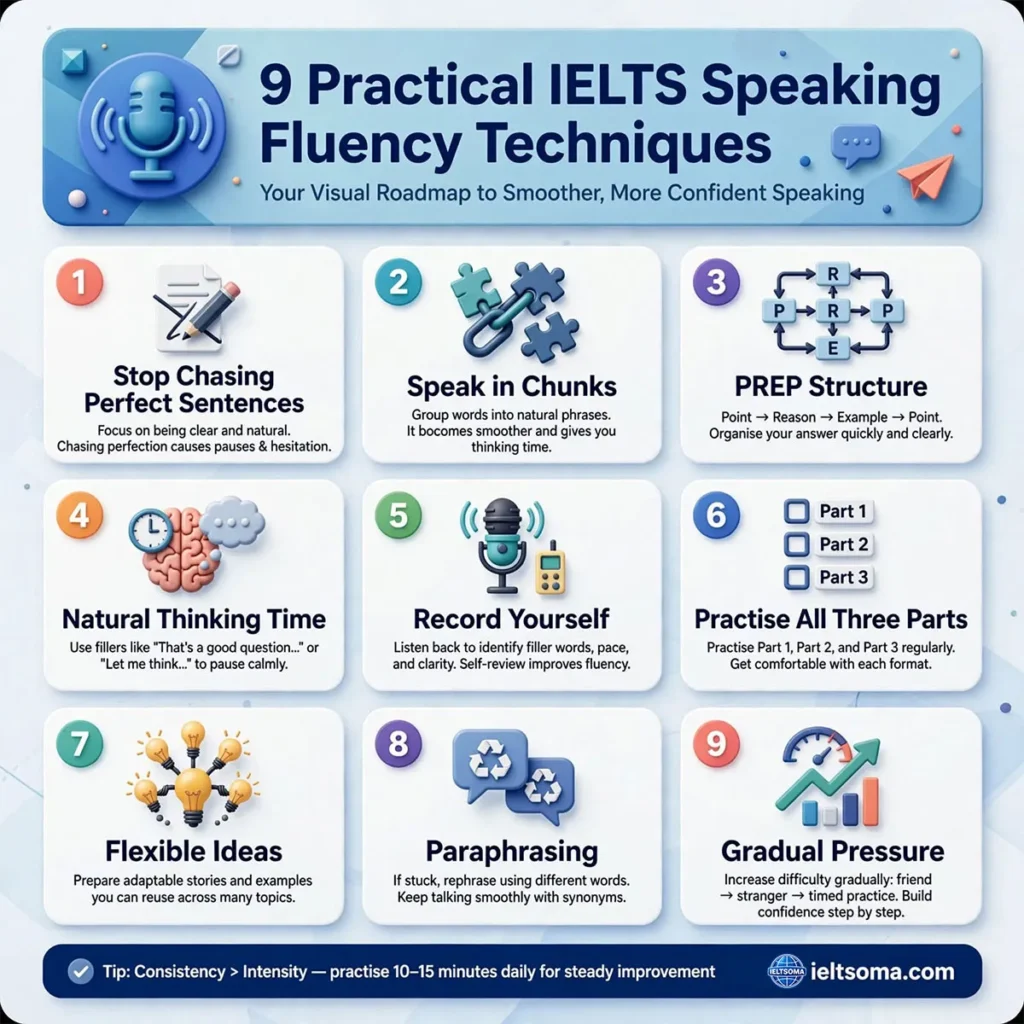
1. Stop Trying to Create Perfect Sentences
Many candidates lose fluency because they attempt to construct grammatically perfect sentences before speaking.
This creates an internal conversation:
“Is this the correct tense?”
“Should I use present perfect?”
“Is this word appropriate?”
“What if I make a mistake?”
By the time you have answered those questions mentally, the conversation has stopped.
Instead, focus on communicating one complete idea at a time.
For example, if the examiner asks:
“Do you enjoy reading?”
Do not spend ten seconds searching for an impressive answer.
Start naturally:
“Yes, I do. I particularly enjoy reading non-fiction because I like learning about new subjects.”
You can then extend the answer if necessary.
Your first objective is to keep communication moving. Accuracy still matters, but constantly correcting yourself can damage fluency.
2. Practise Speaking in Chunks
Fluent speakers do not necessarily create every sentence word by word.
They use groups of words that naturally belong together.
For example:
- “From my point of view…”
- “One of the main reasons is…”
- “For example…”
- “What I particularly like is…”
- “I suppose it depends on…”
- “Having said that…”
- “The main advantage would be…”
These expressions can help you organise your speech.
However, do not memorise dozens of complicated phrases and force them into every answer. IELTS Speaking rewards appropriate communication, not rehearsed language.
Use a small number of flexible expressions that genuinely help you organise your thoughts.
3. Use the PREP Structure for Difficult Questions
When you are unsure how to develop an answer, use a simple structure:
P — Point
Give your main answer.
R — Reason
Explain why.
E — Example
Give a relevant example.
P — Point
Briefly return to the main idea.
For example:
Question: “Do you think people should spend less time on social media?”
“Yes, I think many people would benefit from reducing their social media use. The main reason is that it can take up a considerable amount of time without people realising it. For example, someone might check their phone for five minutes and end up scrolling for half an hour. So I think using social media in moderation is a healthier approach.”
You do not need to announce the structure. Simply use it as a mental framework.
It gives you somewhere to go after your first sentence.
4. Learn to Use Thinking Time Naturally
You are not expected to know the answer to every question immediately.
If you need a moment, use a natural thinking phrase.
For example:
“That’s an interesting question. I’d say…”
“I’ve never really considered that before, but…”
“I suppose there are a couple of reasons for that…”
“Let me think about that for a moment…”
These expressions can be useful when they genuinely reflect your thinking process.
Avoid filling every pause with:
“umm… umm… you know… like… actually… basically…”
Repeated meaningless fillers can make your speech sound less controlled.
The official IELTS criteria specifically consider unnecessary pauses, false starts, backtracking and functionless repetition when evaluating fluency.
5. Record Yourself Every Day
One of the fastest ways to discover your fluency problems is to listen to yourself.
Choose one IELTS Speaking question and record a one- to two-minute response.
Then listen to it.
Do not only ask:
“Was my grammar correct?”
Instead, check:
- How many long pauses did I make?
- Did I repeat the same word?
- Did I restart sentences?
- Did I answer the question directly?
- Did I develop my ideas?
- Did I speak too quickly?
- Did my voice become quieter when I was uncertain?
- Did I use the same linking phrase repeatedly?
Then record the answer again.
The second attempt will usually be better because you now know where the difficulties occurred.
This creates a simple improvement cycle:
Speak → Record → Analyse → Repeat
Do this regularly rather than recording yourself once and never listening to the result.
6. Practise the Three Parts Differently
The IELTS Speaking test contains three parts, and each requires a slightly different speaking approach. Part 1 covers familiar questions, Part 2 requires you to speak about a topic, and Part 3 develops into a longer discussion.
Part 1: Build Natural Responses
Part 1 questions are generally about familiar areas such as your home, studies, interests or everyday life.
Do not prepare huge memorised answers.
Instead, practise answering questions in 20–30 seconds.
For example:
Question: “What do you usually do at weekends?”
Weak:
“I usually stay at home.”
Better:
“I usually have a fairly relaxed weekend. I catch up on things I didn’t have time to do during the week, and I normally meet a friend or spend some time with my family.”
The second answer gives the examiner more evidence of your ability to communicate.
Part 2: Build a Speaking Routine
Part 2 requires you to speak about a given topic for up to two minutes after preparation time.
Do not try to memorise complete answers for every possible cue card.
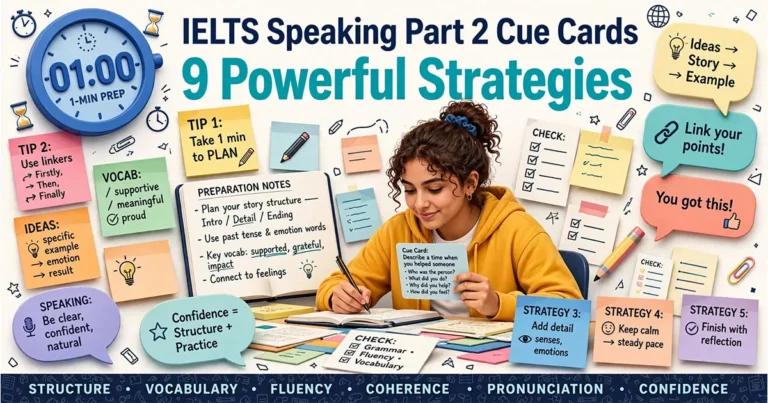
Instead, practise a repeatable structure:
- Introduce the topic.
- Give the basic background.
- Describe the main details.
- Explain your feelings, reasons or opinions.
- Add a short reflection or conclusion.
If you run out of ideas, ask yourself:
Who? What? When? Where? Why? How?
These questions can help you develop the topic without memorising a script.
Part 3: Practise Explaining Ideas
Part 3 is where many candidates lose confidence because the questions become more abstract.
Instead of giving only an opinion, develop it.
Try:
Opinion → Reason → Example → Result
For example:
“I think public transport should be improved in large cities because it can reduce the number of private cars on the road. For example, if buses and trains are reliable and affordable, more commuters may choose them instead of driving. As a result, cities could experience less congestion and pollution.”
This type of development makes it easier to keep speaking.
7. Replace Memorisation with Flexible Ideas
Memorised answers may initially make you feel confident, but they can create problems when the examiner asks an unexpected question.
Suppose you memorise an answer about your favourite teacher.
The examiner asks:
“Do you think teachers have become more important in recent years?”
A memorised personal story may not answer the question.
Instead, prepare ideas, not scripts.
For common IELTS topics, think about:
- advantages and disadvantages
- causes and effects
- personal experiences
- changes over time
- problems and solutions
- comparisons
- future possibilities
This gives you a flexible knowledge base that can be adapted to different questions.
8. Practise Paraphrasing When You Forget a Word
A missing word does not have to end your answer.
This is one of the most valuable confidence-building skills for IELTS Speaking.
Imagine you forget the word “pedestrian crossing.”
Instead of stopping completely, explain it:
“It’s the place where people can cross the road safely, usually marked with white lines.”
You may not have used the exact word, but you have successfully communicated the meaning.
Paraphrasing is also recognised in the official Speaking band descriptors, particularly at higher levels.
The lesson is simple:
If you forget a word, keep communicating.
Do not allow one missing word to destroy the rest of your answer.
9. Build Confidence Through Gradual Pressure
Confidence does not usually appear before practice.
It develops because you repeatedly experience situations that initially make you uncomfortable.
Start with low pressure.
Stage 1: Speak alone.
Stage 2: Record yourself.
Stage 3: Speak with a friend.
Stage 4: Practise with a teacher or study partner.
Stage 5: Complete a full mock Speaking test.
You can also increase the difficulty gradually.
For example:
- Week 1: familiar Part 1 questions
- Week 2: Part 1 + Part 2
- Week 3: all three parts
- Week 4: unfamiliar questions and timed mock tests
This approach makes the real test environment feel less unfamiliar.
Common Fluency Problems and How to Fix Them
| Problem | What usually causes it | Better approach |
|---|---|---|
| Long pauses | Searching for perfect language | Speak with simpler language |
| Speaking too quickly | Trying to sound fluent | Use a controlled pace |
| One-word answers | Lack of idea development | Add a reason or example |
| Repeating “you know” | Nervousness | Replace it with a short pause |
| Memorised answers | Over-preparation | Prepare ideas instead of scripts |
| Constant self-correction | Fear of mistakes | Correct only when necessary |
| Forgetting vocabulary | Over-reliance on exact words | Practise paraphrasing |
| Losing track of ideas | No structure | Use Point → Reason → Example |
What Band 7 Fluency Actually Looks Like
Many candidates believe they need perfect English to reach Band 7.
The official descriptors suggest otherwise.
At Band 7, candidates can produce long turns without noticeable effort or loss of coherence. They may still hesitate, repeat themselves or self-correct, but these issues should not seriously affect coherence. They also use spoken discourse markers, connectives and cohesive features flexibly.
So a Band 7 candidate does not necessarily sound perfect.
They sound controlled.
Consider this example:
“I think working from home can be beneficial, particularly for people who have long commutes. The main advantage is that they can save a significant amount of time every day. For instance, someone who normally spends two hours travelling could use that time for exercise or family activities. Having said that, I don’t think it works equally well for everyone because some people need direct interaction with colleagues.”
There are no extraordinary words here.
The strength comes from:
- clear progression
- relevant ideas
- appropriate linking
- sufficient development
- natural sentence variety
- controlled delivery
That is much more useful than trying to impress the examiner with complicated vocabulary.
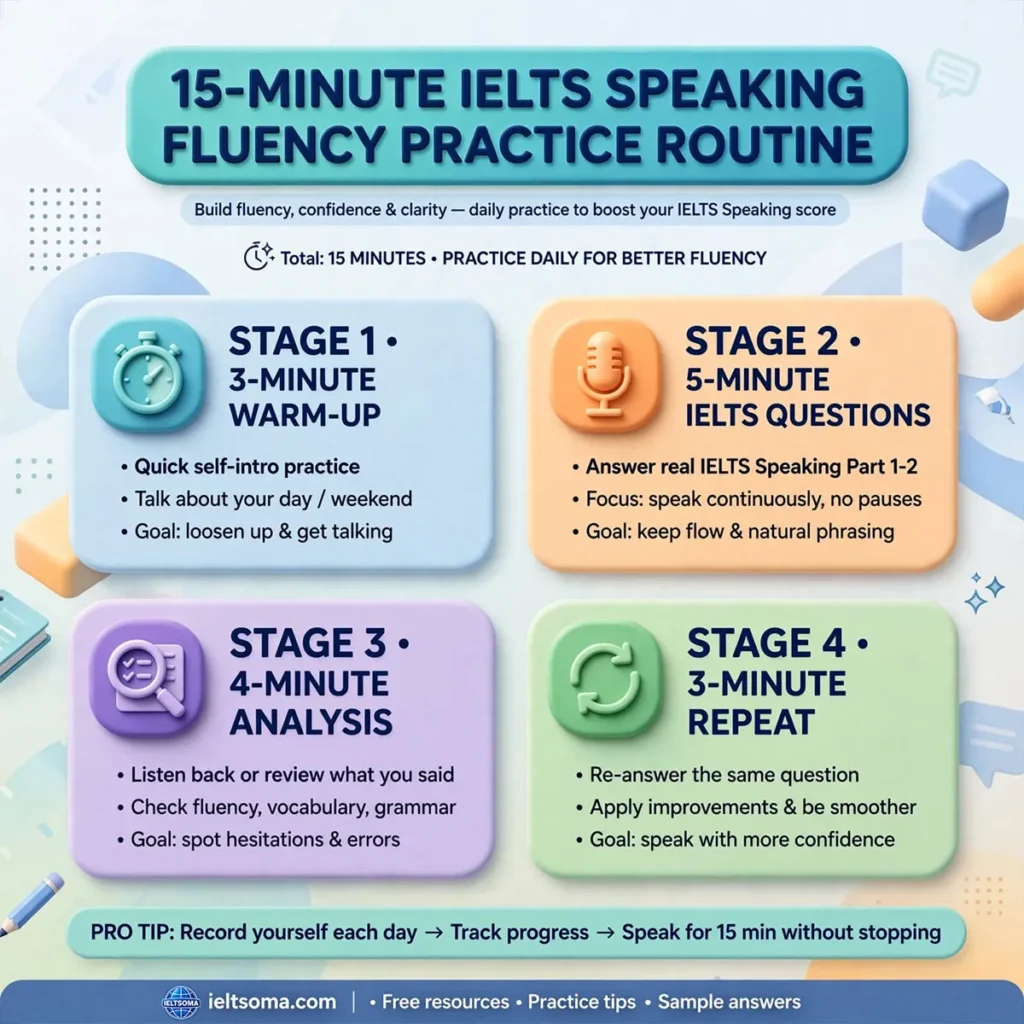
15-Minute Daily Fluency Routine
You do not need to spend hours every day practising speaking.
A focused 15-minute routine can be highly useful.
Minutes 1–3: Warm up
Talk aloud about your day.
Describe:
- what you did
- what you are planning
- something you enjoyed
- something you found difficult
Do not stop to correct yourself.
Minutes 4–8: Answer IELTS questions
Choose three Part 1 questions.
Then choose one Part 2 topic or Part 3 discussion question.
Record yourself.
Minutes 9–12: Analyse
Listen to the recording and identify your biggest problem.
Do not try to fix everything at once.
Choose one:
- hesitation
- vocabulary
- grammar
- pronunciation
- repetition
- idea development
Minutes 13–15: Repeat
Answer the same question again.
Try to improve only the problem you identified.
This final repetition is important because it converts analysis into practice.
Mistakes That Can Reduce Speaking Confidence
Trying to sound like a native speaker
Your goal is not to imitate a particular accent.
Your pronunciation needs to be understandable and effective. Pronunciation is one of the four separate Speaking assessment criteria.
Using vocabulary you cannot control
A simple word used accurately is usually better than an advanced word used incorrectly.
Do not insert unusual vocabulary simply because you memorised it from an IELTS word list.
Panicking after a mistake
One grammar mistake does not mean your answer has failed.
Keep speaking.
Giving extremely short answers
If the question invites an explanation, provide one.
A useful rule is:
Answer → Explain → Example
Memorising entire speeches
Memorised answers can sound unnatural and may become useless when the examiner changes the question.
Prepare flexible ideas instead.
How to Become More Confident Before Test Day
In the final days before your IELTS Speaking test, focus on familiarity rather than trying to transform your entire English ability.
Practise:
- introducing yourself naturally
- answering familiar questions
- speaking for two minutes on random topics
- discussing abstract questions
- asking yourself follow-up questions
- paraphrasing forgotten words
- speaking while being recorded
- completing full mock tests
Also practise entering the conversation calmly.
Before answering, take a short natural pause.
Listen carefully to the question.
Then begin.
You do not need to rush because the examiner is waiting for your response.
The more familiar the speaking process becomes, the less mental energy you are likely to spend worrying about what happens next.
A Simple IELTS Speaking Fluency Formula
When you are practising, remember this:
Understand → Answer → Explain → Example → Extend
For many questions, this gives you enough structure to keep your response moving.
For example:
Question: “Is it important for children to learn how to cook?”
Answer:
“Yes, I think it is quite important.”
Explain:
“One reason is that cooking teaches children to become more independent.”
Example:
“For example, a teenager who can prepare a few basic meals doesn’t always have to depend on their parents.”
Extend:
“It can also encourage healthier eating because they understand what goes into their food.”
You do not need to memorise this exact answer.
Learn the process.
That is what builds genuine fluency.
Final Takeaway
Improving IELTS Speaking fluency and confidence is not about eliminating every hesitation or learning thousands of impressive words.
It is about becoming comfortable with communicating your ideas.
Speak at a controlled pace.
Develop your answers.
Use natural thinking time.
Paraphrase when you forget a word.
Practise all three parts of the Speaking test.
Record yourself and listen critically.
Most importantly, stop treating every mistake as a disaster.
The official IELTS criteria allow some hesitation, repetition and self-correction, particularly when these do not damage the coherence of your speech.
Your target should therefore be clear, connected and appropriately developed speech, not perfection.
With regular practice, the relationship between fluency and confidence can work in your favour: the more comfortably you communicate, the more confident you become — and the more confident you become, the easier it is to keep communicating.
Frequently Asked Questions
How can I improve my IELTS Speaking fluency and confidence?
Practise speaking regularly rather than only studying vocabulary and grammar. Record your answers, identify hesitation and repetition, practise developing ideas, and gradually increase the difficulty of your speaking practice.
Does speaking faster improve IELTS Speaking fluency?
No. Fluency is not simply speaking quickly. IELTS considers continuity, rate, effort, coherence and the way ideas are connected. Speaking too quickly can make your speech harder to understand and may reduce your control.
How can I stop hesitating in IELTS Speaking?
Do not try to eliminate every pause. Practise speaking in chunks, use natural thinking phrases when necessary, prepare flexible ideas and practise paraphrasing. The aim is to make hesitation less frequent and less disruptive.
Should I memorise IELTS Speaking answers?
No. It is better to prepare ideas, vocabulary and flexible structures than complete answers. Memorised responses may not fit the examiner’s exact question and can make it harder to respond naturally.
How can I speak for two minutes in IELTS Speaking Part 2?
Use the preparation time to organise several points around the cue card. Develop the topic through background, details, reasons, examples and personal reactions. If you run out of ideas, consider who, what, when, where, why and how.
Is confidence part of the IELTS Speaking score?
Confidence is not a separate scoring criterion. IELTS Speaking is assessed using fluency and coherence, lexical resource, grammatical range and accuracy, and pronunciation. However, confidence can influence how comfortably you communicate and therefore can indirectly support your performance.
Can I get a high IELTS Speaking score if I make grammar mistakes?
Yes. Higher-band performance does not require every sentence to be perfect. For example, the Band 7 descriptor allows some errors while expecting a range of structures and frequent error-free sentences.
How long should I practise IELTS Speaking each day?
Consistency matters more than very long sessions. A focused 15–30 minutes of speaking practice each day can be more useful than an occasional long session, particularly when you record, analyse and repeat your answers.
What is the best way to build IELTS Speaking confidence?
Start with manageable speaking tasks and gradually introduce more pressure. Speak alone, record yourself, practise with another person, then complete timed mock tests. Confidence grows through repeated successful speaking experiences.
Further Reading: