If you practise IELTS Speaking for weeks but still freeze when someone asks you a simple question, the problem may not be your English. It may be how you practise.
Many IELTS candidates spend hours reading vocabulary lists, watching model answers and memorising impressive phrases. Yet when the examiner asks an unexpected question, they struggle to speak naturally.
Effective practice is different.
You need to practise producing ideas, extending answers, using vocabulary flexibly, controlling grammar, improving pronunciation and responding without relying on memorised scripts.
These IELTS Speaking Practice Tips will help you turn ordinary practice into focused preparation for both IELTS Academic and IELTS General Training.
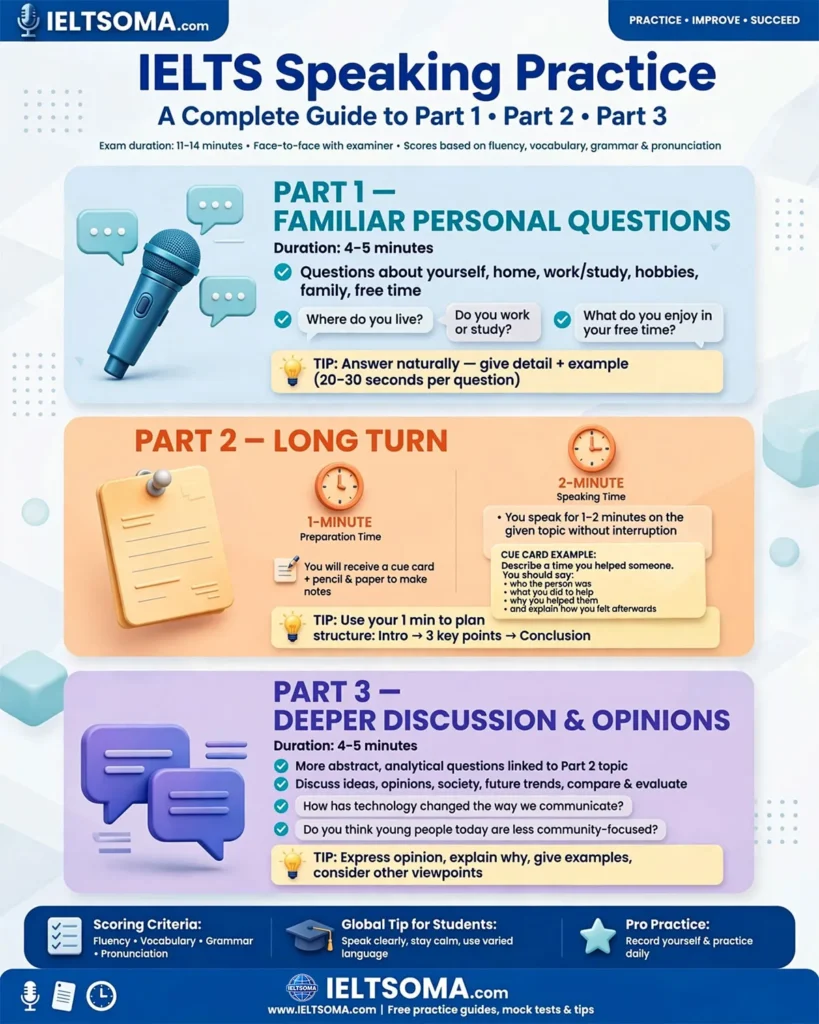
The IELTS Speaking test lasts 11–14 minutes and has three parts. You are assessed on four equally weighted criteria: Fluency and Coherence, Lexical Resource, Grammatical Range and Accuracy, and Pronunciation.
That means speaking practice should not simply mean “talk more”. It should mean practising the skills the examiner actually assesses.
Table of Contents
What Is the Best Way to Practise IELTS Speaking?
The most effective approach is to combine question practice, timed responses, recording, self-review, feedback and repeated practice.
Instead of answering 50 questions once, answer fewer questions, analyse your performance and then answer similar questions again.
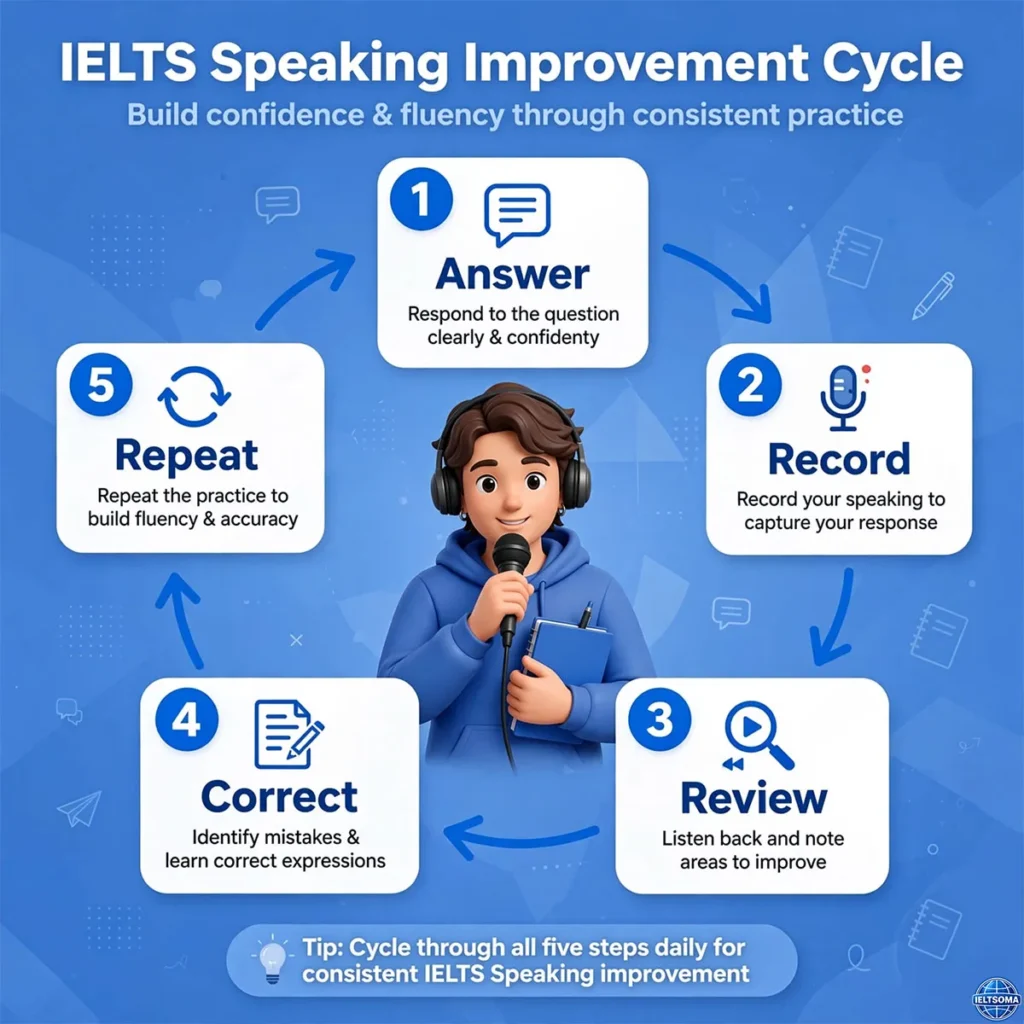
A useful practice cycle is:
Answer → Record → Review → Correct → Repeat
For example, if you notice that you pause whenever you need to explain a reason, do not simply move to another question. Practise giving answers that require reasons until that weakness becomes easier to manage.
1. Understand What the IELTS Speaking Test Measures
Before you begin practising, understand what you are trying to improve.
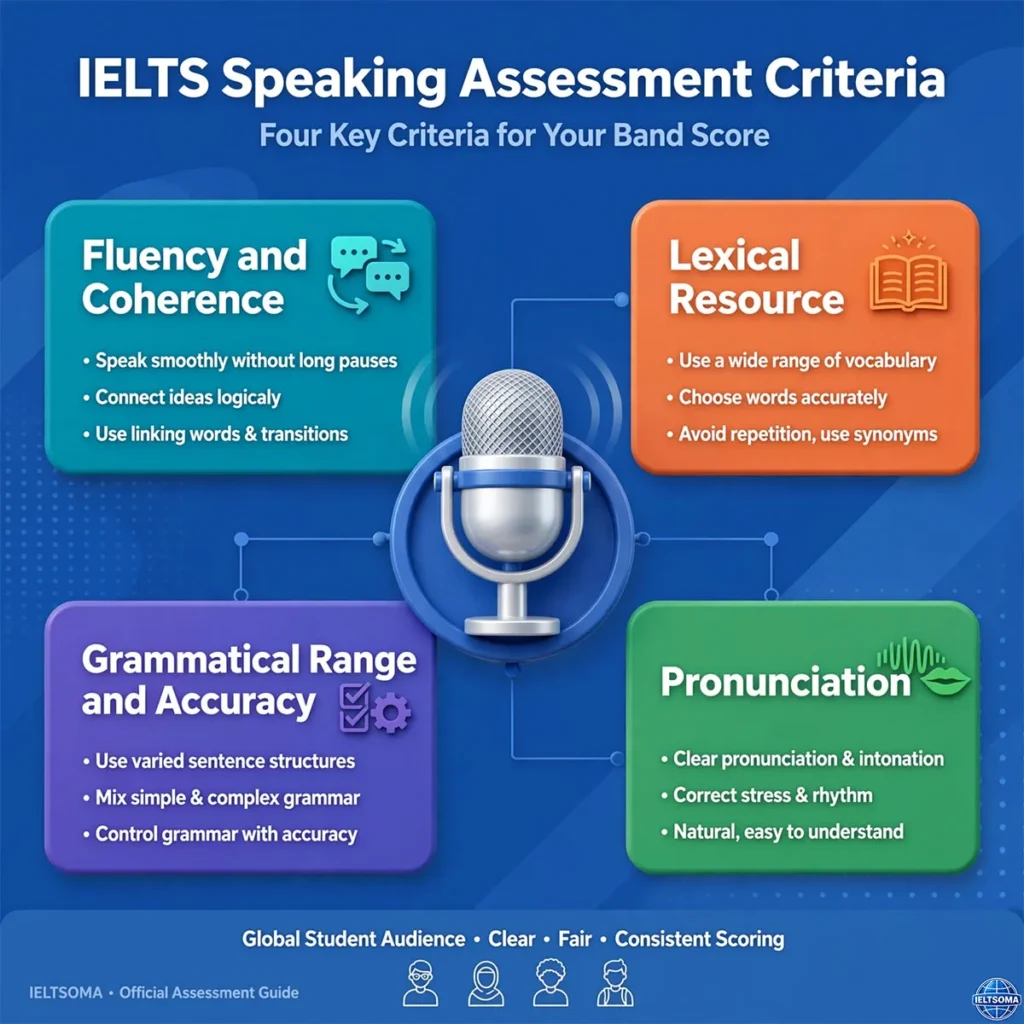
The official IELTS Speaking assessment has four criteria:
| Criterion | What you should practise |
|---|---|
| Fluency and Coherence | Speaking continuously and organising ideas clearly |
| Lexical Resource | Using vocabulary accurately, appropriately and flexibly |
| Grammatical Range and Accuracy | Using a range of grammatical structures accurately |
| Pronunciation | Making your speech easy to understand |
These criteria are used throughout the Speaking test.
This gives you a much better practice strategy.
If you only practise vocabulary, you are ignoring three other areas.
If you only practise speaking quickly, you may not improve coherence.
If you only copy a native speaker’s accent, you may spend time on something that does not address your biggest weakness.
Your practice should develop all four areas.
2. Practise Speaking Every Day
One of the simplest IELTS Speaking Practice Tips is also one of the most effective: speak regularly.
You do not need a two-hour conversation every day.
Even 15–20 minutes of focused speaking can be valuable if you practise actively.
For example:
- 5 minutes: Part 1 questions
- 5 minutes: Part 2 response
- 5 minutes: Part 3 discussion
- 5 minutes: review your recording
The objective is to make speaking a normal part of your daily routine.
If you only speak English once a week, producing language under pressure can feel much harder.
Regular practice helps you become more comfortable forming ideas directly in English rather than translating every sentence from your first language.
3. Record Your IELTS Speaking Answers
Recording yourself is one of the most useful ways to practise without a teacher.
Use your phone, computer or another recording device.
Choose an IELTS-style question and answer it without stopping the recording.
Then listen carefully.
Do not only ask, “Did I sound good?”
Ask more specific questions:
- Did I answer the question directly?
- How often did I pause?
- Did I repeat the same words?
- Did I use complete sentences?
- Did I explain my ideas?
- Did I make recurring grammar mistakes?
- Was my pronunciation easy to understand?
- Did my answer sound natural or memorised?
Your recording can reveal problems that are difficult to notice while you are speaking.
For example, you may believe that you speak fluently, but discover that you frequently say “um”, “actually”, “you know” or repeat the beginning of a sentence while searching for vocabulary.
Once you identify the pattern, you can practise it deliberately.
4. Practise IELTS Speaking Part 1 Naturally
Part 1 contains questions about familiar topics such as your home, family, work, studies and interests. It is designed around everyday topics and lasts about 4–5 minutes.
Do not turn Part 1 into a memorisation exercise.
Suppose the examiner asks:
Do you enjoy cooking?
A weak practice response might be:
Yes, I enjoy cooking because it is very interesting and relaxing.
Stop there and the answer may sound underdeveloped.
A more natural response could be:
Yes, I do, especially at weekends when I have more free time. I usually make simple meals rather than anything complicated. I find it quite relaxing because I can experiment with different ingredients.
The point is not to memorise that answer.
The point is to practise the skill of answering directly and adding relevant detail.
A useful Part 1 pattern is:
Answer → Reason → Small detail/example
Do not force this structure into every answer. Use it as training wheels until extending your responses becomes natural.
5. Use the One-Minute Preparation Time Effectively
Part 2 gives you a topic and preparation time before you speak for up to two minutes.
Many candidates waste the preparation minute by trying to write complete sentences.
Do not do that.
Write short keywords.
For example, if the topic is:
Describe a place you enjoy visiting.
Your notes might be:
- Riverside park
- Near my home
- Weekend visits
- Quiet + fresh air
- Go with friends
- Helps me relax
These prompts are enough to guide your answer.
Your objective is to develop the ideas while speaking rather than reading from a script.
6. Practise Speaking for Two Minutes Without Memorising
A common problem in IELTS Speaking practice is relying too heavily on prepared answers.
Memorised answers can become difficult to adapt when the question changes.
Instead, practise flexible speaking.
Choose a random Part 2 topic.
Give yourself one minute to make notes.
Then speak for up to two minutes.
If you finish after 60–70 seconds, ask yourself:
What else could I explain?
You might add:
- why it matters
- how you felt
- what happened next
- who was involved
- how the experience changed you
- what you would do differently
This teaches you to develop ideas rather than simply fill time.
7. Practise IELTS Speaking Part 3 at a Deeper Level
Part 3 requires a broader and more analytical discussion related to the Part 2 topic.
This is where many candidates struggle because they are comfortable describing personal experiences but less comfortable explaining opinions.
For example:
Why do people prefer living in cities?
Instead of giving only:
Because cities have more facilities.
Develop the idea:
I think one major reason is convenience. Cities usually provide better access to employment, education and public transport. For example, people can often find several universities, hospitals and workplaces within a relatively short distance, which can make everyday life easier.
A useful practice structure is:
Opinion → Explanation → Example → Consequence
You do not need to use every stage in every answer, but practising this structure helps you learn to develop ideas.
8. Build Vocabulary You Can Actually Use
Vocabulary practice should support speaking practice.
Do not simply memorise lists of “Band 9 words”.
Instead, collect useful expressions from topics you regularly practise.
For the topic of technology, you might learn:
- digital devices
- access to information
- online communication
- technological dependence
- privacy concerns
- digital literacy
Then use those expressions in your own answers.
For example:
One major advantage of digital devices is that they give people immediate access to information.
The vocabulary works because it communicates a precise idea.
IELTS assesses Lexical Resource partly through the range, accuracy and appropriacy of vocabulary and the ability to paraphrase when necessary.
That means usable vocabulary is more valuable than impressive vocabulary you cannot control.
9. Practise Paraphrasing When You Forget a Word
You will not know every English word.
That is normal.
One valuable Speaking skill is being able to explain something using different words.
Suppose you forget the word “thermometer”.
You could say:
It’s a small device that people use to measure temperature.
You communicated the meaning without stopping completely.
Practise this deliberately.
Choose an object or concept and explain it without using its name.
For example:
- bicycle
- smartphone
- university
- pollution
- public transport
- recycling
This develops your ability to keep communicating when you experience a vocabulary gap.
10. Work on Fluency Without Trying to Speak Faster
Fluency does not mean speaking as quickly as possible.
The official IELTS guidance describes fluency and coherence in terms of continuity, rate, effort, logical sequencing and the effective linking of ideas.
Speaking too quickly can actually make your pronunciation less clear and your grammar less accurate.
Instead, aim for a steady, comfortable pace.
Practise reducing unnecessary pauses.
There is a difference between:
I think… um… the main… actually… I don’t know… perhaps…
and:
I think the main reason is convenience. People can save time because essential services are usually nearby.
The second answer is not necessarily faster. It is simply more organised.
11. Improve Grammar Through Speaking, Not Only Exercises
Grammar exercises can help you understand rules, but Speaking requires you to use grammar while thinking.
Practise grammar through answers.
For example, choose one topic and deliberately use different structures:
Present:
I usually work from home.
Past:
I started doing this two years ago.
Present perfect:
I have become much more comfortable with it since then.
Conditional:
If I had the opportunity, I would probably continue working remotely.
The aim is not to force complicated grammar into every answer.
A complicated sentence that contains several errors may be less useful than a clear sentence that accurately communicates your meaning.
Official IELTS assessment considers both grammatical range and accuracy.
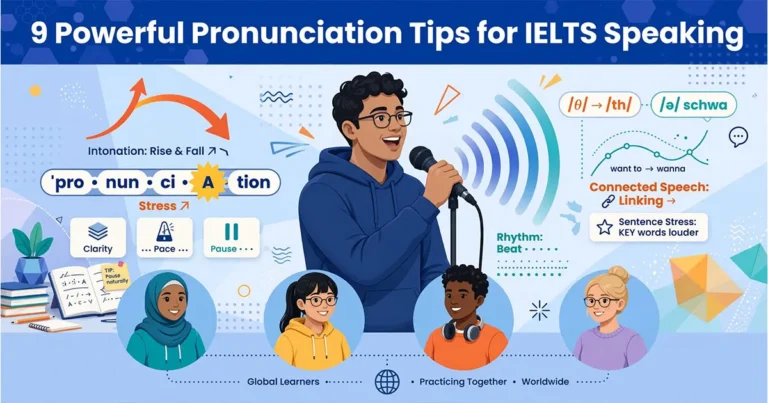
12. Practise Pronunciation for Clarity
You do not need to eliminate your accent to achieve a strong IELTS Speaking score.
Your priority should be understandable speech.
When reviewing recordings, check:
- individual sounds
- word stress
- sentence stress
- intonation
- connected speech
- whether words are easy to understand
Choose a short recording from a reliable English source and listen to a sentence.
Pause it.
Repeat the sentence.
Record yourself.
Then compare the two versions.
This is often called shadowing.
Do not try to imitate every detail perfectly. Focus on features that improve clarity and natural rhythm.
Pronunciation is one of the four official Speaking criteria, and the assessment focuses on how effectively you communicate through spoken language.
13. Practise With a Partner, but Do Not Depend on One
A speaking partner can be extremely useful.
Ask them to give you unexpected questions and interrupt you only when necessary.
However, do not assume you need a partner every day.
You can practise independently by:
- Selecting an IELTS-style question.
- Setting a timer.
- Recording your response.
- Listening to it.
- Writing down three weaknesses.
- Recording the answer again.
The second recording is especially useful.
You can immediately test whether your correction worked.
For example, your first recording may contain repeated words such as “good”, “nice” and “interesting”.
Before the second recording, choose more precise vocabulary.
Then compare the two versions.
14. Create an IELTS Speaking Error Log
One of the most powerful IELTS Speaking Practice Tips is to keep an error log.
Do not write down every tiny mistake.
Focus on recurring problems.
Your log might look like this:
| Problem | Example | Better practice |
|---|---|---|
| Repetition | “I think… I think…” | Pause and organise the idea |
| Grammar | “People is…” | Review subject–verb agreement |
| Vocabulary | Repeating “good” | Build topic-specific alternatives |
| Pronunciation | Unclear word endings | Practise final sounds |
| Development | Very short answers | Add a reason or example |
Review your error log every few days.
If the same mistake appears repeatedly, create practice specifically for it.
This is much more productive than endlessly answering new questions.
15. Simulate the Full Speaking Test
At least once a week, complete a full Speaking simulation.
Follow the real structure:
Part 1
Answer questions on familiar topics.
Part 2
Use the preparation time and complete the long turn.
Part 3
Discuss broader questions connected to the topic.
The official IELTS Speaking test has three parts and lasts 11–14 minutes. The same Speaking test format is used for IELTS Academic and IELTS General Training.
During your simulation, avoid stopping the recording to correct yourself.
Treat it like a real test.
Afterwards, review the recording.
Ask:
- Did I maintain fluency?
- Did I develop my answers?
- Did I use vocabulary flexibly?
- Did I make repeated grammar mistakes?
- Was my pronunciation understandable?
- Did I rely on memorised language?
- Which problem should I fix first?
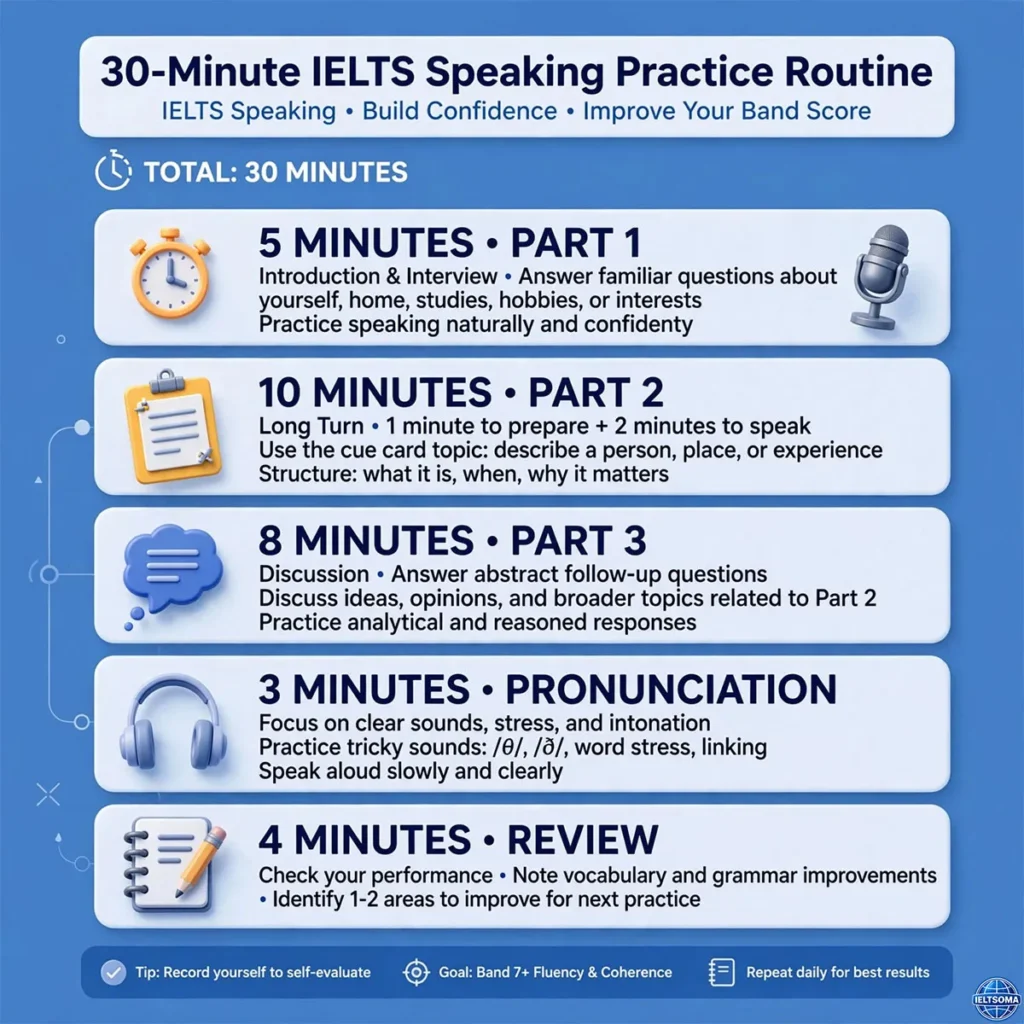
A Simple 30-Minute IELTS Speaking Practice Routine
You can turn these IELTS Speaking Practice Tips into a manageable daily routine.
Minutes 1–5: Part 1
Answer five short questions.
Focus on natural, direct responses.
Minutes 6–15: Part 2
Choose one cue card.
Take one minute to prepare.
Speak for up to two minutes.
Then repeat the task with improved organisation.
Minutes 16–23: Part 3
Answer three deeper questions.
Focus on explaining reasons and giving examples.
Minutes 24–27: Pronunciation
Listen to part of your recording.
Choose two pronunciation problems.
Practise them aloud.
Minutes 28–30: Review
Write down:
- one strength
- one repeated mistake
- one improvement target
Repeat the same process tomorrow.
Common IELTS Speaking Practice Mistakes
Memorising complete answers
Prepared language can become inflexible when the examiner asks a different question.
Learning difficult vocabulary without practising it
A word you recognise is not necessarily a word you can use naturally.
Speaking too quickly
Speed does not automatically create fluency.
Giving very short answers
Answering the question is necessary, but many questions also give you an opportunity to explain and develop your ideas.
Ignoring recordings
If you never listen to yourself, you may not notice repeated problems.
Practising only Part 1
A strong Part 1 performance does not guarantee that you can manage Part 2 and Part 3 effectively.
Correcting every mistake while speaking
Constant self-correction can interrupt your fluency. Record the answer, finish it, then review the mistakes.
Using memorised idioms everywhere
Natural language is more useful than forcing expressions into answers where they do not fit.
How Long Should You Practise IELTS Speaking Each Day?
There is no official daily practice requirement.
For many candidates, 20–30 minutes of focused speaking practice can be more useful than several hours of passive study.
The quality of practice matters.
A focused session should include speaking, review and correction.
If you have more time, increase the number of practice cycles rather than simply speaking continuously.
For example:
30 minutes: one complete practice cycle
60 minutes: two cycles plus detailed review
90 minutes: two cycles plus vocabulary, grammar and pronunciation work based on your mistakes
How Can I Improve IELTS Speaking Quickly?
The fastest improvement usually comes from identifying your biggest weaknesses and practising them repeatedly.
For example, if your main problem is hesitation, spend more time on timed speaking and idea development.
If vocabulary is limiting your answers, build topic-based vocabulary and use it in recorded responses.
If pronunciation affects clarity, focus on specific sounds, stress and rhythm.
If grammar errors are frequent, identify the grammar patterns you repeatedly misuse and practise them in spoken sentences.
Do not try to improve everything at once.
Choose your highest-impact weakness first.
Frequently Asked Questions About IELTS Speaking Practice Tips
How often should I practise IELTS Speaking?
Practise regularly rather than relying on occasional long sessions. A focused 20–30 minute session several times a week can create a useful routine.
Can I practise IELTS Speaking alone?
Yes. Recording yourself answering IELTS-style questions is an effective way to practise independently. You can review fluency, vocabulary, grammar, pronunciation and answer development.
Should I memorise IELTS Speaking answers?
No. Memorising complete answers can make your responses inflexible. Practise ideas, vocabulary and useful language patterns that you can adapt naturally.
How can I improve IELTS Speaking fluency?
Speak regularly, record yourself, reduce unnecessary pauses and practise developing answers without translating every sentence from your first language.
How can I improve my IELTS Speaking vocabulary?
Learn useful vocabulary in context and immediately use new words and phrases in your own spoken answers. Focus on accuracy, appropriacy and flexibility rather than collecting difficult words.
Is IELTS Speaking the same for Academic and General Training?
Yes. The IELTS Speaking test is the same for Academic and General Training candidates. Both use the same three-part format and Speaking assessment criteria.
How can I practise IELTS Speaking Part 2?
Choose a cue-card topic, give yourself one minute to prepare brief notes, then speak for up to two minutes. Record yourself and repeat the task after reviewing your performance.
What should I do if I forget a word while speaking?
Do not panic. Try paraphrasing the word or explaining its meaning. This helps you maintain communication instead of stopping completely.
Final Thoughts
The best IELTS Speaking Practice Tips are not about memorising hundreds of answers or trying to sound like a native speaker.
They are about practising the skills the test actually measures.
Speak regularly.
Record yourself.
Develop your ideas.
Use vocabulary naturally.
Improve grammar through real speaking.
Work on pronunciation for clarity.
Practise all three parts.
Most importantly, review your performance and use what you discover to plan your next practice session.
The goal is not simply to speak more English.
The goal is to make every speaking session more targeted than the last one.
For official information about the Speaking format and assessment, use the IELTS preparation and test-format resources alongside your regular practice.
Other Useful Links: