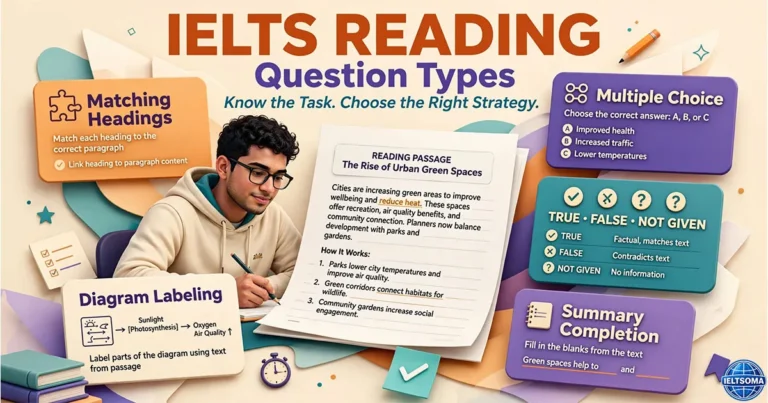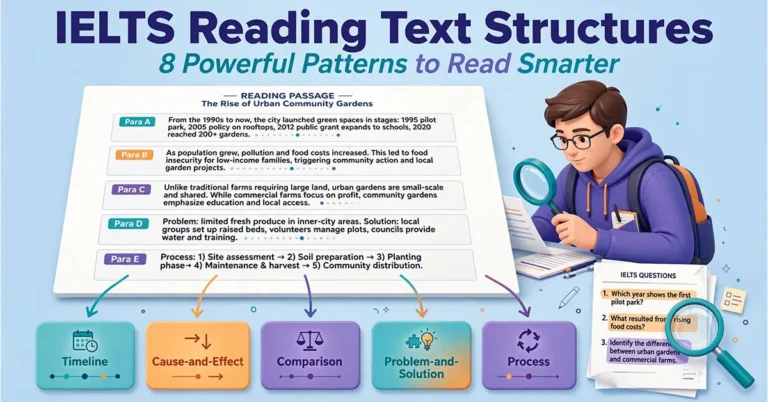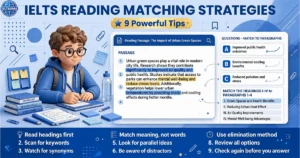
Matching questions can look simple in IELTS Reading: read the options, find the information, and connect the two.
In practice, they can be some of the most time-consuming questions in the test.
The difficulty is not usually the matching itself. It is recognising paraphrases, distinguishing main ideas from supporting details, locating information efficiently, and avoiding attractive but incorrect options.
That is why effective IELTS Reading Matching Strategies are more valuable than simply reading faster.
Whether you are taking IELTS Academic or IELTS General Training, the Reading test gives you 60 minutes to answer 40 questions. The two versions use different reading texts, but both can include matching information, matching headings, matching features and matching sentence endings.
This guide explains how to approach each matching task, what to look for, which mistakes cost marks, and how to practise so that your accuracy improves without sacrificing time.
Table of Contents
What Are IELTS Reading Matching Questions?
IELTS Reading matching questions require you to connect information in the questions with the correct part of the passage or with a list of options.
The exact format varies.
You may need to:
- Match headings to paragraphs.
- Match statements to paragraphs or sections.
- Match information to people, places, theories or other features.
- Match sentence beginnings with appropriate endings.
These tasks test different reading skills, so using the same strategy for every matching question is a mistake.
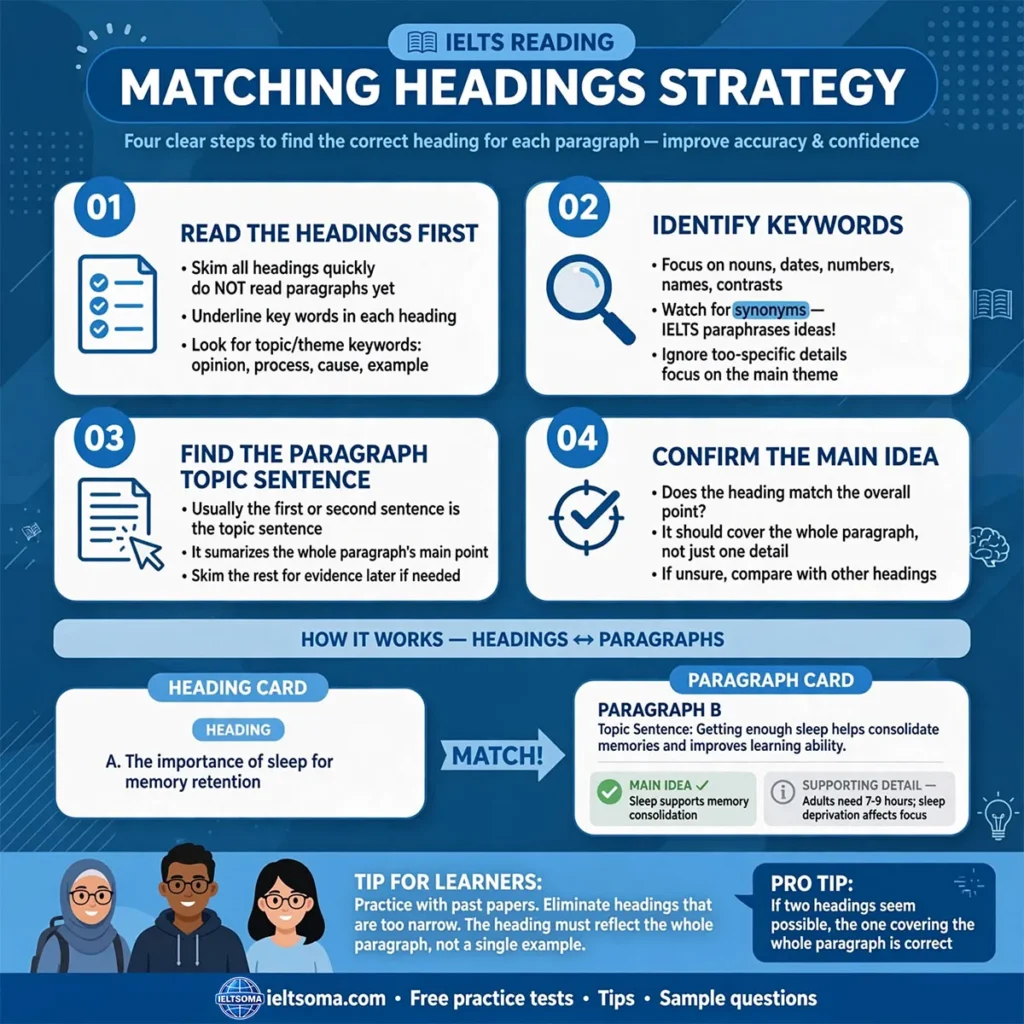
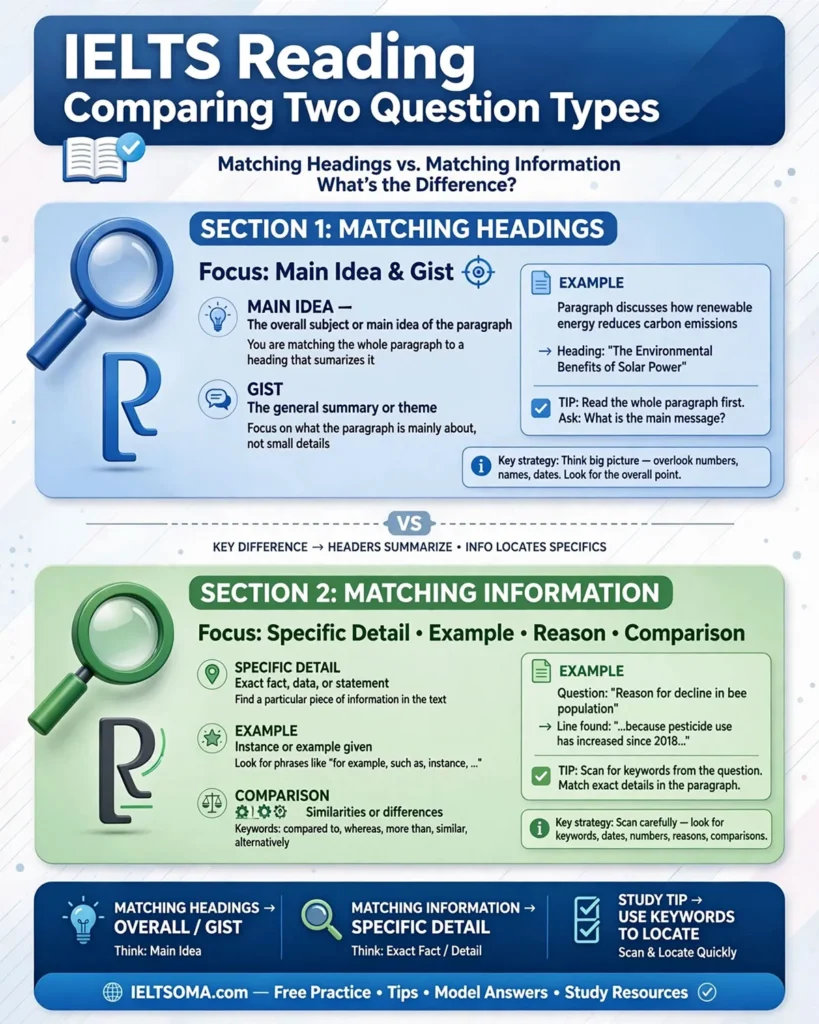
For example, matching headings focuses mainly on the central idea of a paragraph, whereas matching information focuses on locating specific information such as a reason, example, comparison or explanation. Official IELTS guidance makes this distinction clear.
The first step towards better performance is therefore understanding exactly what each task is testing.
1. Identify the Matching Question Type First
Before searching the passage, identify the task.
Ask yourself:
What exactly am I matching?
| Question type | What you are looking for | Main skill |
|---|---|---|
| Matching headings | Main idea of a paragraph | Reading for gist |
| Matching information | Specific information | Scanning |
| Matching features | Relationship between statements and options | Scanning + detailed reading |
| Matching sentence endings | Logical and textual completion | Understanding meaning |
This small step prevents a common problem: using a detailed scanning strategy when the question requires you to understand the overall message of a paragraph.
For instance, if you are answering matching headings questions, searching for one familiar word is rarely enough. You need to understand what the paragraph is mainly about.
If you are answering matching information questions, however, a distinctive name, date, technical term or unusual concept may be an excellent starting point.
2. Read the Instructions Very Carefully
One of the simplest IELTS Reading Matching Strategies is also one of the most frequently ignored: read the instructions before answering.
Instructions can tell you whether:
- Each option can be used once.
- An option can be used more than once.
- Not all options will be used.
- You must write a letter or Roman numeral.
- There is a word limit for a written answer.
For matching headings, for example, official IELTS guidance states that there are always more headings than paragraphs or sections, meaning some headings will not be used. A heading cannot be used more than once in this task.
Matching features can work differently. Some options may be unused, while others may be used more than once when the instructions allow it.
Never assume that every option must be used.
The instructions determine the rules.
3. Use Keywords—but Expect Paraphrasing
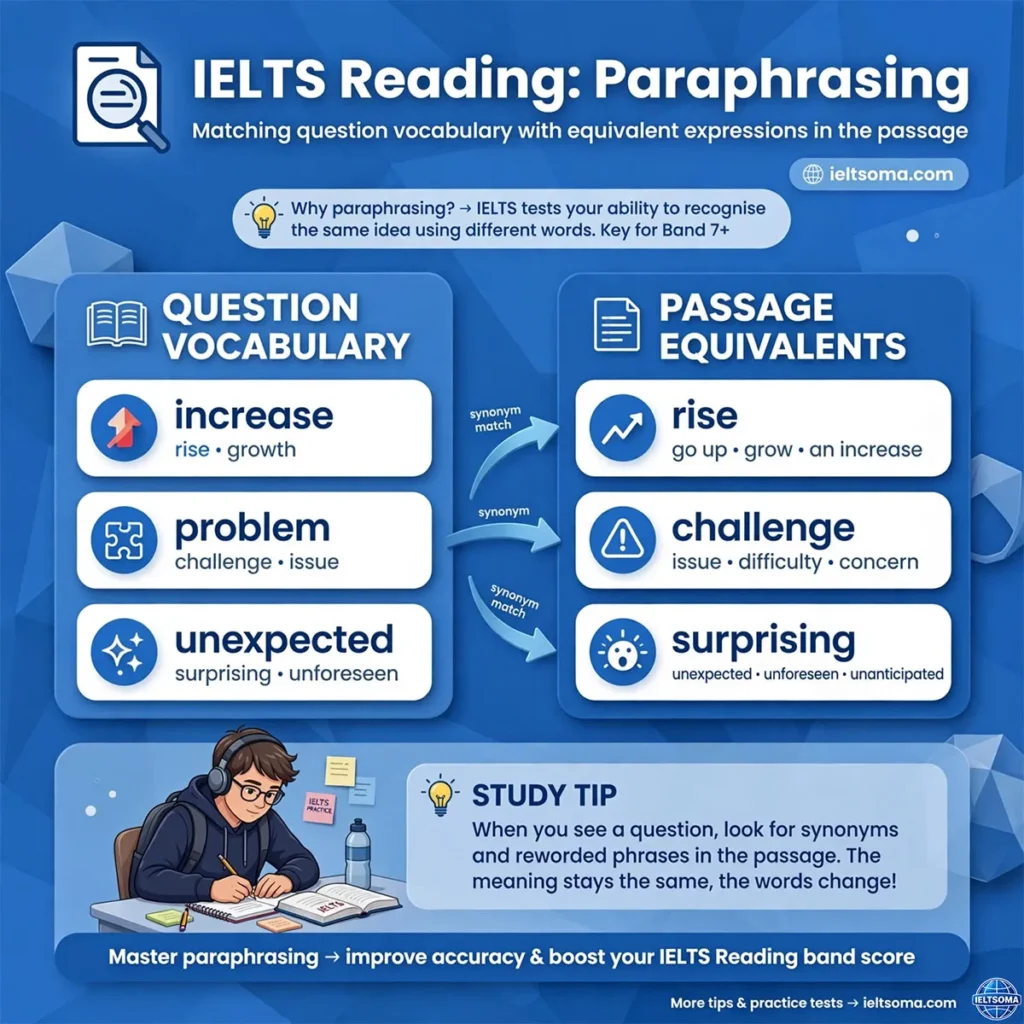
Many candidates underline keywords in the question and then search for exactly the same words in the passage.
That approach is unreliable.
IELTS Reading frequently tests your ability to recognise meaning when the wording changes.
For example:
Question:
The research produced an unexpected result.
Passage:
The findings surprised the scientists involved in the study.
The words are different, but the meaning is closely connected.
This is why strong IELTS Reading Matching Strategies focus on meaning rather than identical vocabulary.
When you underline a keyword, think of possible alternatives.
For example:
| Question word | Possible passage language |
|---|---|
| increase | rise, growth, expansion |
| reduce | decrease, cut, limit |
| problem | difficulty, challenge, issue |
| unexpected | surprising, unforeseen, unanticipated |
| important | significant, major, crucial |
| method | approach, technique, procedure |
| result | outcome, finding, consequence |
Do not try to memorise endless synonym lists.
Instead, train yourself to recognise relationships between words and ideas in context.
4. IELTS Reading Matching Strategies for Matching Headings
Matching headings is often considered one of the hardest Reading tasks because the answer depends on the main idea, not simply one interesting detail.
Official IELTS guidance says this task tests your ability to identify the general topic of a paragraph and distinguish its main idea from supporting ideas.
A reliable approach is:
Step 1: Read the headings
Do not memorise every heading word for word.
Instead, identify the central concept of each heading.
Suppose the options include:
- The development of modern transport
- Problems caused by urban expansion
- A change in consumer behaviour
- The environmental cost of tourism
Your mental notes might be:
- transport development
- urban problems
- consumer behaviour
- tourism/environment
Step 2: Read the paragraph strategically
Look first at the opening sentences.
The first sentence often introduces the topic, although the main idea can also become clear later in the paragraph.
IELTS itself recommends paying attention to topic sentences when approaching matching headings.
Step 3: Ask one question
“If I had to give this paragraph a short title, what would it be?”
That question is often more useful than asking:
“Which heading contains the same word?”
Step 4: Eliminate headings
If a heading is clearly about tourism but the paragraph is mainly about transport policy, eliminate it.
Do not keep reconsidering every option indefinitely.
Step 5: Check the whole paragraph
Before committing to an answer, make sure the heading represents the paragraph as a whole.
A common trap is choosing a heading that describes one example rather than the paragraph’s central idea.
5. Use a Different Strategy for Matching Information
Matching information is not the same as matching headings.
Here, you are looking for specific information inside paragraphs or sections.
Official IELTS guidance explains that matching information can involve finding a specific detail, example, reason, description, comparison, summary or explanation.
For this question type, scanning becomes especially important.
Look for distinctive information such as:
- Names
- Dates
- Numbers
- Places
- Scientific terms
- Unusual nouns
- Names of organisations
- Specific examples
- Strongly defined concepts
For example:
Question:
Which paragraph mentions a study involving 2,000 participants?
Do not read the entire passage carefully.
Scan for:
- 2,000
- two thousand
- participants
- a study
- research involving people
Then read the surrounding sentences carefully to confirm the match.
This is one of the most effective IELTS Reading Matching Strategies because it reduces unnecessary reading.
6. For Matching Features, Build an Option Map
Matching features questions often give you a list of people, organisations, places, theories or other categories.
For example:
A — Dr Brown
B — Professor Khan
C — Maria Lopez
D — The research team
You then have statements such as:
- developed a new approach
- criticised an earlier theory
- conducted research in Brazil
- predicted future changes
Instead of repeatedly reading the entire passage, create a mental map.
As you scan the passage, note what each feature is associated with.
| Feature | Key information |
|---|---|
| A | developed new approach |
| B | criticised earlier theory |
| C | Brazil research |
| D | future predictions |
You do not necessarily need to write this table in the real exam.
The purpose is to organise the information mentally.
Official IELTS guidance notes that matching features tests your ability to recognise relationships and connections between facts, opinions and theories. It also requires skimming and scanning before reading relevant sections more carefully.
7. Match Sentence Endings by Meaning and Grammar
Matching sentence endings requires a slightly different approach.
You receive the beginning of a sentence and several possible endings.
For example:
The researchers changed their original method because…
Possible endings might include:
A. the first experiment produced unreliable results.
B. the equipment was more expensive than expected.
C. participants refused to continue the study.
D. the researchers wanted to publish their findings earlier.
Do not choose an ending simply because it contains a familiar word.
Check three things:
Meaning
Does the completed sentence accurately reflect the passage?
Grammar
Does the ending create a grammatically complete sentence?
Logic
Does the relationship between the two parts make sense?
For Academic Reading, official IELTS guidance states that sentence beginnings appear in the same order as the information in the text.
That ordering can help you locate the relevant section.
8. Do Not Assume Answers Follow the Passage in Every Matching Task
This is a crucial point.
Some IELTS Reading tasks follow the order of information in the text. Others do not.
Candidates often lose time because they assume that every question must move forward through the passage.
That is not safe.
For example:
- Matching headings requires you to compare paragraphs with headings.
- Matching information may require you to search different paragraphs.
- Matching features can involve information distributed across the passage.
- Matching sentence endings has its own ordering rules.
Official IELTS guidance specifically notes that matching information can involve paragraphs being used more than once, depending on the instructions.
Therefore, learn the rules of the specific task instead of relying on one universal technique.
9. Use the Elimination Strategy
Elimination is one of the most powerful IELTS Reading Matching Strategies.
Suppose you have five options but only three are needed.
You identify:
- Option A — definitely wrong
- Option B — possible
- Option C — definitely wrong
- Option D — strong match
- Option E — possible
You have already reduced the search dramatically.
However, elimination should be based on evidence.
Do not eliminate an option merely because the vocabulary looks unfamiliar.
Remember that IELTS deliberately uses paraphrasing.
The correct answer may use completely different vocabulary from the question.
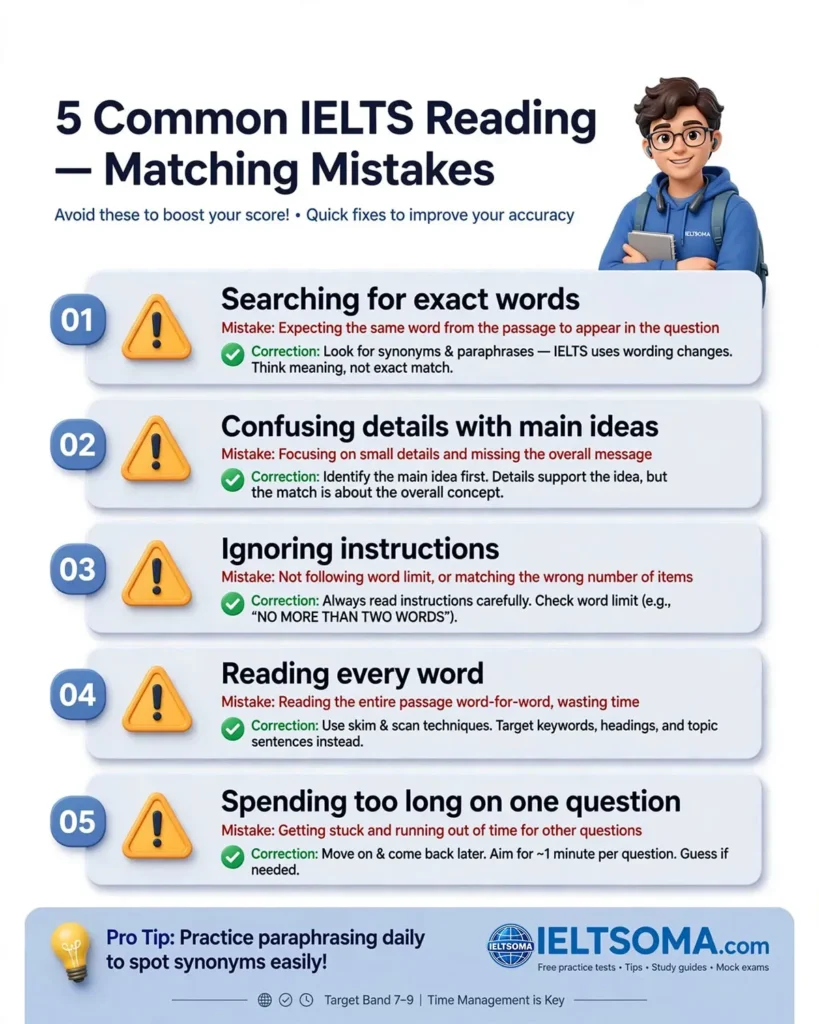
The Biggest IELTS Reading Matching Mistakes
Understanding what not to do can save as many marks as learning new techniques.
Mistake 1: Looking for exact words
A matching question may paraphrase the passage.
Better approach: search for meaning, synonyms and related ideas.
Mistake 2: Choosing an answer because of one word
One matching word does not prove that the answer is correct.
Better approach: read the surrounding information and confirm the complete meaning.
Mistake 3: Confusing a detail with the main idea
This is particularly dangerous in matching headings.
A paragraph might contain an example about electric cars but actually focus on government transport policy.
Better approach: ask what the paragraph is mainly doing.
Mistake 4: Reading every paragraph in detail
This wastes valuable time.
Better approach: skim strategically, scan for distinctive information and read relevant sections closely.
Mistake 5: Spending too long on one answer
A difficult question can consume several minutes.
Better approach: make the best evidence-based choice, mark it mentally, move on and return if time allows.
Mistake 6: Ignoring the instructions
A candidate may assume an option can be reused when it cannot—or fail to reuse an option when the instructions permit it.
Better approach: check the instructions before starting.
A Practical 5-Step Matching Method
If you want a simple routine to use during practice, try this:
1. Identify the task
Determine whether you are matching headings, information, features or sentence endings.
2. Mark useful keywords
Underline names, dates, concepts and distinctive terms.
3. Predict paraphrases
Before scanning, think about how the same idea might be expressed differently.
4. Locate the evidence
Use skimming and scanning to find the relevant paragraph or sentence.
5. Confirm before answering
Read enough of the surrounding text to prove that the match is correct.
This process is deliberately simple.
The goal is not to create a complicated exam ritual. The goal is to make your decisions faster and more reliable.
How to Practise IELTS Reading Matching Strategies
Doing dozens of random Reading tests is not necessarily the fastest way to improve.
Instead, practise by question type.
For example:
Day 1: Matching headings
Day 2: Matching information
Day 3: Matching features
Day 4: Matching sentence endings
Day 5: Mixed matching practice
After every exercise, analyse your mistakes.
Create an error log like this:
| Question | My answer | Correct answer | Why I was wrong |
|---|---|---|---|
| 4 | C | A | Chose supporting detail |
| 7 | B | D | Missed paraphrase |
| 10 | A | C | Scanned too quickly |
The last column is the most valuable.
If you repeatedly lose marks because you choose supporting details for matching headings, that is a strategy problem.
If you repeatedly miss paraphrases, your vocabulary and reading flexibility need more attention.
If you repeatedly run out of time, your scanning and decision-making need improvement.
This approach turns practice into targeted training.
For broader preparation, the IELTSOMA guide to IELTS Preparation Resources can help you build a structured set of official and practice materials.
How Academic and General Training Candidates Should Practise
Both Academic and General Training candidates can benefit from these IELTS Reading Matching Strategies, but your practice material should match your test.
Academic Reading uses texts from sources such as books, journals, magazines and newspapers, while General Training Reading uses a wider range of everyday, workplace and general-interest texts.
Do not prepare for Academic Reading using only General Training passages, or vice versa.
Your strategy can be shared.
Your practice material should not be.
If you are unsure which test you need, confirm the requirements of your university, employer, professional body or immigration authority before preparing.
How to Improve Matching Accuracy Without Reading Faster
You do not necessarily need to become a dramatically faster reader.
You need to become a more selective reader.
That means knowing when to:
- Read quickly.
- Slow down.
- Search for a name.
- Look for a paraphrase.
- Ignore an irrelevant paragraph.
- Check a supporting detail.
- Move to another question.
Consider this example.
A paragraph contains 120 words.
You may only need 20–30 of those words to answer the question.
The skill is knowing which 20–30 words matter.
That is why effective IELTS Reading Matching Strategies combine skimming, scanning, paraphrase recognition and evidence checking rather than relying on speed alone.
Frequently Asked Questions
What is the best strategy for IELTS Reading matching headings?
Read the headings first, identify their central meanings, then examine each paragraph for its main idea. Avoid choosing a heading simply because one word appears in both the heading and paragraph.
Are matching headings questions difficult?
They can be challenging because you must distinguish the main idea from supporting details. Official IELTS guidance confirms that this task tests recognition of the general topic and the difference between main and supporting ideas.
Can I use the same heading more than once?
No. In the IELTS matching headings task, each heading can only be used once. There are also more headings than paragraphs or sections, so some headings will remain unused.
Can the same option be used more than once in matching information?
It can be, depending on the instructions. IELTS states that some matching information tasks allow paragraphs or sections to be used more than once, and the instructions will tell you when this is permitted.
Should I read the whole passage before answering matching questions?
Usually, you do not need to read every sentence in detail before answering. Skimming for structure and main ideas, followed by targeted scanning and careful reading, is generally more efficient.
Should I memorize synonyms for IELTS Reading?
Vocabulary knowledge helps, but memorizing long synonym lists is not enough. You should practice recognizing paraphrases in context because IELTS may express the same idea using substantially different wording.
How can I stop choosing the wrong heading?
After each practice question, ask why your chosen heading was wrong. If it described an example or supporting detail rather than the paragraph’s central message, you need to focus more carefully on the overall purpose of the paragraph.
Final Strategy: Think Like a Searcher, Not a Translator
The biggest change many IELTS candidates need to make is moving away from reading every word as if they are translating the passage.
IELTS Reading rewards a different skill.
You need to understand the structure of the text, identify important information, recognise paraphrasing and locate evidence efficiently.
The most effective IELTS Reading Matching Strategies can therefore be summarised in nine principles:
- Identify the question type.
- Read the instructions carefully.
- Mark meaningful keywords.
- Expect paraphrasing.
- Distinguish main ideas from details.
- Use skimming and scanning strategically.
- Confirm answers with evidence.
- Use elimination when appropriate.
- Analyse your mistakes after practice.
You do not need a complicated technique.
You need a repeatable process that becomes automatic through deliberate practice.
For a broader IELTS preparation routine, combine these techniques with regular timed Reading tests, vocabulary development and detailed error analysis. Your goal should not simply be to complete more questions. It should be to understand why each answer is correct and why your wrong answers were tempting.
That is where real improvement begins.
Further Reading: