
Your culture can shape the way you think, communicate, celebrate, eat, study, work and interact with other people. That makes culture a natural source of ideas in the IELTS Speaking test.
But there is a common misunderstanding: IELTS does not test whether your cultural experience is “right” or “wrong”. It tests how effectively you communicate your ideas in English.
Understanding Cultural Influence in IELTS Speaking can therefore give you something extremely valuable: a reliable way to develop personal, detailed and flexible answers without memorizing scripts.
For example, if an examiner asks:
“How has your culture influenced the way people celebrate important events?”
You do not need an impressive academic theory about culture. You could talk about family traditions, food, clothing, religious or national celebrations, music, hospitality or changes among younger generations.
The stronger answer is usually the one that explains the idea clearly and develops it naturally.
This guide explains how to use Cultural Influence in IELTS Speaking to produce richer answers, handle unfamiliar questions, improve vocabulary and avoid one of the biggest Speaking mistakes: giving short, memorised responses.
Table of Contents
What Does Cultural Influence Mean in IELTS Speaking?
Cultural influence in IELTS Speaking refers to the ways your cultural background, traditions, values, social environment and experiences may shape your opinions or behaviour.
Culture can influence areas such as:
- Food and eating habits
- Family relationships
- Festivals and celebrations
- Clothing
- Education
- Work
- Hospitality
- Social etiquette
- Communication styles
- Gender roles
- Attitudes towards older people
- Community life
- Religion and traditions
- Music and entertainment
- Attitudes towards technology
- Changes between generations
These topics can appear naturally in IELTS Speaking because the test asks candidates to discuss familiar experiences as well as broader social issues.
However, your culture is not something you have to talk about in every answer.
The examiner is interested in your ability to communicate. IELTS Speaking is assessed using four equally weighted criteria: Fluency and Coherence, Lexical Resource, Grammatical Range and Accuracy, and Pronunciation.
That distinction is crucial.
Your cultural knowledge provides ideas. Your English communicates those ideas.
Why Cultural Influence Can Make Your IELTS Answers Stronger
Many candidates struggle with Speaking because they try to invent sophisticated opinions during the test.
Culture can solve part of this problem because it gives you authentic material to discuss.
Imagine you receive this Part 3 question:
“Do you think traditional customs are becoming less important?”
A candidate who has thought about cultural change can immediately develop several ideas:
- Younger people may have more international influences.
- Social media exposes people to different lifestyles.
- Some traditions remain important because families pass them down.
- Certain customs may change rather than disappear.
- Urbanisation and migration can influence traditional lifestyles.
You now have several directions for your answer.
This is much better than memorising a paragraph about “the importance of culture”.
The goal is to develop ideas you can adapt, not sentences you must reproduce.
Culture Gives You Personal Examples
Personal examples are particularly useful in Speaking because they allow you to explain abstract ideas through real experiences.
Suppose the examiner asks:
“What role does food play in your culture?”
Instead of saying:
“Food is very important in my culture because it brings people together.”
you could develop it:
“Food plays a major role in family gatherings where I come from. For example, when relatives visit, it is quite common for the host family to prepare several traditional dishes. I think the meal is not just about eating; it creates an opportunity for people to sit together, talk and strengthen family relationships.”
The second response contains a clear idea, explanation and example.
That gives the examiner more language to assess.
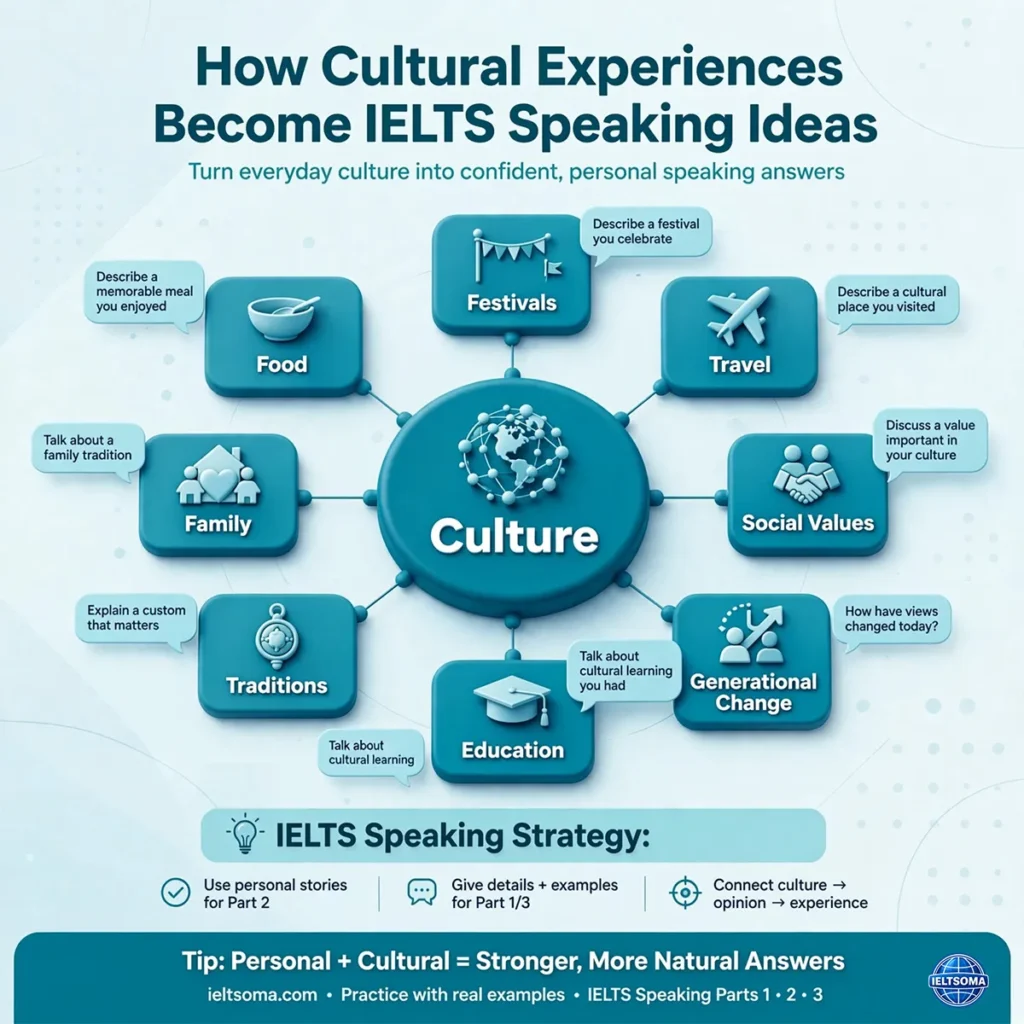
7 Ways to Use Cultural Influence in IELTS Speaking
1. Turn Cultural Experience into Speaking Ideas
Start by identifying experiences you genuinely know.
Think about:
- A traditional celebration
- A popular local dish
- A family custom
- A traditional form of clothing
- A cultural event
- A place with historical importance
- A tradition that is disappearing
- A custom you disagree with
- A tradition younger people are changing
- A cultural habit you would like to preserve
Do not write complete answers.
Instead, create short idea notes.
For example:
Topic: Traditional celebrations
- Family gathering
- Traditional food
- Special clothing
- Music
- Older relatives
- Children learn customs
- Younger generation changing habits
These notes can support multiple questions.
This is one of the most effective ways to use Cultural Influence in IELTS Speaking because one experience can generate several different answers.
2. Explain the Influence, Not Just the Tradition
One of the biggest weaknesses in cultural answers is description without explanation.
Consider this response:
“In my country, people usually celebrate weddings with large gatherings. There is traditional food, music and special clothing.”
The information is understandable, but the answer could go further.
A stronger version explains the influence:
“In my culture, weddings tend to be large family events, partly because marriage is seen as a connection between two families rather than just two individuals. As a result, relatives often play an important role in the celebrations, and people may travel long distances to attend.”
Notice what changed.
The candidate did not simply describe a wedding.
They explained why the tradition exists and how it affects behaviour.
That is the type of development you should practise.
3. Compare Older and Younger Generations
Generational change is one of the richest areas for discussing culture.
You can compare:
- Traditional and modern lifestyles
- Rural and urban communities
- Older and younger generations
- Past and present attitudes
- Local and international influences
For example:
“Older people in my community tend to follow traditional customs more closely, particularly when it comes to family gatherings. Younger people are generally more flexible because they are exposed to different lifestyles through education, travel and social media. However, I wouldn’t say that young people have completely abandoned tradition; many of them simply adapt it to modern life.”
This answer is useful because it demonstrates comparison, qualification and explanation.
You are not claiming that everyone behaves identically.
You are showing awareness that cultures are diverse and changing.
4. Use Cultural Influence to Develop Part 3 Answers
Part 3 is where cultural topics can become particularly useful.
The official IELTS format explains that Part 3 requires candidates to discuss more abstract issues related to the Part 2 topic, including expressing opinions, analysing issues and speculating.
For example:
“Why do some traditional customs disappear?”
A weak answer might be:
“Because young people don’t follow them anymore.”
A stronger response could be:
“One reason is that lifestyles are changing rapidly. Young people often move to cities for education or employment, so they may have less contact with traditional communities. At the same time, international media exposes them to different ways of living. As a result, some customs become less practical or less relevant, although important family traditions often survive.”
The answer moves from:
cause → explanation → wider influence → result
That structure is highly useful for Part 3.
5. Use Cultural Vocabulary Naturally
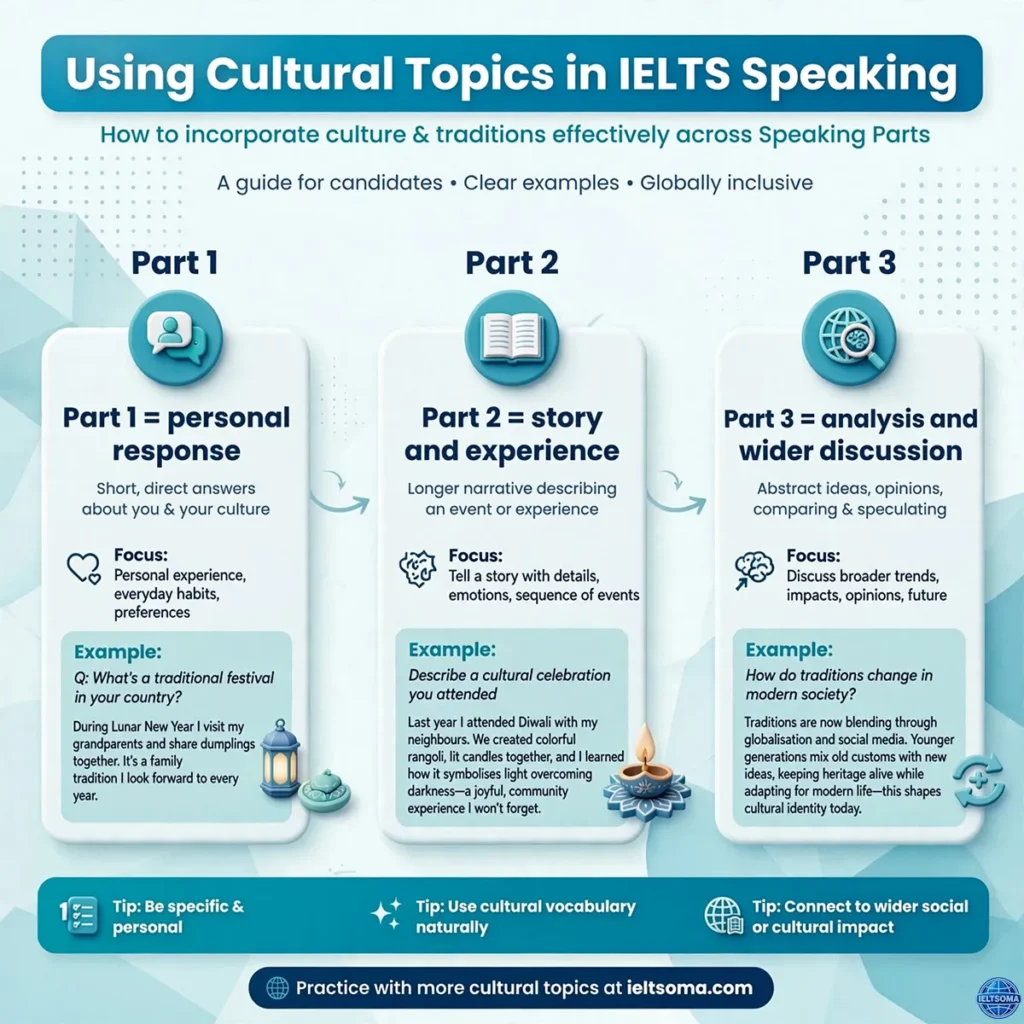
Culture-related vocabulary can help you discuss ideas more precisely, but do not treat difficult words as a shortcut to a high band.
Useful vocabulary includes:
| Expression | Natural use |
|---|---|
| cultural heritage | traditions and practices passed between generations |
| cultural identity | a person’s connection with a particular culture |
| traditional customs | established cultural practices |
| social values | beliefs about how society should behave |
| cultural diversity | the presence of different cultures |
| family traditions | practices followed within families |
| cultural norms | accepted patterns of behaviour |
| preserve traditions | keep traditions alive |
| pass something down | transfer something to younger generations |
| adapt to change | modify behaviour because circumstances change |
| generational differences | differences between age groups |
| cultural exchange | sharing ideas and practices between cultures |
The important point is context.
Do not say:
“My country has enormous cultural diversity.”
and stop.
Explain it:
“My country has considerable cultural diversity, so different regions often have their own languages, foods and celebrations. I think this makes travelling within the country particularly interesting because the experience can change significantly from one region to another.”
The vocabulary works because it carries a meaningful idea.
6. Avoid Stereotypes and Overgeneralisation
This is one of the most important lessons about Cultural Influence in IELTS Speaking.
Avoid absolute statements such as:
“Everyone in my country thinks…”
“Young people never…”
“People from my culture always…”
“Western countries don’t…”
These statements are often too broad.
Use flexible language instead:
- Many people
- Some families
- In my experience
- In my community
- Particularly among older generations
- This is more common in rural areas
- It tends to be more noticeable among…
- In some parts of my country
- Traditionally
- To some extent
For example:
Too absolute:
“People in my country always respect older people.”
More natural:
“Respect for older people is still an important value in many families, although attitudes can vary considerably between generations and communities.”
The second answer demonstrates greater precision.
It also sounds more authentic.
7. Connect Culture to Your Personal Experience
Your personal experience is one of your strongest resources.
You do not need to be an expert on anthropology, history or sociology.
If the examiner asks:
“Do you think international travel changes people’s attitudes?”
you could say:
“Definitely, I think it can. I noticed this when a friend of mine studied abroad for a year. Before leaving, he had quite fixed ideas about certain lifestyles, but after living with people from different backgrounds, he became much more open-minded. I think direct experience can challenge assumptions that people develop simply from their local environment.”
That is a strong Speaking response because it contains:
- A clear opinion
- A personal example
- Explanation
- A broader conclusion
Your experience does not have to be extraordinary.
It simply needs to be relevant and clearly explained.
Cultural Influence in IELTS Speaking: Part 1, Part 2 and Part 3
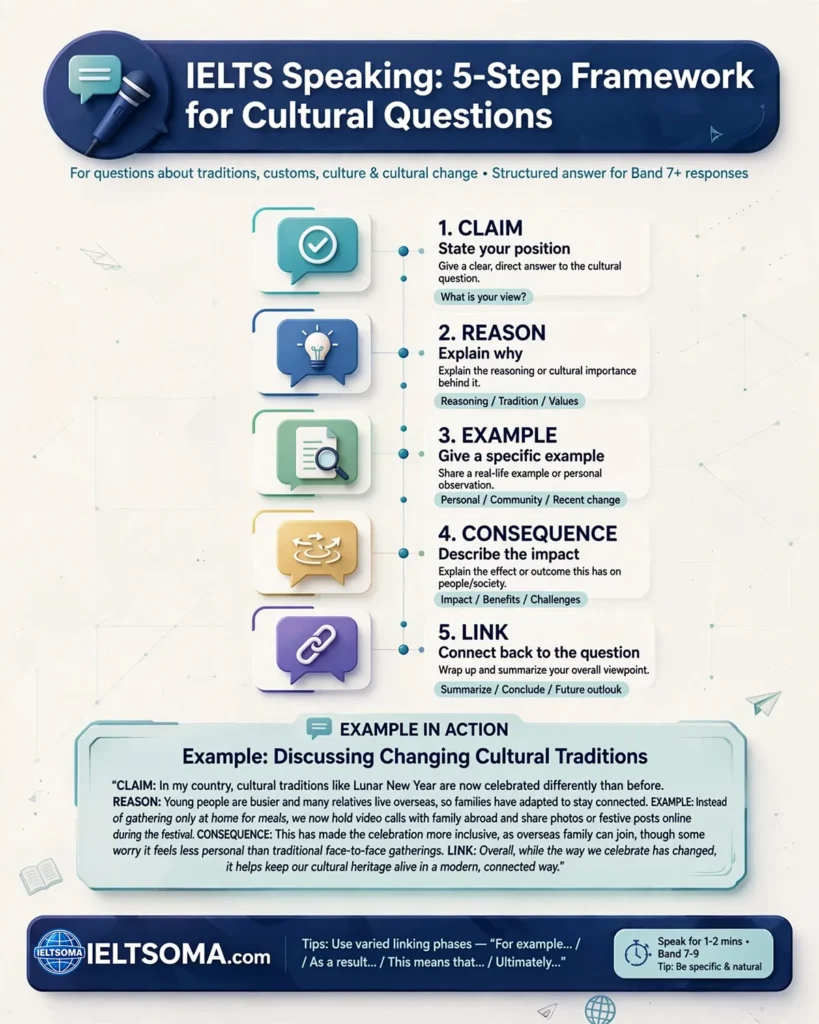
The same cultural idea should be adapted differently depending on the Speaking part.
| Speaking Part | What to do with cultural topics | Example |
|---|---|---|
| Part 1 | Give a direct personal response | “Yes, I enjoy traditional food because…” |
| Part 2 | Tell a structured story or describe an experience | “I remember attending…” |
| Part 3 | Analyse causes, effects, changes and opinions | “One reason this is changing is…” |
Part 1: Keep It Personal
Part 1 focuses on familiar topics and everyday experiences.
Question:
“Do you enjoy traditional food?”
Answer:
“Yes, especially when I’m eating with my family. I particularly enjoy traditional dishes that take a long time to prepare because they remind me of family gatherings when I was younger.”
You do not need a long cultural explanation.
Give a direct answer and add one useful detail.
Part 2: Build a Story
Imagine the cue card asks:
Describe a traditional celebration you have attended.
You could organise your answer around:
What: A family celebration
When: Last year
Where: Relative’s home
Who: Extended family
What happened: Food, music and conversations
Why memorable: Several generations were together
Then turn the notes into a natural story.
“I’d like to talk about a family celebration I attended last year. It was held at my uncle’s home, and quite a few relatives came, including some family members I hadn’t seen for several years. What made the event particularly memorable was the combination of traditional food and modern entertainment…”
You are using culture as content, not as a memorised script.
Part 3: Think Beyond Yourself
Part 3 requires more analytical thinking.
You may need to discuss:
- Why traditions survive
- Why traditions disappear
- Whether governments should preserve heritage
- The impact of globalisation
- Cultural diversity
- Immigration
- Social media
- Generational change
- International travel
- Education and cultural awareness
A useful structure is:
Opinion → Reason → Example → Wider implication
For example:
“I think schools can play an important role in preserving cultural heritage because young people spend a significant amount of their time in educational environments. For example, schools could organise local history projects or cultural events. This could help students understand where certain traditions come from rather than simply following them without understanding their meaning.”
A Powerful Answer Framework for Cultural Questions
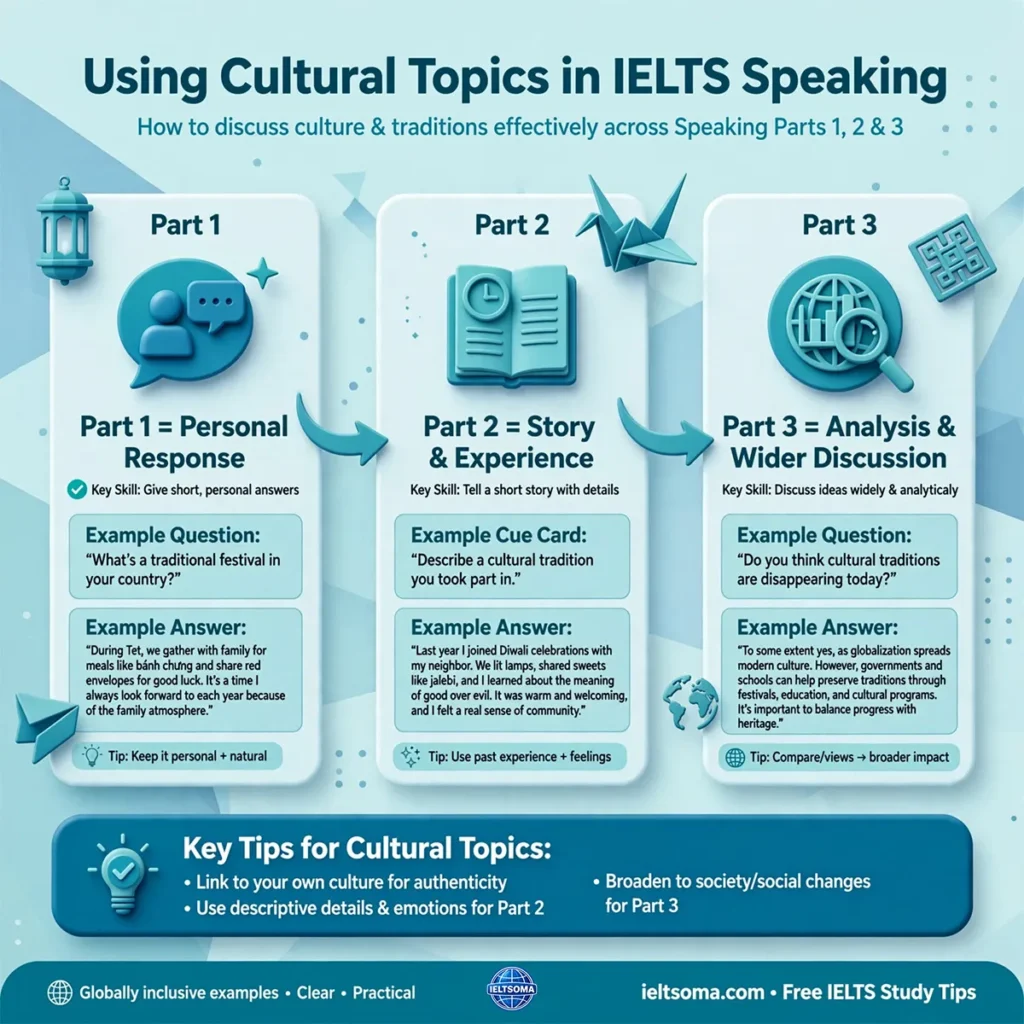
When you get a difficult cultural question, use this five-step framework:
C — Claim
Answer the question directly.
R — Reason
Explain why you think that way.
E — Example
Give a personal, local or hypothetical example.
C — Consequence
Explain what happens as a result.
L — Link
Connect your answer back to the question.
For example:
“I think some traditional customs are becoming less common because modern lifestyles are more demanding. For example, young professionals may not have enough time to participate in lengthy family ceremonies. As a result, some traditions are being shortened or adapted. However, I don’t think this necessarily means they are disappearing completely, because people often find modern ways to maintain traditions.”
This framework is particularly useful when you need to extend an answer without sounding repetitive.
How Cultural Influence Affects Your IELTS Speaking Score
Culture itself does not receive a separate IELTS band score.
This is an important distinction.
The examiner evaluates your spoken English through four criteria:
- Fluency and Coherence
- Lexical Resource
- Grammatical Range and Accuracy
- Pronunciation
Each criterion contributes equally to the Speaking score.
Therefore, talking about culture will not automatically produce a higher band.
What matters is how well you communicate the cultural idea.
For example, a candidate might discuss a fascinating cultural tradition but speak with frequent pauses, limited vocabulary and unclear pronunciation.
Another candidate might describe an ordinary family meal but explain it fluently, accurately and naturally.
The second performance may demonstrate stronger Speaking ability.
This is why Cultural Influence in IELTS Speaking should be treated as a source of ideas, not a scoring trick.
Common Mistakes When Discussing Culture
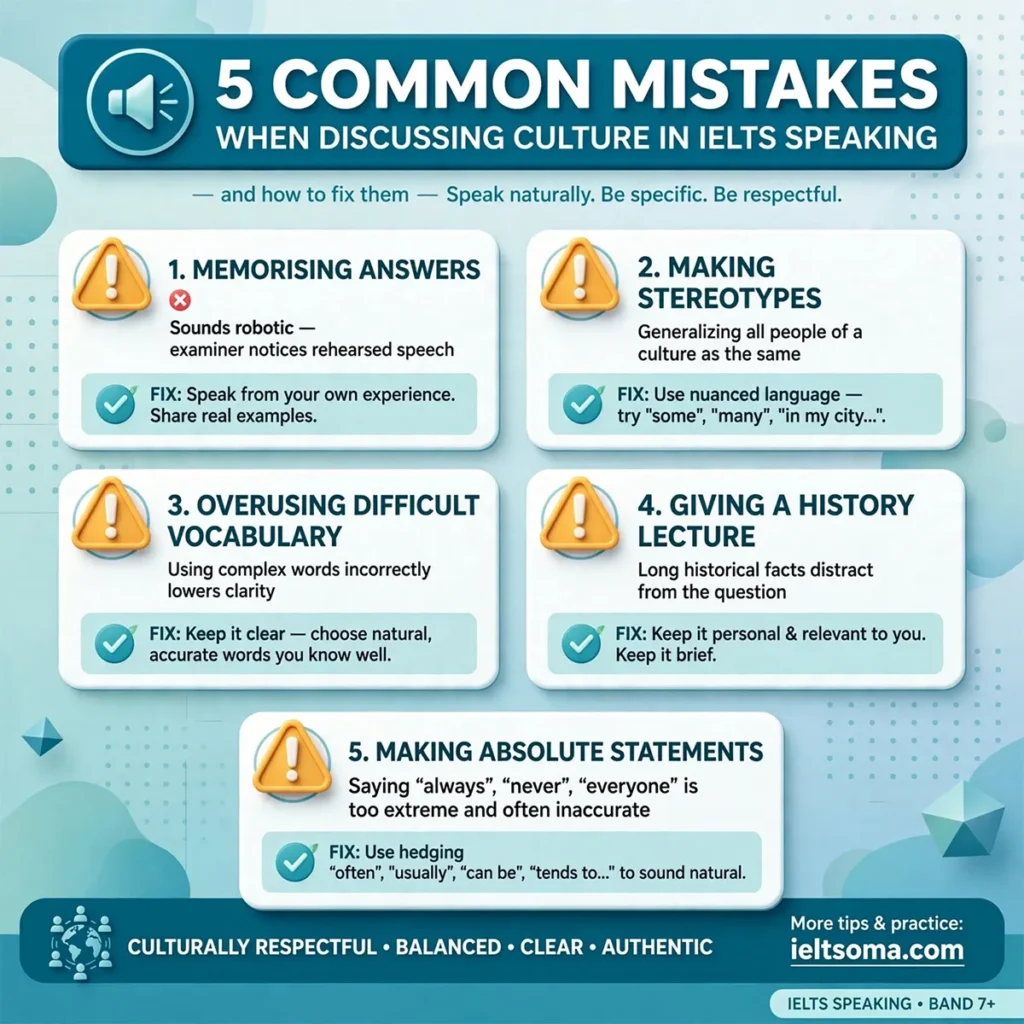
Memorising Cultural Answers
Memorised answers can become difficult to adapt when the examiner changes the question.
Prepare ideas and vocabulary instead.
Making Your Culture Sound Perfect
You do not need to present your culture as superior.
Balanced opinions often sound more natural:
“There are certainly benefits, although some traditions can also create pressure for younger people.”
Giving a History Lecture
The IELTS Speaking test is not a university history presentation.
Give enough background to make your point understandable, then move forward.
Using Difficult Words Incorrectly
Do not use “heritage”, “assimilation”, “multiculturalism” or “globalisation” simply because they sound advanced.
Use vocabulary you understand and can control.
Giving Extremely Short Answers
A one-sentence response may not give you enough opportunity to demonstrate your speaking ability.
Develop your answer with a reason, example or explanation when appropriate.
Speaking Too Quickly
Fast speech is not the same as fluent speech.
Official IELTS assessment guidance focuses on continuity, logical sequencing and comprehensible communication rather than simply speaking as quickly as possible.
Expert Practice: Build a Cultural Idea Bank
Before your test, create a one-page cultural idea bank.
Choose six areas:
- Food
- Festivals
- Family
- Education
- Traditions
- Generational change
For each area, prepare:
- Two personal experiences
- Three useful expressions
- Two reasons
- One comparison
- One example of change
For instance:
Family traditions
Experience:
- Family gathering during an important celebration
Vocabulary:
- family values
- close-knit family
- pass traditions down
Reasons:
- Strengthens relationships
- Maintains a sense of identity
Comparison:
- Older and younger generations
Change:
- Social media and migration have changed how families interact
This gives you a flexible pool of material without memorising complete answers.
How to Practise Cultural Influence in IELTS Speaking
Use this three-stage routine.
Stage 1: Think
Choose one question and spend 15–20 seconds identifying your main idea.
Stage 2: Speak
Talk for 60–90 seconds without reading notes.
Record yourself if possible.
Stage 3: Review
Listen again and ask:
- Did I answer the actual question?
- Did I explain my opinion?
- Did I give a specific example?
- Did I repeat the same words?
- Were my sentences grammatically accurate?
- Did I pause because I was thinking or because I was searching for vocabulary?
- Was my pronunciation easy to understand?
- Did I make unnecessary generalisations?
This type of self-review is much more useful than simply repeating the same answer several times.
Frequently Asked Questions About Cultural Influence in IELTS Speaking
Does IELTS Speaking test my knowledge of different cultures?
No. IELTS Speaking assesses your ability to communicate in English. Cultural topics may provide a context for discussion, but you are not expected to demonstrate specialist knowledge of culture.
Can I talk about my own culture in IELTS Speaking?
Yes. Your own experiences can provide useful and authentic examples, provided they are relevant to the question.
Should I use cultural vocabulary to get Band 7?
Not automatically. Vocabulary contributes to the Lexical Resource criterion, but IELTS evaluates the range, accuracy and appropriateness of your vocabulary.
Can I disagree with a cultural tradition?
Absolutely. You can express a positive, negative or mixed opinion as long as you explain your position clearly.
For example:
“I respect the tradition, but I don’t think every part of it is suitable for modern life.”
A balanced opinion can give you more opportunities to explain and justify your ideas.
What if the examiner asks about a culture I know nothing about?
Do not panic.
You can answer from your general knowledge, make a reasonable comparison, or explain what you think might happen.
For example:
“I’m not very familiar with that tradition, but based on what I’ve seen in documentaries and online, I imagine…”
The examiner is assessing your English, not testing your encyclopedic knowledge.
Should I mention my country in every IELTS Speaking answer?
No.
Use cultural references only when they genuinely help answer the question.
Forced cultural references can make your answers sound rehearsed.
Final Advice: Use Culture as a Resource, Not a Script
The smartest way to use Cultural Influence in IELTS Speaking is to treat culture as a bank of ideas.
Your background can give you experiences, examples, comparisons and opinions that are difficult to invent under pressure.
But the final performance depends on your English.
Use culture to answer questions.
Use personal experience to develop ideas.
Use precise vocabulary to express meaning.
Use examples to make abstract points clearer.
Use comparisons to extend Part 3 discussions.
And avoid turning your cultural knowledge into memorised speeches.
IELTS Speaking rewards effective communication. The official band descriptors emphasise the candidate’s ability to develop ideas, use language flexibly and communicate clearly across the four assessment criteria.
So, before your next practice session, choose one familiar cultural topic and ask yourself:
What do I believe about this, why do I believe it, and what real example can I give?
If you can answer those three questions naturally, you already have the foundation for a much stronger Speaking response.
For more IELTS preparation strategies, explore IELTSOMA’s IELTS Preparation Tips and IELTS Vocabulary Contextual Learning guides.