You know the word.
You have seen it before.
But when the IELTS examiner asks you a question, you suddenly cannot remember it.
Or perhaps you remember the word but use the wrong form, choose an unnatural collocation, or place it in a sentence where it does not quite fit.
This is one of the biggest problems with vocabulary learning: recognising a word is not the same as being able to use it.
That is why effective IELTS Vocabulary preparation requires more than downloading a long list of “advanced words” and trying to memorize them.
You need a system that helps you remember words, understand how they work, and use them naturally.
Flashcards can provide that system.
When designed properly, flashcards can help you review vocabulary regularly, practise active recall, learn words in context, and build useful combinations of words rather than memorising isolated definitions.
This guide explains 7 powerful ways to use flashcards for IELTS Vocabulary, with practical techniques you can apply to IELTS Academic and General Training preparation.
Table of Contents
Why IELTS Vocabulary Matters
Vocabulary is not a separate IELTS test section, but it plays an important role across the exam.
In IELTS Writing, Lexical Resource is one of the four assessment criteria. It considers the range of vocabulary you use and how accurately and appropriately you use it.
Vocabulary also matters directly in IELTS Speaking. The Speaking assessment includes Lexical Resource alongside Fluency and Coherence, Grammatical Range and Accuracy, and Pronunciation.
This means successful vocabulary development is not simply about knowing more words.
You need to develop:
- Range: the ability to use a variety of vocabulary.
- Accuracy: choosing and forming words correctly.
- Appropriacy: selecting language suitable for the context.
- Precision: expressing your intended meaning clearly.
- Collocation: knowing which words naturally occur together.
- Paraphrasing: expressing an idea in another way when necessary.
- Word formation: recognising related noun, verb, adjective, and adverb forms.
For example, knowing the word “benefit” is useful.
But stronger IELTS preparation means understanding:
- benefit from something
- a major benefit
- significant benefits
- beneficial
- financially beneficial
- the benefits of technology
You are no longer memorising one word.
You are learning a vocabulary network.
1. Select High-Impact Words for Your IELTS Vocabulary
The first mistake many learners make is trying to learn every difficult word they encounter.
That approach quickly becomes overwhelming.
Instead, choose vocabulary that is useful, relevant, and likely to help you communicate ideas across common IELTS topics.
What should you put on your flashcards?
Focus on:
- common academic vocabulary
- topic-specific vocabulary
- useful synonyms
- collocations
- phrasal verbs where appropriate
- descriptive language
- opinion and argument expressions
- common word families
- useful paraphrases
- vocabulary from your own mistakes
Common IELTS topics include:
- education
- technology
- environment
- health
- employment
- transportation
- tourism
- cities
- society
- culture
- media
- government
However, do not assume that every “advanced IELTS word” you find online is worth learning.
A sophisticated word that you cannot use accurately may be less useful than a common word you can use precisely.
Use the usefulness test
Before adding a word to your flashcard deck, ask:
Can I imagine myself using this word in an IELTS answer?
If the answer is yes, consider adding it.
If the word is extremely rare, difficult to pronounce, or unlikely to fit your communication needs, skip it unless you have a specific reason to learn it.
2. Create Better Flashcards
A weak flashcard looks like this:
Front: mitigate
Back: make less severe
You may remember the definition for a few days.
But can you use the word?
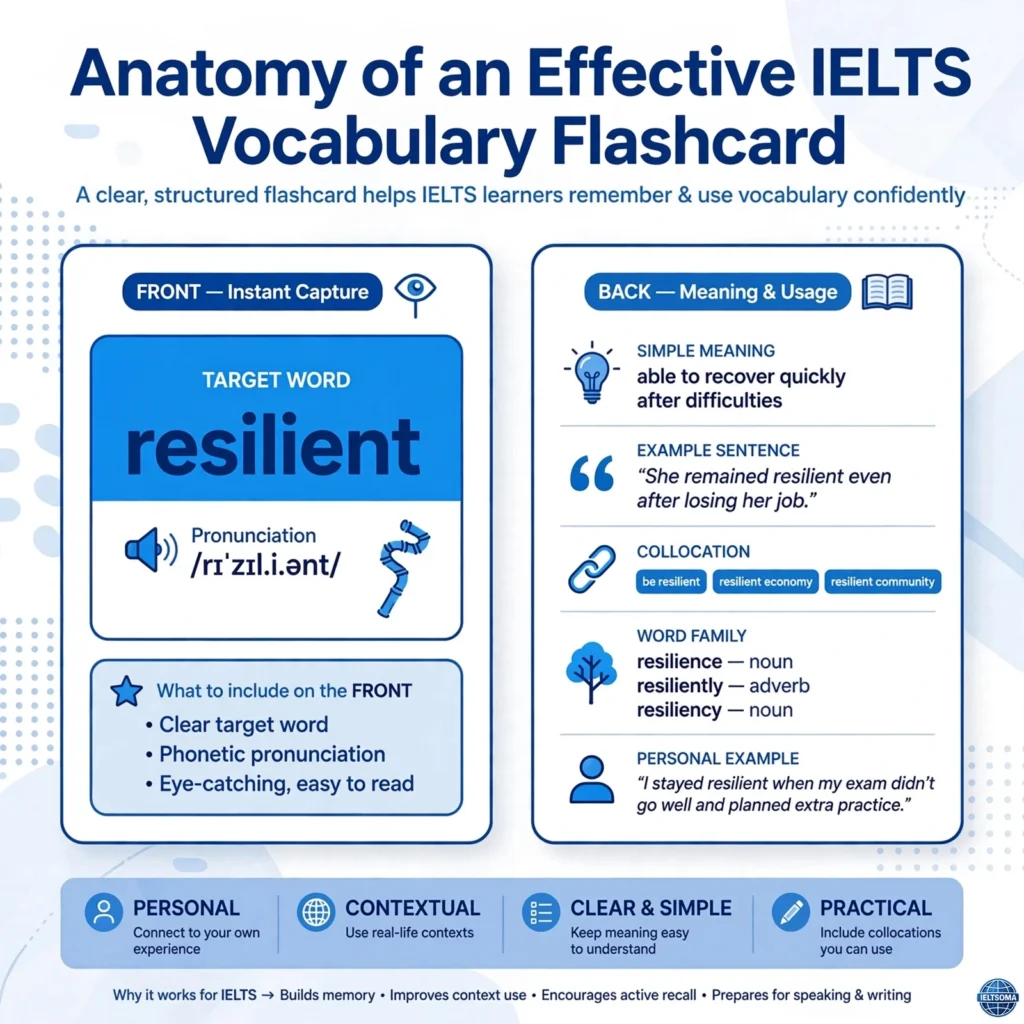
A better flashcard gives you more information.
Example
Front: mitigate
Back:
Meaning: make something less harmful or severe
Example: Governments can introduce policies to mitigate the effects of climate change.
Common combination: mitigate the effects / mitigate the risk
Word family: mitigation
Pronunciation: /ˈmɪtɪɡeɪt/
Now you are learning how the word behaves.
That matters because IELTS assesses how accurately and appropriately you use vocabulary, not simply whether you can recognise difficult words.
Keep each card focused
Do not put ten unrelated pieces of information on every card.
The goal is fast, repeated retrieval.
A useful flashcard can include:
- Target word or phrase
- Simple meaning
- Natural example sentence
- Common collocation
- Word form or family
- Pronunciation when needed
For difficult words, add a short personal example.
The more meaningful the example is to you, the easier it may be to retrieve later.
3. Learn IELTS Vocabulary in Context
One of the most important vocabulary principles is this:
Do not learn words alone. Learn how words work.
Suppose you learn the word “increase.”
You could memorise:
increase = become larger
But IELTS preparation becomes more useful when you learn combinations such as:
- increase significantly
- increase gradually
- increase rapidly
- a sharp increase
- a steady increase
- an increase in demand
Now you have several ways to express an idea.
This is particularly useful in IELTS Writing.
For Academic Writing Task 1, for example, candidates may need to describe changes shown in graphs, charts, or tables. Having a range of natural expressions for increases, decreases, comparisons, and trends can make your language more flexible.
Try the three-sentence technique
Whenever you learn an important word, write three sentences:
Sentence 1: Personal
I try to exercise regularly because it improves my overall health.
Sentence 2: IELTS topic
Regular physical activity can improve public health and reduce the risk of lifestyle-related diseases.
Sentence 3: Speaking style
I think exercise is particularly important for people who spend most of their day sitting at a desk.
This forces you to move from recognition to active use.
4. Use Spaced Repetition Instead of Cramming
Learning IELTS Vocabulary once is not enough.
You need repeated exposure.
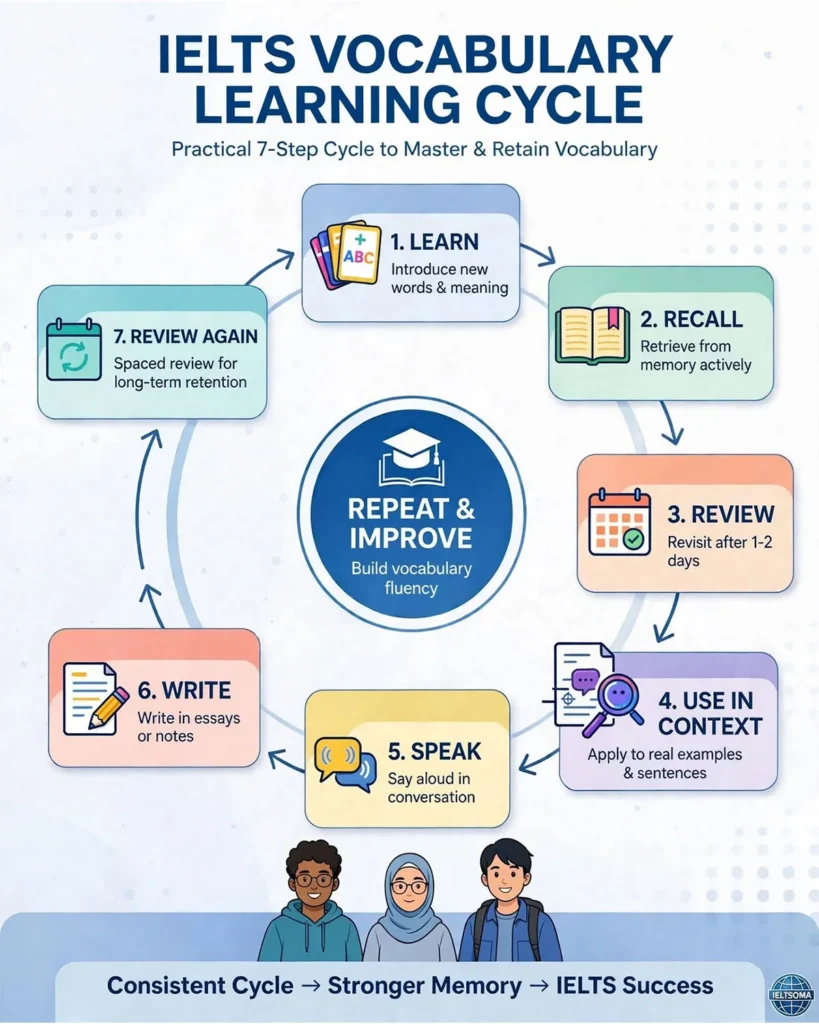
This is where spaced repetition can help.
Instead of reviewing 100 words every day, review words at increasingly spaced intervals based on how well you remember them.
For example:
Day 1
Learn new cards and test yourself later the same day.
Day 2
Review the cards and identify the words you cannot recall.
Day 4
Review difficult cards again.
Day 7
Test yourself without looking at the definitions.
Week 2
Review the words again and use selected vocabulary in speaking or writing.
Week 3–4
Continue reviewing words that remain difficult while reducing attention to words you can consistently recall.
The exact schedule does not need to be identical for every learner.
The important principle is to retrieve vocabulary repeatedly rather than simply reread it.
Use a confidence system
After answering a flashcard, classify it:
Easy: I recalled it immediately.
Medium: I remembered it after thinking.
Difficult: I could not remember it.
Spend more time on difficult cards.
This makes your study sessions more efficient.
5. Turn Passive Vocabulary Into Active IELTS Vocabulary
Recognising a word while reading is passive knowledge.
Using it accurately in your own sentence is active knowledge.
For IELTS Speaking and Writing, active vocabulary is particularly important because you need to produce language yourself.
After learning a word, perform an action with it.
Try these active exercises
Explain it
Define the word without looking at the definition.
Use it
Create your own sentence.
Compare it
Think of a synonym and explain the difference.
Oppose it
Find an appropriate opposite.
Paraphrase it
Express the same idea without using the target word.
Speak it
Use the word in a 30-second response.
Write it
Use the word in an IELTS-style paragraph.
For example, if your target word is “conventional,” you could say:
Some people still prefer conventional teaching methods, while others believe technology can make education more effective.
Then paraphrase the idea:
Traditional approaches to education remain popular, although digital tools are becoming increasingly common.
This type of practice helps you develop flexibility rather than relying on one memorised expression.
Official IELTS Speaking criteria specifically recognise the importance of vocabulary range, appropriacy, collocation, idiomatic language, and paraphrasing.
6. Use Digital Flashcards Strategically
You do not need to create paper flashcards if digital tools fit your study habits better.
Apps such as Anki and Quizlet can make it easier to organise vocabulary, review cards, and study across multiple devices.
But the app itself will not improve your IELTS Vocabulary.
Your study method matters more than the software.
Build separate decks
Instead of creating one enormous vocabulary collection, consider organising your cards into smaller groups.
For example:
- IELTS Environment Vocabulary
- IELTS Education Vocabulary
- IELTS Health Vocabulary
- IELTS Technology Vocabulary
- IELTS Speaking Vocabulary
- IELTS Writing Vocabulary
- IELTS Academic Task 1 Vocabulary
- IELTS General Training Vocabulary
- Personal Mistakes
This makes revision more focused.
Create a “mistake deck”
This can become one of your most valuable vocabulary resources.
Whenever you make a vocabulary-related mistake in a practice test, writing task, or Speaking recording, add it to your deck.
For example:
Incorrect: discuss about the problem
Correct: discuss the problem
Or:
Weak: very big problem
Better: significant problem / major issue
Your personal mistakes are highly relevant because they show exactly where your vocabulary needs improvement.
7. Monitor Your IELTS Vocabulary Progress
Counting how many words you have learned is not the best way to measure vocabulary development.
You might learn 500 words and still struggle to use them naturally.
Instead, measure what you can do with your vocabulary.
Track these areas
Recognition
Can you understand the word when you see or hear it?
Recall
Can you remember the meaning without looking?
Production
Can you use it correctly in a sentence?
Collocation
Can you combine it naturally with other words?
Paraphrasing
Can you express the same idea using different language?
Accuracy
Can you use the correct word form, spelling, and grammatical pattern?
Use your IELTS practice to measure progress
Once a week, complete a short Writing or Speaking exercise.
Then review your vocabulary.
Ask:
- Did I repeat the same words too often?
- Did I use useful topic-specific vocabulary?
- Did I make word-choice errors?
- Did I use any unnatural collocations?
- Did I use words I had recently learned?
- Did those words actually fit the context?
Official IELTS Writing guidance emphasises that Lexical Resource includes vocabulary range, accuracy, appropriacy, precision, collocations, idiomatic expressions, spelling, and word formation.
This is much more meaningful than simply saying, “I learned 30 new words this week.”
Build IELTS Vocabulary by Topic
Flashcards become even more effective when you organise vocabulary around common IELTS themes.
Environment
Useful vocabulary might include:
- climate change
- renewable energy
- carbon emissions
- biodiversity
- environmental damage
- conservation
- sustainable development
But do not stop at definitions.
Learn combinations such as:
reduce carbon emissions
protect biodiversity
promote sustainable development
Education
Build vocabulary around:
- higher education
- academic achievement
- vocational training
- educational inequality
- learning environment
- teaching methods
- access to education
Then practise putting these expressions into arguments.
Technology
Useful areas include:
- artificial intelligence
- digital communication
- technological advancement
- online privacy
- automation
- digital literacy
- remote working
The objective is not to memorise a “perfect vocabulary list.”
It is to develop enough flexible language to discuss familiar IELTS topics accurately.
Learn Word Families for Greater Flexibility
Word families can help you understand how one idea changes depending on its grammatical role.
Consider:
benefit — noun/verb
beneficial — adjective
beneficially — adverb, though less commonly needed
Or:
educate — verb
education — noun
educational — adjective
educator — noun
When you create flashcards, record useful forms.
For example:
educate → verb
education → noun
educational → adjective
educator → person
Then practise each form in a sentence.
This can reduce word-formation mistakes and give you more flexibility in Writing and Speaking.
Learn Collocations, Not Just Individual Words
A collocation is a combination of words that commonly occurs together.
For example:
- make a decision
- reach an agreement
- conduct research
- pose a threat
- play a role
- take measures
- raise awareness
- economic growth
- serious consequences
- highly effective
Compare:
make research
with:
conduct research
The second combination is natural English.
This is why a strong IELTS Vocabulary strategy should include phrases and collocations.
The official IELTS Writing criteria specifically consider collocation and sophisticated phrasing as part of Lexical Resource.
Flashcard format for collocations
Front: What verb commonly goes with “awareness”?
Back: raise awareness
Then create a sentence:
Governments can raise awareness of the environmental impact of excessive consumption.
This tests retrieval and usage at the same time.
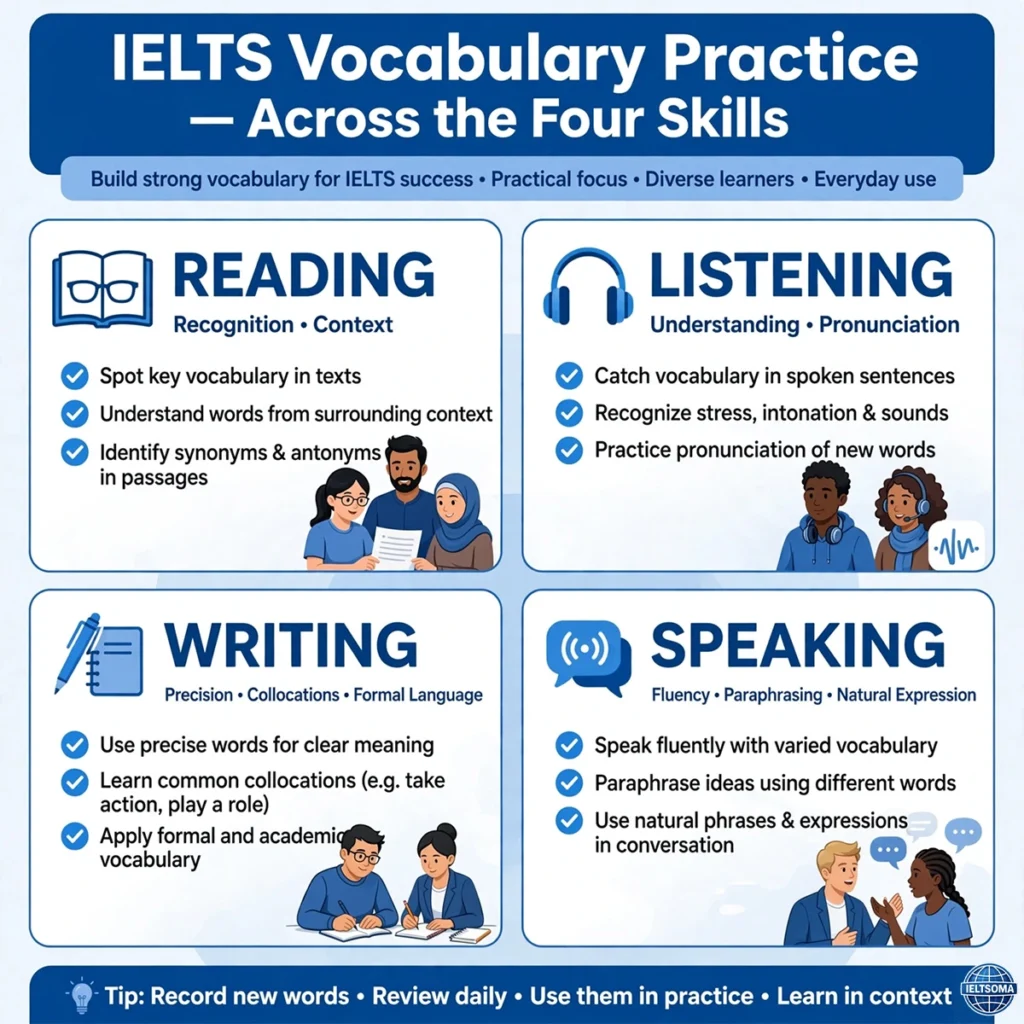
Tailor IELTS Vocabulary to Each Test Component
Not all vocabulary practice should look the same.
Your target should depend on the skill you are practising.
IELTS Writing Task 1
Academic candidates should practise language for:
- increases
- decreases
- comparisons
- proportions
- trends
- quantities
- processes
- stages
General Training candidates should practise language for:
- formal letters
- semi-formal communication
- informal letters
- requests
- complaints
- explanations
- invitations
IELTS Writing Task 2
Focus on:
- expressing opinions
- explaining causes
- describing effects
- comparing advantages and disadvantages
- presenting examples
- discussing solutions
- developing arguments
IELTS Speaking Part 1
Focus on natural vocabulary for familiar subjects:
- home
- family
- work
- studies
- hobbies
- food
- travel
- daily routines
IELTS Speaking Part 2
Build descriptive language for:
- people
- places
- experiences
- objects
- events
- activities
IELTS Speaking Part 3
Develop vocabulary for:
- opinions
- causes
- consequences
- comparisons
- social trends
- advantages
- disadvantages
- predictions
The goal is flexible communication, not memorised speeches.
How Many Words Should You Learn for IELTS?
There is no single official number of vocabulary words that guarantees a particular IELTS band score.
More vocabulary does not automatically mean a higher score.
What matters is whether you can use vocabulary with an appropriate range, accuracy, precision, and flexibility.
For example, knowing 1,000 words that you can use confidently may be more useful in productive tasks than memorising thousands of words that you recognise but cannot produce accurately.
Your target should therefore be:
Learn fewer words deeply rather than many words superficially.
For each important word, aim to understand its meaning, word forms, pronunciation, collocations, context, and common alternatives.
A Practical 30-Minute IELTS Vocabulary Routine
You do not need several hours every day.
A focused 30-minute routine can be easier to maintain.
Minutes 1–10: Review
Review older flashcards.
Prioritise difficult words.
Minutes 11–15: Learn
Add five to ten useful new words or phrases.
Avoid adding dozens of words simply to increase your card count.
Minutes 16–20: Context
Create sentences using your new vocabulary.
Use IELTS topics whenever possible.
Minutes 21–25: Speaking
Choose two or three words and use them in a short spoken response.
Record yourself if possible.
Minutes 26–30: Writing
Write a short paragraph containing two or three target expressions.
Then check whether the vocabulary actually fits the context.
This final step is important.
A word should not be included simply because you learned it.
Use it because it improves your meaning.
Common IELTS Vocabulary Mistakes to Avoid
Memorising difficult words without understanding them
A complicated word is not automatically a better word.
Learning synonyms without learning differences
Words that look similar may differ in meaning, formality, or usage.
Ignoring collocations
Knowing individual words is not enough if you combine them unnaturally.
Using idioms everywhere
Idiomatic language should be used appropriately. The official IELTS guidance notes the relevance of idiomatic language in higher Speaking bands, but that does not mean every answer should contain memorised idioms.
Repeating the same vocabulary
Paraphrasing can help you avoid unnecessary repetition, but do not replace words with inaccurate synonyms simply for variety.
Learning vocabulary without using it
A flashcard is only the beginning.
Use the word in speaking and writing.
Trying to sound “too advanced”
Natural, accurate vocabulary is more useful than impressive-looking vocabulary used incorrectly.
Frequently Asked Questions About IELTS Vocabulary
How can I improve my IELTS Vocabulary quickly?
Use a focused system based on active recall, spaced review, context, collocations, and regular Speaking and Writing practice. Learning a smaller number of useful words deeply can be more effective than memorizing large lists.
Are flashcards good for IELTS Vocabulary?
Yes. Flashcards can be useful for learning and reviewing vocabulary, particularly when they include context, collocations, word forms, and examples rather than only dictionary definitions.
How many IELTS vocabulary words should I learn per day?
There is no universal number. A practical starting point is around five to ten useful words or phrases per day, provided you also review older vocabulary and actively use what you learn.
Should I learn synonyms for IELTS?
Yes, but learn them carefully. Synonyms can help you paraphrase and avoid unnecessary repetition, but similar words are not always interchangeable. Learn each word in context and check its collocations and level of formality.
What vocabulary is important for IELTS Speaking?
Useful Speaking vocabulary includes language for expressing opinions, describing experiences, explaining reasons, comparing ideas, discussing advantages and disadvantages, and developing answers. You also need vocabulary that sounds natural for the topic and situation.
What vocabulary is important for IELTS Writing?
You need vocabulary that allows you to discuss the task accurately and appropriately. Depending on the task, this can include language for trends, comparisons, arguments, causes, effects, solutions, opinions, and examples.
Should I memorize idioms for IELTS Speaking?
Do not memorize large collections of idioms simply to sound advanced. Learn useful expressions in context and use them only when they fit naturally. The IELTS Speaking assessment considers vocabulary range, appropriacy, collocation, idiomatic language, and paraphrasing.
Is IELTS Vocabulary different for Academic and General Training?
Some vocabulary overlaps because both tests assess your ability to communicate in English. However, preparation should reflect the different tasks. Academic candidates may need more practice with academic and formal language, while General Training candidates should also develop vocabulary for everyday and workplace communication.
How do I remember difficult IELTS words?
Use repeated retrieval. Review difficult words at spaced intervals, create personal example sentences, learn collocations, and use the words in Speaking and Writing. Connecting a word to a meaningful context can make it easier to recall.
Can I use the same flashcards for IELTS Reading and Speaking?
You can but add different practice activities. Reading requires you to recognize and understand vocabulary, while Speaking requires you to retrieve and produce it. Turn important Reading vocabulary into active Speaking practice.
Conclusion: Build IELTS Vocabulary You Can Actually Use
A strong IELTS Vocabulary is not created by memorising the longest possible word list.
It is built by learning useful language deeply and repeatedly putting it into practice.
Flashcards can help you create that system.
Select high-impact words.
Build better cards.
Learn vocabulary in context.
Use spaced repetition.
Practise active recall.
Study collocations and word families.
Track your progress through real IELTS tasks.
Most importantly, use the vocabulary you learn.
When a new word moves from a flashcard into a sentence, then into a paragraph, and finally into a natural Speaking response, it becomes much more valuable.
Your goal is not to impress the examiner with difficult words.
Your goal is to communicate your ideas accurately, naturally, precisely, and flexibly.
That is the foundation of effective IELTS Vocabulary preparation.
Start with five useful words today.
Learn them deeply.
Use them in context.
Review them tomorrow.
Then use them again.
Over time, this simple habit can turn vocabulary learning from a frustrating memorization exercise into a practical part of your IELTS preparation.
Useful Links: