If you are preparing for IELTS Writing, you have probably heard the same advice again and again: “Use advanced vocabulary.”
But there is a problem with that advice.
Many candidates memorise difficult words, insert them into every essay, and expect their Writing score to rise. Instead, they often create awkward sentences, misuse collocations, repeat the same phrases, or choose words that do not fit the context.
The real secret is not to use the most complicated vocabulary.
It is to use the right vocabulary accurately, naturally and flexibly.
That is what makes IELTS Writing Task Vocabulary valuable.
In IELTS Writing, Lexical Resource is one of the four assessment criteria. It considers the range of vocabulary you use, as well as how accurately and appropriately you use it. The official Band 7 and Band 8 descriptors also look for flexibility, precision, awareness of style and collocation, with higher bands requiring increasingly sophisticated control.
This guide gives you 25 useful words and phrases for IELTS Writing, explains where they work best, and shows you how to use them without making your writing sound memorised.
Table of Contents
What Makes Good IELTS Writing Task Vocabulary?
Good IELTS Writing Task Vocabulary has four important characteristics:
- It is relevant to the topic.
- It is accurate in meaning and grammar.
- It fits the style and purpose of the task.
- It combines naturally with other words.
For example, consider these two sentences:
Governments should make an important effort to reduce pollution.
The meaning is understandable, but “make an important effort” is not the most natural collocation.
A better version is:
Governments should make a concerted effort to reduce pollution.
The second sentence demonstrates more precise vocabulary because “concerted effort” is a natural combination.
This distinction matters.
IELTS does not simply ask whether you know difficult words. Lexical Resource assesses how effectively you use vocabulary to communicate meaning.
25 IELTS Writing Task Vocabulary Words and Phrases
1. Significant
Meaning: Important or noticeable in size, amount or effect.
Useful for: Academic Task 1 and Task 2.
Example:
There was a significant increase in the number of people using public transport.
Other useful combinations include:
- significant change
- significant difference
- significant increase
- significant decline
- significant impact
2. Substantial
Meaning: Large or considerable.
Useful for: Data description and formal essays.
Example:
The company experienced a substantial increase in revenue during the second half of the year.
Use “substantial” when the size or effect is genuinely considerable.
3. Gradual
Meaning: Happening slowly over a period of time.
Useful for: Academic Writing Task 1.
Example:
The graph shows a gradual decline in the number of people purchasing newspapers.
Common combinations include:
- gradual increase
- gradual decline
- gradual change
- gradual recovery
4. Dramatic
Meaning: Very large or sudden.
Useful for: Academic Task 1 when describing major changes.
Example:
The percentage of households with internet access experienced a dramatic increase after 2010.
Do not use “dramatic” for every change. The vocabulary should reflect the actual data.
5. Remained stable
Meaning: Stayed approximately the same.
Useful for: Academic Task 1.
Example:
The proportion of residents who travelled by car remained stable throughout the period.
This is far more useful than repeatedly writing “did not change”.
6. Fluctuated
Meaning: Changed repeatedly, usually moving up and down.
Useful for: Line graphs and data descriptions.
Example:
The price of oil fluctuated considerably between 2015 and 2020.
Remember that “fluctuated” suggests variation rather than a simple upward or downward movement.
7. Accounted for
Meaning: Represented a particular amount or proportion.
Useful for: Academic Task 1.
Example:
Renewable energy accounted for approximately 30% of total electricity production.
This is particularly useful when describing percentages and proportions.
8. Proportion
Meaning: A part or percentage of a whole.
Useful for: Academic Task 1.
Example:
The proportion of students studying abroad increased considerably.
You can also use:
- proportion of residents
- proportion of households
- proportion of students
- proportion of expenditure
9. Whereas
Meaning: Used to contrast two facts or situations.
Useful for: Task 1 comparisons and Task 2 essays.
Example:
The percentage of younger participants increased, whereas the figure for older participants declined.
It is useful for creating concise comparisons.
10. In contrast
Meaning: Used to introduce an opposing or different point.
Example:
Spending on transport increased steadily. In contrast, expenditure on entertainment fell.
Do not use contrast expressions simply because you have memorised them. There should be a genuine difference between the ideas.
11. Consequently
Meaning: As a result.
Useful for: Task 2 cause-and-effect arguments.
Example:
Many employees now work remotely. Consequently, demand for office space has declined in some areas.
Other alternatives include:
- therefore
- as a result
- thus
- hence
12. Nevertheless
Meaning: Despite what has just been stated.
Useful for: Balanced arguments and concessions.
Example:
Online education is convenient for many students. Nevertheless, it may not provide the same level of interaction as face-to-face teaching.
This can help you present a contrasting consideration without abandoning your main argument.
13. Furthermore
Meaning: In addition; adding another supporting point.
Example:
Public transport can reduce congestion. Furthermore, it can lower the number of private vehicles on the road.
Use it selectively. A well-organised essay does not need a linking word at the beginning of every sentence.
14. A key factor
Meaning: An important reason or influence.
Useful for: Task 2 essays.
Example:
A key factor behind the growth of online shopping is the convenience it offers consumers.
This is often more natural than repeatedly writing “one important reason”.
15. Play a crucial role
Meaning: Have an extremely important influence.
Example:
Schools play a crucial role in developing children’s social and communication skills.
Useful combinations include:
- play a crucial role
- play a significant role
- play an important role
16. Address
Meaning: Deal with a problem or issue.
Useful for: Problem-solution essays.
Example:
Governments must take effective measures to address the problem of urban congestion.
Do not confuse “address” in this context with a postal address.
17. Mitigate
Meaning: Reduce the seriousness or harmful effects of something.
Useful for: Environmental and problem-solution essays.
Example:
Investment in renewable energy could help mitigate the effects of climate change.
This is a useful advanced word, but only when you understand precisely what it means.
18. Widespread
Meaning: Existing or happening across a large area or among many people.
Example:
The widespread use of smartphones has changed the way people communicate.
Common combinations include:
- widespread adoption
- widespread use
- widespread concern
- widespread availability
19. Beneficial
Meaning: Producing a positive effect.
Example:
Regular physical activity is beneficial to both physical and mental health.
Be careful with prepositions and collocations. “Beneficial to” is a useful pattern to learn as a complete phrase.
20. Adverse
Meaning: Harmful or negative.
Example:
Excessive dependence on technology may have adverse effects on social interaction.
Common combinations include:
- adverse effects
- adverse consequences
- adverse impact
21. Enhance
Meaning: Improve the quality, value or effectiveness of something.
Example:
Public investment in parks can enhance the quality of life in urban communities.
This can be a useful alternative to repeatedly using “improve”.
22. Facilitate
Meaning: Make something easier or help something happen.
Example:
Digital technology can facilitate access to educational resources.
A common mistake is using “facilitate” when “cause” is intended. The word means to make a process easier, not necessarily to create the outcome itself.
23. Sustainable
Meaning: Able to continue without causing unacceptable long-term damage or depletion.
Example:
Governments should encourage sustainable forms of transport in major cities.
This word is particularly useful for topics involving:
- environment
- energy
- urban development
- agriculture
- transport
- economic growth
24. Inevitably
Meaning: In a way that cannot reasonably be avoided.
Example:
As cities expand, they will inevitably face greater pressure on transport infrastructure.
Use strong adverbs carefully. Do not claim something is inevitable unless your argument supports that degree of certainty.
25. A growing concern
Meaning: An issue that is becoming increasingly worrying or important.
Example:
The excessive use of social media has become a growing concern among parents and educators.
This phrase works particularly well in introductions and topic discussions.
IELTS Writing Task Vocabulary for Academic Task 1
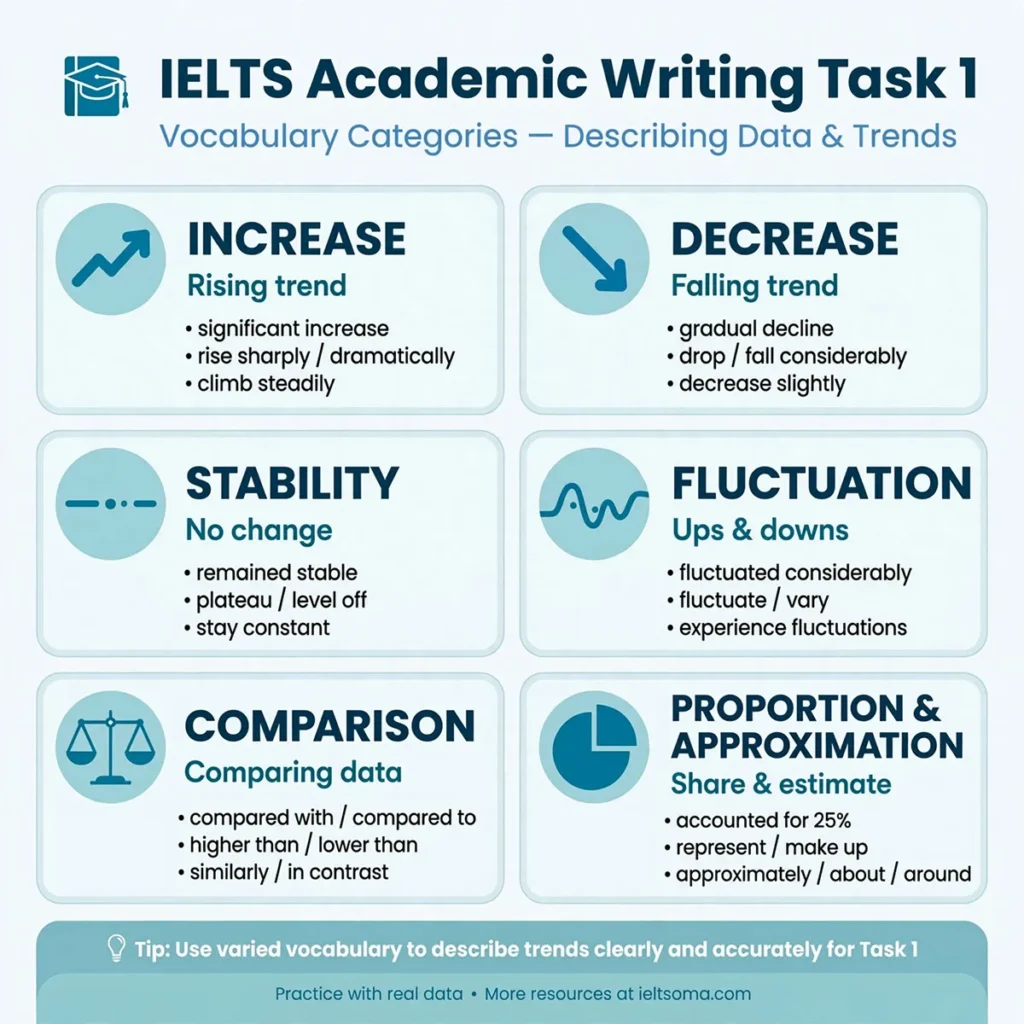
Academic Writing Task 1 requires you to describe visual information such as graphs, charts, tables, diagrams or processes. You need to select and report the important information rather than simply describe every detail.
Useful vocabulary can be grouped according to function.
Describing increases
Use:
- increase
- rise
- grow
- climb
- surge
- upward trend
Example:
The number of international students increased steadily between 2010 and 2015.
Describing decreases
Use:
- decrease
- decline
- fall
- drop
- decrease gradually
- decline sharply
Example:
The figure declined gradually over the following decade.
Describing stability
Use:
- remain stable
- remain unchanged
- level off
- remain constant
Example:
The percentage remained relatively stable from 2018 onwards.
Describing comparisons
Use:
- compared with
- in comparison with
- whereas
- while
- respectively
- considerably higher than
- slightly lower than
Example:
In 2020, the figure for private transport was considerably higher than that for cycling.
The important point is not to memorise every synonym. Learn which words accurately describe the visual information you are given.
IELTS Writing Task Vocabulary for General Training Task 1
General Training Task 1 requires a letter responding to a situation. Candidates may need to request information, explain a situation, express needs or provide an opinion. The style must be appropriate for the audience and purpose.
This means vocabulary should change according to the relationship with the recipient.
Formal vocabulary
Useful phrases include:
- I am writing to enquire about…
- I would be grateful if…
- I would appreciate it if…
- I am writing to express my concern regarding…
- I look forward to hearing from you.
Semi-formal vocabulary
You might write:
I am writing to ask about…
I would appreciate some information about…
Could you please let me know whether…?
Informal vocabulary
When writing to a friend, natural conversational language is more appropriate:
I was really pleased to hear that…
I just wanted to let you know that…
It would be great if you could…
The best IELTS Writing Task Vocabulary is therefore not identical for every task. Register matters.
IELTS Writing Task Vocabulary for Task 2 Essays
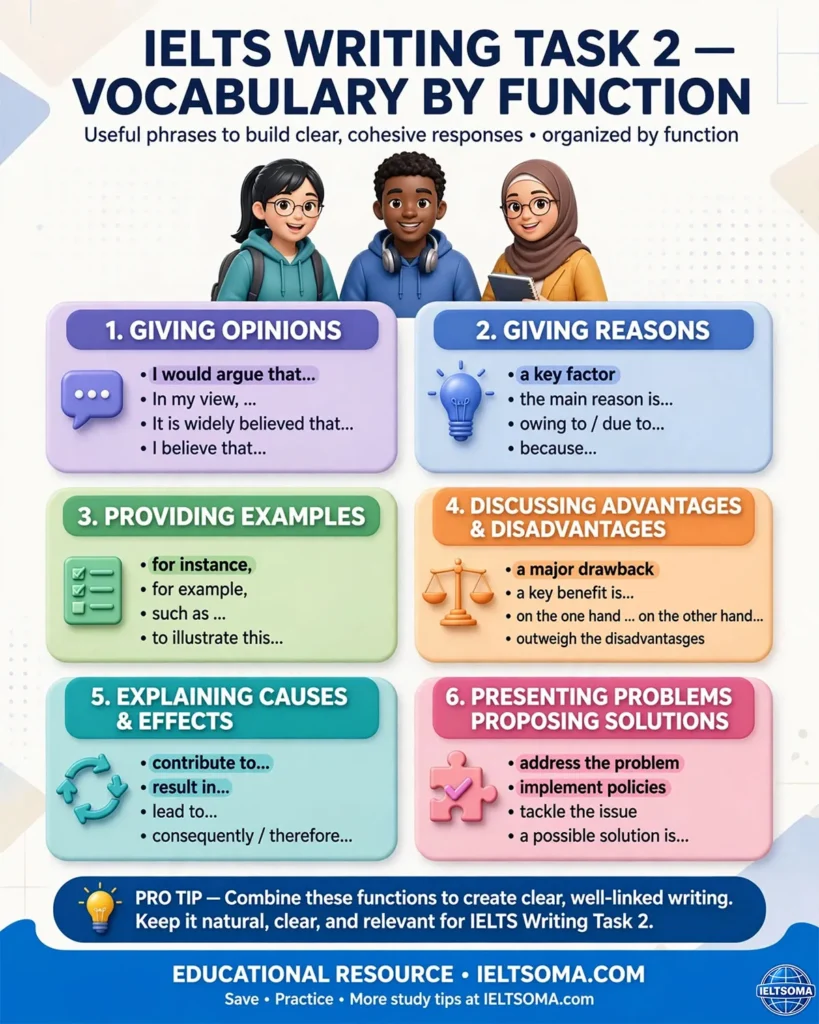
Task 2 asks candidates to respond to a point of view, argument or problem. Both Academic and General Training candidates need to develop ideas clearly and support them with relevant examples or evidence. Task 2 also carries more weight than Task 1 in the overall Writing score.
Here are useful vocabulary patterns by purpose.
Giving an opinion
- I believe that…
- In my view…
- I would argue that…
- It is reasonable to suggest that…
- From my perspective…
Example:
I would argue that governments should prioritise investment in public transport.
Giving reasons
- a key factor is…
- one major reason is…
- this can be attributed to…
- this is largely because…
- one explanation for this is…
Giving examples
- for example
- for instance
- such as
- a clear example of this is…
- this can be seen in…
Discussing advantages and disadvantages
- a major advantage
- a significant drawback
- a potential benefit
- a serious disadvantage
- a long-term consequence
Discussing causes and effects
- contribute to
- result in
- lead to
- give rise to
- stem from
- consequently
- as a result
Example:
Excessive reliance on private cars can contribute to traffic congestion and air pollution.
Discussing solutions
- address the problem
- introduce measures
- implement policies
- tackle the issue
- reduce the impact
- mitigate the effects
Example:
Governments could implement policies that encourage people to use public transport.
How to Use IELTS Writing Task Vocabulary Naturally
The biggest mistake is treating vocabulary as a list of words that must be inserted into an essay.
Instead, learn collocations.
A collocation is a combination of words that naturally occur together.
For example:
significant increase
is more useful than simply memorising:
significant = important
Likewise:
pose a threat
is more useful than memorising:
pose = present
And:
address an issue
is more useful than learning:
address = deal with
When learning IELTS Writing Task Vocabulary, record the word together with two or three natural combinations.
This gives you vocabulary that is ready to use in context.
Do Not Memorise “Band 9 Words”
There is no magic list of words that automatically produces Band 9.
The official Band 9 descriptor refers to a wide range of vocabulary used with very natural and sophisticated control. Band 8 requires a wide resource used fluently and flexibly to convey precise meanings, while Band 7 requires sufficient range to allow some flexibility and precision, alongside awareness of style and collocation.
That means:
“utilise”
is not automatically better than:
“use”.
If “use” is the natural word, use it.
Likewise, forcing unusual synonyms into an essay can make your writing less precise rather than more advanced.
IELTS Writing Vocabulary Mistakes to Avoid
Using a word without knowing its exact meaning
If you are unsure whether a word is appropriate, do not use it simply because it sounds academic.
Repeating the same vocabulary
Using “important” five times is less effective than varying your language appropriately:
- important
- significant
- crucial
- essential
- influential
However, do not replace every repeated word with an unnatural synonym.
Using memorised phrases everywhere
Phrases such as “in this modern era” or “every coin has two sides” can make essays sound formulaic.
Focus on answering the actual question.
Ignoring collocation
A word can be correct individually but wrong in combination.
For example, learn:
make a decision
rather than trying to create combinations such as:
do a decision
Using informal vocabulary in academic writing
Avoid unnecessarily conversational expressions such as:
kids
loads of
stuff
a lot of people reckon
Choose language appropriate to the task.
Using vocabulary that is too strong
Words such as “always”, “never”, “everyone” and “inevitably” make very strong claims.
Use them only when the argument genuinely supports them.
How to Build Your IELTS Writing Task Vocabulary
Do not try to learn 500 new words in one week.
Instead, build vocabulary systematically.
Choose common IELTS themes such as:
- education
- technology
- environment
- health
- transport
- employment
- crime
- government
- globalisation
- society
For each topic, learn:
10 useful nouns + 10 verbs + 10 adjectives + useful collocations.
Then write short paragraphs using those words.
For example, for education:
access to education
educational resources
academic performance
vocational training
equal opportunities
acquire knowledge
develop skills
improve employability
enhance learning
educational institutions
The next step is to use these expressions in complete sentences.
That is how passive vocabulary becomes active vocabulary.
A Practical IELTS Writing Vocabulary Strategy
Before your exam, create a vocabulary notebook with five columns:
| Word/Phrase | Meaning | Collocation | Example | Topic |
|---|---|---|---|---|
| mitigate | reduce harmful effects | mitigate the impact | Policies can mitigate the impact of pollution. | Environment |
| substantial | large | substantial increase | There was a substantial increase in demand. | Task 1 |
| facilitate | make easier | facilitate access | Technology can facilitate access to education. | Education |
| adverse | harmful | adverse effects | Pollution has adverse effects on health. | Environment |
Review the sentences, not just the individual words.
This approach helps you remember how vocabulary actually works.
Frequently Asked Questions About IELTS Writing Task Vocabulary
What vocabulary should I use in IELTS Writing?
Use vocabulary that is relevant, accurate, appropriate and flexible. Learn topic-specific words, collocations, comparison language, cause-and-effect expressions and phrases for developing arguments.
Does advanced vocabulary increase my IELTS Writing score?
Advanced vocabulary can help when it is used accurately and appropriately. Simply using difficult words does not guarantee a higher score. IELTS Lexical Resource assesses range as well as accuracy, appropriacy and flexibility.
How many vocabulary words should I learn for IELTS Writing?
There is no official number you need to memorize. A smaller collection of useful words and collocations that you can use accurately is generally more valuable than a huge list of words you rarely understand or use correctly.
What vocabulary is useful for IELTS Academic Writing Task 1?
Useful categories include language for increases, decreases, stability, fluctuations, comparisons, proportions and approximate quantities. The exact vocabulary should depend on the visual information presented.
What vocabulary is useful for IELTS Writing Task 2?
Useful Task 2 vocabulary includes language for opinions, reasons, examples, advantages, disadvantages, causes, effects, problems, solutions and concessions. Topic-specific vocabulary is also important.
Should I use idioms in IELTS Writing?
Use idiomatic or less common expressions only when they are appropriate and natural. Memorized idioms are not necessary for a high Writing score and can make formal writing sound inappropriate.
Is “moreover” better than “also” in IELTS Writing?
Not automatically. “Moreover” can be appropriate in formal writing, but using different linking words does not by itself improve your score. What matters is whether ideas are logically connected and the vocabulary is used accurately.
How can I improve my Lexical Resource in IELTS Writing?
Learn vocabulary in context, study collocations, practice paraphrasing, write regularly, review your repeated errors and replace inaccurate or repetitive expressions with precise alternatives.
Is vocabulary more important than grammar in IELTS Writing?
Neither should be treated as a replacement for the other. Lexical Resource and Grammatical Range and Accuracy are separate assessment criteria, alongside Task Achievement/Task Response and Coherence and Cohesion.
Does Task 2 vocabulary matter more than Task 1 vocabulary?
Task 2 contributes more to the overall Writing score than Task 1, so strong Task 2 performance is particularly important. However, candidates should still develop appropriate vocabulary for both tasks.
Conclusion
The best IELTS Writing Task Vocabulary is not necessarily the most complicated vocabulary you can find.
It is vocabulary that allows you to express your meaning precisely, naturally and appropriately.
For Task 1, learn language for describing trends, comparisons, proportions, changes and processes. For General Training Task 1, learn how register changes between formal, semi-formal and informal letters. For Task 2, develop vocabulary for opinions, causes, effects, examples, comparisons, problems and solutions.
Most importantly, learn words with their collocations and example sentences.
Instead of memorising:
“mitigate = reduce”
learn:
“mitigate the impact of climate change”
Instead of memorising:
“significant = important”
learn:
“a significant increase in…”
That small change can make your vocabulary more accurate, flexible and useful in the exam.
And remember: you do not need to impress the examiner with a dictionary.
You need to show that you can control the language you choose.