You can know plenty of English and still walk out of the IELTS Speaking test disappointed with your band score.
Why?
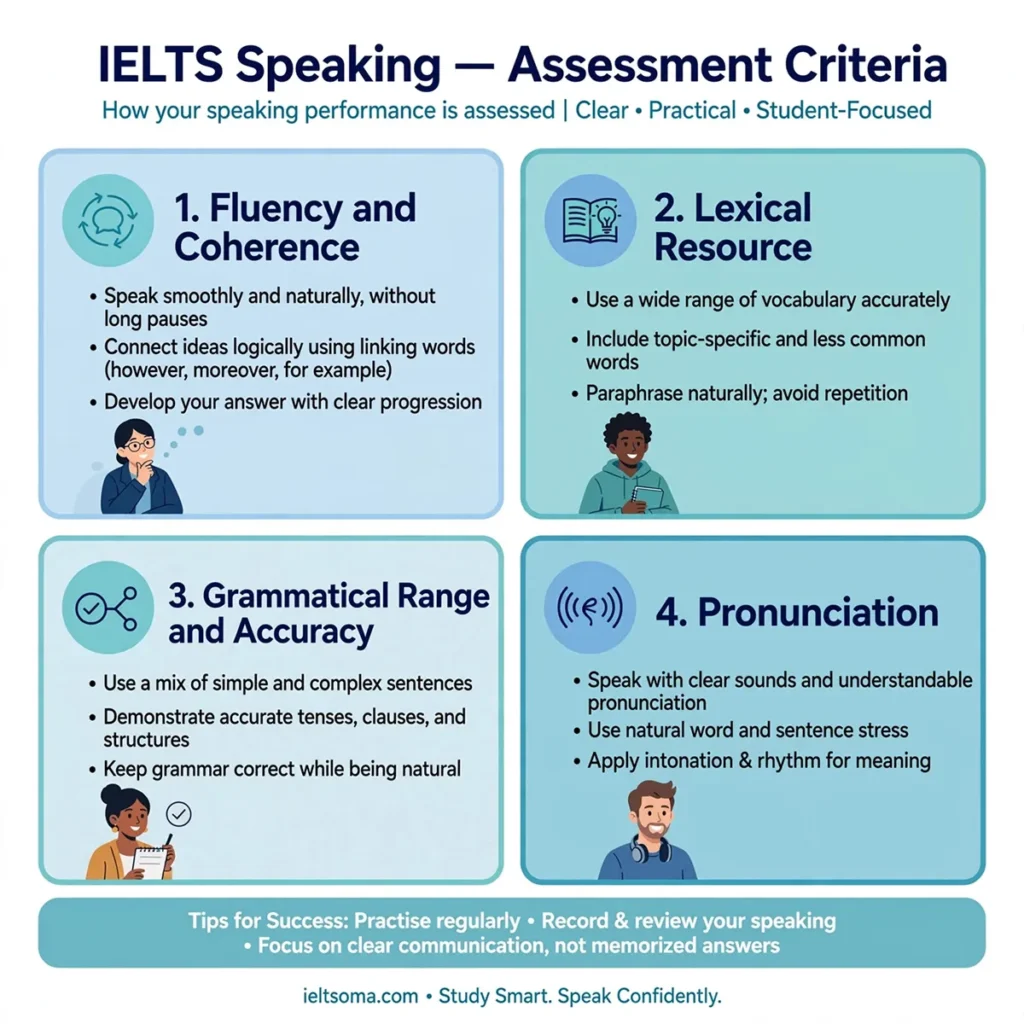
Because IELTS Speaking is not simply a test of how many English words you know. Your performance is assessed across fluency and coherence, lexical resource, grammatical range and accuracy, and pronunciation. The way you communicate your ideas matters just as much as the ideas themselves.
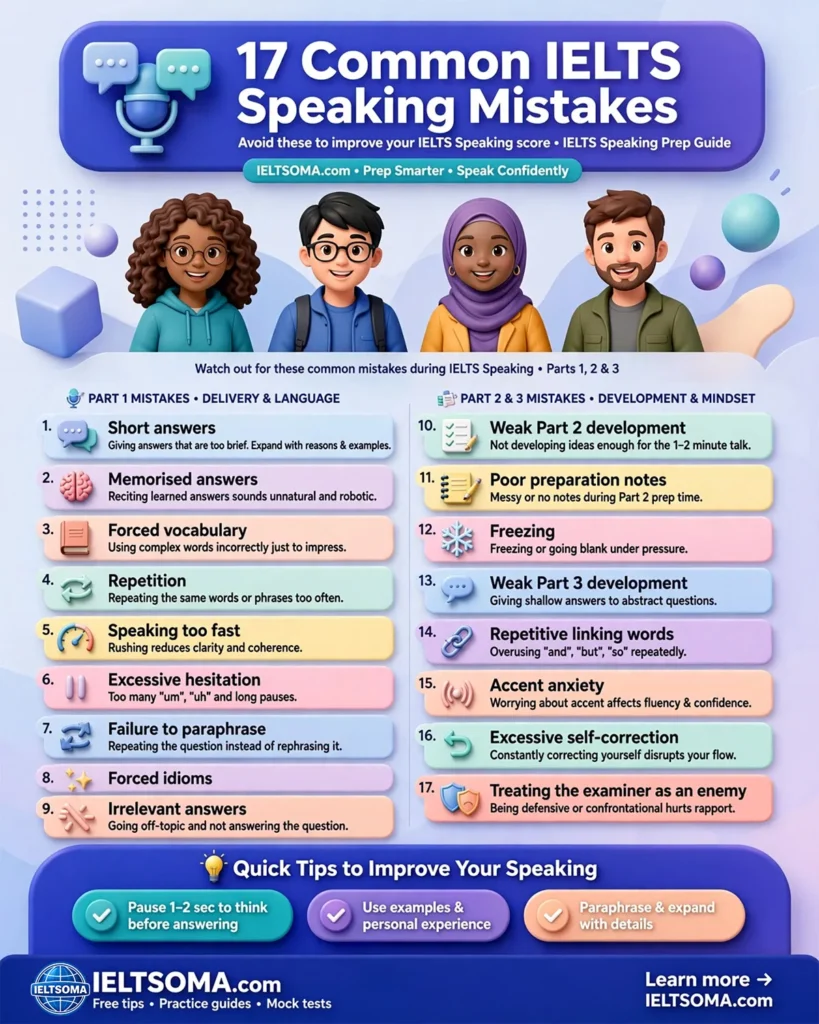
That is why many candidates make avoidable IELTS Speaking Test Mistakes such as giving extremely short answers, memorising entire responses, speaking too quickly, forcing advanced vocabulary, or panicking when they do not understand a question.
The good news is that most of these problems can be identified and corrected before test day.
Whether you are taking IELTS Academic or IELTS General Training, the Speaking test follows the same format. It lasts 11–14 minutes and has three parts: an introduction and interview, an individual long turn, and a discussion. Your goal is not to sound like a native speaker. Your goal is to communicate clearly, naturally and effectively.
Here are 17 IELTS Speaking Test Mistakes that experienced IELTS teachers regularly see — and exactly what you should do instead.
Table of Contents
Why IELTS Speaking Test Mistakes Matter
IELTS Speaking rewards effective communication, not the performance of a memorised script.
The examiner considers how well you maintain your speech, develop ideas, use vocabulary, control grammar and produce understandable pronunciation. A candidate may therefore have good vocabulary but still struggle if frequent hesitation prevents ideas from developing.
Similarly, making occasional grammar mistakes does not automatically mean a low score. Strong candidates can make errors and still demonstrate a wide range of language.
The key is your overall performance across the assessment criteria.
This is why fixing IELTS Speaking Test Mistakes should focus on communication rather than trying to eliminate every single error.
17 IELTS Speaking Test Mistakes to Avoid
1. Giving One-Sentence Answers in Part 1
Part 1 contains familiar questions about topics such as your home, studies, work, interests and daily life.
One of the most common IELTS Speaking Test Mistakes is answering every question with only “Yes”, “No”, or one short sentence.
Weak answer:
Do you enjoy cooking?
Yes, I do. I like cooking.
This answer is grammatically acceptable, but it gives you very little opportunity to demonstrate your speaking ability.
Better answer:
Yes, I really enjoy cooking, especially at weekends. I usually prepare something simple for my family because it gives me a chance to relax after a busy week.
You do not need to give a long speech. Give a direct answer, add a reason, and provide a small example or detail when appropriate.
2. Memorising Complete Answers
Memorised answers may sound impressive during practice, but they can become a serious problem when the examiner asks an unexpected question.
Another danger is that memorised language may sound unnatural or disconnected from the actual question.
Instead of memorising paragraphs, prepare ideas, vocabulary and flexible structures.
For example, prepare several ways to discuss:
- your hometown
- education
- technology
- travel
- work
- hobbies
- the environment
- relationships
- future plans
Then practise expressing your own ideas about these subjects.
3. Trying to Use Difficult Words in Every Answer
Using sophisticated vocabulary does not automatically produce a high IELTS Speaking score.
One of the most damaging IELTS Speaking Test Mistakes is choosing a complicated word when a simpler and more accurate word would communicate the meaning better.
For example:
“My hometown is a magnificent metropolitan conglomeration…”
This may sound unnatural if you would normally say:
“My hometown is a lively city with a mixture of modern buildings and traditional areas.”
Strong candidates use a wide vocabulary accurately and appropriately. They do not turn every answer into a vocabulary demonstration.
4. Repeating the Same Words Again and Again
The opposite problem is using the same basic words throughout the test.
If every opinion is “good”, every experience is “interesting”, and every person is “nice”, your vocabulary range becomes limited.
Instead, build flexible alternatives.
For example:
Good: beneficial, enjoyable, effective, valuable, convenient
Interesting: fascinating, engaging, unusual, memorable
Important: significant, essential, valuable, influential
Do not memorise huge synonym lists. Learn words in phrases and practise using them naturally.
5. Speaking Too Fast
Some nervous candidates believe speaking quickly demonstrates fluency.
It does not.
Speaking at an uncontrolled speed can reduce pronunciation clarity, create grammar problems and make your ideas harder to follow.
Fluency means maintaining a natural flow of speech. It is not a race.
Practise speaking at a comfortable pace and use short pauses when you need to organise your thoughts.
6. Speaking Too Slowly Because You Are Searching for Perfect Grammar
The opposite problem is also common.
Some candidates mentally construct every sentence before speaking because they are afraid of making a grammatical mistake.
This creates long pauses and interrupts communication.
Remember: the objective is not perfect English. You need a combination of range, accuracy, fluency and effective communication.
If you make a small mistake, continue unless correcting it is genuinely useful.
7. Panicking When You Do Not Know a Word
Not knowing one word does not mean you have failed the question.
A strong speaker can explain an idea using different language.
Suppose you cannot remember the word “sustainable”.
You could say:
“I mean something that can continue for a long time without causing serious damage to the environment.”
That is paraphrasing.
Developing this ability is one of the most useful ways to handle IELTS Speaking Test Mistakes involving vocabulary gaps.
8. Giving Memorised Idioms That Do Not Fit
Another common mistake is forcing idioms into every answer.
For example:
“My hometown is the best place in the world, and I think it is the bee’s knees.”
This may sound unnatural depending on the context.
Idiomatic language can be useful when it genuinely fits the meaning and your normal speaking style. Do not insert idioms simply because you were told that Band 7 candidates must use them.
Natural language is more important than decorative language.
9. Ignoring the Question
Some candidates prepare an answer about a topic and then try to use it regardless of what the examiner asks.
This creates irrelevant responses.
Listen carefully to the exact question.
If the examiner asks:
“Would you like to change anything about your hometown?”
Do not spend your entire answer describing your hometown.
Answer the actual question first, then explain your opinion.
10. Failing to Extend Ideas in Part 2
Part 2 gives you one minute to prepare before you speak for up to two minutes.
A frequent problem is running out of ideas after 30–40 seconds.
Do not try to memorise a perfect speech.
Use the task card as your structure.
For example:
Topic: Describe a memorable journey.
You can organise your response around:
- When and where you travelled
- Who you travelled with
- What happened
- Why you remember it
Then add details, reasons, feelings and consequences.
If you finish one point quickly, develop it instead of jumping randomly to another idea.
11. Writing Full Sentences During the One-Minute Preparation
Your preparation time is limited.
Some candidates waste it trying to write complete sentences.
Instead, write keywords.
For example:
Istanbul – summer – cousin – first flight – delayed – nervous – amazing food – unforgettable
These notes can trigger your memory while you speak.
The purpose of preparation is to organise ideas, not write your speech.
12. Stopping Completely During Part 2
You may forget an idea during your long turn.
Do not freeze.
Use natural language to buy thinking time:
“Let me think about that for a moment.”
“What I remember most clearly is…”
“Another thing that comes to mind is…”
Then continue developing the topic.
A short, natural pause is far better than repeatedly stopping because you are searching for a perfect sentence.
13. Giving Simple Answers to Part 3 Questions
Part 3 is different from Part 1.
The questions become more general and abstract. You may need to discuss reasons, consequences, comparisons, trends or possible solutions.
One of the biggest IELTS Speaking Test Mistakes is treating Part 3 like a personal interview.
Instead of:
“Yes, I think technology is important.”
Develop the idea:
“Yes, I think technology has become essential in education because it gives students access to information that may not be available in traditional classrooms. For example, students can now attend online courses and use digital resources from universities around the world.”
A useful structure is:
Answer → Reason → Example → Result
You do not need to use this mechanically, but it is an excellent way to develop ideas.
14. Using “Because” for Every Explanation
Linking words are useful, but repetitive linking can make your speech sound mechanical.
Instead of beginning every explanation with “because”, vary your structures.
Try:
- “One reason is that…”
- “This is mainly due to…”
- “The main factor is…”
- “This happens because…”
- “As a result…”
- “For this reason…”
The goal is not to use as many connectors as possible. The goal is to make relationships between ideas clear.
15. Trying to Hide Your Accent
IELTS does not require you to sound British, American, Australian or like a native English speaker.
Your priority should be intelligibility.
If your accent is noticeable but the examiner can understand you without excessive effort, your accent itself is not something you need to eliminate.
Work instead on:
- word stress
- sentence stress
- clear sounds
- rhythm
- connected speech
- intonation
- pronunciation of frequently mispronounced words
Record yourself regularly and identify patterns that affect clarity.
16. Correcting Every Small Mistake
Self-correction can be useful.
However, constant correction can damage fluency.
For example:
“I went—sorry—I go—actually, I went—last week—sorry, last month…”
This creates unnecessary disruption.
If the meaning is already clear, keep moving.
If you notice a meaningful error, a brief correction is fine:
“I visit—sorry, I visited London last year.”
Then continue.
17. Treating the Examiner Like an Enemy
This may sound surprising, but nervous candidates sometimes become so focused on scoring that they forget they are having a conversation.
The examiner is not trying to trick you.
Listen to the question, respond naturally and engage with the topic.
You do not need to impress the examiner with complicated vocabulary or unusual opinions.
You need to demonstrate your English ability clearly.
How to Fix These IELTS Speaking Test Mistakes
The best preparation is not simply answering hundreds of random questions.
You need a system that identifies your recurring weaknesses.
Step 1: Record Your Speaking
Choose an IELTS Speaking question and record your answer.
Then listen to it.
Ask yourself:
- Did I answer the question directly?
- Did I speak continuously?
- Did I repeat words?
- Where did I hesitate?
- Did I use a range of vocabulary?
- Did I make repeated grammar errors?
- Was my pronunciation clear?
- Did I develop my ideas?
This turns vague nervousness into specific problems you can fix.
Step 2: Practise Under Real Time Limits
Practise Part 1 questions naturally.
For Part 2, give yourself exactly one minute to prepare and then speak for up to two minutes.
For Part 3, practise answering questions that require opinions, comparisons, reasons and predictions.
Your practice should increasingly resemble the real test.
Step 3: Build Flexible Language, Not Scripts
Create language banks for:
- giving opinions
- explaining reasons
- comparing ideas
- describing experiences
- making predictions
- expressing uncertainty
- giving examples
- changing your mind
- paraphrasing unknown words
Then use them across different topics.
Step 4: Practise Developing Ideas
If your answers are too short, ask yourself:
Why?
Then:
Can I give an example?
Then:
What is the result or consequence?
For example:
“I prefer public transport.”
Why?
“It is cheaper.”
Example?
“For example, I can take the train to work instead of paying for fuel and parking.”
Result?
“It also reduces the amount of traffic on the roads.”
This creates a developed response without memorising one.
IELTS Speaking Test Mistakes That Matter Most for Band 7+
If your target is Band 7 or above, focus particularly on the quality of your communication.
Official IELTS descriptors indicate that stronger Band 7 performance includes the ability to speak at length without noticeable effort or loss of coherence, use vocabulary flexibly, use a range of grammatical structures and maintain effective pronunciation.
That does not mean you need flawless English.
A Band 7 candidate can still make mistakes.
The difference is that errors should not consistently prevent effective communication, and the candidate should demonstrate enough range and control across the four criteria.
For Band 8, the expectations become higher: stronger flexibility, more precise vocabulary, a wider range of structures and very clear pronunciation are expected.
So do not spend all your preparation time hunting for “Band 9 words”.
Work on consistent performance.
A Simple IELTS Speaking Test Mistakes Checklist
Before your test, ask yourself:
- Can I answer Part 1 questions without memorised scripts?
- Can I speak for up to two minutes in Part 2?
- Can I develop abstract ideas in Part 3?
- Can I paraphrase when I forget a word?
- Can I explain reasons and give examples?
- Can I speak at a comfortable speed?
- Can I recover after making a mistake?
- Can the listener understand me clearly?
- Do I use vocabulary naturally rather than forcing difficult words?
- Can I maintain a conversation without excessive hesitation?
If you answered “no” to several questions, those areas should become the focus of your final preparation.
Frequently Asked Questions About IELTS Speaking Test Mistakes
What are the most common IELTS Speaking Test Mistakes?
The most common problems include giving very short answers, memorizing responses, speaking too quickly, overusing difficult vocabulary, excessive hesitation, poor idea development, weak paraphrasing and unclear pronunciation.
Can memorized answers reduce my IELTS Speaking score?
Memorized answers can become a problem when they sound unnatural, fail to answer the exact question or prevent you from responding flexibly. Preparing ideas and useful language is generally more effective than memorizing complete speeches.
Do I need a British accent to get a high IELTS Speaking score?
No. IELTS assesses pronunciation based on how effectively and clearly, you communicate. You do not need to imitate a particular English accent.
Is it bad to make grammar mistakes in IELTS Speaking?
Not necessarily. Some grammatical mistakes can occur even in strong performances. What matters is your overall grammatical range and accuracy and whether errors regularly interfere with communication.
How can I speak for two minutes in IELTS Speaking Part 2?
Use the task-card points to create a simple structure. Add reasons, descriptions, examples, feelings, comparisons or consequences to develop each idea instead of memorizing a complete answer.
What should I do if I forget an English word during IELTS Speaking?
Paraphrase it. Describe the meaning, function, appearance, purpose or situation associated with the word. Effective paraphrasing allows you to continue communicating instead of becoming stuck.
Should I use idioms in IELTS Speaking?
Use idiomatic expressions only when they are natural and appropriate for the context. Do not force memorized idioms into answers simply to appear advanced.
How should I practice IELTS Speaking before the test?
Record yourself answering realistic questions, practice with the correct time limits, review your recurring errors and repeat weak answers after making targeted improvements.
Is IELTS Speaking the same for Academic and General Training?
Yes. The Speaking test has the same basic format for Academic and General Training candidates. Both versions use three parts and assess the same four Speaking criteria.
What should I do if I do not understand the examiner’s question?
Ask politely for clarification or repetition when necessary. It is better to make sure you understand the question than to give a long answer to the wrong topic.
Conclusion
The biggest lesson from these IELTS Speaking Test Mistakes is simple: high-scoring Speaking is not about sounding perfect; it is about communicating effectively and consistently.
You do not need to memorise hundreds of answers.
You do not need to use an accent that is not your own.
You do not need to fill every sentence with complicated vocabulary.
Instead, learn to answer questions directly, develop your ideas, paraphrase when necessary, use grammar and vocabulary flexibly, and speak clearly enough to be understood without excessive effort.
Most importantly, identify your personal IELTS Speaking Test Mistakes before test day.
Record yourself. Analyse your performance. Correct one weakness at a time. Then practise again.
That approach is far more valuable than simply completing another hundred Speaking questions without reviewing how you answered them.
For both Academic and General Training candidates, the objective remains the same: show the examiner what you can communicate in real time.
Further Reading: