Knowing thousands of English words does not automatically make your IELTS Writing stronger.
You may know economic, environment, government and problem, yet still write sentences that sound unnatural because the words are combined incorrectly.
That is where IELTS Writing Collocation Practice becomes valuable.
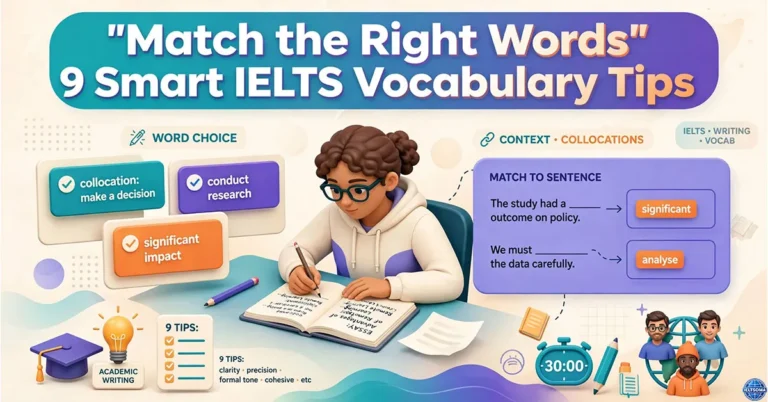
A collocation is a combination of words that commonly and naturally occur together, such as make a decision, economic growth, raise awareness, pose a threat, and serious consequences.
For IELTS candidates, learning collocations is not about filling an essay with impressive-looking phrases. It is about choosing words accurately, naturally and appropriately for the task.
The official IELTS Writing assessment criteria specifically include the control and use of collocations within Lexical Resource. Examiners consider vocabulary range, appropriacy, precision, collocations, word formation and spelling.
This guide gives you practical IELTS Writing Collocation Practice, including useful collocations, sentence examples, common mistakes and exercises you can use for Academic and General Training preparation.
Table of Contents
What Are Collocations in IELTS Writing?
Collocations are words that naturally appear together in English.
For example:
- make a decision
- take responsibility
- conduct research
- achieve a goal
- economic growth
- social inequality
- environmental damage
- serious consequences
- highly effective
- widely available
The individual words may be familiar, but knowing the correct combination makes your writing more natural.
Consider these examples:
Governments should make measures to reduce pollution.
This is understandable, but the collocation is incorrect.
A more natural version is:
Governments should take measures to reduce pollution.
The difference is small, but accurate word combinations are an important part of effective vocabulary use.
Why Is Collocation Important for IELTS Writing?
IELTS does not award a high Writing score simply because you use difficult vocabulary.
The official assessment criteria emphasise the range, accuracy and appropriacy of vocabulary. They also specifically mention control and use of collocations, idiomatic expressions and sophisticated phrasing.
This means a candidate who uses moderately advanced vocabulary accurately can produce stronger writing than someone who uses rare words incorrectly.
For example:
Governments should ameliorate the issue of traffic.
The word ameliorate may look sophisticated, but it is not necessarily the best choice here.
Compare:
Governments should take effective measures to address traffic congestion.
The second sentence is clearer, more natural and more useful for IELTS Writing.
Collocations can help you:
- express ideas more precisely
- avoid repetitive vocabulary
- write more naturally
- improve word choice
- develop topic-specific vocabulary
- paraphrase more effectively
- reduce awkward word combinations
- communicate complex ideas clearly
However, collocations should support your ideas rather than replace them.
25 Useful Collocations for IELTS Writing
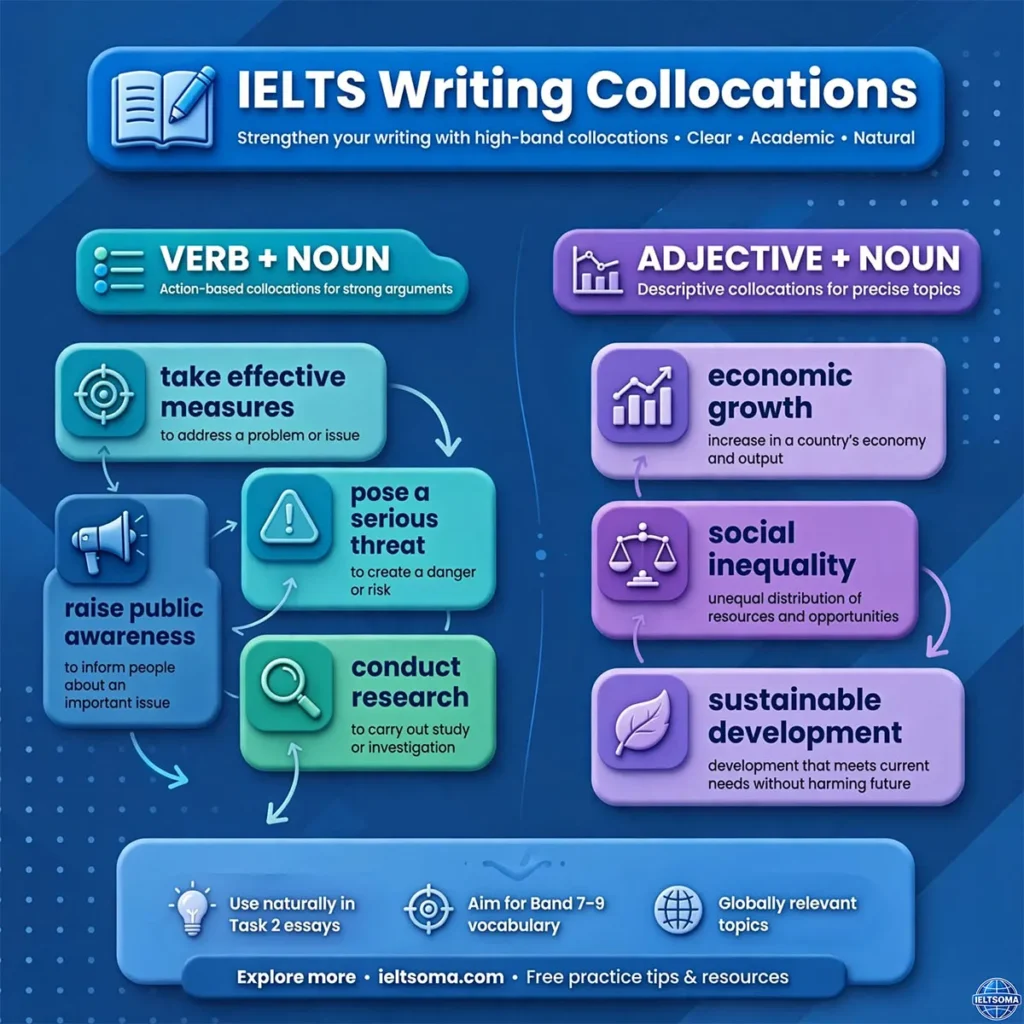
The following collocations are particularly useful across common IELTS topics. Do not memorise them as isolated lists. Study the meaning, grammar pattern and example sentence together.
1. Make a significant contribution
Meaning: contribute substantially to something.
Public transport can make a significant contribution to reducing urban congestion.
This works well when discussing education, technology, the environment, employment or society.
2. Play a crucial role
Meaning: have an extremely important function.
Schools play a crucial role in developing children’s social and academic skills.
Other useful combinations include:
- play an important role
- play a major role
- play a vital role
3. Take effective measures
Meaning: introduce actions intended to solve or reduce a problem.
Governments should take effective measures to reduce air pollution.
This is particularly useful for problem-solution essays.
4. Raise public awareness
Meaning: increase people’s knowledge or understanding of an issue.
Governments should raise public awareness of the consequences of excessive plastic consumption.
Useful topics include health, climate change, recycling and public safety.
5. Pose a serious threat
Meaning: create a significant danger.
Climate change poses a serious threat to coastal communities.
You can also use:
- pose a major threat
- pose a potential threat
- pose a significant threat
6. Have a negative impact
Excessive screen time can have a negative impact on children’s physical and mental wellbeing.
Other useful forms include:
- have a positive impact
- have a significant impact
- have a long-term impact
7. Lead to serious consequences
Poor waste management can lead to serious consequences for public health.
Remember that lead to is followed by a noun or noun phrase.
8. Address an issue
Governments need to address the issue of affordable housing.
Do not write:
address about the issue
Address already contains the meaning of dealing with something.
9. Tackle a problem
Cities must tackle the problem of traffic congestion through better urban planning.
Tackle is especially useful when discussing solutions.
10. Provide access to
Online education can provide access to learning opportunities for people in remote areas.
This collocation is useful for education, healthcare, technology and employment.
11. Gain access to
Students from disadvantaged backgrounds may struggle to gain access to high-quality education.
The distinction is useful:
- governments provide access
- individuals gain access
12. Achieve academic success
Effective study habits can help students achieve academic success.
Other useful combinations include:
- achieve academic goals
- achieve long-term objectives
- achieve financial independence
13. Improve quality of life
Reliable public transport can improve the quality of life of urban residents.
This is useful for essays about cities, healthcare, employment and public services.
14. Economic growth
Investment in infrastructure can stimulate economic growth.
This is one of the most useful collocations for essays about business, employment, government and development.
15. Economic development
Education can contribute to long-term economic development.
Do not confuse economic growth with economic development. Growth generally focuses on expansion in economic activity, while development is broader.
16. Social inequality
Access to quality education can help reduce social inequality.
This works well in essays about education, wealth, employment and government policy.
17. Environmental damage
Excessive consumption can cause significant environmental damage.
You can also write:
- prevent environmental damage
- minimise environmental damage
- reduce environmental damage
18. Sustainable development
Governments should promote sustainable development rather than focusing exclusively on short-term economic gains.
This is particularly useful for environmental and development-related topics.
19. Conduct research
Universities should conduct research into the long-term effects of artificial intelligence.
Avoid:
make research
Use:
conduct research
20. Reach a conclusion
After examining the evidence, researchers can reach a conclusion about the effectiveness of the policy.
This can also be useful when discussing research, education and decision-making.
21. Strong evidence
There is strong evidence that regular physical activity benefits public health.
Other useful combinations include:
- compelling evidence
- convincing evidence
- scientific evidence
22. Significant increase
The graph shows a significant increase in the number of people using public transport.
This is particularly useful for Academic Writing Task 1.
23. Steady decline
The percentage of households using coal experienced a steady decline over the period.
Other useful Task 1 collocations include:
- sharp increase
- gradual increase
- dramatic decline
- slight decrease
- considerable variation
24. Highly effective
Public awareness campaigns can be highly effective when they provide practical information.
Use highly with adjectives that naturally accept this intensifier.
25. Long-term benefits
Investing in preventive healthcare can produce significant long-term benefits for society.
This is useful when evaluating policies, education, healthcare and environmental measures.
IELTS Writing Collocation Practice: Task 1
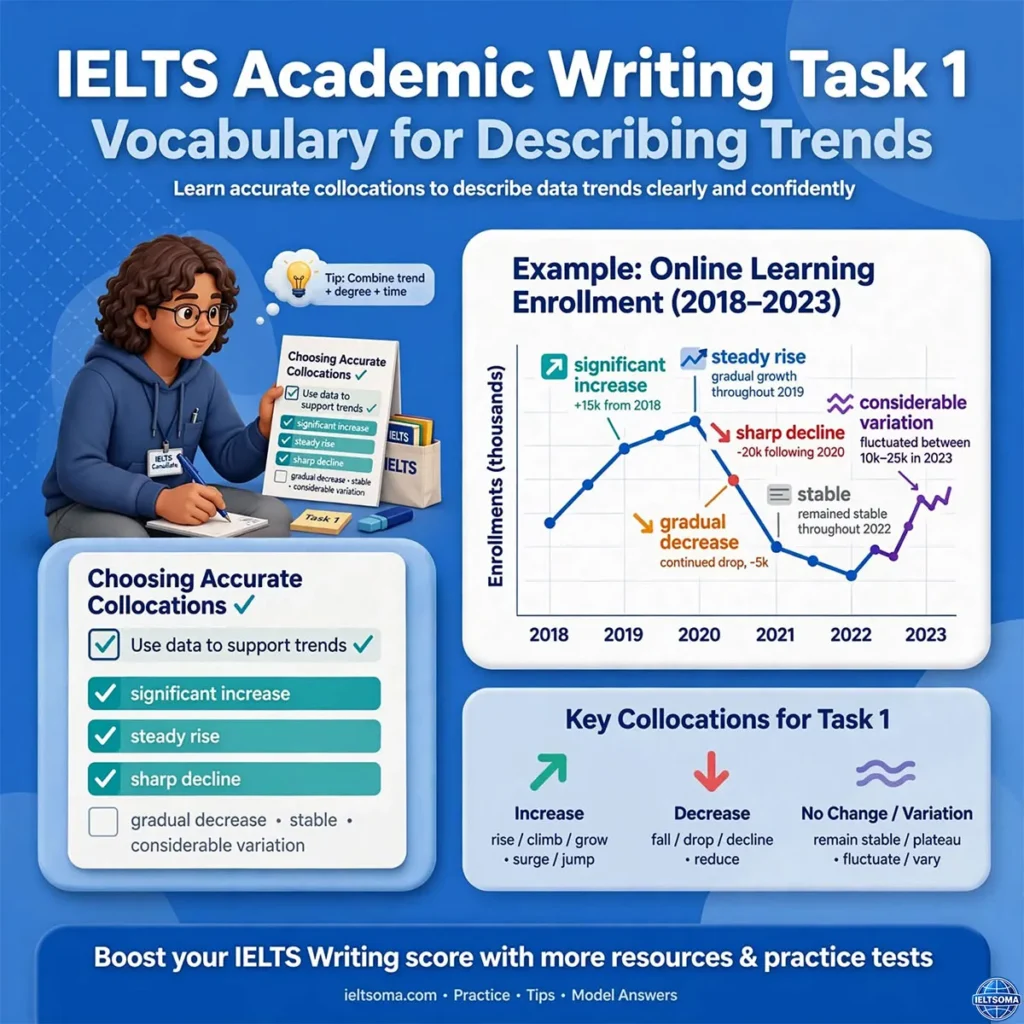
Collocations are useful in both Academic and General Training Writing, but their application differs between the tasks.
Academic Writing Task 1 requires candidates to describe visual information such as graphs, tables, charts and diagrams. General Training Task 1 requires a letter responding to a situation. Task 2 involves an essay for both versions.
For Academic Task 1, focus on collocations for:
- increases
- decreases
- comparisons
- proportions
- trends
- stability
- fluctuations
For example:
The number of international students increased significantly between 2015 and 2020.
Instead of repeatedly writing went up, you could use:
- increased significantly
- rose steadily
- experienced a sharp increase
- showed considerable growth
For decreases:
- declined gradually
- fell sharply
- experienced a significant decrease
- showed a steady decline
The goal is not to use every synonym in one response. Choose the expression that accurately describes the data.
IELTS Writing Collocation Practice: Task 2
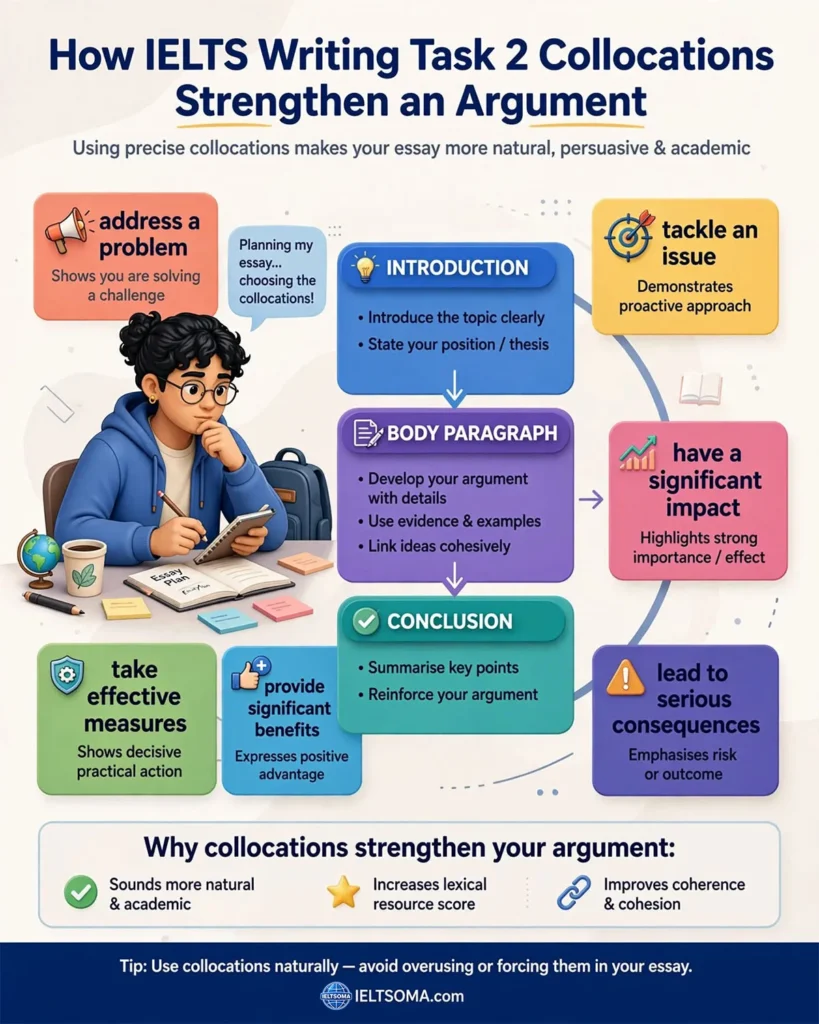
Task 2 is where collocations become especially valuable because you need to discuss ideas, explain causes, evaluate consequences and support your position.
For example, imagine the question:
Some people believe governments should spend more money on public transport than on building new roads. To what extent do you agree or disagree?
Instead of writing:
Public transport is good because it helps cities.
You could write:
Investing in public transport can reduce traffic congestion, improve the quality of life and make a significant contribution to sustainable urban development.
The vocabulary is stronger because the words work together naturally and communicate specific ideas.
Useful Task 2 collocations by function
Introducing problems
- address a growing problem
- tackle a serious issue
- face significant challenges
- create social problems
Explaining causes
- contribute to a problem
- be a major factor
- result from
- stem from
- be largely caused by
Explaining effects
- have a significant impact
- lead to serious consequences
- result in higher costs
- create long-term problems
Discussing solutions
- take effective measures
- implement policies
- introduce regulations
- provide financial support
- raise public awareness
Discussing benefits
- provide significant benefits
- improve quality of life
- create employment opportunities
- increase access to services
Discussing disadvantages
- have negative consequences
- place pressure on
- create financial burdens
- pose a serious threat
How to Practise Collocations Without Memorising Lists
A long list of 100 collocations may look impressive, but simply reading it will not make the expressions part of your active vocabulary.
Use a four-step practice cycle instead.
Step 1: Learn the combination
Choose five collocations related to one topic.
For education:
- access to higher education
- academic achievement
- educational opportunities
- develop critical thinking
- achieve academic success
Step 2: Complete sentence gaps
Remove one part of the collocation.
Governments should ______ effective measures to reduce pollution.
Answer:
take
Step 3: Create your own sentences
Write one original sentence for every collocation.
Governments should take effective measures to reduce the amount of plastic waste entering oceans.
Step 4: Use the collocation in an IELTS paragraph
Now move beyond individual sentences.
Governments should take effective measures to reduce plastic waste. For example, they could restrict unnecessary single-use packaging and provide incentives for businesses that adopt reusable alternatives.
This final stage matters because IELTS requires connected writing rather than isolated sentences.
A Simple Collocation Exercise
Complete the sentences using the correct word.
- Governments should ______ measures to reduce unemployment.
- Social media can have a significant ______ on public opinion.
- Universities should ______ research into artificial intelligence.
- Better public transport can improve the quality of ______.
- Climate change poses a serious ______ to coastal areas.
- Education can make a significant ______ to economic development.
- Governments should raise public ______ of unhealthy lifestyles.
- Excessive consumption can lead to serious ______.
Answers
- take
- impact
- conduct
- life
- threat
- contribution
- awareness
- consequences
Do not stop after checking the answers. Write a new sentence using each completed collocation.
Common Collocation Mistakes in IELTS Writing
Mistake 1: Translating directly from your first language
A phrase may be grammatically understandable but unnatural because its word combination comes from your native language.
For example:
make a research
Better:
conduct research
The solution is to learn English in combinations rather than translating individual words.
Mistake 2: Using the wrong verb
Some nouns naturally pair with particular verbs.
Compare:
- make a decision
- take responsibility
- conduct research
- reach a conclusion
- raise awareness
Do not assume that make, do, take and have are interchangeable.
Mistake 3: Forcing advanced collocations into every sentence
Memorising sophisticated expressions does not mean you need to use them constantly.
A natural essay might contain several useful collocations, but the ideas, organisation and accuracy remain more important.
Mistake 4: Using memorised phrases that do not fit the topic
The official IELTS band descriptors specifically warn about inappropriate lexical chunks and memorised language at lower levels.
For example, a phrase such as:
In this day and age, every coin has two sides…
does not automatically improve your essay.
It may sound memorised and contribute little to your argument.
Use vocabulary because it communicates your idea, not because it sounds advanced.
Mistake 5: Replacing every simple word with a complicated synonym
Consider:
Governments should ameliorate the detrimental ramifications of vehicular congestion.
This is unnecessarily complicated.
A clearer version is:
Governments should take effective measures to reduce the negative effects of traffic congestion.
Strong IELTS vocabulary should improve precision and communication, not make your writing difficult to understand.
Build a Collocation Notebook
A useful IELTS vocabulary notebook should contain more than definitions.
Use this format:
| Word | Collocation | Meaning | Example |
|---|---|---|---|
| awareness | raise awareness | increase understanding | Campaigns can raise awareness of climate change. |
| research | conduct research | carry out systematic study | Universities conduct research into healthcare. |
| threat | pose a threat | create danger | Pollution poses a threat to public health. |
| growth | economic growth | expansion of economic activity | Investment can stimulate economic growth. |
| consequence | serious consequences | major results or effects | Poor planning can have serious consequences. |
Add collocations from your own writing mistakes.
That is often more useful than copying vocabulary from a generic list because your error log shows which combinations you personally need to improve.
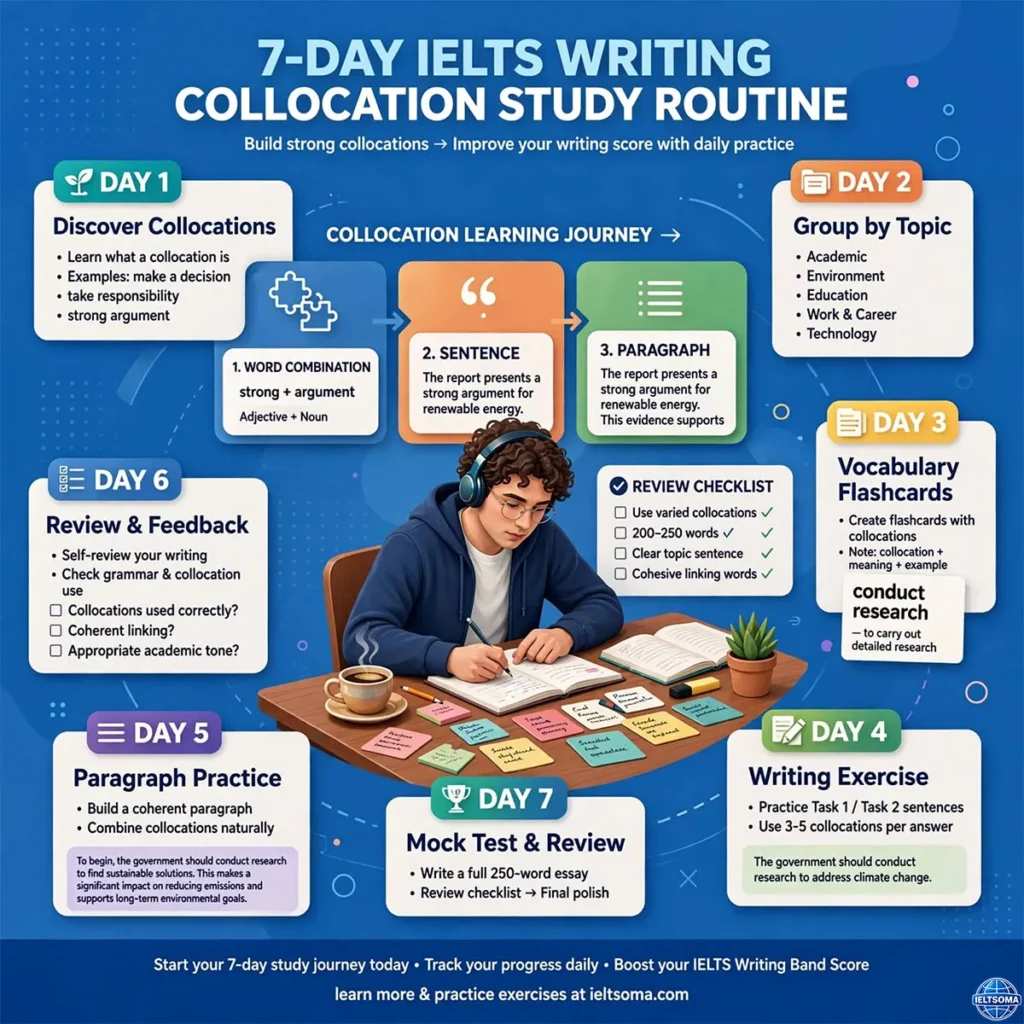
A 7-Day IELTS Writing Collocation Practice Plan
You do not need to memorise hundreds of expressions.
Try this seven-day cycle.
Day 1 — Education
Learn five collocations and write five sentences.
Day 2 — Environment
Learn five collocations and write one short paragraph.
Day 3 — Technology
Complete gap-fill exercises and correct unnatural combinations.
Day 4 — Health
Write a Task 2 body paragraph using five target collocations.
Day 5 — Society and government
Write sentences explaining causes and solutions.
Day 6 — Academic Task 1
Practise collocations for increases, decreases, comparisons and trends.
Day 7 — Review
Write a timed paragraph without looking at your notes. Then identify which collocations you used accurately.
This approach changes collocations from passive vocabulary into active writing skills.
How Many Collocations Should You Use in an IELTS Essay?
There is no official rule saying that an IELTS essay must contain a particular number of collocations.
That is important.
Do not set yourself a target such as “I must use 15 advanced collocations”.
Instead, aim for accurate, appropriate and flexible vocabulary.
The official IELTS Writing criteria assess lexical resource as part of the overall Writing performance, including vocabulary range, appropriacy, precision and collocation control.
A well-developed essay might naturally contain several collocations, but forcing them into every sentence can make the writing repetitive or unnatural.
Quality matters more than quantity.
How Collocations Can Improve Your Vocabulary Practice
Collocations also make vocabulary learning more efficient.
Instead of learning:
consequence = result
learn:
- serious consequences
- negative consequences
- long-term consequences
- unintended consequences
- environmental consequences
Now one word has become a useful vocabulary network.
The same approach works with:
Benefit
- significant benefit
- long-term benefits
- provide benefits
- gain benefits
Impact
- significant impact
- negative impact
- positive impact
- have an impact on
Role
- play a crucial role
- play an important role
- play a major role
This is more practical than memorising long lists of unrelated words.
A Better Way to Check Your Own Writing
After completing an IELTS Writing task, highlight your vocabulary.
Then ask:
- Did I repeat the same word too often?
- Did I use topic-specific vocabulary?
- Are my collocations natural?
- Did I choose the correct verb?
- Did I use the correct noun, adjective or verb form?
- Did I use any phrase simply because it sounded advanced?
- Does every difficult word actually communicate my meaning?
- Can I replace any unnatural combination with a more natural one?
This type of review is far more valuable than simply checking spelling.
For additional vocabulary practice, see IELTSOMA’s guide to IELTS Vocabulary Contextual Learning, which explains why vocabulary is more useful when learned through sentences, topics and collocations.
You can also use IELTS Vocabulary: 7 Powerful Flashcard Strategies to turn collocations into a structured revision system.
Final IELTS Writing Collocation Practice Checklist
Before your next Writing task, remember:
- Learn word combinations, not isolated words.
- Choose collocations that fit the topic.
- Practise them in original sentences.
- Use them in complete paragraphs.
- Check whether the combination sounds natural.
- Avoid direct translation from your first language.
- Do not force sophisticated expressions into your essay.
- Review your own vocabulary mistakes.
- Practise collocations for both Task 1 and Task 2.
- Prioritise accuracy and appropriacy over complexity.
The purpose of IELTS Writing Collocation Practice is not to make every sentence sound complicated. It is to help you select vocabulary that communicates your ideas naturally, precisely and effectively.
When you consistently learn words in meaningful combinations, vocabulary becomes easier to retrieve during the exam. More importantly, you become better at choosing language that actually fits your argument.
That is the kind of vocabulary development that can support stronger performance in the Lexical Resource criterion.
FAQs About IELTS Writing Collocation Practice
What are the best collocations for IELTS Writing?
Useful collocations include take effective measures, play a crucial role, raise public awareness, pose a serious threat, have a significant impact, conduct research, achieve academic success, economic growth, social inequality and sustainable development.
However, the best collocation depends on the topic and the meaning you want to express.
Can collocations improve my IELTS Writing score?
Accurate collocations can support your Lexical Resource because the official IELTS criteria specifically assess the control and use of collocations. However, collocations alone do not determine your Writing score. Task response, coherence and cohesion, and grammatical range and accuracy also matter.
Should I memorise IELTS collocation lists?
Lists can be useful as a starting point, but memorisation alone is not enough. Learn each collocation in a sentence, practise retrieving it, and then use it in your own IELTS paragraphs.
How many collocations should I learn each day?
There is no fixed requirement. Five well-practised collocations can be more valuable than 30 expressions that you cannot use accurately.
Are collocations useful for both Academic and General Training IELTS?
Yes. Both IELTS Academic and General Training Writing assess Lexical Resource. The tasks differ, but accurate and appropriate vocabulary is important in both versions.
Should I use advanced collocations in every sentence?
No. Use a collocation when it expresses your meaning naturally. Overusing memorised or unnecessarily complicated expressions can make your writing less natural.
What is the fastest way to improve collocations?
A practical method is to learn five useful combinations, write your own sentences, use them in a paragraph, and then review them several times. Your own writing mistakes should also become part of your vocabulary practice.
Can I use the same collocations in every IELTS essay?
Some general collocations can be reused when appropriate, but avoid inserting memorised phrases regardless of the topic. Adapt your vocabulary to the question and make sure every expression contributes to your argument.