You can know plenty of English and still struggle to communicate your ideas effectively.
Perhaps you begin answering an IELTS Speaking question confidently, but your answer becomes too long. You repeat the same point in different words, lose track of your main idea, or add unnecessary details. By the time you finish, the examiner may understand you—but your response was harder to follow than it needed to be.
This is where clarity and conciseness in speaking become essential.
Clear speaking means your listener can easily understand your message. Concise speaking means you express that message without unnecessary words or repetition. In IELTS Speaking, these skills help you organise your ideas, respond directly to questions and develop answers naturally.
However, concise does not mean giving short answers.
A strong IELTS response should be clear, relevant, developed and natural. The goal is not to say as little as possible. The goal is to say enough to communicate your idea effectively.
The official IELTS Speaking assessment includes four equally weighted criteria: Fluency and Coherence, Lexical Resource, Grammatical Range and Accuracy, and Pronunciation. Fluency and coherence include how logically you organise and connect your ideas, making clarity an important part of effective spoken communication.
Here are seven practical ways to improve clarity and conciseness in speaking for IELTS.
Table of Contents
What Does Clarity and Conciseness Mean in IELTS Speaking?
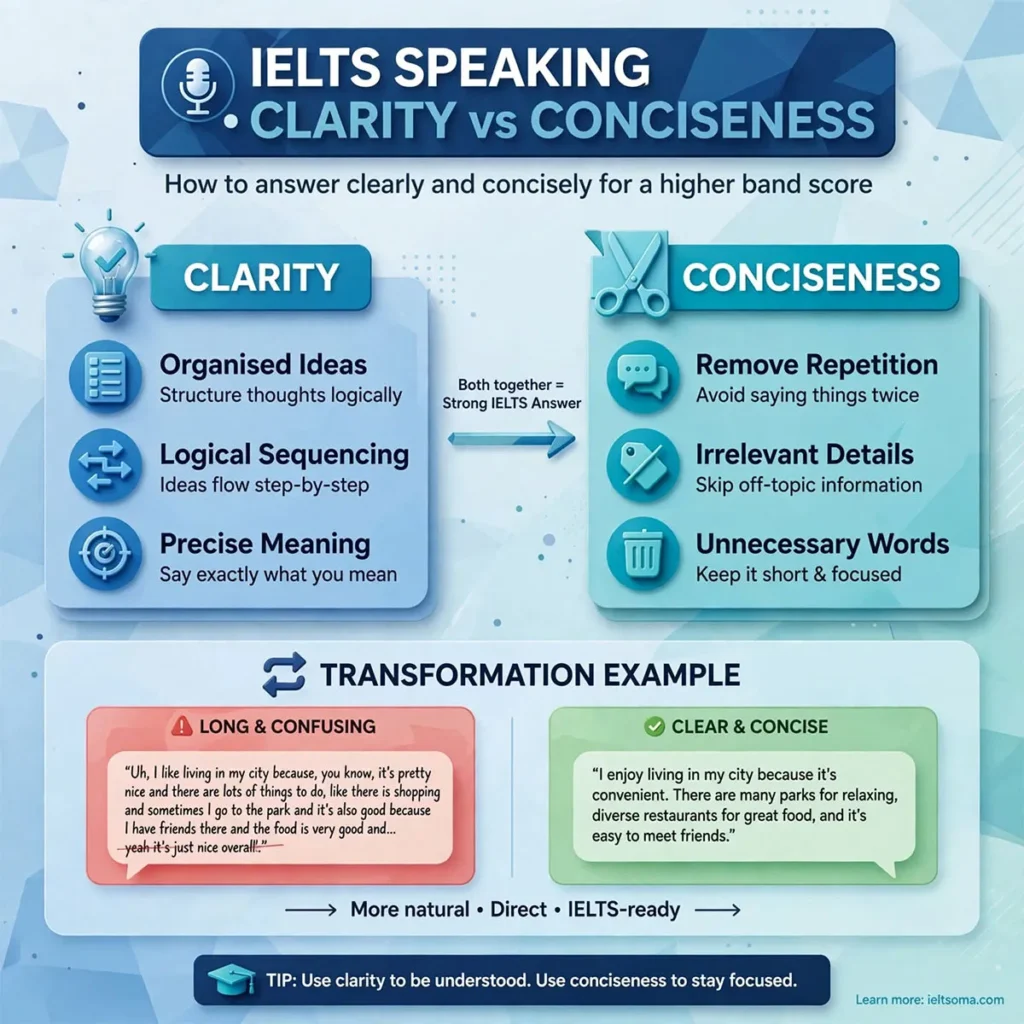
Clarity means expressing your ideas in a way that is easy for the examiner to understand.
Conciseness means communicating your meaning efficiently without unnecessary repetition, irrelevant information or excessive wording.
Consider this answer:
“Yes, I really like travelling because travelling is something that I have always enjoyed, and whenever I get the opportunity to travel, I really enjoy going to different places because there are so many different places that you can visit.”
The candidate has a clear basic idea, but the response repeats “travel”, “enjoy” and “places” several times.
A clearer version would be:
“Yes, I really enjoy travelling. It gives me a chance to experience different cultures, try new food and take a break from my usual routine.”
The second answer is shorter, but it contains more useful information.
That is the key principle:
Do not make your answers shorter simply for the sake of being concise. Make every sentence contribute something useful.
Why Clarity and Conciseness Matter in IELTS Speaking
The IELTS examiner is listening to your communication throughout the Speaking test.
The official IELTS criteria describe Fluency and Coherence in terms of continuity, rate, effort and the ability to link ideas into coherent, connected speech. The official criteria also highlight logical sequencing, relevance and appropriate cohesive devices.
This means an answer can become weaker when:
- you repeatedly change direction
- you give irrelevant details
- you repeat the same idea
- your sentences are unnecessarily complicated
- you use fillers excessively
- you speak so quickly that your pronunciation becomes difficult to understand
- you give an answer that does not directly address the question
Clarity also works alongside vocabulary and grammar.
Using a difficult word does not automatically make an answer better. The official IELTS descriptors emphasise the ability to use vocabulary flexibly and precisely to convey meaning.
So instead of asking yourself:
“How can I sound more advanced?”
ask:
“How can I express this idea accurately and naturally?”
That change in mindset can significantly improve your speaking practice.
1. Answer the Question First
One of the easiest ways to improve clarity and conciseness in speaking is to answer the question immediately.
This is particularly useful in Part 1.
Suppose the examiner asks:
“Do you enjoy cooking?”
A weak response might begin:
“Well, cooking is actually something that has been quite popular in my family for many years, and when I was younger, I used to see my mother cooking different kinds of food, and I think that probably influenced me…”
The candidate eventually answers the question, but the main point is delayed.
A clearer response would be:
“Yes, I enjoy cooking, especially at weekends. I find it relaxing, and I like experimenting with different recipes.”
The structure is simple:
Answer → reason → small detail
For example:
“Yes, I do. I enjoy cooking because it helps me relax after a busy week. I particularly like making pasta and trying different sauces.”
This gives the examiner a direct answer and enough development without unnecessary background information.
Try the “first sentence” test
After answering a question, ask yourself:
Did my first sentence actually answer the question?
If not, practise getting to the main point faster.
This does not mean every answer must begin with “Yes” or “No”. You can naturally introduce your position:
“I would say that I prefer studying in the morning because I can concentrate better.”
The important thing is that your main idea is easy to identify.
2. Use One Main Idea at a Time
Another common problem is trying to communicate too many ideas in one answer.
Imagine the question:
“What do you like about your hometown?”
A candidate might mention:
- the food
- transport
- parks
- shopping
- family
- weather
- schools
- nightlife
- historical buildings
The result may sound like a list rather than a developed response.
Instead, choose one or two relevant ideas and develop them.
For example:
“What I like most about my hometown is its relaxed atmosphere. It isn’t as crowded as a major city, so people tend to know their neighbours and there are plenty of quiet places to spend time outdoors.”
The candidate has one central idea: the relaxed atmosphere.
The second sentence develops it.
This is much easier to follow.
A useful practice formula is:
Main idea → explanation → example
For example:
“I prefer working from home because I can concentrate better. There are fewer interruptions than in a busy office. For instance, I can usually complete difficult tasks much faster when I work in a quiet environment.”
You do not need five ideas when three connected sentences can communicate one idea effectively.
3. Replace Repetition with Development
Repetition is one of the biggest enemies of clarity.
Some candidates believe that repeating an idea helps them speak for longer. Usually, it simply makes the answer sound less controlled.
Consider:
“I like my job because it is interesting. It is interesting because I find the work interesting, and I really like doing interesting tasks.”
The candidate is using several words but communicating very little.
A better response would be:
“I like my job because it gives me plenty of variety. I work on different projects throughout the week, so I rarely feel that I’m doing exactly the same thing every day.”
The second answer develops the idea instead of repeating it.
When you notice yourself repeating a word or sentence, ask:
Can I add a reason, example, result or contrast instead?
For example:
Instead of:
“I like technology. Technology is useful. I use technology every day.”
Try:
“I rely heavily on technology because it makes everyday tasks much easier. For example, I use online banking and mobile apps to manage most of my daily errands.”
You are still talking about the same topic, but the answer contains progression.
4. Use Simple Structure to Organise Longer Answers
Clarity becomes especially important in Parts 2 and 3.
The IELTS Speaking test has three parts. Part 1 focuses on familiar topics, Part 2 requires an individual long turn, and Part 3 involves a more abstract discussion. The Speaking test generally lasts around 11–14 minutes.
In Part 2, you need to speak continuously about a topic. The examiner gives you one minute to prepare, and you then speak for up to two minutes.
A simple internal structure can help:
Beginning → details → personal reaction → result
Suppose the topic is:
Describe a memorable trip you took.
You could organise your answer like this:
Beginning: When and where you went
Details: Who you went with and what you did
Reaction: Why the experience was memorable
Result: What you learned or how you felt afterwards
For example:
“One trip I remember particularly well was a family holiday to the northern areas of Pakistan a few years ago. We travelled by car and spent several days exploring the mountains and nearby villages. What made the trip memorable was the scenery, because I had never seen such dramatic landscapes before. It also gave my family a chance to spend uninterrupted time together, which is difficult when everyone is busy with work and studies.”
The response is not complicated, but the ideas move logically.
That is what good organisation does: it reduces the effort required from the listener.
5. Choose Precise Words Instead of More Words
Concise speaking does not mean using basic vocabulary.
It means choosing words that communicate your meaning efficiently.
Compare:
“The restaurant was a place that had a very large number of different types of food available.”
with:
“The restaurant offered a wide variety of dishes.”
The second sentence is shorter and more precise.
This is particularly useful for IELTS because Lexical Resource assesses not only vocabulary range but also how accurately and appropriately vocabulary is used.
However, do not force sophisticated vocabulary into your answers.
For example, if you normally say:
“The city is very crowded.”
there is no need to replace it with an unnecessarily complicated expression.
You might naturally say:
“The city is extremely crowded during rush hour.”
That adds precision rather than decoration.
Build vocabulary in phrases
Instead of memorising isolated words, learn useful combinations.
For example:
- a major advantage
- a significant problem
- a practical solution
- a noticeable improvement
- a relatively small community
- a wide range of options
This makes it easier to express ideas naturally during the test.
6. Control Fillers, Pauses and Self-Correction
Clarity and conciseness in speaking does not mean eliminating every pause.
Some hesitation is completely natural.
The problem occurs when pauses, fillers and self-corrections become so frequent that they interrupt communication.
For example:
“I think, um, basically, you know, maybe, I suppose, actually, what I mean is…”
The listener has to work harder to find the main message.
A better approach is to use a short thinking phrase and then continue:
“I think the main reason is convenience.”
Or:
“There are two reasons for that. First…”
Official IELTS guidance describes fluency in terms of continuity, rate and effort, and identifies excessive false starts, backtracking, repetition and pauses while searching for words as relevant indicators.
Practise purposeful pauses
Instead of filling every silence with “um”, “you know” or “like”, pause briefly while organising your thought.
For example:
“I think there are two main reasons. [pause] First, it’s much more convenient…”
A short, controlled pause can be clearer than several fillers.
7. Develop Answers Without Overexplaining
Perhaps the biggest misunderstanding about conciseness is the belief that a concise answer should always be short.
That is not true.
IELTS Speaking requires you to develop your answers appropriately. In Part 3 especially, questions are designed to encourage explanation, analysis and discussion.
Consider this question:
“Why do some people prefer living in cities?”
A response such as:
“Because cities have more opportunities.”
is clear but underdeveloped.
An overly long response might move into unrelated subjects such as education, transport, politics, tourism and housing.
A better answer develops the central point:
“I think the main reason is the wider range of opportunities. Large cities tend to offer more jobs, universities and entertainment options, so people have greater choice. For young professionals in particular, that variety can be very attractive.”
This answer is concise but sufficiently developed.
A useful formula for Part 3 is:
Opinion → reason → explanation/example
You can also use:
Point → reason → result
or:
Opinion → contrast → conclusion
These structures help you extend your response without rambling.
Clarity and Conciseness in Speaking: Part-by-Part Strategy
| IELTS Speaking Part | Main goal | Useful approach |
|---|---|---|
| Part 1 | Give natural answers about familiar topics | Answer + reason + brief detail |
| Part 2 | Maintain a coherent long turn | Organise the story or description into stages |
| Part 3 | Explain and analyse ideas | Opinion + reason + explanation/example |
The same principle applies throughout the test: make your message easy to follow.
Common Mistakes That Reduce Clarity
Giving a memorised answer
Memorised responses often contain unnatural expressions and information that does not directly answer the question.
Prepare ideas and vocabulary, but remain flexible.
Using too many linking words
Words such as “moreover”, “furthermore”, “nevertheless” and “consequently” have their uses, but spoken English does not require a formal connector in every sentence.
Use linking expressions when they genuinely help the listener understand the relationship between ideas.
Speaking too quickly
Fast speech is not automatically fluent speech.
If your speed causes unclear pronunciation, missing word endings or poor sentence control, slow down slightly.
Giving irrelevant examples
An example should clarify your point.
If the example introduces an entirely new subject, it may make the answer harder to follow.
Repeating the question
Some candidates repeat the examiner’s question before answering:
“Do I enjoy reading? Well, do I enjoy reading…”
A short reformulation can sometimes help you start naturally, but unnecessary repetition wastes time and can make the response sound rehearsed.
Correcting every small mistake
If you make a minor error and the meaning is still clear, continuing naturally is often better than repeatedly stopping to repair every sentence.
The official Band 7 descriptor allows some hesitation, repetition and self-correction as long as these do not affect coherence.
A 10-Minute Daily Practice Routine
You can practise clarity and conciseness without spending hours studying.
Minutes 1–2: Choose a question
Pick one IELTS Speaking Part 1 or Part 3 question.
For example:
“Do you think people spend too much time on their phones?”
Minutes 3–4: Give your first answer
Speak naturally and record yourself.
Do not stop every time you make a mistake.
Minutes 5–6: Listen critically
Ask:
- Did I answer the question immediately?
- Did I repeat myself?
- Did I use unnecessary fillers?
- Did I introduce irrelevant ideas?
- Was my main point easy to identify?
Minutes 7–8: Improve the answer
Remove unnecessary sentences and replace repeated words.
Add one useful explanation or example if the answer is underdeveloped.
Minutes 9–10: Record it again
Give the improved answer.
Then compare the two recordings.
This process is more useful than simply speaking repeatedly without reviewing your performance.
A Simple Self-Assessment Checklist
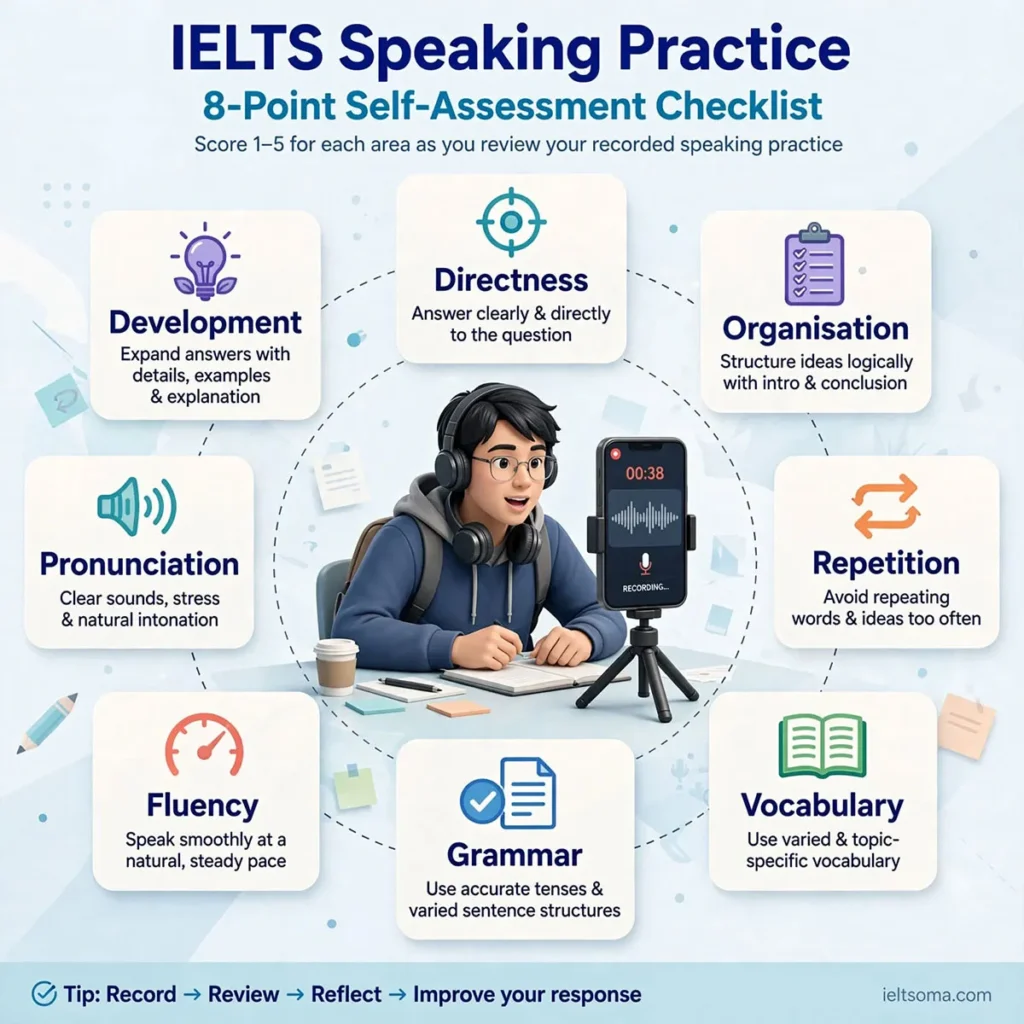
After each practice session, score yourself from 1 to 5:
| Skill | Question |
|---|---|
| Directness | Did I answer the question quickly? |
| Organisation | Were my ideas logically ordered? |
| Repetition | Did I avoid repeating the same point? |
| Vocabulary | Did I choose precise words? |
| Grammar | Were my sentences controlled and accurate? |
| Fluency | Did I avoid excessive hesitation? |
| Pronunciation | Was my speech easy to understand? |
| Development | Did I explain important ideas sufficiently? |
Do not try to improve everything at once.
Choose your weakest two areas and focus on them during your next practice session.
The Biggest Principle: Clear Does Not Mean Basic
Some IELTS candidates become so concerned about conciseness that they start giving extremely short answers.
That is another mistake.
Compare:
“Yes, I like travelling.”
with:
“Yes, I really enjoy travelling because it gives me a chance to experience different cultures. I particularly like visiting smaller towns because they usually feel less touristy.”
The second answer is longer, but it is still concise because each sentence contributes something useful.
The goal is not short English.
The goal is efficient English.
A strong IELTS speaker can communicate a complete idea, explain it and provide relevant detail without constantly circling back to the same point.
How Clarity Supports a Higher Speaking Performance
Clarity is not a separate fifth IELTS scoring criterion.
The official IELTS Speaking assessment uses four criteria: Fluency and Coherence, Lexical Resource, Grammatical Range and Accuracy, and Pronunciation. Each contributes equally to the Speaking score.
However, clarity supports several of these areas simultaneously.
Clear organisation can strengthen coherence.
Precise word choice supports lexical resource.
Controlled sentence construction supports grammatical accuracy.
Clear delivery supports intelligibility and pronunciation.
This is why improving clarity can have a broader benefit than simply learning more vocabulary.
A candidate who knows 2,000 additional words but cannot organise ideas clearly may struggle to demonstrate that vocabulary effectively.
A candidate with a more practical vocabulary range who communicates precise ideas naturally may produce a stronger overall performance.
Final Tips for Better Clarity and Conciseness in Speaking
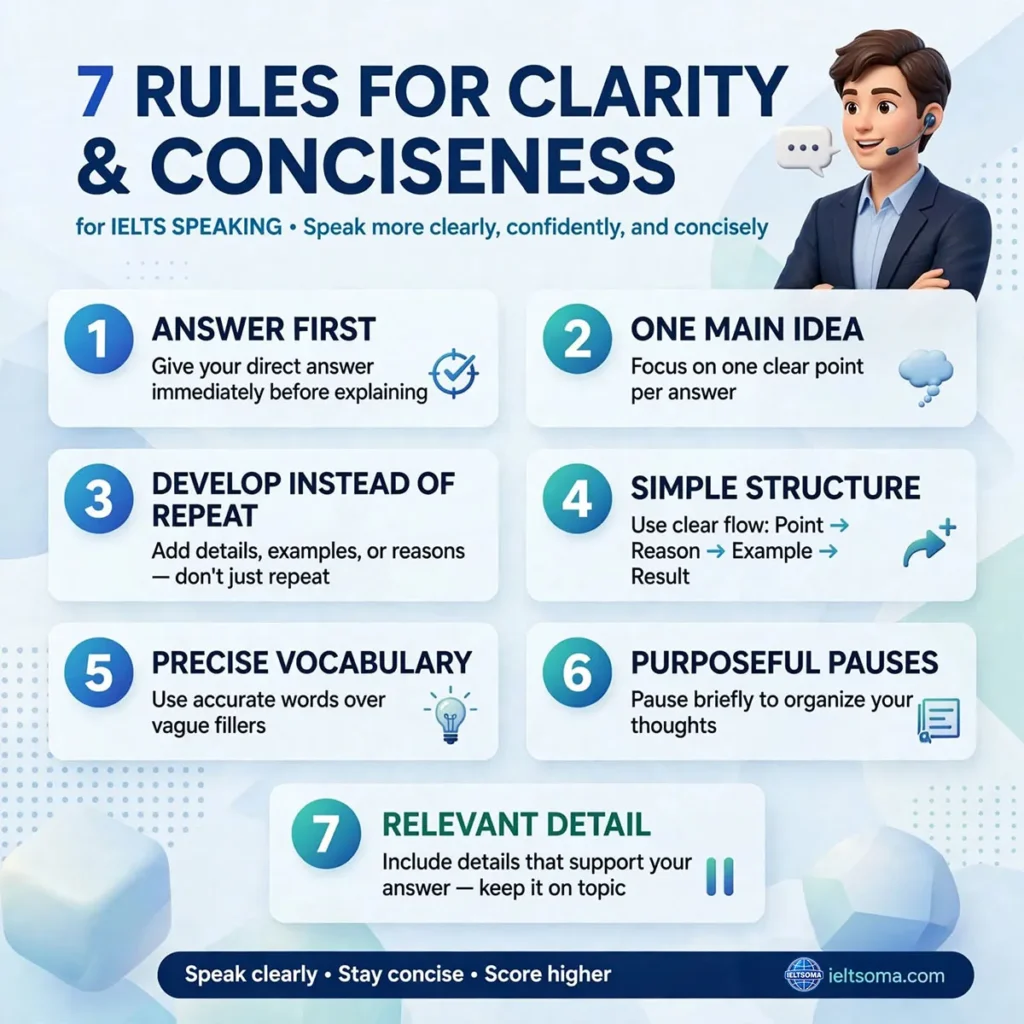
Before your IELTS test, remember these seven rules:
- Answer the question first.
- Focus on one main idea at a time.
- Develop ideas instead of repeating them.
- Use a simple structure for longer responses.
- Choose precise vocabulary instead of unnecessary words.
- Use pauses deliberately and control fillers.
- Give enough detail without going off topic.
Most importantly, do not try to sound impressive in every sentence.
Try to sound clear, natural and controlled.
The best IELTS Speaking answer is not necessarily the longest answer or the one containing the most advanced vocabulary. It is the answer that communicates the candidate’s meaning effectively, develops relevant ideas and remains easy to follow.
If you practise this consistently, clarity and conciseness in speaking can become a natural part of your communication rather than something you have to think about during the test.
Frequently Asked Questions
What is clarity and conciseness in speaking?
Clarity means expressing ideas so the listener can understand them easily. Conciseness means communicating those ideas without unnecessary repetition, irrelevant details or excessive wording.
Is it better to give short answers in IELTS Speaking?
No. IELTS Speaking answers should be appropriately developed. A short answer may be clear but insufficiently developed, particularly for questions requiring explanation. Aim for relevant detail rather than simply trying to speak less.
How can I stop repeating myself in IELTS Speaking?
Focus on developing an idea rather than restating it. After making a point, add a reason, explanation, example, result or comparison instead of saying the same thing again.
Does speaking quickly improve my IELTS Speaking score?
No. Speaking quickly does not automatically demonstrate fluency. You need to maintain understandable, coherent speech with appropriate control. The official IELTS criteria consider continuity, rate and effort rather than speed alone.
Should I use advanced vocabulary to sound clearer?
Not necessarily. Choose vocabulary that accurately expresses your meaning and fits the context. Precise, natural vocabulary is more useful than difficult words that you cannot use confidently or accurately.
How can I make my Part 3 answers clearer?
Start with your opinion, explain why you think that way, and then support the idea with an example, consequence or comparison. This gives your response a logical progression.
Can I pause during the IELTS Speaking test?
Yes. Natural pauses are part of spoken communication. The problem is excessive hesitation or long pauses while searching for words, particularly when they interrupt the coherence of your response.
Is clarity important for both IELTS Academic and General Training Speaking?
Yes. The Speaking test is the same for IELTS Academic and General Training, and both versions assess the same four Speaking criteria.
Further Readings: