Planning to study, work, join family or settle in the UK? IELTS for UK visa applications can be an important part of your journey—but choosing the wrong test or preparing for the wrong score can create unnecessary problems.
The first thing to understand is simple: there is no single IELTS score that applies to every UK visa. The English requirement depends on your immigration route and the level of English you need to demonstrate. Some applicants need a four-skills test covering Listening, Reading, Writing and Speaking, while others may need only Speaking and Listening through IELTS Life Skills.
For immigration purposes, UK Visas and Immigration (UKVI) recognises approved Secure English Language Tests (SELTs), including IELTS for UKVI. The correct test must meet the requirements of your particular visa route.
This guide explains what IELTS for UK visa applicants need to know before booking a test, including test types, CEFR levels, score requirements, common mistakes and practical preparation strategies.
Table of Contents
What Is IELTS for UK Visa?
IELTS for UK visa applications refers to IELTS tests approved for use by UK Visas and Immigration as evidence of English language ability.
IELTS for UKVI is a Secure English Language Test (SELT). UKVI requires approved tests to be taken under specific security arrangements, and IELTS states that UKVI tests must be taken at an official IELTS for UKVI test centre.
Depending on the immigration route, you may need:
- IELTS for UKVI Academic
- IELTS for UKVI General Training
- IELTS for UKVI Life Skills A1
- IELTS for UKVI Life Skills A2
- IELTS for UKVI Life Skills B1
The correct choice depends on why you are applying to the UK and which immigration route you are using.
Do not simply book a normal IELTS test because you see that a university, employer or organisation accepts IELTS. A test accepted for general study or employment purposes is not automatically the correct SELT for an immigration application.
Always check the current UK government requirements for your specific route before booking.
1. Your UK Visa Determines the English Requirement
This is the most important rule to remember.
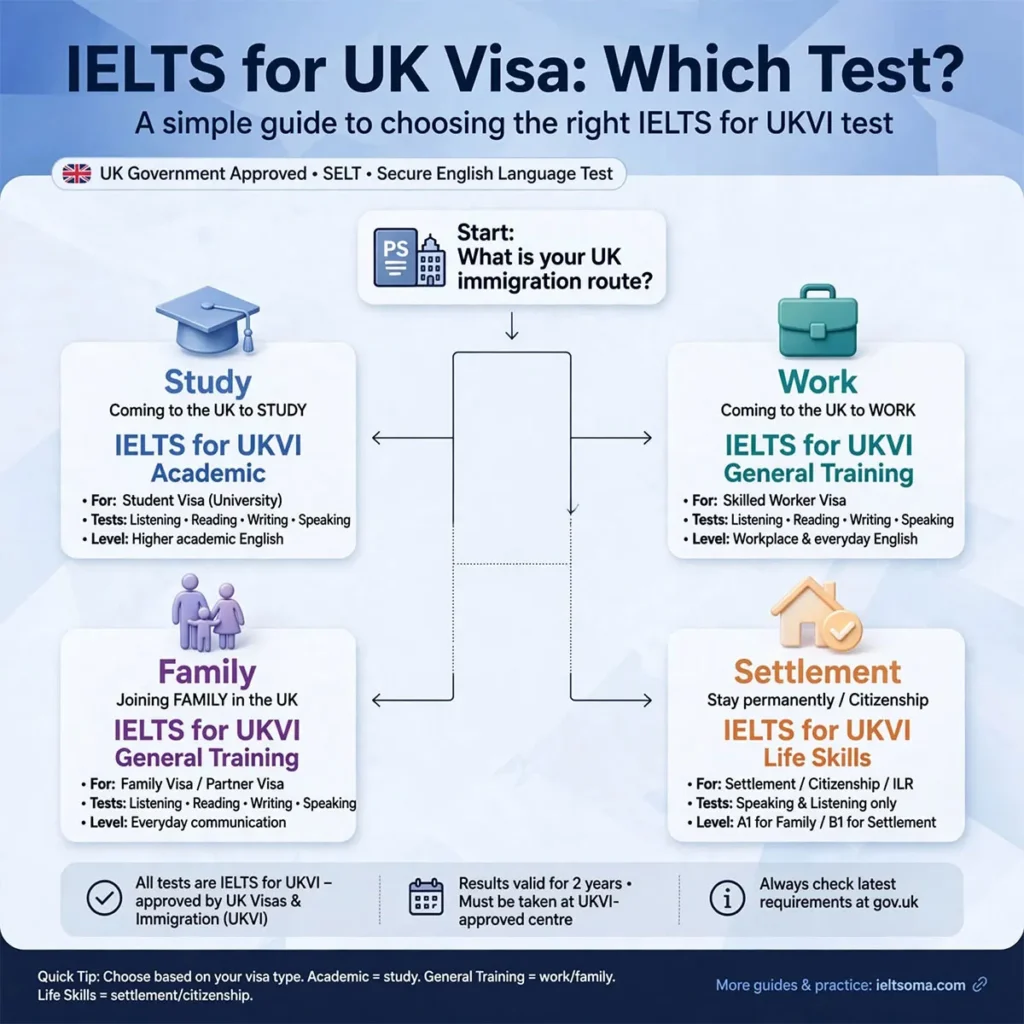
The English language requirement is linked to your immigration route, not simply to the fact that you are moving to the UK.
UK government guidance sets English requirements using the Common European Framework of Reference for Languages (CEFR). Depending on the route, requirements can range from A1 to B2 and, for some circumstances, higher levels may apply.
For example, current UK government guidance lists:
| Immigration route | Example English level |
|---|---|
| Family visa – first application | A1 |
| Family visa – certain extensions | A2 |
| Student visa – below degree level | B1 |
| Student visa – degree level or above | B2 |
| Skilled Worker | B2 in relevant circumstances |
| High Potential Individual | B2 |
| Innovator Founder | B2 |
| Scale Up | B2 in relevant circumstances |
These requirements can change, and the exact rules can depend on the circumstances of the application. Always verify the requirement on GOV.UK before taking the test.
That means two people moving to the UK at the same time could legitimately need different English tests or different levels.
2. IELTS for UKVI Is Not the Same as Choosing Any IELTS Test
One of the most common mistakes is assuming that every IELTS test is interchangeable.
IELTS offers several test types. Academic and General Training are designed for different purposes, while IELTS for UKVI is available for immigration purposes where a SELT is required.
For example:
IELTS Academic is generally designed for higher education and professional registration.
IELTS General Training is commonly used for migration and work-related purposes.
IELTS for UKVI is a version of IELTS that meets UKVI’s Secure English Language Test requirements where the immigration route requires it.
The important distinction is therefore not simply:
“Is IELTS accepted?”
Instead, ask:
“Which IELTS test is approved for my specific UK immigration route?”
That question can prevent an expensive mistake.
3. Understand the CEFR Levels Before Choosing Your Test
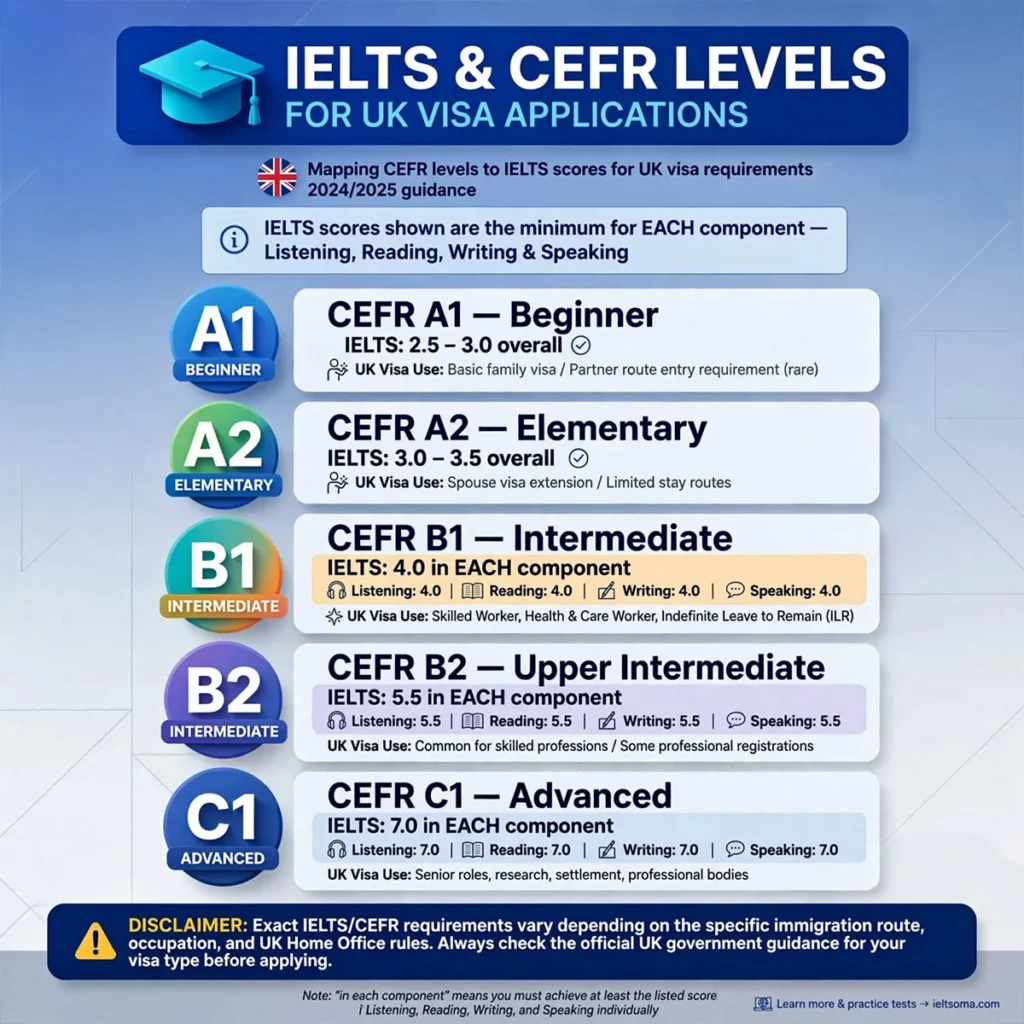
UK immigration requirements often refer to CEFR levels rather than simply saying “get Band 6” or “get Band 7”.
The CEFR provides a framework for describing language ability from lower to higher levels.
For IELTS for UKVI, IELTS currently gives the following examples for four-skill requirements:
| CEFR level | IELTS requirement |
|---|---|
| B1 | At least 4.0 in each component |
| B2 | At least 5.5 in each component |
| C1 | At least 7.0 in each component |
These figures apply to the relevant IELTS for UKVI four-skills requirements and should not be interpreted as a universal score requirement for every UK visa.
This distinction matters.
Suppose an applicant needs B2 English for an immigration route requiring all four skills. Getting:
- Listening 6.0
- Reading 6.0
- Writing 5.0
- Speaking 6.5
does not meet a requirement that specifies at least 5.5 in each component.
The overall band score is not always the deciding factor.
Overall band versus individual component scores
This is one of the biggest differences between ordinary IELTS preparation and immigration-focused preparation.
A candidate may be proud of an overall score of 6.0, but if their visa route requires a minimum score in every component, one weaker skill can prevent them from meeting the English requirement.
Therefore, identify whether your route requires:
- an overall score,
- minimum scores in individual components,
- a CEFR level,
- a pass in Life Skills,
- or another form of evidence.
Never assume that your overall IELTS band automatically determines visa eligibility.
4. Some UK Visa Applicants Need IELTS Life Skills
Not every applicant needs to sit the full four-skills IELTS test.
IELTS for UKVI Life Skills focuses on Speaking and Listening. It is available at A1, A2 and B1 levels for relevant UK immigration purposes.
For example, current IELTS guidance associates:
- Life Skills A1 with certain family visa applications
- Life Skills A2 with certain family visa extensions
- Life Skills B1 with citizenship or indefinite leave to remain in relevant circumstances
The Life Skills test is different from the four-skills IELTS test.
You are not being assessed on Reading and Writing in the same way because the test is designed specifically to assess spoken communication and listening ability.
The test involves an examiner and another test taker, with tasks based on everyday communication. Topics can include family, work, education, transport, housing, leisure and other familiar situations.
If your immigration route requires Life Skills, preparing for a full four-skills IELTS test may not be the most efficient approach.
5. Check Whether You Need IELTS Academic or General Training
If your route requires a four-skills IELTS test, you still need to establish which version is appropriate.
IELTS for UKVI is available in Academic and General Training formats. IELTS explains that the Listening and Speaking sections are shared between Academic and General Training, while Reading and Writing differ.
A simplified comparison is:
| Test | Typical purpose |
|---|---|
| IELTS for UKVI Academic | Certain study/professional purposes |
| IELTS for UKVI General Training | Certain work, migration and training purposes |
| IELTS for UKVI Life Skills | Certain family, settlement and citizenship-related requirements |
However, “typical purpose” does not mean you should choose based on guesswork.
Your immigration route determines the appropriate test.
If you are applying for a Student visa, for example, the English requirement depends on your level of study. Current GOV.UK guidance states that students studying at degree level or above generally need an English level equivalent to B2, while below-degree study generally requires B1, subject to the applicable rules and circumstances.
Your higher education provider may also assess English for certain degree-level applications, so check both the visa rules and your institution’s requirements.
6. Your Degree May Sometimes Help You Prove English
IELTS is not necessarily the only way to demonstrate English ability.
UK immigration rules allow certain applicants to meet English requirements through other forms of evidence, including qualifying degree-level qualifications taught in English, subject to the relevant rules and evidence requirements.
For some applicants with overseas qualifications, an assessment may also be required to confirm the qualification’s equivalence and language of instruction.
This means that before paying for an IELTS test, ask:
“Do I actually need to take an English language test for my route?”
Depending on your circumstances, you may already have another acceptable way to demonstrate the required level.
The answer depends on the specific immigration route and your personal circumstances, so check the current GOV.UK guidance rather than relying on advice from social media or unofficial websites.
7. IELTS for UK Visa Results Must Meet the Relevant Validity Rules
Another detail candidates sometimes overlook is the age of their test result.
UK government guidance states that an approved English language test used for immigration purposes generally needs to have been awarded within the two years before the application, subject to the applicable rules.
Therefore, do not assume:
“I took IELTS two years ago, so it will definitely be accepted.”
Check:
- The date of your test.
- The immigration route.
- The exact English requirement.
- Whether your result is still valid for that application.
- Whether you need to prove the same or a higher level for a later application.
This becomes particularly important for applicants whose immigration journey involves several stages.
What IELTS Score Do You Need for a UK Visa?
There is no universal answer.
The correct IELTS score depends on your visa route and the CEFR level required.
For four-skills IELTS for UKVI requirements, IELTS currently gives these examples:
- B1: minimum 4.0 in Listening, Reading, Writing and Speaking
- B2: minimum 5.5 in all four components
- C1: minimum 7.0 in all four components
But family visa applicants may have a different requirement, while applicants using Life Skills may need a Pass rather than an IELTS band score.
So instead of searching for:
“What IELTS score is needed for a UK visa?”
find the answer to:
“What English level does my specific UK immigration route require?”
That is a much safer starting point.
A Simple Example
Imagine three applicants:
Applicant A: Family visa
The applicant is making a first family visa application and needs to meet an A1 English requirement.
They may need an approved SELT such as IELTS for UKVI Life Skills A1, depending on their circumstances.
Applicant B: Skilled Worker
The applicant’s route requires B2 English.
For the relevant IELTS for UKVI four-skills requirement, they need at least 5.5 in each component.
Applicant C: Student
The applicant is studying at degree level or above.
The current Student visa guidance states that the required level is equivalent to B2, although a Higher Education Provider may assess English itself in certain circumstances.
These three candidates should not simply book the same IELTS test and aim for the same score.
Their requirements are different.
Common IELTS for UK Visa Mistakes
Mistake 1: Booking the wrong test
A candidate books ordinary IELTS without checking whether the immigration route requires a SELT.
Better approach: Check the approved test and provider requirements on GOV.UK before booking.
Mistake 2: Focusing only on the overall band
A candidate gets a strong overall score but misses the required minimum in one component.
Better approach: Identify the minimum requirement for each component.
Mistake 3: Choosing Academic or General Training based on preference
A candidate chooses whichever test appears easier.
Better approach: Let your immigration route determine the appropriate test.
Mistake 4: Confusing IELTS for UKVI with Life Skills
These tests serve different purposes and assess different skills.
Better approach: Confirm whether you need a four-skills IELTS for UKVI test or Life Skills.
Mistake 5: Trusting outdated visa information
Immigration rules can change.
Better approach: Use current GOV.UK guidance when making your final decision.
Mistake 6: Preparing only to “pass”
If your route requires a minimum score in every component, weak preparation in one skill can cause problems.
Better approach: Build balanced ability across the required components.
How to Prepare for IELTS for UK Visa
Once you know the correct test and target level, your preparation becomes much more straightforward.
1. Identify your exact target
Write down:
- Visa route
- Required CEFR level
- Required IELTS test
- Required score
- Required minimum in each component
- Test date
- Result validity requirements
Do not begin intensive preparation until these details are clear.
2. Take a diagnostic test
Before creating a study plan, establish your current level.
For a four-skills test, assess:
- Listening
- Reading
- Writing
- Speaking
Then identify your weakest area.
If you need B2 and your Writing is significantly weaker than your other skills, spending all your preparation time on vocabulary may not solve the real problem.
3. Practise according to the test format
Do not prepare with random English exercises alone.
Practise the actual IELTS question types and timing conditions.
For Listening, train yourself to predict answers, recognise corrections and continue when you miss an answer. IELTSOMA’s IELTS Listening Section Strategies provides additional strategies for these skills.
For Reading, develop scanning, paraphrase recognition and question-specific strategies. See IELTSOMA’s IELTS Reading Strategies for a broader preparation framework.
For Speaking, focus on developing answers naturally rather than memorising scripts. IELTSOMA’s IELTS Speaking Practice Tips covers practical ways to build fluency, vocabulary, grammar and confidence.
4. Build your weakest skill
If your target is 5.5 in every component, a 7.0 in Listening does not compensate for a 5.0 in Writing when the requirement specifies 5.5 in each component.
Your preparation should therefore focus on meeting the minimum in every required area, not simply maximising your overall score.
5. Practise under realistic conditions
As your test date approaches, include timed practice.
For example:
Week 1: Identify weaknesses and review fundamentals.
Weeks 2–3: Practise individual question types and language skills.
Weeks 4–5: Introduce timed sections and full tests.
Final week: Focus on accuracy, timing, common mistakes and confidence rather than trying to learn huge amounts of new material.
Adjust this schedule according to your current level and test date.
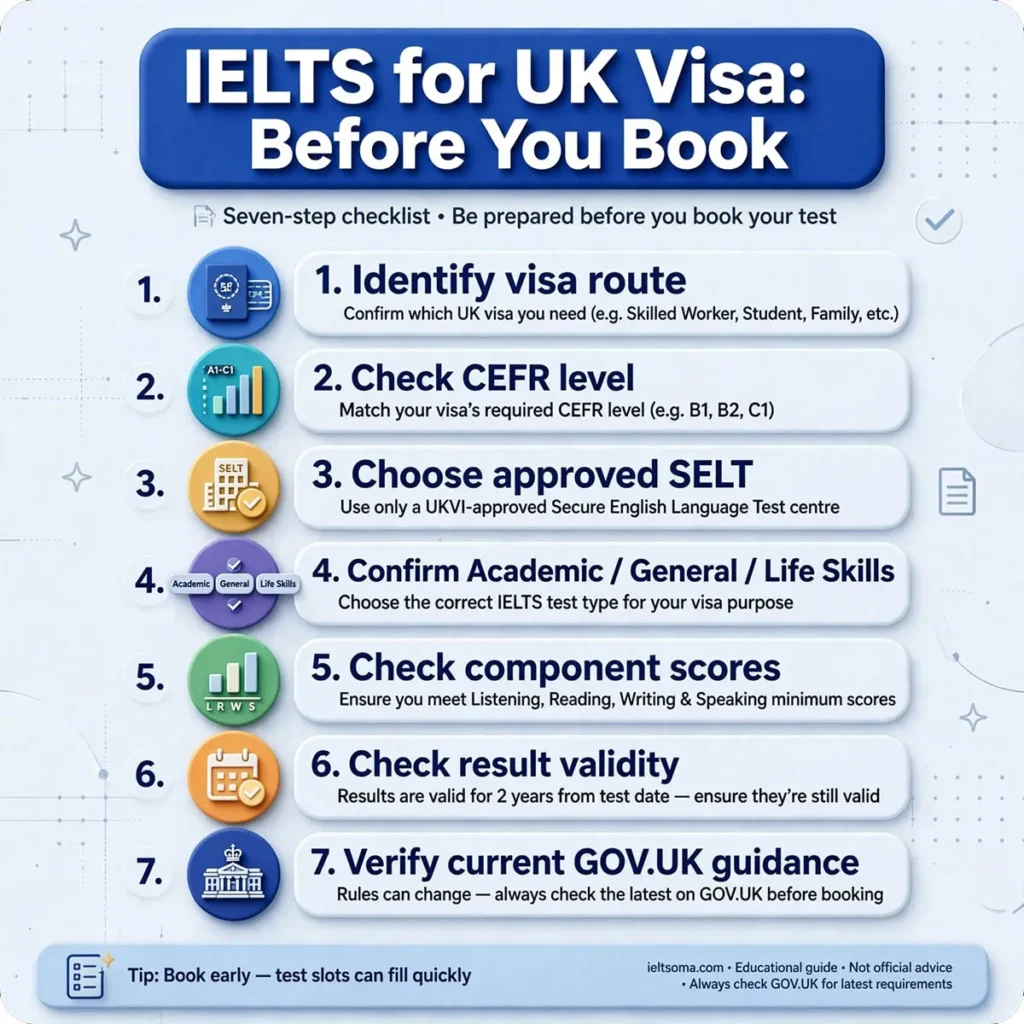
IELTS for UK Visa Preparation Checklist
Before booking:
- Confirm your UK immigration route.
- Check whether an English test is required.
- Check the required CEFR level.
- Confirm whether you need IELTS for UKVI or Life Skills.
- Confirm Academic or General Training where applicable.
- Check whether minimum component scores apply.
- Check approved test providers and test locations.
- Check the validity rules for your result.
- Check whether another qualification can prove your English.
- Confirm the requirements again before submitting your application.
This final check can save considerable time and money.
Frequently Asked Questions About IELTS for UK Visa
Is IELTS required for every UK visa?
No. English language requirements depend on the immigration route. Some routes require an approved English test, while certain applicants may meet the requirement through another accepted form of evidence or may qualify for an exemption.
What IELTS score is required for a UK visa?
There is no single score for every UK visa. For relevant four-skills IELTS for UKVI requirements, IELTS currently lists 4.0 in each component for B1, 5.5 in each component for B2 and 7.0 in each component for C1. Your visa route determines which level applies.
Is IELTS for UKVI different from normal IELTS?
IELTS for UKVI is an approved Secure English Language Test designed to meet UKVI requirements where a SELT is required. The test must be taken under the required security arrangements at an approved location.
Do I need IELTS Academic or General Training for a UK visa?
It depends on the immigration route. IELTS for UKVI is available in Academic and General Training versions, while Life Skills is used for certain requirements involving Speaking and Listening. Always check your specific route before booking.
Can I use IELTS Life Skills for a UK visa?
For certain immigration routes, yes. IELTS for UKVI Life Skills is available at A1, A2 and B1 levels and assesses Speaking and Listening. It is used for specific UK immigration requirements rather than as a general replacement for four-skills IELTS.
Do I need a minimum score in every IELTS section?
For some immigration routes, yes. For example, IELTS states that relevant B1, B2 and C1 four-skills requirements require the specified minimum in each component. Therefore, do not rely only on your overall band score.
How long is an IELTS result valid for UK visa purposes?
UK government guidance generally requires an approved English language test used for immigration to have been awarded within the two years before the application, subject to the applicable rules. Check the current rules for your route before applying.
Can a degree taught in English replace IELTS?
In some circumstances, yes. UK immigration rules allow certain applicants to meet English requirements through qualifying degrees or other accepted evidence. The conditions depend on the immigration route and qualification.
Final Advice
The biggest mistake with IELTS for UK visa applications is treating IELTS as a one-size-fits-all requirement.
It isn’t.
Your first task is to identify your immigration route. Then establish the required CEFR level, the correct SELT, the required IELTS version, and whether you need minimum scores in individual components.
Only then should you build your preparation plan.
If your route requires IELTS for UKVI, prepare for the exact test you will take—not simply for “IELTS” in general. Focus on the weakest component, practise under realistic conditions and check your answers against the precise requirement.
Most importantly, immigration rules can change. Before booking your test or submitting an application, confirm the current requirements through the official UK government guidance.
That small step can prevent a very expensive mistake.
Further Reading: