Choosing an IELTS test centre can feel surprisingly stressful. You may hear candidates say that one centre has better equipment, another has quieter rooms, or that a particular location gives “easier” Speaking tests.
But how much of this is actually true?
The most important point is this: an IELTS test centre does not have the power to make the IELTS test easier or harder. IELTS is a standardised test, and official IELTS guidance confirms that the test questions and format are the same for paper and computer delivery at test centres. What can differ is the environment in which you take the test, the available test dates, delivery options, facilities and certain services.
Understanding these IELTS test centre differences can help you choose a location based on practical factors rather than rumours.
In this guide, you will learn what can genuinely vary between test centres, what should not vary, and how to choose a centre that gives you the best conditions for your own performance.
Table of Contents
What Are IELTS Test Centre Differences?
IELTS test centre differences are the practical differences between authorised locations where candidates take IELTS.
These can include:
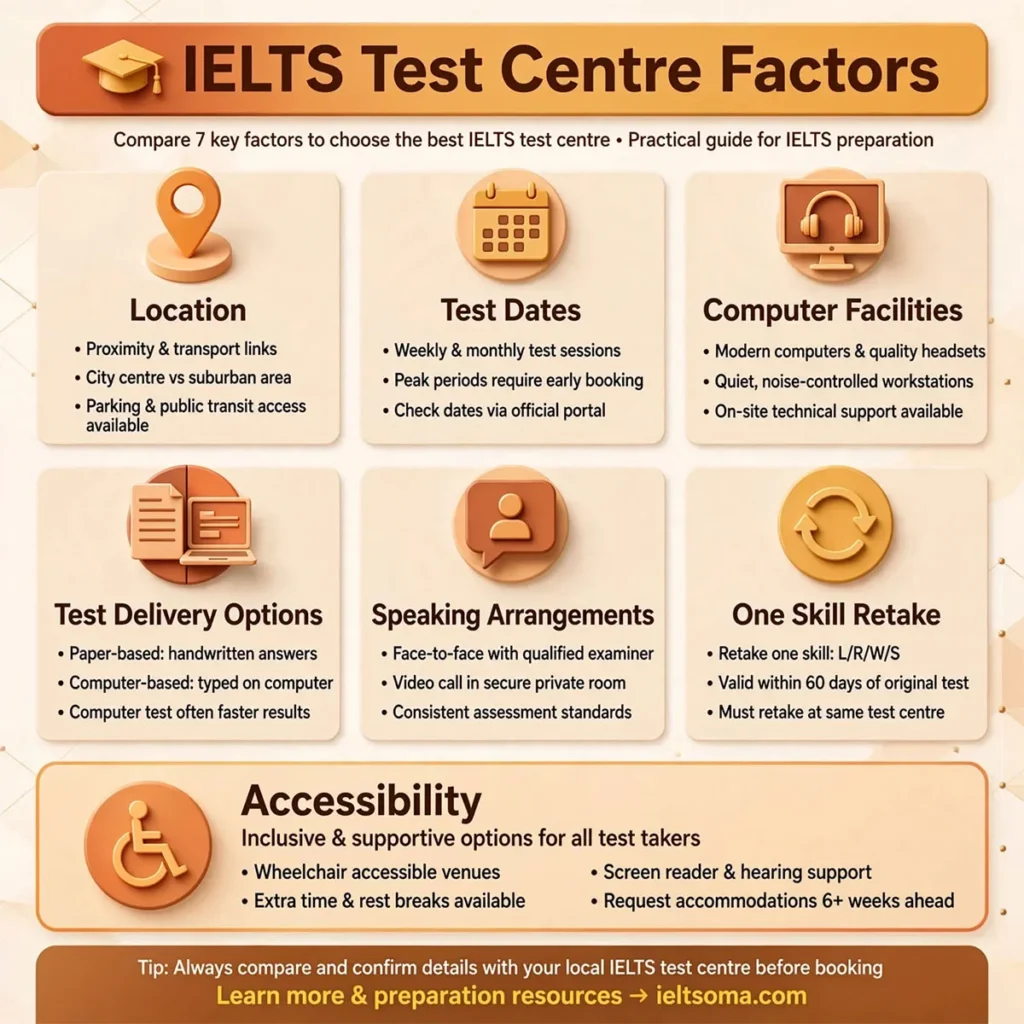
- Location and travel time
- Test dates and availability
- Computer-based facilities
- Listening equipment
- Room layout and test-day environment
- Speaking test scheduling
- Availability of One Skill Retake
- UKVI approval
- Accessibility and special arrangements
- Local administrative procedures
However, these differences should not be confused with differences in the standard of the IELTS test itself.
IELTS is designed to provide comparable results regardless of where an eligible candidate takes the test. The choice of centre should therefore be based primarily on convenience, suitability and available services—not on claims that a particular centre gives higher band scores.
1. The IELTS Questions Are Not Simply “Easier” at One Centre
One of the biggest misconceptions among IELTS candidates is that some test centres provide easier questions.
You may hear statements such as:
“This centre gives easier Reading tests.”
Or:
“Go to that centre because the Speaking examiner is more generous.”
You should be extremely cautious about such claims.
Your test centre is not supposed to decide whether your IELTS test is easy or difficult. IELTS uses standardised assessment procedures, and official IELTS information states that there is no difference in the test questions or format between paper and computer delivery at a test centre.
Different candidates can, of course, receive different test questions. IELTS has multiple test versions, and your experience may therefore feel different from another candidate’s.
That does not mean that one centre has an easier version.
Example
Imagine that Candidate A takes IELTS in London while Candidate B takes IELTS in Dubai.
Candidate A may receive a Reading passage about archaeology, while Candidate B receives one about environmental research.
The topics are different, but that does not mean one centre has deliberately provided an easier test.
Your preparation should therefore focus on handling different IELTS question types and topics rather than trying to predict which centre will provide the easiest paper.
2. Test Delivery Options Can Differ
One of the most important IELTS test centre differences is the way the test is delivered.
IELTS has been moving towards computer delivery globally. IELTS announced in March 2026 that paper-based IELTS would be phased out from mid-2026, with exact timelines varying by market. In selected markets, a new Writing on Paper option is being introduced for candidates who prefer to handwrite their Writing responses while taking the rest of the test on computer.
This means that the options available at one centre may not necessarily be identical to those available at another.
For example, one centre may offer:
- IELTS on computer
- One Skill Retake
- Writing on Paper
while another may offer fewer options.
The availability depends on the local test centre and market.
This is one reason you should check the official IELTS test-centre listing before booking rather than relying entirely on information from social media groups.
3. Computer Facilities Can Make a Practical Difference
Although the IELTS test itself is standardised, your experience using the equipment can differ from one centre to another.
When taking IELTS on computer, you interact with a computer throughout Listening, Reading and Writing. Official IELTS information confirms that the questions and test format remain the same; the difference is how you provide your answers.
The practical environment may nevertheless matter.
For example, you may want to consider:
- How comfortable you are typing
- Whether you can clearly hear the Listening recording
- Whether the screen is comfortable to use
- Whether the room feels crowded
- Whether you prefer a particular type of workstation
- How easily you can travel to the centre
Do not interpret these factors as differences in IELTS standards.
Instead, think about them as performance conditions.
If you type quickly and comfortably, a computer-based test may suit you very well.
If typing causes you unnecessary stress, you may need to investigate whether a Writing on Paper option is available at your chosen location.
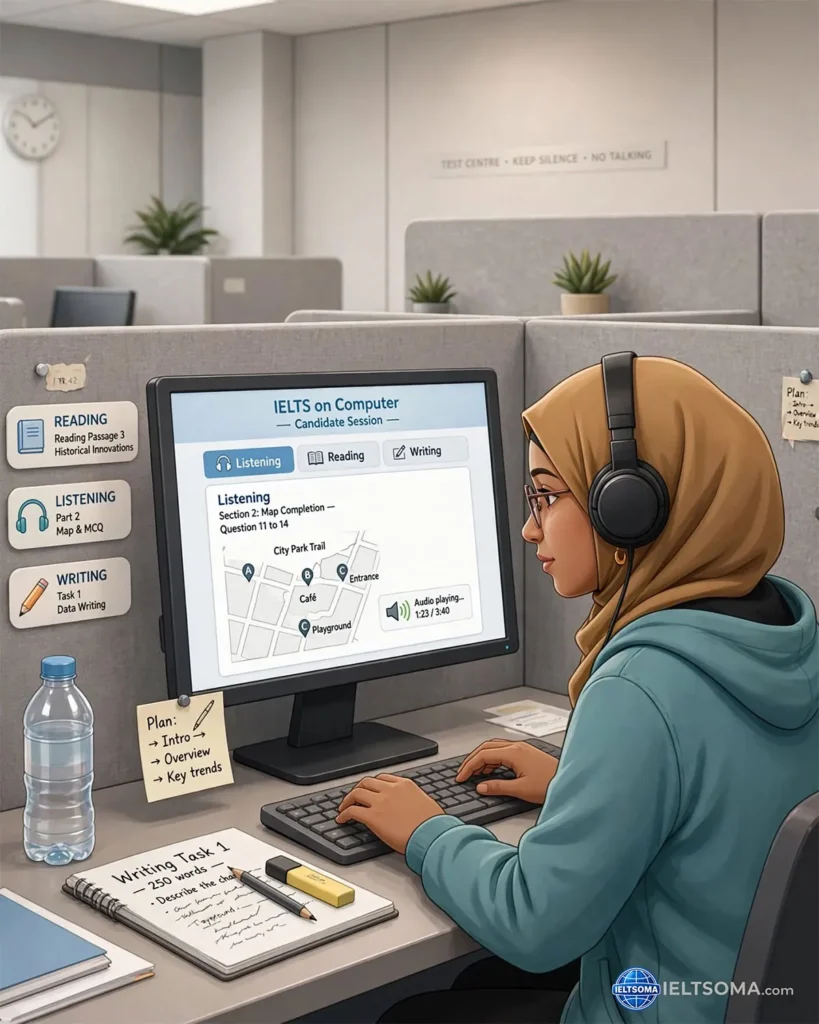
4. Listening Conditions Are Worth Considering
Listening is one section where the physical environment can have a noticeable effect on your concentration.
The questions and assessment standards are standardised, but candidates still sit in a physical environment where factors such as concentration, comfort and familiarity with headphones can matter.
If your centre provides headphones for computer-based IELTS, you should become comfortable with listening through headphones during preparation.
Practise with the same general setup:
- Wear headphones.
- Listen at a comfortable volume.
- Avoid repeatedly pausing recordings.
- Read questions while listening.
- Train yourself to recover quickly after missing an answer.
Do not spend too much time trying to find a centre because you have heard that its headphones are “better”.
A much more reliable strategy is to prepare yourself to perform under normal test conditions.
5. Speaking Test Arrangements May Vary
The Speaking test is another area that causes considerable speculation.
Candidates sometimes believe that a particular centre has easier Speaking examiners.
This is not a sensible basis for choosing your test centre.
The Speaking test is conducted by trained IELTS examiners, and candidates are assessed according to IELTS Speaking assessment criteria rather than according to whether an examiner personally likes a particular candidate.
Your Speaking score depends on your performance in areas such as:
- Fluency and coherence
- Lexical resource
- Grammatical range and accuracy
- Pronunciation
The practical arrangement, however, can vary.
For example, the time of your Speaking test may differ from your Listening, Reading and Writing schedule. Your centre will provide the relevant arrangements for your test.
Instead of asking:
“Which centre has the easiest examiner?”
ask:
“Which centre gives me a practical test schedule that works well for me?”
That is a much more useful question.
6. Test Dates and Availability Can Be Very Different
This is one of the most genuine IELTS test centre differences.
Not every centre offers the same number of test dates.
Some locations may have frequent test sessions, while smaller locations may have fewer available dates.
The official IELTS test-centre search allows candidates to find available options by location and test type. IELTS currently lists more than 4,500 test locations across more than 160 countries.
This can make location an important part of your preparation plan.
For example
Suppose your university application deadline is 30 October.
You find two possible test centres:
Centre A
- Convenient location
- Next available test in late October
Centre B
- Slightly longer journey
- Several earlier test dates
Centre B may be the better choice even if Centre A is closer.
Your goal is not simply to find the nearest centre.
Your goal is to find a suitable test date that gives you enough time to prepare and receive your results before your deadline.
7. One Skill Retake Availability Can Differ
One of the most important services to check when comparing test centres is IELTS One Skill Retake.
One Skill Retake allows eligible candidates to retake one of the four IELTS skills—Listening, Reading, Writing or Speaking—rather than taking the complete test again.
However, it is not automatically available at every test centre.
Official IELTS guidance states that candidates should check whether their chosen test centre offers One Skill Retake. The original full test must also meet the relevant eligibility requirements.
This can be particularly useful if your university or organisation accepts One Skill Retake and you narrowly miss the required score in one skill.
Example
Suppose your results are:
- Listening: 7.5
- Reading: 7.0
- Writing: 6.0
- Speaking: 7.5
If your target is 6.5 in every skill, your Writing score is the problem.
Instead of automatically repeating the entire IELTS test, One Skill Retake may provide an alternative—provided you meet the eligibility requirements and your receiving organisation accepts the result.
This makes checking centre-specific availability worthwhile.
What Should Not Be Different Between IELTS Test Centres?
When comparing IELTS test centres, it is useful to separate legitimate practical differences from myths about scoring.
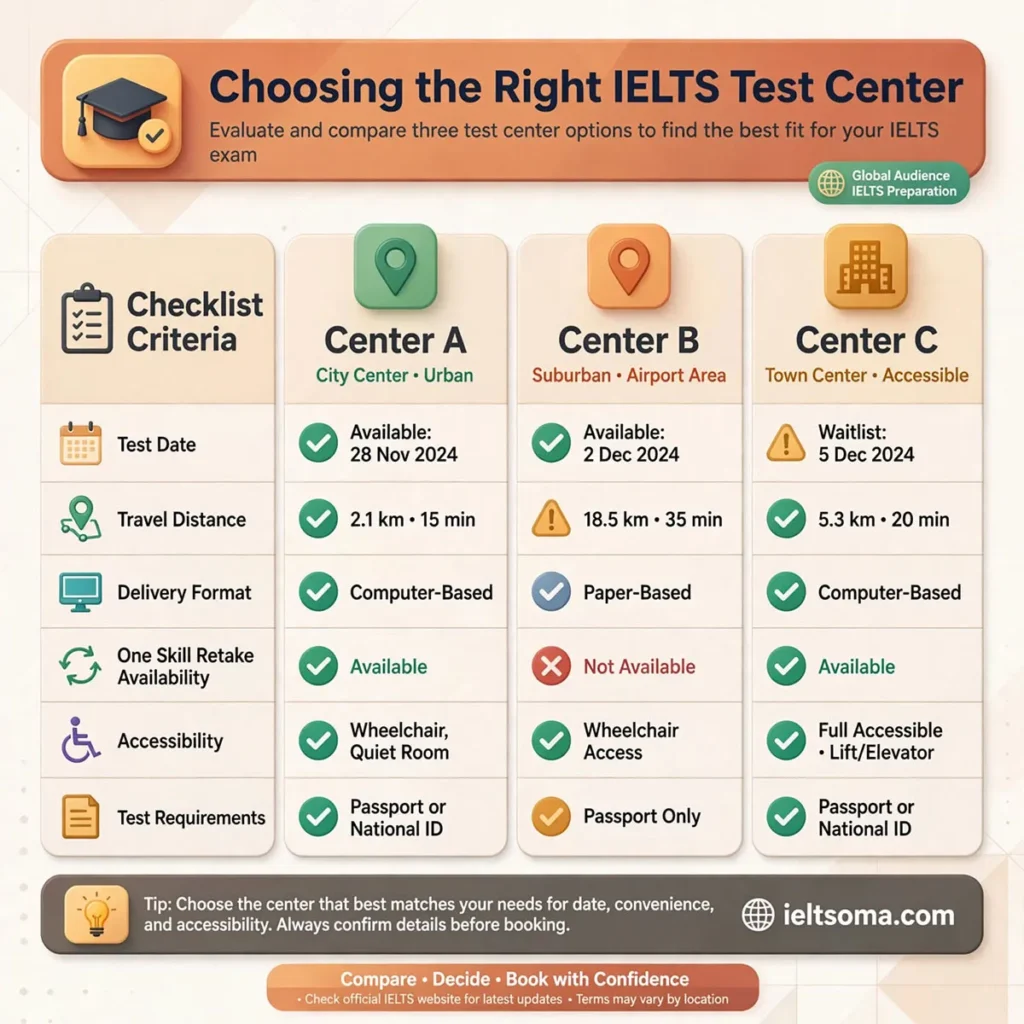
| Factor | Can vary between centres? | What you should know |
|---|---|---|
| Location | Yes | Choose a convenient location |
| Test dates | Yes | Availability differs |
| Delivery options | Yes | Check what your centre offers |
| One Skill Retake | Yes | Availability must be confirmed |
| Facilities | Yes | Practical conditions can differ |
| Speaking schedule | Yes | Follow your centre’s arrangements |
| Test questions | Not because a centre chooses them to be easier | IELTS is standardised |
| Assessment criteria | No | IELTS uses standardised criteria |
| Examiner generosity | Not a valid selection strategy | Prepare for the criteria |
| Guaranteed higher band score | No | No centre can guarantee this |
This distinction is important.
A test centre can provide a more convenient experience without providing an “easier IELTS”.
How Should You Choose an IELTS Test Centre?
Rather than searching for rumours about the easiest centre, use a practical checklist.
1. Check the official test centre
Start with the official IELTS test-centre search.
Look for your city and nearby locations, then compare the available test options.
2. Check the test date
Make sure the date gives you enough preparation time.
If you have a university, employment or visa deadline, work backwards from that deadline rather than booking the first available test.
3. Check the test format
Confirm whether the centre offers the delivery option you want.
If you prefer typing, IELTS on computer may suit you.
If you specifically want to handwrite your Writing responses, check whether the Writing on Paper option is available in your market and at your chosen centre.
4. Check One Skill Retake availability
If this option matters to you, verify it before booking your original test.
Do not assume that every centre provides it.
5. Consider travel time
A centre that is 20 minutes farther away may actually be a better choice if the journey is reliable and the test date works better.
Avoid arriving exhausted after a long and unpredictable journey.
6. Check special requirements early
If you require access arrangements or other support, contact the test centre well before your test.
IELTS advises candidates with disabilities or mobility requirements to contact their local test centre in advance so appropriate support can be arranged.
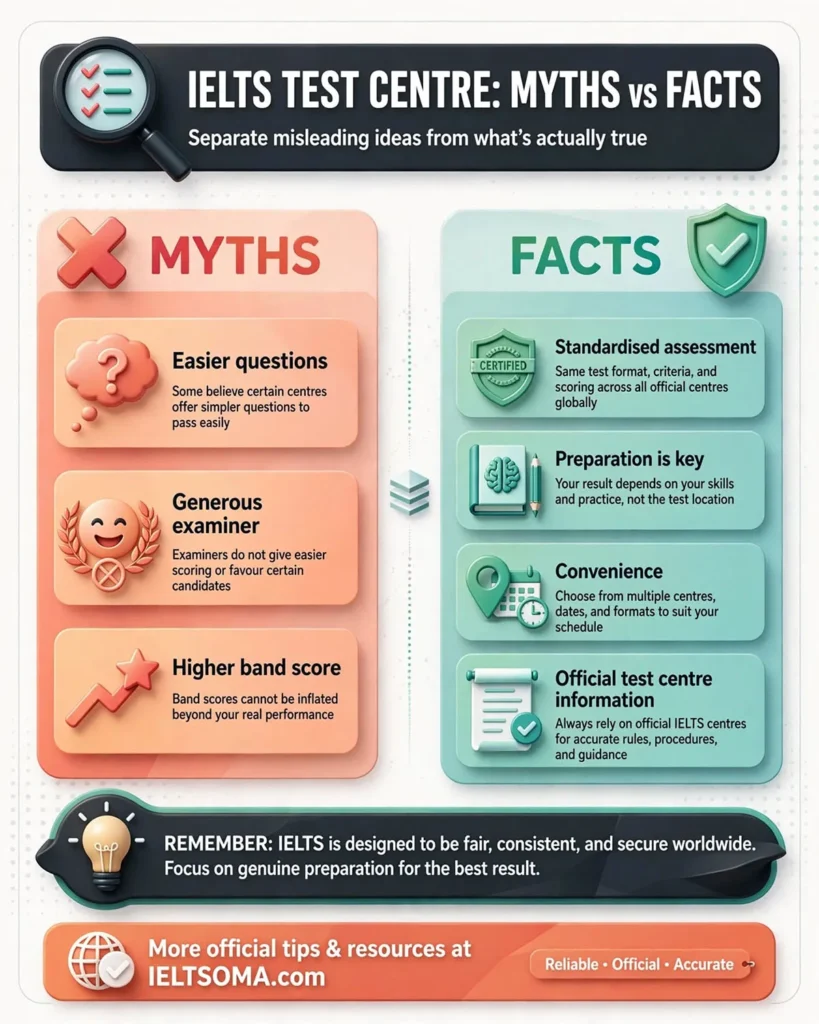
IELTS Test Centre Myths You Should Ignore
Myth 1: “This centre gives easier questions.”
There is no reliable reason to choose a centre based on this claim.
Different test versions can exist, but that does not make one centre an easier option.
Myth 2: “This centre has generous Speaking examiners.”
Your Speaking performance is assessed using IELTS criteria. Choosing a centre because someone claims its examiners are more generous is not a dependable strategy.
Myth 3: “You can get a higher band score at a particular centre.”
A location cannot guarantee a higher score.
Your preparation and test-day performance matter far more.
Myth 4: “Everyone gets the same questions at every centre.”
Not necessarily.
Different candidates may encounter different test questions. The important point is that IELTS is designed as a standardised assessment, rather than giving a particular centre the ability to choose easier questions.
Myth 5: “The nearest centre is automatically the best.”
Not always.
A slightly farther centre may have a better test date, a preferred delivery option or One Skill Retake availability.
Should You Change Your IELTS Test Centre?
Changing your test centre can make sense if there is a practical reason.
Consider changing if:
- Your preferred test date is unavailable.
- The centre does not offer the delivery method you want.
- One Skill Retake availability is important to you.
- The journey is unnecessarily difficult.
- You need an access arrangement that the centre cannot provide.
- Another authorised centre offers a more suitable schedule.
But changing simply because someone says:
“That centre gives easier IELTS.”
is not a strong reason.
Your preparation should not depend on rumours.
The Best Strategy Is to Control What You Can
You cannot control which Reading topic appears.
You cannot control the exact Listening recording.
You cannot choose your Speaking examiner.
And you cannot guarantee that your preferred topic will appear in Writing.
What you can control is your preparation.
Before test day, make sure you can:
- Manage IELTS time limits.
- Understand every major question type.
- Follow instructions accurately.
- Take effective notes during Listening.
- Locate answers efficiently in Reading.
- Plan and develop Writing responses.
- Speak naturally without memorising entire answers.
- Check your work efficiently.
- Use the computer confidently if taking IELTS on computer.
- Arrive at the centre with enough time.
That preparation will have a much greater effect on your result than trying to identify a supposedly “easy” test centre.
A Simple IELTS Test Centre Comparison Checklist
Before booking, compare your shortlisted centres using these questions:
- Is the centre authorised for the IELTS test I need?
- Does it offer my preferred test format?
- Is my preferred test date available?
- Is the location practical for me?
- Can I travel there reliably on test day?
- Does it offer One Skill Retake if I need it?
- Does it have the access arrangements I require?
- Does the test type meet my university, employer or visa requirements?
- Have I checked the information directly with the centre?
- Am I choosing this centre for practical reasons rather than rumours?
If the answer to these questions is satisfactory, you have probably done enough research.
Final Takeaway
The most useful way to understand IELTS test centre differences is to separate the test itself from the test-day environment.
The centre can affect practical matters such as location, dates, facilities, delivery options and the availability of services such as One Skill Retake. But you should not assume that one authorised centre provides easier questions, more generous marking or guaranteed higher scores.
Choose your centre based on convenience, availability, suitability and official requirements.
Then put your energy where it belongs: preparing to perform confidently under IELTS test conditions.
A well-prepared candidate at a convenient centre is in a much stronger position than an unprepared candidate who has spent weeks searching for the “easiest” test centre.
Frequently Asked Questions
Does the IELTS test differ between test centres?
The practical test experience can differ between centres, including location, dates, facilities and available services. However, IELTS is a standardised test, and the test questions and format do not become easier simply because you choose a particular centre.
Is IELTS easier at some test centres?
There is no reliable basis for choosing a test centre because it supposedly offers easier IELTS questions. Different candidates can receive different test versions, but you should prepare for the full range of IELTS content and question types.
Do IELTS Speaking examiners differ between centres?
Different trained examiners may conduct Speaking tests, but your performance is assessed using IELTS Speaking assessment criteria. You should not choose a centre based on claims that its examiners give higher scores.
Does the test centre affect my IELTS band score?
The centre itself does not guarantee or determine a particular band score. Your result reflects your performance under IELTS assessment procedures.
Can I choose between IELTS on paper and computer?
Test delivery options depend on the current arrangements in your market and at the centre you choose. IELTS has been transitioning to computer delivery, while selected markets are introducing a Writing on Paper option.
Is One Skill Retake available at every IELTS test centre?
No. One Skill Retake is available at participating centres, so you should check availability before booking your original test.
Should I choose the IELTS test centre closest to me?
Not necessarily. The closest centre may be convenient, but another centre could have a better test date, preferred delivery option or other service that suits your circumstances.
How can I find an official IELTS test centre?
Use the official IELTS test-centre search to check available locations and test options.
Further Reading: