
You have taken IELTS more than once. You have completed practice tests. You have watched videos, learned vocabulary, worked through grammar exercises and perhaps even memorised model answers.
Yet your IELTS score is not improving.
You might be getting 6.0 again and again. Perhaps your Listening and Reading scores have improved, but Writing refuses to move. Or your Speaking score stays at the same band despite months of practice.
This is frustrating, but a plateau does not necessarily mean that you have reached your limit.
In many cases, the problem is not a lack of effort. The problem is that the type of practice has stopped matching the skill you actually need to improve.
If you keep practising the same way, you can become very good at practising without becoming significantly better at IELTS.
The solution is to diagnose exactly where marks are being lost, understand what the test is assessing, and change your preparation accordingly.
Table of Contents
Why Is Your IELTS Score Not Improving?
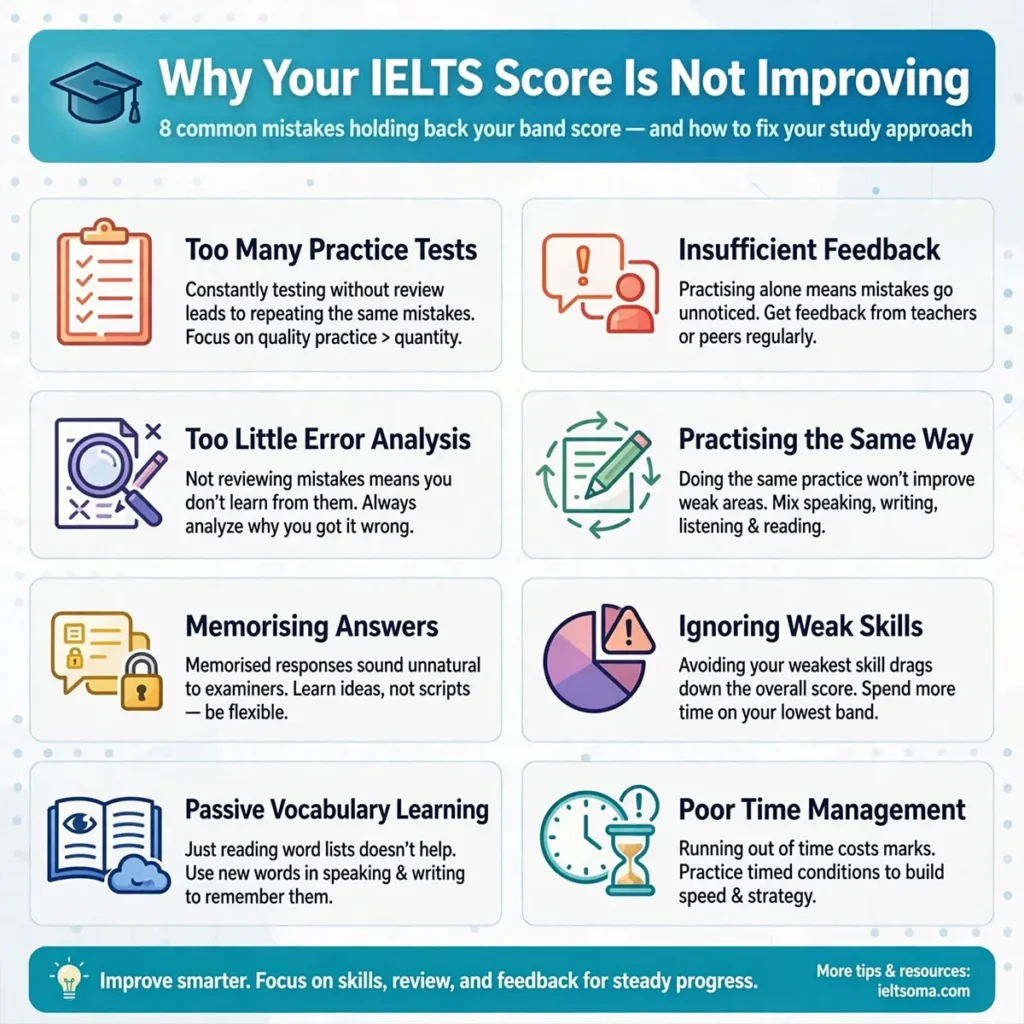
The most common reason an IELTS score stops improving is that candidates continue using a general study routine when they actually need targeted correction.
For example, a learner who repeatedly scores Band 6 in Writing may spend another month learning vocabulary. But if the real weakness is Task Response or Coherence and Cohesion, hundreds of new words may make very little difference.
Similarly, a Speaking candidate who struggles with fluency may memorise sophisticated expressions instead of practising spontaneous speech.
IELTS assesses different skills through specific criteria. Speaking, for example, is assessed using Fluency and Coherence, Lexical Resource, Grammatical Range and Accuracy, and Pronunciation. These four criteria carry equal weighting.
That means your preparation should be based on the actual source of lost marks—not simply on doing more questions.
1. You Are Practising Too Much and Analysing Too Little
Doing practice tests feels productive because you can see a score at the end.
But a practice test only tells you what happened. It does not automatically tell you why it happened.
Imagine that you complete three Reading tests and score:
- Test 1: 27/40
- Test 2: 28/40
- Test 3: 27/40
Doing another five tests may produce very similar results.
Instead, analyse the mistakes.
Ask:
- Did I misunderstand the question?
- Did I locate the wrong paragraph?
- Did I miss a keyword or paraphrase?
- Did I choose an answer too quickly?
- Did I spend too much time on one question?
- Did I make a spelling mistake?
- Did I fail to recognise the type of question?
The same principle applies to Listening, Writing and Speaking.
Your mistakes are diagnostic information.
Try an error log
Create a simple table:
| Date | Skill | Mistake | Why it happened | Corrective action |
|---|---|---|---|---|
| 23 Sept | Reading | Matching headings | Confused main idea with detail | Practise identifying paragraph purpose |
| 24 Sept | Listening | Map question | Lost track of directions | Practise signposting language |
| 25 Sept | Writing | Weak conclusion | Repeated ideas | Practise concise conclusions |
| 26 Sept | Speaking | Long pauses | Searching for vocabulary | Practise speaking with familiar vocabulary |
After several tests, patterns begin to appear.
That pattern is far more useful than another raw practice score.
2. You Are Measuring Progress Only Through Full Tests
A full IELTS test is useful, but it should not be your only measurement.
Suppose your target is Band 7. You should track smaller skills before expecting your overall score to change.
For Reading, you could track:
- Matching Headings
- True/False/Not Given
- Yes/No/Not Given
- Multiple Choice
- Summary Completion
- Matching Information
For Listening, track:
- spelling
- numbers
- names
- map labelling
- multiple choice
- distractors
- note completion
For Writing, track:
- Task Response
- Coherence and Cohesion
- vocabulary
- grammatical accuracy
- paragraph development
For Speaking, track:
- fluency
- idea development
- vocabulary
- grammar
- pronunciation
This approach turns an apparently large problem—“my IELTS score is not improving”—into smaller problems that can actually be trained.
3. You Are Learning Vocabulary Instead of Learning to Use It
Vocabulary is important, but memorising long lists of advanced words is not the same as developing a strong lexical resource.
A candidate may know words such as:
- detrimental
- indispensable
- multifaceted
- unprecedented
- sustainable
but still struggle to communicate naturally.
The better question is:
Can you use appropriate vocabulary quickly, accurately and naturally when you need it?
For IELTS, active vocabulary is more useful than vocabulary that you recognise but rarely use.
Instead of memorising 50 unrelated words, choose a topic such as education.
Build a small network:
Education
→ tuition fees
→ academic performance
→ practical skills
→ higher education
→ vocational training
→ access to education
→ career prospects
Then practise using these expressions in complete ideas.
For example:
University education can improve career prospects, but high tuition fees may prevent some students from accessing higher education.
Now the vocabulary is attached to meaning.
That makes it easier to retrieve during the test.
4. You Are Memorising Answers
Memorisation can create a dangerous illusion of preparation.
You may memorise a Speaking answer about your favourite teacher, your hometown or an unforgettable journey. But IELTS Speaking is designed to assess your ability to communicate rather than simply reproduce rehearsed material. The official IELTS guidance notes that Speaking tasks are delivered in a way that does not allow candidates to rehearse set responses beforehand.
If the question changes slightly, the memorised answer can become difficult to adapt.
A better approach is to memorise language tools, not complete answers.
For example:
One experience that immediately comes to mind is…
The main reason I remember it so clearly is…
Another aspect worth mentioning is…
Looking back, I would say that…
These are flexible structures.
You can use them with many different topics without sounding as though you are reciting a script.
5. Your IELTS Speaking Practice Is Too Predictable
This is one of the most common reasons a Speaking score can remain stuck.
If you always practise questions you already know, your brain becomes comfortable with predictable language.
The real test requires you to respond to questions you have not rehearsed.
This is particularly important in Speaking Part 2.
A practical IELTS Speaking Part 2 cue card strategy
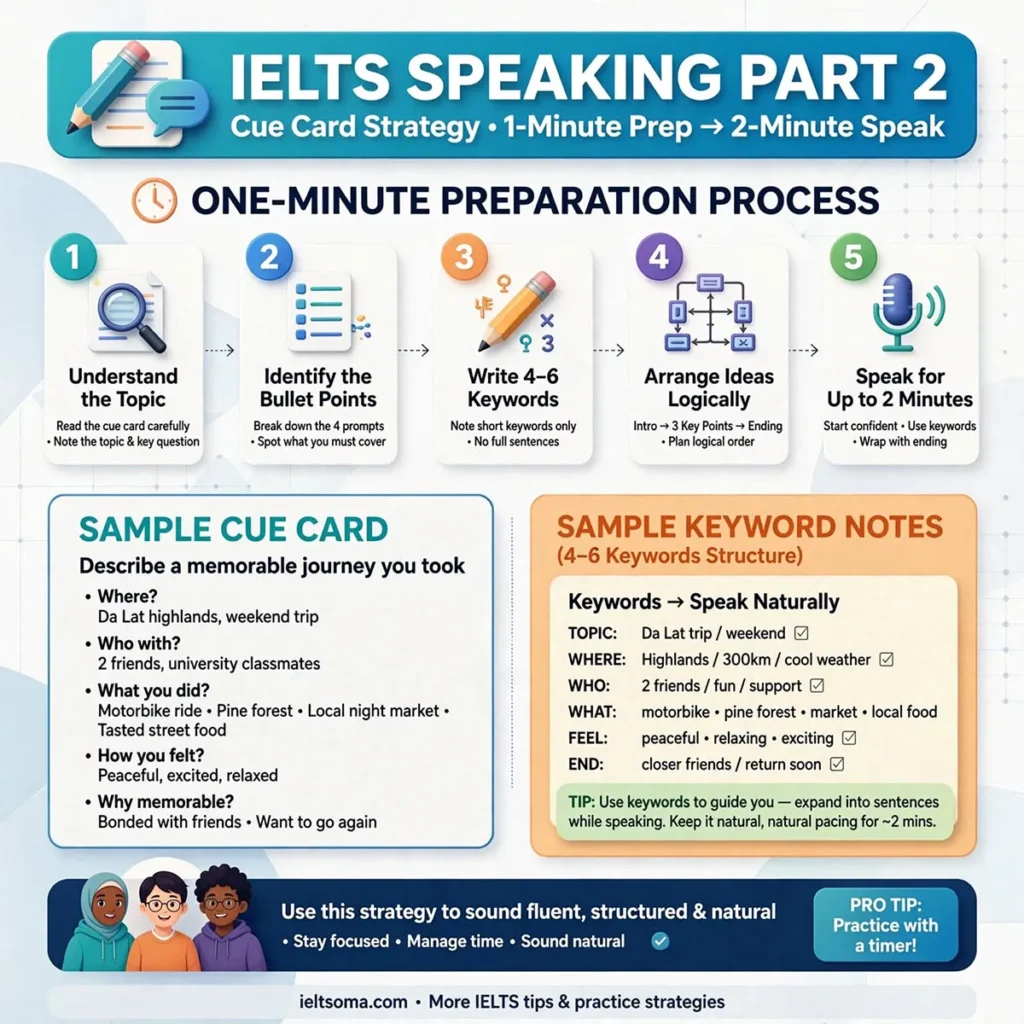
In Part 2, you receive a task card and have one minute to prepare before speaking for up to two minutes. The task card provides points to guide your response.
Your one minute should not be spent writing a complete speech.
Use it to create a simple speaking route.
For example, imagine the cue card asks you to describe a person who influenced you.
Your notes could be:
teacher → secondary school → encouraged writing → difficult year → confidence → still remember advice
That’s enough.
You now have a sequence:
- Who the person was
- Where you met them
- What they did
- Why it mattered
- How you feel about the experience now
This is much more useful than writing full sentences.
How to answer IELTS Speaking Part 2
A reliable structure is:
Introduce → Describe → Explain → Example → Reflect
For example:
I’d like to talk about one of my secondary school teachers, who had a surprisingly strong influence on me.
Then describe the person and situation.
Next, explain what the person did.
Then give a specific example.
Finally, explain why the experience remains important.
This structure helps you develop ideas rather than simply listing information.
The official IELTS guidance also recommends using the one-minute preparation time to understand the task, make notes and organise what you want to say.
Make your one minute of preparation count
A useful one minute preparation IELTS routine is:
First 15 seconds: understand the topic.
Next 30 seconds: write 4–6 keywords covering the bullet points.
Final 15 seconds: decide how you will begin and what final point you want to make.
Do not attempt to write your entire answer.
Your notes are there to remind you of ideas, not to become a script.
6. You Are Trying to Sound “Advanced”
This is particularly damaging in Speaking and Writing.
Many candidates believe a higher IELTS band requires complicated English in every sentence.
It does not.
If an advanced word makes your sentence unnatural or inaccurate, it may be less useful than a simpler word you can use correctly.
Compare:
The proliferation of digital devices has precipitated an unprecedented transformation in contemporary interpersonal communication.
with:
The widespread use of smartphones has changed the way people communicate.
The second sentence is simpler, but it communicates a clear idea naturally.
Your objective should be precision, flexibility and control, not complexity for its own sake.
7. You Are Not Getting Specific Feedback
“Your grammar needs improvement” is not enough.
“Your vocabulary is limited” is not enough.
“Your writing lacks coherence” is not enough.
Good feedback should tell you:
What happened → why it happened → what to do next.
For example:
Weak feedback:
Your Speaking needs more fluency.
Useful feedback:
You pause frequently before giving reasons because you are searching for vocabulary. For the next seven days, practise answering familiar questions using simple vocabulary without stopping to search for sophisticated expressions.
The second instruction gives you something you can actually train.
If you are taking IELTS again, try to obtain feedback that identifies recurring weaknesses rather than simply giving you another estimated band score.
8. You Are Trying to Improve Everything at Once
This sounds sensible:
“I need better grammar, vocabulary, pronunciation, reading speed, listening, writing and speaking.”
But it creates an impossible study plan.
Instead, identify your highest-impact weakness.
For example:
Reading: Band 7
Listening: Band 7.5
Writing: Band 6
Speaking: Band 6.5
If your target requires improvement in Writing, spending most of your study time doing Listening tests may not be the best use of your preparation time.
Likewise, if Speaking is the weakest component, watching grammar videos for several hours may not directly address the problem.
Use your scores to decide where your training time goes.
9. You Are Repeating the Same Study Routine
A score plateau is often a sign that your preparation needs a new method.
Consider a candidate who spends every evening:
- Takes a practice test
- Checks answers
- Watches a YouTube video
- Learns 20 words
- Takes another practice test
After several weeks, the candidate is still at the same band.
The problem may not be motivation.
It may be the lack of deliberate practice.
A better routine could be:
Monday — Diagnose
Complete one section and analyse every mistake.
Tuesday — Repair
Work specifically on the weakest question type or skill.
Wednesday — Apply
Complete a smaller timed exercise using the same skill.
Thursday — Speaking/Writing
Produce your own language and receive or perform detailed self-review.
Friday — Retest
Repeat a similar task and compare performance.
Weekend — Full practice
Complete a realistic test and compare the results with your previous baseline.
The key is the cycle:
Test → Analyse → Practise → Retest
rather than:
Test → Test → Test → Test
How Long Does It Take to Improve an IELTS Score?
There is no universal number of days or practice tests that guarantees a particular band improvement.
Your progress depends on factors such as:
- your current English level
- your target band
- the size of the gap
- which skills are limiting your score
- the quality of your practice
- how consistently you practise
- whether you receive useful feedback
A candidate who needs to correct a small test-taking problem may progress differently from someone who needs substantial development in grammar, vocabulary or comprehension.
Therefore, avoid promises such as “increase your IELTS score by one band in seven days”.
Instead, measure whether specific weaknesses are improving.
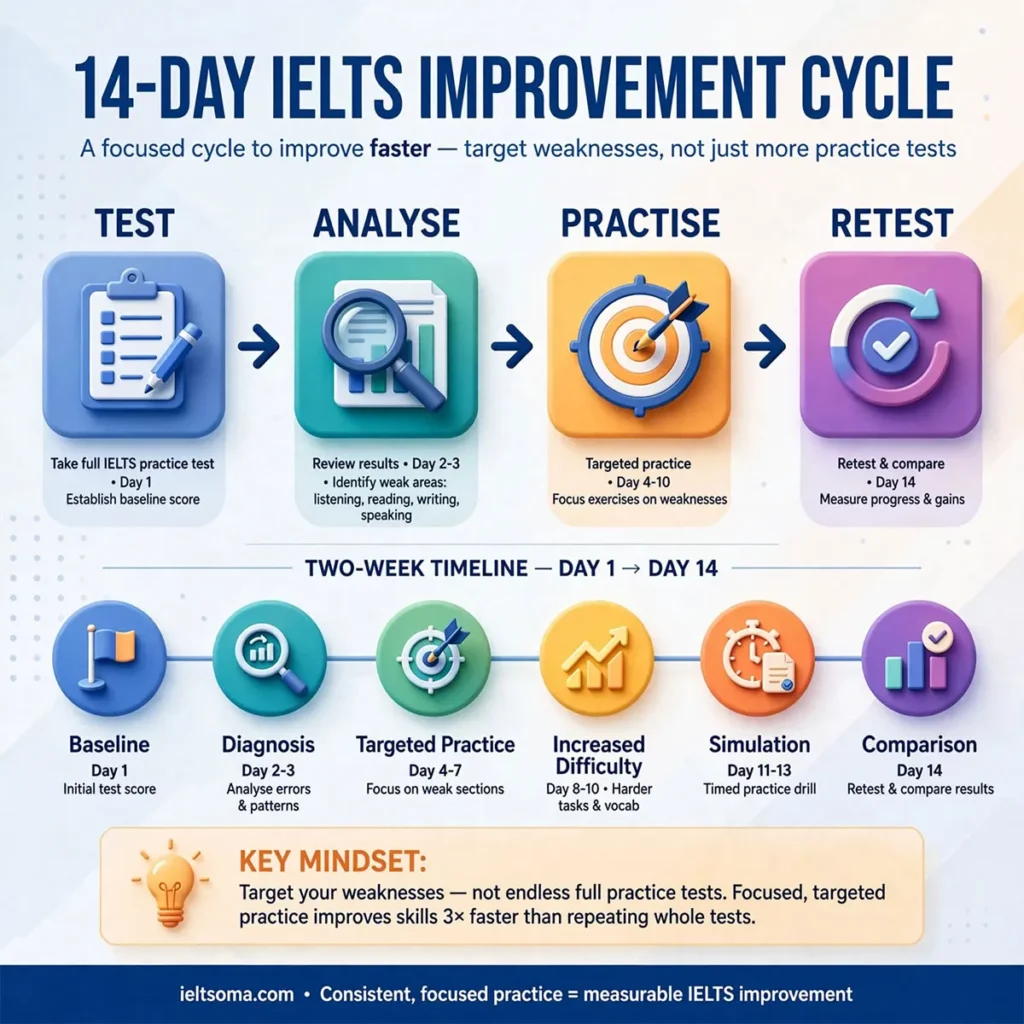
A Better 14-Day IELTS Score Improvement Plan
If your IELTS score is not improving, try a short diagnostic cycle before simply booking another test.
Days 1–2: Establish your baseline
Complete realistic Listening and Reading sections and produce a Writing and Speaking sample.
Record your results.
Days 3–5: Identify patterns
Analyse your mistakes.
Do not simply count them.
Write down why each mistake happened.
Days 6–8: Target the weakest area
Choose one or two recurring weaknesses.
For example:
- Reading Matching Headings
- Listening distractors
- Writing paragraph development
- Speaking fluency
Practise these intensively.
Days 9–11: Increase difficulty
Move from guided practice to timed practice.
For Speaking, use unfamiliar cue cards.
For Writing, vary the topics.
For Reading and Listening, use different question types.
Days 12–13: Simulate the test
Complete timed sections under realistic conditions.
Do not pause to check answers.
Day 14: Compare
Compare your performance with Day 1.
Look for evidence of improvement in the specific skills you targeted.
If the same weaknesses remain, continue the cycle rather than simply doing more full tests.
What to Do If Only One IELTS Skill Is Stuck
Sometimes your overall IELTS score is not improving because one component is acting as the bottleneck.
For example:
| Listening | Reading | Writing | Speaking |
|---|---|---|---|
| 7.5 | 7.0 | 6.0 | 7.0 |
Here, spending most of your preparation time trying to increase Listening from 7.5 to 8 may not address the component that is currently limiting the overall result.
The overall IELTS band is calculated from the four component scores and rounded according to IELTS scoring rules.
This is why your preparation should begin with your score profile rather than with a generic study timetable.
When You Should Stop Taking Full Practice Tests
If you have taken numerous tests and your score remains almost identical, pause the full tests.
You probably do not need another measurement yet.
You need intervention.
For example:
Problem: Speaking pauses while searching for vocabulary.
Intervention: Daily two-minute spontaneous speaking using familiar vocabulary.
Measurement: Number and length of unnecessary pauses.
Retest: New cue card after seven days.
Or:
Problem: Writing paragraphs contain ideas but lack clear development.
Intervention: Practise explaining each main idea with a reason and specific example.
Measurement: Whether each paragraph contains a clear progression of ideas.
Retest: Write another timed Task 2 response.
This turns preparation into a controlled improvement process.
Common Mistakes Candidates Make When Their IELTS Score Is Stuck
Avoid these habits:
- Taking endless practice tests without analysing errors
- Memorising complete Speaking answers
- Learning vocabulary without using it
- Using complicated words simply to sound advanced
- Ignoring pronunciation because “the examiner understands me”
- Spending all your time on your strongest skill
- Changing strategies every few days
- Relying on predicted questions
- Comparing yourself with other candidates
- Booking another test without changing your preparation
- Treating a practice score as a precise prediction of your eventual result
The goal is not to become better at taking practice tests.
The goal is to become better at the underlying skills the test measures.
A Simple Rule for Breaking an IELTS Plateau
When your IELTS score is not improving, ask yourself one question:
“What exactly am I doing differently this week that I was not doing before?”
If the answer is “nothing”, your results may remain unchanged.
Improvement normally requires a change in one or more of these areas:
Strategy + skill + feedback + deliberate practice + measurement
You do not necessarily need to study for more hours.
You need to make more of those hours useful.
Frequently Asked Questions About IELTS Score Not Improving
Why is my IELTS score not improving after repeated practice?
Repeated practice does not automatically correct weaknesses. If you keep making the same mistakes without identifying their causes, you may simply reinforce the same habits. Analyse your errors, identify recurring patterns and design practice around those weaknesses.
How can I improve my IELTS score quickly?
Start by identifying the specific component and skill limiting your score. Then use targeted practice, feedback and retesting. Avoid relying on promises of guaranteed band increases within a fixed number of days.
Why does my IELTS Speaking score stay the same?
Speaking may remain unchanged if your practice focuses mainly on memorised answers or passive activities such as watching videos. Practise spontaneous speaking and work specifically on Fluency and Coherence, Lexical Resource, Grammatical Range and Accuracy, and Pronunciation.
What should I do during the one-minute preparation in IELTS Speaking Part 2?
Read the task carefully, identify the required points and write short keywords rather than complete sentences. Arrange your notes in the order you intend to speak. IELTS officially provides one minute of preparation before the Part 2 long turn.
Should I memorise IELTS Speaking Part 2 answers?
No. Prepare flexible ideas, vocabulary and speaking structures instead of memorising complete responses. You need to be able to adapt when the topic or question changes.
How do I know what is stopping me from getting a higher IELTS band?
Analyse your performance by component and by skill. Look for recurring errors rather than isolated mistakes. For Speaking, use the four official assessment criteria as a framework for analysing your performance.
Should I take IELTS again if my score has not improved?
Consider another test only after you have identified and addressed the weaknesses responsible for your previous result. Taking another test without changing your preparation may simply reproduce the same problems.
Final Takeaway
If your IELTS score is not improving, do not automatically conclude that you need more vocabulary, more practice tests or more study hours.
First, find the bottleneck.
Then change the method.
Analyse your mistakes. Target one weakness at a time. Practise the skill deliberately. Use feedback. Retest under realistic conditions.
For Speaking, learn to develop ideas rather than memorising speeches. For Part 2, use the one-minute preparation period to create a simple route through your answer. For Writing, diagnose the assessment criterion that is holding you back. For Reading and Listening, identify the question types and behaviours responsible for repeated errors.
A plateau is useful information.
It tells you that your current preparation method is no longer producing enough improvement.
Change the method, measure the result, and let the evidence from your practice guide what you do next.
Further Reading: