Getting the right IELTS score for university admission is not simply a matter of aiming for Band 6.5 or 7.0. The score you need depends on the university, degree program, level of study, country, and sometimes even the individual department.
IELTS University Admission Requirements usually include an overall band score and minimum scores in individual sections. For example, a university may ask for an overall 6.5 with no band below 6.0, while a more linguistically demanding program may require 7.0 or 7.5 with higher minimum scores in each component.
That is why checking only the university’s general admission page can be risky. Your specific program may have a different requirement.
This guide explains how IELTS score requirements work, what scores students commonly encounter, how requirements differ by study level, and what to check before booking your test.
Table of Contents
What Are IELTS University Admission Requirements?
IELTS University Admission Requirements are the English-language scores a university requires from applicants who need to demonstrate their ability to study in English.
These requirements can include:
- An overall IELTS band score
- Minimum scores for Listening, Reading, Writing and Speaking
- A specific IELTS test type, usually IELTS Academic
- A validity period for the result
- Requirements that differ by faculty or program
- Conditions attached to an offer of admission
- Alternative English-language qualifications or exemptions
There is no universal IELTS score for university admission.
IELTS itself provides guidance to institutions, but universities decide which score is appropriate for their own programs. IELTS guidance indicates that linguistically demanding academic programs may call for a higher level of English than less demanding programs.
This distinction matters because two universities offering the same degree can set different IELTS requirements.
For example, the University of Toronto currently requires an overall 6.5 with no band below 6.0 for its undergraduate English-language requirement. Its School of Graduate Studies requires 7.0 overall with at least 6.5 in each component.
The lesson is simple: do not choose your IELTS target from a general internet list. Check the exact program you want to study.
IELTS Score Requirements for University: What Score Do You Need?
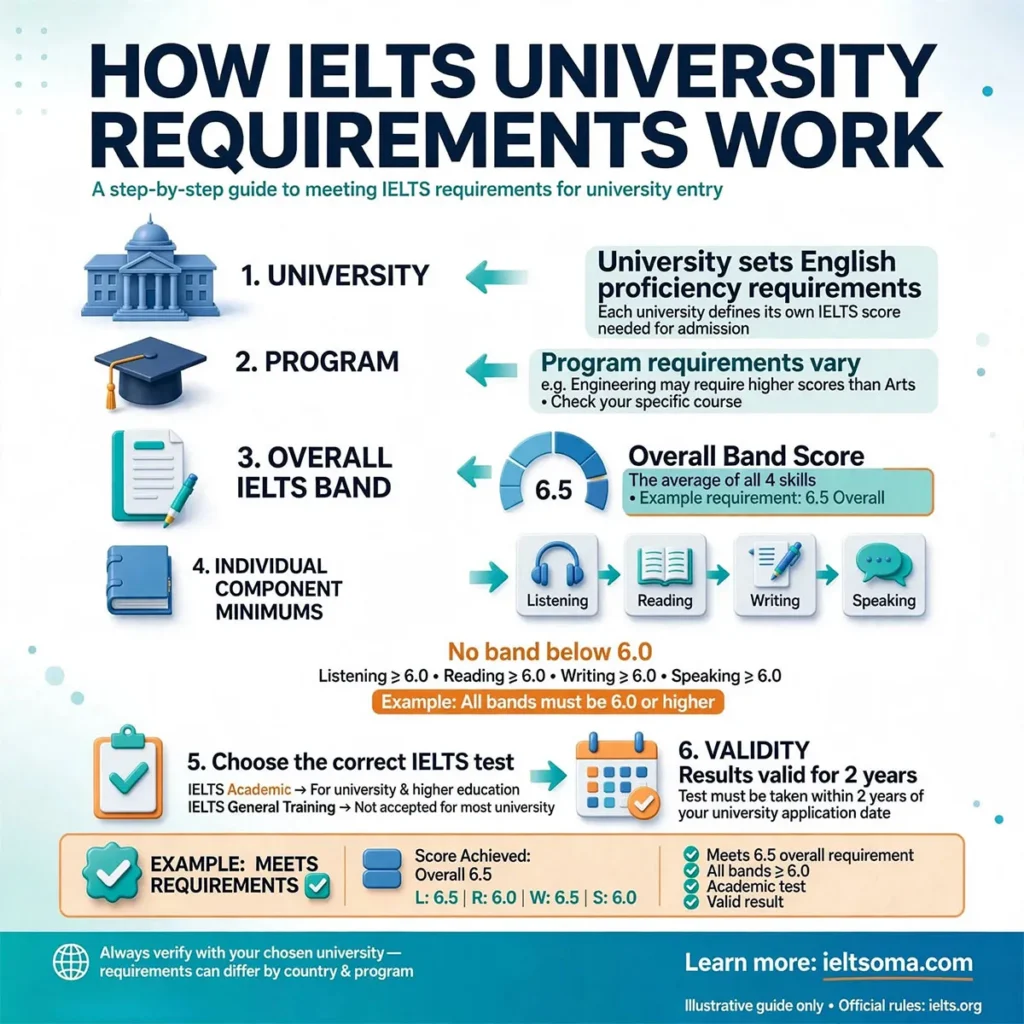
A useful way to think about IELTS requirements is to separate the score into two parts:
- Overall band score
- Minimum score in each component
Suppose a university states:
IELTS Academic: 6.5 overall, with no band below 6.0.
A result such as this would meet the stated requirement:
| Listening | Reading | Writing | Speaking | Overall |
|---|---|---|---|---|
| 7.0 | 6.5 | 6.0 | 6.5 | 6.5 |
But this result may not meet the same requirement:
| Listening | Reading | Writing | Speaking | Overall |
|---|---|---|---|---|
| 8.0 | 7.0 | 5.5 | 6.5 | 6.5 |
The overall score is 6.5, but Writing is below the required 6.0.
This is one of the most common mistakes students make when interpreting IELTS score requirements for university.
Overall score is not the whole requirement
Universities may use wording such as:
- 6.5 overall, minimum 6.0 in each component
- 7.0 overall, minimum 6.5 in each component
- 7.5 overall, minimum 7.0 in each component
- 7.0 overall, with a specified minimum in Writing
- 6.5 overall, with different requirements for particular faculties
Always look for phrases such as “no band below”, “minimum in each component”, or “minimum sub-score”.
IELTS Requirements by Study Level
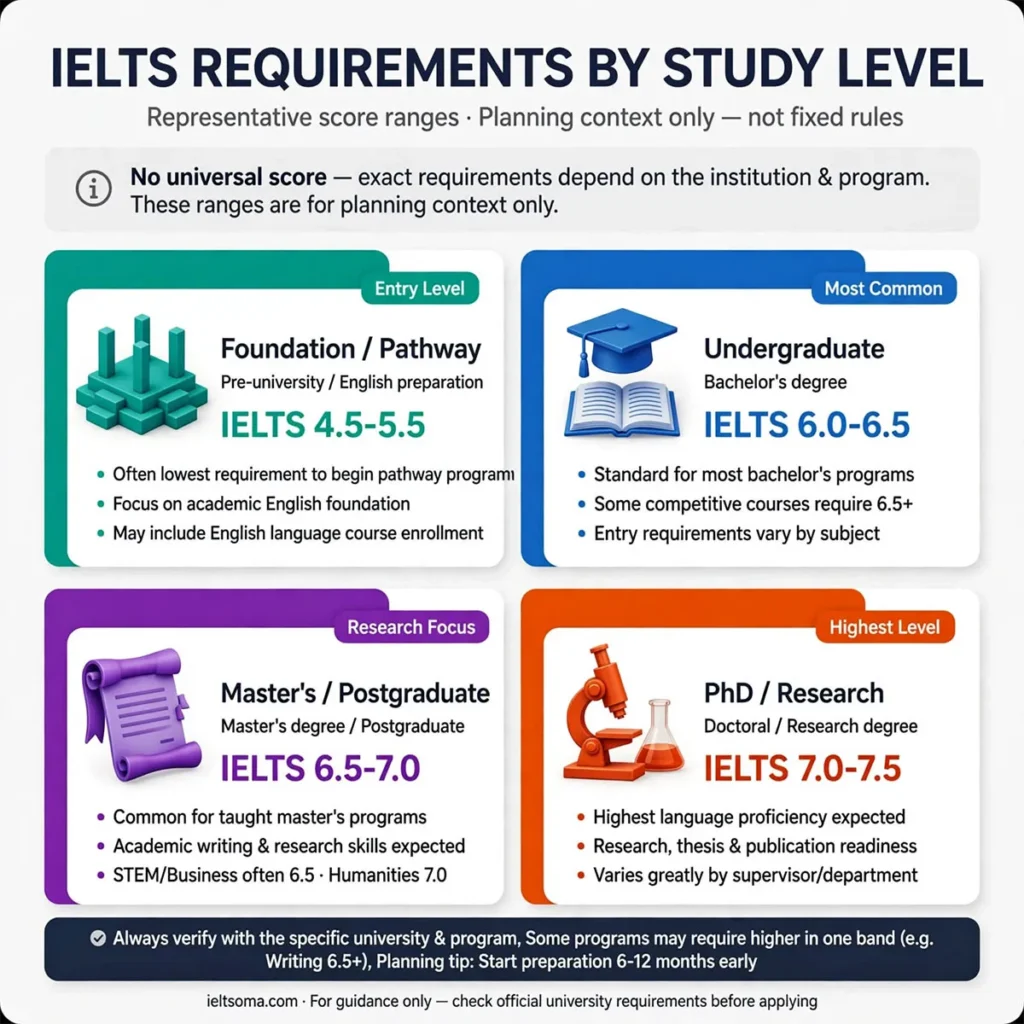
There is no official universal table saying that every bachelor’s degree requires one score and every master’s degree requires another.
However, the level and academic demands of a program can influence the requirement. The safest approach is to use study level as a starting point, not as a substitute for checking the program.
Foundation and pathway programs
Foundation and pathway programs can have lower English-language entry requirements than direct university degree programs.
For example, the University of Toronto’s International Foundation Program lists IELTS admission ranges below its direct-admission requirement in certain circumstances. Its published ranges vary according to the intake and pathway.
This means a student who does not yet meet the direct degree requirement may sometimes have a pathway option.
However, a pathway program is not automatically available at every university, and its English requirement can vary considerably.
Undergraduate study
Undergraduate requirements often fall somewhere around the mid-to-upper 6 bands, but this is not a universal rule.
For example, the University of Toronto currently requires 6.5 overall with no band below 6.0 for its undergraduate English-language requirement.
Some programs or universities may require higher scores.
UNSW Sydney, for example, lists 6.0 overall with a minimum of 5.5 in each subtest for many programs, while several specified programs have a higher requirement of 6.5 overall with at least 6.0 in each subtest.
This illustrates why searching for a single “IELTS band score for university admission” can produce misleading answers.
Master’s and postgraduate taught programs
Postgraduate requirements can be higher, particularly where the course involves substantial academic reading, writing, research, presentations or professional communication.
The University of Toronto’s School of Graduate Studies currently lists IELTS Academic 7.0 overall with at least 6.5 in each component.
At Oxford, the university distinguishes between a standard and higher English-language requirement. Its current graduate guidance lists:
| Requirement level | Overall IELTS | Minimum per component |
|---|---|---|
| Standard | 7.0 | 6.5 |
| Higher | 7.5 | 7.0 |
Some Oxford courses specify the higher level, demonstrating that even within one university, requirements can depend on the program.
PhD and research programs
Research degrees can have demanding English requirements because doctoral students may need to read complex academic literature, write extended research documents, participate in seminars and communicate their research clearly.
However, a PhD does not automatically mean IELTS 7.5 everywhere.
The exact requirement depends on the institution and program.
Oxford, for example, uses standard and higher English-language levels rather than applying one score automatically to every postgraduate applicant.
Therefore, when planning for doctoral study, check the specific department and course page rather than relying on a general postgraduate score.
IELTS Band Score for University Admission: Why the Course Matters
The subject you want to study can influence the required English level.
A program that involves extensive academic writing and communication may have more demanding language expectations than a program with fewer language-intensive tasks.
IELTS guidance for institutions reflects this principle: it identifies 7.5–9.0 as acceptable for linguistically demanding academic programs, while lower bands may be considered acceptable or may require additional English study depending on the program context.
This does not mean that every law, medicine, education or humanities course automatically requires 7.5.
It means that academic language demands are one factor institutions can consider when establishing entry requirements.
For example, Oxford currently requires 7.5 overall with 7.0 in each component for programs using its higher-level English requirement.
Why Universities Have Different IELTS Requirements
You may find one university asking for 6.0, another asking for 6.5, and another asking for 7.5.
That difference is normal.
Universities determine their requirements according to factors such as:
- The language demands of the program
- The academic level of study
- Faculty or departmental policy
- Expected student performance
- Professional or regulatory expectations
- Previous institutional experience
- Other evidence of English proficiency
- Whether additional language support is available
Research published by IELTS found considerable variation in how universities establish and use English-language requirements. It also found that institutions can differ substantially in the minimum scores they set.
So if you see an article claiming that “all universities require IELTS 6.5”, treat that statement with caution.
There is no such universal rule.
IELTS Academic or IELTS General Training for University?
For university admission, IELTS Academic is generally the version designed for higher-education applicants.
IELTS explains that the Academic test is designed to measure the English skills needed in an academic, higher-learning environment.
The Reading and Writing sections differ between IELTS Academic and General Training.
That difference matters when you are applying for a degree program.
For example, the University of Toronto explicitly states that IELTS Academic is required for its graduate admissions English-language requirement.
However, never assume that the same test version is accepted everywhere.
Before booking your test, check the exact English-language requirements published by your university.
What IELTS Score Should You Aim For?
If the university says you need 6.5, you do not necessarily have to aim for exactly 6.5.
A better strategy is to build a safety margin.
For example:
University requirement: 6.5 overall, no band below 6.0
Practical target: 7.0 overall, no band below 6.5
Why?
Because IELTS results can vary slightly from one test attempt to another. Aiming exactly at the minimum leaves little room for an unexpected lower score in one component.
A higher score can also give you more flexibility if you later decide to apply to another university or program with a stricter requirement.
A sensible target strategy
If your target university requires:
- 6.0 → consider preparing for 6.5
- 6.5 → consider preparing for 7.0
- 7.0 → consider preparing for 7.5
- 7.5 → focus on consistently achieving 7.5 rather than relying on one strong practice test
These are preparation targets, not admission rules.
The actual minimum remains the requirement published by your institution.
How to Check IELTS Requirements for Your University
Do not rely on a random university ranking website or an old social media post.
Use this process instead.
1. Find your exact university
Go to the university’s official website.
2. Find the admissions section
Search for terms such as:
- International admissions
- English language requirements
- English proficiency
- Entry requirements
- International students
- Admission requirements
3. Find your exact program
Do not stop at the university-wide requirement.
Open the page for your:
- Bachelor’s degree
- Master’s degree
- PhD
- Faculty
- Department
- Professional program
4. Check the overall IELTS score
Write down the exact overall band.
5. Check every component
Look for minimum requirements for:
- Listening
- Reading
- Writing
- Speaking
6. Check the test version
Confirm whether the university accepts:
- IELTS Academic
- IELTS Academic Online, where applicable
- IELTS for UKVI, where specifically required
Do not choose a test based on a friend’s experience.
7. Check result validity
Some universities specify how recent the test result must be. Oxford, for example, states for relevant graduate applicants that the test must have been taken no more than two years before the course start date.
8. Check exemptions
You may not need IELTS if you meet certain educational or language-background conditions.
For example, the University of Toronto lists specific circumstances in which applicants may qualify for an English-language exemption.
The rules are institution-specific, so check them carefully.
What Happens If Your IELTS Score Is Too Low?
A score below the university’s stated minimum does not always mean your study plans are finished.
Depending on the institution, possible options may include:
- Retaking IELTS
- Taking an accepted alternative English test
- Applying to a pathway or foundation program
- Completing an approved English-language program
- Applying to a course with a different requirement
- Providing evidence for an available exemption
For example, the University of Toronto describes English-language transition programs for academically qualified students who do not yet meet its English-language requirement.
But do not assume that every university offers a pathway.
Always check the official admissions information.
Common Mistakes When Checking IELTS University Requirements
Mistake 1: Assuming 6.5 is the universal university score
It is not.
Requirements vary between institutions and programs.
Mistake 2: Looking only at the overall band
A 7.0 overall may still be insufficient if your Writing score falls below the required minimum.
Mistake 3: Checking the university but not the program
A university may publish a general requirement while a particular faculty has a higher one.
Mistake 4: Taking IELTS General Training without checking
For many university applications, IELTS Academic is the relevant test. Confirm before registering.
Mistake 5: Using outdated information
Universities can change their English-language requirements.
Always check the current admissions page for your intended intake.
Mistake 6: Preparing only for the minimum
If you need 6.5, preparing to achieve exactly 6.5 can be risky.
A stronger target gives you a useful safety margin.
A Quick Example: How to Read an IELTS Requirement
Imagine a university publishes:
IELTS Academic: 7.0 overall, with no component below 6.5.
Consider these two results.
Candidate A
- Listening: 7.5
- Reading: 7.0
- Writing: 6.5
- Speaking: 7.0
- Overall: 7.0
Result: Meets the stated requirement.
Candidate B
- Listening: 8.0
- Reading: 7.5
- Writing: 6.0
- Speaking: 7.0
- Overall: 7.0
Result: Does not meet the stated requirement because Writing is below 6.5.
The second candidate has the same overall score but fails the component requirement.
This is why understanding the wording of your university’s English requirement is just as important as knowing your overall band.
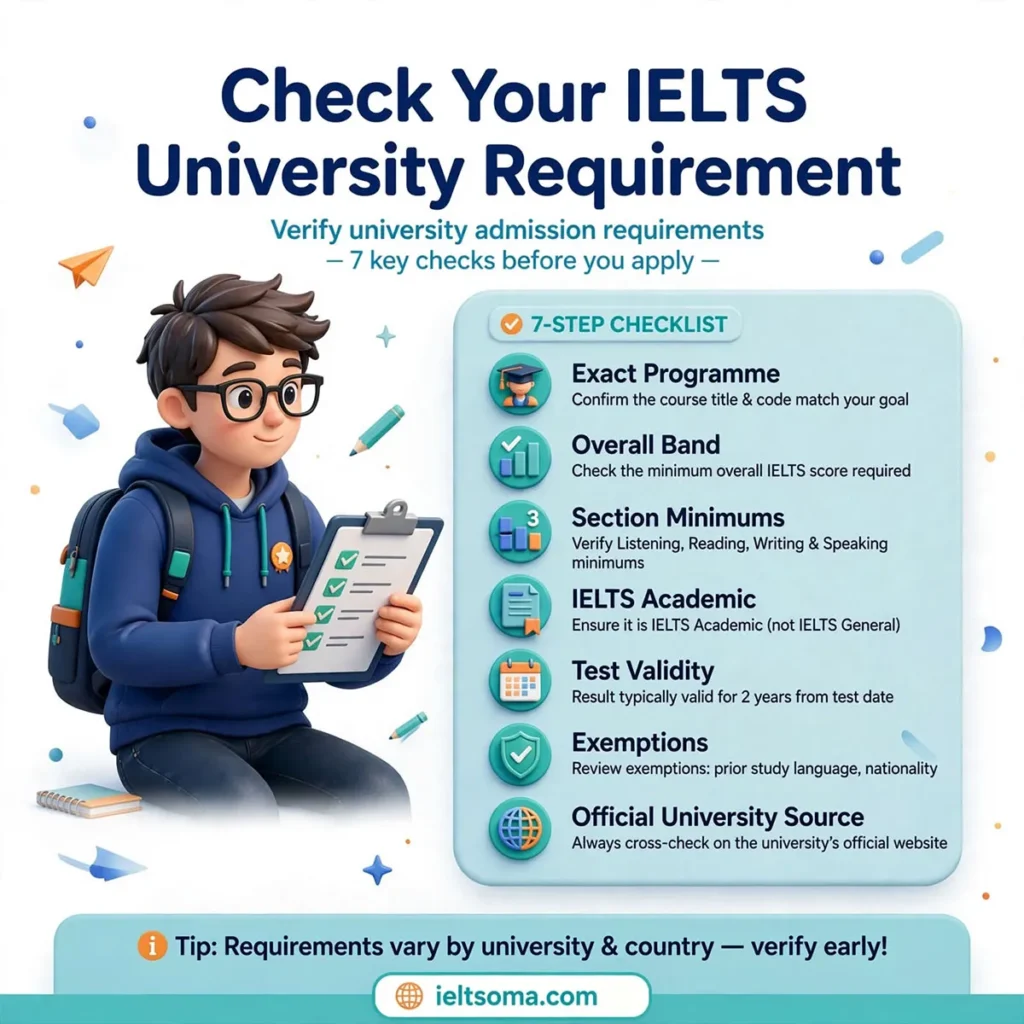
IELTS University Admission Requirements: Your Final Checklist
Before you register for IELTS, make sure you can answer all of these questions:
- What university am I applying to?
- What exact program am I applying for?
- Do I need IELTS Academic?
- What overall IELTS score is required?
- Is there a minimum score for each component?
- Is Writing subject to a higher minimum?
- Is Speaking subject to a higher minimum?
- Does my program have a higher requirement than the university’s general requirement?
- Are there exemptions?
- How old can my IELTS result be?
- Does the university accept my chosen test format?
- Do I need the result before applying or only before enrolment?
- Is there a pathway option if I miss the requirement?
If you cannot answer these questions, you are not ready to choose your IELTS target score.
FAQs About IELTS Score Requirements for University
What IELTS score is required for university admission?
There is no single IELTS score required by every university. Many institutions use requirements around 6.0–7.5, but the exact minimum depends on the university and program. Some courses require higher scores or minimum scores in individual components.
Is IELTS 6.5 enough for university admission?
IELTS 6.5 is enough for some university programs but not all. For example, the University of Toronto currently requires 6.5 overall with no band below 6.0 for its undergraduate English-language requirement. Other universities and programs may require 7.0 or higher.
Is IELTS 7.0 good for university admission?
Yes. IELTS 7.0 is a strong university-admission score and meets the published English-language requirement for many programs. However, some universities or academically demanding programs require 7.5 or higher, so always check the specific course.
What IELTS band score is needed for a master’s degree?
There is no universal master’s requirement. Some universities require around 6.5–7.0, while more demanding programs may require 7.5 or higher. Oxford, for example, currently lists 7.0 overall with 6.5 in each component for its standard graduate English requirement and 7.5 overall with 7.0 in each component for its higher requirement.
Do universities look at individual IELTS scores?
Yes. Many universities specify minimum scores for individual components as well as an overall band. A candidate can therefore achieve the required overall score but still fail to meet the university’s English-language condition because one component is too low.
Do I need IELTS Academic for university admission?
IELTS Academic is generally the relevant IELTS test for higher education. However, requirements differ between institutions, so check your university’s official admissions page before booking your test. IELTS describes Academic as the test designed for academic and higher-learning contexts.
Can I get university admission with IELTS 6.0?
Yes, at some institutions and programs. For example, UNSW Sydney lists 6.0 overall with a minimum 5.5 in each subtest for many programs. Other programs at the same university have higher requirements.
What should I do if my IELTS score is below the university requirement?
You may be able to retake IELTS, submit another accepted English test, qualify for an exemption, or use a pathway or English-language program if your university offers one. Check the institution’s official admissions policy before choosing an alternative.
The Bottom Line
The most important thing to remember about IELTS University Admission Requirements is that there is no universal number.
Your required score depends on where you are applying, what you are studying, and the English-language policy of that particular program.
A 6.5 may be enough for one university. Another may require 7.0. A highly demanding program may require 7.5 with 7.0 in every component.
So do not ask only:
“What IELTS score do I need for university?”
Ask:
“What IELTS Academic score does my exact university and program require, including minimum component scores?”
Once you know that number, prepare above the minimum where possible. A realistic safety margin can make your application less stressful and give you greater flexibility when comparing universities.
For authoritative information about IELTS and university entry scores, consult the official IELTS guidance and then verify the exact requirement directly with your chosen institution.
Further Reading: