Booking your IELTS test should be straightforward—but choosing the wrong test, entering incorrect personal information, or overlooking your target organisation’s requirements can create expensive problems later.
IELTS registration is the process of selecting the right IELTS test, choosing a suitable test date and location, providing your identification details, paying the test fee, and receiving confirmation from an authorised test centre.
The important point is that registration is not simply about finding the earliest available date. Before you book, you need to know which IELTS test you actually need, where you want to take it, which identification document you will use, and how much time you need to prepare.
This guide explains how to register for IELTS, what information you need, how the IELTS registration process works, and the most common IELTS registration mistakes to avoid.
Table of Contents
What Is IELTS Registration?
IELTS registration is the process of officially booking an IELTS test with an authorised IELTS test centre or booking provider.
Depending on your location and purpose, you may have several choices, including:
- IELTS Academic
- IELTS General Training
- IELTS for UKVI
- IELTS Life Skills
- IELTS on computer
- IELTS on paper, where available
- IELTS Online, where available
The available test types and delivery methods depend on your country and test centre. IELTS states that candidates can find test locations across more than 160 countries, while online testing is available only in selected countries.
Your first task, therefore, is not to book the test immediately.
Your first task is to confirm which IELTS test your university, employer, professional body or immigration authority requires.
Which IELTS Test Should You Register For?
Choosing the correct test is one of the most important parts of IELTS registration.
IELTS Academic
IELTS Academic is generally designed for people who want to study at undergraduate or postgraduate level, or for certain professional registration purposes.
However, the exact English-language requirement is determined by the institution or organisation you are applying to.
IELTS General Training
IELTS General Training is commonly used for purposes involving work, migration and training, although requirements differ between countries and organisations.
Do not choose General Training simply because someone tells you it is “easier”.
The correct test depends on your purpose.
IELTS for UKVI
If your UK visa or immigration application specifically requires IELTS for UKVI, you should register for the appropriate UKVI test rather than automatically booking an ordinary IELTS Academic or General Training test.
The British Council’s booking guidance lists IELTS Academic, IELTS General Training and IELTS for UKVI as separate test choices.
IELTS Life Skills
IELTS Life Skills is a separate test designed for specific UK visa and immigration purposes.
It is not a substitute for Academic or General Training simply because it may appear in the same registration system.
A Simple Decision Rule
Before beginning the IELTS registration process, ask:
“What exact IELTS test does the organisation I am applying to require?”
Check the official website of the university, employer, professional organisation or immigration authority concerned.
Do not rely solely on advice from friends, agents or social media posts.
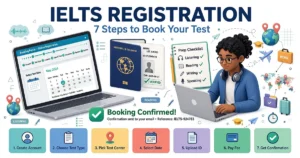
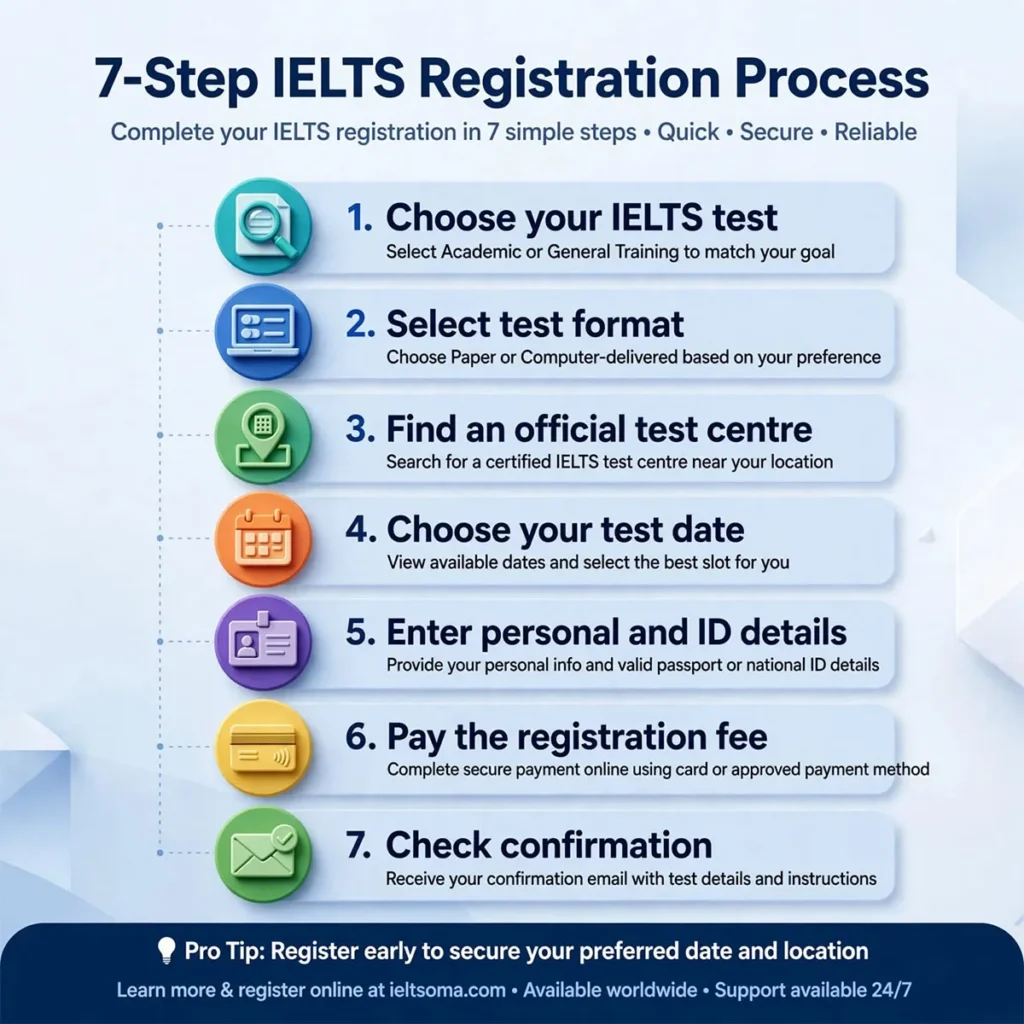
IELTS Registration: 7 Steps to Book Your Test
The exact screens and payment procedures vary by country, but the general IELTS registration process follows a similar pattern.
Step 1: Confirm Your IELTS Test Type
Start by confirming whether you need:
- Academic
- General Training
- UKVI
- Life Skills
- Another specific IELTS option required for your purpose
This should be settled before you select a date.
For example, if a university requires IELTS Academic, booking General Training because it has a convenient date could leave you with a test result that does not meet the institution’s requirement.
Step 2: Choose Your Test Delivery Method
Depending on your location, you may be able to choose between computer-delivered and paper-based IELTS, or potentially IELTS Online.
Availability varies by country.
British Council’s current booking guide asks candidates to select their test type and then choose the available test mode, such as IELTS on computer, IELTS on paper where available, or IELTS Online where available.
Consider more than the test date.
Think about which format you can perform comfortably in.
If you type quickly and are comfortable reading on screen, IELTS on computer may suit you. If you strongly prefer handwriting, paper-based IELTS may be preferable where it is offered.
The test format should never be chosen simply because someone says one version is easier.
The questions and assessment criteria are designed to measure the same underlying English-language abilities.
Step 3: Find an Official IELTS Test Centre
Use an official IELTS booking channel or authorised test centre.
IELTS provides an official test-centre search and booking pathway, while organisations such as the British Council and IDP provide registration services in many countries.
When comparing available centres, check:
- City
- Test type
- Test format
- Available dates
- Test fee
- Speaking-test arrangements
- Cancellation or transfer policies
- Travel time
- Identification requirements
Do not assume that every test centre offers every IELTS test.
Availability can differ considerably between locations.
Step 4: Select Your IELTS Test Date
Choose your date based on your application deadline and preparation level, not simply on the earliest available appointment.
Before confirming a date, check:
- When your university or organisation needs your result.
- How long results may take for your chosen test format.
- Whether you need time for a possible retake.
- Your current level of English.
- How much preparation you realistically need.
If your application deadline is close, leaving no time between your IELTS result and your application deadline can create unnecessary pressure.
Also remember that the Speaking test may not always occur at exactly the same time as the other components. For example, British Council Pakistan states that the Speaking test may be scheduled on the main test day or within a week before or after it, subject to availability.
Step 5: Enter Your Personal and Identification Details Carefully
This is one of the most important stages of IELTS registration.
Enter your information exactly as it appears on the identification document you will use for the test.
Depending on the country and test centre, the accepted identification document may be a passport, national identity card or another approved document.
For example, British Council Pakistan currently states that candidates registering there need a valid passport or national ID card, while its test-day guidance requires candidates to bring the same valid identification document used during registration.
Pay particular attention to:
- Full name
- Date of birth
- Identification document number
- Email address
- Telephone number
- Country of residence
- Test type
- Test date
A simple spelling mistake can become a serious registration problem.
Do not enter an informal version of your name just because that is what people normally call you.
Use the details required by your test centre and identification document.
Step 6: Pay the IELTS Registration Fee
The IELTS fee varies according to the country, test type, centre and sometimes delivery method.
IELTS advises candidates to check the fee for their specific location and test selection through the booking process.
Payment methods also vary.
Depending on the test centre, you may be able to pay online by card or use locally available payment methods.
For example, British Council Pakistan currently lists online card payment as well as several offline payment options for IELTS bookings in Pakistan.
Before paying, check:
- Total fee
- Payment deadline
- Accepted payment methods
- Whether additional bank charges may apply
- Refund conditions
- Test-transfer conditions
Keep your payment receipt or confirmation.
It can be useful if you need to resolve a registration issue later.
Step 7: Check Your Registration Confirmation
Your IELTS registration is not something you should simply assume is complete because you submitted a form.
Check for the official confirmation.
Depending on your test centre, your confirmation may include information such as:
- Test date
- Test location
- Test type
- Test time
- Speaking-test arrangements
- Candidate or reference number
- Instructions for test day
British Council Pakistan, for example, states that candidates receive registration confirmation and an IELTS Reference Number for access to the Test Taker Portal.
Check the confirmation as soon as you receive it.
If something is wrong, contact the test centre rather than waiting until test day.
What Do You Need for IELTS Registration?
The exact requirements depend on your country and test centre, but you will generally need some combination of the following:
| Requirement | Why You Need It |
|---|---|
| Valid identification | To verify your identity |
| Personal details | Required for registration |
| Email address | For booking and confirmation messages |
| Telephone number | For communication where required |
| Payment method | To pay the test fee |
| Preferred test date | To reserve a test session |
| Test location | To select your test centre |
| Correct IELTS test type | To meet your intended purpose |
Your identification document deserves particular attention.
The document requirements are not necessarily identical in every country, so check the instructions of the test centre where you intend to take IELTS.
For example, British Council’s Pakistan guidance specifically tells candidates to have a valid passport or national ID card available during registration.
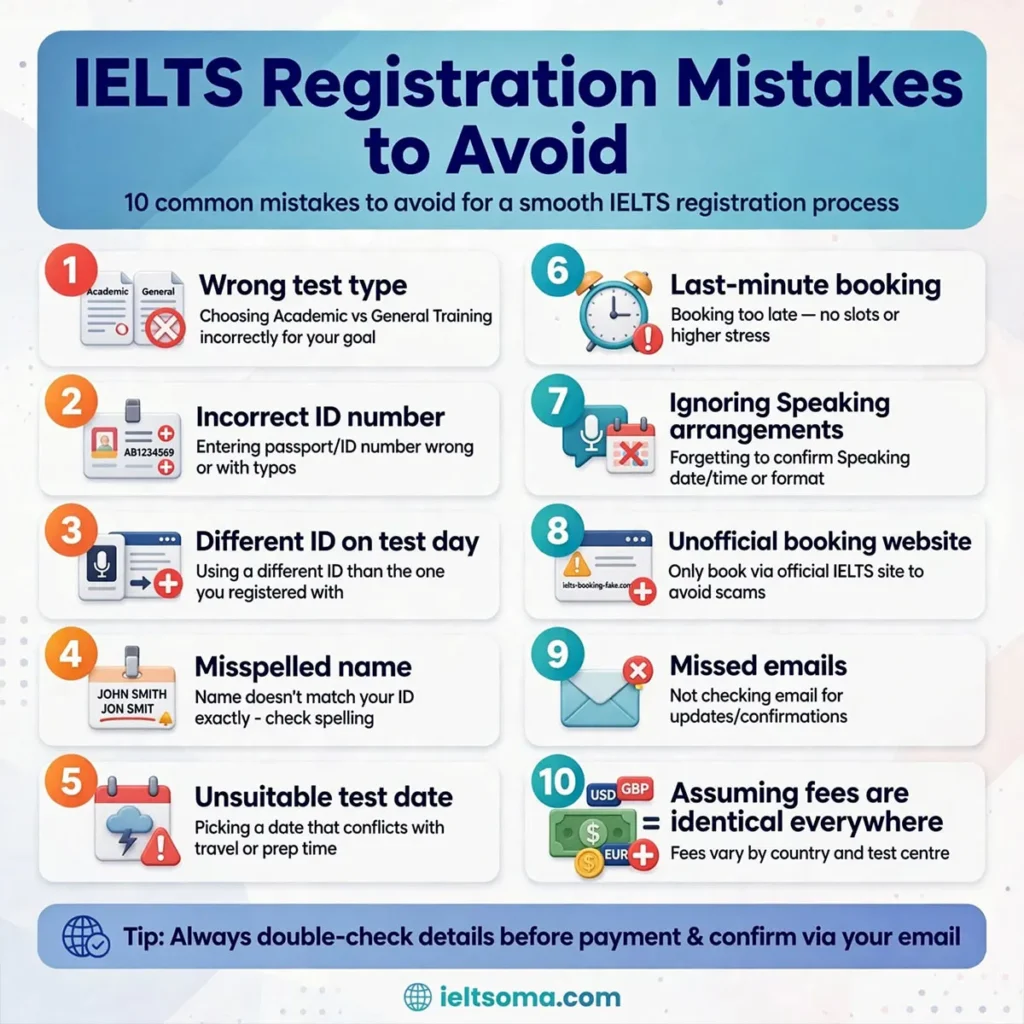
IELTS Registration Mistakes You Should Avoid
Many registration problems are preventable.
Here are some of the most common IELTS registration mistakes.
1. Booking the Wrong IELTS Test
This is perhaps the most consequential mistake.
A candidate may need Academic but register for General Training, or may require IELTS for UKVI but book a different IELTS test.
Solution: Check the official requirement of the organisation receiving your result before booking.
2. Entering the Wrong ID Number
A wrong passport or national ID number can cause problems during identity verification.
Solution: Have your original identification document beside you while completing the registration form.
3. Using Different Identification on Test Day
Do not assume you can register with one document and arrive with another.
British Council’s test-day guidance explicitly states that candidates should bring the same valid identification document used during booking.
Solution: Keep the registration ID document safe and check the test centre’s instructions before test day.
4. Spelling Your Name Incorrectly
Your name should be entered carefully according to the applicable registration and identification requirements.
Solution: Check every letter before submitting the registration.
5. Choosing a Date Without Checking Your Deadline
An available test date is not necessarily a suitable test date.
If your university application closes shortly after your test, you may not leave enough time for your result to arrive.
Solution: Work backwards from your application deadline.
6. Waiting Until the Last Moment
Popular test dates and locations can become unavailable.
Solution: Once you know your test type and preparation timeline, investigate available dates early.
7. Ignoring the Speaking Test Arrangement
Some candidates assume all four IELTS components will necessarily take place at exactly the same time.
That is not always the case.
Solution: Read your confirmation carefully and check the Speaking-test date and time.
8. Using an Unofficial Registration Website
Search engines may show websites offering to “register IELTS for you”.
That does not automatically make them an official IELTS provider.
Solution: Begin with IELTS’s official booking information or an authorised test provider/test centre.
9. Forgetting to Check Your Email
Your booking information and important updates may be sent electronically.
Solution: Use an email address you check regularly and make sure you enter it correctly.
10. Assuming the IELTS Fee Is the Same Everywhere
IELTS fees vary by location and test type.
Solution: Check the current fee for your selected centre instead of relying on an old fee mentioned online.
How Early Should You Register for IELTS?
There is no universal number of days that works for every candidate.
The right time depends on:
- Your preparation level
- Test-centre availability
- Your application deadline
- Your preferred location
- Your required test type
- Whether you may need a retake
A useful approach is to work backwards.
For example:
Application deadline → result needed → IELTS test date → preparation period → registration
This prevents one of the most common planning errors: booking IELTS first and discovering later that the result is needed sooner than expected.
Can You Change Your IELTS Test Date?
Policies concerning cancellations, transfers and refunds vary by test provider and location.
Do not assume that changing your date is always free or automatically available.
Read the terms and conditions provided by your test centre before completing your registration.
If you already know that a particular date may conflict with travel, university deadlines or other commitments, resolve the issue before booking rather than relying on a future transfer.
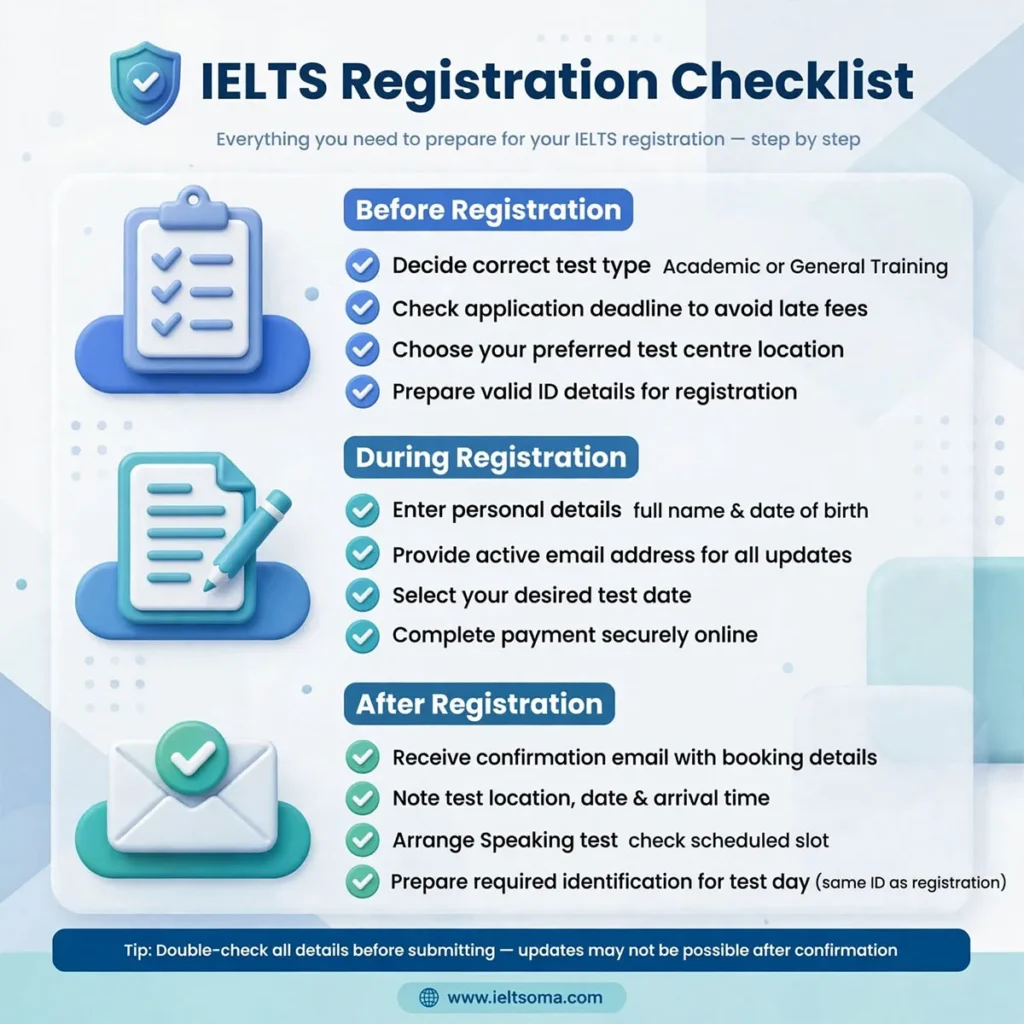
IELTS Registration Checklist
Before clicking the final registration or payment button, use this checklist.
Before Registration
- I know whether I need Academic or General Training.
- I have checked whether I need IELTS for UKVI or another specific test.
- I have checked my organisation’s official English-language requirements.
- I know whether I prefer computer or paper, where both are available.
- I have selected a suitable test centre.
- I have checked my application deadline.
- I have allowed enough preparation time.
During Registration
- My name is correct.
- My date of birth is correct.
- My identification number is correct.
- My email address is correct.
- My telephone number is correct.
- I selected the correct IELTS test.
- I selected the correct date.
- I selected the correct location.
- I have reviewed the fee.
- I understand the payment requirements.
After Registration
- I received confirmation.
- I saved my booking information.
- I know where my test centre is.
- I know my test date and time.
- I have checked my Speaking-test arrangements.
- I know which identification document I must bring.
What Happens After IELTS Registration?
Registration is only the beginning of your IELTS journey.
Once your booking is confirmed, use the remaining time strategically.
Your preparation should cover all four components:
- Listening
- Reading
- Writing
- Speaking
Do not spend the entire preparation period taking full practice tests.
Instead, identify the areas that are reducing your score and work on those specific weaknesses.
For example, a candidate struggling with Reading may need to improve question analysis and locating evidence, while a candidate struggling with Speaking may need better fluency, pronunciation and answer development.
Your registration date should therefore become the starting point for a structured preparation plan.
Frequently Asked Questions About IELTS Registration
How do I register for IELTS?
You can register through an official IELTS booking channel or an authorised test provider. You normally select your test type, test format, location and date, provide your personal and identification details, pay the applicable fee and receive booking confirmation.
Can I register for IELTS online?
In many countries, yes. British Council’s current booking guidance provides an online registration process, although the exact options available depend on your country and test centre.
How much does IELTS registration cost?
There is no single worldwide IELTS registration fee. The price varies according to location, test type and test centre. Check the current fee displayed by the official booking provider for your selected test.
Can I choose my IELTS test date?
You can normally select from available dates shown by the relevant test centre. Your options depend on location, test type and availability.
Can I choose between IELTS Academic and General Training?
Yes, where both are offered, but you should select the test required for your purpose. Academic and General Training are designed for different purposes, so check your institution, employer or immigration authority’s requirements before registering.
What identification do I need for IELTS registration?
Identification requirements vary by country and test centre. You should check the specific requirements of the centre where you will take the test.
For example, British Council Pakistan currently asks candidates to have a valid passport or national ID card available for registration.
Do I need the same ID on IELTS test day?
You should check your test centre’s instructions, but the identification document recorded during registration is particularly important. British Council Pakistan states that candidates must bring the same valid ID used when booking.
Can I change my IELTS test date after registration?
Possibly, but transfer and cancellation rules vary by test provider and location. Check the terms and conditions applicable to your booking before requesting a change.
How far in advance should I register for IELTS?
Register early enough to secure a suitable date and leave sufficient time for preparation and your application deadline. There is no single ideal number of days for every candidate.
Can I register for IELTS without knowing my university’s required score?
You can technically begin the booking process in many locations, but you should first check the score and test-type requirements of the organisation you are applying to. Knowing the target score helps you create an appropriate preparation plan.
What is the biggest IELTS registration mistake?
One of the most serious mistakes is booking a test that does not match your purpose—for example, selecting the wrong test type. Incorrect personal or identification information can also create significant problems.
Final IELTS Registration Advice
Treat IELTS registration as part of your test preparation, not as a five-minute administrative task.
Before you pay, confirm three things:
The right test.
The right date.
The right identification details.
Then save your confirmation and build your preparation plan around the date you have booked.
The registration process itself is usually straightforward. The real difficulty comes when candidates rush it, rely on outdated information, or assume that someone else’s IELTS requirements are the same as theirs.
Check the official requirements for your destination and purpose, register through an authorised channel, and verify every detail before submitting your booking.
That small amount of care can prevent a surprisingly large problem later.
Useful Links: