Preparing for IELTS can feel like a second full-time job.
You already have work deadlines, university classes, family responsibilities, social commitments, exercise, errands and a life outside the exam. Then someone tells you to “study for three or four hours every day”.
For many IELTS candidates, that advice is unrealistic.
The better approach is to prepare for IELTS without disrupting life by making your preparation more focused, measurable and sustainable. You do not necessarily need more study hours. You need to make better use of the hours you already have.
A busy professional might have 45 minutes before work. A university student might have an hour between classes. A parent might only get short periods of uninterrupted time in the evening. All three can make meaningful IELTS progress if those sessions have a clear purpose.
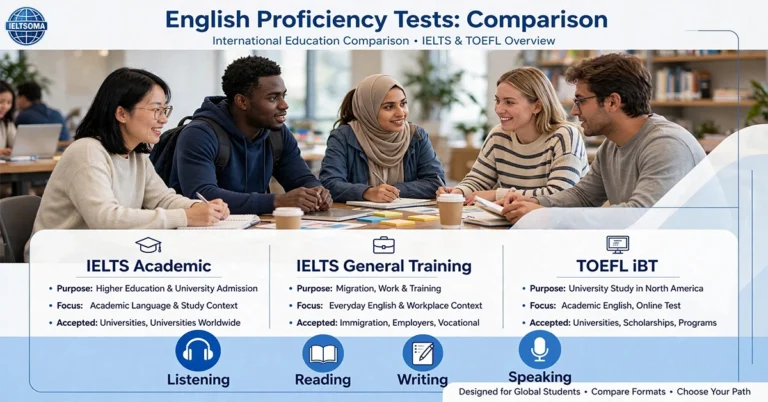
The IELTS test assesses Listening, Reading, Writing and Speaking. Listening and Speaking are the same in IELTS Academic and IELTS General Training, while Reading and Writing differ.
That means your preparation should not simply be “study English every day”. It should be targeted towards the skills, question types and weaknesses that matter for your particular test.
This guide explains how to build IELTS preparation around your existing life rather than forcing your life around IELTS.
Table of Contents
Can You Prepare for IELTS Without Disrupting Life?
Yes. In fact, for many candidates, a sustainable routine is more effective than an extreme study schedule.
A useful starting point is to aim for consistent, focused practice rather than maximum study time.
For example:
| Daily time available | What to prioritise |
|---|---|
| 20–30 minutes | One focused skill or vocabulary review |
| 30–45 minutes | Skill practice + error analysis |
| 45–60 minutes | One substantial IELTS task |
| 60–90 minutes | Two skills or a timed section |
| 2+ hours | Deeper practice, feedback and a mock test |
The important question is not:
“How many hours can I study?”
Ask instead:
“What IELTS improvement can I realistically achieve with the time I have today?”
That change in thinking is crucial.
A candidate who studies for 45 focused minutes five days a week can build a much stronger routine than someone who studies for five hours on Sunday, becomes exhausted and then does nothing for the next six days.
The official IELTS preparation guidance also recommends becoming familiar with the test format, using official practice materials and learning from practice rather than simply completing questions repeatedly.
1. Build IELTS Preparation Around Your Real Schedule
Do not create an imaginary timetable based on the life you wish you had.
Build it around the life you actually have.
Start by identifying three things:
- Your fixed commitments
- Your most reliable free periods
- Your highest-energy periods
Suppose you work from 9:00 to 17:30 and commute for an hour each way.
Trying to complete a two-hour IELTS session after work every evening may look impressive on paper, but it may be impossible to maintain.
Instead, you could use:
- 20 minutes during your morning commute for English listening
- 40 minutes after dinner for focused IELTS practice
- One longer session at the weekend for Writing and a timed test
That is already a substantial preparation routine.
Use “anchor sessions”
An anchor session is a study period attached to something that already happens every day.
For example:
- After breakfast → 20 minutes of vocabulary
- During your commute → English listening
- After dinner → 40 minutes of IELTS practice
- Saturday morning → Writing practice
- Sunday afternoon → mock test or review
This is easier to maintain than repeatedly asking yourself, “When should I study today?”
Protect your non-IELTS time
Preparing for an exam does not mean eliminating everything else.
Keep time for:
- Sleep
- Exercise
- Family
- Friends
- Meals
- Relaxation
- Work or university responsibilities
If your IELTS routine destroys your sleep or leaves you mentally exhausted, the routine needs adjusting.
The goal is sustainable preparation, not permanent exam mode.
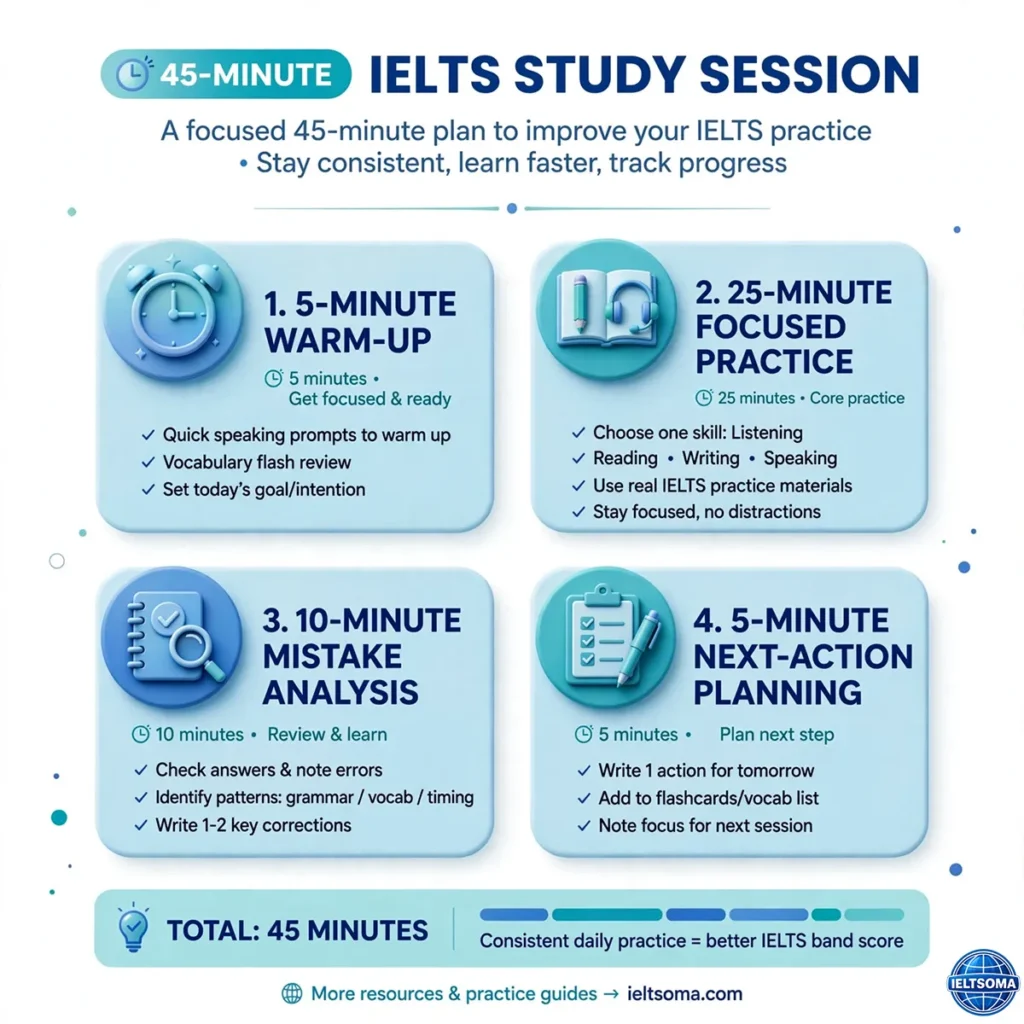
2. Use the 45-Minute IELTS Study Session
One of the most practical ways to prepare for IELTS without disrupting life is to make short sessions highly structured.
Try this 45-minute model:
Minutes 1–5: Warm-up
Review:
- Yesterday’s mistakes
- Five vocabulary items
- One grammar problem
- A previous Speaking response
Minutes 6–30: Main practice
Work on one specific IELTS skill.
For example:
- Listening Section 3 questions
- Reading matching headings
- Academic Writing Task 1 overview practice
- General Training Writing Task 1 letter
- Speaking Part 2
Do not try to practise everything in one session.
Minutes 31–40: Analyse mistakes
This is the part many candidates skip.
Do not simply mark an answer wrong.
Ask:
- Why did I choose it?
- What clue did I miss?
- Did I misunderstand the question?
- Was the problem vocabulary?
- Did I run out of time?
- Was the mistake caused by grammar or spelling?
Minutes 41–45: Record the next action
Write one sentence:
“Tomorrow I will practise…”
This gives your next session a clear starting point.
Four or five sessions like this each week can produce meaningful progress without taking over your schedule.
3. Stop Giving Equal Time to Every IELTS Skill
A common mistake is dividing preparation equally between Listening, Reading, Writing and Speaking.
That sounds fair.
It is not always efficient.
Imagine your current practice results look like this:
| IELTS skill | Approximate level | Priority |
|---|---|---|
| Listening | 7.0 | Maintain |
| Reading | 6.5 | Maintain/improve |
| Writing | 5.5 | High |
| Speaking | 6.0 | Medium |
Spending exactly 25% of your preparation time on each skill may not be the best strategy.
Instead, allocate more time to Writing because it is currently the biggest weakness.
A practical distribution might be:
- Listening: 15%
- Reading: 20%
- Writing: 40%
- Speaking: 25%
This is especially useful when your test date is approaching.
The “weakest link” rule
After every meaningful practice test, identify:
What is currently preventing me from reaching my target band?
Then give that area additional attention.
This does not mean ignoring your strongest skills. It means maintaining them while fixing the area that offers the greatest potential improvement.
Official IELTS guidance also recommends using practice and mistakes to identify weaknesses and improve rather than simply chasing scores.
4. Turn Everyday Life Into IELTS Practice
You do not need to be sitting at a desk for every minute of English exposure.
This is one of the easiest ways to prepare for IELTS without disrupting life.
During your commute
Listen to:
- English podcasts
- Interviews
- News programmes
- Educational videos
- Conversations
Do not listen passively every time.
Occasionally challenge yourself to identify:
- The speaker’s main idea
- Supporting details
- Numbers and dates
- Changes in opinion
- Unfamiliar vocabulary
- Different accents
While doing household tasks
You can listen to English while:
- Cooking
- Walking
- Cleaning
- Exercising
- Travelling
You are not replacing focused IELTS practice, but you are increasing your exposure to natural English.
While reading online
Instead of scrolling through every article in your first language, occasionally read:
- News articles
- Opinion pieces
- Science articles
- Business content
- Travel articles
- Educational material
Then summarise what you read in two or three sentences.
That small habit combines Reading, vocabulary and Writing.
While speaking
Talk to yourself in English.
Describe what you are doing:
“I need to finish this report before lunch because I have a meeting at two.”
Or give yourself a one-minute opinion:
“I think remote work has more advantages than disadvantages because…”
It may feel strange initially.
It works because you are training yourself to formulate ideas in English without waiting for a classroom.
5. Make Your Week About Outcomes, Not Hours
Instead of saying:
“I will study IELTS for six hours this week.”
Set outcome-based goals.
For example:
- Complete one Reading passage and analyse every mistake.
- Write one Task 2 introduction and two body paragraphs.
- Complete two Speaking Part 2 recordings.
- Learn 20 useful collocations from real reading material.
- Complete one timed Listening section.
- Review last week’s error log.
This gives every study session a purpose.
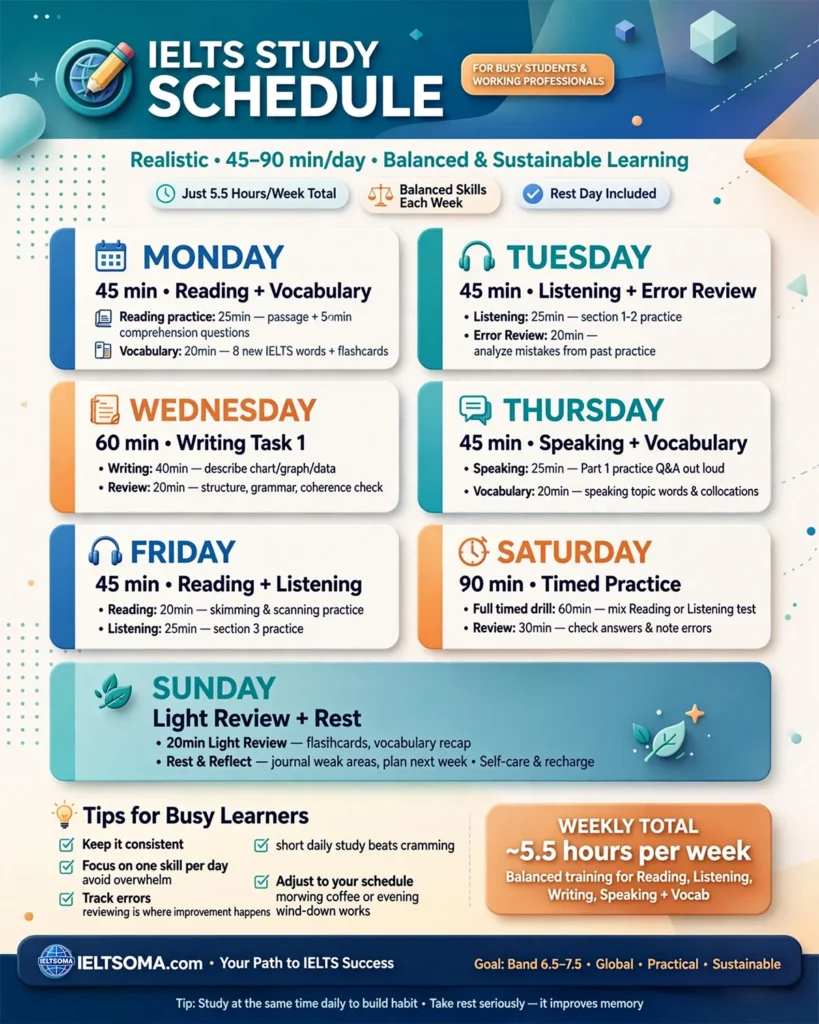
A realistic weekly IELTS routine
Here is an example for someone with work or university commitments:
| Day | Time | Activity |
|---|---|---|
| Monday | 40 min | Reading + error analysis |
| Tuesday | 30 min | Listening + vocabulary |
| Wednesday | 45 min | Writing Task 2 |
| Thursday | 30 min | Speaking practice |
| Friday | 20 min | Vocabulary + error review |
| Saturday | 90 min | Writing + Reading |
| Sunday | 60–90 min | Timed practice + weekly review |
Total: approximately 5–6 hours.
That is enough to create a serious preparation routine without turning IELTS into your entire life.
Your exact schedule should depend on your current level, target band, exam date and weaknesses.
6. Use Different Strategies for Academic and General Training
Your preparation should match the IELTS test you are actually taking.
The Listening and Speaking components are the same for Academic and General Training, but Reading and Writing are different.
For IELTS Academic, your preparation should include:
- Academic Reading passages
- Academic vocabulary in context
- Graph, chart, table and process descriptions
- Academic Task 2 essays
- Formal argumentation
For IELTS General Training, include:
- Everyday and workplace reading
- Notices and practical texts
- Letter writing
- General-interest Reading passages
- Task 2 essay practice
If you have not yet decided which version you need, confirm the requirements of your university, employer or immigration authority before preparing.
You can also read IELTSOMA’s guide to the differences between the two tests:
IELTS Academic vs General: The Ultimate Showdown for Success
Choosing the wrong test can waste far more time than a poorly organised study session.
7. Replace Passive Studying With High-Value Practice
A busy candidate cannot afford to spend most of their limited study time on activities that feel productive but produce little improvement.
Consider these examples.
Low-value approach
Watch three hours of IELTS videos.
Higher-value approach
Watch one explanation of a Reading question type, complete ten questions, analyse mistakes and repeat the task.
Another example:
Low-value approach
Memorise 100 vocabulary words.
Higher-value approach
Learn 10 useful words from a real article, understand their collocations and use each in an original sentence.
And:
Low-value approach
Write five essays without feedback.
Higher-value approach
Write one essay, analyse it against the IELTS criteria, identify recurring problems and rewrite weak sections.
The second approach usually gives you more information about what to improve.
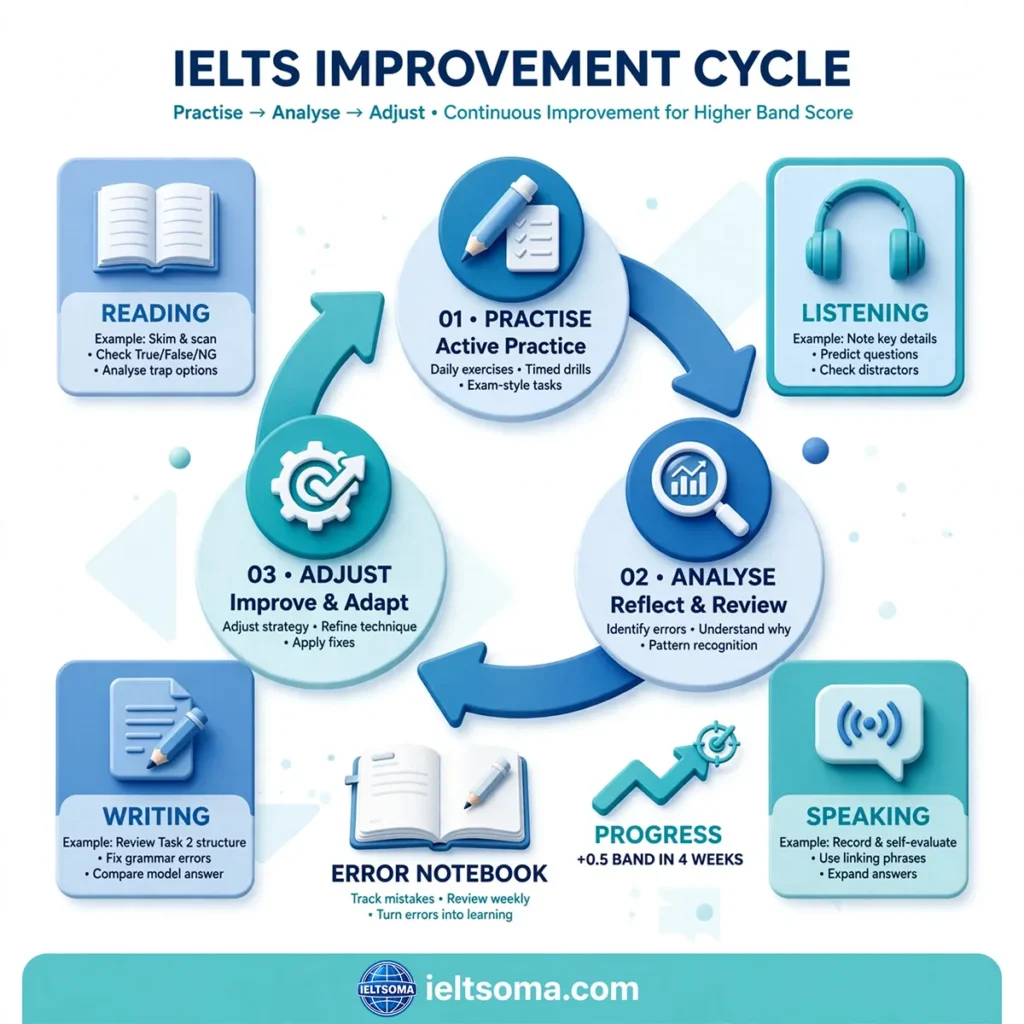
The 3-step improvement cycle
Use this after important practice sessions:
Practise → Analyse → Adjust
Do not move straight from one test to another.
The analysis stage is where much of the learning happens.
A Simple IELTS Error Log That Saves Time
You do not need an elaborate spreadsheet.
A notebook or simple digital document is enough.
Create five columns:
| Question | My mistake | Why it happened | Correct approach | Next action |
|---|---|---|---|---|
| Reading Q18 | Chose B | Missed synonym | Scan for paraphrase | Practise matching synonyms |
| Listening Q27 | Wrong spelling | Did not check answer | Check spelling | Review common spelling errors |
| Writing | Weak example | Idea not developed | Explain consequence | Practise PEEL paragraphs |
| Speaking | Long pauses | Ideas not organized | Use simple structure | Record 2-minute answers |
After a few weeks, patterns will appear.
Perhaps you repeatedly make spelling errors in Listening.
Perhaps your Reading problem is not vocabulary but time management.
Perhaps your Writing weakness is idea development rather than grammar.
That information is far more useful than simply knowing that you scored 28/40.
How to Prepare for IELTS When You Have Very Little Time
Sometimes life becomes genuinely busy.
You may have exams at university, a major work project, travel, family responsibilities or other commitments.
Do not abandon IELTS completely.
Switch to maintenance mode.
A 20-minute session could look like:
- 5 minutes vocabulary review
- 10 minutes Listening or Reading
- 5 minutes Speaking aloud
Or:
- 10 minutes Reading
- 10 minutes Writing sentences
The objective during a busy period is not necessarily dramatic improvement.
It is maintaining your English habits until you have more time.
Then return to intensive preparation when your schedule allows.
This is much better than stopping completely for three weeks and trying to restart from zero.
What to Do in the Final 4 Weeks Before IELTS
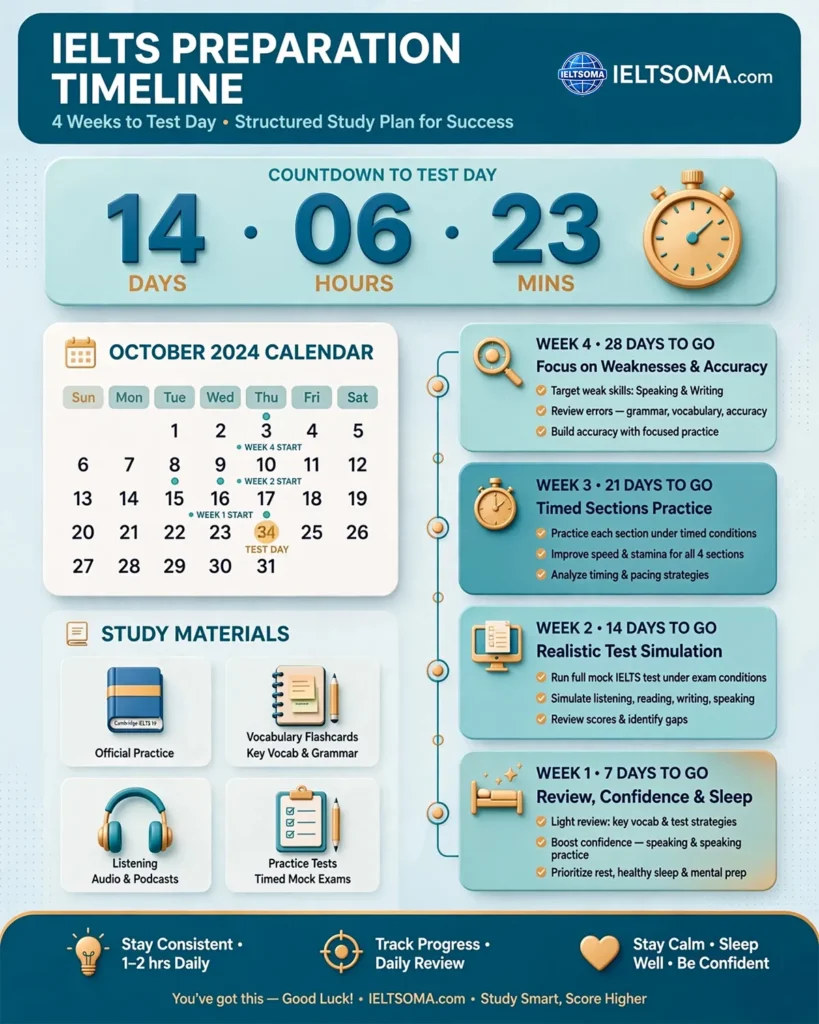
Your strategy should gradually change as test day approaches.
Four weeks before
Focus on:
- Identifying weak areas
- Building accuracy
- Practising all four skills
- Completing timed sections
Three weeks before
Increase:
- Timed Reading
- Writing under exam conditions
- Speaking practice
- Full Listening tests
Two weeks before
Start simulating the real test more frequently.
Pay attention to:
- Timing
- Concentration
- Writing stamina
- Question selection
- Error patterns
One week before
Do not attempt to learn everything you have missed over the previous months.
Prioritise:
- Familiar question types
- Your recurring mistakes
- Timing
- Vocabulary review
- Speaking fluency
- Sleep and routine
The official IELTS sample materials are particularly useful because they allow candidates to become familiar with task types and practise under timed conditions.
Common Mistakes That Make IELTS Preparation Take Over Your Life
Studying without a target
If you open an IELTS book and simply “do some questions”, it is easy to waste an hour.
Know what the session is designed to improve.
Following someone else’s timetable
A six-hour study plan from a full-time student may be completely unsuitable for someone working eight hours a day.
Your plan should fit your circumstances.
Taking too many full mock tests
Mock tests are useful, but completing them repeatedly without analysing mistakes is inefficient.
One carefully reviewed test can teach you more than several rushed tests.
Ignoring English outside IELTS
IELTS preparation should improve your English ability, not just your familiarity with question patterns.
Use authentic English in your daily routine.
Sacrificing sleep
Studying until 2 a.m. before work is not a sustainable preparation strategy.
A tired learner may struggle to concentrate, remember vocabulary or analyse mistakes effectively.
Trying to improve everything simultaneously
Choose priorities.
If Writing is preventing you from reaching your target score, give Writing more attention.
How to Stay Consistent Without Burning Out
The best IELTS routine is one you can repeat.
Use these principles:
Keep sessions specific.
“Practise Reading” is vague. “Complete one matching-headings exercise and analyse mistakes” is clear.
Keep the minimum manageable.
On difficult days, commit to 15–20 minutes rather than abandoning the routine.
Track progress visibly.
Record mock scores, recurring mistakes and completed tasks.
Allow recovery.
A rest day is not wasted time.
Change activities when you are mentally tired.
If you cannot concentrate on Reading, switch to Speaking or listening exposure.
Reward consistency, not just scores.
Your goal is to become the kind of learner who practises regularly.
For additional beginner-friendly guidance, IELTSOMA’s comprehensive IELTS preparation guide covers the exam format, study planning, skills and common preparation mistakes:
IELTS for Beginners: 12 Powerful Tips to Get Started
A Practical Rule for Busy IELTS Candidates
If your life is already full, remember this:
Do not try to find more time. Make the time you already have more valuable.
Thirty minutes of targeted practice can be excellent preparation.
Thirty minutes of unfocused scrolling through IELTS videos is not.
The difference is planning.
Before every session, decide:
- What skill am I practising?
- What specific problem am I trying to solve?
- How will I know whether I improved?
- What will I do differently next time?
Those four questions turn ordinary practice into deliberate preparation.
Frequently Asked Questions
Can I prepare for IELTS while working full-time?
Yes. Many full-time workers prepare successfully by using shorter weekday sessions and longer weekend sessions. A consistent 30–60 minutes on most days can be more sustainable than trying to study for several hours every evening.
How many hours a day should I study for IELTS?
There is no universal number. Your required study time depends on your current English level, target band, exam date and weaknesses. Focus on the quality of practice rather than chasing a fixed number of hours.
Can I prepare for IELTS in one hour a day?
Yes. One focused hour can be highly productive if you target your weaknesses, practise under appropriate time limits and analyse your mistakes. You can also use everyday English exposure outside that hour.
How can I prepare for IELTS without coaching?
Use reliable official practice materials, understand the test format, practise each skill, keep an error log and obtain feedback on Writing and Speaking when possible. Independent preparation is possible, but feedback can be particularly valuable for productive skills.
Is 2 hours a day enough for IELTS?
For many candidates, two focused hours can provide substantial preparation. However, the answer depends on your starting level and target. A Band 7 candidate with a strong English foundation may need a very different routine from someone building fundamental language skills.
How long should I prepare for IELTS?
There is no fixed preparation period. Some candidates need several months, while others with a strong English foundation may need considerably less. Take a diagnostic practice test first, then plan around the gap between your current performance and target score.
Should I practise all four IELTS skills every day?
Not necessarily. It is often more efficient to rotate skills while maintaining regular exposure to English. For example, you could practise Reading on Monday, Writing on Tuesday, Speaking on Wednesday and Listening on Thursday.
How do I avoid IELTS burnout?
Use realistic study sessions, protect sleep and personal time, vary activities and avoid excessive mock testing. Build a routine that you can maintain for weeks rather than an intense schedule that lasts only a few days.
Final Takeaway
You do not need to put your life on hold to prepare for IELTS.
You need a preparation system that fits into your life.
Prepare for IELTS without disrupting life by using focused sessions, prioritising weak skills, turning everyday activities into English practice, analysing mistakes and adjusting your routine as the exam approaches.
The most effective preparation is not necessarily the longest.
It is the preparation that you can repeat consistently.
If you work full-time, study at university, care for a family or simply have a demanding schedule, build your IELTS routine around your real commitments. Start with the time you genuinely have, make each session purposeful and gradually increase the intensity as your test date approaches.
IELTS is a test you need to prepare for—but it should not become your entire life.
At IELTSOMA, the goal is simple: help you prepare smarter, practise with purpose and move towards your target band without sacrificing everything else that matters.
Further Reading: