You hear the answer.
You know it is the answer.
Then the speaker changes the information.
You hesitate.
The recording moves on.
Suddenly, you have missed one answer — and while thinking about it, you miss another.
This is one of the most frustrating experiences in IELTS Listening.
And it is precisely why IELTS Listening Section Strategies matter.
Many candidates assume that a high Listening score simply comes from having “good English”. English ability certainly matters, but IELTS Listening is also a test of concentration, prediction, spelling, timing, information processing and your ability to recognize how questions are designed.
You can understand most of a recording and still lose several marks through avoidable mistakes.
The good news is that these mistakes can be trained.
This guide explains the most useful IELTS Listening Section Strategies I would recommend to candidates who want to turn practice into measurable improvement.
Table of Contents
Understand the IELTS Listening Test Before You Practise
Before applying IELTS Listening Section Strategies, understand what you are preparing for.
The IELTS Listening test contains four parts and 40 questions. You hear each recording once. The recordings and questions become progressively more challenging as the test continues. IELTS Academic and IELTS General Training use the same Listening test. (IELTS.org)
The recordings involve a range of situations and speakers.
You may hear a conversation about an everyday situation, a monologue, an educational discussion or a lecture-style recording.
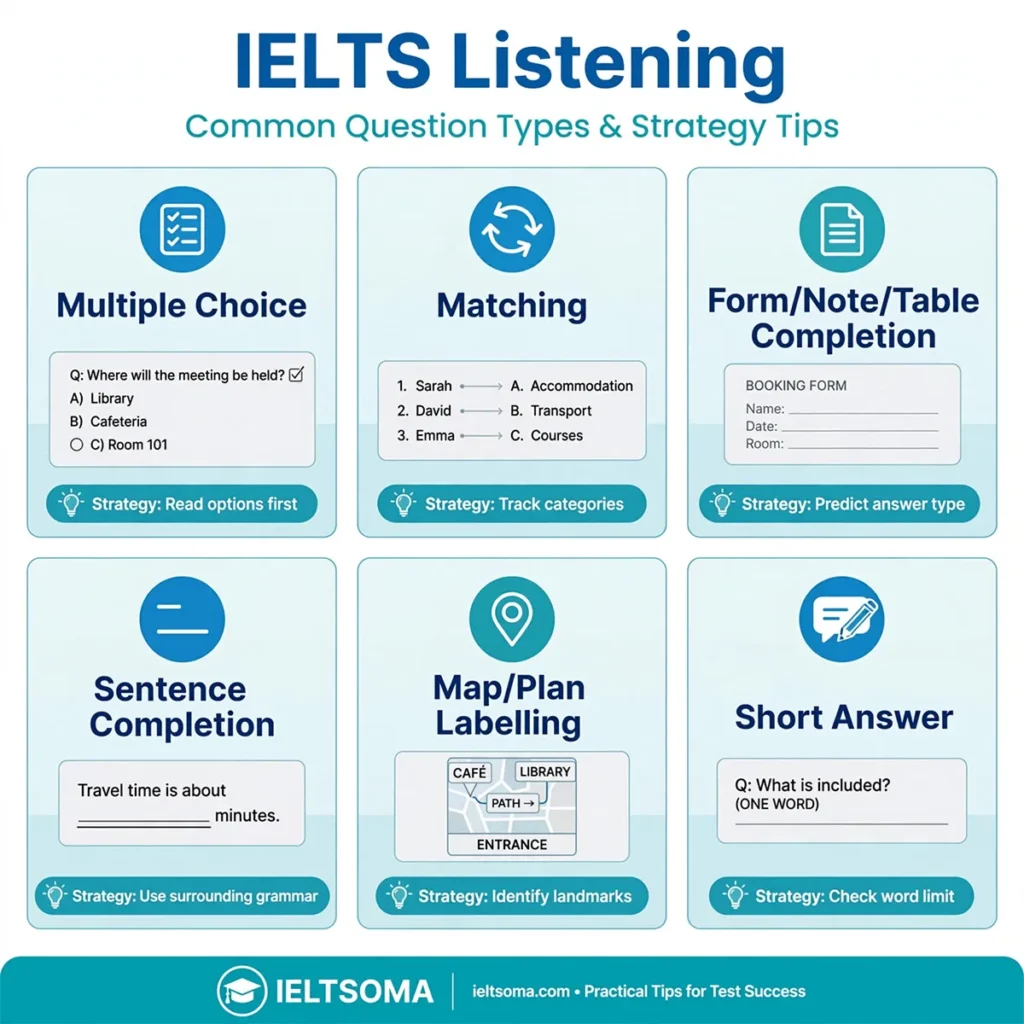
Question formats can include:
- Multiple choice
- Matching
- Plan, map or diagram labelling
- Form, note, table or flow-chart completion
- Sentence completion
- Short-answer questions
The exact combination can vary.
Your objective is not to understand every single word.
Your objective is to identify the information required by the question and record the answer accurately.
1. Read the Instructions Before Listening Starts
One of the simplest IELTS Listening Section Strategies is also one of the easiest to ignore.
Read the instructions carefully.
If the instruction says:
NO MORE THAN TWO WORDS AND/OR A NUMBER
you must follow that limit.
If the correct answer contains three words, you can lose the mark even if you understood the recording correctly.
For example, imagine the recording says:
“The course lasts for three weeks.”
If the question requires NO MORE THAN TWO WORDS, an answer such as:
three weeks
fits the limit.
But if you write:
it lasts three weeks
you have exceeded the limit.
This is not an English comprehension problem.
It is an instruction-following problem.
Train yourself to check the word limit before you begin answering.
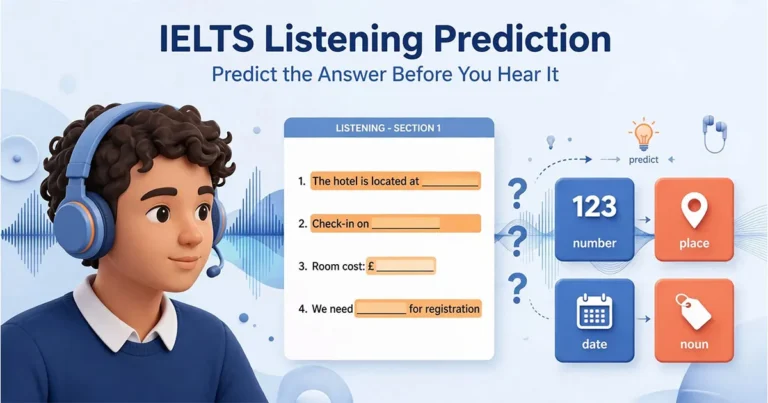
2. Predict the Answer Before You Hear It
Prediction is one of the most powerful IELTS Listening Section Strategies because it gives your brain something specific to search for.
Suppose the question is:
The student’s appointment is on __.
Before the recording begins, ask:
What type of answer am I expecting?
Probably a day, date or possibly a time.
If you see:
The new building has __ floors.
you can predict a number.
If you see:
The speaker recommends __ for beginners.
you may expect a noun or noun phrase.
Prediction does not mean guessing the exact answer.
It means identifying the likely type and meaning of the missing information.
This reduces the amount of information your brain has to process.
3. Listen for Meaning, Not Every Word
A common mistake is trying to understand every word in the recording.
That is unnecessary.
Imagine you hear:
“The original plan was to hold the meeting on Tuesday, but because several members are unavailable, we’ve decided to move it to Thursday.”
If you were listening for the meeting date, you should notice the change.
The speaker mentions Tuesday, but Tuesday is not the final answer.
The important information is:
Thursday
This illustrates an essential Listening principle:
Do not simply listen for words that appear in the question. Listen for the meaning of the complete sentence.
A candidate who understands the purpose of the statement is much less likely to fall for a distractor.
4. Master Distractors and Corrections
Distractors are among the biggest sources of lost marks.
The speaker may mention one answer and then correct it.
For example:
“The workshop was originally scheduled for Room 15. Actually, we’ve moved it to Room 21.”
A candidate who hears “Room 15” and immediately writes it down may lose the mark.
Listen carefully for expressions such as:
- actually
- but
- however
- instead
- rather
- I mean
- sorry
- no, that’s not right
- we’ve changed
- we’ve decided to
- originally
- now
These words do not automatically mean that an answer will change, but they can signal that the speaker is correcting or contrasting information.
One of the most valuable IELTS Listening Section Strategies is therefore to remain mentally flexible.
Do not assume that the first number, name or location you hear must be the answer.
5. Follow the Order of the Questions
In many IELTS Listening tasks, information generally follows the order of the questions.
This gives you an important advantage.
If you are answering Question 8 and the recording has already moved beyond that information, do not spend too long trying to recover it.
Move forward.
Why?
Because Question 9 and Question 10 may already be approaching.
A candidate can lose several marks by becoming emotionally attached to one missed answer.
Use this rule:
If you miss an answer, recover quickly and focus on the next question.
You cannot rewind the recording.
Your best opportunity is the information that comes next.
6. Protect Your Spelling, Grammar and Word Limits
Understanding the answer is only part of the job.
You must also write an acceptable answer.
This is why IELTS Listening Section Strategies should include technical accuracy.
Pay particular attention to:
Spelling
If the answer is a name or unfamiliar word, listen carefully to the spelling when it is provided.
Singular and plural forms
If the recording clearly indicates a plural answer, do not automatically write the singular form.
Numbers
Be careful with:
- 15 and 50
- 16 and 60
- 18 and 80
- dates
- prices
- telephone numbers
- room numbers
Word limits
Always check the instruction.
Grammar
The sentence surrounding the blank can help you determine the correct form.
For example:
The company provides __ to new employees.
You should consider what grammatical form fits naturally in the sentence.
7. Learn How Each IELTS Listening Question Type Works
Different question types require slightly different approaches.
Multiple Choice
Read the options carefully before listening.
Do not simply wait to hear the exact wording from one option.
The recording may paraphrase the answer.
For example, an option may say:
The course is expensive.
The speaker may say:
“It’s certainly not cheap.”
The meaning is similar even though the words are different.
Matching
Quickly identify the categories or options you need to distinguish.
Focus on the specific information that separates one option from another.
Form, Note, Table and Flow-Chart Completion
Predict the type of missing information.
Is it likely to be:
- a name?
- a number?
- a location?
- a noun?
- an adjective?
This makes listening more focused.
Sentence Completion
Read the whole sentence rather than only the blank.
The surrounding grammar provides clues.
Map or Plan Labelling
Before the recording starts, identify the starting point and major landmarks.
Listen for directional language such as:
- opposite
- next to
- beside
- behind
- at the end of
- on the left
- on the right
- north of
Short Answer Questions
Read the question carefully and predict the information required.
Remember the word limit.
8. Use the Review Time Properly
Depending on the delivery format and test arrangements, you may have opportunities to review answers. Your strategy should reflect the format you are actually taking.
For paper-based IELTS, official guidance describes time to transfer answers to the answer sheet after the Listening recording has finished. For computer-delivered IELTS, answers are entered directly during the test, so the review process differs.
Do not waste review time simply rereading answers without purpose.
Check:
- spelling
- word limits
- singular/plural forms
- obvious grammatical errors
- unanswered questions
- numbers and dates
- whether an answer was changed by the speaker
If you have no idea about one answer, do not allow it to consume your attention.
Review it quickly and continue.
9. Practise with a Mistake Log
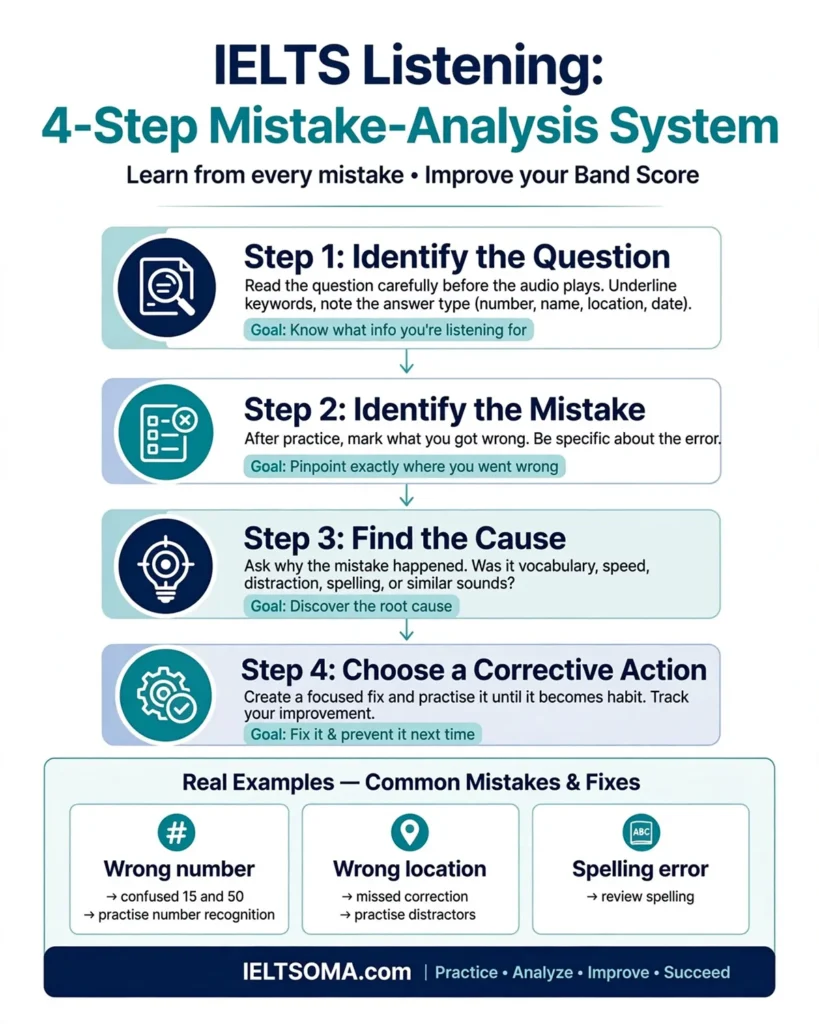
One of the most effective IELTS Listening Section Strategies is to stop treating practice tests as simple scores.
Suppose you complete a practice test and score 29/40.
You could simply record:
29/40
Or you could investigate.
Create a mistake log:
| Question | Error | Cause | Corrective Action |
|---|---|---|---|
| 4 | Wrong number | Confused 15/50 | Practise number recognition |
| 9 | Wrong location | Fell for distractor | Listen for corrections |
| 18 | Spelling error | Knew the answer but wrote it incorrectly | Review spelling |
| 27 | Missed answer | Lost concentration | Practise longer sections |
| 34 | Wrong option | Did not recognise paraphrase | Study paraphrasing |
Now your practice test has given you a training plan.
This is far more valuable than repeatedly taking tests without analysing why you lose marks.
10. Train Your Ears for Different Voices and Accents
IELTS Listening preparation should expose you to different English accents and speaking styles.
The goal is not to memorise accents.
The goal is to become comfortable when pronunciation differs from what you normally hear.
Use high-quality listening materials from reliable sources.
Practise listening to:
- British English
- Australian English
- North American English
- New Zealand English
- other international varieties of English
Do not panic when an accent sounds unfamiliar.
Focus on meaning.
Also pay attention to connected speech.
In natural conversation, words may not sound exactly as they appear in a vocabulary list.
The more varied your listening practice becomes, the less likely you are to become unsettled by an unfamiliar speaker.
11. Build Concentration for the Full Test
Listening concentration is a skill.
If you usually practise for ten minutes, suddenly completing a full Listening test can feel mentally demanding.
Gradually increase the length and intensity of your practice.
More importantly, practise recovering after distractions.
If you miss one answer:
Reset immediately.
Do not think:
“I have already lost Question 15.”
Think:
“Question 16 is next.”
That mental reset is one of the most valuable habits you can develop.
The strongest candidates are not necessarily those who never lose focus.
They are often the candidates who recover quickly when something goes wrong.
Academic vs General Training IELTS Listening
The Listening test is the same for Academic and General Training candidates. The main differences between the two IELTS versions are found in Reading and Writing.
Therefore, the IELTS Listening Section Strategies in this guide apply to both test types.
Do not assume that you need a completely different Listening strategy simply because you are taking General Training rather than Academic.
Instead, concentrate on:
- question types
- prediction
- paraphrasing
- distractors
- spelling
- word limits
- concentration
- timing
- error analysis
Your preparation should match the actual test format and official practice materials.
A 7-Day IELTS Listening Improvement Plan
If your Listening score has stopped improving, try a focused seven-day cycle.
Day 1: Diagnose
Complete a full Listening practice test under realistic conditions.
Record your score.
Day 2: Analyse
Review every incorrect answer.
Do not just look at the correct answers.
Identify why you made each mistake.
Day 3: Prediction
Complete several exercises focusing specifically on predicting answer types before listening.
Day 4: Distractors
Practise recordings containing corrections, changes and contrasting information.
Day 5: Question Types
Choose your weakest question type and complete targeted practice.
Day 6: Full Test
Complete another full Listening test.
Compare not only your score but also the types of mistakes you made.
Day 7: Review
Create three priorities for your next week.
For example:
- Improve number recognition.
- Stop changing correct answers without evidence.
- Review spelling errors.
This is much more productive than simply saying:
“I need to practise Listening more.”
Frequently Asked Questions About IELTS Listening Section Strategies
What are the best IELTS Listening Section Strategies?
The most useful strategies include predicting answers, reading instructions carefully, recognising distractors, following the question order, checking spelling and word limits, analysing mistakes and practising different question types.
How can I improve my IELTS Listening score quickly?
Start by identifying exactly where you lose marks. If your main problems are spelling and word limits, more general listening practice may not solve them. Target the specific causes of your errors and measure your results regularly.
Should I try to understand every word in IELTS Listening?
No. You should focus on understanding the information needed to answer the questions. Trying to process every word can increase cognitive pressure and make it easier to miss important information.
What should I do if I miss an answer in IELTS Listening?
Move on quickly. Do not spend too long thinking about the missed answer because the recording continues. Focus your attention on the next question.
How do I deal with distractors in IELTS Listening?
Listen for changes, corrections and contrasts. A speaker may mention one piece of information and then replace it with another. Do not automatically choose the first relevant word or number you hear.
Is IELTS Listening the same for Academic and General Training?
Yes. The Listening test is the same for Academic and General Training candidates. The principal differences between the two versions are in Reading and Writing.
How important is spelling in IELTS Listening?
Spelling is important because an incorrectly written answer can prevent you from receiving the mark even when you understood the spoken information. Review spelling carefully during preparation.
How many practice tests should I take before IELTS?
There is no universal number. Quality matters more than simply counting tests. Every practice test should be followed by detailed error analysis so that you understand what needs improvement.
Why do I get a good score at home but perform poorly in the real IELTS test?
Possible reasons include test anxiety, unfamiliar conditions, concentration problems, timing issues or differences between your practice environment and the real test. Practise under realistic conditions and develop a consistent pre-test routine.
Can watching English videos improve IELTS Listening?
It can help develop general listening ability, especially when the material exposes you to natural speech. However, it should complement rather than replace IELTS-specific practice with authentic question types, timing and answer requirements.
Conclusion
Strong IELTS Listening Section Strategies are not about finding a secret trick.
They are about understanding what the test demands and training yourself to respond effectively.
Read the instructions.
Predict before listening.
Follow the questions.
Watch for distractors.
Do not panic when you miss an answer.
Check spelling and word limits.
Practise different question types.
Analyse every mistake.
Build concentration.
Most importantly, stop measuring your Listening preparation only by how many practice tests you complete.
Measure what you learn from them.
A candidate who scores 28/40 repeatedly without analysing mistakes may learn very little.
A candidate who scores 28/40, identifies the reasons for the errors, works on those weaknesses and then reaches 31/40 has created genuine progress.
That is the purpose of effective IELTS Listening Section Strategies.
You are not trying to become perfect at listening.
You are training yourself to recognise the information that matters, respond accurately and stay focused when the recording keeps moving.
That is a skill.
And like any skill, it can be trained.
Further Reading: