You hear the answer.
You recognise the words.
Then the speaker changes the information, moves to the next point, and suddenly you are trying to remember what you just heard while searching for the next answer.
This is why IELTS Listening can feel harder than ordinary English listening.
Effective Listening Skills for IELTS are not simply about understanding English. You need to listen with a purpose, predict what is coming, recognise paraphrases, follow changes in information, manage your attention and record answers accurately while the recording continues.
The IELTS Listening test has four parts and 40 questions. It is the same for IELTS Academic and IELTS General Training, and you hear each recording once. Parts 1 and 2 focus mainly on everyday and social situations, while Parts 3 and 4 move into educational, training and academic contexts.
That means passive listening is not enough.
You need a system.
This guide explains the most useful Effective Listening Skills for IELTS, including how to predict answers, recognise distractors, listen for meaning rather than individual words, handle different accents, improve concentration and learn from your mistakes.
Table of Contents
What Are Effective Listening Skills for IELTS?
Effective Listening Skills for IELTS are the practical abilities that help you understand spoken information accurately while simultaneously following questions and making decisions under time pressure.
The most important skills include:
- Predicting what information you are likely to hear
- Listening for meaning rather than exact keywords
- Recognising paraphrases and synonyms
- Identifying corrections and changes
- Following the order of information
- Distinguishing important information from distractors
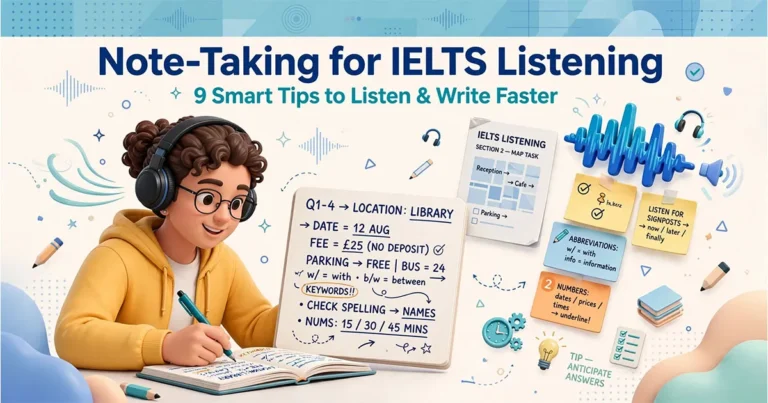
- Recognising numbers, names, dates and spelling
- Following different speakers and viewpoints
- Staying focused when you miss an answer
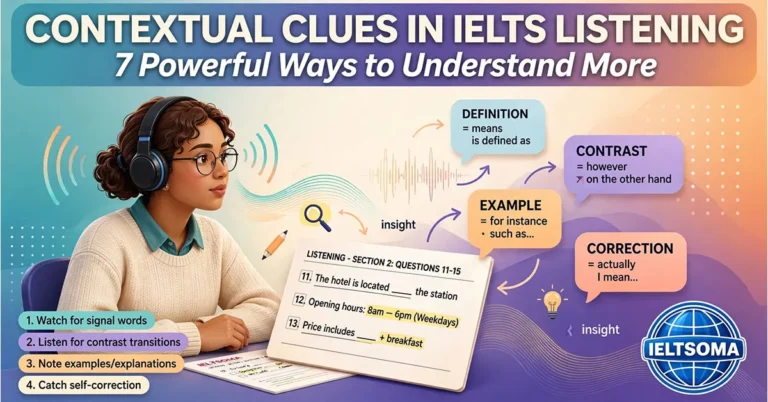
- Using context to understand unfamiliar language
- Checking grammar and word limits
- Analysing mistakes after practice
These skills work together.
For example, imagine the question says:
The meeting will take place on ______.
Before listening, you can predict that the answer will probably be a day or date.
Then you hear:
“We originally planned to hold the meeting on Tuesday, but the manager is unavailable, so it has been moved to Thursday.”
A candidate listening only for keywords may write Tuesday.
A candidate with stronger listening skills notices the correction and chooses Thursday.
The difference is not necessarily vocabulary.
It is listening technique.
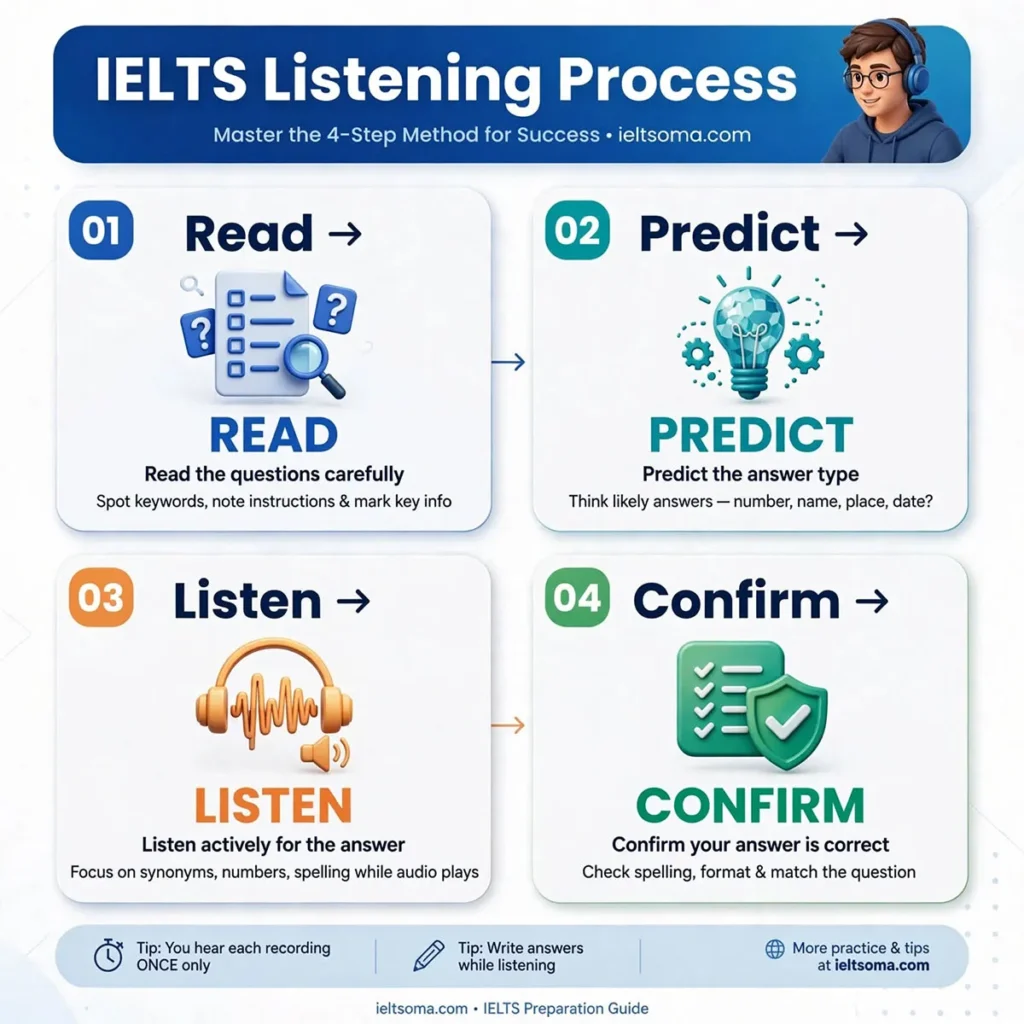
1. Read, Predict and Prepare Before the Audio
One of the most effective IELTS Listening habits begins before the recording starts.
Do not use the preparation time simply to read the questions once.
Use it to predict what you are likely to hear.
Suppose you see:
The course starts on ______.
You can predict:
- a day
- a date
- possibly a month
If you see:
The course costs £______.
You know to listen for a number.
If you see:
The meeting will be held in ______.
You are probably looking for a place.
This prediction gives your brain a target.
Use the question grammar as a clue
Look carefully at the words surrounding the gap.
For example:
The new facility is located ______.
You might expect a place.
The programme lasts ______.
You might expect a period of time.
Students must bring their own ______.
You probably need a noun.
This is especially useful in completion questions because the grammar of the sentence can help you anticipate the form of the answer.
A simple prediction routine
Before each question group, ask:
- What information do I need?
- What type of answer is likely?
- What words in the recording might express the same idea?
- Could the speaker change or correct the information?
- What spelling or number problems might occur?
You do not need to spend a long time doing this.
A few seconds of purposeful preparation can make your listening much more focused.
2. Listen for Meaning, Not Just Keywords
One of the biggest IELTS Listening mistakes is waiting for the exact word that appears in the question.
IELTS Listening frequently uses paraphrasing.
The question might say:
The accommodation is inexpensive.
But the speaker might say:
“It’s reasonably priced compared with the other options.”
The meaning is similar, even though the vocabulary is different.
Train yourself to connect ideas rather than individual words.
| Question wording | Possible recording wording |
|---|---|
| inexpensive | affordable |
| increased | went up |
| problem | difficulty |
| immediately | straight away |
| near | close to |
| approximately | about |
| cancelled | called off |
| purchase | buy |
| children | young people |
| occupation | job |
Do not try to memorise thousands of synonym pairs.
Instead, build the habit of asking:
“How else could this idea be expressed?”
That question is much more useful during the actual test.
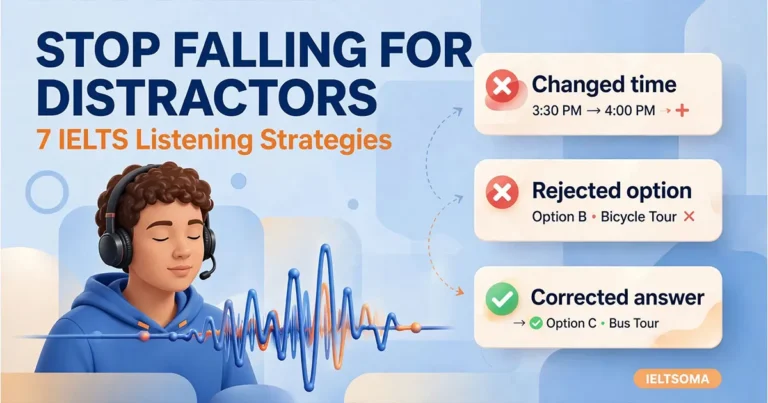
3. Recognise Corrections and Distractors
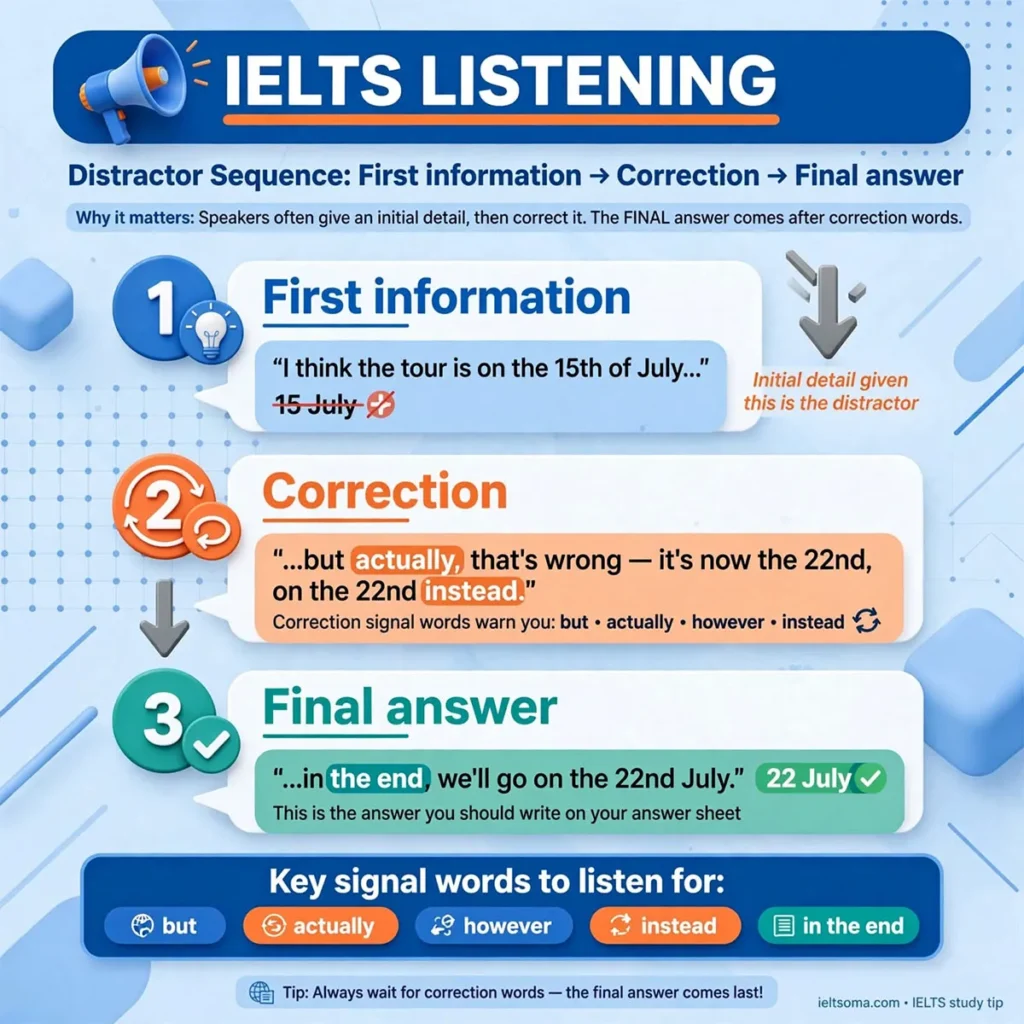
A speaker may mention an answer before correcting it.
For example:
“The registration fee is £80. Actually, that’s the standard price. Students only pay £60.”
If the question asks for the student price, £60 is the answer.
The first number was a distractor.
Listen carefully for expressions such as:
- but
- however
- actually
- instead
- rather
- I mean
- sorry
- although
- in fact
- eventually
- in the end
- we’ve decided to
These expressions can signal that the speaker is changing, qualifying or rejecting information.
Example
Imagine the question asks:
Which venue did they choose?
You hear:
“We first considered the Riverside Centre, but it was too expensive. The university hall looked promising, although it wasn’t available. In the end, we booked the conference centre.”
Three venues were mentioned.
Only one was chosen.
The skill is not simply hearing the names.
You need to understand the relationship between the pieces of information.
The three-step distractor rule
When you hear something that looks like an answer:
Hear it → check the context → confirm the final meaning.
Do not automatically write the first familiar word or number.
4. Follow the Order of the Recording
A major advantage in IELTS Listening is that the questions generally follow the order of information in the recording.
Use that structure.
If you have just answered Question 14, your attention should normally move towards Question 15 rather than remain stuck on Question 14.
This creates a mental tracking system:
Question 14 → answer → Question 15 → answer → Question 16 → answer
If you lose your place, quickly identify the current question and reconnect with the recording.
Never let one missed answer become five
Suppose you miss Question 18.
Your brain starts thinking:
“What was that answer? Did they say Tuesday or Thursday?”
While you are thinking, the speaker gives the information for Questions 19 and 20.
Now one problem has created three.
Instead:
- Make your best decision if possible.
- Mark the question mentally.
- Move immediately to the next question.
- Keep listening.
- Return to the missed answer only if the test format gives you an appropriate opportunity.
This is one of the most important concentration skills in IELTS Listening.
5. Train Your Ear for Numbers, Names and Spelling
Simple factual information can produce surprisingly many lost marks.
You may need to identify:
- telephone numbers
- dates
- prices
- addresses
- room numbers
- measurements
- percentages
- names
- postcodes
Numbers are particularly easy to confuse.
Practise distinguishing:
- 13 and 30
- 14 and 40
- 15 and 50
- 16 and 60
- 17 and 70
- 18 and 80
- 19 and 90
Also practise spelling unfamiliar names and places.
For example:
“The surname is McKenzie.”
“Could you spell that?”
“M-C-K-E-N-Z-I-E.”
The ability to recognise that the speaker is about to spell a name is itself a useful listening skill.
Do not ignore grammar
Suppose the sentence is:
Students need to submit their ______.
You hear:
applications
The grammar of the sentence supports a plural noun.
The question itself gives you another clue about the type of answer required.
Strong listening is therefore not just auditory recognition. It combines sound, meaning, context and grammar.
6. Develop Active Listening Instead of Passive Listening
Listening to English in the background can give you exposure, but it is not the same as focused practice.
Active listening means you deliberately concentrate on what the speaker is saying and analyse how the information is presented.
Try this three-stage method:
Stage 1: Listen for the main idea
Do not worry about every unfamiliar word.
Ask:
What is this recording mainly about?
Stage 2: Listen for important details
Now identify:
- names
- numbers
- reasons
- opinions
- changes
- examples
- comparisons
Stage 3: Analyse what you missed
If you have a transcript, check difficult sections after your first listen.
Ask:
- Did I not know the vocabulary?
- Did I fail to recognise the pronunciation?
- Was the speaker too fast for me?
- Did I miss a paraphrase?
- Did I lose concentration?
- Did I misunderstand the context?
This turns listening into a learning process rather than passive exposure.
7. Learn to Follow Signposting Language
Speakers often use language to organise their ideas.
These expressions act like road signs.
Listen for:
| Signposting language | What it may signal |
|---|---|
| Firstly | First point |
| Another factor | New point |
| However | Contrast |
| In contrast | Difference |
| For example | Supporting example |
| As a result | Consequence |
| The main reason | Important explanation |
| Finally | Final point |
| On the other hand | Alternative viewpoint |
| In other words | Restatement |
This is particularly useful in Parts 3 and 4, where you may need to follow ideas, opinions and explanations over a longer stretch of speech.
You do not need to understand every sentence equally.
You need to understand how the speaker is organising the information.
8. Improve Your Ability to Handle Different Accents
IELTS Listening exposes candidates to different varieties of English.
You should therefore avoid preparing with only one familiar accent.
Listen to a mixture of:
- British English
- Australian English
- New Zealand English
- North American English
- Other clear varieties of international English
The goal is not to imitate these accents.
It is to become comfortable understanding them.
Focus on pronunciation differences
Sometimes the problem is not vocabulary.
You know the word when you read it, but you do not recognise it when spoken naturally.
This can happen because of:
- connected speech
- weak forms
- reduced sounds
- linking
- natural speech rhythm
- unfamiliar pronunciation
For example, words may sound different in connected speech from the way you pronounce them individually.
That is why listening practice should include natural speech rather than only slow learner recordings.
9. Build Concentration for the Full Test
IELTS Listening requires sustained attention.
The test contains four parts and 40 questions, with the recordings becoming more demanding as you progress.
A candidate can perform well at the beginning and then lose concentration during the later sections.
Do not let this happen.
Train your concentration gradually.
Try the 5–10–20 method
If your concentration is weak, begin with:
5 minutes: focused listening
Then progress to:
10 minutes: focused listening
Then:
20 minutes: focused listening
Eventually, practise complete IELTS Listening tests without pausing or replaying the recording.
The aim is to make sustained attention normal before test day.
Effective Listening Skills for IELTS: Question-Type Strategies
Different question types require slightly different listening behaviour.
Multiple choice
Do not simply wait for one option to be mentioned.
Several options may appear in the recording.
Listen for the speaker’s actual meaning and final decision.
Matching
Keep the options organised mentally.
Pay attention to descriptions, opinions and relationships between people, places or ideas.
Form, note and table completion
Predict the type of information that belongs in each gap.
Names, numbers, dates, places and nouns are often important.
Map and plan labelling
Listen carefully for:
- left
- right
- opposite
- next to
- behind
- near
- at the end of
- between
- entrance
- north
- south
Visualise the movement as the speaker describes it.
Summary completion
Focus on the overall meaning as well as individual details.
The surrounding grammar can help you predict the type of word required.
Sentence completion
Read the sentence carefully before listening.
The words around the gap often tell you what kind of answer to expect.
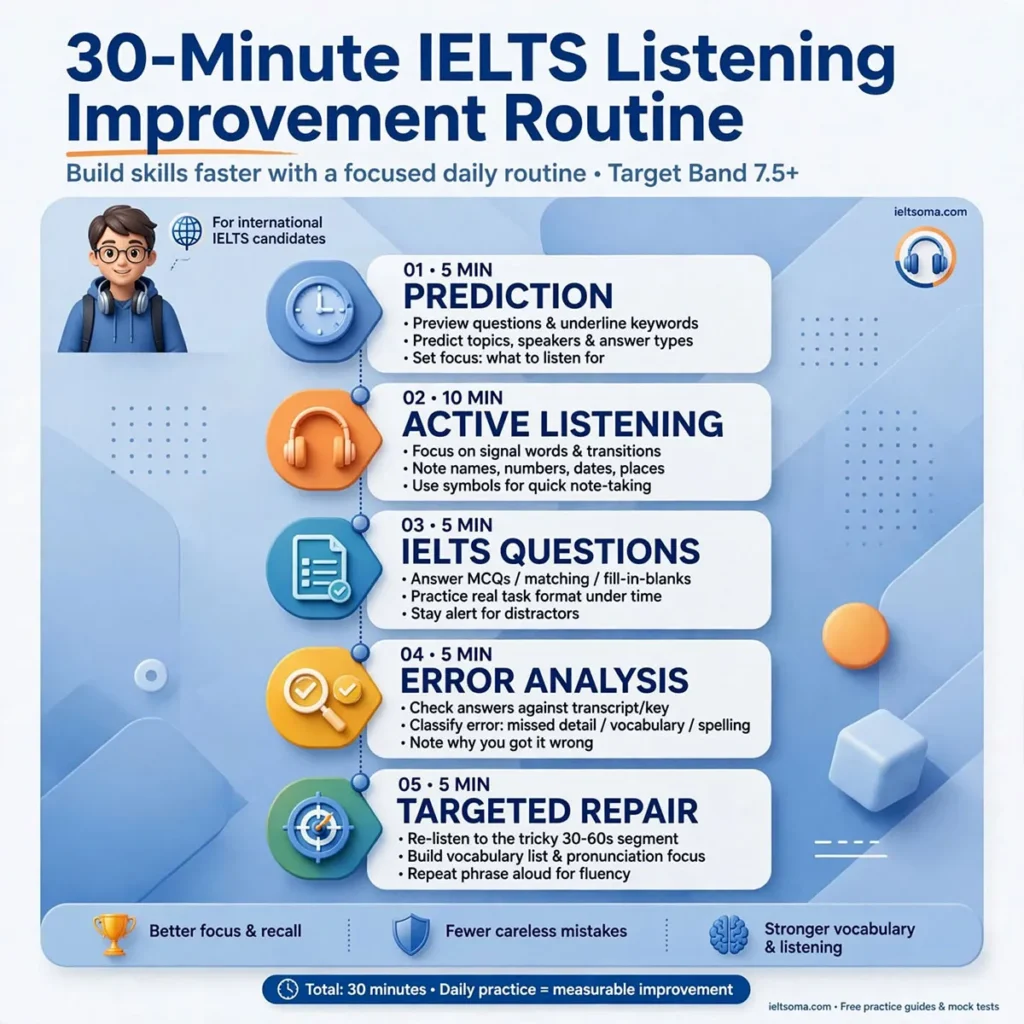
A 30-Minute Daily Routine for Effective Listening Skills for IELTS
You do not need to complete a full practice test every day.
A focused routine can be more useful.
| Time | Activity | Purpose |
|---|---|---|
| 5 minutes | Predict questions | Train anticipation |
| 10 minutes | Active listening | Build comprehension |
| 5 minutes | IELTS questions | Apply exam skills |
| 5 minutes | Check mistakes | Identify weaknesses |
| 5 minutes | Targeted repair | Fix one specific problem |
For example, if you repeatedly miss numbers, spend your final five minutes practising numbers.
If paraphrasing is your weakness, practise connecting question vocabulary with alternative expressions.
If concentration is the problem, use longer uninterrupted recordings.
The key is targeted practice.
How to Use Podcasts to Improve IELTS Listening
Podcasts can be useful because they expose you to natural speech, different speakers and longer stretches of English.
However, simply playing a podcast in the background is not enough.
Use this process:
Listen → Analyse → Re-listen
During the first listen, focus on meaning.
During the analysis stage, identify difficult words, pronunciation features and information you missed.
Then listen again.
You can also create your own IELTS-style questions from a podcast.
For example, after listening to a discussion about renewable energy, create questions about:
- the speaker’s main opinion
- a specific example
- a problem mentioned
- a reason
- a number or statistic
- a conclusion
This turns ordinary listening material into focused IELTS practice.
Common Listening Mistakes That Prevent Improvement
Many candidates practise regularly but make the same mistakes repeatedly.
Mistake 1: Trying to understand every word
You do not need to understand every word.
Focus on the information required by the question.
Mistake 2: Listening only for exact keywords
IELTS uses paraphrasing.
Train yourself to recognise meaning expressed in different ways.
Mistake 3: Choosing the first answer you hear
The speaker may correct or replace it.
Listen for the complete idea.
Mistake 4: Translating everything mentally
Translation takes time.
Train yourself to understand English directly.
Mistake 5: Ignoring grammar
The grammar of the question can help you predict the answer.
Mistake 6: Giving up after one missed answer
Move on.
One missed answer should not become several.
Mistake 7: Taking practice tests without analysing mistakes
Your score tells you what happened.
Your error analysis tells you why.
How to Analyse Your IELTS Listening Mistakes
After every practice test, create a simple error log.
| Question | Mistake | Cause | Action |
|---|---|---|---|
| 7 | Wrong number | Similar pronunciation | Practise numbers |
| 12 | Wrong option | Distractor | Study correction signals |
| 19 | Missed answer | Lost concentration | Practise tracking |
| 27 | Wrong word | Paraphrase missed | Build meaning links |
| 34 | Spelling error | Unfamiliar word | Add to spelling practice |
After several tests, patterns will emerge.
Perhaps most of your mistakes come from spelling.
Perhaps you understand the recording but struggle with multiple choice.
Perhaps Part 4 causes your concentration to drop.
That information is much more valuable than simply knowing that you scored 27/40.
Effective Listening Skills for IELTS: A Better Practice Cycle
Use this cycle throughout your preparation:
Practise → Check → Diagnose → Repair → Re-test
Practise
Complete a Listening task under realistic conditions.
Check
Mark your answers.
Diagnose
Identify exactly why each mistake happened.
Repair
Practise that particular weakness.
Re-test
Return to IELTS-style questions and see whether your accuracy improves.
This is how practice becomes deliberate training.
Taking ten tests without analysing them is not necessarily better than taking five tests carefully and learning from every mistake.
What Score Should You Aim For?
IELTS Listening contains 40 questions, with one mark awarded for each correct answer. The raw score is converted to the IELTS nine-band scale.
Official IELTS scoring guidance currently gives approximate examples such as:
| Correct answers | Approximate Listening band |
|---|---|
| 16 | 5.0 |
| 23 | 6.0 |
| 30 | 7.0 |
| 35 | 8.0 |
The exact conversion can vary slightly between test versions.
Use these figures as a general guide rather than assuming that one exact raw score will always produce the same band.
More importantly, identify where your lost marks are coming from.
If you are scoring 27 and repeatedly losing marks through spelling and distractors, targeted practice may be more valuable than simply completing another full test.
A Practical 7-Day Listening Improvement Plan
If you want to strengthen your Effective Listening Skills for IELTS, try this weekly structure.
Day 1: Prediction
Practise reading questions and predicting answer types.
Day 2: Paraphrasing
Practise recognising different expressions with the same meaning.
Day 3: Numbers and spelling
Focus on dates, prices, names, addresses and numbers.
Day 4: Distractors
Practise corrections, alternatives and changes of information.
Day 5: Accent and natural speech
Listen to a variety of speakers and accents.
Day 6: Full IELTS Listening test
Complete all four parts under realistic conditions.
Day 7: Error analysis
Review every mistake and create a targeted plan for the following week.
This is more productive than doing exactly the same activity every day.
FAQs About Effective Listening Skills for IELTS
What are the most important listening skills for IELTS?
The most important skills include prediction, understanding paraphrases, following the order of information, recognising corrections and distractors, identifying specific details, maintaining concentration and recording accurate answers.
How can I improve my IELTS Listening quickly?
Start by identifying your biggest source of lost marks. Then practise that skill deliberately while continuing regular IELTS Listening practice. Active listening and detailed error analysis are usually more productive than simply listening to English for many hours.
Should I listen to English every day for IELTS?
Regular listening is useful because it builds familiarity with natural speech, pronunciation and different accents. However, combine general listening with IELTS-specific practice so that your improved comprehension transfers to exam performance.
Why do I understand English but still get a low IELTS Listening score?
You may have adequate general English but weak exam-specific listening skills. Common problems include missing paraphrases, choosing distractors, losing concentration, spelling errors, poor question tracking or failing to follow word-limit instructions.
How can I stop missing answers in IELTS Listening?
Preview the questions, predict the answer type and follow the information in sequence. If you miss one answer, move on immediately rather than allowing it to disrupt the next questions.
Is IELTS Listening the same for Academic and General Training?
Yes. The Listening test is the same for IELTS Academic and IELTS General Training. Both have four parts and 40 questions.
How can I improve my listening for Part 4?
Practise following longer monologues and academic discussions. Focus on signposting language, main ideas, supporting details, examples and changes in the speaker’s argument. Do not try to understand every word.
Are podcasts useful for IELTS Listening?
Yes, when used actively. Podcasts can help you become more comfortable with natural speech, different accents and longer stretches of spoken English. They should complement rather than replace IELTS-specific practice.
Should I use subtitles when practising listening?
Use transcripts strategically rather than immediately. First listen without reading so you can test your actual listening ability. Then use the transcript to identify pronunciation, vocabulary and comprehension problems.
How do I know whether my IELTS Listening is improving?
Track your practice scores, but also monitor the types of mistakes you make. A reduction in spelling, paraphrasing, distractor and concentration errors is a stronger indication of improvement than simply completing more practice tests.
Final Checklist for Effective Listening Skills for IELTS
Before your test, make sure you can:
- Predict likely answer types.
- Read questions quickly.
- Listen for meaning rather than exact words.
- Recognise paraphrases.
- Identify corrections.
- Ignore distractors.
- Follow the sequence of questions.
- Recognise numbers and dates accurately.
- Spell answers correctly.
- Understand different accents.
- Follow signposting language.
- Stay focused through Part 4.
- Recover quickly after missing an answer.
- Respect word limits.
- Analyse your practice-test mistakes.
The biggest change you can make is to stop thinking of IELTS Listening as a test where you must understand everything.
You do not.
You need to understand the right information at the right moment.
That requires prediction, attention, context, paraphrasing, concentration and accurate answer recording.
Build those skills deliberately and your Listening practice becomes much more than repeatedly pressing play on another mock test.
The goal is simple:
Listen with purpose. Recognise meaning. Follow the information. Stay in control.
That is what effective listening looks like in IELTS.
Further Reading:
- Grammar Rules for IELTS: 9 Powerful Rules for Success
- IELTS Reading Comprehension Strategies: 9 Powerful Ways to Understand Texts
- Active Listening for IELTS: 9 Powerful Ways to Improve
- Goal Setting for IELTS Preparation: 7 Smart Steps to Reach Your Target Band
- IELTS Listening Skills: 7 Powerful Ways to Improve
- Official IELTS Listening sample questions