If you are getting 25–28 correct answers in IELTS Reading but cannot consistently reach Band 7, the problem may not be your English.
It may be your strategy.
IELTS Reading is not simply a test of how quickly you can read. You have 60 minutes to deal with 40 questions, locate relevant information, understand paraphrased ideas, distinguish fact from opinion, and make accurate decisions under pressure.
The good news is that these skills can be trained.
The most effective IELTS Reading Strategies focus on how you approach the passage and questions, not on trying to understand every sentence perfectly.
This guide explains 15 practical strategies that can help both IELTS Academic and IELTS General Training candidates improve their Reading performance.
Table of Contents
IELTS Reading Test Format You Need to Know
Both Academic and General Training Reading tests contain 40 questions, and you have 60 minutes, including the time needed to transfer answers to the answer sheet.
The overall structure is similar, but the reading material differs.
| Feature | IELTS Academic Reading | IELTS General Training Reading |
|---|---|---|
| Time | 60 minutes | 60 minutes |
| Questions | 40 | 40 |
| Main reading material | Academic-style texts | Everyday, workplace and general-interest texts |
| Number of sections | 3 | 3 |
| Difficulty | Longer and more academically demanding | Increasing difficulty across sections |
| Common tasks | Matching headings, T/F/NG, completion, multiple choice | Similar range of question types |
Academic Reading uses texts from sources such as books, journals, magazines, newspapers and online resources. General Training Reading includes everyday materials, workplace texts and a longer general-interest passage.
The official IELTS format confirms that both tests contain 40 questions and allow 60 minutes for Reading.
That means you have an average of 90 seconds per question.
But you should not spend exactly 90 seconds on every question.
Some questions can be solved in 20–30 seconds. Others require considerably more thought.
That difference is the foundation of good time management.
15 IELTS Reading Strategies That Actually Work
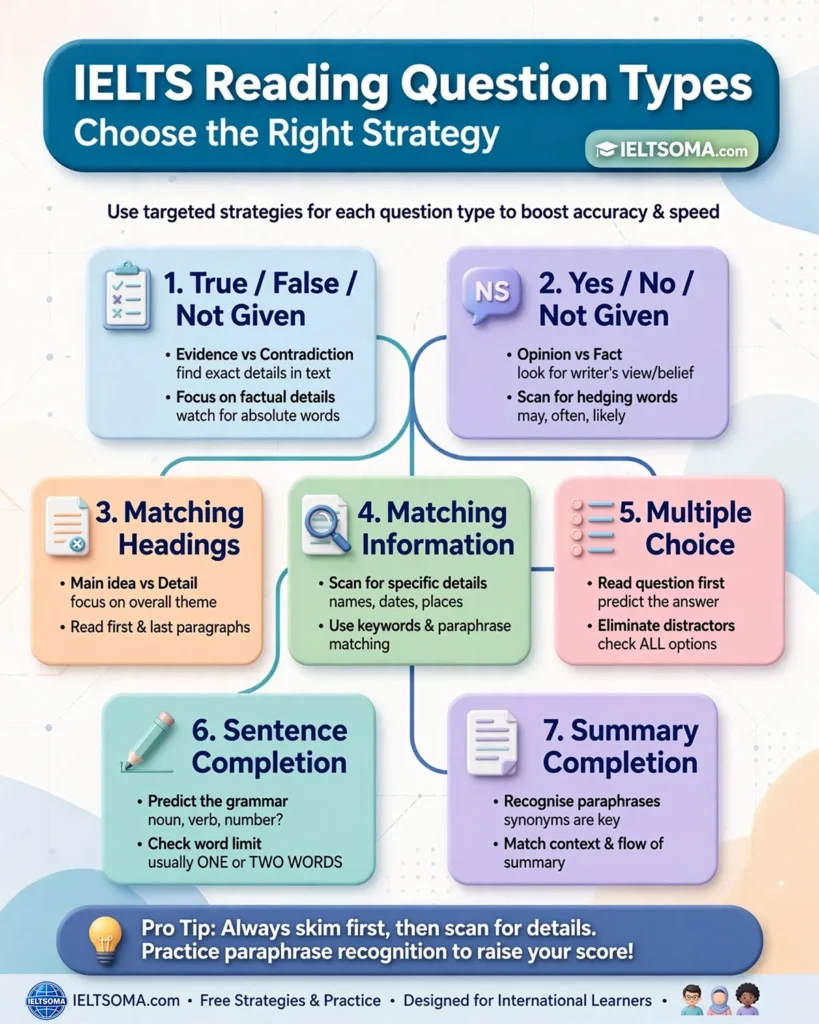
1. Read the Questions Before Hunting for Answers
One of the biggest mistakes candidates make is reading the entire passage slowly before looking at the questions.
That approach can consume valuable time without giving you a clear purpose.
Instead, preview the questions first.
Look for:
- Names
- Dates
- Numbers
- Places
- Technical terms
- Unusual nouns
- Key concepts
- Strong adjectives
- Words indicating comparison or contrast
These become your search targets.
For example, if a question asks:
Why did researchers abandon the original experiment?
Your key ideas might be:
- researchers
- abandon
- original experiment
- reason
The passage may not use those exact words. It might say:
The research team eventually discontinued the initial trial because…
You are searching for the idea, not just identical vocabulary.
That distinction is central to effective IELTS Reading Strategies.
2. Do Not Try to Understand Every Word
IELTS Reading is not a vocabulary examination in isolation.
You do not need to understand every word in a passage to answer most questions correctly.
Suppose you encounter:
The researchers observed a substantial decline in nocturnal activity following prolonged exposure to artificial illumination.
If you do not know nocturnal, you can still understand much of the sentence from context.
You can identify:
- researchers
- observed
- decline
- activity
- prolonged exposure
- artificial illumination
The surrounding information may be enough to answer the question.
When an unfamiliar word appears, ask:
Do I actually need to understand this word to answer the question?
If the answer is no, keep moving.
Stopping repeatedly to decode vocabulary is one of the fastest ways to lose Reading time.
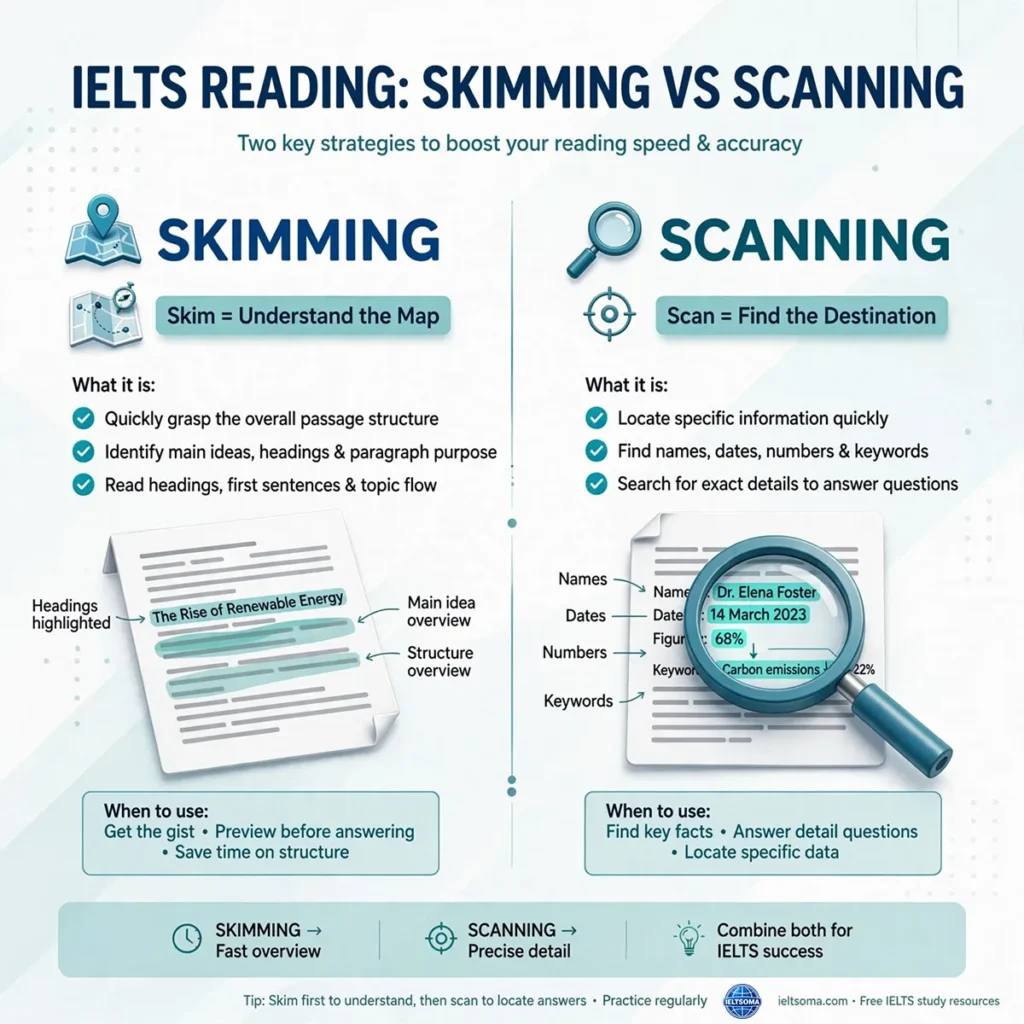
3. Master Skimming Before You Master Scanning
Skimming and scanning are different skills.
Skimming means moving quickly through a text to understand its general structure and main ideas.
Scanning means searching for a particular piece of information.
You need both.
When skimming, pay particular attention to:
- The title
- Headings
- The first sentence of paragraphs
- The final sentence when useful
- Names and dates
- Repeated concepts
- Contrast markers
- Examples
- Changes in argument
You are not trying to memorise the passage.
You are creating a mental map.
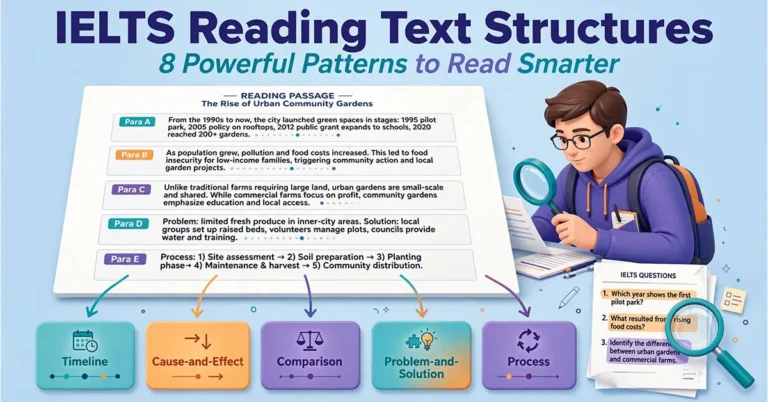
For example:
Paragraph A — background
Paragraph B — early theory
Paragraph C — problems with the theory
Paragraph D — new evidence
Paragraph E — implications
Now, if a question asks about problems with the original theory, you already know where to look.
This is much more efficient than rereading the entire passage.
4. Learn to Recognise Paraphrasing
This may be the single most important of all IELTS Reading Strategies.
IELTS rarely gives you the answer using exactly the same wording as the question.
Instead, it tests whether you can recognise equivalent meaning.
For example:
Question:
The project was completed earlier than expected.
Passage:
The team finished the initiative ahead of schedule.
The wording is different, but the meaning is essentially the same.
Build connections such as:
| Question wording | Possible passage wording |
|---|---|
| increased | rose, grew, climbed |
| decreased | declined, fell, dropped |
| important | significant, crucial, vital |
| problem | issue, difficulty, challenge |
| changed | altered, modified, transformed |
| began | started, commenced, initiated |
| stopped | ended, ceased, discontinued |
| approximately | about, roughly, around |
| caused | led to, resulted in, contributed to |
Do not memorise endless synonym lists.
Instead, train yourself to recognise meaning relationships.
5. Use Question Order to Your Advantage
Many IELTS Reading question types follow the order of information in the passage.
This is particularly useful for:
- Multiple choice
- True/False/Not Given
- Yes/No/Not Given
- Sentence completion
- Short-answer questions
- Matching sentence endings
If Question 8 is answered around the middle of a paragraph, Question 9 will often be found later rather than earlier.
This creates a powerful navigation advantage.
However, do not assume every task follows passage order.
For example, matching headings requires you to identify the main idea of paragraphs, while some matching tasks can require you to search across the passage.
Understanding which question types generally follow order prevents unnecessary backtracking.
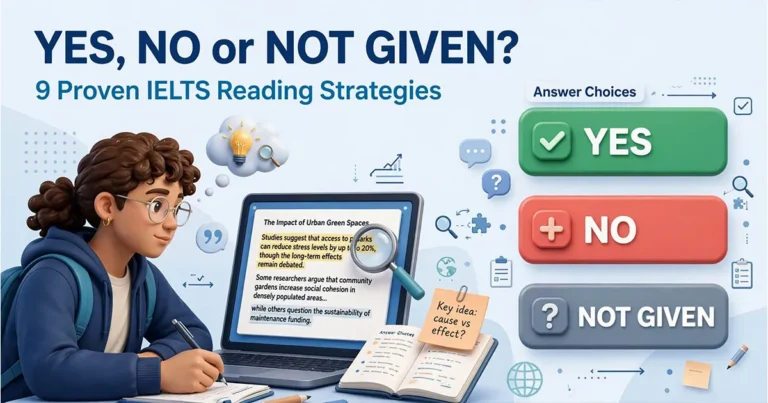
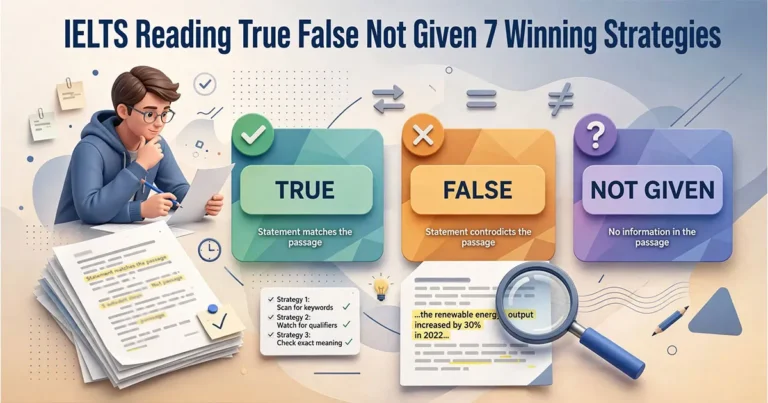
6. Treat True, False and Not Given Differently
True/False/Not Given is responsible for countless lost marks.
The key is to understand the three decisions precisely.
True = the statement agrees with the information in the passage.
False = the passage contradicts the statement.
Not Given = the passage does not provide enough information to confirm or contradict it.
Consider this:
Passage:
The museum opened in 1985 and attracts visitors from several countries.
Statement:
The museum opened in 1985.
Answer: True
Statement:
The museum opened in 1995.
Answer: False
Statement:
The museum receives more than one million visitors every year.
Answer: Not Given
The third statement may sound plausible, but IELTS does not ask whether something is likely.
It asks what the passage tells you.
Never use your personal knowledge to fill information that the text does not provide. The official IELTS guidance makes this distinction explicit.
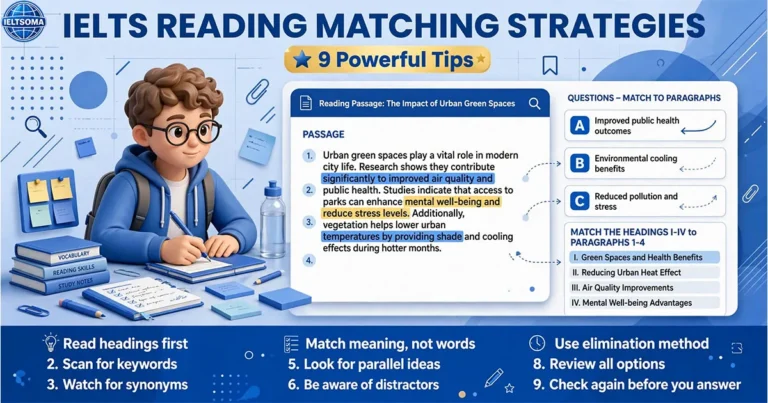
7. For Matching Headings, Find the Main Idea
Matching headings is not about finding a sentence that looks similar to a heading.
A heading represents the central idea of the paragraph.
Consider a paragraph that mentions:
- A scientist
- A new machine
- Several experiments
- A surprising result
- The implications of the result
If the paragraph is mainly explaining the surprising result, a heading about the scientist may be a distractor.
Ask:
If I had to summarise this entire paragraph in five or six words, what would I say?
That answer is usually closer to the correct heading.
The official IELTS description also distinguishes matching headings from matching information: headings focus on the general topic or main idea, whereas matching information focuses on specific details.
8. Do Not Confuse a Supporting Detail With the Main Idea
A paragraph can contain several attractive keywords.
That does not mean the matching heading containing those keywords is correct.
For example:
Paragraph: A researcher describes how electric vehicles developed from early experimental models into commercially viable alternatives, with falling battery costs playing an important role.
Possible headings:
A. The cost of modern batteries
B. The development of electric vehicles
C. An experiment by a famous researcher
D. Problems facing modern transport
A paragraph may mention battery costs, but the broader idea is the development of electric vehicles.
IELTS tests whether you can distinguish the main idea from supporting information.
9. Respect the Word Limit Exactly
This sounds simple, but it costs candidates marks every week.
If the instruction says:
NO MORE THAN TWO WORDS AND/OR A NUMBER
you cannot write three words.
For example:
Passage:
The conference was held at the University of Cambridge.
If the question is:
The conference was held at ______.
and the instruction allows NO MORE THAN TWO WORDS, you could write:
Cambridge University
if that is exactly supported by the passage.
But writing:
the University of Cambridge
would exceed the two-word limit.
Official IELTS guidance states that answers exceeding the stated word limit lose the mark.
Always read the instruction before answering.
10. Use Grammar to Predict the Answer
Before scanning the passage, examine the grammatical structure of the gap.
For example:
The researchers developed a new ______ to measure air quality.
You can predict that the answer is probably a noun.
Another example:
The number of visitors has ______ significantly.
You expect a verb or participle.
This prediction reduces the number of possibilities you need to consider.
Grammar is therefore not just useful in Writing and Speaking.
It can make your Reading decisions faster and more accurate.
11. Do Not Spend Three Minutes on One Question
A difficult question can become a psychological trap.
You think:
“I have already spent two minutes, so I must solve it.”
No.
That is sunk-cost thinking.
If a question is consuming too much time:
- Make the best decision you can.
- Mark it mentally or on your screen/paper.
- Move forward.
- Return if time remains.
One difficult question should never cause you to lose three easier questions later.
Strong IELTS Reading Strategies are designed to maximise your total score, not your pride on one question.
12. Build a Three-Stage Timing System
Instead of trying to divide 60 minutes perfectly, use a practical framework.
A useful starting point is:
| Stage | Suggested time |
|---|---|
| Passage 1 / Section 1 | 15–17 minutes |
| Passage 2 / Section 2 | 18–20 minutes |
| Passage 3 / Section 3 | 23–25 minutes |
For Academic Reading, many candidates find the third passage more demanding.
For General Training, the later section is also more challenging, so your timing should allow extra thinking time as difficulty increases.
Do not treat these timings as rigid laws.
If you finish the first section in 14 minutes with high accuracy, move on.
The goal is to prevent one difficult section from consuming the entire test.
13. Learn the Difference Between “Finding” and “Proving”
Finding an apparent answer is not enough.
You need to prove that it answers the question.
Imagine the question asks:
Why did the company change its production method?
You locate:
The company introduced a new production system in 2019.
That tells you when, not why.
Continue reading until you find the relevant relationship:
The new system was introduced because the previous method had become too expensive.
Now you have the reason.
A useful mental question is:
What exactly is this question asking me to prove?
Is it asking for:
- A reason?
- A result?
- A comparison?
- A location?
- A person’s opinion?
- A specific fact?
- The writer’s overall argument?
This prevents keyword matching without comprehension.
14. Keep an Error Log After Every Practice Test
Completing practice tests without analysing your mistakes is one of the least efficient ways to prepare.
After each test, classify every wrong answer.
Use categories such as:
| Error type | What it means |
|---|---|
| Vocabulary | You did not understand key wording |
| Paraphrase | You failed to recognise equivalent meaning |
| Location | You searched the wrong part of the text |
| Question type | You misunderstood the task |
| Logic | You chose an answer without sufficient evidence |
| Timing | You ran out of time |
| Careless error | You found the answer but recorded it incorrectly |
Then look for patterns.
If you repeatedly lose marks on Matching Headings, doing another ten random Reading tests may not solve the problem.
You need targeted practice on main ideas and paragraph structure.
If you repeatedly miss True/False/Not Given, focus on evidence, contradiction and missing information.
Your mistakes are data.
Use them.
15. Practise Reading for Meaning, Not Just for IELTS
IELTS preparation should include actual English reading outside practice tests.
Academic candidates can read:
- Science and technology articles
- University-related material
- Environmental articles
- History and social science texts
- Quality newspapers and magazines
General Training candidates can also read:
- Workplace documents
- Notices
- Advertisements
- Instructions
- News articles
- Practical information pages
The purpose is not to memorise vocabulary.
It is to become comfortable with unfamiliar subjects, different writing styles and changing sentence structures.
The more comfortable you become with unfamiliar English, the less mental energy you spend panicking when an IELTS passage looks difficult.
Academic vs General Training: Should Your Strategy Change?
Yes — but not completely.
The fundamental skills remain the same:
- Skimming
- Scanning
- Paraphrase recognition
- Evidence-based answering
- Time management
- Question-type awareness
- Vocabulary in context
The reading material is what changes.
Academic Reading uses texts aimed at a non-specialist academic audience and may contain detailed arguments, descriptive writing and diagrams or illustrations.
General Training Reading progresses from everyday texts to workplace material and then a longer text on a topic of general interest.
Therefore:
Academic candidates should spend additional time developing comfort with complex arguments, academic vocabulary and dense paragraphs.
General Training candidates should become highly efficient at extracting practical information from shorter texts while also preparing carefully for the more complex final section.
Do not assume that General Training Reading requires little preparation simply because some texts are more familiar.
The final section can still demand strong comprehension. For further reading on Academic vs General IELTS read the article, IELTS Academic vs General: The Ultimate Showdown for Success.
A Better Way to Practise IELTS Reading
Do not simply complete test after test.
Use a three-step practice cycle.
Step 1: Untimed Accuracy Practice
Choose one question type.
Work slowly.
Understand why each answer is correct.
Step 2: Controlled Timed Practice
Repeat the same question type under time pressure.
Your objective is to maintain accuracy while increasing speed.
Step 3: Full Test Practice
Once individual skills are reliable, complete the full 40-question Reading test under the 60-minute limit.
Then analyse every mistake.
This progression is far more useful than repeatedly taking full tests without learning from them.
The 60-Minute IELTS Reading Strategy
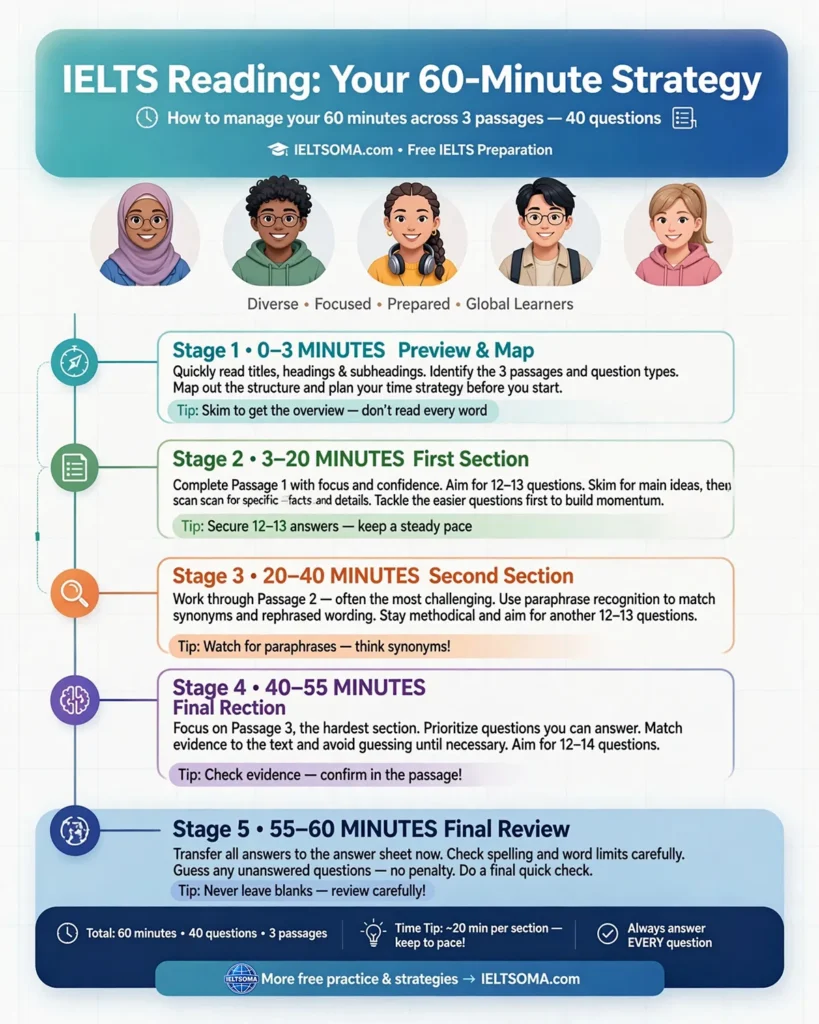
When you enter the Reading test, use this sequence:
First 2–3 minutes
Quickly understand the structure of the passage.
Look at headings, paragraph divisions and obvious names or numbers.
Next
Read the questions and identify search terms.
Then
Locate the relevant part of the text.
After locating it
Read around the answer carefully.
Do not stop at the first matching word.
Before moving on
Check whether the answer actually satisfies the question.
At the end
Use remaining time to revisit uncertain questions and check spelling, word limits and answer transfer.
Remember that there is no additional transfer time for IELTS Reading. Your answers must be transferred during the 60-minute Reading period.
Common IELTS Reading Mistakes to Avoid
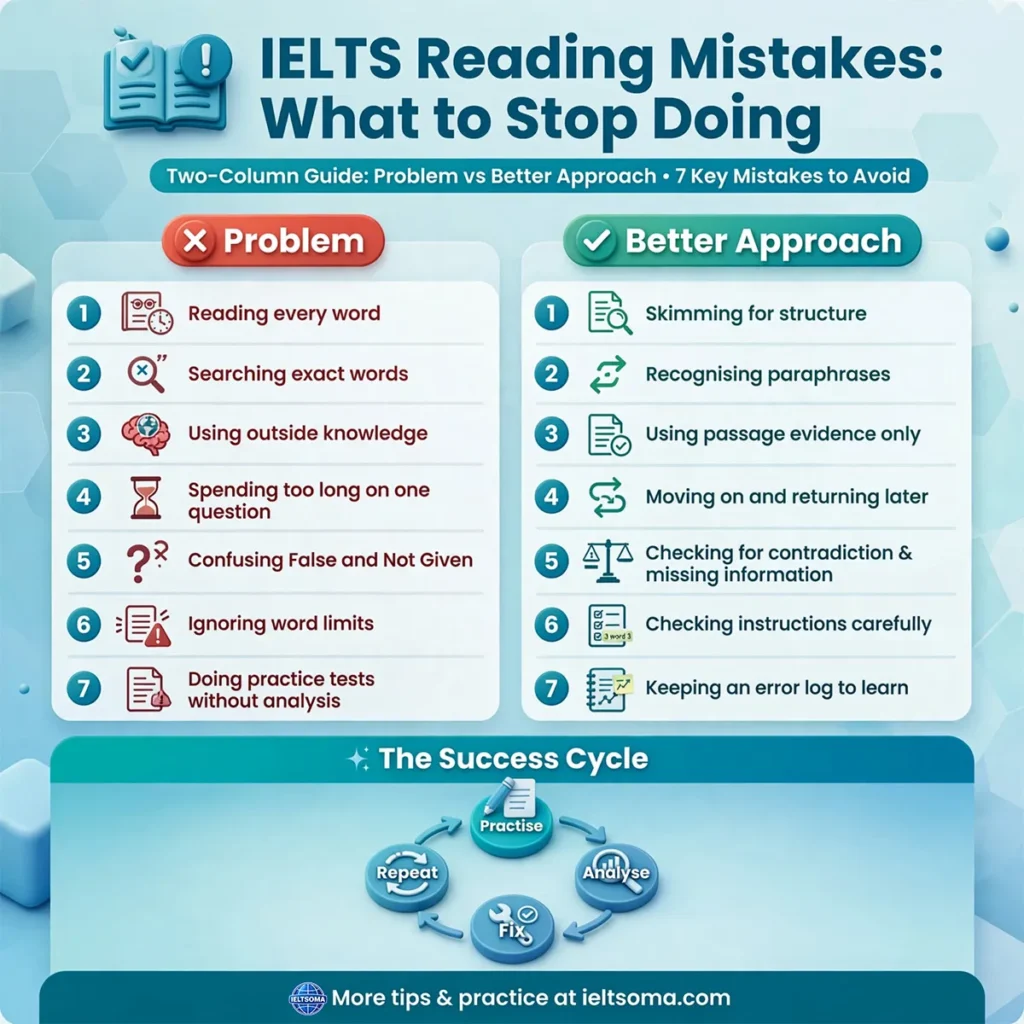
Even strong English users can lose marks because of poor test technique.
Avoid these mistakes:
- Reading every sentence slowly
- Trying to translate the passage mentally
- Searching only for exact words
- Ignoring synonyms and paraphrases
- Choosing an answer because it “sounds right”
- Using outside knowledge
- Confusing False with Not Given
- Confusing No with Not Given
- Spending too long on one question
- Ignoring the word limit
- Forgetting to check spelling
- Failing to analyse practice-test mistakes
- Assuming every question follows passage order
- Choosing a matching heading because it contains a familiar keyword
The strongest candidates are not necessarily those who read the fastest.
They are often the candidates who make fewer inefficient decisions.
How to Improve Your IELTS Reading Score Faster
If your current score is around Band 5.5–6.0, focus first on accuracy.
You need to discover why you are losing marks.
If you are around Band 6.5–7.0, concentrate more heavily on:
- Timing
- Difficult question types
- Paraphrase recognition
- Avoiding careless errors
- Managing the final passage
If you are targeting Band 8 or higher, small mistakes matter.
Your training should become highly analytical.
After every practice test, ask:
- Which questions did I get wrong?
- Where was the evidence?
- Why did I choose my answer?
- What made the correct answer better?
- Was the problem English ability or test technique?
- What will I do differently next time?
That final question turns practice into improvement.
Frequently Asked Questions About IELTS Reading Strategies
What are the best IELTS Reading Strategies?
The most useful strategies include reading questions strategically, recognising paraphrases, skimming for structure, scanning for specific information, understanding question types, managing time and using evidence rather than guessing.
Should I read the whole IELTS Reading passage first?
Not necessarily.
A brief skim can help you understand the structure and main ideas, but reading every sentence carefully before looking at questions can waste valuable time. Use a combination of skimming, question analysis and targeted reading.
How much time should I spend on each IELTS Reading passage?
A practical starting point is approximately 15–17 minutes for the first passage, 18–20 minutes for the second and 23–25 minutes for the final passage. Adjust this according to your strengths and the difficulty of the test.
Is skimming enough for IELTS Reading?
No.
Skimming helps you understand the overall structure, while scanning helps you locate specific information. You also need close reading to confirm that a located sentence actually answers the question.
How can I improve IELTS Reading quickly?
Identify your recurring error types rather than simply completing more tests. Practise the specific skills causing lost marks, then apply them under timed conditions.
Why do I understand the passage but still get IELTS Reading questions wrong?
You may have a strategy problem rather than a language problem.
Common causes include confusing main ideas with details, failing to recognise paraphrases, misunderstanding Not Given, choosing an answer without sufficient evidence, or spending too long on difficult questions.
Is IELTS Academic Reading harder than General Training Reading?
The two versions use different types of reading material. Academic Reading contains longer academic-style texts, while General Training progresses from everyday and workplace texts to a more complex general-interest section. Your experience also depends on your English strengths and reading background.
Can I get Band 8 in IELTS Reading?
Yes, but a Band 8 target requires a high level of accuracy.
The exact raw-score requirement can vary by test version and should not be treated as a permanent fixed conversion. Focus on consistently performing at a very high level in authentic practice tests rather than chasing one memorised score conversion.
Your IELTS Reading Strategy Checklist
Before your next practice test, remember:
- Read the instructions carefully.
- Understand the question type.
- Identify useful keywords.
- Expect paraphrasing.
- Skim for structure.
- Scan for specific information.
- Read the surrounding context.
- Use evidence from the passage.
- Respect the word limit.
- Do not use outside knowledge.
- Move on from time-consuming questions.
- Keep track of your timing.
- Check spelling.
- Analyse every mistake afterwards.
The goal is not to become a faster reader overnight.
The goal is to become a more strategic reader.
That is the real advantage of effective IELTS Reading Strategies.
Final Takeaway
A high IELTS Reading score does not come from reading the entire passage perfectly.
It comes from making good decisions repeatedly.
Know what you are looking for. Recognise paraphrased information. Understand what each question is actually testing. Use the passage as your evidence. Protect your time. Then analyse your mistakes until the same errors stop appearing.
For both Academic and General Training candidates, the biggest improvement often comes when practice changes from “How many questions did I get right?” to “Why did I get each question wrong?”
That shift turns practice into training.
Use these IELTS Reading Strategies consistently, combine them with authentic practice materials, and track your performance over time. Your target band score becomes much more manageable when every practice session has a specific purpose.
IELTSOMA is built to help you prepare with that kind of focused, practical approach — smarter preparation, better analysis and less wasted effort.
Further Reading: