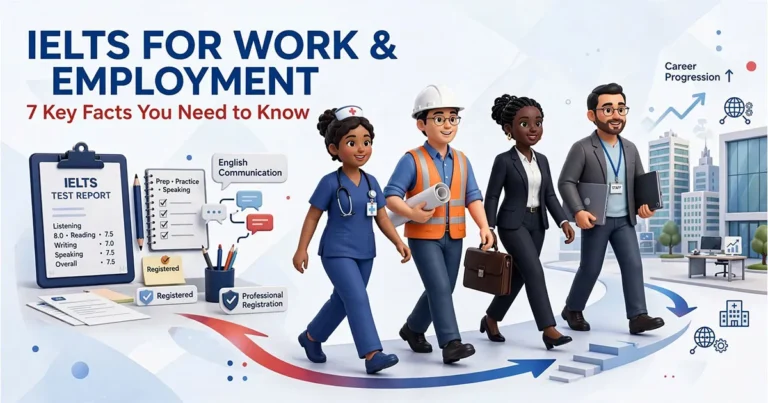
A strong IELTS score can do more than help you meet an English-language requirement. For the right candidate, it can strengthen an international job application, support professional registration, improve mobility and provide credible evidence of English proficiency.
The Benefits of IELTS for Career Advancement are especially relevant if you want to work abroad, move into an English-speaking workplace, qualify for a regulated profession or compete for opportunities where employers need evidence of your communication ability.
But there is an important distinction: IELTS does not guarantee a job, promotion or higher salary. Its value comes from what the score represents and where an employer, professional body, university or immigration authority requires or accepts it.
IELTS is trusted by more than 13,500 organisations worldwide, including employers, professional associations, educational institutions and governments. See which organisations accept IELTS
So, what can IELTS actually do for your career?
Table of Contents
Quick Answer: How Can IELTS Help Your Career?
The main Benefits of IELTS for Career Advancement include:
- Providing recognised evidence of English proficiency
- Supporting international job applications
- Helping meet professional registration requirements
- Increasing access to overseas career opportunities
- Demonstrating communication skills across four language abilities
- Supporting migration and work-related applications
- Helping professionals prepare for English-speaking workplaces
However, the required IELTS test type and band score depend on the employer, professional regulator, country and specific application. Always check the current requirements before booking your test.
1. IELTS Can Strengthen International Job Applications
One of the biggest Benefits of IELTS for Career Advancement is that it can give employers an independently assessed indication of your English proficiency.
This matters when you are applying for a position where English is essential.
Imagine two candidates with similar technical qualifications. One has experience working internationally but provides no formal evidence of English ability. The other has comparable qualifications and an IELTS result that meets the employer’s stated requirement.
If the employer accepts IELTS, the second candidate has an additional piece of evidence to support their application.
That does not automatically make them the better candidate. Technical skills, experience, qualifications, interviews and cultural fit still matter.
However, an IELTS score can remove uncertainty about language ability.
IELTS itself explains that employers around the world use the test to help assess whether candidates have the English skills needed to succeed in their organisations.
Where can this matter?
IELTS may be relevant to professionals working in areas such as:
- Healthcare
- Engineering
- Accounting
- Law
- Aviation
- Finance
- Construction
- Energy
- Tourism
- Education
- Government
The exact requirements vary considerably by employer and country.
That is why you should treat IELTS as a career-enabling credential, rather than a universal employment credential.
2. IELTS Can Support Professional Registration
For some professionals, English proficiency is not simply a desirable skill. It can be part of the registration process.
This is particularly important in regulated professions where poor communication could affect clients, patients, colleagues or public safety.
Healthcare is a major example.
Professional bodies in different countries may use IELTS as part of their English-language requirements for professions such as nursing, medicine and pharmacy. Requirements can differ by profession, jurisdiction, minimum band score and test type.
Other regulated professions may also have English-language requirements.
This makes professional registration one of the most significant Benefits of IELTS for Career Advancement for internationally trained professionals.
For example, consider a qualified nurse who wants to practise in another country.
Their nursing qualification demonstrates professional competence. Their work experience demonstrates practical ability. But the relevant regulator may separately require evidence of English proficiency.
In that situation, achieving the required IELTS result can become one of the steps between having a qualification and being eligible to practise.
Expert tip: Never assume that a particular IELTS band score applies to every profession or country. Check the professional regulator’s current requirements before choosing Academic or General Training.
3. IELTS Can Open Doors to International Career Mobility
Career advancement does not always mean getting promoted in your current company.
Sometimes it means being able to apply for opportunities in another country.
The Benefits of IELTS for Career Advancement can therefore extend beyond your current job market.
A recognised English test may help when you are:
- Applying for jobs overseas.
- Seeking professional registration.
- Applying for migration.
- Moving into an English-speaking workplace.
- Studying for a qualification that can lead to professional opportunities.
- Building a pathway towards long-term international employment.
IELTS is accepted by governments, employers, professional bodies and educational institutions across many countries. The official IELTS organisation information confirms that employers and professional organisations worldwide use IELTS results for English-language assessment.
For someone whose career is limited by their current location, this can be strategically important.
Instead of asking only, “What job can I get here?”, you may eventually be able to ask, “Which international job markets can I realistically apply to?”
That is a much bigger career decision.
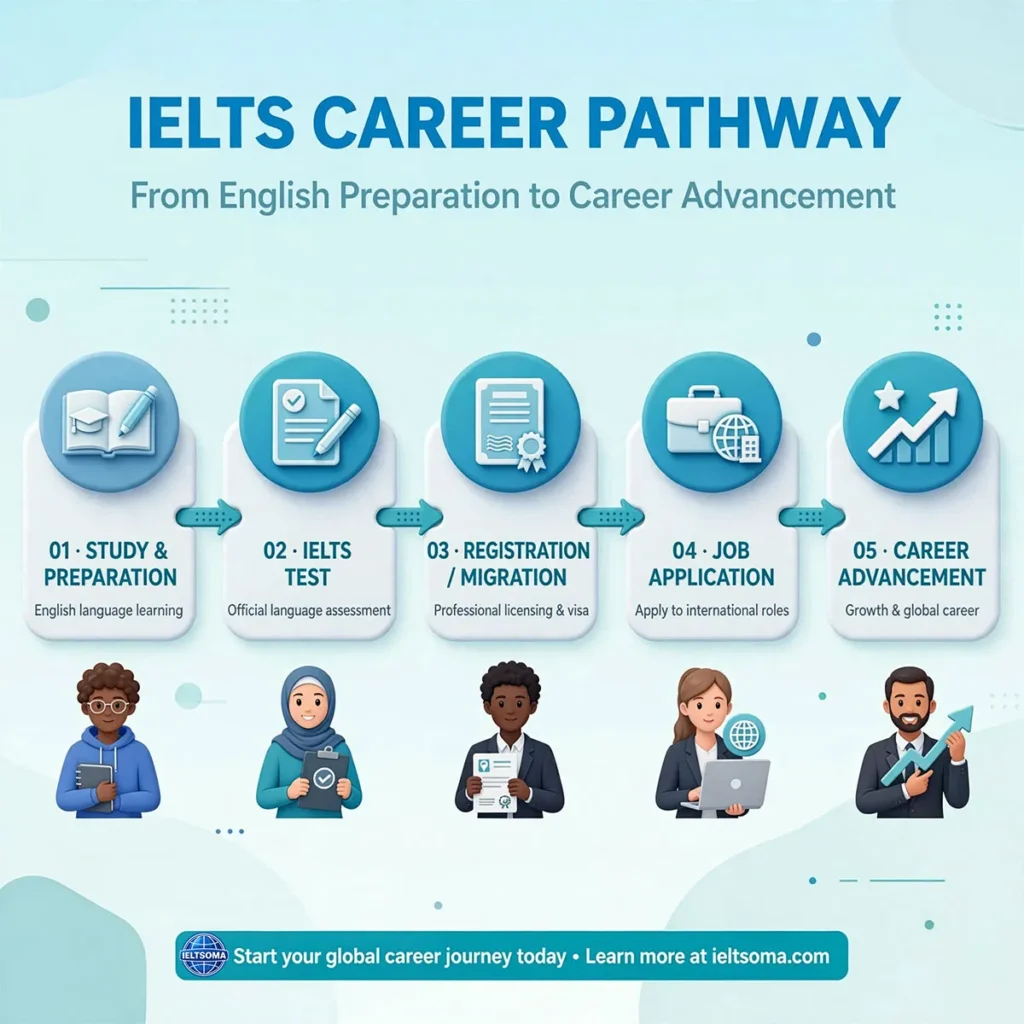
IELTS can form one part of a wider pathway towards international employment and professional mobility.
4. IELTS Gives Employers Evidence of Four Communication Skills
Another advantage of IELTS is that it does not focus on a single aspect of English.
The test assesses:
- Listening
- Reading
- Writing
- Speaking
The results provide individual band scores for each skill as well as an overall band score.
This can be particularly useful in professional environments.
A workplace rarely requires you to communicate in only one way.
You may need to:
- Understand instructions during a meeting.
- Read reports and emails.
- Write professional correspondence.
- Explain an idea to a colleague.
- Participate in discussions.
- Present information.
- Understand different speakers and accents.
For example, an engineer may need to read technical documentation, participate in meetings, write project updates and explain problems to clients.
A nurse may need to listen carefully to patients, communicate with colleagues, document information and understand workplace instructions.
The exact communication demands differ by profession, but the principle is the same: professional English is multi-dimensional.
That is why preparing for IELTS can also expose weaknesses that you may not have noticed in everyday conversation.
5. A High IELTS Score Can Demonstrate Stronger English Proficiency
A high IELTS score is not a substitute for professional experience, but it can provide stronger evidence of English proficiency when a recognised test is required.
The IELTS band scale ranges from 0 to 9, with separate scores awarded for the four skills.
For career purposes, however, there is no universal “good IELTS score”.
A Band 7 may be more than enough for one purpose and insufficient for another.
For example:
| Career situation | What matters most |
|---|---|
| International job application | Employer’s stated English requirement |
| Professional registration | Regulator’s required score and test type |
| Migration | Current visa or immigration requirements |
| University pathway | Institution and programme requirements |
| Workplace promotion | Whether the employer actually values or requires IELTS |
| Professional training | Training provider’s English requirement |
This is why chasing a Band 9 simply because it sounds impressive is not always the smartest strategy.
Your target should be the score you actually need for your specific career objective.
6. IELTS Preparation Can Improve Practical Workplace English
The Benefits of IELTS for Career Advancement are not limited to the certificate or test report.
The preparation process itself can develop useful communication habits.
For example, IELTS Writing preparation can teach you to:
- Organise information logically.
- Support ideas with relevant evidence.
- Use appropriate vocabulary.
- Improve sentence control.
- Write clearly under time pressure.
IELTS Speaking preparation can help you practise:
- Expressing opinions clearly.
- Explaining reasons.
- Giving examples.
- Comparing ideas.
- Speaking with greater fluency.
- Responding spontaneously.
These abilities can transfer into professional situations.
Suppose you have to give a short presentation at work.
You need to introduce the topic, explain your main points, provide supporting information and respond to questions.
That is not the IELTS Speaking test.
But the communication habits developed through good IELTS preparation can still be useful.
This is one reason experienced IELTS preparation should focus on real communication skills, not memorising model answers.
For more practical preparation strategies, see IELTSOMA’s IELTS Preparation Tips: 15 Proven Strategies to Achieve Your Target Band Score.
7. IELTS Can Support a Larger Career and Migration Strategy
For many international professionals, IELTS is only one part of a much bigger plan.
A typical pathway might look like this:
English preparation → IELTS result → professional registration or migration requirement → job applications → international employment
The order can change depending on your profession and destination.
This is particularly relevant for people considering countries such as Australia, Canada, New Zealand or the UK, where English-language evidence can form part of certain migration or professional pathways. IELTS states that it is accepted by the immigration authorities of these four countries where English-language evidence is required.
The important point is that IELTS should fit into your career strategy.
Do not take the test simply because someone told you that “IELTS is good for your career”.
First identify the opportunity you want.
Then work backwards.
A smarter career-planning approach
Ask yourself:
- Which country do I want to work in?
- Which occupation am I targeting?
- Is my profession regulated?
- Which organisation determines the English requirement?
- Do I need IELTS Academic or General Training?
- What minimum band score is required?
- Is a minimum score required in each individual skill?
- How long will my result be accepted for my specific purpose?
- Do I need any other qualifications or assessments?
- When should I take IELTS in relation to my application?
This approach can save you time and money.
IELTS Academic vs General Training for Career Goals
Choosing the correct test is one of the most important decisions you can make.
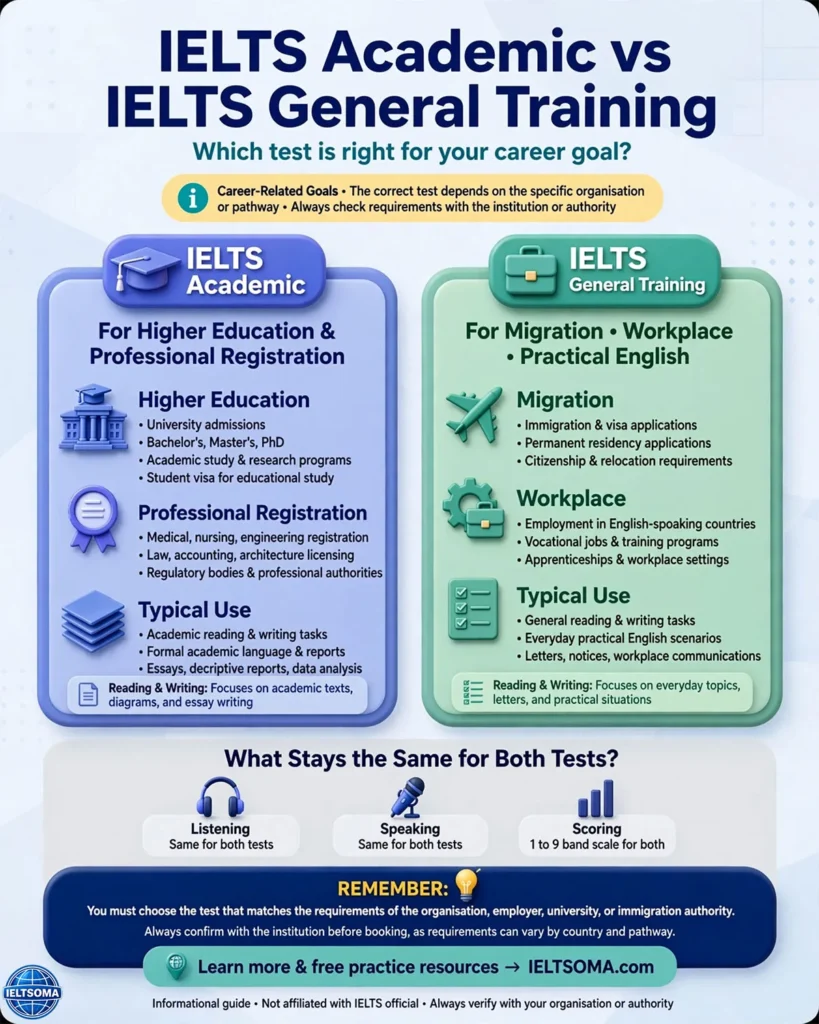
IELTS Academic is generally designed for higher education and certain professional registration purposes.
IELTS General Training is commonly used for migration, workplace-related and practical English contexts.
But there is no universal rule that says “career = General Training”.
Some professions require IELTS Academic for registration, while a particular immigration pathway may specify another test or version.
The official IELTS guidance states that the required test type and score can vary according to the organisation, profession, country and jurisdiction.
| Goal | Test to consider |
|---|---|
| University or postgraduate study | IELTS Academic |
| Certain professional registration | Often IELTS Academic, depending on regulator |
| Migration | Often IELTS General Training, depending on pathway |
| Overseas employment | Depends on employer and country |
| Professional licensing | Depends on the regulatory body |
Before registering, check the organisation that will actually receive your result.
You can also read IELTSOMA’s IELTS Academic vs General: The Ultimate Showdown for Success for a more detailed comparison.
What IELTS Cannot Do for Your Career
Understanding the limitations is just as important as understanding the benefits.
IELTS cannot:
- Guarantee employment.
- Guarantee a promotion.
- Replace professional qualifications.
- Replace industry experience.
- Prove technical competence.
- Guarantee a particular salary.
- Automatically qualify you for professional registration.
- Make an employer choose you over another candidate.
A Band 8 accountant with weak technical experience is not automatically a better candidate than a Band 7 accountant with stronger professional experience.
Likewise, an excellent IELTS score cannot compensate for missing professional licensing requirements.
Think of IELTS as evidence of English proficiency within a larger professional profile.
That distinction prevents unrealistic expectations.
Common Mistakes When Using IELTS for Career Advancement
Mistake 1: Taking the wrong IELTS test
A candidate may spend months preparing for IELTS General Training and later discover that their professional regulator requires Academic.
Better approach: Check the receiving organisation before booking the test.
Mistake 2: Choosing a target score without checking requirements
Some candidates automatically aim for Band 7 because they have heard it is a “good score”.
Your actual requirement might be 6.5, 7.5 or a specific minimum in each skill.
Better approach: Find the exact requirement first.
Mistake 3: Believing IELTS alone will get you a job
Employers consider much more than English proficiency.
Better approach: Combine your IELTS result with strong qualifications, relevant experience, CV writing, interview skills and professional networking.
Mistake 4: Preparing only for the test
Memorising speaking answers may help you recognise patterns, but it does not build genuine communication ability.
Better approach: Use IELTS preparation to improve your underlying English.
Mistake 5: Ignoring individual skill scores
An overall score can look impressive while one skill falls below the requirement.
For professional registration, this can be critical.
Better approach: Check both the overall band and individual skill requirements.
How to Make IELTS Work Harder for Your Career
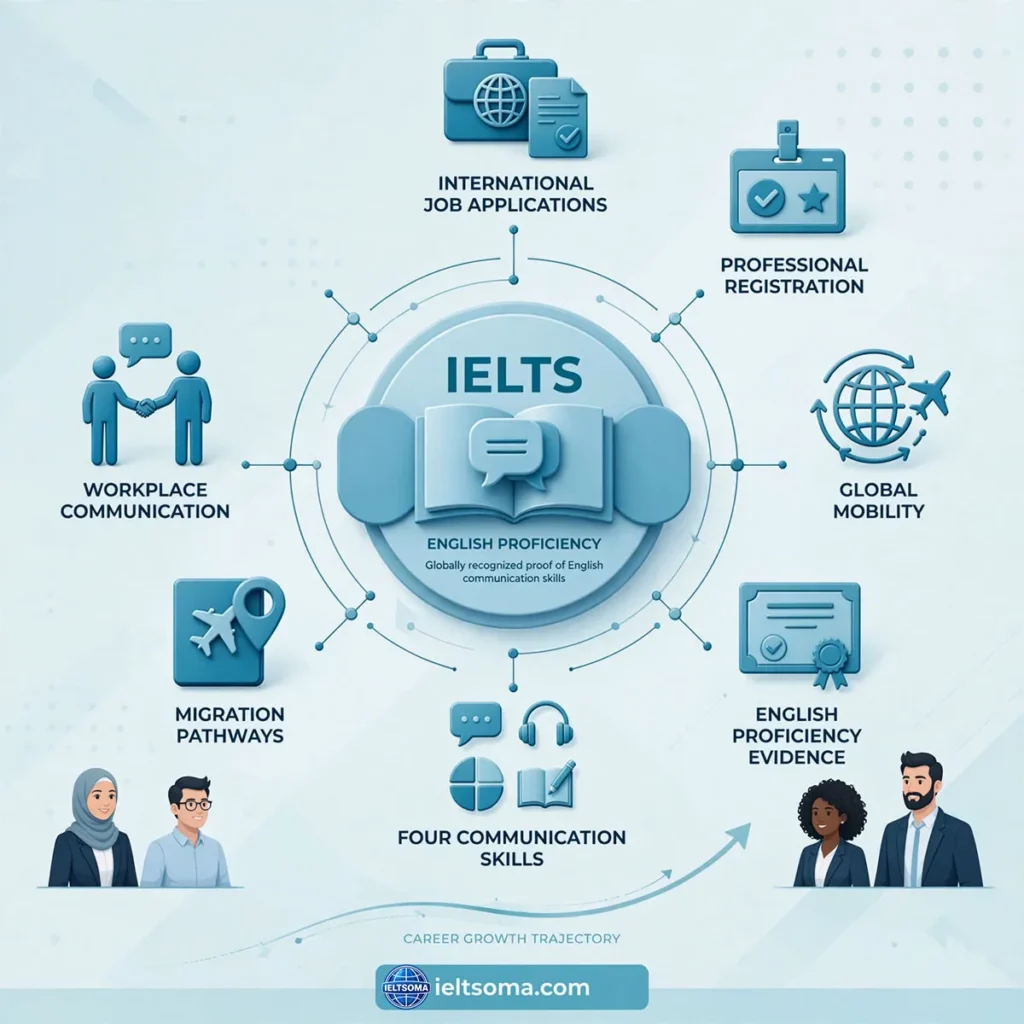
If career advancement is your primary objective, use IELTS strategically.
Step 1: Define the career destination
Do not start with the test.
Start with the job, profession, country or qualification you want.
Step 2: Identify the organisation setting the requirement
This could be:
- An employer
- A professional regulator
- A government department
- A university
- An immigration authority
- A licensing organisation
Step 3: Find the exact English requirement
Record:
- Test type
- Overall band
- Individual skill minimums
- Accepted test formats
- Any validity conditions
- Any special requirements
Step 4: Build a realistic preparation plan
Use diagnostic tests to identify your weakest skills.
Then divide your study time according to the areas that need the most improvement.
Step 5: Turn IELTS practice into professional practice
Do not practise only exam questions.
Read industry articles.
Listen to professional discussions.
Write workplace-style emails.
Practise explaining technical ideas in simple English.
Record yourself answering unexpected questions.
This makes your preparation more transferable.
Step 6: Use your result strategically
Once you achieve the required score, update the relevant parts of your:
- CV
- LinkedIn profile
- Professional registration application
- Immigration documentation
- University application
- Employer application
Only include the score where it is relevant and accurate.
Frequently Asked Questions
Is IELTS useful for career advancement?
Yes, IELTS can support career advancement when employers, professional bodies, universities or immigration authorities require or accept it as evidence of English proficiency. Its value depends on your profession, destination and career objective.
Can IELTS help me get a job abroad?
It can help meet an English-language requirement for some international jobs, but IELTS does not guarantee employment. Employers may also consider qualifications, professional experience, technical skills and interview performance.
Which IELTS is better for work: Academic or General Training?
Neither is universally better for work. The correct test depends on the employer, professional regulator, immigration pathway or organisation requiring your result.
What IELTS band score is good for career advancement?
There is no universal career band score. The right target is the score required by the specific employer, professional body, university or immigration pathway you are applying to.
Can IELTS help with professional registration?
Yes. Some professional registration bodies accept IELTS as evidence of English proficiency. Healthcare is one important example, but requirements vary by profession and jurisdiction.
Does a higher IELTS score mean a higher salary?
Not necessarily. A higher IELTS score may help you meet a requirement or strengthen your profile, but salary is normally influenced by factors such as occupation, experience, qualifications, location, employer and market demand.
Is IELTS worth taking if I already speak English well?
It can be worthwhile if an organisation requires formal evidence of English proficiency. Strong everyday English does not automatically satisfy a formal language-testing requirement.
Final Takeaway
The real Benefits of IELTS for Career Advancement come from using the test strategically.
IELTS can provide recognised evidence of English proficiency, support professional registration, strengthen certain international job applications and contribute to migration or study pathways.
But the certificate itself is not the career.
Your qualifications, professional experience, communication ability, technical competence and career strategy still matter.
The smartest approach is simple:
Choose the career goal first. Check the exact requirement. Choose the correct IELTS test. Prepare for the required score. Then use your result as one part of a stronger professional profile.
If international career mobility is your goal, IELTS can be an important piece of the puzzle — but knowing exactly where that piece fits is what makes the investment worthwhile.
IELTSOMA provides practical IELTS guidance for candidates preparing for Academic and General Training. For a broader overview of the test and its career, study and migration pathways, read the Guide to IELTS Success: Everything You Need to Know to Achieve Your Target Band Score.
Further Reading: