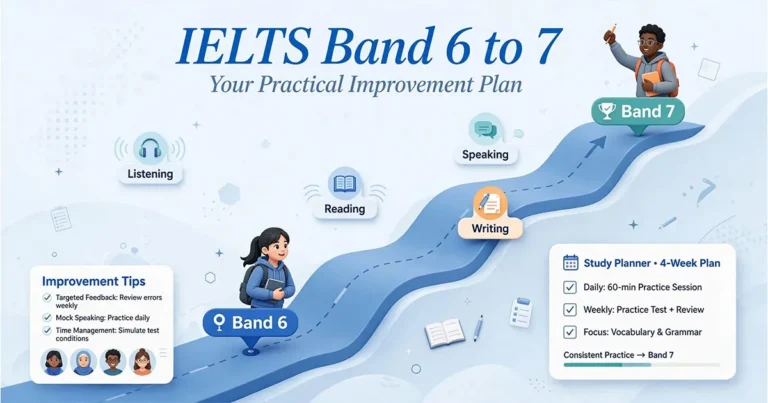
Preparing for IELTS without clear goals can feel like studying on a road with no destination. You may complete practice tests, memorise vocabulary and watch endless videos, yet still wonder why your score is not improving.
Effective goal setting for IELTS preparation changes that.
Instead of simply saying, “I want Band 7,” you can turn your target into measurable weekly objectives: improve Listening accuracy, increase Reading speed, strengthen Writing Task 2 responses, or speak more fluently under time pressure.
The key is to make your IELTS goal specific, realistic and connected to your current ability.
IELTS itself does not have a universal “pass” score. The score you need depends on the organisation, university, employer or immigration authority you are applying to.
This guide explains how to set an IELTS target and build a practical preparation plan around it.
Table of Contents
Why Goal Setting Matters in IELTS Preparation
Many candidates make the same mistake: they start studying before deciding exactly what they need to achieve.
A better approach is to begin with three questions:
- What IELTS score do I need?
- What is my current level?
- What do I need to improve to close the gap?
Official IELTS guidance recommends understanding your current level, practising the relevant skills and measuring progress through practice tests.
This turns IELTS preparation from a vague activity into a measurable process.
For example, consider two students:
| Student | Goal |
|---|---|
| A | “I will study IELTS every day.” |
| B | “I need an overall 7.0, with at least 6.5 in every skill, so I will improve my Writing from 5.5 to 6.5 over the next eight weeks.” |
Student B has a much clearer path.
The goal tells them what to practise, how much improvement is required and how progress should be measured.
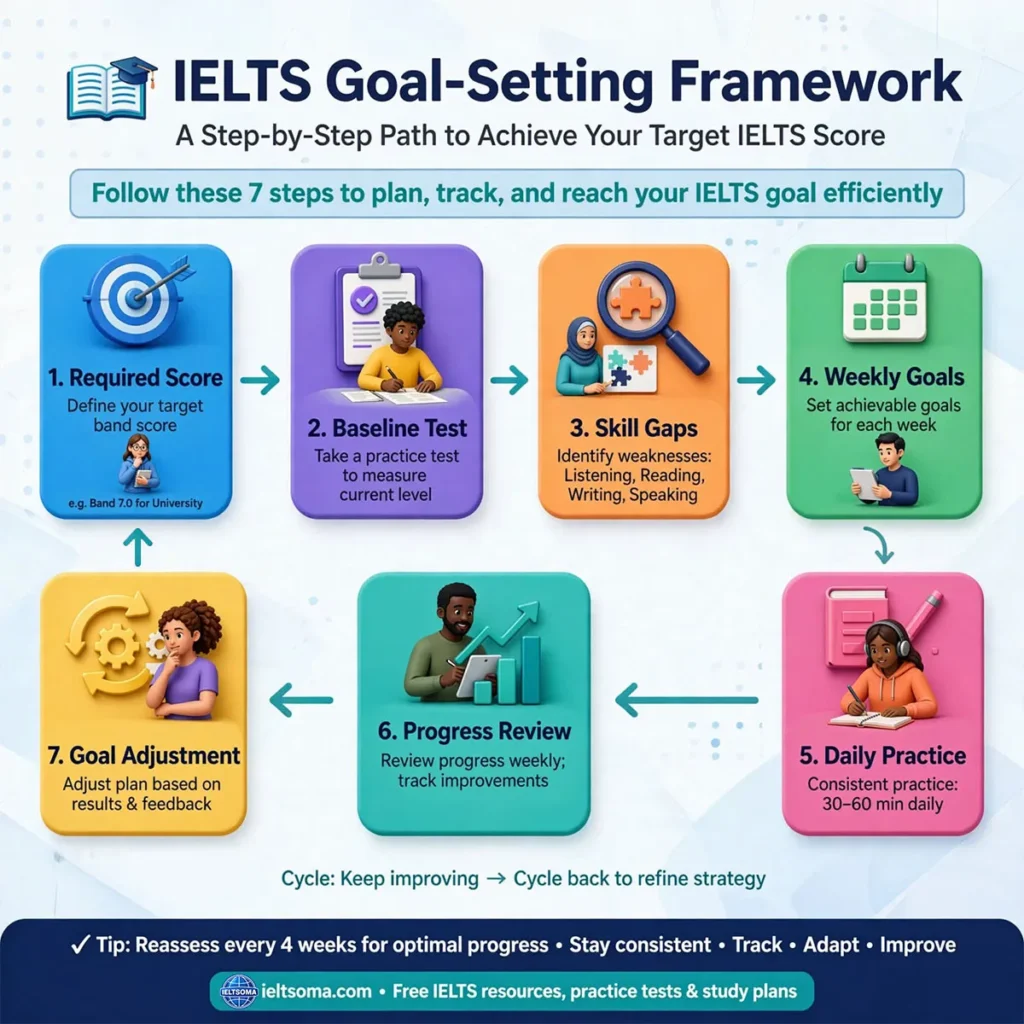
1. Start With Your Required IELTS Band Score
Your first goal should come from the actual requirement you need to meet.
Do not automatically choose Band 7 simply because it sounds like a good score.
A university may require one score, while an employer, professional body or immigration pathway may require another. IELTS advises test takers to check the requirements of the organisation they are applying to.
Write down your requirement clearly.
Example:
Overall IELTS: 7.0
Listening: 7.0
Reading: 7.0
Writing: 6.5
Speaking: 6.5
This is much more useful than simply writing:
“I want a high IELTS score.”
Remember the overall score
IELTS calculates the overall band score by averaging the four component scores and rounding according to its scoring rules.
For example:
- Listening: 7.0
- Reading: 7.0
- Writing: 6.0
- Speaking: 7.0
Average = 6.75
The overall band becomes 7.0.
However, this does not mean you can ignore individual requirements. If your university requires at least 6.5 in every component, an overall 7.0 will not compensate for a Writing score of 6.0.
Always check the exact requirement.
2. Take a Baseline IELTS Practice Test
One of the most important principles of goal setting for IELTS preparation is knowing where you are starting.
You cannot create a sensible study plan without understanding your current performance.
Take a properly timed practice test before beginning serious preparation.
Record your approximate scores:
| Skill | Current Score | Target Score | Gap |
|---|---|---|---|
| Listening | 6.0 | 7.0 | +1.0 |
| Reading | 6.5 | 7.0 | +0.5 |
| Writing | 5.5 | 6.5 | +1.0 |
| Speaking | 6.0 | 6.5 | +0.5 |
This table immediately shows where your attention is needed.
The British Council similarly recommends taking a practice test to understand your level and identify strengths and areas for improvement.
Official IELTS also provides sample questions and practice materials that can help you become familiar with the test format and task types.
Why your baseline matters
Suppose your target is Band 7.
If your current Reading performance is already around Band 7 but Writing is around Band 5.5, spending most of your preparation time doing Reading tests may produce little benefit.
Your weakest area deserves more attention.
3. Break Your IELTS Goal Into Four Skill Goals
An overall IELTS target can feel intimidating.
Break it down.
Your preparation should include separate objectives for:
- Listening
- Reading
- Writing
- Speaking
Each skill is assessed differently.
For example, IELTS Writing is assessed using criteria including task achievement or task response, coherence and cohesion, lexical resource, and grammatical range and accuracy. Speaking is assessed through fluency and coherence, lexical resource, grammatical range and accuracy, and pronunciation.
That means “improve Writing” is too broad to be a useful goal.
Instead, create smaller goals.
Listening goal
Increase my practice-test score from 25/40 to around 30/40.
Reading goal
Improve my ability to locate answers quickly and reach around 30/40 under timed conditions.
Writing goal
Improve paragraph organisation, idea development and grammatical accuracy so that my Task 2 responses consistently meet my target band requirements.
Speaking goal
Give longer, better-developed answers with fewer pauses and clearer pronunciation.
These goals are easier to practise and evaluate.
4. Turn Big Goals Into Weekly IELTS Targets
Long-term goals are useful, but weekly goals create momentum.
Suppose you have eight weeks before your IELTS test.
Instead of writing:
“Prepare for IELTS for eight weeks.”
Create weekly milestones.
Example eight-week plan
| Week | Main Goal |
|---|---|
| 1 | Establish baseline and understand test format |
| 2 | Improve weakest question types |
| 3 | Build vocabulary and grammar for productive skills |
| 4 | Develop Writing and Speaking performance |
| 5 | Increase Reading and Listening accuracy |
| 6 | Complete more timed practice |
| 7 | Identify remaining weaknesses |
| 8 | Full mock tests and final preparation |
This approach gives every week a purpose.
British Council guidance also recommends breaking IELTS practice into manageable sessions and mapping key milestones into a study plan.
5. Create Daily Goals You Can Actually Complete
A common mistake is setting an impressive schedule that cannot survive real life.
For example:
“I will study IELTS for five hours every day.”
That may work for a short period, but it can become difficult when you have university classes, work, family responsibilities or other commitments.
A more sustainable goal might be:
“I will complete 60–90 minutes of focused IELTS preparation six days a week.”
You can divide that time into smaller sessions.
Example:
- 20 minutes — vocabulary and grammar
- 25 minutes — Listening or Reading
- 30 minutes — Writing or Speaking
- 10 minutes — reviewing mistakes
The exact schedule should depend on your circumstances.
Consistency matters more than creating a timetable that looks impressive.
British Council preparation guidance specifically recommends manageable study sessions and regular practice rather than overwhelming yourself.
6. Set Process Goals, Not Only Score Goals
A Band 7 is an outcome.
You cannot directly control the score you will receive on test day.
You can control the actions that make improvement more likely.
This is why your IELTS plan should contain both outcome goals and process goals.
Outcome goal
Achieve an overall Band 7.0.
Process goals
Complete three timed Listening sections each week.
Write two Task 2 essays each week.
Practise Speaking Part 2 four times each week.
Review every practice-test mistake.
Learn and actively use useful vocabulary rather than simply memorising word lists.
Process goals keep you moving even when your score temporarily stops improving.
7. Review and Adjust Your IELTS Goals
Your first study plan should not be treated as a permanent contract.
Use your results to adjust it.
Imagine your first three practice tests show:
| Test | Listening | Reading | Writing | Speaking |
|---|---|---|---|---|
| 1 | 6.0 | 6.5 | 5.5 | 6.0 |
| 2 | 6.5 | 6.5 | 5.5 | 6.0 |
| 3 | 7.0 | 7.0 | 6.0 | 6.0 |
You now have evidence that Listening and Reading are improving.
Writing is improving slowly.
Speaking has barely moved.
Your preparation should therefore change.
You might reduce some Reading practice and dedicate more time to Speaking and Writing.
That is what effective goal setting looks like: measure → analyse → adjust → practise → measure again.
How to Set a Realistic IELTS Target
A realistic target should consider three things:
Your current score
A candidate currently scoring around Band 6 does not necessarily need the same preparation strategy as someone scoring around Band 4.
Your required score
The larger the gap between your current performance and your required score, the more substantial your preparation may need to be.
British Council guidance notes that preparation time depends on both your current English level and the score you need; candidates who are more than two bands below their target may need additional English learning rather than relying only on test familiarisation.
Your available preparation time
Someone studying for two hours a day has different possibilities from someone who can study for only 30 minutes.
Do not copy another student’s timetable.
Build one around your own situation.
Goal Setting for IELTS Preparation: Use SMART Goals Carefully
The familiar SMART framework can be useful for IELTS preparation:
Specific
Define exactly what you want to improve.
Measurable
Use scores, completed tasks or practice frequency.
Achievable
Set a target that fits your current level and available time.
Relevant
Focus on the score and skills you actually need.
Time-bound
Give yourself a deadline.
For example:
“I will improve my Academic Reading practice score from 26/40 to around 30/40 within six weeks by completing three timed Reading sessions each week and reviewing every incorrect answer.”
That is far more actionable than:
“I want to improve my Reading.”
A Practical IELTS Goal-Setting Template
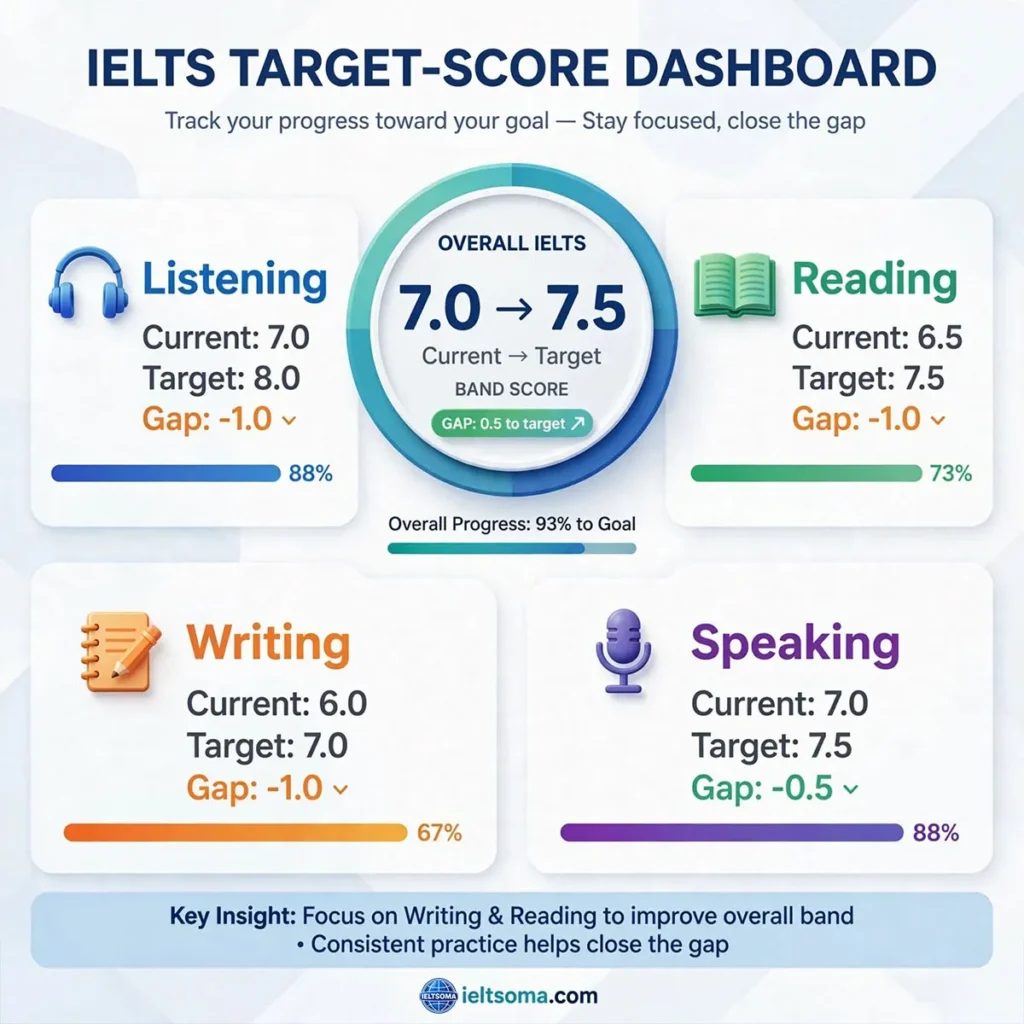
You can create your own IELTS preparation dashboard using this structure:
| Area | Your Goal |
|---|---|
| Required overall band | ______ |
| Required minimum component score | ______ |
| Current overall level | ______ |
| Listening target | ______ |
| Reading target | ______ |
| Writing target | ______ |
| Speaking target | ______ |
| Test date | ______ |
| Biggest weakness | ______ |
| Weekly study time | ______ |
| Weekly practice target | ______ |
| Next progress review | ______ |
Review this information every one or two weeks.
Your goal is not simply to complete the table.
Your goal is to use it to make better study decisions.
Common Goal-Setting Mistakes IELTS Candidates Make
Setting a score without checking requirements
You may prepare for Band 7 when your actual application requires a different combination of scores.
Check the requirements first.
Studying without a baseline
Without an initial assessment, you may spend too much time on skills you already perform well.
Creating unrealistic schedules
A plan that requires five hours every day may look ambitious but fail after a few days.
Focusing only on vocabulary
Vocabulary is useful, but IELTS performance involves much more than knowing individual words.
Ignoring mistakes
Completing practice tests is not enough.
Your mistakes contain information about what needs to change.
Changing strategies every few days
Trying a new technique every day makes it difficult to determine what is actually helping.
Give your strategy enough time to produce evidence.
Measuring only final scores
A score is useful, but also track things such as:
- question types you frequently miss
- recurring grammar errors
- Speaking hesitation
- time-management problems
- spelling mistakes
- weak paragraph development
These smaller indicators can explain why your score is changing—or not changing.
Academic and General Training: Set the Right Goals
Your goal-setting process should also reflect which IELTS test you are taking.
Listening and Speaking are the same for IELTS Academic and IELTS General Training, while Reading and Writing differ.
Therefore, make sure your practice materials match your test.
For example, if you are taking IELTS Academic, your Reading and Writing preparation should reflect Academic tasks.
If you are taking IELTS General Training, use General Training Reading and Writing materials.
Using the wrong materials can make your preparation less relevant even if you are studying consistently.
How to Know When Your IELTS Goals Are Working
A good preparation plan should produce evidence of progress.
Look for several signals:
Your practice scores are improving.
You are making fewer repeated mistakes.
You can complete tasks within the required time.
Your Writing responses are becoming more organised.
Your Speaking answers are becoming easier to develop.
You understand why you got an answer wrong rather than simply memorising the correct answer.
You feel more familiar with the test format.
Official IELTS practice materials are particularly useful because they allow candidates to become familiar with task types and practise under timed conditions.
Your 30-Day IELTS Goal-Setting Challenge
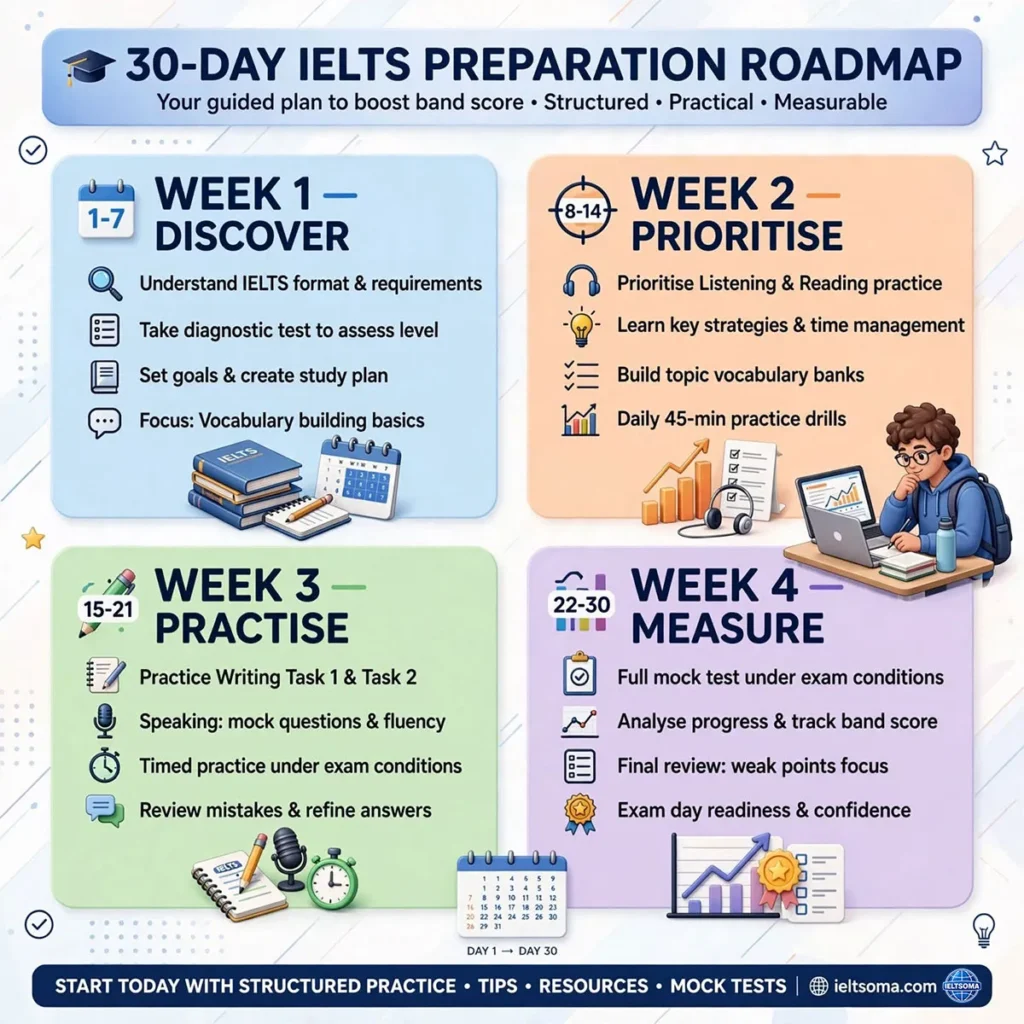
If you are unsure how to begin, use this simple four-week structure.
Week 1: Discover
- Identify your required score.
- Confirm whether you need Academic or General Training.
- Take a baseline practice test.
- Record your four skill scores.
- Identify your three biggest weaknesses.
Week 2: Prioritise
- Choose your two highest-priority skills.
- Identify the question types causing problems.
- Create daily study targets.
- Start an error log.
Week 3: Practise
- Complete targeted practice.
- Write timed responses.
- Record Speaking practice.
- Review mistakes.
- Compare your new results with your baseline.
Week 4: Measure
- Take another timed practice test.
- Compare your results.
- Identify improvements.
- Identify remaining gaps.
- Adjust your next month’s goals.
This creates a continuous preparation cycle instead of a one-time study plan.
Final IELTS Goal-Setting Checklist
Before you begin serious IELTS preparation, make sure you can answer these questions:
- What exact IELTS score do I need?
- Do I need Academic or General Training?
- What are my minimum component requirements?
- What is my current score?
- Which skill is weakest?
- Which question types cause the most problems?
- How many hours can I realistically study each week?
- What will I accomplish this week?
- How will I measure progress?
- When will I take my next practice test?
- What will I change if my score does not improve?
If you can answer these questions, your preparation already has much more direction.
FAQs About Goal Setting for IELTS Preparation
What is the best way to set an IELTS goal?
Start with the score required by your university, employer or other organisation. Then take a baseline practice test, identify the gap between your current and required scores, and divide your preparation into skill-specific and weekly goals.
Should I aim for Band 7 if I need Band 6.5?
You can choose a slightly higher personal target as a safety margin, but your plan should be based on the actual requirement. Avoid setting an unnecessarily high target that creates unrealistic pressure.
How long should I prepare for IELTS?
There is no universal preparation period. It depends on your current English level, target score, previous experience and available study time. British Council guidance similarly notes that preparation needs vary according to current level and target score.
Should I study all four IELTS skills every day?
Not necessarily. A balanced preparation plan should cover all four skills over time, but you can give additional attention to your weakest areas.
How often should I check my IELTS progress?
A full practice test every one or two weeks can be useful during intensive preparation, provided you also review mistakes between tests. Frequent smaller checks can help you identify problems earlier.
Can I improve my IELTS score without studying for several hours every day?
Yes. A realistic, consistent study routine can be more sustainable than occasional long sessions. The British Council recommends breaking preparation into manageable sessions and practising regularly.
What should I do if my IELTS score stops improving?
Do not simply increase the amount of practice. Analyse your errors first. Identify whether the problem is language ability, understanding the question, timing, strategy, accuracy or task performance, then change your preparation accordingly.
Conclusion
Goal setting for IELTS preparation is not about creating a complicated timetable or writing down an ambitious Band 9 target.
It is about knowing exactly where you are, where you need to go and what actions will move you towards that destination.
Start with your required score.
Measure your current performance.
Break the target into four skills.
Turn those skills into weekly and daily goals.
Track your mistakes.
Review your progress.
Then adjust your plan based on evidence.
The strongest IELTS preparation is not necessarily the one with the most study hours. It is the one where every study session has a clear purpose.
With a realistic target and a measurable plan, your IELTS preparation becomes easier to manage—and every practice session becomes a step towards the score you need.
Further Useful Links: