Most IELTS Listening mistakes do not happen because you cannot hear English.
They happen because you are listening passively.
You hear the words, but you do not predict what is coming next. You notice a familiar word, but miss the speaker’s correction. You understand the general topic, yet lose the exact answer because your attention drifts for a few seconds.
This is where active listening for IELTS can make a significant difference.
Active listening means deliberately paying attention to meaning, structure, key details, speaker changes, paraphrases and signals that tell you important information is coming. Instead of simply hearing English, you interact with what you hear.
That skill is particularly valuable in IELTS because the Listening test contains 40 questions across four parts, and each recording is played only once. The Listening test is the same for IELTS Academic and IELTS General Training.
This guide explains how to use active listening for IELTS, how to practise it effectively, the mistakes to avoid and how to turn everyday listening into targeted IELTS preparation.
Table of Contents
What Is Active Listening for IELTS?
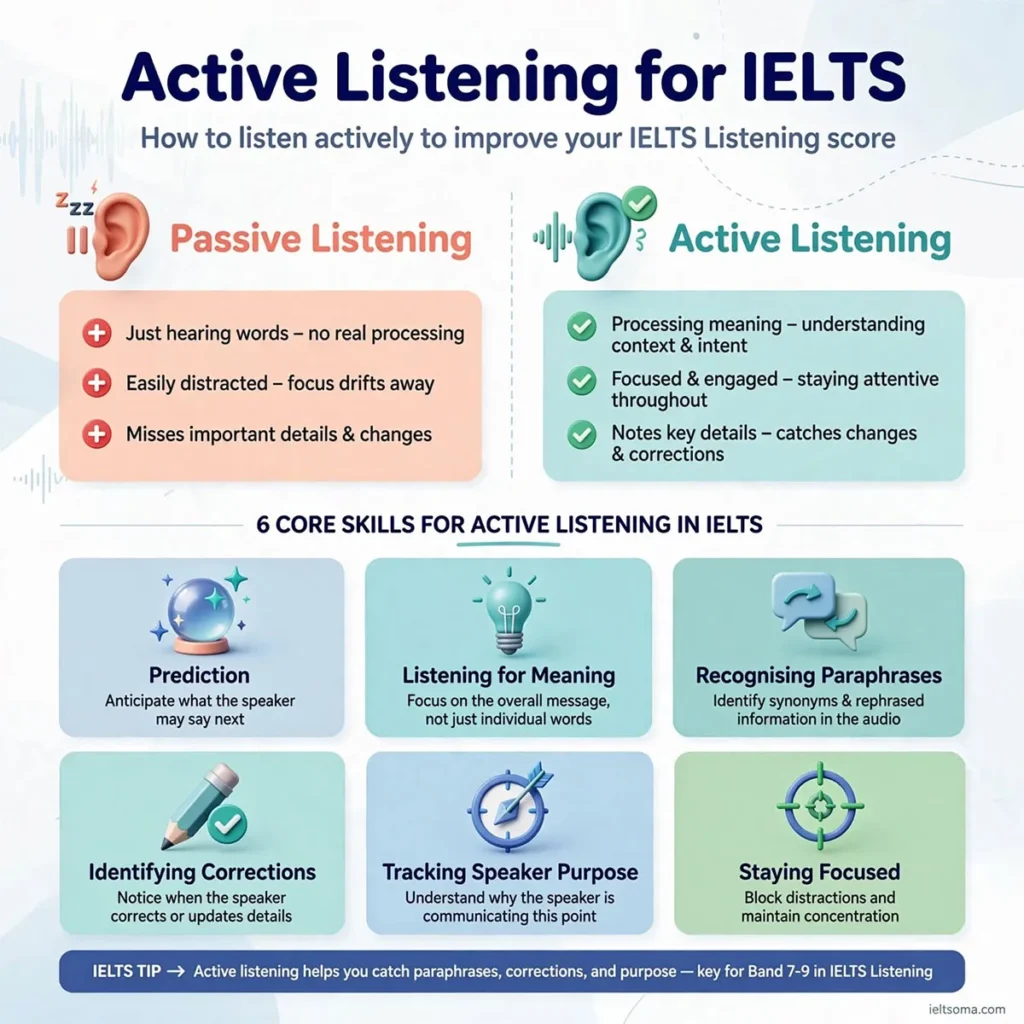
Active listening for IELTS is the deliberate process of listening with a specific purpose rather than simply hearing spoken English.
A passive listener may hear:
“The meeting was originally scheduled for Monday, but because the manager is unavailable, it has been moved to Wednesday.”
An active listener immediately notices:
- the original information: Monday
- the change: “but”
- the reason: the manager is unavailable
- the final information: Wednesday
If the question asks for the meeting day, an active listener knows that Wednesday is the important answer.
The difference is not simply vocabulary.
It is attention.
Active listening involves asking yourself questions while listening:
- What information am I looking for?
- What is the speaker’s main point?
- Has the speaker changed or corrected something?
- Is this information an example or the actual answer?
- What words indicate an important detail?
- How is the speaker connecting one idea to another?
This makes your listening more purposeful.
Why Active Listening Matters in the IELTS Listening Test
The IELTS Listening test is designed to assess your ability to understand spoken English in different situations.
The test has four parts with 10 questions in each. Parts 1 and 2 involve everyday social situations, while Parts 3 and 4 involve educational or training contexts. You may encounter conversations, discussions, monologues and academic-style talks. Different accents can also be used.
Because the recording is played once, you cannot rely on repeated listening to recover information.
Active listening helps you deal with this pressure.
For example, suppose you hear:
“The library will remain open until 9 p.m. during the examination period. Normally, however, it closes at 7.”
A passive listener may remember “7 p.m.”
An active listener notices the contrast between the normal schedule and the temporary change.
The answer is 9 p.m.
This type of attention is essential because IELTS Listening often requires you to understand how information develops rather than simply recognise individual words.
Active Listening vs Passive Listening
Understanding the difference can transform your practice.
| Passive listening | Active listening |
|---|---|
| Hearing words without a purpose | Listening for specific information |
| Trying to understand every word | Prioritising relevant information |
| Waiting for familiar vocabulary | Predicting what information may come next |
| Focusing only on exact words | Recognising paraphrases and synonyms |
| Ignoring speaker changes | Tracking who is saying what |
| Continuing after losing concentration | Deliberately bringing attention back |
| Checking only the final score | Analysing why answers were missed |
Passive listening still has value for general exposure to English.
However, if your goal is to improve your IELTS Listening performance, your practice should regularly include active listening tasks.
9 Active Listening Techniques for IELTS
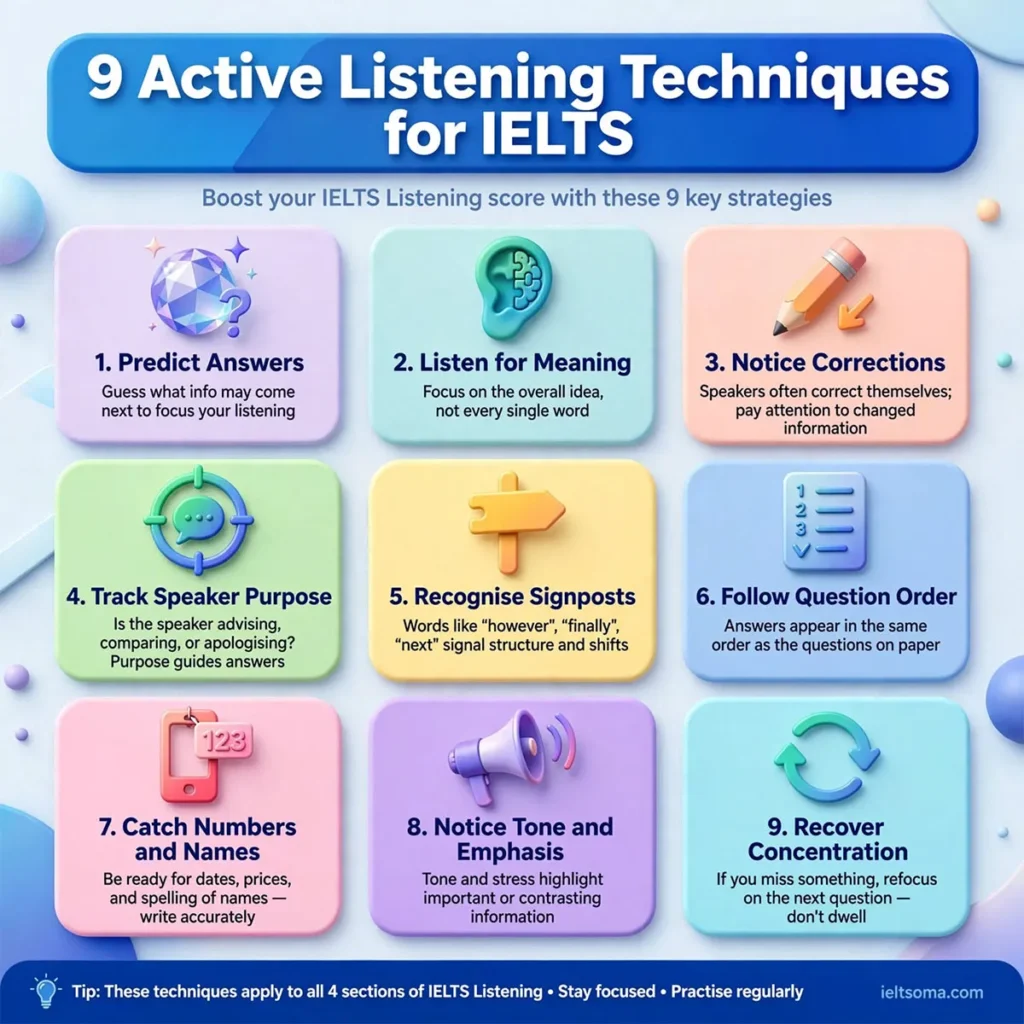
1. Predict the Answer Before Listening
Prediction is one of the most useful active listening techniques.
Before the recording reaches a question, examine the wording and ask what type of information you need.
For example:
The course begins on ______.
You can predict that the answer is probably a day or date.
Or:
The building contains ______ classrooms.
You can expect a number.
Or:
Students are advised to bring ______.
You might expect a noun or noun phrase.
Prediction does not mean guessing the exact answer.
It means preparing your brain to recognise the relevant information when it appears.
This reduces the amount of information you need to process.
2. Listen for Meaning, Not Just Keywords
IELTS Listening questions frequently require you to recognise information that has been paraphrased.
The question might use:
“a substantial increase”
while the recording says:
“sales rose considerably.”
The words are different, but the meaning is similar.
If you listen only for the exact vocabulary in the question, you may miss the answer.
Active listening means asking:
“What idea is the speaker communicating?”
rather than:
“Did I hear the exact word from the question?”
Build this skill by regularly writing down a sentence you hear and then explaining its meaning using different words.
3. Watch for Corrections and Changes
Speakers do not always give information in a straightforward way.
They may provide one detail and then correct it.
Listen carefully for signals such as:
- but
- however
- actually
- although
- instead
- rather
- I mean
- sorry
- no, that’s not right
- we’ve changed it to
- I should correct that
Consider this example:
“The workshop was originally planned for Thursday. Actually, I’ve just received confirmation that the room isn’t available then, so it will take place on Friday.”
If the question asks when the workshop will take place, Thursday is a distractor.
Friday is the final decision.
Active listening means recognising the relationship between the pieces of information, not simply recording the first answer you hear.
4. Track the Speaker’s Purpose
Do not listen to every sentence as though it has equal importance.
Ask yourself why the speaker is saying something.
Is the speaker:
- giving an example?
- making a comparison?
- explaining a problem?
- giving a reason?
- introducing a solution?
- changing a decision?
- describing a process?
- giving a recommendation?
- summarising a point?
Imagine a university lecturer says:
“There are several possible explanations for the decline. For example, changes in consumer behaviour may have contributed to it. However, our research suggests that pricing was the more significant factor.”
The example about consumer behaviour is useful, but the speaker then signals a more important conclusion.
Active listening helps you distinguish supporting information from the main point.
5. Listen for Signpost Words
Speakers often use language that signals what is coming next.
Common signposts include:
Adding information
- also
- in addition
- furthermore
- another point is
Contrasting
- however
- whereas
- on the other hand
- although
Giving examples
- for example
- for instance
- such as
Showing cause
- because
- due to
- as a result of
Showing conclusions
- therefore
- consequently
- overall
- in summary
When you hear these expressions, adjust your attention.
For example:
“There are two main advantages. First… Secondly…”
You should expect two important points.
Similarly:
“The main problem, however, is…”
The information following “however” deserves particular attention.
6. Follow the Questions, Not Every Detail
Official IELTS guidance states that the questions follow the order of information in the recording.
This gives you an important advantage.
You do not need to remember the entire recording.
Instead, move through the questions and concentrate on the information relevant to the current section.
Suppose you are answering Questions 12–15.
Once you have identified the answer to Question 12, shift your attention towards Question 13.
Do not continue thinking about Question 12.
If you miss an answer, make your best decision where appropriate and move forward.
One missed question should not become three missed questions because you were still thinking about it.
7. Listen for Numbers, Names and Spelling Carefully
Some answers are lost not because of comprehension problems but because candidates fail to process small details accurately.
Pay particular attention to:
- names
- addresses
- telephone numbers
- prices
- dates
- times
- measurements
- locations
- singular and plural forms
For example:
“The appointment is on the 15th — sorry, I mean the 16th.”
An active listener notices the correction.
Similarly:
“The fee is £60, but students receive a £15 discount.”
If the question asks for the amount students pay, £60 is not necessarily the final answer.
Active listening requires you to interpret the information rather than automatically write down the first number you hear.
8. Notice Tone and Emphasis
Meaning is not always communicated through vocabulary alone.
A speaker’s tone can help indicate:
- surprise
- disagreement
- uncertainty
- enthusiasm
- correction
- importance
- contrast
For example:
“The plan sounds reasonable, but I’m not entirely convinced.”
The phrase “not entirely convinced” changes the meaning of the response.
The speaker is not giving wholehearted approval.
You do not need to analyse every emotional nuance in the IELTS Listening test, but noticing emphasis and changes in tone can help you understand the speaker’s intention.
This is particularly useful in discussions and multiple-choice questions.
9. Bring Your Attention Back When It Wanders
Even strong listeners lose concentration.
The problem is not necessarily that your mind wanders.
The bigger problem is failing to recover quickly.
Imagine you lose concentration for five seconds and miss one sentence.
Do not mentally replay what you missed.
Instead:
- Look at the next question.
- Identify what information you now need.
- Listen for the next relevant detail.
- Continue following the recording.
Think of your attention as a moving target.
The recording will not stop because you were distracted.
Your job is to reconnect with it as quickly as possible.
How to Practise Active Listening for IELTS
You do not need to complete a full IELTS Listening test every day.
In fact, repeated full tests without analysis can become inefficient.
Instead, use shorter active listening exercises.
Exercise 1: Listen and Predict
Choose a short English recording.
Before listening to each section, write down three things you expect to hear.
For example:
- a number
- a reason
- a recommendation
Then listen and check whether your predictions were correct.
This trains your brain to listen with a purpose.
Exercise 2: Listen for Paraphrases
Take a short transcript.
Highlight important phrases.
Then listen to the recording and write down different expressions that communicate the same meaning.
For example:
Question:
The accommodation is close to the university.
Recording:
The halls are only a few minutes’ walk from campus.
The vocabulary differs, but the meaning is connected.
Exercise 3: Identify Distractors
Listen to short conversations and deliberately look for corrections.
Write down:
| First information | Correction | Final information |
|---|---|---|
| Tuesday | “Actually…” | Thursday |
| £80 | “With the discount…” | £65 |
| Room 14 | “Sorry, I meant…” | Room 40 |
This exercise teaches you not to accept the first piece of information automatically.
Exercise 4: Summarise After Listening
Listen to a one- or two-minute recording.
Do not write down everything.
After listening, answer three questions:
- What was the main point?
- What were the two most important details?
- What conclusion or decision did the speaker reach?
This develops your ability to distinguish main ideas from supporting information.
Exercise 5: Shadow Short Sections
Choose a short section of natural English.
Listen to one sentence and repeat it immediately.
Try to copy:
- pronunciation
- rhythm
- stress
- pauses
- connected speech
Shadowing can make you more familiar with the way natural English sounds, which can make future listening easier.
However, the goal is not to imitate an accent.
The goal is to become more comfortable processing naturally spoken English.
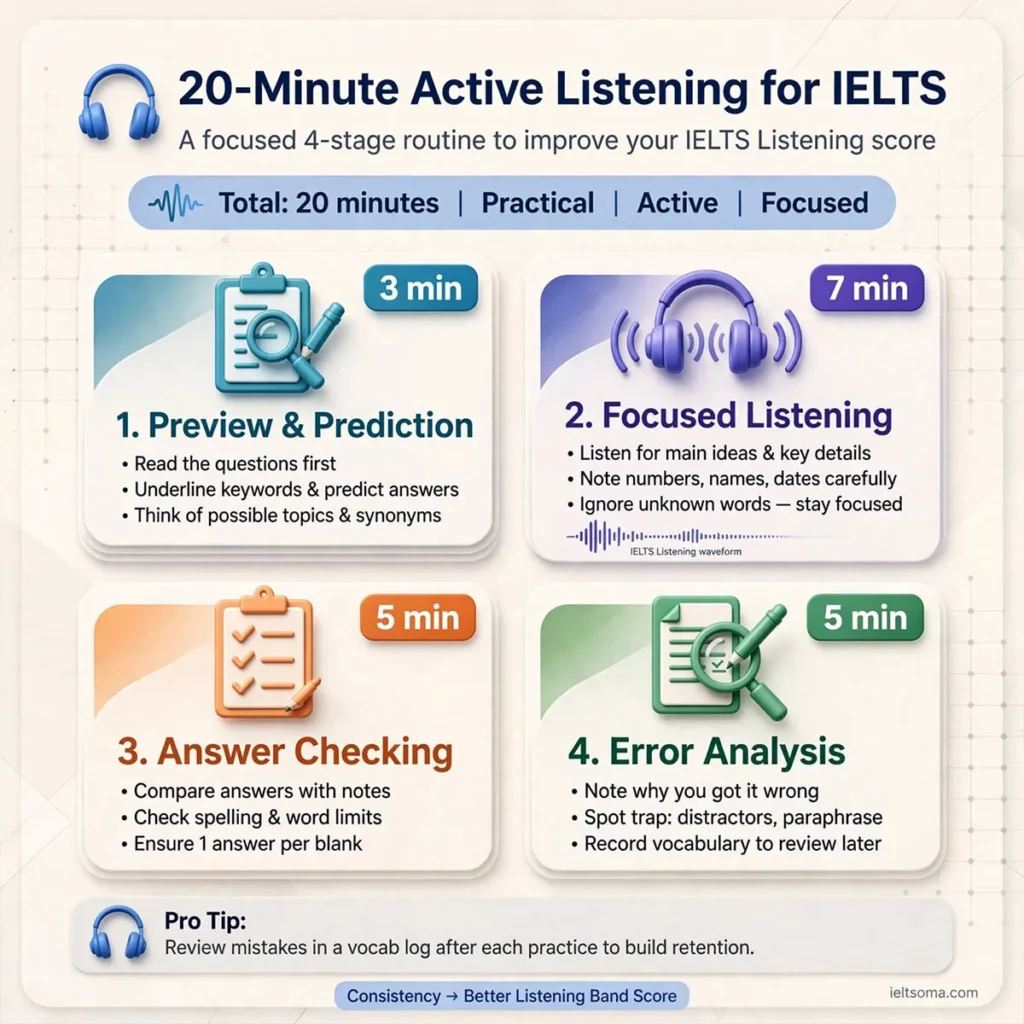
A 20-Minute Active Listening for IELTS Routine
If you have limited preparation time, use this routine.
Minutes 1–3: Preview
Read the questions.
Underline key information.
Predict the answer type.
Minutes 4–10: Listen
Complete a short IELTS Listening task.
Stay focused on meaning and question progression.
Minutes 11–15: Check
Compare your answers with the correct answers.
Do not stop at your score.
Minutes 16–20: Analyse
For every incorrect answer, ask:
- Did I misunderstand the vocabulary?
- Did I miss a paraphrase?
- Did I fall for a distractor?
- Did I lose concentration?
- Did I mishear a number?
- Did I ignore a correction?
- Did I make a spelling error?
- Did I misunderstand the question?
This final stage is where much of the improvement happens.
Common Active Listening Mistakes
Trying to Understand Every Word
You do not need to understand every word to answer the questions.
Focus on the information relevant to the task.
Writing the First Answer You Hear
The speaker may correct or change information.
Always listen to the complete idea.
Ignoring Paraphrases
The question and recording may express the same idea using different vocabulary.
Train yourself to recognise meaning, not just identical words.
Becoming Obsessed With One Missed Answer
A missed answer cannot be recovered by stopping the recording mentally.
Move forward.
Practising Only With IELTS Tests
Full tests are important, but they should not be your only listening activity.
Short, focused exercises can target specific weaknesses much more effectively.
Listening Without Analysing Errors
A score tells you what happened.
It does not necessarily tell you why it happened.
Your error analysis should identify the specific listening skill that needs improvement.
Active Listening Strategies for Different IELTS Question Types
Different question formats require different kinds of attention.
| Question type | Active listening focus |
|---|---|
| Multiple choice | Meaning, paraphrases and distractors |
| Matching | Speaker details and relationships |
| Form completion | Names, numbers and factual information |
| Note completion | Main ideas and supporting details |
| Table completion | Information within categories |
| Flow-chart completion | Sequence and process language |
| Sentence completion | Meaning, grammar and key details |
| Map or plan labelling | Directions and spatial relationships |
| Short-answer questions | Specific facts and word limits |
The official IELTS format includes these major question types, although the exact combination varies.
How Active Listening Can Improve Your IELTS Band Score
Active listening is not a shortcut to a particular band score.
Your Listening result depends on the number of questions you answer correctly. IELTS states that there are 40 questions, with one mark for each correct answer, and the raw score is converted to the IELTS nine-band scale.
IELTS gives approximately 30 correct answers out of 40 as the average mark associated with Band 7, although the precise conversion can vary slightly between test versions.
Active listening can help because it targets several skills that influence accuracy:
- concentration
- prediction
- paraphrase recognition
- distractor recognition
- understanding speaker intention
- identifying important details
- following information in sequence
The aim is not simply to “listen harder”.
It is to listen more intelligently.
A Better Weekly Active Listening Plan
Try this seven-day cycle if you want to make active listening part of your IELTS preparation.
Day 1: Prediction practice
Day 2: Synonyms and paraphrases
Day 3: Distractors and corrections
Day 4: Numbers, dates, names and spelling
Day 5: Speaker purpose and signposting
Day 6: Complete a full IELTS Listening test
Day 7: Analyse your errors and repeat your weakest exercise
Keep a record of recurring problems.
For example:
| Problem | Frequency | Next action |
|---|---|---|
| Missed paraphrases | 6 | Practise synonym recognition |
| Distractors | 4 | Listen for corrections |
| Numbers | 3 | Complete number drills |
| Lost concentration | 5 | Use shorter focused exercises |
| Spelling | 2 | Build a spelling review list |
This turns preparation into a feedback system.
Instead of saying, “My Listening is weak,” you can identify exactly which listening behaviour is causing lost marks.
Frequently Asked Questions About Active Listening for IELTS
What is active listening for IELTS?
Active listening for IELTS means listening deliberately for meaning, key information, paraphrases, speaker changes, corrections, signposts and other clues that help you answer questions accurately.
Is active listening useful for both IELTS Academic and General Training?
Yes. The IELTS Listening test is the same for Academic and General Training candidates. The two test versions differ in Reading and Writing, not Listening.
Should I try to understand every word in IELTS Listening?
No. Trying to understand every word can overload your attention. Focus on the information required by the questions and listen for meaning, relationships and important details.
How can I improve my IELTS Listening concentration?
Use short, focused exercises, preview questions before listening, predict answer types and practise recovering quickly when your attention wanders.
How do I avoid IELTS Listening distractors?
Listen for changes, corrections and contrast signals such as “but”, “however”, “actually” and “instead”. Do not assume the first information you hear is automatically the answer.
Can active listening improve my IELTS Listening score?
It can help improve the listening behaviours that contribute to accurate answers, particularly concentration, paraphrase recognition, prediction and distractor recognition. However, improvement also depends on vocabulary, pronunciation awareness, familiarity with question types and regular practice.
How long should I practise active listening each day?
A focused 15–20 minute session can be useful when combined with regular IELTS practice. Quality matters more than simply listening for a large number of minutes.
Should I use podcasts and videos for active listening?
Yes. Natural English from podcasts, interviews, lectures and educational videos can provide useful listening practice. However, combine general listening with authentic IELTS practice so that you also develop familiarity with the test format.
Final Takeaway
Active listening for IELTS is about turning listening from a passive activity into a deliberate skill.
Do not simply hear the recording.
Predict what you need.
Listen for meaning.
Recognise paraphrases.
Watch for corrections.
Notice signpost words.
Track the speaker’s purpose.
Follow the questions.
Recover quickly when your concentration slips.
Most importantly, analyse your mistakes.
If you repeatedly miss answers because you accept the first detail you hear, practise corrections and distractors.
If you miss answers because you cannot recognise paraphrases, work on meaning and synonyms.
If you lose your place after one difficult question, practise moving forward immediately.
The strongest IELTS Listening preparation is not about completing the greatest number of practice tests.
It is about understanding why you lose marks and deliberately training the skill behind each mistake.
That is what makes active listening for IELTS a valuable part of a serious preparation plan.
Further Reading: