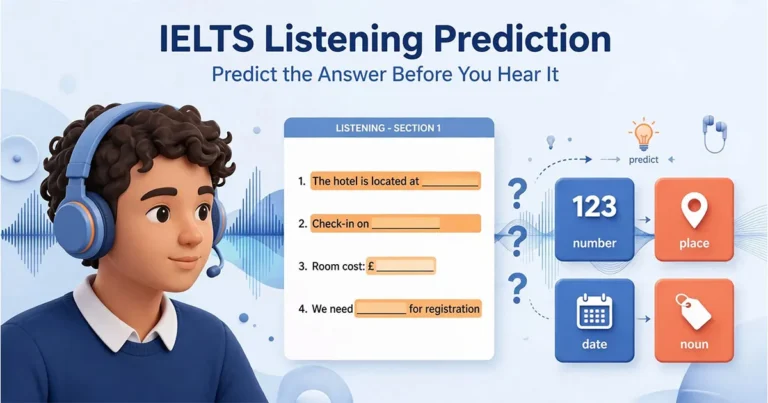
Good note-taking can make the difference between following an IELTS Listening recording confidently and losing several answers because you cannot keep up.
The key is not to write everything you hear.
In fact, trying to record every word can make your Listening performance worse. The recording continues whether you are writing or not, so effective Note-Taking for IELTS Listening means capturing only the information that helps you identify, confirm and remember answers.
This is particularly useful when a speaker gives several details, changes information, compares options or explains a process. A few well-chosen notes can help you stay oriented while your attention remains on the recording.
The IELTS Listening test contains four parts and 40 questions. Each recording is played once, and the questions generally follow the order of information in the recording. The Listening test is the same for IELTS Academic and IELTS General Training.
So how should you take notes without falling behind?
The answer is to develop a fast, selective system.
Table of Contents
What Is Note-Taking for IELTS Listening?
Note-Taking for IELTS Listening is the process of quickly recording important information while listening to an IELTS recording without trying to write down complete sentences.
Good notes usually contain:
- Keywords
- Names
- Numbers
- Dates
- Places
- Changes or corrections
- Comparisons
- Reasons and results
- Important examples
- Short abbreviations
- Information that helps you remember the speaker’s main point
Your notes are not the final answer sheet.
They are temporary reminders that help you process information while listening.
For example, if you hear:
“The original meeting was scheduled for Tuesday, but because the manager is unavailable, it has been moved to Thursday.”
You do not need to write:
The original meeting was scheduled for Tuesday, but because the manager is unavailable, it has been moved to Thursday.
A much faster note might be:
meeting → Tue → manager unavailable → Thu
The note captures the important change without wasting valuable listening time.
Why Note-Taking Matters in IELTS Listening
The IELTS Listening test requires you to process spoken information quickly.
You may hear a name, number, date or location and then immediately hear additional information that changes its meaning.
For example:
“The course will begin on 12 September. Actually, I should correct that — the start date is now 19 September.”
If you write only 12 September, you may choose the wrong answer.
If your notes show:
course → 12 Sep → correction → 19 Sep
you have a visual reminder that the first piece of information was changed.
Official IELTS guidance also recommends making notes as you listen because you cannot replay the recording.
The important point is that note-taking should support listening, not replace it.
9 Note-Taking for IELTS Listening Tips
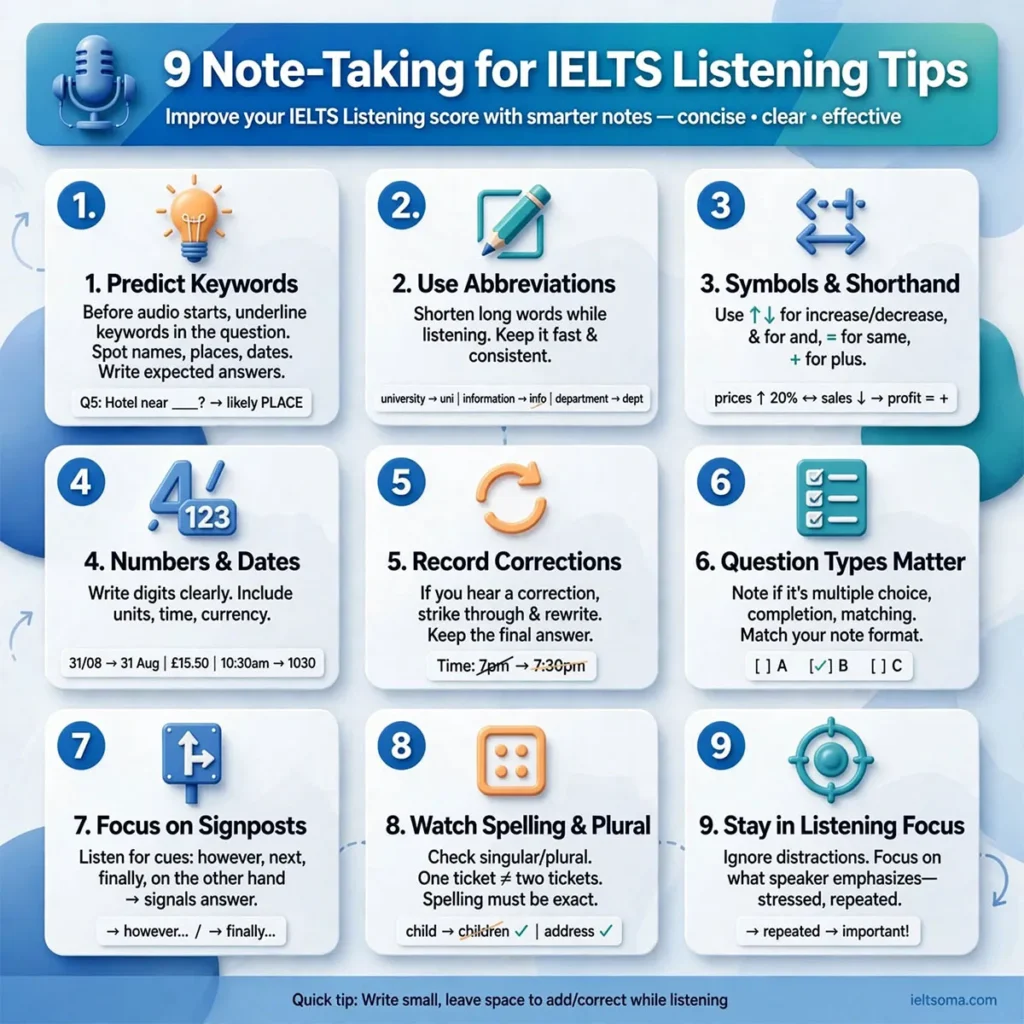
1. Write Keywords, Not Complete Sentences
The first rule of effective note-taking is simple:
Write less. Listen more.
Do not attempt to reproduce the speaker’s sentences.
Suppose you hear:
“The university introduced the new transport service because many students were having difficulty travelling to campus in the morning.”
Your notes could be:
new transport → students → morning travel problem
That is enough to remind you of the idea.
Useful keywords are usually nouns, verbs, numbers and important adjectives.
For example:
| Full information | Useful note |
|---|---|
| The library closes at 8 p.m. | library → 8pm |
| The course lasts six weeks. | course → 6 wks |
| The price has increased by £20. | price → +£20 |
| Students must register online. | students → register online |
| The lecture was moved to Room 14. | lecture → R14 |
The goal is not beautiful handwriting.
The goal is useful information recorded quickly.
2. Develop Your Own Abbreviations
Abbreviations can save valuable seconds.
You do not need to use a complicated shorthand system. Build a small collection that feels natural to you.
For example:
- b/c = because
- w/ = with
- w/o = without
- gov = government
- uni = university
- info = information
- dept = department
- appt = appointment
- approx = approximately
- ↑ = increase
- ↓ = decrease
- → = leads to / becomes
- + = additional / increase
- – = reduction / decrease
- ? = uncertainty or something to check
You can also shorten familiar words.
environmental protection might become:
env. protect.
The abbreviation only needs to make sense to you.
Do not spend weeks learning elaborate shorthand. IELTS Listening is an English test, not a shorthand examination.
3. Use Symbols for Changes and Relationships
Symbols are particularly useful when speakers compare information or change their decisions.
Consider:
“The exhibition was originally going to be held in the main hall, but it has now been moved to the conference centre.”
You could write:
exhibition → main hall → but → conference centre
The arrow helps you see the movement from the original plan to the final decision.
Useful symbols include:
→ change, sequence or result
↔ comparison or relationship
↑ increase
↓ decrease
≠ difference
= same/equivalent
+ addition
− reduction
? something to verify
These symbols are especially helpful in longer recordings where several ideas are connected.
4. Record Numbers, Dates and Names Carefully
Some information is too important to abbreviate casually.
Numbers, dates, prices, room numbers, telephone numbers and names can directly answer Listening questions.
For example:
“The membership fee is £75 for the first year, although students only pay £50.”
Your notes should make the contrast obvious:
membership → £75 / students → £50
Similarly:
“The workshop was originally planned for 15 June, but it has been postponed until 25 June.”
Write:
workshop → 15 Jun → postponed → 25 Jun
Do not rely on memory when the information can be recorded in one or two seconds.
5. Listen for Corrections
One of the most important parts of Note-Taking for IELTS Listening is recording changes.
IELTS speakers may mention an initial piece of information and then correct it.
Listen carefully for expressions such as:
- Actually
- But
- However
- Sorry
- I mean
- No, that’s not right
- Instead
- Rather
- Originally
- We’ve changed it
- We’ve decided to
- It’s now
For example:
“The seminar will take place in Room 6. Sorry, I mean Room 16.”
A weak note might be:
seminar → R6
A better note is:
seminar → R6 → correction → R16
The second version makes the final answer much easier to identify.
This is one reason you should not automatically write down the first number, name or place you hear.
6. Use Notes to Track the Structure of the Recording
Notes can also help you understand where you are in the recording.
For example:
Problem → Cause → Solution → Result
If a speaker explains a process, your notes might look like:
Step 1 → materials
Step 2 → preparation
Step 3 → testing
Step 4 → final product
This can be especially useful in Part 4, where you may hear a longer academic monologue.
You do not need to record every supporting detail.
Instead, create a simple structure and add only information that helps you answer the questions.
IELTS Listening questions commonly include form, note, table, flow-chart and sentence completion tasks, as well as multiple choice, matching and map or diagram labelling.
Your note-taking style should therefore change depending on the task.
7. Match Your Note-Taking to the Question Type
Different IELTS Listening question types require different kinds of attention.
Form or Note Completion
Focus on:
- Names
- Addresses
- Dates
- Numbers
- Places
- Specific facts
Example:
Name → address → phone → appointment
Table Completion
Organise information by category.
For example:
| Course | Duration | Fee |
|---|---|---|
| A | 6 wks | £120 |
| B | 8 wks | £150 |
You do not need to write every sentence around the information.
Multiple Choice
Do not write everything.
Instead, note differences between options.
For example:
A = morning
B = afternoon
C = evening
Then listen for evidence that confirms or eliminates each choice.
Map or Plan Labelling
Use very short directional notes:
entrance → left → stairs → second door
Focus on location words such as:
- opposite
- beside
- behind
- next to
- across from
- at the end of
- on the left
- on the right
Flow-Chart Questions
Use arrows.
research → testing → analysis → report
The visual structure can help you maintain the sequence while listening.
8. Do Not Let Note-Taking Cause You to Miss the Next Answer
This is one of the biggest dangers.
You hear an important detail.
You start writing.
You are still writing when the speaker gives the next answer.
Now you have one note — but you have missed another question.
The solution is to keep your notes extremely short.
Suppose the speaker says:
“The conference centre is located near the railway station and is approximately five minutes from the city library.”
You do not need to write:
The conference centre is located near the railway station and is approximately five minutes from the city library.
Instead:
centre → near station → 5 min → library
Done.
Then immediately return your attention to the recording.
A useful rule is:
Hear → identify → note → look/listen ahead.
Do not remain focused on your notebook.
9. Practise Note-Taking Before You Need It in the Test
Note-taking is a skill.
It becomes much easier when you practise it deliberately.
Choose a short English audio recording and listen once.
During the recording, write only keywords.
Then stop the audio and try to reconstruct the main information from your notes.
Ask yourself:
- Did my notes make sense?
- Did I capture the important points?
- Did I waste time writing complete sentences?
- Did I record changes?
- Did I miss information because I was writing?
- Could I make the notes shorter?
Then repeat the exercise.
Your objective is to make your notes shorter and more useful, not longer.
A Simple Note-Taking System for IELTS Listening
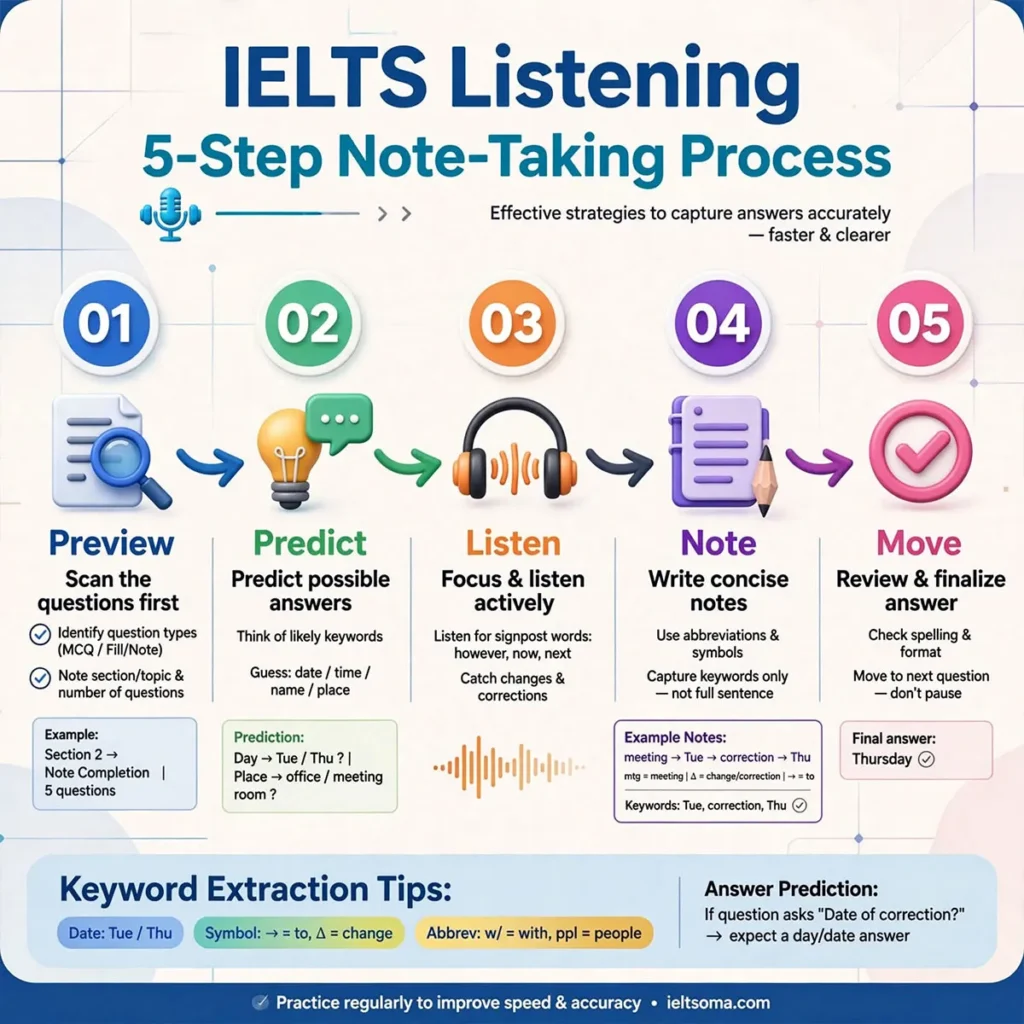
You can use the following five-step system during practice.
Step 1: Preview
Read the questions before the recording begins.
Underline or mentally identify the most important keywords.
Official British Council preparation advice also recommends identifying key words and thinking about the type of answer you need.
Step 2: Predict
Ask:
What am I likely to hear?
For example:
The appointment is on ______.
Possible answer:
day/date
The course costs ______.
Possible answer:
price
The speaker recommends ______.
Possible answer:
noun or noun phrase
Prediction gives your listening a target.
Step 3: Listen
Follow the recording rather than trying to understand every word.
Listen for:
- Meaning
- Paraphrases
- Signpost words
- Corrections
- Numbers
- Names
- Changes
- Answers to the current question
Step 4: Note
Record only the information that matters.
Use:
keywords + abbreviations + symbols
Step 5: Move Forward
Once you have captured the relevant information, stop writing and continue listening.
Never sacrifice several future answers because you are trying to perfect one note.
What Should You Write Down in IELTS Listening?
A useful rule is to write information that is either:
- Directly related to a question, or
- Important for understanding a change, comparison or sequence.
You may want to note:
- Names
- Places
- Dates
- Times
- Prices
- Numbers
- Main ideas
- Corrections
- Alternatives
- Causes
- Results
- Processes
- Directions
- Key comparisons
You usually do not need to write:
- Complete sentences
- Repeated information
- Examples that are irrelevant to the questions
- Filler words
- Every adjective
- Every unfamiliar word
- Information you can easily remember
The official IELTS format includes tasks that require candidates to identify important information from recordings, including note, form, table and flow-chart completion.
Common Note-Taking Mistakes in IELTS Listening
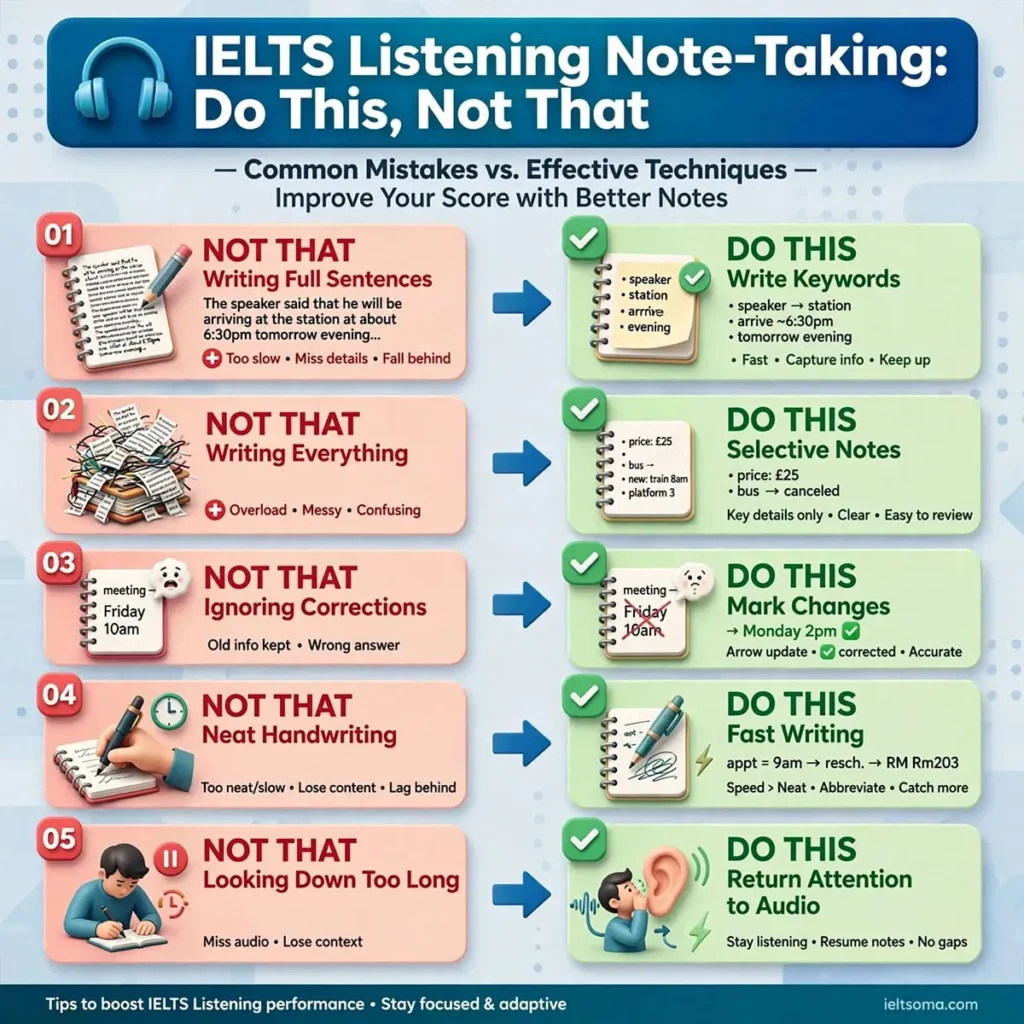
Writing Too Much
This is the most obvious problem.
If your notes look like a transcript, you are probably writing too much.
Using Abbreviations You Cannot Understand
An abbreviation is useful only if you can recognise it immediately.
Do not create complicated symbols that make you think twice.
Ignoring Corrections
Writing the first answer you hear can be dangerous.
Always stay alert when the speaker changes information.
Looking Down for Too Long
Your notebook should support your listening.
It should not become the centre of your attention.
Trying to Make Notes Neat
IELTS does not award marks for beautiful notes.
Fast and understandable is better than neat and slow.
Writing Every Unfamiliar Word
You are not required to understand every word.
If an unfamiliar word does not affect the question, keep listening.
Forgetting the Question
Your notes should support the question you are answering.
Do not become so focused on the recording that you forget what information you actually need.
Note-Taking for IELTS Listening: A Practical Example
Imagine the recording says:
“The photography course was originally scheduled to begin on 4 October and cost £180. However, because of the renovation work, the start date has been moved to 11 October. The student fee is also lower, at £150.”
You could write:
photo course
4 Oct → 11 Oct
£180 → £150 student
This is much faster than writing complete sentences.
If the questions ask for the final start date and student fee, your notes give you both answers immediately.
Notice what happened:
- You recorded the original information.
- You marked the correction.
- You recorded the final information.
- You captured the price change.
- You avoided unnecessary words.
That is effective note-taking.
How to Improve Note-Taking Speed
If you are too slow, do not simply force yourself to write faster.
Improve the system instead.
Use fewer words
Change:
The price has increased from £50 to £70
to:
£50 → £70
Use symbols
Change:
The number of students decreased
to:
students ↓
Remove unnecessary grammar
Change:
Students must register before Friday
to:
students → register → Fri
Practise with short recordings
Start with 30–60 seconds.
Then increase the length.
Review your notes
After listening, check whether another person could understand your notes.
If not, simplify your system.
A 7-Day Note-Taking Practice Plan
Day 1: Keywords
Listen to a short recording and write only nouns and verbs.
Day 2: Numbers
Practise dates, prices, times, percentages and telephone numbers.
Day 3: Abbreviations
Create and practise your own 10–15 useful abbreviations.
Day 4: Corrections
Listen for changes such as:
original → correction → final
Day 5: Question Types
Practise note-taking with forms, tables, multiple choice and flow charts.
Day 6: Full Listening Test
Complete a full IELTS Listening test under realistic conditions.
Day 7: Error Analysis
Review your mistakes and ask whether poor note-taking contributed to them.
Do not just record your score.
Record the specific problem.
For example:
| Problem | Frequency | Solution |
|---|---|---|
| Writing too much | 4 | Use keywords |
| Missing corrections | 3 | Mark changes |
| Slow numbers | 2 | Number drills |
| Losing next answer | 3 | Stop writing sooner |
| Weak abbreviations | 2 | Build shorthand |
This turns your practice into a personalised improvement plan.
Note-Taking for IELTS Listening: Final Checklist
Before your next practice test, remember:
- Read the questions before listening.
- Predict the type of answer required.
- Write keywords, not sentences.
- Use simple abbreviations.
- Use arrows and symbols.
- Record important numbers and dates.
- Watch for corrections.
- Track comparisons and changes.
- Adapt your notes to the question type.
- Do not write so much that you miss the next answer.
- Do not worry about neat handwriting.
- Keep listening while taking notes.
- Review your mistakes after every practice test.
- Practise until your note-taking becomes automatic.
Frequently Asked Questions
Is note-taking important in IELTS Listening?
Yes. Effective note-taking can help you remember important information, track changes and organise details while the recording continues. However, you should not try to write everything you hear.
Should I write everything in IELTS Listening?
No. Writing everything is likely to make you fall behind. Focus on keywords, numbers, names, dates, places, corrections, comparisons and information directly related to the questions.
What should I write down during IELTS Listening?
Write information that helps you answer or remember a question. This can include names, dates, numbers, prices, locations, key ideas, changes, causes, results and process steps.
Can I use abbreviations in IELTS Listening?
Yes. During preparation, developing simple abbreviations can help you write faster. Use abbreviations that you can recognise immediately and avoid complicated shorthand that slows you down.
How can I take notes faster in IELTS Listening?
Use keywords, abbreviations and symbols instead of complete sentences. Practise recording only the essential information and gradually increase the speed and length of your listening exercises.
Should I take notes for every IELTS Listening question?
Not necessarily. Some questions may require very little additional note-taking because the information can be entered directly as the answer. Your notes should support your listening rather than become a separate task.
What should I do if I miss an answer while taking notes?
Do not stop listening. Make a quick decision if possible and move immediately to the next question. Spending too long trying to recover one missed answer can cause you to miss additional questions.
Is the Listening test the same for Academic and General Training?
Yes. The IELTS Listening test is the same for Academic and General Training. The main differences between the two versions are in Reading and Writing.
Final Takeaway
Effective Note-Taking for IELTS Listening is not about writing more.
It is about writing the right information quickly.
Use keywords instead of sentences. Build simple abbreviations. Record numbers and names carefully. Use arrows to show changes and sequences. Watch for corrections and never allow your notes to distract you from the recording.
Most importantly, remember that your notes are a tool — not the objective.
The objective is to listen, identify the information the question requires and record the correct answer.
Once your note-taking becomes faster and more selective, you can devote more attention to the recording itself. That combination of focused listening and efficient note-taking can make your IELTS preparation considerably more productive.
Further Reading: