Good grammar can make your IELTS answer clearer, more precise and easier to understand. But getting a higher IELTS score does not mean filling every sentence with complicated structures.
The real goal is accurate, appropriate and varied grammar.
This is particularly important because Grammar Rules for IELTS are directly connected to the IELTS assessment criterion called Grammatical Range and Accuracy. In Writing, examiners consider the range and appropriacy of structures you use, the accuracy of your sentences, the effect of grammatical errors and your punctuation. In Speaking, they assess how accurately and appropriately you use a range of grammatical structures.
That means learning grammar for IELTS is not simply about memorising rules. You need to know which structures to use, when to use them and how to use them accurately under test conditions.
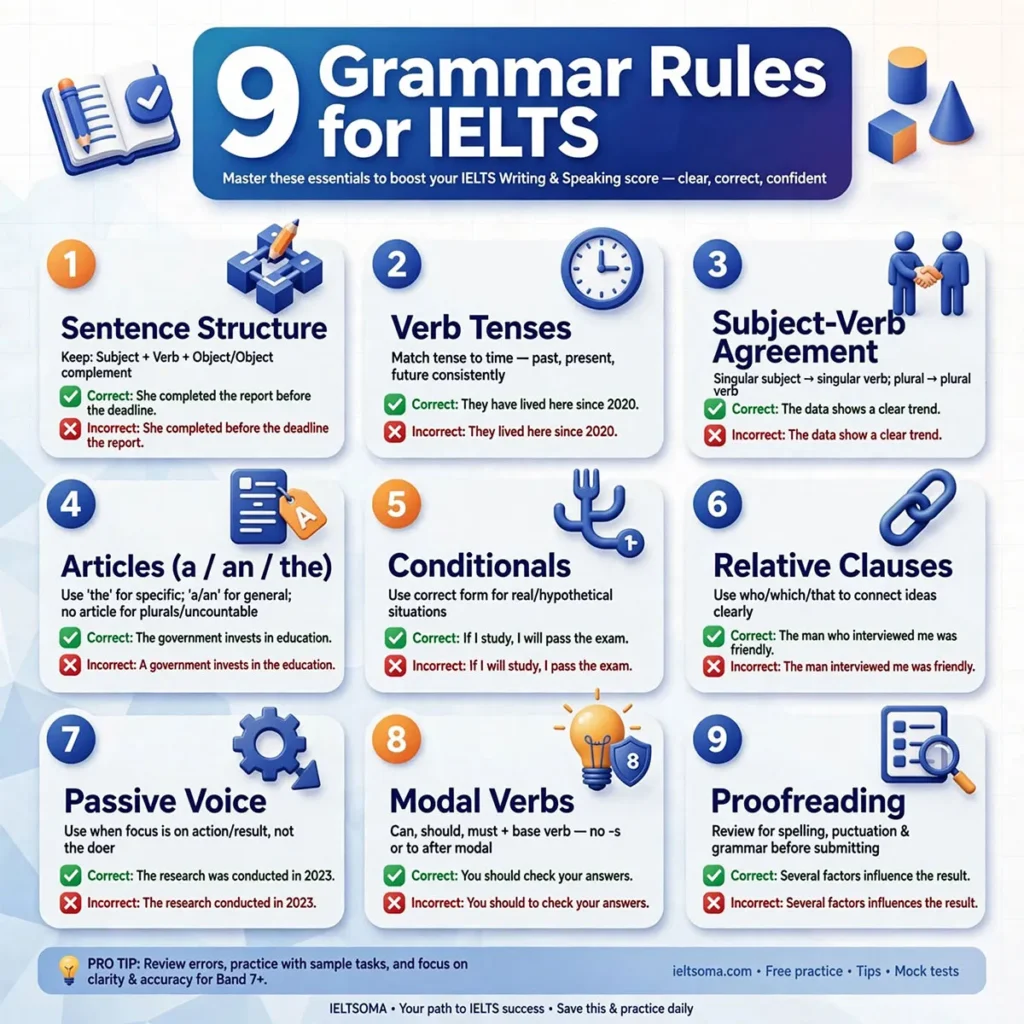
Here are nine grammar rules that can make a meaningful difference to your IELTS preparation.
Table of Contents
1. Master Sentence Structure Before Using Complex Grammar
One of the most important grammar rules for IELTS is also one of the simplest: make sure your basic sentences are correct before trying to produce advanced ones.
A simple sentence contains one independent clause:
Many students study abroad.
A compound sentence connects two independent clauses:
Many students study abroad, and they gain valuable international experience.
A complex sentence contains a main clause and a dependent clause:
Many students study abroad because international universities offer specialised programmes.
All three structures can be useful in IELTS.
The mistake is assuming that a complex sentence is automatically better. It is not.
Compare these examples:
Incorrect:
Although many students want to study abroad, but they cannot afford the fees.
The sentence incorrectly combines two contrasting structures: although and but.
Correct:
Although many students want to study abroad, they cannot afford the fees.
Or:
Many students want to study abroad, but they cannot afford the fees.
The lesson is simple: complexity only helps when it is accurate.
Official IELTS guidance explains that candidates targeting Band 6 or higher should demonstrate a range of sentence forms, while higher bands require increasingly effective control of complex structures.
IELTS tip
Do not deliberately make every sentence complex. Instead, combine:
- Simple sentences for clarity
- Compound sentences for connections
- Complex sentences for relationships between ideas
- Occasional more sophisticated structures where they genuinely improve the message
This creates natural grammatical variety.
2. Control Verb Tenses Carefully
Verb tense errors are among the most noticeable grammar problems in IELTS.
You do not need to use every tense you know. You need to use the correct tense for the meaning you want to express.
Present simple
Use the present simple for general facts, routines and established situations.
Many young people use social media every day.
Present perfect
Use the present perfect when discussing changes or experiences connected to the present.
Technology has changed the way people communicate.
Past simple
Use the past simple for completed actions in the past.
The number of visitors increased significantly in 2019.
Future forms
Use appropriate future structures when discussing predictions or plans.
Governments are likely to introduce stricter environmental regulations.
One particularly important area is IELTS Academic Writing Task 1, where candidates may need to describe changes shown in graphs, charts or tables.
For example:
The percentage of households using solar energy increased from 20% in 2015 to 35% in 2020.
Using the present tense here would change the meaning and create an avoidable error.
Common mistake
The number of international students increased between 2010 and 2020, and it continues to grow rapidly during this period.
The sentence mixes past and present unnecessarily.
Better:
The number of international students increased between 2010 and 2020.
Or, if the growth continues to the present:
The number of international students increased between 2010 and 2020 and continues to grow.
IELTS tip
Before submitting a Writing answer, check every main verb and ask:
“What time period am I talking about?”
This quick question can catch many tense errors.
3. Use Subject–Verb Agreement Correctly
Subject–verb agreement looks basic, but mistakes in this area can appear repeatedly in IELTS Writing and Speaking.
The verb must agree with the subject.
The government has introduced a new policy.
Not:
The government have introduced a new policy.
Another common problem occurs when a long phrase separates the subject from the verb.
The increasing number of international students creates pressure on university accommodation.
The subject is number, not students.
Similarly:
The effects of social media are difficult to measure.
The subject is effects, so the verb must be plural.
Pay special attention to these expressions
The number of + plural noun + singular verb
The number of cars on the road has increased.
A number of + plural noun + plural verb
A number of students have complained about the timetable.
This distinction is particularly useful in formal IELTS Writing.
IELTS tip
When proofreading, temporarily ignore the words between the subject and verb.
For example:
The number of people who regularly use public transport in large cities has increased.
The core structure is:
The number has increased.
That makes agreement easier to check.
4. Use Articles More Accurately
Articles — a, an and the — cause persistent problems for many IELTS candidates.
The basic distinction is:
- a/an = one non-specific countable noun
- the = a specific or previously identified noun
- no article = often used with plural nouns or uncountable nouns when discussing things generally
Compare:
Governments should invest in education.
Here, education is being discussed generally.
But:
The government should invest in the education system.
Here, a particular system is being discussed.
Another example:
I bought a book yesterday. The book was about environmental science.
The first reference is non-specific. The second is specific because the reader now knows which book is meant.
Common IELTS errors
Government should provide better services.
Depending on the intended meaning, this may need:
The government should provide better services.
Or, when referring to governments generally:
Governments should provide better public services.
Another common problem:
Technology has changed the society.
When discussing society generally, the more natural form is:
Technology has changed society.
IELTS tip
Do not translate article usage directly from your first language.
Instead, learn common noun phrases as complete patterns:
- the environment
- the government
- the economy
- public transport
- higher education
- social media
- economic growth
- technological development
This helps you develop more natural grammatical habits.
5. Use Conditionals to Express Ideas Precisely
Conditionals are useful in IELTS because they allow you to discuss consequences, possibilities, predictions and hypothetical situations.
First conditional
Used for realistic future possibilities:
If governments improve public transport, fewer people will rely on private cars.
Second conditional
Used for hypothetical or less likely situations:
If public transport were cheaper, more people would use it.
Third conditional
Used for hypothetical situations in the past:
If the government had invested earlier, the problem might have been avoided.
Conditionals can make an argument more precise because they show the relationship between a situation and its possible result.
However, do not use them simply to appear advanced.
Common mistake
If governments will invest more in public transport, congestion will decrease.
Better:
If governments invest more in public transport, congestion will decrease.
The first conditional normally uses present simple after if and a future form in the main clause.
IELTS tip
Use conditionals when your argument genuinely involves a condition and a consequence.
For example:
If schools provide more practical financial education, young people may make better decisions about money.
That is more useful than inserting a conditional sentence simply because you want to demonstrate advanced grammar.
6. Use Relative Clauses to Add Detail
Relative clauses are particularly valuable in IELTS because they allow you to combine information without creating a series of short, repetitive sentences.
Compare:
Many students attend university. They study away from home. They need affordable accommodation.
With:
Many students who attend university away from home need affordable accommodation.
The second version is more concise and demonstrates control over sentence structure.
Common relative pronouns include:
- who for people
- which for things
- that for people or things in many defining clauses
- where for places
- whose for possession
Examples:
Students who work part-time may have less time for academic study.
Universities that offer flexible courses can attract working professionals.
Cities where public transport is efficient often experience less traffic congestion.
Common mistake
The university which is located in London, offers several postgraduate programmes.
There should not be a comma if the relative clause is essential to identifying the university.
Better:
The university which is located in London offers several postgraduate programmes.
However, when the information is non-essential, commas may be appropriate:
The university, which is located in London, offers several postgraduate programmes.
IELTS tip
Use relative clauses to combine related ideas, but avoid making sentences so long that their meaning becomes difficult to follow.
7. Use Passive Voice When It Is Appropriate
The passive voice is especially useful in formal and academic writing.
Compare:
Researchers conducted the study in 2025.
The study was conducted in 2025.
The second version focuses attention on the study rather than the researchers.
Passive structures are particularly useful in Academic Writing Task 1, especially when describing processes.
For example:
The raw materials are transported to the factory.
The products are then packaged and delivered to retailers.
The passive can also be useful when the person performing an action is unknown or unimportant.
New regulations were introduced to reduce air pollution.
However, do not turn every sentence into the passive voice.
Weak overuse
The policy was introduced by the government. The funding was provided by the government. The programme was managed by the government.
This becomes repetitive.
Better:
The government introduced the policy and provided funding for the programme, which was subsequently managed by a specialist agency.
IELTS tip
Use passive structures where the action or result is more important than the person responsible for it.
That is grammatical choice, not grammatical decoration.
8. Use Modal Verbs to Show Meaning and Certainty
Modal verbs are extremely useful for expressing possibility, obligation, ability and probability.
Common examples include:
- can
- could
- may
- might
- should
- must
- would
Compare:
Governments should invest in renewable energy.
This expresses a recommendation.
Governments must invest in renewable energy.
This expresses a stronger obligation.
Governments might invest in renewable energy.
This expresses possibility rather than certainty.
Using the wrong modal can weaken an argument because it changes the level of certainty.
Compare
Technology will solve the problem.
This is a very strong prediction.
Technology may help to solve the problem.
This is more cautious.
Academic writing often benefits from appropriate caution because many issues do not have absolute answers.
IELTS tip
Do not use words such as must, will or always unless your meaning genuinely requires a strong claim.
Consider whether your idea is:
- certain
- highly likely
- possible
- recommended
- necessary
- hypothetical
Then choose the grammatical structure that communicates that meaning.
9. Proofread for Accuracy, Not Just Spelling
Learning grammar rules for IELTS is only half the task. You also need a reliable proofreading system.
Many candidates finish a Writing Task 2 essay and spend their remaining time reading it as if they were a normal reader.
That is not the most effective approach.
Instead, proofread systematically.
Check 1: Verb tense
Underline the main verbs mentally and ask:
Is the tense appropriate for the time period?
Check 2: Subject–verb agreement
Look for:
he/she/it + verb
and
plural subject + plural verb
Check 3: Articles
Check common problem areas involving:
a / an / the / no article
Check 4: Singular and plural nouns
Look for missing plural endings:
many student ❌
many students ✅
Check 5: Sentence boundaries
Look for sentences that are too long or contain incorrectly joined clauses.
Check 6: Punctuation
Check commas, full stops and apostrophes.
Check 7: Complex structures
Ask whether your complex sentences are actually correct.
A simple accurate sentence is better than an ambitious sentence containing several errors.
Grammar Rules for IELTS Writing vs Speaking
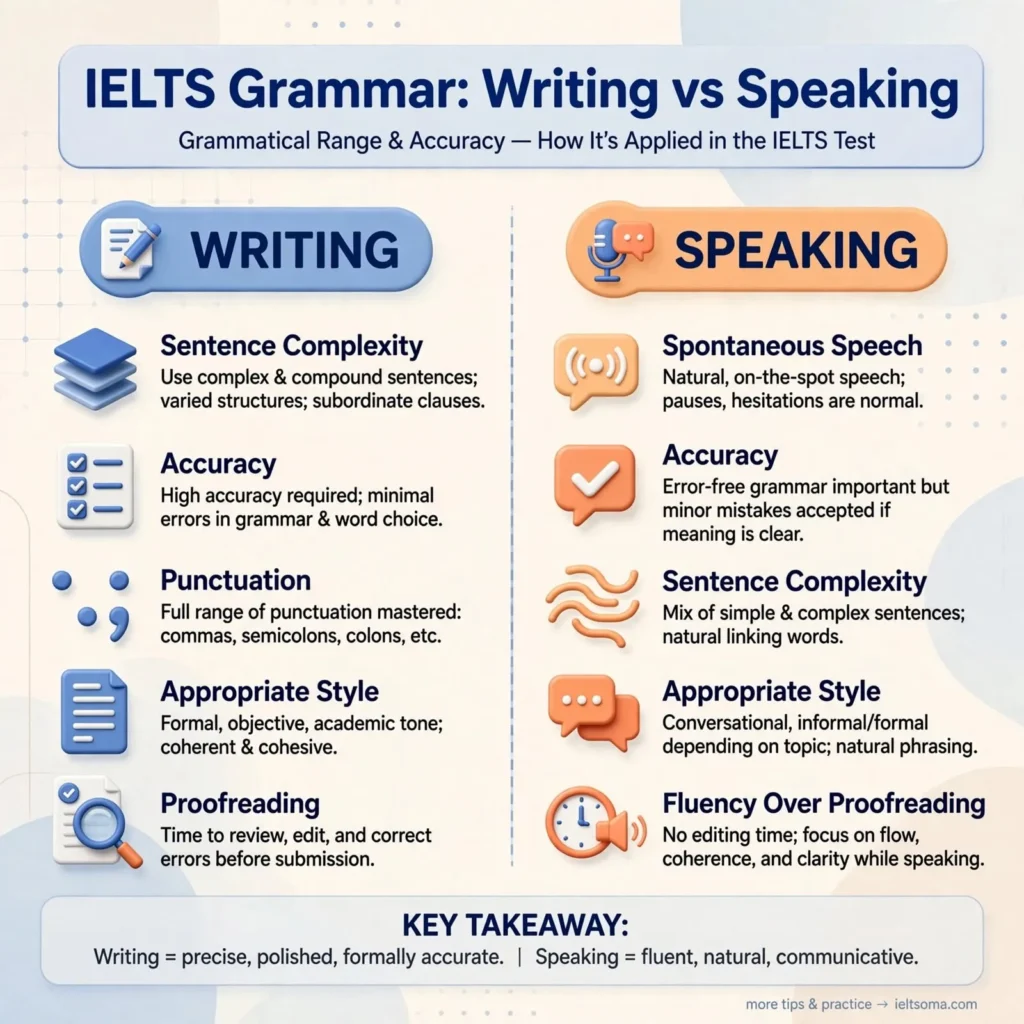
Grammar matters in both Writing and Speaking, but the way you use it should reflect the task.
In IELTS Writing, grammatical range and accuracy is one of four assessment criteria. The official IELTS materials state that the criterion considers the range and appropriacy of structures, accuracy of simple, compound and complex sentences, grammatical errors and punctuation.
In IELTS Speaking, grammatical range and accuracy is also one of four equally weighted criteria.
| Writing | Speaking |
|---|---|
| Greater control of written sentence structure | Natural spoken sentence formation |
| Punctuation matters | Punctuation is irrelevant to speech |
| Academic or appropriate written style | Appropriate conversational style |
| Complex structures can be planned | Structures must often be produced spontaneously |
| Accuracy should be checked during proofreading | Accuracy must be controlled while communicating |
This difference is important.
You should not memorise an essay full of complicated structures and expect to speak in exactly the same way.
In Speaking, the priority is communicating naturally while demonstrating an appropriate range of grammatical structures.
Research published by IELTS has also found that grammatical accuracy tends to increase with speaking proficiency, while more complex structures become more common at higher proficiency levels, although attempts at complex structures can also produce errors.
The Most Common Grammar Mistakes in IELTS
If you are preparing for IELTS, pay particular attention to these recurring areas:
- Subject–verb agreement
- Incorrect verb tense
- Missing or incorrect articles
- Singular and plural noun errors
- Incorrect prepositions
- Sentence fragments
- Run-on sentences
- Incorrect conditional structures
- Confusing active and passive structures
- Incorrect word forms
- Pronoun errors
- Incorrect punctuation in Writing
You do not need to eliminate every tiny mistake to achieve a strong IELTS score. What matters is developing reliable grammatical control and reducing errors that affect clarity.
Official IELTS band descriptors show that higher bands require increasingly broad grammatical range and stronger control, while errors become less frequent and less significant.
How to Improve Your IELTS Grammar Faster
Reading grammar rules repeatedly is unlikely to be enough.
Use a cycle of learn → practise → produce → correct → repeat.
Step 1: Identify your recurring errors
Take three recent IELTS essays or speaking recordings.
Create a simple error list:
| Error | Your sentence | Correct version |
|---|---|---|
| Tense | People used social media every day now. | People use social media every day now. |
| Article | Government should act quickly. | The government should act quickly. |
| Agreement | The number of users have increased. | The number of users has increased. |
Patterns will emerge.
Step 2: Focus on one grammar area at a time
Do not attempt to fix fifteen grammar problems simultaneously.
For one week, you might focus on:
Subject–verb agreement
Then move to:
Articles
Then:
Verb tenses
Then:
Complex sentences
This makes improvement easier to measure.
Step 3: Use grammar in IELTS-style sentences
Do not practise grammar only with random textbook sentences.
Take IELTS topics such as:
- education
- technology
- environment
- health
- transport
- employment
- globalisation
Then create sentences using the structure you are practising.
For example, while practising conditionals:
If governments provide better cycling infrastructure, more commuters may choose bicycles.
The grammar is being practised in a context you may actually encounter in IELTS.
Step 4: Reuse corrected structures
If you repeatedly make the same mistake, write five to ten new sentences using the correct structure.
This helps turn grammatical knowledge into a usable skill.
Step 5: Build a proofreading routine
During Writing practice, reserve several minutes at the end specifically for grammar.
Do not use this time to rewrite your entire essay.
Look for your known errors first.
That is usually more productive than searching randomly for mistakes.
Should You Use Advanced Grammar to Get Band 7?
Yes, but with an important qualification.
You should demonstrate a range of structures, including complex structures where appropriate. However, using complicated grammar does not guarantee a high score.
A study of IELTS Writing band descriptors shows a progression from limited structures at lower bands to a mix of simple and complex forms at Band 6, a variety of complex structures with frequent error-free sentences at Band 7, and wider range with stronger accuracy at higher bands.
So instead of thinking:
“I need difficult grammar.”
Think:
“I need a useful range of grammar that I can control accurately.”
For example:
Basic:
Many people work from home.
More developed:
Many people work from home because technology allows them to communicate with colleagues remotely.
More sophisticated but still natural:
As remote-working technology has become more accessible, an increasing number of employees have been able to work effectively without travelling to a traditional workplace.
The third sentence demonstrates greater grammatical range, but it is only useful because the structure remains clear and accurate.
A Practical Grammar Checklist Before Your IELTS Test
Before the exam, make sure you can confidently use:
- Present and past simple
- Present perfect
- Future forms
- Conditional sentences
- Modal verbs
- Relative clauses
- Passive voice
- Comparatives and superlatives
- Compound sentences
- Complex sentences
- Subject–verb agreement
- Articles
- Countable and uncountable nouns
- Singular and plural forms
- Common prepositions
- Pronouns
- Correct punctuation in Writing
You do not need to demonstrate every item in every answer.
The aim is to have enough grammatical resources to express your ideas accurately and flexibly.
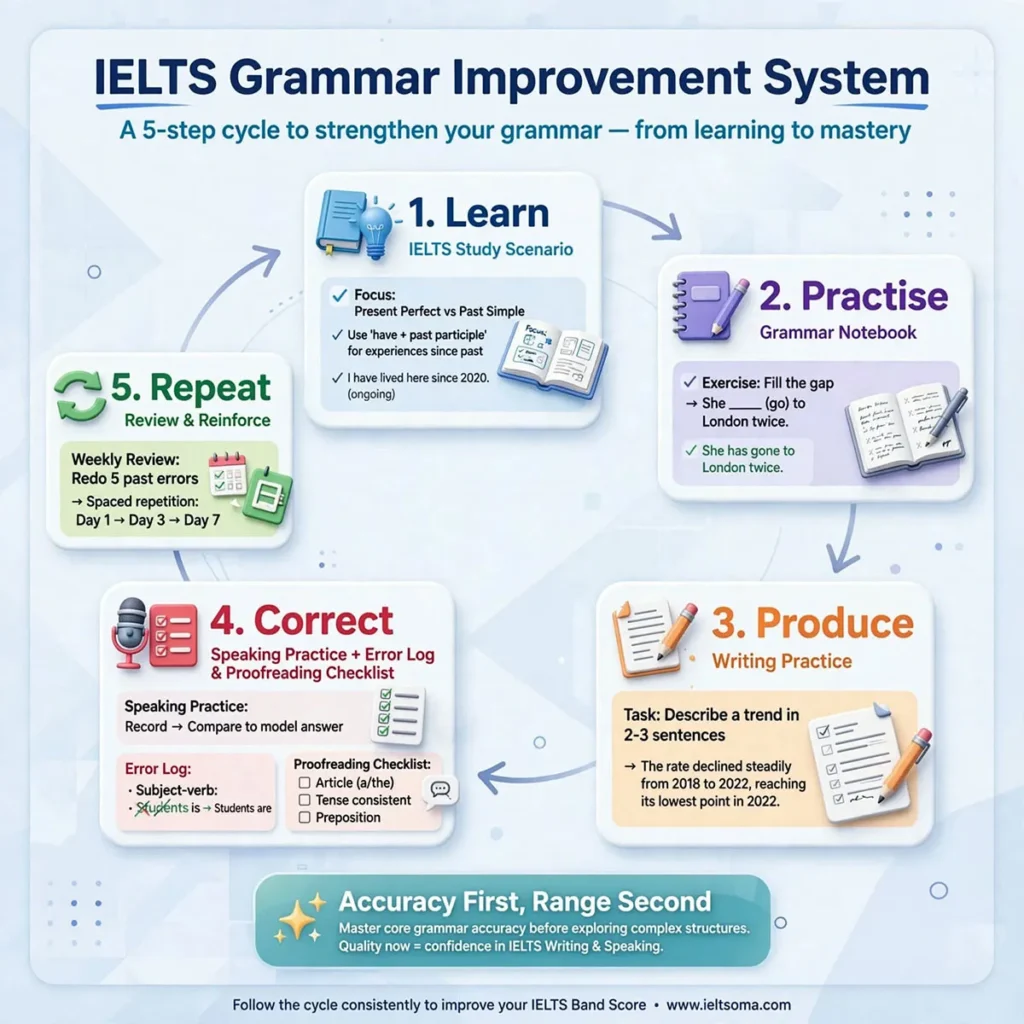
Final Strategy: Accuracy First, Range Second
The most effective approach to grammar rules for IELTS is not to chase increasingly complicated grammar.
Build your accuracy first.
Then expand your range.
Then practise using that range naturally under time pressure.
A strong IELTS candidate can move between simple and complex structures depending on what the idea requires. They can describe facts, explain causes, compare information, discuss hypothetical situations, make predictions and express opinions without repeatedly losing control of grammar.
Remember the three questions you should ask whenever you write or speak:
Is my grammar correct?
Does this structure express exactly what I mean?
Am I using enough variety without sacrificing accuracy?
If you can consistently answer yes, your grammar is doing what it should do: helping you communicate your ideas clearly and effectively.
FAQs About Grammar Rules for IELTS
How important is grammar in IELTS?
Grammar is directly assessed in both IELTS Writing and Speaking through the Grammatical Range and Accuracy criterion. In Writing, it is one of four assessment criteria, while in Speaking it is also one of four equally weighted criteria.
What grammar should I learn for IELTS?
Focus on practical structures such as verb tenses, subject–verb agreement, articles, conditionals, relative clauses, passive voice, modal verbs and complex sentences. You should also develop accurate use of punctuation in Writing.
Do I need complex grammar for IELTS Band 7?
You need to demonstrate a variety of grammatical structures, including complex structures, but complexity alone is not enough. Accuracy and appropriate use are equally important. Official Band 7 descriptors refer to a variety of complex structures and frequent error-free sentences.
Is grammar more important in IELTS Writing or Speaking?
Grammar is assessed in both. In Writing, grammatical range and accuracy is one of four criteria, and in Speaking it is also one of four equally weighted criteria. The practical demands are different because Writing allows more planning and proofreading, whereas Speaking requires you to produce language spontaneously.
How can I reduce grammar mistakes in IELTS?
Identify your recurring errors, practise one grammar area at a time, use the structures in IELTS-style sentences and keep an error log. During Writing practice, reserve time for systematic proofreading.
Can simple sentences get a good IELTS score?
Yes. Simple sentences are not inherently bad. Strong IELTS performance requires a range of structures, so the goal is to combine simple, compound and complex sentences effectively rather than making every sentence complicated.
Should I memorise complex grammar structures?
It is better to understand and practise structures than to memorise sentences. Memorised grammar that does not fit the meaning can make your Writing or Speaking sound unnatural and can increase errors.
What is the biggest grammar mistake IELTS candidates make?
There is no single mistake that applies to every candidate. However, recurring problems such as verb tense, subject–verb agreement, articles, sentence structure and incorrect complex sentences can significantly affect grammatical accuracy.
Key Takeaway
The best grammar strategy for IELTS is simple: build accuracy, develop range and use grammar purposefully.
Do not try to impress the examiner with unnecessarily complicated sentences. Instead, show that you can control different grammatical structures while communicating your ideas clearly.
That is the real purpose of grammar in IELTS — not complicated English, but effective English with strong grammatical control.
Further Useful Links:
- IELTS Speaking Accuracy and Fluency: 7 Smart Ways to Improve
- IELTS Reading Question Types: 14 Essential Tasks & Tips
- Academic Vocabulary for IELTS: 7 Powerful Ways to Build It
- IELTS Writing Collocation Practice: 25 Powerful Ways to Improve Your Vocabulary
- IELTS Speaking Practice Tips: 15 Powerful Ways to Improve
- Official IELTS Writing assessment criteria