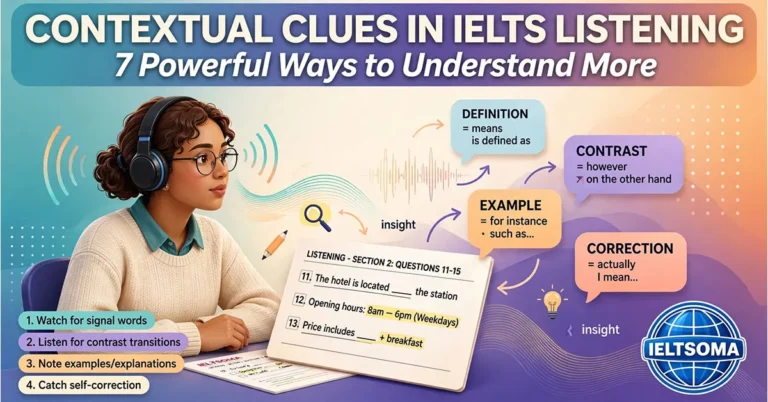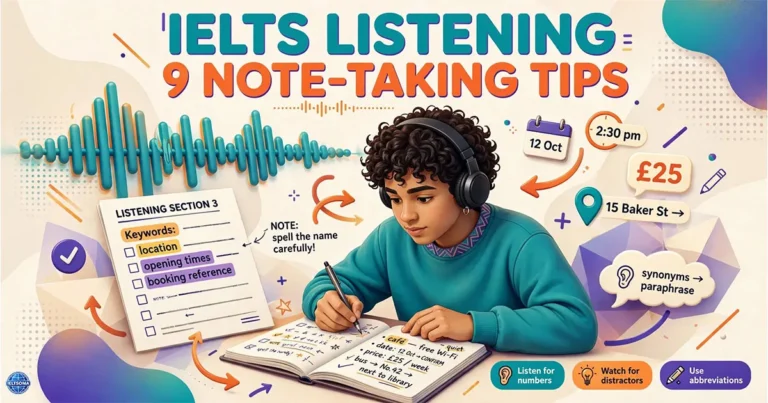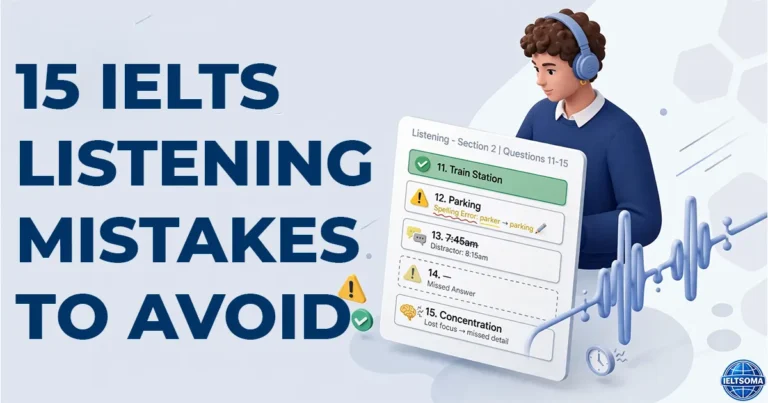
You hear an answer, write it down, and move on. A few seconds later, you realise the speaker has changed direction. You missed the next answer. Then another.
This is how many IELTS Listening test takers lose marks—not because they cannot understand English, but because they are not using the right listening strategies.
The good news? You can improve your IELTS Listening score without understanding every single word in the recording. With the right preparation, you can predict answers, recognise paraphrases, avoid distractions and stay focused when the audio becomes challenging.
These IELTS Listening Tips are designed for both Academic and General Training test takers. Whether you are preparing for your first IELTS exam or trying to move from Band 6 to Band 7 or higher, this guide will help you practise more effectively and approach the Listening test with greater confidence.
Table of Contents
How the IELTS Listening Test Works
Before applying any strategy, understand what you are preparing for.
The IELTS Listening test contains 40 questions based on four recordings. You hear each recording once, and the questions follow the order of the information in the recording.
The test takes approximately 30 minutes. In the paper-based test, you normally have time to transfer your answers to the answer sheet after listening. In the computer-delivered test, you enter answers on screen and receive time to check them at the end.
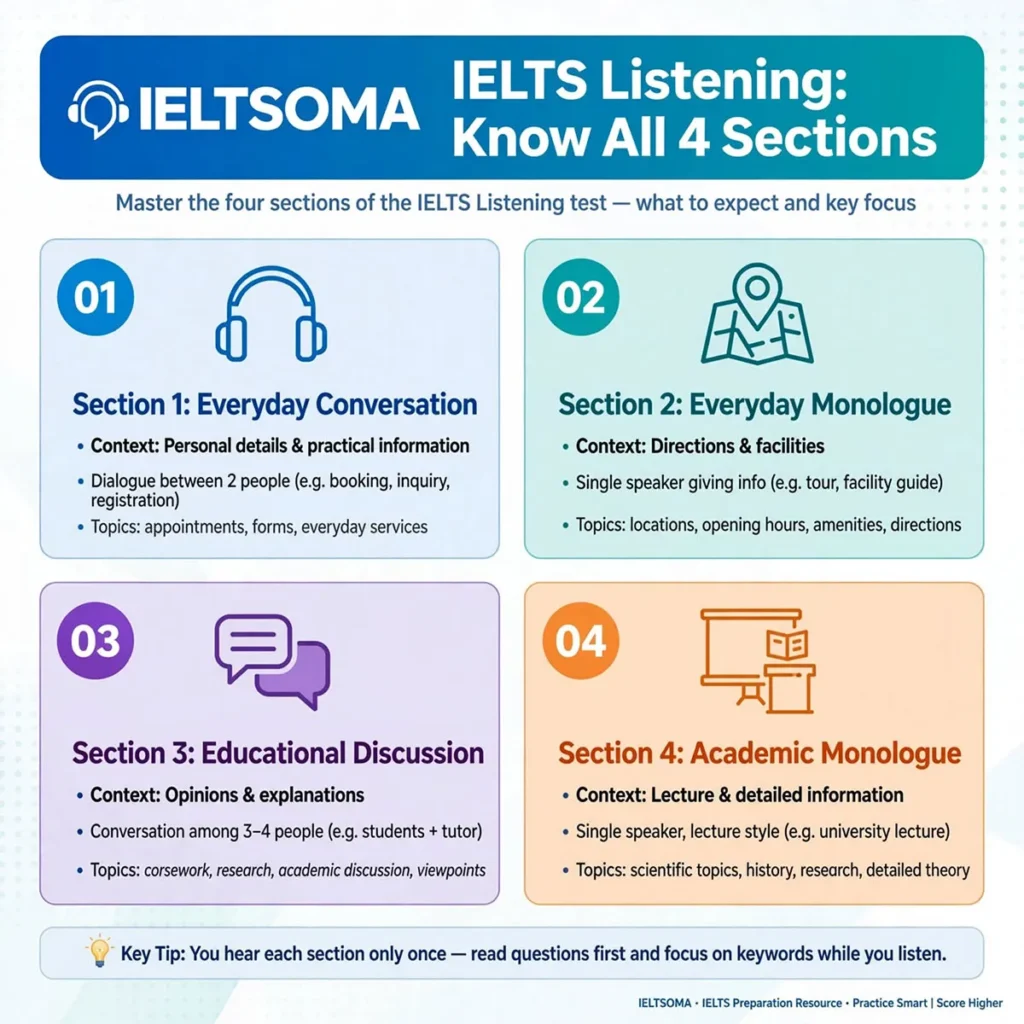
The four sections are:
| Section | Recording | What it tests |
|---|---|---|
| 1 | A conversation in an everyday social situation | Names, dates, numbers, personal details and practical information |
| 2 | A monologue in an everyday social context | Directions, facilities, announcements and factual details |
| 3 | A conversation in an educational or training context | Opinions, discussions, explanations and academic vocabulary |
| 4 | A monologue on an academic subject | Following a structured lecture and identifying detailed information |
Both Academic and General Training IELTS use the same Listening test.
Your score is based on the number of correct answers out of 40. There is no need to understand every sentence perfectly to achieve a strong result.
15 IELTS Listening Tips to Improve Your Score
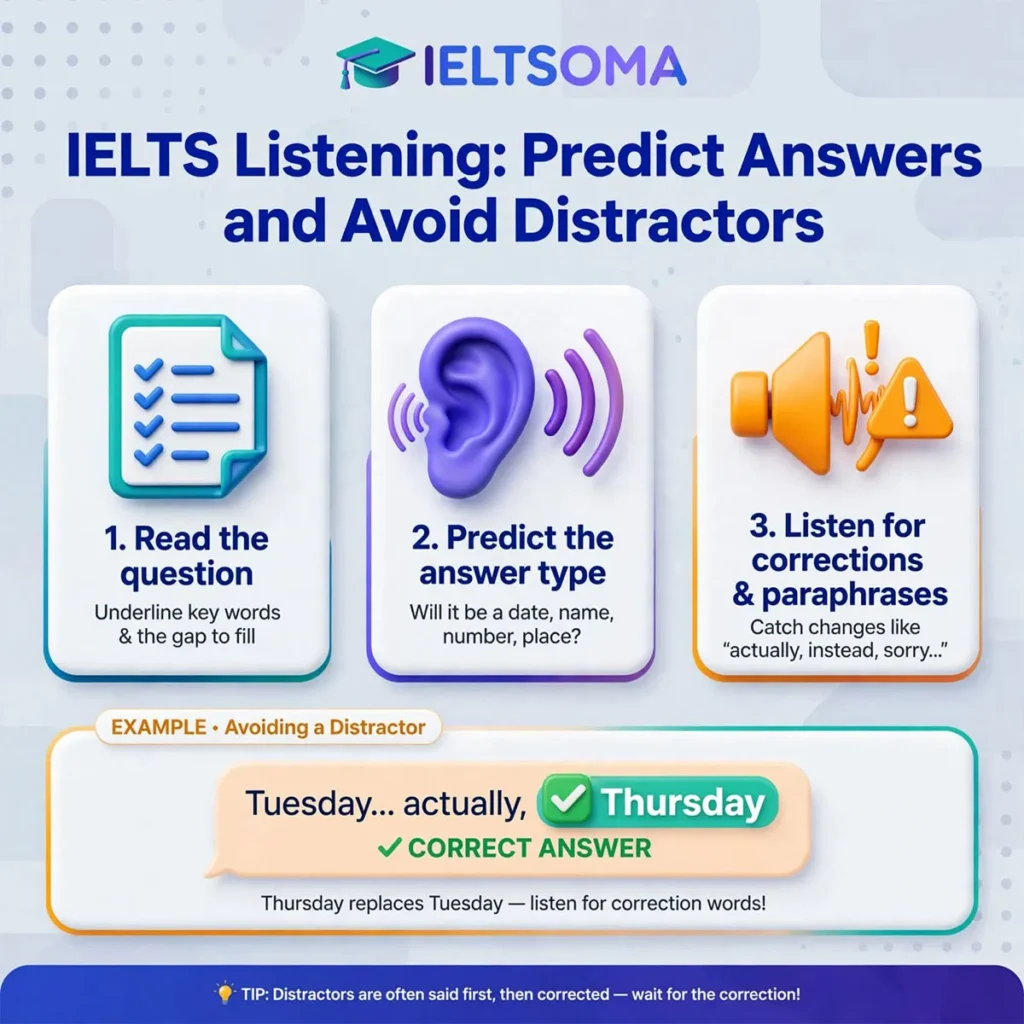
1. Read the Questions Before the Recording Starts
One of the most valuable IELTS Listening tips is to use the preparation time wisely.
Before the audio begins, read the questions and identify what information you need.
For example:
The meeting will take place on ______.
You should immediately expect a date, day or possibly a time.
Another example:
The museum is located near ______.
You need to listen for a place or location.
Do not spend all your time reading every word slowly. Scan the questions, identify the key information and prepare your mind for the answers.
Expert tip: Underline or mentally highlight words such as when, where, how many, which and why. These often tell you what kind of answer to expect.
2. Predict the Type of Answer
Strong IELTS Listening candidates do not listen passively. They make predictions.
Before listening, ask:
- Do I need a noun?
- Is the answer likely to be a number?
- Will I hear a name or location?
- Is the answer a verb or adjective?
- How many words can I write?
Consider this question:
The course lasts for ______ weeks.
The answer is likely to be a number.
Now consider:
Students should bring their own ______.
The answer is likely to be an object or item.
This prediction helps you recognise the answer more quickly when the speaker says it.
However, remember that predictions are not guarantees. Always follow the information in the recording.
3. Listen for Synonyms and Paraphrases
The recording often uses different words from those in the questions.
This is one of the biggest challenges in IELTS Listening.
For example:
Question: The hotel is close to the railway station.
Recording: The hotel is just a short walk from the train terminal.
The meaning is similar, but the vocabulary changes.
Here are some common examples:
| Question wording | Possible recording wording |
|---|---|
| Cheap | Affordable, low-cost, inexpensive |
| Near | Close to, within walking distance |
| Begin | Start, commence |
| Increase | Rise, grow, go up |
| Problem | Difficulty, issue, challenge |
| Buy | Purchase, get |
Do not wait to hear the exact words from the question. Train yourself to recognise meaning.
IELTSOMA practice method: When reviewing a Listening exercise, write down the words used in the question and the different expressions used in the recording. This builds paraphrase recognition over time.
4. Follow the Order of the Questions
IELTS Listening questions generally follow the order of information in the recording.
If you have answered Question 5, the information for Question 6 is likely to come next.
This makes it easier to track the recording.
For example:
- Question 1 asks for a person’s name.
- Question 2 asks for a date.
- Question 3 asks for a price.
The speaker is likely to provide these details in that sequence.
If you become stuck on one answer, do not spend too long searching backwards. You may miss several upcoming answers.
The rule: If you miss an answer, make a reasonable decision, move on and return to it later if you have time.
5. Watch Out for Distractors
Distractors are details that can confuse you before the speaker gives the correct answer.
For example:
The appointment was originally planned for Tuesday, but it has now been moved to Thursday.
If the question asks for the appointment day, the answer is Thursday, not Tuesday.
Other common examples include:
- An old price followed by a new price.
- One location being mentioned before the correct location.
- A speaker changing their opinion.
- A wrong option being discussed before the right one.
- A date being corrected during the conversation.
Listen carefully for phrases such as:
- Actually…
- Sorry, I meant…
- No, that’s not correct.
- It was originally…, but now…
- Rather than…
- I should clarify…
These expressions often signal that the information is changing.
6. Learn to Recognise Signpost Words
Signpost words help you follow the structure of the recording.
They show when the speaker is moving to a new point, giving an example or making a contrast.
Useful signposts include:
For adding information
- Also
- In addition
- Furthermore
For contrast
- However
- On the other hand
- Although
- Whereas
For examples
- For example
- Such as
- For instance
For sequence
- First
- Next
- Finally
- Moving on to…
In Section 4, signposting is particularly helpful because the recording may be a longer academic lecture.
When you hear “Now let’s move on to…”, prepare yourself for a new topic or a new set of answers.
7. Improve Your Spelling and Grammar
A correct answer can be marked wrong if it is misspelled.
This is especially important for:
- Names
- Places
- Dates
- Numbers
- Singular and plural nouns
- Common academic vocabulary
For example:
- Environment — not enviroment
- Accommodation — not accomodation
- Necessary — not neccessary
You should also check whether the answer requires a singular or plural form.
Example:
The library has several ______.
If the recording says “computers”, writing “computer” may be incorrect when the plural is required.
Read the instructions carefully. If the question says “NO MORE THAN TWO WORDS”, do not write three words.
Spelling practice may seem simple, but it can make a significant difference to your Listening score.
8. Practise Numbers, Dates and Names
Section 1 frequently includes practical details such as telephone numbers, prices, addresses and dates.
These may seem easy, but they can cause mistakes because the speaker may say them quickly.
Practise listening to:
- 13 and 30
- 15 and 50
- 18 and 80
- 40 and 14
- Dates and months
- Telephone numbers
- Prices and measurements
- Names and addresses
For example:
The registration fee is £45.
You must distinguish between “forty-five” and “fifty-four”.
When practising, write the answer immediately rather than waiting for the speaker to repeat it.
Also, become familiar with different accents. IELTS Listening may include British, Australian, New Zealand, American and other English accents.
The goal is not to imitate every accent. It is to understand the information regardless of pronunciation style.
9. Use the Preparation Time Strategically
The preparation time before each section is valuable.
Do not waste it by reading the same question repeatedly without a plan.
Instead:
- Read the questions.
- Identify keywords.
- Predict the answer type.
- Notice the instructions.
- Prepare for possible synonyms.
- Check the next question before the recording moves forward.
If you have time, read ahead.
This is particularly useful in Sections 2, 3 and 4, where the information may become more complex.
Remember: Preparation time is not a break. It is part of your test strategy.
10. Stay Focused When You Miss an Answer
Almost every IELTS candidate misses an answer at some point.
The problem is not missing one answer. The problem is allowing that mistake to affect the next five answers.
Imagine you miss Question 12 because the speaker talks too quickly.
You become frustrated and continue thinking about it. Meanwhile, the recording moves on to Questions 13, 14 and 15.
Now one missed answer has become four.
Instead, use this approach:
- Accept that the answer has passed.
- Make a quick note if possible.
- Move to the next question.
- Regain focus immediately.
A calm test taker can recover. A distracted test taker may continue losing marks.
11. Practise Different IELTS Listening Question Types
Different question types require different strategies.
Form, Note and Table Completion
Look for:
- Names
- Numbers
- Dates
- Places
- Factual details
Predict the type of information required before the recording begins.
Multiple Choice
Read all the options carefully.
Do not choose an answer simply because the speaker mentions one of the words in an option. The speaker may mention it as a distractor.
Focus on meaning and the final decision.
Matching Questions
Identify the items you need to match.
For example, you may need to match people with their opinions or places with facilities.
Use keywords and listen for paraphrases.
Map and Plan Labelling
Study the map before listening.
Identify:
- The starting point
- Directions
- Left and right
- North, south, east and west
- Landmarks
- Locations
Listen for phrases such as “opposite”, “next to”, “behind” and “on your right”.
Sentence Completion
Check the grammar of the sentence.
For example:
The main reason for the delay was ______.
You are likely to need a noun or noun phrase.
The instructions are essential. Never exceed the word limit.
12. Use Practice Tests Correctly
Completing practice tests is useful, but simply doing test after test is not enough.
The real improvement comes from reviewing your mistakes.
After each practice test, ask:
- Did I miss the answer because of vocabulary?
- Did I misunderstand the speaker?
- Did I lose focus?
- Did I write the wrong spelling?
- Did I miss a correction or distractor?
- Did I misunderstand the question instructions?
- Did I fail to predict the answer type?
Keep a Listening error log.
| Question | My answer | Correct answer | Reason for mistake |
|---|---|---|---|
| 8 | Tuesday | Thursday | Missed correction |
| 16 | Computer | Computers | Singular/plural error |
| 25 | Library | Laboratory | Misheard word |
This approach turns every mistake into a learning opportunity.
13. Use the Transcript to Improve Listening
A transcript is one of the most useful tools for IELTS Listening practice.
After completing a practice recording:
- Check your answers.
- Identify the questions you got wrong.
- Listen again without reading.
- Read the transcript.
- Find the exact phrase containing the answer.
- Listen again and repeat the sentence.
This helps you understand why you missed the answer.
For example, you may discover that you heard “fifteen” when the speaker said “fifty”.
Or perhaps the recording used “a short distance from” instead of “near”.
The transcript helps you identify these gaps.
However, do not read the transcript before attempting the recording. You need to train your real listening ability first.
14. Improve Your Listening Outside IELTS Practice Tests
You should not rely entirely on IELTS practice tests.
Real English listening can help you become more comfortable with different speakers, speeds and vocabulary.
Useful materials include:
- English podcasts
- Educational videos
- Interviews
- Documentaries
- News reports
- University lectures
- English conversations
Choose material that is challenging but understandable.
You do not need to understand every word. Focus on the main idea, important details and the speaker’s purpose.
For example, listen to a five-minute educational video and write down:
- The main topic.
- Three important details.
- Any new vocabulary.
- One sentence that summarises the speaker’s message.
This develops the ability to listen for meaning rather than translating every word into your first language.
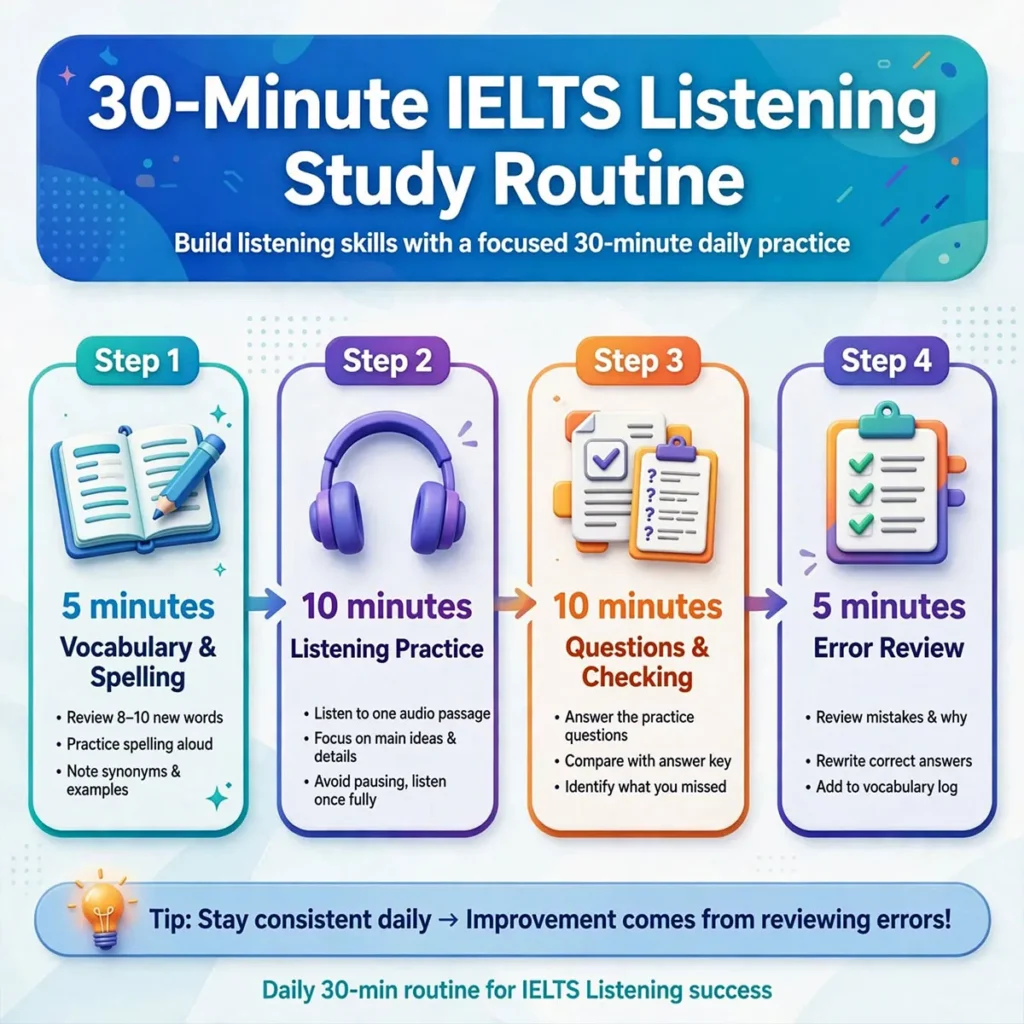
15. Follow a Consistent IELTS Listening Study Plan
Consistency is more effective than studying for several hours once a week.
A simple daily routine can make your preparation more organised.
30-minute IELTS Listening routine
| Time | Activity |
|---|---|
| 5 minutes | Review vocabulary and common spelling errors |
| 10 minutes | Listen to a short recording or IELTS section |
| 10 minutes | Complete questions and check answers |
| 5 minutes | Review mistakes and note new expressions |
If you have more time, complete a full Listening practice test and review it carefully.
Your goal should not be to complete the largest number of tests. Your goal should be to understand why you lose marks and reduce those mistakes.
Common IELTS Listening Mistakes to Avoid
Even well-prepared candidates can lose marks because of poor test habits.
Trying to Understand Every Word
You do not need to understand every word in the recording.
Focus on the information required by the questions.
Ignoring the Word Limit
If the instruction says “NO MORE THAN TWO WORDS”, three words may be marked incorrect.
Spending Too Long on One Question
Do not sacrifice several answers because you are stuck on one.
Writing an Answer That Does Not Fit Grammatically
Check whether your answer fits the sentence.
Failing to Check Spelling
A misspelled answer may lose the mark even if you understood the recording.
Not Reviewing Practice Mistakes
A practice score is only useful if you learn from it.
How to Improve Your IELTS Listening Score
Your score depends on how many answers you get correct out of 40.
The exact conversion to a band score can vary slightly by test version, so use official score guidance when setting your target.
As a general preparation reference:
| Correct answers out of 40 | Approximate band range |
|---|---|
| 16–17 | Band 5 |
| 23–25 | Band 6 |
| 30–31 | Band 7 |
| 35–36 | Band 8 |
| 37–40 | Band 8.5–9 |
These are approximate ranges, not guaranteed conversion thresholds for every test.
If your target is Band 7, aim to practise consistently above your target level. This gives you some protection against a difficult recording or a few avoidable mistakes.
IELTS Listening Tips for Band 7 and Above
If you are targeting Band 7 or higher, focus on accuracy as well as understanding.
Build Paraphrase Recognition
Do not memorise isolated synonyms. Learn how meaning changes in real sentences.
Reduce Spelling Errors
Keep a personal list of words you regularly misspell.
Practise Section 3 and Section 4
These sections often require more concentration, discussion tracking and academic vocabulary.
Improve Your Recovery Skills
A strong listener can recover quickly after missing an answer.
Review Every Wrong Answer
Ask yourself exactly why you lost the mark.
This is the difference between practising and improving.
Frequently Asked Questions About IELTS Listening
Is IELTS Listening the same for Academic and General Training?
Yes. The IELTS Listening test is the same for Academic and General Training candidates.
How many questions are there in IELTS Listening?
There are 40 questions based on four recordings.
Can I listen to the recording twice?
No. Each recording is played once during the test.
What happens if I miss an answer?
Move on to the next question. Do not allow one missed answer to affect the rest of the section.
Is spelling important in IELTS Listening?
Yes. Incorrect spelling can result in a wrong answer. Follow the instructions and check singular and plural forms.
How can I improve IELTS Listening quickly?
Practise consistently, review mistakes, learn paraphrases, improve spelling and listen to a variety of English recordings.
Should I use transcripts when practising?
Yes. First complete the recording without the transcript. Then use it to understand missed information, vocabulary and pronunciation.
Is Section 4 always the hardest?
Many candidates find Section 4 challenging because it is a longer academic monologue. However, difficulty depends on the recording, question type and your preparation.
Final Advice from IELTSOMA
Improving IELTS Listening is not about hoping the recording will be easy.
It is about developing the ability to predict answers, recognise meaning, follow the speaker and recover when something goes wrong.
Use these IELTS Listening Tips as part of your daily preparation. Practise with purpose, review your mistakes and build confidence through repetition.
You do not need perfect English to achieve a strong Listening score.
You need a reliable strategy, careful attention and consistent practice.
Start with one practice section today, identify your biggest weakness and work on it before your next test.
Further Reading:
- Note-Taking for IELTS Listening: 9 Smart Tips
- Active Listening for IELTS: 9 Powerful Ways to Improve
- IELTS Listening Skills: 7 Powerful Ways to Improve
- IELTS Exam Stress: 9 Powerful Ways to Stay Calm and Perform Better
- IELTS Listening Note-taking Tips: 9 Powerful Ways to Listen and Write Better
- Official IELTS Listening test information