Getting Yes/No/Not Given Questions in IELTS Reading wrong is rarely a vocabulary problem. More often, candidates choose Not Given when the writer actually disagrees with the statement or select Yes simply because the passage contains similar words.
That is exactly where these questions become difficult.
The official IELTS test distinguishes Yes/No/Not Given from True/False/Not Given. Yes/No/Not Given questions ask whether a statement agrees with the views or claims of the writer. Yes means the statement agrees with the writer’s view, No means it contradicts the writer’s view, and Not Given means the passage neither supports nor contradicts it.
The good news is that this question type becomes much more manageable once you stop treating it as a simple vocabulary-matching exercise.
This guide explains how to identify the writer’s position, distinguish No from Not Given, recognise paraphrasing, avoid common traps and develop a reliable method for answering these questions under IELTS time pressure.
Table of Contents
What Are Yes/No/Not Given Questions in IELTS Reading?
Yes/No/Not Given Questions in IELTS Reading test your ability to identify the writer’s opinions, views or claims.
You are given several statements and asked whether they agree with what the writer says.
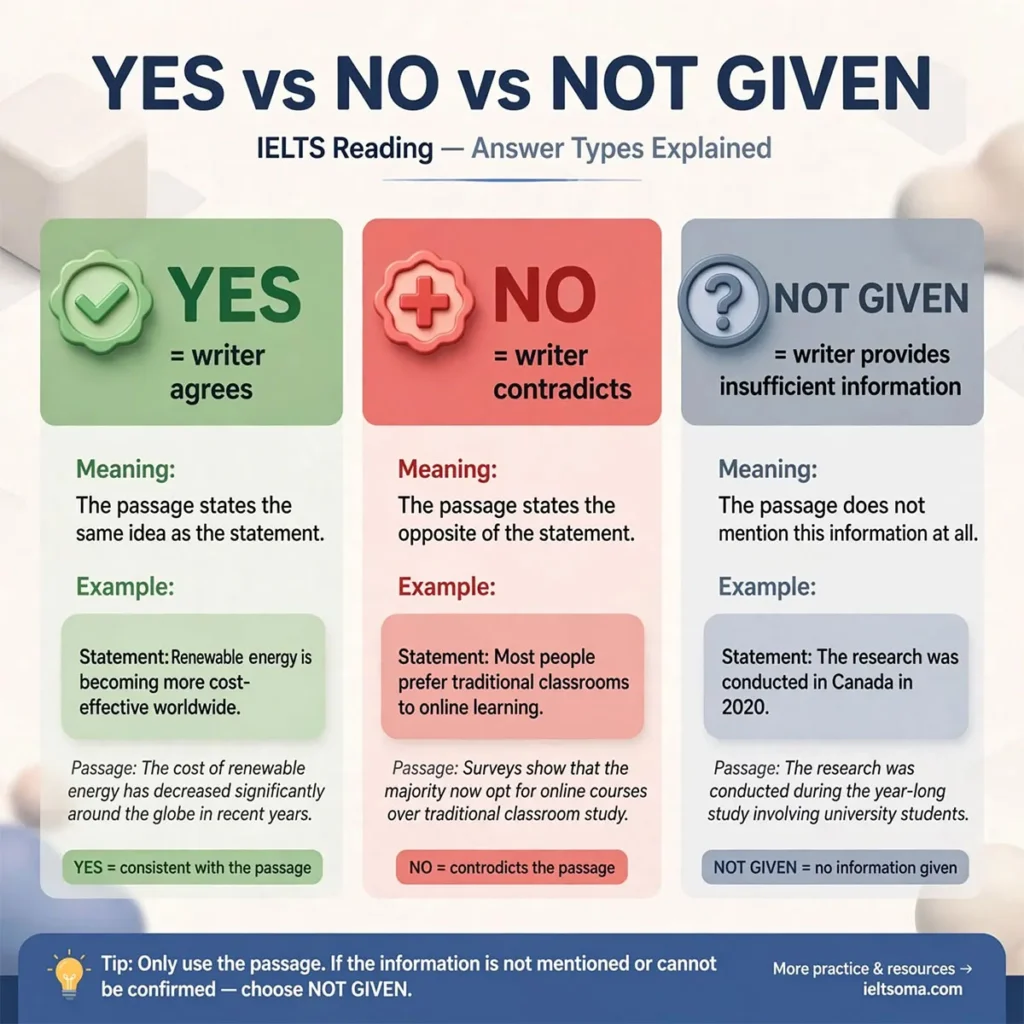
The three possible answers mean:
| Answer | What it means |
|---|---|
| YES | The statement agrees with the writer’s view or claim. |
| NO | The statement contradicts the writer’s view or claim. |
| NOT GIVEN | The writer does not provide enough information to say whether the statement agrees or disagrees. |
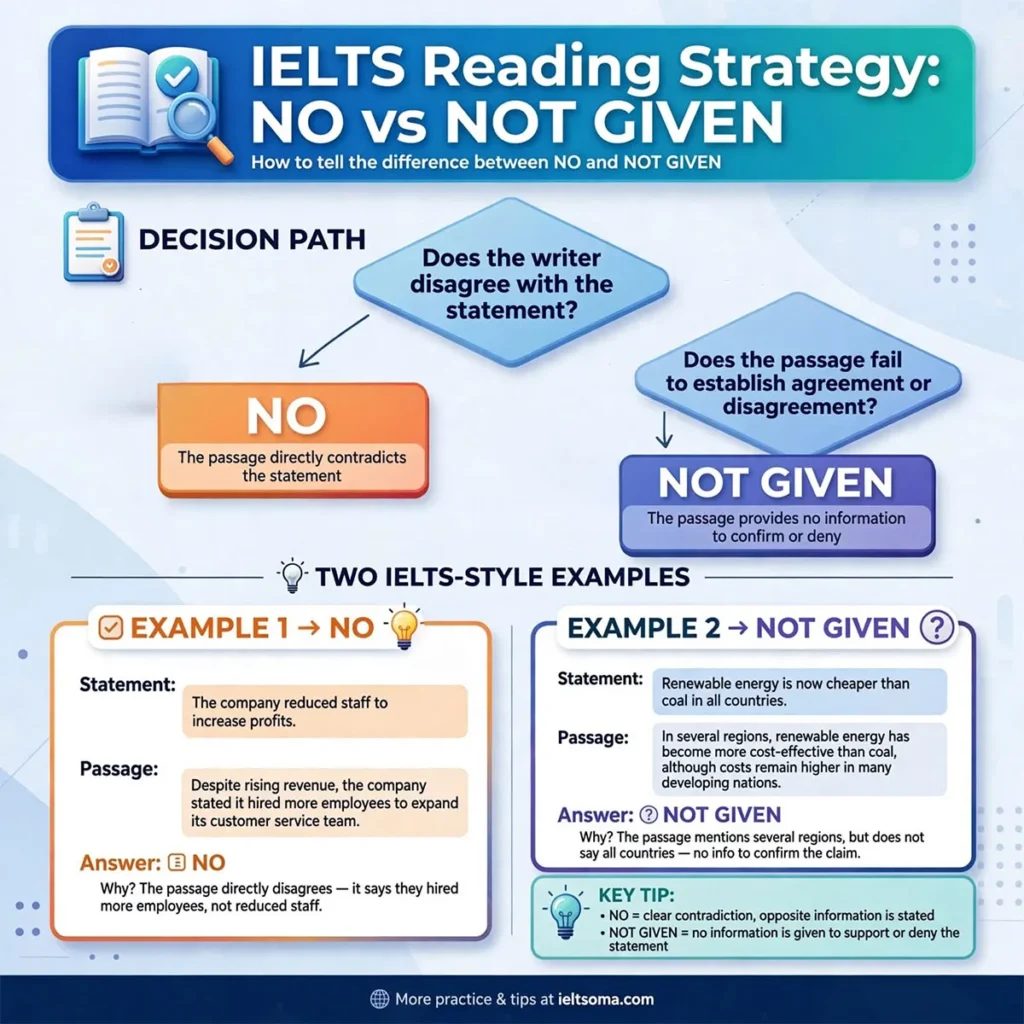
The most important distinction is between NO and NOT GIVEN.
If the writer clearly expresses the opposite idea, the answer is NO.
If the writer does not tell you enough to determine the writer’s position, the answer is NOT GIVEN.
Official IELTS guidance specifically warns candidates not to use their own knowledge when deciding these answers. Your answer must be based on the information and views expressed in the passage.
Yes vs No vs Not Given: The Essential Difference
Think of the task as a three-way evidence test.
Ask:
Does the writer agree?
If yes → YES
Then ask:
Does the writer clearly disagree?
If yes → NO
If neither is true → NOT GIVEN
This sounds simple, but candidates often make the mistake of treating the absence of supporting evidence as proof that the writer disagrees.
It is not.
Example 1: YES
Passage:
The writer argues that public transport should receive greater investment because it can reduce congestion in major cities.
Statement:
The writer believes that governments should invest more heavily in public transport.
Answer: YES
The statement expresses essentially the same idea as the writer.
Example 2: NO
Passage:
The writer argues that public transport should receive greater investment because it can reduce congestion in major cities.
Statement:
The writer believes that governments should reduce investment in public transport.
Answer: NO
The statement contradicts the writer.
Example 3: NOT GIVEN
Passage:
The writer argues that public transport should receive greater investment because it can reduce congestion in major cities.
Statement:
The writer believes that public transport is cheaper than private cars.
Answer: NOT GIVEN
The writer discusses investment and congestion but does not express a view about whether public transport is cheaper than private cars.
That is the key.
No evidence of agreement is not automatically evidence of disagreement.
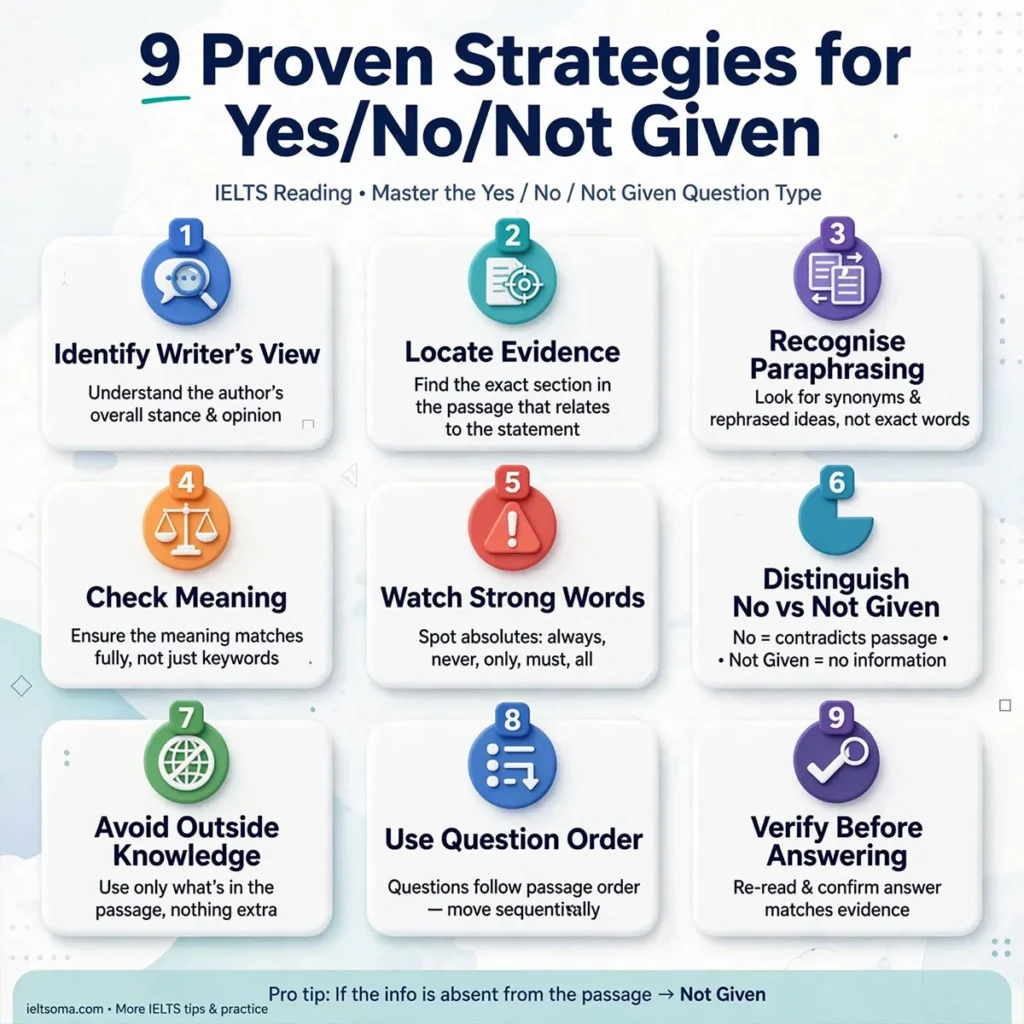
1. Identify Whether the Question Is About the Writer’s View
Before searching for an answer, read the instructions carefully.
You may see wording such as:
Do the following statements agree with the views of the writer?
or:
Do the following statements agree with the claims of the writer?
This wording matters.
You are not simply looking for whether something is factually true.
You are identifying the writer’s position.
For example:
Statement:
Electric vehicles are the best solution to urban pollution.
Suppose the passage says:
Several researchers have investigated whether electric vehicles can reduce pollution in cities.
That does not mean YES.
The writer may be reporting research without personally claiming that electric vehicles are the best solution.
Look carefully for language that signals the writer’s position.
Common signals include:
- argues
- claims
- suggests
- believes
- maintains
- contends
- proposes
- questions
- criticises
- supports
- rejects
- recommends
- points out
However, do not assume that every sentence containing these words represents the writer’s own view. The writer may be reporting someone else’s opinion.
2. Find the Writer’s Position, Not Just the Topic
One of the most common mistakes in Yes/No/Not Given Questions in IELTS Reading is finding the correct topic but missing the writer’s attitude towards it.
Consider:
Some economists argue that remote working increases productivity. However, the writer questions whether these benefits apply equally across different industries.
Now consider the statement:
The writer believes that remote working always increases productivity.
The passage mentions increased productivity, but the writer questions whether the benefits apply equally.
The correct answer is NO.
The word “always” also makes the statement much stronger than the writer’s actual position.
This is why you should focus on the strength and direction of the writer’s claim, not simply the subject being discussed.
3. Use the Evidence Triangle
When solving a question, use three pieces of information:
Statement → Passage → Writer’s position
Do not jump directly from the statement to an answer.
For example:
Statement:
The writer considers technology essential for improving education.
Now locate the relevant passage.
Perhaps it says:
Technology has provided teachers with new tools, although its effectiveness depends heavily on how those tools are implemented.
The writer recognises benefits but does not necessarily say technology is essential.
The word “essential” is stronger.
The statement may therefore be NO or NOT GIVEN, depending on the complete context.
This is why the surrounding sentences matter.
4. Learn to Recognise Paraphrasing
IELTS rarely makes these questions easy by repeating the same sentence word for word.
The statement may use different vocabulary while expressing the same idea.
For example:
Statement:
The writer believes that traditional farming methods are no longer effective.
Passage:
According to the author, conventional agricultural practices have become increasingly unsuitable for modern conditions.
The vocabulary is different:
| Statement | Passage |
|---|---|
| traditional | conventional |
| farming methods | agricultural practices |
| no longer effective | increasingly unsuitable |
| believes | according to the author |
But the underlying meaning is similar.
The answer is YES.
This is why building paraphrase awareness is more useful than memorising enormous lists of synonyms.
When you practise, record relationships between ideas:
- increase → rise / grow / climb
- reduce → decrease / cut / lower
- traditional → conventional
- important → significant / crucial
- problem → difficulty / challenge / issue
- support → favour / advocate
- oppose → reject / criticise
- uncertain → doubtful / unclear
The goal is not to memorise every possible synonym.
The goal is to recognise when two different expressions communicate the same idea.
5. Master the Difference Between NO and NOT GIVEN
This is the skill that deserves the most attention.
Imagine the statement says:
The writer believes that online education is more effective than classroom teaching.
Case A — YES
The writer says:
Online education can be more effective than traditional classroom teaching when students have access to appropriate support.
The writer agrees, although with a qualification.
Answer: YES
Case B — NO
The writer says:
Despite its convenience, online education generally produces weaker learning outcomes than face-to-face teaching.
The writer expresses the opposite position.
Answer: NO
Case C — NOT GIVEN
The writer says:
Online education has become increasingly popular because it offers greater flexibility.
The writer discusses popularity and flexibility but does not compare effectiveness with classroom teaching.
Answer: NOT GIVEN
This three-example comparison is worth remembering:
YES = same position
NO = opposite position
NOT GIVEN = position cannot be established
6. Watch for Strong Words
Small words can completely change the meaning of a statement.
Pay particular attention to:
- always
- never
- all
- none
- only
- completely
- mainly
- generally
- often
- sometimes
- rarely
- probably
- certainly
- must
- may
- could
Consider:
Passage:
The writer suggests that exercise can improve concentration for many students.
Statement:
The writer believes that exercise always improves concentration.
The writer says can and many.
The statement says always.
That is a significant difference.
Do not automatically choose YES because both sentences discuss exercise and concentration.
The strength of the claim matters.
7. Use Question Order to Navigate the Passage
Yes/No/Not Given questions generally provide a useful navigation advantage because the relevant information is typically encountered in the same order as the statements.
If you locate the evidence for Question 4, you can normally continue forward rather than restarting the search from the beginning.
This does not mean that you should blindly assume every answer will appear neatly in sequence.
Instead, use question order as a navigation tool.
For example:
- Locate the evidence for Question 1.
- Confirm the writer’s position.
- Continue from that point for Question 2.
- Continue forward for Question 3.
If you keep jumping backwards through the passage, you waste valuable time.
8. Do Not Use Your Own Knowledge
This is one of the most important IELTS Reading rules.
Suppose the passage says:
The writer discusses the potential environmental benefits of solar energy.
The statement says:
Solar energy is the cheapest form of renewable energy.
You may know that solar energy can be inexpensive.
It does not matter.
If the writer does not make that claim, you cannot choose YES simply because the statement sounds reasonable.
The IELTS Reading task is not asking:
“Is this statement true in real life?”
It is asking:
“Does this statement agree with the writer’s view or claim?”
Always return to the passage.
9. Use a Fast Decision-Making Method
Under exam conditions, you cannot spend several minutes debating every statement.
Use this process.
Step 1: Read the statement
Identify the central claim.
Ignore unnecessary words temporarily.
Step 2: Underline the key idea mentally
For example:
The writer believes that government funding is essential for scientific research.
Your key idea is:
government funding → essential → scientific research
Step 3: Locate the relevant passage
Search for the topic and likely paraphrases.
Step 4: Read around the evidence
Do not rely on one isolated sentence if the writer’s position is unclear.
Read enough surrounding text to understand the argument.
Step 5: Compare meanings
Ask:
Does the writer agree?
YES.
Does the writer contradict it?
NO.
Does the writer fail to establish either position?
NOT GIVEN.
Step 6: Move on
Do not spend excessive time trying to force an answer.
Your goal is accurate decision-making, not perfect certainty.
A Complete Worked Example
Read this short passage:
Many cities have introduced cycling schemes to encourage residents to use bicycles instead of cars. The writer believes these programmes can reduce pressure on urban transport networks. However, their success depends on several factors, including safe cycling infrastructure and public willingness to use it. The writer does not suggest that cycling can replace private cars completely. Instead, cycling should be viewed as one component of a broader transport strategy.
Now consider the statements.
Statement 1
The writer believes cycling schemes can reduce pressure on city transport systems.
Answer: YES
The passage directly supports this.
Statement 2
The writer believes cycling schemes are successful in every city.
Answer: NOT GIVEN
The writer discusses conditions that affect success but does not say that schemes succeed everywhere.
Statement 3
The writer believes cycling can completely replace private cars.
Answer: NO
The writer explicitly says the opposite.
Statement 4
The writer believes cycling should be part of a wider transport strategy.
Answer: YES
This is directly supported by the final sentence.
Notice how the answers depend on the writer’s position rather than individual vocabulary matches.
Common Traps in Yes/No/Not Given Questions
Trap 1: Same words, different meaning
A statement may repeat several words from the passage but change the meaning.
Passage:
The project was initially considered expensive.
Statement:
The writer believes the project is currently too expensive.
The word “expensive” appears in both, but the time reference and meaning have changed.
Do not choose YES automatically.
Trap 2: True in real life
A statement may be factually correct but still be NOT GIVEN.
The passage is your source of evidence.
Trap 3: A partial match
The passage may support part of a statement but not all of it.
For example:
The writer believes public transport is affordable and more reliable than private cars.
Perhaps the writer only says that public transport is affordable.
If the comparison with private cars is not established, you cannot treat the entire statement as YES.
Trap 4: Extreme language
Words such as always, never, all and only deserve immediate attention.
The passage may express a moderate opinion while the question presents an absolute one.
Trap 5: Confusing someone else’s opinion with the writer’s
Consider:
Professor Ahmed argues that government subsidies are essential. The writer, however, questions this assumption.
If the statement says:
The writer believes government subsidies are essential.
The answer is NO, even though the passage contains the phrase “subsidies are essential”.
You must identify who holds the opinion.
Yes/No/Not Given vs True/False/Not Given
These two question types look almost identical, which causes many mistakes.
The key difference is what you are evaluating.
| Question type | What you evaluate |
|---|---|
| True/False/Not Given | Information or facts in the passage |
| Yes/No/Not Given | The writer’s views or claims |
The official IELTS format describes True/False/Not Given as identifying information and Yes/No/Not Given as identifying the writer’s views or claims.
Example
True/False/Not Given
The city introduced a new transport policy in 2022.
You are checking whether the factual information is supported, contradicted or absent.
Yes/No/Not Given
The writer believes the city’s new transport policy is effective.
Now you need to identify the writer’s opinion.
Do not use exactly the same mental process for both tasks.
A Useful Comparison: YES, NO and NOT GIVEN
| Situation | Answer |
|---|---|
| Writer agrees with the statement | YES |
| Writer clearly expresses the opposite | NO |
| Writer does not provide enough information | NOT GIVEN |
| Statement is true in your own knowledge | Ignore this |
| Passage contains similar vocabulary | Investigate the meaning |
| Another person’s opinion matches the statement | Check the writer’s own position |
| Statement is partly supported but adds an unsupported claim | Be careful; do not automatically choose YES |
How to Practise Yes/No/Not Given Questions Effectively
Doing practice tests repeatedly is useful, but analysing your mistakes is even more valuable.
After each exercise, create an error log.
| Question | My answer | Correct answer | Why I was wrong |
|---|---|---|---|
| 4 | YES | NOT GIVEN | I assumed missing information |
| 7 | NOT GIVEN | NO | I missed the writer’s opposite view |
| 9 | YES | NO | I focused on identical vocabulary |
| 12 | NO | YES | I misunderstood the paraphrase |
Look for patterns.
If you repeatedly confuse NO and NOT GIVEN, practise evidence classification.
If you choose YES because of repeated vocabulary, practise paraphrasing.
If you struggle to identify the writer’s position, practise opinion markers and attribution.
This is much more effective than simply completing another ten questions.
Academic and General Training Candidates
Yes/No/Not Given questions can appear in both IELTS Academic and General Training Reading. Official IELTS sample materials list identifying writer’s views/claims using Yes/No/Not Given among the Reading task types for both versions.
The reading material differs between the two tests, but the fundamental reasoning remains the same.
Academic candidates may encounter more complex arguments, academic vocabulary and research-based discussion.
General Training candidates may encounter a wider range of practical and general-interest texts.
In both cases, the core process is unchanged:
Locate → understand → identify the writer’s position → compare → decide.
How to Improve Your Accuracy Before Test Day
Use this five-part training routine.
1. Practise one question type at a time
Do not immediately mix every IELTS Reading question type.
Spend dedicated sessions on Yes/No/Not Given.
2. Explain every answer
Do not simply write:
Question 5 = NO
Write:
NO because the writer says X, whereas the statement claims Y.
This forces you to understand the evidence.
3. Highlight the contradiction
When the answer is NO, identify exactly where the writer disagrees.
4. Identify missing evidence
When the answer is NOT GIVEN, ask:
What information would I need to prove YES or NO?
Then confirm that the passage does not provide it.
5. Practise paraphrase recognition
Compare the statement with the relevant passage sentence and identify how the wording has changed.
This develops one of the most transferable IELTS Reading skills.
The 30-Second Mental Checklist
When you are uncertain, ask yourself these questions:
- Is this question asking about the writer’s opinion?
- Where does the writer discuss this idea?
- What exactly does the writer say?
- Does the writer agree with the statement?
- If not, does the writer clearly disagree?
- If neither, is it NOT GIVEN?
- Am I using only the passage rather than my own knowledge?
If you can answer those questions consistently, your accuracy should improve.
Frequently Asked Questions About Yes/No/Not Given Questions in IELTS Reading
What is the difference between No and Not Given in IELTS Reading?
No means the writer’s view contradicts the statement. Not Given means the writer does not provide enough information to establish whether the statement agrees or disagrees with the writer’s view.
Can Not Given mean the statement is probably false?
No. Not Given does not mean false. It means the passage does not provide sufficient evidence to classify the statement as either agreeing or disagreeing with the writer.
Should I use my general knowledge?
No. Your answer must be based on the information and views presented in the passage. Official IELTS guidance specifically warns candidates against relying on outside knowledge.
Are Yes/No/Not Given questions the same as True/False/Not Given?
No. True/False/Not Given focuses on information in the text, while Yes/No/Not Given focuses on the writer’s views or claims.
How can I find Yes/No/Not Given answers quickly?
Use the question order to help navigate the passage, identify important words and paraphrases, locate the relevant section, and then read enough context to establish the writer’s position.
What should I do when the passage uses different words from the question?
Look for equivalent meaning rather than identical vocabulary. IELTS commonly tests your ability to recognise paraphrasing.
What if only part of the statement is supported?
Be careful. A statement must agree with the writer’s position as a whole. If the statement adds a claim that the writer does not make, do not automatically choose YES.
Final Strategy: Think Like the Writer
The biggest improvement you can make with Yes/No/Not Given Questions in IELTS Reading is to stop asking:
“Can I find these words in the passage?”
Instead, ask:
“What does the writer actually believe, claim or argue?”
That shift changes the entire task.
Remember:
YES = the writer agrees.
NO = the writer disagrees.
NOT GIVEN = the writer does not establish either position.
Then add three habits:
- Expect paraphrasing.
- Watch for strong or limiting words.
- Never replace the passage with your own knowledge.
When you practise this method consistently, Yes/No/Not Given questions become less about guessing and more about evidence.
That is the real skill IELTS is testing: your ability to recognise and evaluate a writer’s ideas accurately, even when those ideas are expressed using unfamiliar vocabulary or complex language.
For additional practice, use the official IELTS sample Reading materials for Academic and General Training
Further Reading:
- IELTS Reading Multiple Choice Questions: 9 Smart Strategies
- IELTS Reading Comprehension Strategies: 9 Powerful Ways to Understand Texts
- IELTS Reading Question Types: 14 Types You Must Master
- IELTS Reading Text Structures: 8 Powerful Patterns to Read Faster
- IELTS Reading Summary Completion: 7 Proven Tips to Score Higher