Imagine hearing an unfamiliar word in the IELTS Listening test. You do not know its exact meaning, and you cannot pause the recording. Do you panic and lose the next answer?
You do not have to.
One of the most useful skills you can develop is learning to use contextual clues in IELTS Listening. Instead of depending on every individual word, you learn to understand what the speaker means from the surrounding information, tone, examples, explanations, and changes in direction.
This skill can be particularly valuable when the recording contains unfamiliar vocabulary, paraphrasing, corrections, distractors, or information that is presented differently from the question.
The IELTS Listening test contains four parts and 40 questions. You hear each recording once, so being able to use context quickly can make a significant difference to your performance.
In this guide, you will learn how contextual clues in IELTS Listening work, where to find them, how to use them with different question types, and how to practise this skill effectively.
Table of Contents
What Are Contextual Clues in IELTS Listening?
Contextual clues are pieces of information surrounding an unfamiliar word, phrase, idea, or answer that help you understand its meaning.
In IELTS Listening, these clues can come from:
- Words before or after an unfamiliar expression
- Examples given by the speaker
- Explanations or definitions
- Contrasting information
- Cause-and-effect relationships
- Speaker corrections
- Changes in topic
- Tone and emphasis
- The situation being discussed
- Information in the question itself
For example, imagine you hear:
“The accommodation was rather cramped. There was barely enough room for two people to move around.”
You may not know the word cramped.
However, the second sentence provides a clear clue. “Barely enough room” suggests that the accommodation was small or lacking space.
You do not necessarily need to know the dictionary definition immediately. You need to understand the meaning that matters for the listening task.
This is the central idea behind using contextual clues in IELTS Listening.
Why Context Matters in the IELTS Listening Test
The IELTS Listening test is not simply a test of how many English words you recognise.
The official IELTS description states that Listening assesses skills including understanding main ideas and detailed factual information, understanding speakers’ opinions and attitudes, understanding the purpose of an utterance, and following the development of ideas.
That means you need to understand meaning in context, not just individual vocabulary items.
This becomes particularly important because:
- You hear the recording only once.
- Different accents may be used.
- Speakers may paraphrase information.
- You may encounter unfamiliar vocabulary.
- Speakers may change or correct information.
- Incorrect options may appear as distractors.
- The information may be surrounded by additional details.
The official IELTS test format confirms that recordings are played once and may feature British, Australian, New Zealand and North American accents.
Context gives you another way to interpret the information when a single word is unclear.
7 Types of Contextual Clues in IELTS Listening
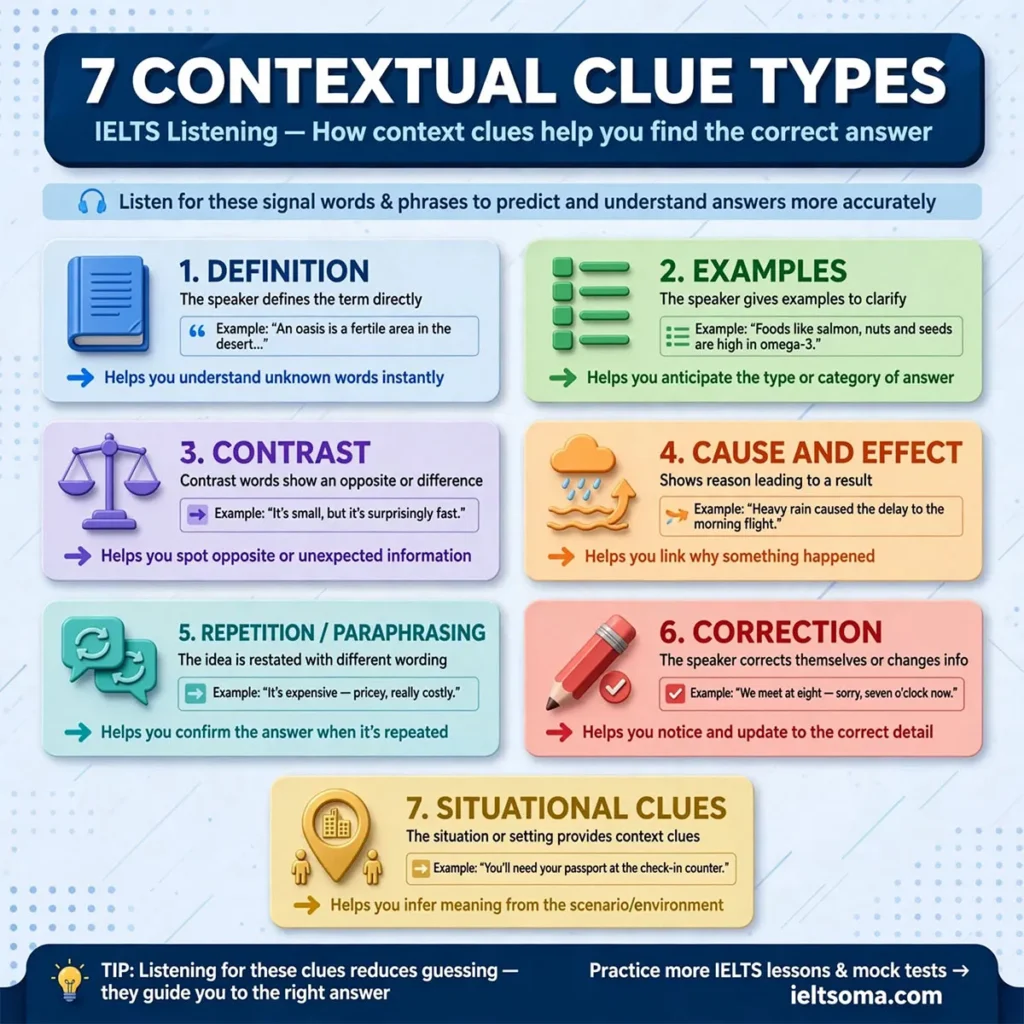
Learning to recognise different types of clues makes the skill much easier to apply.
1. Definition Clues
Sometimes speakers explain an unfamiliar term immediately after using it.
For example:
“The building uses passive ventilation. In other words, air moves through the building naturally rather than through mechanical systems.”
Even if passive ventilation is unfamiliar, the phrase “in other words” signals an explanation.
The explanation tells you what the term means.
Listen carefully for expressions such as:
- in other words
- that means
- this refers to
- what I mean is
- essentially
- basically
- known as
- called
These expressions often introduce clarification.
2. Example Clues
Examples can reveal the meaning of an unfamiliar word.
For example:
“Several forms of renewable energy are becoming popular, such as solar power, wind energy and hydropower.”
Even if you do not know exactly what renewable energy means, the examples provide useful information.
You can infer that it refers to types of energy such as solar and wind power.
Listen for:
- for example
- for instance
- such as
- including
- particularly
- one example is
- like
Examples are especially useful in Part 4, where you may hear academic explanations or lectures.
3. Contrast Clues
Contrast is another powerful contextual signal.
Consider:
“The original design was expensive to construct. However, the revised version is considerably cheaper.”
If you hear that something is expensive and then hear however, you should expect a contrast.
Common contrast signals include:
- however
- but
- although
- whereas
- unlike
- instead
- on the other hand
- in contrast
- rather than
These words can be extremely important because the speaker may introduce one piece of information and then replace it with another.
4. Cause-and-Effect Clues
A speaker may explain why something happened.
For example:
“The event was moved indoors because heavy rain was forecast.”
Even if you do not understand every word, the relationship is clear:
Heavy rain → event moved indoors
Listen for expressions such as:
- because
- because of
- due to
- as a result
- therefore
- consequently
- this led to
- resulting in
- since
These clues can help you connect information and predict what the speaker is likely to say next.
5. Repetition and Paraphrasing
Sometimes a speaker expresses the same idea more than once using different words.
For example:
“The course is fairly demanding. In fact, students are expected to complete several hours of independent study each week.”
The phrase “in fact” introduces supporting information.
The second statement helps explain what “demanding” means in this particular context.
This is especially useful because IELTS questions often do not repeat the exact wording from the recording.
The question may say:
The course requires a significant amount of ______.
The speaker might say:
Students are expected to complete several hours of independent study.
The important skill is recognising the relationship between the ideas rather than waiting for identical words.
6. Correction Clues
Corrections are particularly important in IELTS Listening.
A speaker may give one piece of information and then immediately correct it.
For example:
“The meeting is on Thursday—sorry, I mean Friday afternoon.”
The first answer may sound attractive because you hear it clearly. However, the correction tells you that Friday is the final information.
Listen for:
- sorry
- actually
- I mean
- rather
- no, that’s not right
- let me correct that
- I should say
- or rather
When you hear a correction, pay close attention to what follows.
7. Situational Clues
Sometimes the situation itself gives you useful information.
Suppose Part 1 involves someone booking a hotel room.
Before the recording begins, you might see questions asking about:
- arrival date
- number of nights
- room type
- price
- breakfast
The situation helps you predict the vocabulary and information you are likely to hear.
This is one reason preparation time matters. IELTS guidance encourages test takers to anticipate the topic and the type of information they need before listening.
How to Use Contextual Clues Before Listening
Contextual clues are not only something you use after hearing a difficult word.
You can begin using context before the recording starts.
Step 1: Read the Questions
Look at the questions carefully during the available preparation time.
Ask yourself:
What is this section probably about?
For example, if you see:
- accommodation
- deposit
- landlord
- address
- facilities
you can reasonably predict that the conversation may involve renting accommodation.
You are preparing your brain for the likely context.
Step 2: Predict the Type of Information
Look at the grammar around each blank.
For example:
The apartment has ______ bedrooms.
You can predict that a number is likely.
Or:
The main reason for the change was ______.
You are probably listening for a reason or explanation.
Prediction does not give you the answer, but it tells you what to listen for.
Step 3: Identify Key Words
Do not try to memorise every word on the page.
Instead, identify the words that establish the context.
For example:
Conference | location | transport | accommodation
These words create a mental framework.
Step 4: Think About Possible Paraphrases
If the question says:
The hotel is close to the airport.
The recording may say:
It’s only about ten minutes from the terminal.
The meaning is similar even though the vocabulary is different.
How to Use Contextual Clues While Listening
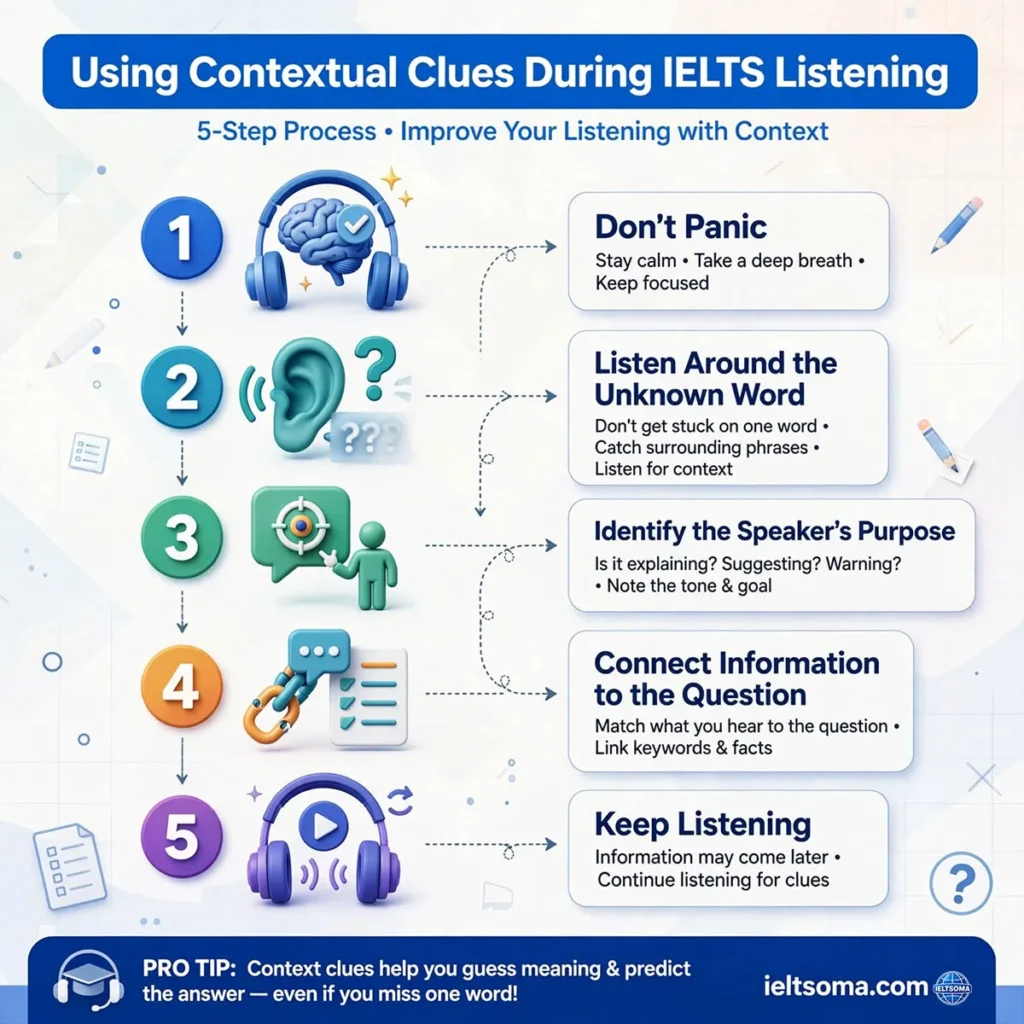
Once the recording begins, your job changes from preparation to active interpretation.
Listen Beyond Individual Words
One of the biggest mistakes IELTS candidates make is trying to understand every word.
That approach can cause problems.
If you hear one unfamiliar word and spend several seconds thinking about it, the speaker may already have moved to the next answer.
Instead, ask:
What does the surrounding information tell me?
Suppose you hear:
“The museum was initially quite inaccessible, particularly for visitors using wheelchairs.”
Even if inaccessible is unfamiliar, the phrase about wheelchair users provides useful context.
You can infer that the museum was difficult to reach or use for some visitors.
Follow the Development of Ideas
The official IELTS description highlights the importance of following the development of ideas.
This is where contextual listening becomes powerful.
Speakers often move through a predictable structure:
Topic → explanation → example → contrast → conclusion
If you understand where the speaker is in that structure, you have a better chance of identifying the important information.
Contextual Clues and IELTS Question Types
Contextual clues can help with several IELTS Listening question types.
Multiple Choice
Multiple-choice questions often contain several plausible options.
A speaker may mention more than one option, but only one represents the final answer.
For example:
“We originally considered holding the event in the library, but it was too small. The sports hall was another possibility, although it wasn’t available. So we’ve decided to use the community centre.”
You may hear all three locations.
The context tells you the progression:
Library → rejected
Sports hall → unavailable
Community centre → final choice
Do not automatically choose the first option you hear.
Form, Note and Table Completion
Context can help you predict what belongs in a blank.
Suppose the question says:
Number of participants: ______
You know that a number is likely.
If the speaker says:
“We expected around 40 people, but 55 eventually registered.”
You need to understand which number answers the question.
Context helps distinguish expectation from actual registration.
Matching Questions
Matching questions require you to connect information to people, places or categories.
Contextual clues can help you identify who is speaking and what their role is.
For example:
“Unlike Maria, I wasn’t particularly interested in the historical aspect. I was more concerned with how the building was designed.”
The contrast between the speakers helps you identify their different opinions.
Map and Plan Questions
Context is also valuable when following directions.
Official IELTS guidance recommends listening for phrases describing movement and location, such as directions to the left, straight ahead or opposite.
For example:
“Walk through the main entrance. The café is directly opposite the reception desk.”
You can use the starting point, direction and nearby landmarks together.
The meaning comes from the relationship between locations, not from one word alone.
A Simple Contextual Clue Formula
When you hear an unfamiliar word, use this five-step process:
1. Don’t panic.
You probably do not need the exact dictionary definition.
2. Listen to the words around it.
Look for explanations, examples or contrasts.
3. Identify the speaker’s purpose.
Is the speaker defining something, giving an example, correcting information or changing the topic?
4. Connect it to the question.
Ask whether the information helps answer the current question.
5. Keep listening.
Never sacrifice several answers trying to understand one unfamiliar expression.
A Practical Example
Imagine the question says:
The new transport system was introduced to reduce ______.
You hear:
“The city introduced the new tram network partly because traffic congestion had become a serious problem. During peak hours, journey times had increased dramatically.”
You might not hear the exact phrase from the question.
But the contextual relationship is clear:
New tram network → response to traffic congestion
The answer is therefore related to traffic congestion, not journey times.
This is an important distinction.
Context helps you understand the relationship between the information and the question.
Common Mistakes When Using Contextual Clues
Mistake 1: Trying to Translate Everything
If you translate every unfamiliar word into your first language, you may lose track of the recording.
Train yourself to understand ideas directly in English.
Mistake 2: Choosing the First Answer You Hear
IELTS Listening can include distractors.
A speaker may mention an option before rejecting or correcting it.
Always listen for what happens next.
Mistake 3: Ignoring Signal Words
Words such as but, however, actually, because, therefore and for example can reveal the relationship between ideas.
Do not treat them as insignificant.
Mistake 4: Getting Stuck on One Unknown Word
Missing one word does not necessarily mean missing the answer.
Use the surrounding information and continue listening.
Mistake 5: Assuming the Question and Recording Will Use the Same Words
IELTS Listening frequently requires you to recognise meaning across different wording.
Focus on ideas and relationships rather than exact vocabulary.
How to Practise Contextual Clues in IELTS Listening
You can develop this skill with deliberate practice rather than simply completing test after test.
Practice 1: Listen for Meaning, Not Answers
Choose a short English audio clip.
Listen once without looking at questions.
Write down:
- What is the topic?
- Who is speaking?
- What is the purpose?
- What are the main points?
- What examples are given?
This builds general comprehension.
Practice 2: Build a Context Notebook
When you encounter an unfamiliar word, do not record only the definition.
Record the context too.
For example:
Word: cramped
Context: accommodation with very little space
Clue: “barely enough room to move”
This teaches you how vocabulary functions in real speech.
Practice 3: Identify Signal Words
Take a Listening transcript and highlight:
- contrasts
- examples
- explanations
- corrections
- causes
- results
- changes of topic
Then listen again and notice how these signals sound.
Practice 4: Predict Before Listening
Before starting a practice test, predict:
- the topic
- likely vocabulary
- possible answer types
- possible relationships between ideas
Then compare your predictions with the recording.
Practice 5: Review Your Mistakes by Cause
Do not simply mark an answer as wrong.
Ask why you missed it.
Was it because:
- you did not know the vocabulary?
- you missed a paraphrase?
- you ignored a correction?
- you followed a distractor?
- you lost concentration?
- you misunderstood the context?
- you wrote the wrong spelling?
This type of analysis is much more useful than simply doing another test.
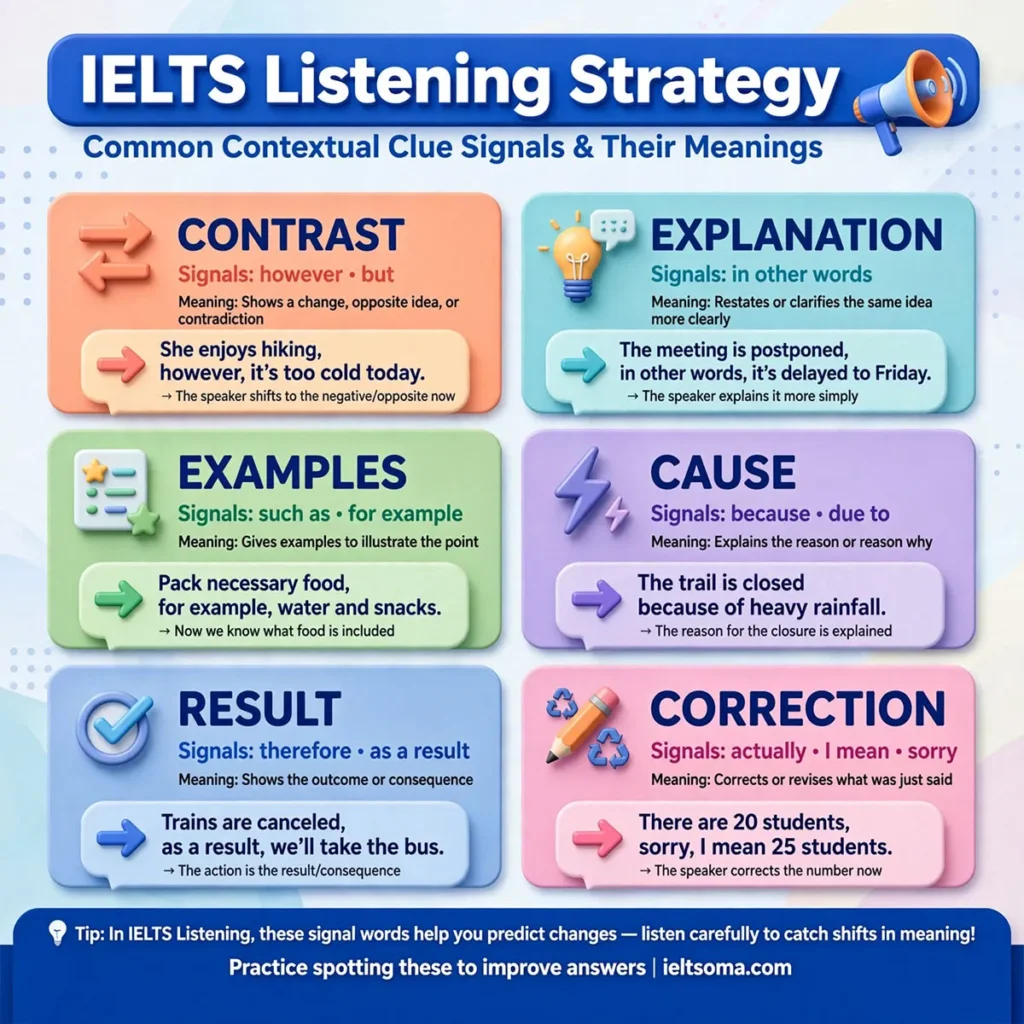
Contextual Clues in IELTS Listening: Quick Comparison
| Clue type | What to listen for | What it helps you understand |
|---|---|---|
| Definition | “In other words”, “that means” | Meaning |
| Example | “For example”, “such as” | Specific meaning |
| Contrast | “However”, “but”, “although” | Difference or change |
| Cause | “Because”, “due to” | Reason |
| Result | “Therefore”, “as a result” | Consequence |
| Correction | “Actually”, “sorry”, “I mean” | Final information |
| Repetition | Similar idea in different words | Paraphrased meaning |
| Situation | Topic, speakers, setting | Likely information |
Expert Tips for Better Listening Performance
If you want to use contextual clues in IELTS Listening more effectively, remember these principles:
Think in ideas, not isolated words.
The recording is a connected message. Understanding relationships between ideas is often more valuable than recognising every vocabulary item.
Use the questions as context.
The question paper gives you information about the topic and the type of answer you need.
Watch for changes.
Words such as but, however, actually and instead can signal that the speaker is changing direction.
Expect paraphrasing.
The recording may communicate the same idea using different vocabulary.
Keep moving.
The recording continues whether you understand a word or not.
Review strategically.
After each practice test, identify the exact reason you missed an answer.
FAQs About Contextual Clues in IELTS Listening
What are contextual clues in IELTS Listening?
Contextual clues are surrounding pieces of information that help you understand an unfamiliar word, phrase, idea or answer. They can include examples, definitions, contrasts, corrections, causes and explanations.
Why are contextual clues important in IELTS Listening?
They help you understand meaning even when you do not recognise every word. This is especially useful because IELTS Listening recordings are heard only once and may contain different accents and unfamiliar vocabulary.
Can contextual clues help with multiple-choice questions?
Yes. They can help you distinguish between options when the recording mentions several possibilities. Pay close attention to corrections, contrasts and changes of opinion.
How can I practise contextual clues?
Use listening transcripts to identify definitions, examples, contrasts, causes, results and corrections. Then listen again without relying on the transcript and notice how these relationships are communicated.
Do I need to understand every word in IELTS Listening?
No. Trying to understand every word can actually reduce your effectiveness. Focus on the meaning of the message, the questions and the relationships between ideas.
Are contextual clues useful in all four IELTS Listening parts?
Yes. The Listening test has four parts covering social, educational and training situations, including conversations and monologues. Contextual understanding can therefore be useful throughout the test.
Final Takeaway
Strong IELTS Listening performance is not simply about having a large vocabulary.
It is about understanding meaning quickly.
When an unfamiliar word appears, do not immediately assume that you have lost the answer. Listen to what comes before and after it. Look for examples, explanations, contrasts, corrections and relationships between ideas.
The more effectively you use contextual clues in IELTS Listening, the less dependent you become on recognising every individual word.
And that is a much more realistic way to approach a test in which the recording keeps moving.
Further Readings: