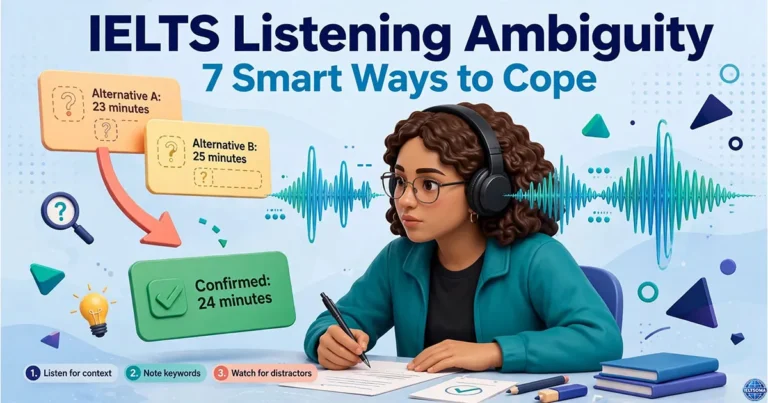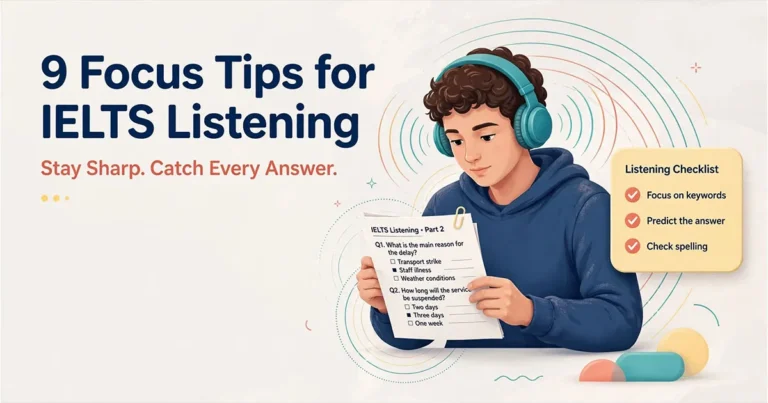
If you can understand English in a normal conversation but still lose marks in the IELTS Listening test, your problem may not be your English level. It may be how you listen under test conditions.
IELTS Listening is designed to test more than whether you can hear English. You need to follow ideas, recognise key information, predict answers, handle different accents, notice corrections, and keep moving when you miss something.
The good news is that these are trainable skills.
By developing the right IELTS Listening skills and practising them systematically, you can become faster, more accurate and more confident without simply listening to hours of random English every day.
Table of Contents
What IELTS Listening Skills Do You Need?
The IELTS Listening test contains four parts and 40 questions. You hear each recording once, and the questions generally follow the order of the information in the recording. Parts 1 and 2 use everyday social contexts, while Parts 3 and 4 involve educational or training situations.
The most important IELTS Listening skills include:
- Predicting what information is likely to come next
- Listening for specific details
- Identifying key words and phrases
- Recognising paraphrases and synonyms
- Following changes in information
- Understanding different accents
- Distinguishing important information from supporting details
- Keeping track of several speakers
- Identifying a speaker’s attitude or intention
- Checking spelling, grammar and word limits
You do not need to master all of these at once. A structured approach is much more effective.
7 Powerful Ways to Improve IELTS Listening Skills
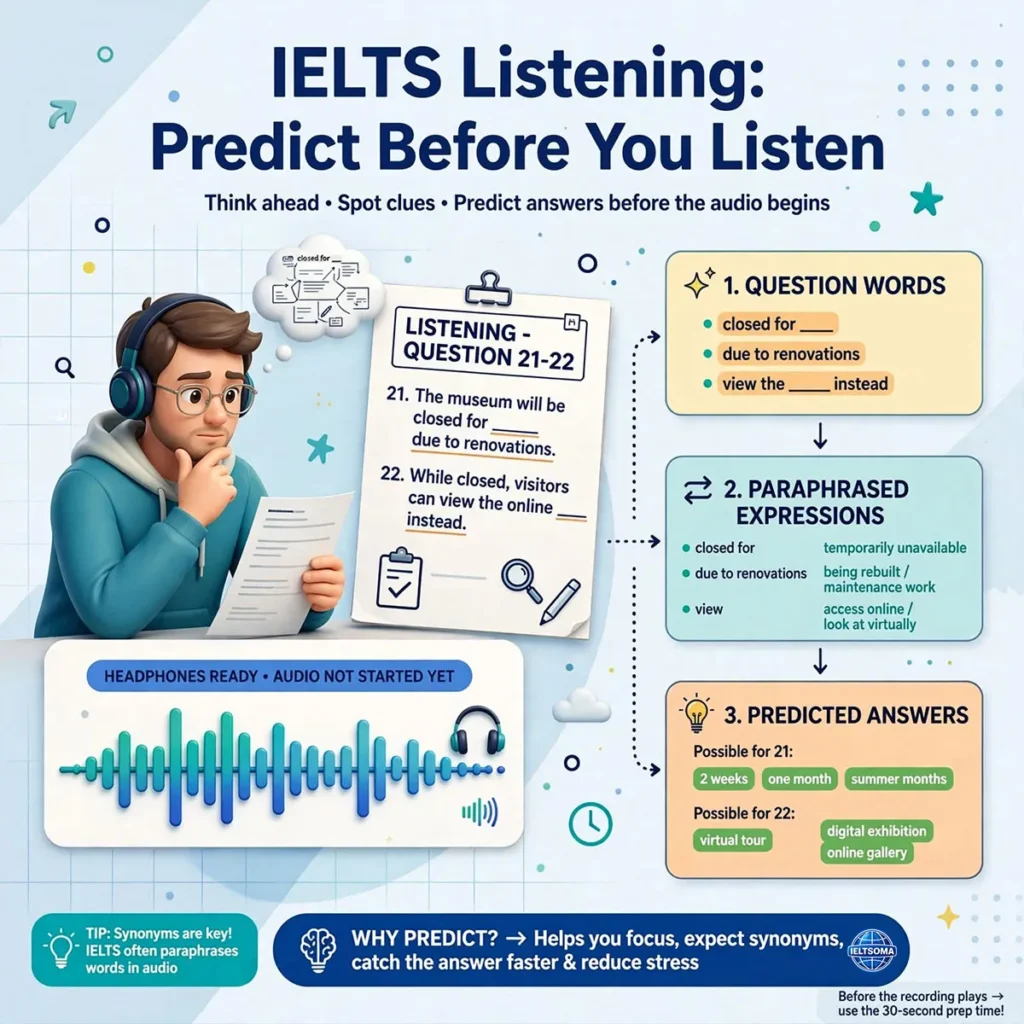
1. Predict the Answer Before You Listen
One of the most useful IELTS Listening skills is prediction.
Many candidates wait for the recording to tell them what to listen for. Strong listeners do something different: they examine the question first and create a mental prediction.
For example:
The student will stay at the ______ for three nights.
Before listening, ask:
What type of answer is required?
The answer is probably a place or accommodation.
You can then predict possibilities such as:
- hotel
- hostel
- guest house
- apartment
You do not need to predict the exact answer. You are preparing your brain to recognise the relevant information quickly.
How to practise prediction
Before each section:
- Read the questions carefully.
- Underline important words.
- Identify the type of information required.
- Predict possible answers.
- Think about synonyms that might be used in the recording.
If the question contains:
The course begins in ______.
You should immediately expect a date, day, month or time-related expression.
This reduces the amount of information your brain has to process while listening.
2. Train Yourself to Recognise Paraphrasing
A major reason candidates miss answers is that the recording often does not use exactly the same words as the question.
For example:
Question:
The library is located near the main entrance.
Recording:
You’ll find the library just beside the front doors.
The meaning is similar, but the vocabulary is different.
This is why simply memorising vocabulary lists is not enough. Your IELTS Listening skills must include recognising meaning across different expressions.
Here are some common examples:
| Question language | Possible recording language |
|---|---|
| inexpensive | affordable |
| approximately | about |
| commence | begin |
| purchase | buy |
| additional | extra |
| difficult | challenging |
| near | close to |
| postpone | put off |
| occupation | job |
| accommodation | place to stay |
When practising, do not only ask, “What was the answer?”
Ask:
“How did the recording express the same idea?”
That question turns ordinary practice into useful listening training.
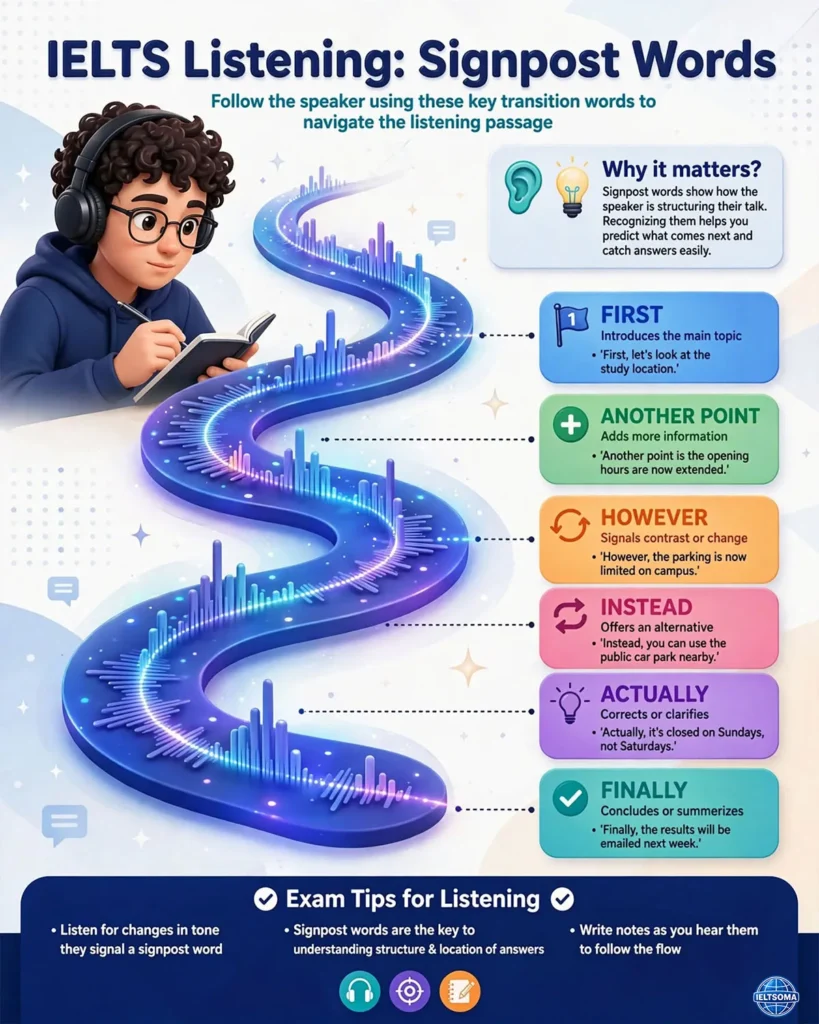
3. Listen for Signpost Words
Good speakers constantly give signals that help listeners follow their ideas.
These signals are particularly valuable in IELTS Listening because they can tell you that an important piece of information is coming.
Listen for expressions such as:
- first
- however
- but
- actually
- in contrast
- for example
- the main reason is
- another point is
- finally
- instead
- originally
- the problem was
- what I mean is
Consider this example:
The original meeting was scheduled for Tuesday. However, because several people were unavailable, it has been moved to Thursday.
If a question asks:
When will the meeting take place?
A candidate who remembers only “Tuesday” may choose the wrong answer.
A stronger listener notices the change introduced by however.
Words such as but, actually, instead, rather and although can be especially important because speakers sometimes introduce one answer and then correct or replace it.
4. Improve Your Ability to Follow Numbers, Names and Details
Some candidates understand the general meaning of a recording but still lose easy marks because they cannot process details quickly enough.
IELTS Listening frequently requires you to identify information such as:
- names
- addresses
- telephone numbers
- prices
- dates
- times
- measurements
- room numbers
- locations
These details can appear simple, but they require concentration.
For example:
“The appointment was originally at 3:15, but we’ve changed it to 3:50.”
If you hear “3:15” and stop paying attention, you may miss the correction.
Build detail-listening practice
Spend five to ten minutes several times a week listening specifically for numbers and factual information.
You could listen to a short English conversation and write down:
- every number you hear
- every name
- every date
- every location
- every change or correction
The goal is not to understand every sentence.
The goal is to become comfortable processing small pieces of information quickly.
5. Practise With Different English Accents
IELTS Listening uses a range of English accents, including British, Australian, New Zealand and North American accents.
This means that preparing exclusively with one familiar accent can create problems on test day.
You do not need to imitate different accents. You need to become comfortable understanding them.
For example, you may be familiar with one pronunciation of a word but struggle when the same word sounds different in another accent.
A better approach
Build variety into your listening practice.
Listen to:
- interviews
- educational videos
- podcasts
- lectures
- documentaries
- discussions
- news reports
Do not choose content only because it is difficult.
Choose material that exposes you to different speakers while remaining understandable enough for productive practice.
Your goal should be:
“I can understand the message even when the speaker does not sound like the English I normally hear.”
6. Learn to Keep Listening After Missing an Answer
This is one of the most important IELTS Listening skills.
You will not understand every word.
You may miss an answer because:
- the speaker talks too quickly
- you are thinking about the previous question
- you do not recognise a pronunciation
- you misunderstand a word
- you lose concentration for a few seconds
The dangerous response is to keep thinking about the missed answer.
Suppose you miss Question 14.
You continue thinking:
“What did they say? Was it Monday? Maybe it was Tuesday…”
Meanwhile, the recording has already moved to Question 15 and 16.
Now one missed answer can become three missed answers.
Use the recovery rule
When you miss an answer:
Let it go and follow the recording.
Mark your best guess if appropriate and immediately return your attention to the next question.
This is a skill you can practise.
During mock tests, deliberately train yourself to recover quickly after missing information.
A strong IELTS listener is not someone who never misses an answer.
It is someone who does not allow one missed answer to destroy the next five.
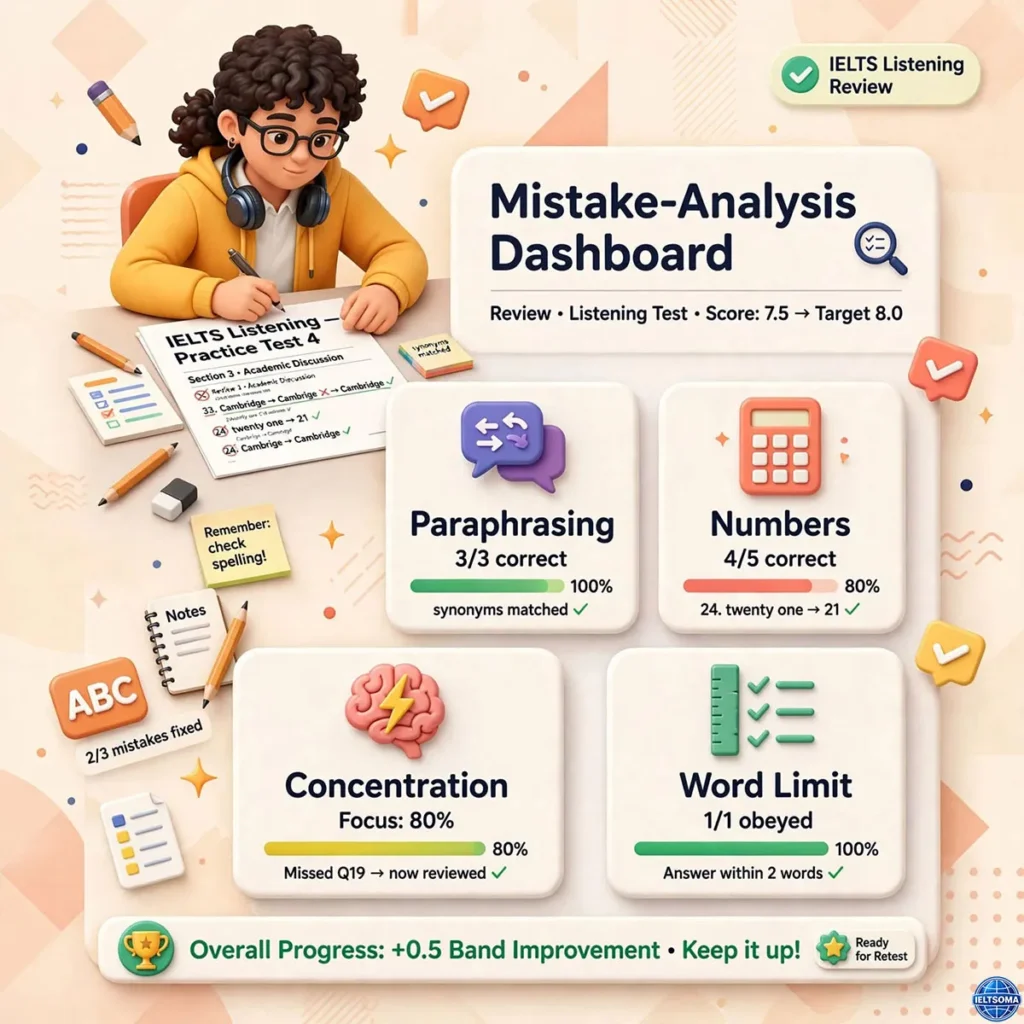
7. Review Your Mistakes Properly
Many candidates complete a Listening test, check the answers and move on.
That is not enough.
The real improvement happens during the review.
If you scored 28/40, for example, you know how many questions you got wrong. But that number does not tell you why you got them wrong.
Create a mistake log.
| Question | My answer | Correct answer | Why I missed it |
|---|---|---|---|
| 7 | hotel | hostel | Did not recognise paraphrase |
| 12 | Monday | Thursday | Missed correction |
| 19 | 15 | 50 | Number confusion |
| 26 | environment | environmental | Grammar/word form |
| 34 | — | research | Lost concentration |
After several practice tests, patterns begin to appear.
Perhaps most of your mistakes are caused by:
- spelling
- vocabulary
- paraphrasing
- numbers
- concentration
- multiple-choice questions
- map questions
- following several speakers
Now you know what to practise.
That is much more valuable than simply completing another test.
IELTS Listening Skills for Each Part
Different parts require slightly different approaches.
Part 1: Focus on Accuracy
Part 1 often involves an everyday conversation, such as making arrangements or discussing accommodation.
Focus on:
- names
- numbers
- dates
- times
- addresses
- prices
- spelling
These questions can look easy, but small mistakes can cost marks.
Part 2: Follow the Organisation
Part 2 is typically a single speaker discussing an everyday situation.
You may need to follow:
- directions
- facilities
- locations
- schedules
- descriptions
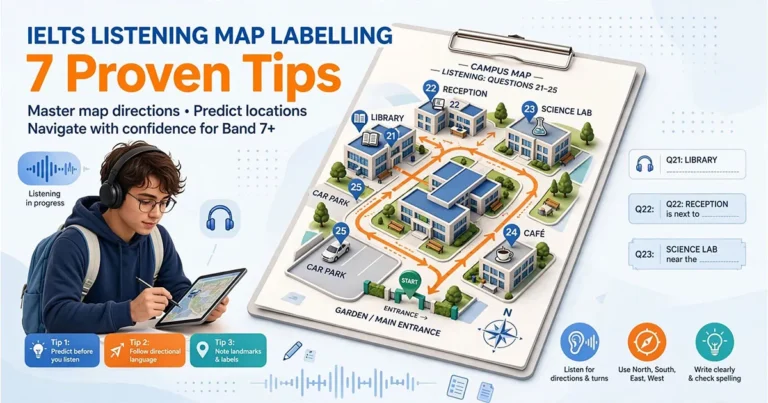
For map or plan questions, examine the visual before the recording begins.
Look for:
- entrances
- roads
- buildings
- landmarks
- directional language
Part 3: Track Different Speakers
Part 3 can involve several speakers discussing an educational or training topic.
This can be challenging because speakers may:
- agree
- disagree
- change their opinions
- interrupt one another
- give examples
- refer to someone else’s opinion
Pay attention to who is saying what.
Do not assume that the first opinion you hear is necessarily the final answer.
Part 4: Focus on Structure
Part 4 is a monologue on an academic subject.
You may hear:
First…
followed by an explanation, example or detail.
Then:
Another important factor…
and later:
Finally…
These organisational signals can help you anticipate how the information is developing.
For Part 4, practise listening to short lectures and making brief notes about the structure rather than trying to write every word.
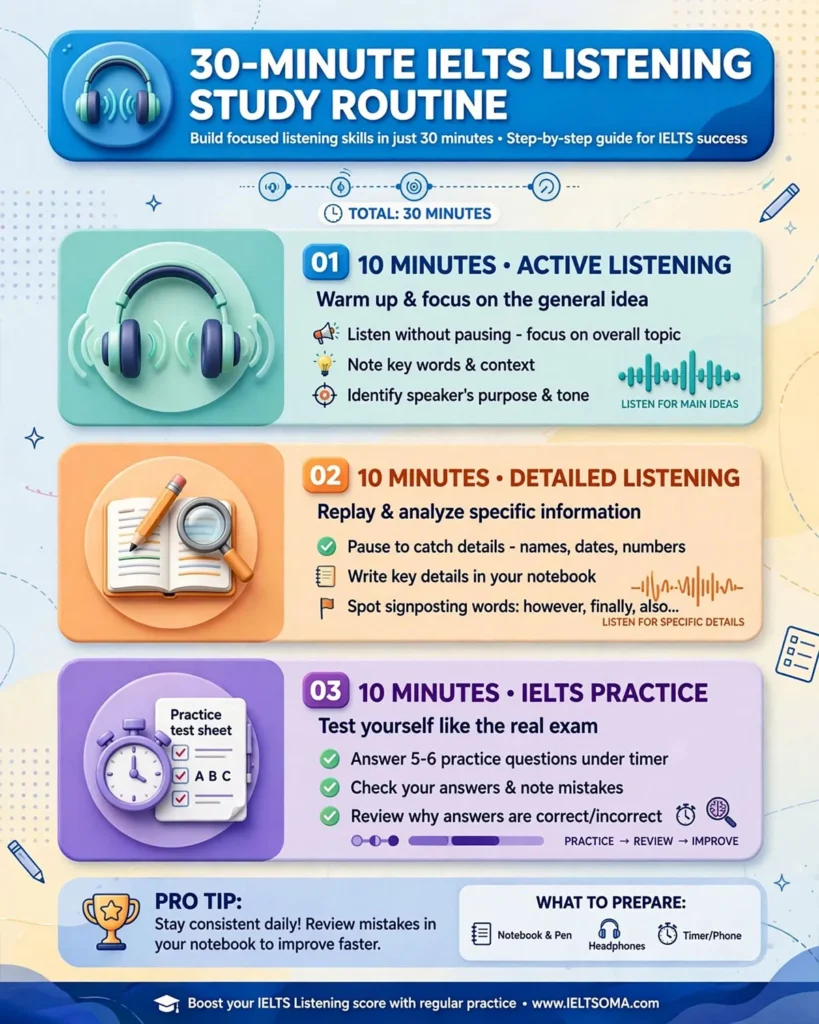
A Simple Daily Routine to Build IELTS Listening Skills
You do not need to spend several hours every day listening to English.
A focused 30-minute routine can be more useful.
10 minutes: Active listening
Choose a short recording.
Listen without subtitles and identify:
- the topic
- the main idea
- important details
- the speaker’s purpose
10 minutes: Detailed listening
Listen again.
Write down:
- unfamiliar expressions
- numbers
- important facts
- paraphrases
- signpost expressions
10 minutes: IELTS practice
Complete a small set of IELTS Listening questions.
Then check your answers and investigate every mistake.
The final step is crucial.
Do not measure progress only by the number of questions you complete. Measure it by the mistakes you stop making.
Common IELTS Listening Mistakes to Avoid
Reading questions too slowly
If you spend too much time on one question, you may not be ready for the next answer.
Trying to understand every word
IELTS Listening is not a dictation test.
You need to identify the information relevant to the questions.
Ignoring the word limit
If the instruction says:
NO MORE THAN TWO WORDS AND/OR A NUMBER
you must follow it.
The official IELTS guidance states that answers exceeding the stated word limit lose the mark.
Forgetting spelling
A correct idea with incorrect spelling can still lose the mark.
Panicking after one missed answer
Recover immediately and continue listening.
Doing practice tests without reviewing them
A practice test gives you a score.
A careful review gives you a lesson.
How to Use IELTS Practice Tests Effectively
Official IELTS practice materials can help you become familiar with the test format, question types and timed conditions.
But do not use every practice test simply as an exam.
Use a three-stage process.
Stage 1: Test
Complete the Listening test under realistic conditions.
Stage 2: Diagnose
Check every incorrect answer.
Ask:
- Did I misunderstand the recording?
- Did I miss a paraphrase?
- Did I lose concentration?
- Did I make a spelling mistake?
- Did I misunderstand the question?
- Did I exceed the word limit?
- Did I fail to notice a correction?
Stage 3: Retrain
Choose exercises that target your weaknesses.
If you repeatedly miss numbers, practise numbers.
If you struggle with maps, practise maps.
If paraphrasing causes problems, build a synonym and paraphrase notebook.
This creates a much more efficient preparation cycle.
IELTS Listening Skills: A Quick Comparison
| Weak approach | Strong approach |
|---|---|
| Listen passively | Listen with a specific purpose |
| Wait for exact words | Expect paraphrasing |
| Try to understand everything | Focus on relevant information |
| Panic after a missed answer | Recover immediately |
| Take endless practice tests | Analyse mistakes |
| Listen to only one accent | Build accent variety |
| Memorise vocabulary alone | Learn vocabulary in context |
| Ignore instructions | Check word limits carefully |
Can You Improve IELTS Listening Skills Quickly?
Yes, but the speed of improvement depends on your current level, weaknesses and consistency.
If your main problem is test technique, targeted practice may produce noticeable improvement relatively quickly.
If your main problem is vocabulary, pronunciation recognition or general comprehension, you may need longer-term language development.
The key is to identify the actual problem.
For example, a candidate scoring 26/40 because of poor prediction needs a different study plan from a candidate scoring 26/40 because they cannot understand the vocabulary in Part 4.
Your score tells you where you are. Your mistakes tell you what to do next.
Final Tips for Better IELTS Listening Performance
Before your next Listening practice session, remember these seven principles:
- Predict before listening.
- Expect paraphrasing.
- Listen for signpost words.
- Pay close attention to numbers and factual details.
- Expose yourself to different accents.
- Move on quickly when you miss an answer.
- Review mistakes instead of simply checking your score.
The IELTS Listening test rewards-controlled attention. You do not have to understand every word to achieve a strong score. You need to recognise relevant information quickly, understand how speakers develop and change ideas, and stay focused throughout the recording.
Build these habits consistently and your IELTS Listening skills can become considerably stronger.
Frequently Asked Questions
How can I improve my IELTS Listening skills?
Practise active listening, prediction, paraphrase recognition, detail listening and question-specific strategies. Most importantly, review your mistakes after every practice test and identify the exact reason you lost each mark.
How long should I practise IELTS Listening each day?
A focused 20–30 minutes can be effective when you practise deliberately. Quality matters more than simply spending hours listening passively.
Why do I understand English but still get a low IELTS Listening score?
Understanding general English is different from performing under IELTS conditions. You may struggle with prediction, paraphrasing, spelling, concentration, numbers, question types or keeping up after missing an answer.
Should I listen to English every day for IELTS?
Regular listening is useful because it develops familiarity with natural speech, vocabulary and different accents. Combine general listening with targeted IELTS practice rather than relying exclusively on full practice tests.
How can I get better at IELTS Listening Part 4?
Practise listening to short lectures and focus on structure, signpost language, main ideas and supporting details. Learn to follow how the speaker moves from one point to another instead of trying to write down everything.
Is the IELTS Listening test the same for Academic and General Training?
Yes. The Listening test is the same for IELTS Academic and IELTS General Training. The two test types differ in their Reading and Writing sections.
How many questions are there in IELTS Listening?
There are 40 questions, divided across four parts, with 10 questions in each part. Each correct answer receives one mark.
What should I do if I miss an answer?
Do not spend too long trying to recover it. Make your best decision if possible, then immediately focus on the next question. Losing concentration over one answer can cause you to miss several more.
Recommended Link(s):