Have you ever heard the correct answer in an IELTS Listening recording, only to change it at the last moment and lose the mark? Perhaps a speaker mentions one date before correcting it, discusses two different prices, or initially agrees with a suggestion before rejecting it.
These are classic examples of IELTS Listening distractors: words, details, or statements that can lead you towards an incorrect answer if you do not follow the speaker’s full meaning.
The challenge is not simply understanding English. You must recognise when a speaker changes their mind, corrects information, rejects an option, or provides a detail that sounds right but does not answer the question.
The good news is that distractors often follow recognisable patterns. Once you learn to identify them, you can make more accurate decisions in multiple-choice questions, form completion, note completion, matching tasks, and other IELTS Listening question types.
This guide explains how to avoid distractors in IELTS Listening, explores common examples, and provides practical strategies you can practise before test day.
Table of Contents
What Are IELTS Listening Distractors?
IELTS Listening distractors are words, phrases, or pieces of information that may initially appear to be the correct answer but are not supported by the speaker’s final meaning or the specific requirements of the question.
For example, imagine that you hear:
“We originally planned to meet on Tuesday, but the meeting has been moved to Thursday.”
If the question asks when the meeting will take place, Thursday is the answer. Tuesday is a distractor because it was mentioned but subsequently replaced.
Distractors do not necessarily mean that the speaker is trying to trick you deliberately. In everyday conversations, people naturally correct themselves, change plans, compare alternatives, and revise their opinions. IELTS Listening tests your ability to understand these developments.
A useful principle is to distinguish between information you hear and information that actually answers the question.
You may hear several relevant details during a recording, but only one may satisfy the question accurately.
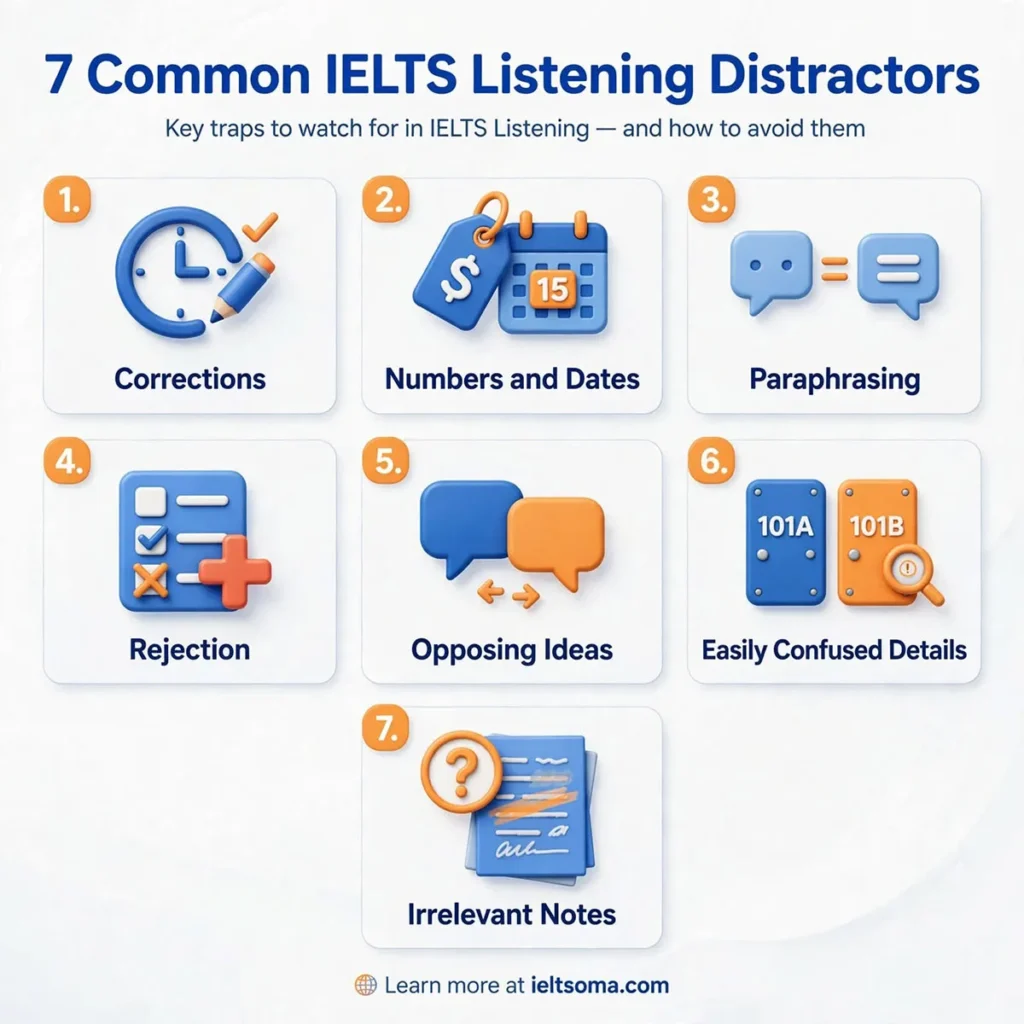
7 Common IELTS Listening Distractors and How to Avoid Them
Understanding the main distractor patterns helps you recognise them while listening instead of trying to work out what happened after the recording ends.
1. Corrections and Changes of Mind
This is one of the most recognisable IELTS Listening distractor patterns.
A speaker may mention an initial answer and then correct it using expressions such as:
- Actually…
- Sorry, I meant…
- No, that’s not right.
- Rather than…
- We’ve changed our minds.
- On second thought…
- I should correct that.
IELTS Listening distractor example
Question: What time does the tour begin?
Recording:
“The tour was advertised for 9:30, but we’ve changed the starting time to 10:15.”
Possible answers:
- A. 9:00
- B. 9:30
- C. 10:15
Correct answer: C. 10:15
The time 9:30 is mentioned explicitly, but it describes the original schedule rather than the current arrangement.
How to avoid this distractor
Do not select an answer simply because you recognise the same words in the recording. Listen for the relationship between the details.
When you hear a correction, ask yourself:
- Was the first detail rejected?
- What information replaced it?
- Which detail answers the question as it stands now?
During practice, underline correction phrases in transcripts. This helps you associate particular expressions with changes in meaning.
2. Multiple Numbers, Dates, Times, and Prices
IELTS Listening frequently includes conversations involving bookings, travel arrangements, appointments, purchases, and course information. Such conversations may contain several similar numbers.
For example, a speaker might mention a booking reference, an original price, a discount, and the final amount payable within a few sentences.
IELTS Listening distractor example
Question: How much will the student pay for the course?
Recording:
“The standard fee is £240. Students normally receive a £20 discount, but because you registered late, that discount doesn’t apply. Your total will therefore be £240.”
Correct answer: £240
The £20 figure is relevant to the conversation but is not the amount the student will pay.
How to avoid this distractor
Before the recording begins, identify exactly what the question requires.
Is it asking for:
- The original price or the final price?
- The departure time or arrival time?
- The booking date or the event date?
- The number of people attending or the number of people invited?
Pay particular attention to words such as total, final, remaining, after discount, departure, and arrival.
These words define the relationship between the numbers. Without that relationship, even a correctly heard number may lead to a wrong answer.
3. Synonyms and Paraphrasing
IELTS Listening questions often express information differently from the recording. You may see one word in the question but hear a synonym or a paraphrase in the audio.
This is not always a distractor in itself. However, unfamiliar paraphrasing can make you choose an incorrect option or miss the correct answer entirely.
IELTS Listening distractor example
Question: Why did the student choose the accommodation?
Option A: It was inexpensive.
Option B: It was close to the university.
Option C: It included meals.
Recording:
“I considered the cheaper residence, but it would have taken me nearly an hour to get to campus. The place I’ve chosen is only a ten-minute walk away.”
Correct answer: B. It was close to the university.
The recording does not repeat the exact phrase close to the university. Instead, it expresses the same idea through the travel time.
How to avoid this distractor
Build your vocabulary around meaning rather than memorising isolated words.
For example:
| Question wording | Possible wording in the recording |
|---|---|
| Inexpensive | Affordable, low-cost, cheaper |
| Near the university | Within walking distance, a short journey away |
| Cancel | Call off, abandon, decide not to proceed |
| Difficult | Challenging, demanding, not straightforward |
| Improve | Enhance, develop, make better |
| Postpone | Put off, delay, move to a later date |
Do not assume that every synonym you hear identifies the answer. Confirm that the complete meaning matches the question.
4. Negative Statements and Rejected Options
A speaker may mention an option but explain that it is unsuitable, unavailable, or no longer being considered.
If you focus on the noun or keyword and ignore the negative expression, you may choose the wrong answer.
Common signals include:
- We decided against…
- I don’t think that will work.
- That isn’t available anymore.
- We won’t be using…
- It’s not suitable because…
- I wouldn’t recommend…
IELTS Listening distractor example
Question: Which facility will the group use?
Recording:
“We first thought about hiring the sports hall, but it is being renovated. The outdoor court is too small, so we’ll use the community centre instead.”
Options:
- A. Sports hall
- B. Outdoor court
- C. Community centre
Correct answer: C. Community centre
All three facilities are mentioned. However, the first two are rejected for specific reasons.
How to avoid this distractor
When a speaker discusses several alternatives, track the decision rather than counting how often each option is mentioned.
A simple note-taking method is:
- Sports hall — rejected
- Outdoor court — too small
- Community centre — selected
In multiple-choice questions, this approach is especially useful when all three options appear in the recording.
5. Contrasting Ideas and Concessions
Speakers often acknowledge one point before introducing a more important or contrasting point. Words such as but, however, although, and nevertheless help communicate these relationships.
However, do not automatically assume that everything after but is the answer. You must still check what the question asks.
IELTS Listening distractor example
Question: What does the student think about the new library?
Recording:
“The design looks attractive, and the reading areas are comfortable. However, I find the lack of study rooms frustrating because they’re usually fully booked.”
If the question asks what the student dislikes, the answer concerns the lack of available study rooms.
The positive comments about the design and reading areas are not the answer to that particular question.
How to avoid this distractor
Listen for changes in the speaker’s attitude or emphasis.
Useful contrast expressions include:
- But…
- However…
- Although…
- Even though…
- Despite that…
- On the other hand…
- Nevertheless…
The key is to understand how the ideas relate to one another. A speaker may like one aspect of something while disliking another.
6. Similar-Sounding Words and Easily Confused Details
Sometimes, a distractor arises because two details sound similar or belong to the same category. This is particularly challenging when the recording contains names, addresses, room numbers, dates, or unfamiliar vocabulary.
For example, a speaker might distinguish between the science building and the social sciences building, or between rooms 14 and 40.
IELTS Listening distractor example
Question: Which room has been reserved for the seminar?
Recording:
“We initially booked Room 14, but that room is too small. The seminar will now take place in Room 40.”
Correct answer: Room 40
The room numbers are similar, and both are clearly spoken. The correction determines the answer.
How to avoid this distractor
Use the preparation time to identify the type of information required. If the answer is a room number, expect to hear one or more numbers and be ready to distinguish them.
Practise listening for:
- Teen numbers versus multiples of ten.
- Dates with similar day numbers.
- Names that differ by one sound.
- Letter sequences in names and reference codes.
- Similar place names or building names.
Do not rely solely on what seems familiar. Listen to the ending of a number or name, and check whether the speaker subsequently corrects it.
7. Extra Information That Does Not Answer the Question
A recording may contain accurate details that are irrelevant to the specific question. These can distract you when you try to remember every fact instead of identifying the requested information.
IELTS Listening distractor example
Question: What is the main reason the student enrolled in the photography course?
Recording:
“The course is held on Saturday mornings, the tutor has published several books, and the studio has excellent equipment. I enrolled because I want to learn how to take better photographs in low light.”
Correct answer: To improve low-light photography skills.
The schedule, tutor’s experience, and equipment are relevant background information, but they do not answer the question about the student’s main reason.
How to avoid this distractor
Read the question carefully and identify its key requirement.
Words such as main reason, most important, purpose, problem, and advantage tell you what kind of information to look for.
You do not need to memorize the entire conversation. You need to recognize the detail that directly satisfies the question.
How to Avoid Distractors in IELTS Listening: A Step-by-Step Strategy
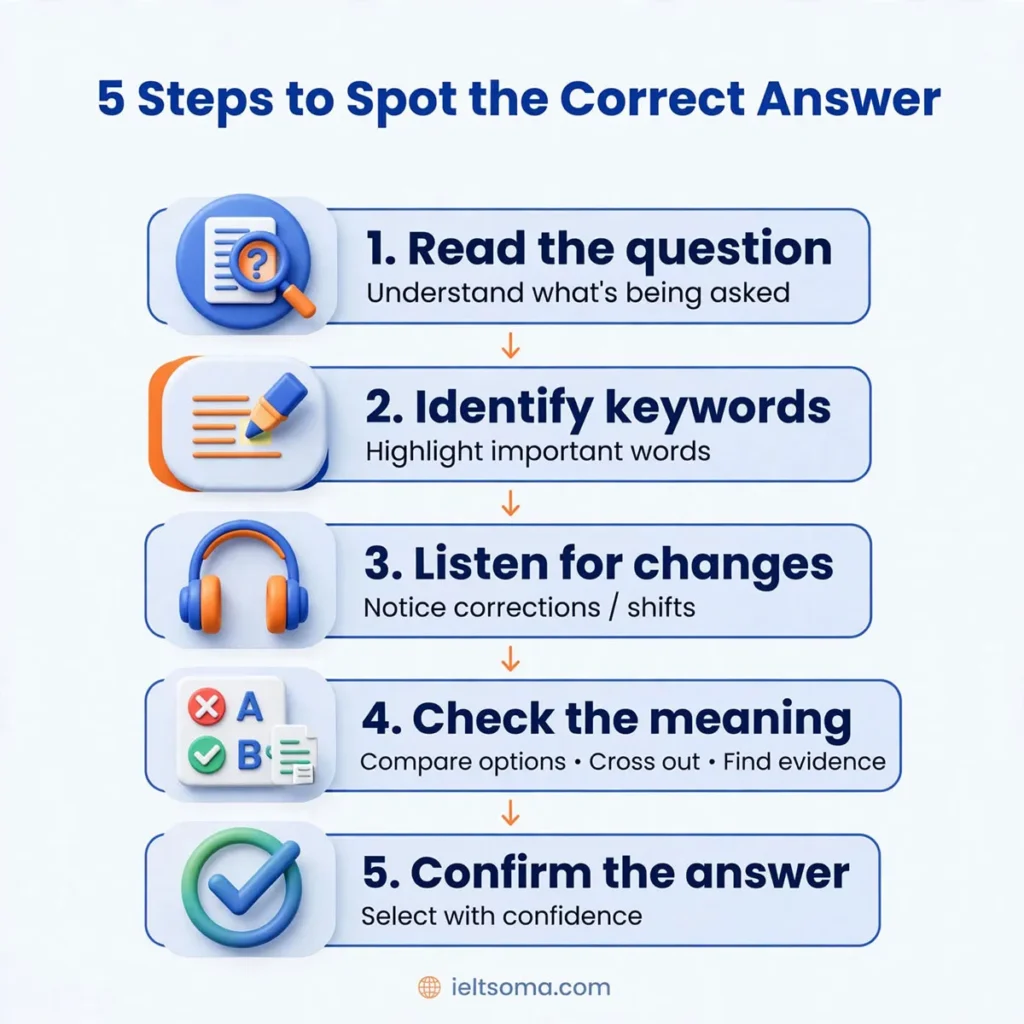
Knowing the different types of distractors is useful, but you also need a repeatable method to apply under exam conditions.
Step 1: Read the Questions Before Listening
Use the time provided to read the questions and answer options carefully.
Identify the topic, the information required, and any distinctions between the options. For example, if the options are three locations, note what makes each location different.
Ask yourself:
- Is the question asking for a fact, a reason, an opinion, or a decision?
- Are the options similar?
- Could the answer involve a change of plan or a rejected alternative?
This preparation helps you anticipate the information you need without trying to predict the exact answer.
Step 2: Underline Keywords and Meaningful Differences
Do not underline every word. Focus on the words that distinguish the possible answers.
For example:
- A. The course is cheaper.
- B. The course is shorter.
- C. The course is more practical.
The topic is the same in all three options, so the distinguishing words matter most.
During the recording, listen for expressions that communicate these meanings, even when the exact words are different.
Step 3: Follow the Speaker’s Meaning, Not Individual Words
A keyword match is only a clue. It is not proof that you have found the answer.
Suppose a question asks where a visitor will stay. The recording mentions a hotel, a hostel, and a university residence. If the speaker rejects the first two and confirms the residence, the residence is the correct choice.
Keep track of the speaker’s final decision and the reason behind it.
Step 4: Listen for Signal Words
Signal words can alert you to a correction, contrast, or change of direction.
| Function | Expressions to recognise |
|---|---|
| Correction | Actually, sorry, I mean |
| Contrast | But, however, although |
| Rejection | Not suitable, decided against |
| Change of plan | Instead, we’ve changed it |
| Final decision | We’ve settled on, we’ve decided to |
| Qualification | Mainly, partly, except for |
These expressions do not guarantee that the answer follows immediately. They tell you to pay attention to the relationship between ideas.
Step 5: Keep Listening After You Think You Have the Answer
One of the most damaging mistakes is selecting an option as soon as you hear a matching word.
The speaker may provide a correction or additional detail a few seconds later.
When you hear a possible answer, hold it provisionally in your mind. Confirm it against the remainder of the relevant sentence or exchange before committing to it.
This is particularly important in multiple-choice questions, where several options may be mentioned.
Step 6: Follow the Instructions Exactly
Avoiding distractors is only part of the task. You must also follow the question instructions.
For completion questions, check:
- The maximum number of words permitted.
- Whether a number, word, or combination is required.
- Whether the answer fits grammatically into the sentence.
- Whether spelling is correct.
- Whether singular or plural forms are needed.
For example, if the instruction says NO MORE THAN TWO WORDS AND/OR A NUMBER, an answer that exceeds the limit may be marked incorrect even if the information is accurate.
Step 7: Do Not Let One Difficult Answer Ruin the Next
If you miss an answer, continue listening. Spending too long worrying about a previous question can cause you to miss further information.
Make the best decision you can, move on, and focus on the next question.
After the test or practice session, return to the missed question using the recording and transcript if available. Identify whether the problem involved vocabulary, a correction, concentration, or misunderstanding the question.
IELTS Listening Distractor Examples: Practise Your Skills
Try these short examples before checking the answers. Read each question, then focus on the information that determines the final answer.
Practice 1: A Changed Appointment
Question: When will the appointment take place?
Recording script:
“Your appointment was originally scheduled for Monday at 11 a.m. Unfortunately, the doctor is unavailable then. We can see you on Tuesday at 11 a.m. instead.”
What is the correct answer?
A. Monday at 11 a.m.
B. Tuesday at 11 a.m.
C. Tuesday at 10 a.m.
Answer: B. Tuesday at 11 a.m.
Monday is the original appointment date and is rejected. The speaker confirms Tuesday at the same time.
Practice 2: A Student’s Preference
Question: Which feature does the student value most about the accommodation?
Recording script:
“The rent is reasonable, and the rooms are quite spacious. However, what really matters to me is that I can walk to the university in five minutes.”
A. Low rent
B. Large rooms
C. Location
Answer: C. Location
The student mentions the rent and room size positively but identifies proximity to the university as the most important factor.
Practice 3: A Course Fee
Question: How much will the applicant pay?
Recording script:
“The normal registration fee is £60. We offered a £10 discount last month, but that promotion has ended. You will need to pay the standard fee.”
A. £10
B. £50
C. £60
Answer: C. £60
The discount is mentioned, but the speaker confirms that the standard fee applies.
Practice 4: Choosing a Meeting Place
Question: Where will the team meet?
Recording script:
“We considered the café near the station, but it gets too crowded. The library closes early on Fridays, so we’ve decided to meet in the student common room.”
A. Café
B. Library
C. Student common room
Answer: C. Student common room
The café and library are both rejected. The common room is the final decision.
After each practice question, explain why the other options are wrong. This is more valuable than simply memorising the correct letters because it trains you to recognise distractors in unfamiliar recordings.
Common IELTS Listening Distractor Mistakes
Even students with good English can lose marks by using ineffective listening habits.
Choosing the first matching word: A familiar word may appear in an option, but the speaker may later reject that information. Follow the full meaning.
Ignoring negative expressions: Missing a word such as not, never, or unavailable can reverse the meaning of a sentence.
Assuming the last detail is always correct: Speakers sometimes add background information after giving an answer. Select the detail that answers the question, not automatically the final detail mentioned.
Confusing paraphrases with contradictions: Different wording does not necessarily mean different meaning. Learn to recognise equivalent expressions while checking the context.
Panicking after missing an answer: Dwelling on one question can cost you marks on subsequent questions. Recover your concentration quickly.
Ignoring question instructions: A correct idea written in an invalid format or beyond the word limit can still lose the mark.
Practising without reviewing mistakes: Repeatedly completing tests without analysing errors may reinforce the same habits. Review the audio, transcript, question, and distractor pattern after every practice session.
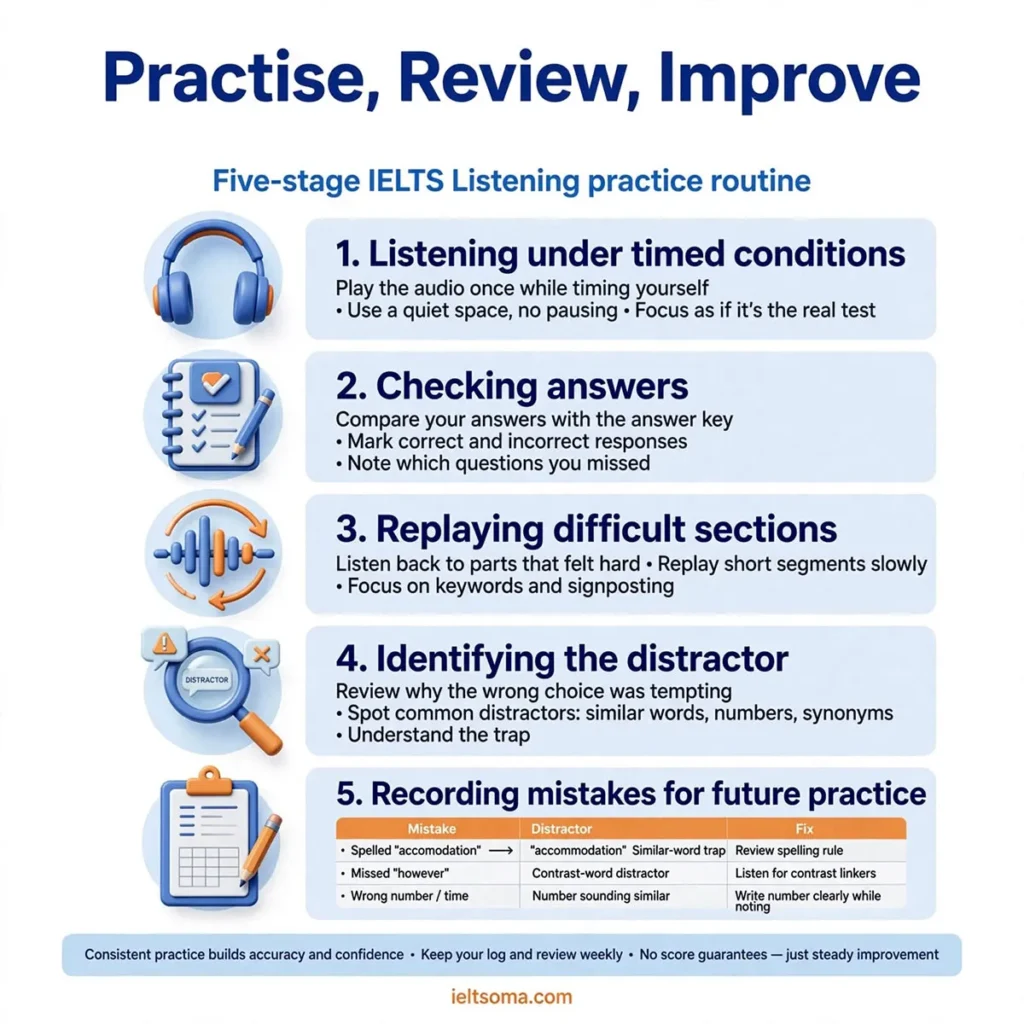
A Practical IELTS Listening Distractor Training Routine
You can develop stronger listening habits with a short, focused routine rather than completing full practice tests every day.
Try this 20-minute session:
- Minutes 1–3: Preview. Read a small set of questions and identify their keywords and answer requirements.
- Minutes 4–8: Listen. Complete the questions without pausing the recording, as you would under test conditions.
- Minutes 9–12: Check. Mark your answers and identify the questions you missed.
- Minutes 13–17: Review. Replay relevant sections, then compare what you heard with the transcript if one is available.
- Minutes 18–20: Record patterns. Write down the distractor type, the signal phrase, and the reason your original answer was wrong.
Keep a simple error log with these headings:
| Question | My answer | Correct answer | Distractor type | Lesson learned |
|---|---|---|---|---|
| 1 | Tuesday | Thursday | Changed plan | Listen for corrections |
| 2 | £20 | £240 | Extra number | Identify the final amount |
| 3 | Sports hall | Community centre | Rejected option | Track the final decision |
These entries are illustrative. Use your own errors to identify which distractors repeatedly affect your performance.
Over time, your error log will show whether you need more practice with numbers, paraphrasing, negative statements, multiple-choice questions, or concentration.
Frequently Asked Questions About IELTS Listening Distractors
What are the most common IELTS Listening distractors?
Common IELTS Listening distractors include corrected information, changed plans, multiple numbers, rejected options, contrasting opinions, paraphrased information, and irrelevant details. The key is to understand the speaker’s intended meaning rather than selecting an answer because a matching word appears in the audio.
How can I avoid distractors in IELTS Listening multiple-choice questions?
Read the options before listening, identify how they differ, and listen for the evidence supporting each possibility. Do not select an option merely because it is mentioned. Pay attention to corrections, contrasts, and the speaker’s final decision, then check that the answer directly addresses the question.
Are IELTS Listening distractors designed to trick candidates?
Distractors are a useful way of describing information that can mislead a candidate, but not every incorrect option represents a deliberate trick. Conversations naturally include changes of mind, alternative suggestions, background details, and paraphrasing. Your task is to understand the meaning relevant to the question.
Do distractors appear in all IELTS Listening sections?
Potentially misleading information can occur across the Listening test. Everyday conversations may include changes to appointments or bookings, while discussions and academic-style talks can contain contrasting viewpoints, examples, and qualifications. Practice identifying meaning across different contexts rather than preparing for only one section.
Should I always choose the last option mentioned in the recording?
No. The last option mentioned is not automatically correct. A speaker may provide extra information or discuss another possibility after the relevant answer. Choose the information that best satisfies the question and is supported by the complete context.
How should I practice IELTS Listening distractor examples?
Use official or reputable IELTS practice materials with audio and, where available, transcripts. Attempt each question without pausing, check your answers, and replay the relevant section. Identify the exact words that signaled a correction, rejection, contrast, or final decision. Record recurring errors and practice those patterns again.
Can understanding distractors improve my IELTS Listening band score?
Recognizing distractors can help you avoid preventable mistakes and may improve your performance. However, your overall result also depends on vocabulary, comprehension, attention, spelling, and accurate completion of the required answers. Progress is best measured through consistent practice with timed tests and careful error analysis.
Final Checklist: Before You Choose an Answer
When you hear a possible answer in the IELTS Listening test, ask yourself:
- Does this information directly answer the question?
- Did the speaker correct or reject an earlier detail?
- Are there other numbers, names, places, or options that sound similar?
- Is the information paraphrased rather than repeated exactly?
- Have I followed the word limit and answer instructions?
- Am I choosing the answer because of its meaning rather than simply recognising a keyword?
Remember: the most useful IELTS Listening skill is not hearing the most words. It is understanding which information matters, how the speaker’s meaning develops, and which detail accurately answers the question.
Practise these strategies consistently, review your mistakes carefully, and treat every distractor as an opportunity to strengthen your listening accuracy.
Further Reading: