Many IELTS candidates can read an entire passage and still get a surprising number of questions wrong.
They know the vocabulary. They understand most of the sentences. Yet when they answer the questions, their score does not reflect their apparent reading ability.
Why?
Because IELTS Reading comprehension is more than understanding individual words and sentences. You need to understand how ideas connect, identify what a paragraph is really saying, recognise paraphrased information, distinguish facts from opinions, follow an argument and use evidence from the text.
That is why effective IELTS Reading Comprehension Strategies focus on meaning, not simply reading speed.
Whether you are taking IELTS Academic or IELTS General Training, the objective is the same: understand what the text actually communicates and make accurate decisions based on that information.
This guide explains nine practical strategies to help you understand IELTS Reading passages more effectively and avoid the comprehension mistakes that cost valuable marks.
Table of Contents
Understand What IELTS Reading Is Really Testing
The IELTS Reading test gives you 60 minutes to answer 40 questions. Academic Reading contains three sections with texts totalling approximately 2,150–2,750 words. General Training Reading also contains three sections and 40 questions, with reading materials suited to everyday, workplace and general-interest contexts.
The test can assess several aspects of reading ability, including:
- Understanding main ideas
- Finding specific information
- Understanding detailed information
- Recognising implied meaning
- Following logical arguments
- Identifying opinions and attitudes
- Recognising relationships between ideas
- Understanding paraphrased information
- Locating evidence efficiently
This means that simply reading faster is not enough.
Imagine that you understand 95% of a passage but misunderstand the relationship between two paragraphs. You could still select the wrong answer for several questions.
Good comprehension means understanding what the writer says, how the writer develops the idea and what the information means in context.
That is the foundation of effective IELTS Reading Comprehension Strategies.
1. Build a Mental Map Before Reading Deeply
One of the most useful IELTS Reading Comprehension Strategies is to understand the structure of a passage before trying to understand every detail.
Do not begin by treating the passage as one enormous block of English.
Instead, quickly identify what each paragraph appears to do.
For example:
| Paragraph | Main function |
|---|---|
| A | Introduces the topic |
| B | Explains the original theory |
| C | Presents evidence against it |
| D | Describes a new approach |
| E | Discusses possible consequences |
You do not need to write this down during the actual test.
The objective is to develop a mental map.
Once you know that Paragraph C discusses problems with an earlier theory, you will know where to look when a question asks about those problems.
What should you look for?
During your initial reading, pay attention to:
- Titles
- Headings and subheadings
- Opening sentences
- Repeated concepts
- Names
- Dates
- Numbers
- Examples
- Contrast words
- Cause-and-effect relationships
- Changes in the writer’s argument
You are not trying to memorise details.
You are asking:
“What role does each part of this passage play?”
That question improves comprehension because it forces you to see the passage as a connected argument rather than a collection of sentences.
2. Find the Main Idea Before the Supporting Details
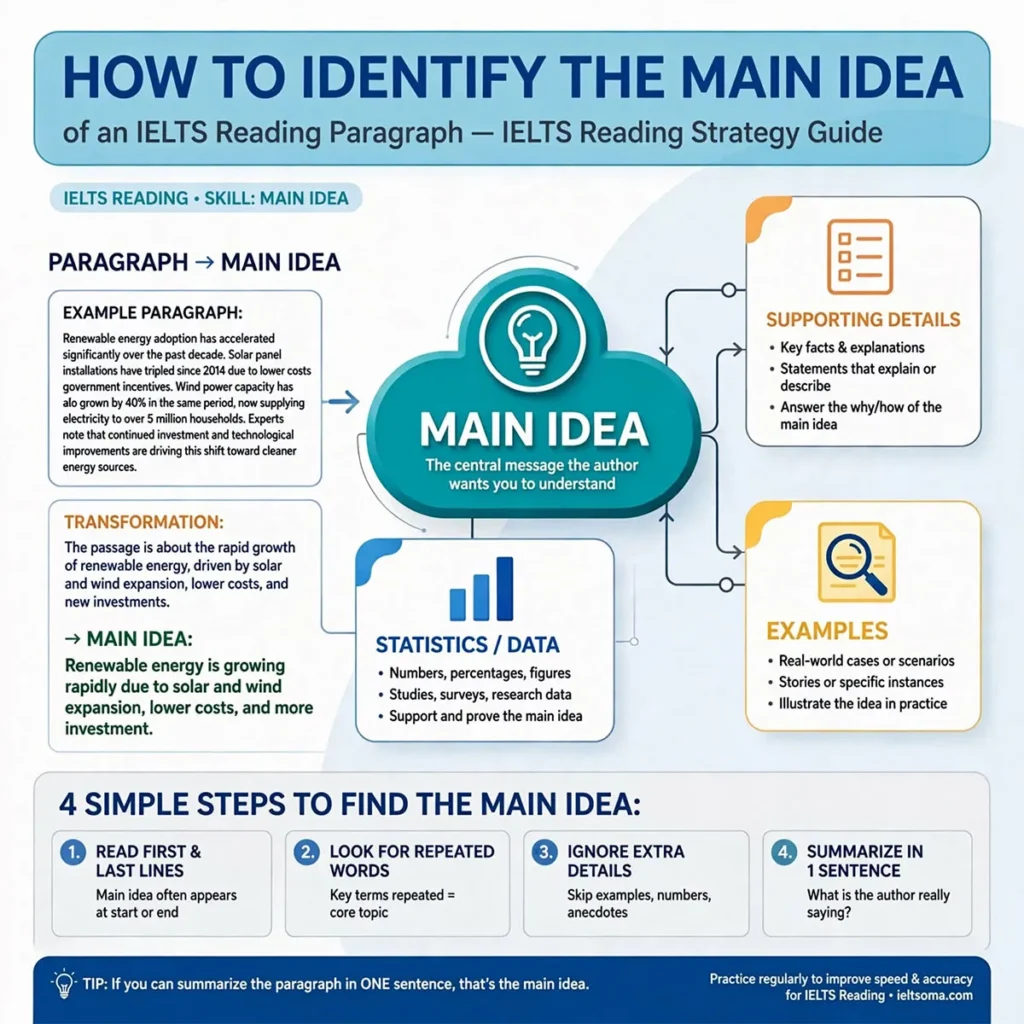
A common IELTS Reading problem is confusing an interesting detail with the main point.
A paragraph might contain:
- A historical example
- A statistic
- A person’s name
- A research finding
- A comparison
- An explanation
But none of these may represent the paragraph’s central idea.
Consider this simplified paragraph:
Several European cities introduced bicycle-sharing schemes during the early 2000s. Paris expanded its programme considerably, while other cities introduced similar systems. Although the programmes initially faced operational problems, they demonstrated that shared bicycles could become an important part of urban transport.
If a matching-heading question asks for the main idea, choosing a heading about Paris would probably be too narrow.
The paragraph is primarily about the development and significance of bicycle-sharing programmes.
This distinction is essential.
Ask the “So what?” question
After reading a paragraph, ask:
“What is the writer really trying to tell me here?”
Then ask:
“If I removed the examples and supporting details, what idea would remain?”
That remaining idea is often close to the paragraph’s main point.
This is particularly valuable for Matching Headings questions, because official IELTS guidance explains that these questions test your ability to identify the general topic of a paragraph and distinguish the main idea from a supporting idea.
3. Read for Relationships, Not Just Sentences
Strong IELTS Reading comprehension requires you to understand relationships between ideas.
Writers rarely present information as a simple list.
They may establish:
Cause → Effect
Rising temperatures reduced crop yields.
Problem → Solution
Traditional storage methods caused significant waste, so researchers developed a new cooling system.
Claim → Evidence
The researchers argued that the method was effective. Subsequent trials supported their conclusion.
Contrast
The first approach was inexpensive, whereas the alternative required considerable investment.
Concession
Although the technology was expensive initially, its long-term operating costs were considerably lower.
If you only understand individual sentences, you may miss the logical relationship connecting them.
Watch for signal words
Certain expressions help reveal relationships:
Contrast
- however
- although
- whereas
- while
- in contrast
- nevertheless
Cause
- because
- since
- due to
- as a result of
Effect
- therefore
- consequently
- resulting in
- leading to
Examples
- for example
- for instance
- such as
Addition
- furthermore
- moreover
- in addition
These words are not answers by themselves.
They are comprehension signals.
When you notice them, ask what relationship they establish between the ideas around them.
4. Train Yourself to Recognise Paraphrased Meaning
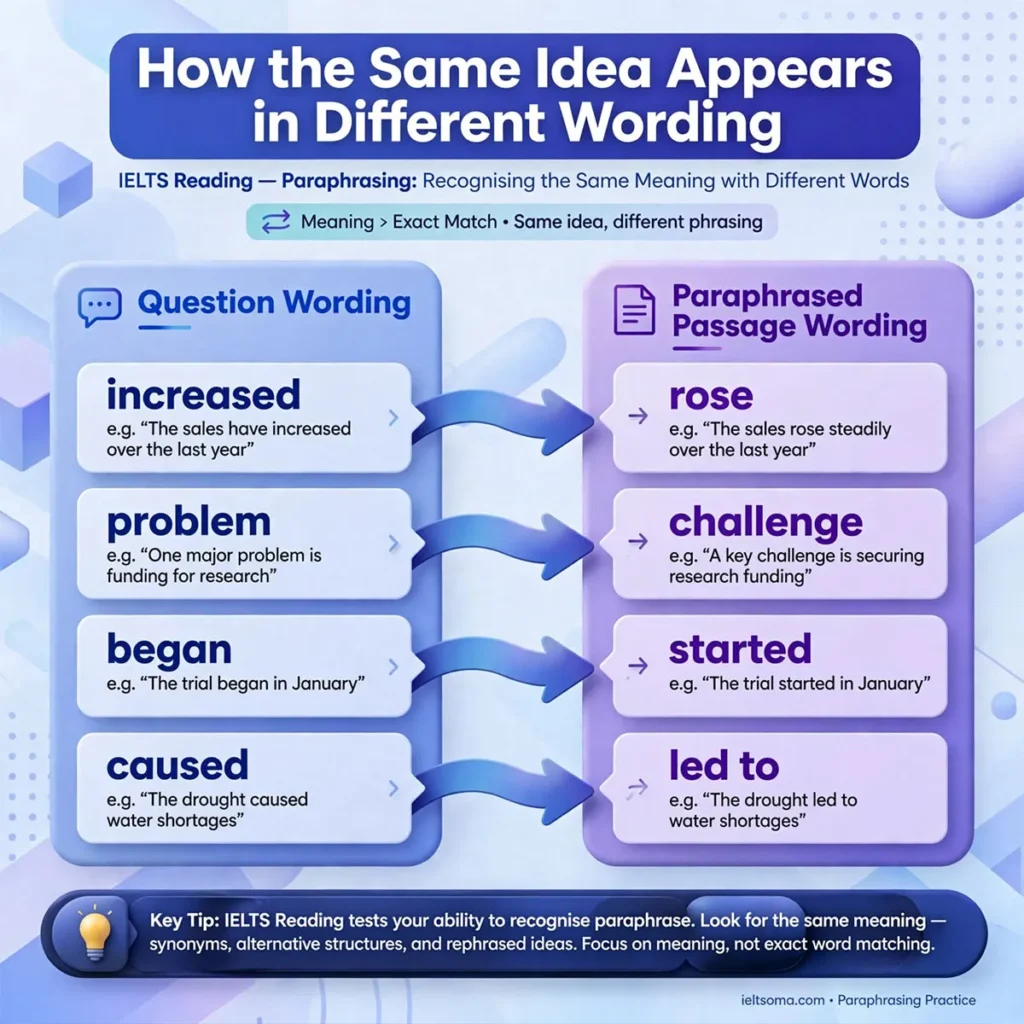
Perhaps the most important of all IELTS Reading Comprehension Strategies is learning to recognise the same idea when it appears in different language.
IELTS questions frequently use wording that differs from the passage.
For example:
Question:
The number of people working remotely increased rapidly.
Passage:
Remote employment experienced a sharp rise during the period.
The wording changes, but the underlying meaning remains similar.
Notice the connections:
- number of people → employment
- working remotely → remote employment
- increased → rise
- rapidly → sharp
You should therefore avoid searching for exact word matches.
Instead, search for meaning matches.
Build paraphrase awareness
| Question wording | Possible passage wording |
|---|---|
| increased | rose, grew, climbed |
| decreased | declined, fell, dropped |
| important | significant, crucial, influential |
| problem | issue, difficulty, challenge |
| cause | reason, factor |
| result | consequence, outcome |
| changed | altered, modified |
| began | started, commenced |
| stopped | ended, ceased |
| approximately | about, roughly, around |
However, do not turn IELTS preparation into endless synonym memorisation.
A synonym is not automatically interchangeable in every context.
Your goal is to understand equivalent ideas in context.
For example, “significant” can mean important, but in a statistical context it may have a more specific meaning.
Comprehension comes before substitution.
5. Use Context to Understand Difficult Vocabulary
Encountering unfamiliar vocabulary is normal in IELTS Reading.
The mistake is believing that every unknown word must immediately be translated.
Suppose you read:
The species is particularly vulnerable to habitat fragmentation, which can isolate populations and restrict their access to food.
You may not know “fragmentation”.
But the surrounding sentence gives clues.
You can see that it:
- affects a species
- can isolate populations
- can restrict access to food
The context suggests that fragmentation involves breaking or dividing habitat into separate areas.
You may not need a dictionary definition.
Use the four-step context method
When you encounter an unfamiliar word:
1. Look at the surrounding sentence.
What is happening?
2. Look at the sentences before and after it.
Does the writer explain or illustrate the concept?
3. Identify its grammatical role.
Is it a noun, verb, adjective or adverb?
4. Ask whether the word is actually necessary for the question.
If it is not relevant, move on.
This is particularly important under exam conditions.
Stopping every few sentences to mentally translate vocabulary can destroy your timing and concentration.
The goal is not to understand every word.
The goal is to understand enough of the text to answer accurately.
6. Separate Facts, Opinions and Inferences
IELTS Reading can require more than finding explicit facts.
You may need to understand what the writer believes, implies or suggests.
Consider:
The government introduced the scheme in 2018. Several researchers subsequently questioned whether it had achieved its intended objectives.
The first sentence provides a fact.
The second reports researchers’ doubts.
Now imagine a question:
The researchers believed the scheme had completely achieved its objectives.
That would contradict the information.
But consider another statement:
The government introduced the scheme because researchers demanded it.
That information is not established by the passage.
The answer would therefore depend on the question type and the evidence actually provided.
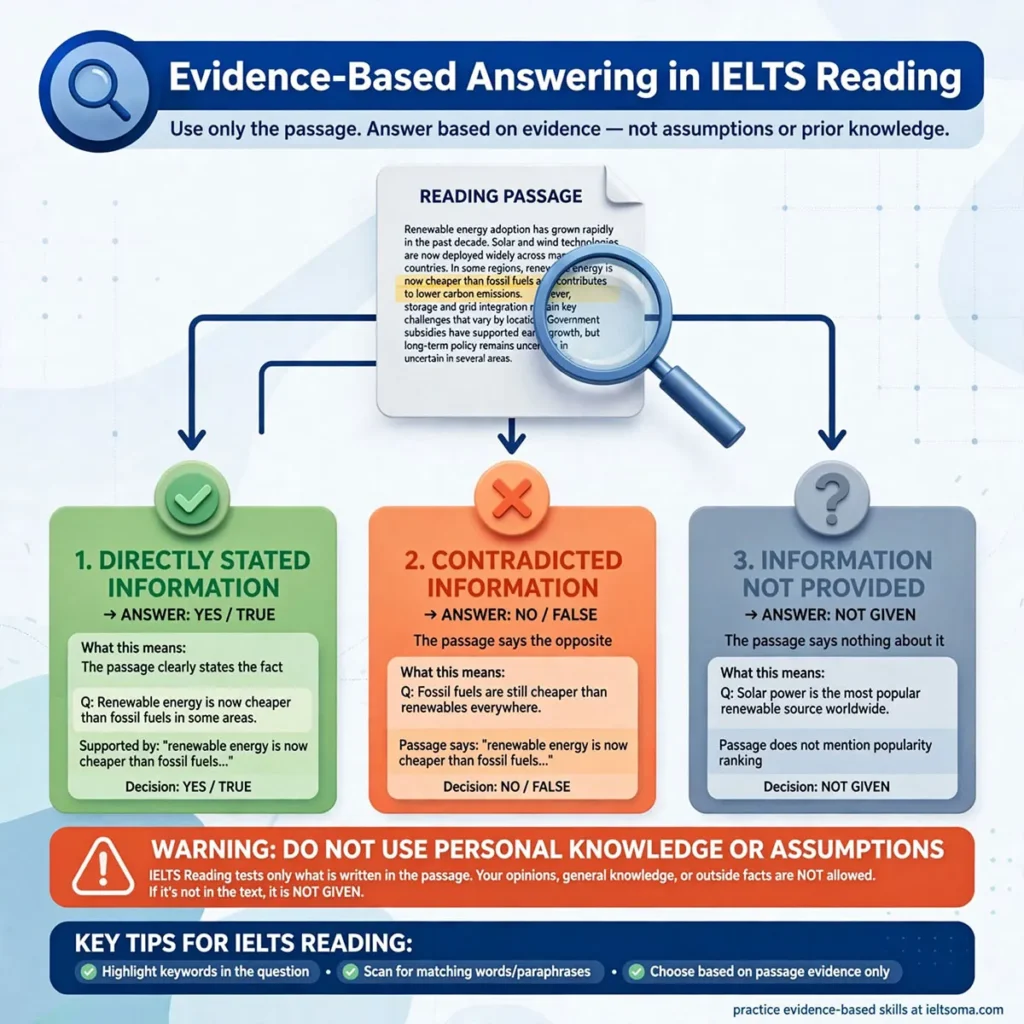
Use the evidence rule
When answering a comprehension question, ask:
“Where is the evidence for this answer?”
If you cannot point to evidence in the passage, be careful.
You may be relying on:
- Personal knowledge
- Common sense
- Assumptions
- Information from another paragraph
- What you think the writer probably means
IELTS rewards answers supported by the text, not answers that simply sound reasonable.
This is especially important for True/False/Not Given and Yes/No/Not Given questions. Official IELTS guidance distinguishes contradiction from information that is simply not provided.
7. Understand the Difference Between “What the Passage Says” and “What You Know”
This is one of the most damaging comprehension habits.
Suppose a passage says:
Researchers examined the effects of sleep deprivation on university students.
A question states:
Sleep deprivation always causes students to perform poorly.
You may personally believe that lack of sleep damages academic performance.
But that is irrelevant unless the passage supports the statement.
IELTS Reading is not asking:
“Is this statement true in real life?”
It is asking:
“Does the passage support, contradict or fail to mention this information?”
This distinction can completely change your answer.
A useful mental rule
During Reading, temporarily forget what you know about the subject.
Treat the passage as your evidence source.
If the writer says something surprising, accept it for the purpose of the question.
If the writer fails to mention something that seems obvious, do not invent the missing information.
This is one of the most valuable IELTS Reading Comprehension Strategies for avoiding attractive but unsupported answers.
8. Match Your Reading Depth to the Question
Not every question requires the same level of comprehension.
Some questions require you to locate a specific fact.
Others require you to understand a whole paragraph.
Others require you to understand the writer’s argument.
Therefore, change your reading depth according to the task.
For specific information
Use scanning first.
Look for:
- Names
- Dates
- Numbers
- Places
- Technical terms
- Distinctive concepts
Once you locate the likely section, slow down and read the surrounding sentences.
For main ideas
Read the paragraph as a whole.
Do not choose an answer because one sentence resembles the heading.
For writer’s views
Pay close attention to language indicating:
- certainty
- doubt
- criticism
- approval
- disagreement
- recommendations
Words such as “argues”, “claims”, “suggests”, “questions” and “rejects” can reveal the writer’s position.
For inference
Combine the relevant pieces of information.
An inference must be supported by what the text communicates, even if the exact answer is not written word-for-word.
The key principle is simple:
Read deeply enough to answer the question, but not so deeply that you waste time on irrelevant information.
9. Turn Wrong Answers Into Comprehension Training
One of the most powerful IELTS Reading Comprehension Strategies happens after the test.
Do not simply check your score and move on.
Analyse your mistakes.
For every wrong answer, ask:
- What was the question testing?
- Where was the relevant evidence?
- Did I misunderstand the question?
- Did I misunderstand the passage?
- Did I miss a paraphrase?
- Did I confuse the main idea with a detail?
- Did I make an assumption?
- Did I ignore a contrast or cause-and-effect relationship?
- Did I choose an answer because of one matching keyword?
- What should I do differently next time?
Create an error log like this:
| Question | Error | Cause | Better approach |
|---|---|---|---|
| 7 | Wrong heading | Chose a detail | Identify the paragraph’s central idea |
| 12 | False instead of Not Given | Used outside knowledge | Look only for textual evidence |
| 18 | Wrong option | Exact-keyword matching | Search for paraphrased meaning |
| 24 | Missed inference | Read one sentence only | Connect information across sentences |
| 31 | Wrong answer | Misread contrast | Pay attention to “however” |
After several practice tests, patterns become visible.
You may discover that your problem is not vocabulary.
It may be comprehension.
Or perhaps your comprehension is strong but you repeatedly fall for distractors.
This distinction matters because different problems require different solutions.
IELTS Academic vs General Training: Do the Comprehension Strategies Change?
The fundamental comprehension skills remain similar, but the reading material differs.
Academic Reading uses texts from sources such as books, journals, magazines, newspapers and online resources. The material is written for a non-specialist audience and may include narrative, descriptive or argumentative writing, with at least one text containing a detailed logical argument.
General Training Reading includes practical and general-interest material, with texts drawn from contexts such as everyday life and the workplace.
Therefore, your comprehension training should reflect your test.
Academic candidates should practise:
- Complex arguments
- Academic-style explanations
- Research findings
- Abstract concepts
- Cause-and-effect relationships
- Writer’s opinions
- Dense paragraphs
General Training candidates should practise:
- Notices
- Advertisements
- Workplace information
- Instructions
- Practical texts
- General-interest articles
- Longer informational passages
The core skill remains the same:
Understand exactly what the text communicates.
A Practical IELTS Reading Comprehension Routine
If you want to improve comprehension rather than simply complete more tests, use a structured routine.
Stage 1: Read for Structure
Take a passage and identify what each paragraph does.
Do not answer questions yet.
Write a short label for each paragraph.
For example:
- A — background
- B — problem
- C — evidence
- D — alternative
- E — conclusion
Stage 2: Read for Relationships
Go through the passage again.
Identify:
- causes
- effects
- contrasts
- examples
- claims
- evidence
- conclusions
Stage 3: Identify Paraphrases
Take several questions.
Underline the key concepts.
Then find where those ideas appear in the passage using different wording.
Stage 4: Answer Questions
Now complete the questions under timed conditions.
Stage 5: Analyse Errors
Do not stop at the answer key.
Find the evidence.
Explain why your answer was wrong.
Then identify the comprehension skill that needs improvement.
This five-stage cycle turns passive practice into deliberate training.
Common IELTS Reading Comprehension Mistakes
Even candidates with strong English can make comprehension errors.
Avoid these habits:
Reading every word with equal attention
Some information is central; some is supporting detail.
Translating mentally
Constant translation slows processing and can make complex sentences harder to understand.
Looking only for exact keywords
Questions frequently paraphrase information from the passage.
Choosing the most familiar answer
An answer can contain vocabulary from the passage and still be wrong.
Confusing examples with main ideas
An example supports an idea; it is not necessarily the idea itself.
Using personal knowledge
Your knowledge cannot replace evidence from the passage.
Ignoring connecting words
Words such as “however”, “therefore” and “although” can completely change the relationship between ideas.
Giving up when vocabulary is unfamiliar
Use context before assuming that an unknown word prevents you from understanding the question.
Spending too long on one interpretation
If the evidence is unclear, move on and return later when appropriate.
The aim is not perfect comprehension of every sentence.
The aim is accurate comprehension of the information that matters.
How to Know Whether Your Comprehension Is Improving
Your score is useful, but it is not the only measurement.
Track these five areas:
| Skill | Question to ask yourself |
|---|---|
| Main ideas | Can I summarise a paragraph in one sentence? |
| Paraphrasing | Can I recognise the same idea in different wording? |
| Relationships | Can I explain why two ideas are connected? |
| Evidence | Can I identify exactly where my answer comes from? |
| Inference | Can I reach a conclusion without inventing information? |
If these abilities improve, your Reading performance should become more consistent.
You should also notice that difficult passages become less intimidating.
You may still encounter unfamiliar vocabulary or complicated ideas, but you will have a system for dealing with them.
Frequently Asked Questions About IELTS Reading Comprehension Strategies
What are the best IELTS Reading Comprehension Strategies?
The most useful strategies are identifying main ideas, understanding relationships between ideas, recognising paraphrases, using context for unfamiliar vocabulary, distinguishing fact from opinion, making evidence-based inferences and analysing mistakes after practice.
How can I improve IELTS Reading comprehension?
Practise understanding the structure and meaning of passages rather than only completing questions. After each practice session, identify where the evidence appears and explain why each wrong answer was incorrect.
Do I need to understand every word in IELTS Reading?
No. You need sufficient understanding to answer the questions accurately. Context, grammar, surrounding information and paragraph structure can often help you understand an unfamiliar word without knowing its exact definition.
Why do I understand the passage but still get answers wrong?
You may understand the general topic but miss relationships between ideas, paraphrased information, writer’s opinions or important details. You may also be selecting answers based on keywords rather than evidence.
How can I improve my ability to understand IELTS Reading questions?
First identify what the question is actually asking: a fact, reason, result, comparison, opinion, main idea or inference. Then locate the relevant part of the passage and read enough surrounding context to confirm the answer.
Is skimming enough for IELTS Reading?
No. Skimming helps you understand the overall structure, but accurate answers often require scanning and close reading. The most effective approach is to change your reading depth according to the question.
How can I avoid choosing answers that sound correct?
Ask yourself where the evidence is in the passage. If you cannot identify evidence supporting the answer, reconsider it. IELTS questions can include plausible options that are not actually supported by the text.
Are IELTS Academic and General Training Reading comprehension strategies the same?
The fundamental skills are similar, including identifying main ideas, recognising paraphrases and understanding relationships. However, the types of texts differ, so your practice material should match the IELTS version you are taking.
Your IELTS Reading Comprehension Checklist
Before your next Reading practice session, remember:
- Identify the passage structure.
- Find the main idea of each paragraph.
- Separate main ideas from supporting details.
- Look for relationships between ideas.
- Expect paraphrasing.
- Use context to understand unfamiliar vocabulary.
- Distinguish facts from opinions.
- Do not use outside knowledge.
- Find evidence before committing to an answer.
- Read more deeply when the question requires it.
- Pay attention to contrast and cause-and-effect signals.
- Analyse every mistake after practice.
- Record recurring comprehension problems.
Final Takeaway
Effective IELTS Reading Comprehension Strategies are not about trying to understand every word as quickly as possible.
They are about understanding meaning, structure and evidence.
You need to see how a passage is organised.
You need to recognise its main ideas.
You need to understand how one idea leads to another.
You need to recognise when the question and passage express the same idea using different language.
And when you choose an answer, you need to know exactly why the text supports it.
That is the difference between simply reading an IELTS passage and actually comprehending it.
Start with structure. Then focus on meaning. Look for relationships. Expect paraphrasing. Use context when vocabulary becomes difficult. Most importantly, make the passage—not your assumptions—the source of your answers.
With deliberate practice, IELTS Reading comprehension becomes less about guessing what the examiner wants and more about accurately understanding what the writer has actually communicated.
That is the skill that can make your Reading performance more accurate, more consistent and much more manageable under the 60-minute test limit.
Further Reading:
- IELTS Reading Summary Completion: 7 Proven Tips to Score Higher
- IELTS Reading Question Types: 14 Essential Tasks & Tips
- Academic Vocabulary for IELTS: 7 Powerful Ways to Build It
- IELTS Speaking Practice Tips: 15 Powerful Ways to Improve
- IELTS Reading Matching Strategies: 9 Powerful Tips
- official IELTS Academic Reading test format