Many IELTS candidates understand the examiner’s questions but struggle to give answers that go beyond a few words. They say “Yes, I do”, “Because it is interesting” or “I like it very much” and then stop. The result is often an awkward silence, even when they have more ideas to share.
The solution is not to memorise longer answers or use complicated vocabulary. It is to learn how to develop a thought naturally.
IELTS Speaking answer extension means adding relevant information to your initial response so that you can explain your ideas, support your opinions and keep the conversation moving. You can do this by giving a reason, adding an example, describing an experience or explaining a result.
In this guide, you will learn how to extend IELTS Speaking answers, give longer answers without rambling, and develop ideas naturally in all three parts of the test. You will also find practical examples, useful sentence patterns and exercises to help you build confidence.
Table of Contents
Why Do You Need to Extend IELTS Speaking Answers?
The IELTS Speaking test assesses your ability to communicate in spoken English across three parts: a conversation about familiar topics, an individual long turn and a more detailed discussion. Your performance is assessed using four criteria: fluency and coherence, lexical resource, grammatical range and accuracy, and pronunciation.
Extending your answers helps you demonstrate that you can do more than produce short, disconnected sentences.
For example, consider this question:
Examiner: Do you enjoy reading?
Short answer: Yes, I do.
Developed answer: Yes, I do, particularly when I have some free time in the evening. Reading helps me relax after a busy day, and I usually choose novels or books about personal development because I enjoy learning something new.
The second answer communicates a clear opinion, provides a reason and includes specific details. It also gives the examiner more evidence of your ability to use vocabulary and grammar in context.
However, longer answers are not automatically better. Repeating the same idea, adding irrelevant details or speaking for too long can make your response less coherent.
Your aim should be to give a complete, relevant and naturally developed answer, not the longest answer possible.
7 Effective Ways to Extend IELTS Speaking Answers
You do not need to use every technique in every response. Choose the one or two that fit the question and allow your answer to develop logically.
1. Give a Reason for Your Answer
One of the easiest ways to develop an answer is to explain why you think or feel something.
A simple structure is:
Direct answer + reason
For example:
Question: Do you enjoy cooking?
Basic answer: Yes, I enjoy cooking.
Extended answer: Yes, I enjoy cooking because it allows me to experiment with different flavours. I also find it relaxing, especially when I have enough time to prepare a meal without rushing.
The reason explains your preference, while the second sentence adds another relevant detail.
Useful expressions include:
- Mainly because…
- The main reason is that…
- I particularly enjoy it because…
- One reason I prefer it is that…
- This is largely due to…
Use these expressions when they genuinely help you explain your answer. You do not need to begin every response with “The main reason is”.
2. Add a Specific Example
An example makes your answer more convincing and helps you generate additional ideas when you are unsure what to say next.
Use this structure:
Direct answer + explanation + example
Question: Do you prefer studying alone or with other people?
Extended answer: I generally prefer studying alone because I can concentrate better without distractions. For example, when I prepare for an important examination, I usually study in a quiet room and switch off my phone so that I can focus completely on the material.
The example illustrates the reason instead of simply repeating it.
You can introduce examples naturally with phrases such as:
- For example…
- For instance…
- A good example of this is…
- I remember one occasion when…
- This happened to me when…
Your example does not have to be dramatic or unusual. An ordinary experience from your daily life is often enough.
3. Describe a Personal Experience
Personal experiences are especially useful for questions about hobbies, travel, education, family, food, technology and memorable events.
They help you move from a general statement to a more detailed response.
Question: Do you enjoy travelling?
Extended answer: Yes, I really enjoy travelling because it gives me a break from my usual routine. Last year, I visited a mountain area with some friends, and we spent most of our time walking and exploring the local surroundings. It was memorable because the scenery was completely different from what I see in my hometown.
Notice how the answer develops from a preference to a specific experience and then to an explanation of why that experience mattered.
You can use natural expressions such as:
- I remember when…
- The last time I did this was…
- One experience that stands out was…
- A few years ago, I had the opportunity to…
- What I particularly remember is…
Do not invent an elaborate story simply to make your answer longer. If you cannot recall a specific event, use a realistic general example or explain what you usually do.
4. Explain the Result or Benefit
Another effective technique is to explain what happens because of an activity, decision or preference.
Question: Do you exercise regularly?
Extended answer: Yes, I try to exercise several times a week because it helps me stay physically active. I usually go for a walk in the evening, and I find that it also improves my mood after a stressful day at work.
The answer develops through a habit, a reason and a benefit.
This technique is particularly useful for questions about:
- Exercise and healthy lifestyles
- Education and learning
- Technology
- Reading and hobbies
- Work and productivity
- Public transport and the environment
Useful expressions include:
- As a result…
- This helps me…
- One benefit is that…
- It means that I can…
- Because of this…
- This has made it easier for me to…
Remember that you should explain a result only when it is relevant. Avoid adding a benefit that has little connection to the question.
5. Add a Contrast or Comparison
Sometimes, comparing two things gives you more to say without forcing extra information into your answer.
Question: Do you prefer living in a city or in the countryside?
Extended answer: I would prefer to live in a city because it offers better access to jobs, universities and public services. The countryside, on the other hand, is usually quieter and may provide a more relaxed lifestyle. However, at this stage of my life, I think the opportunities available in a city are more important to me.
The contrast develops your preference and demonstrates your ability to organise different ideas.
Useful expressions include:
- Compared with…
- On the other hand…
- Whereas…
- Unlike…
- Although…
- While both options have advantages…
This technique is particularly effective when the question asks you to choose between two things or discuss preferences.
6. Explain Your Feelings or Opinions
Questions about preferences and experiences often become easier when you explain how you feel and why.
Question: Do you like receiving gifts?
Extended answer: Yes, I do, although I usually value thoughtful gifts more than expensive ones. For me, the most meaningful gifts are those that show someone has paid attention to my interests. For instance, a book chosen specifically for me would probably mean more than an expensive item I did not need.
This answer moves beyond a simple preference and explains the personal value behind it.
You can develop opinions using expressions such as:
- What I like most about it is…
- I particularly appreciate…
- For me, the most important thing is…
- I find it rewarding because…
- It matters to me because…
These expressions are useful because they help you communicate your own perspective rather than recite a generic answer.
7. Explain What You Would Like to Do in the Future
Future plans are a useful way to extend answers about hobbies, skills, travel, work and education.
Question: Is there a skill you would like to learn?
Extended answer: I would like to learn photography because I enjoy capturing interesting places and everyday moments. At the moment, I only use my phone, but I hope to take a short course in the future so that I can understand lighting and composition better.
The answer gives a direct response, explains the motivation and describes a realistic future plan.
Useful expressions include:
- In the future, I hope to…
- I would like to…
- If I have the opportunity, I plan to…
- One thing I would love to try is…
- My next goal is to…
Use future plans when they fit the question. They are not necessary for every answer.
The Best Formula for Developing IELTS Speaking Answers
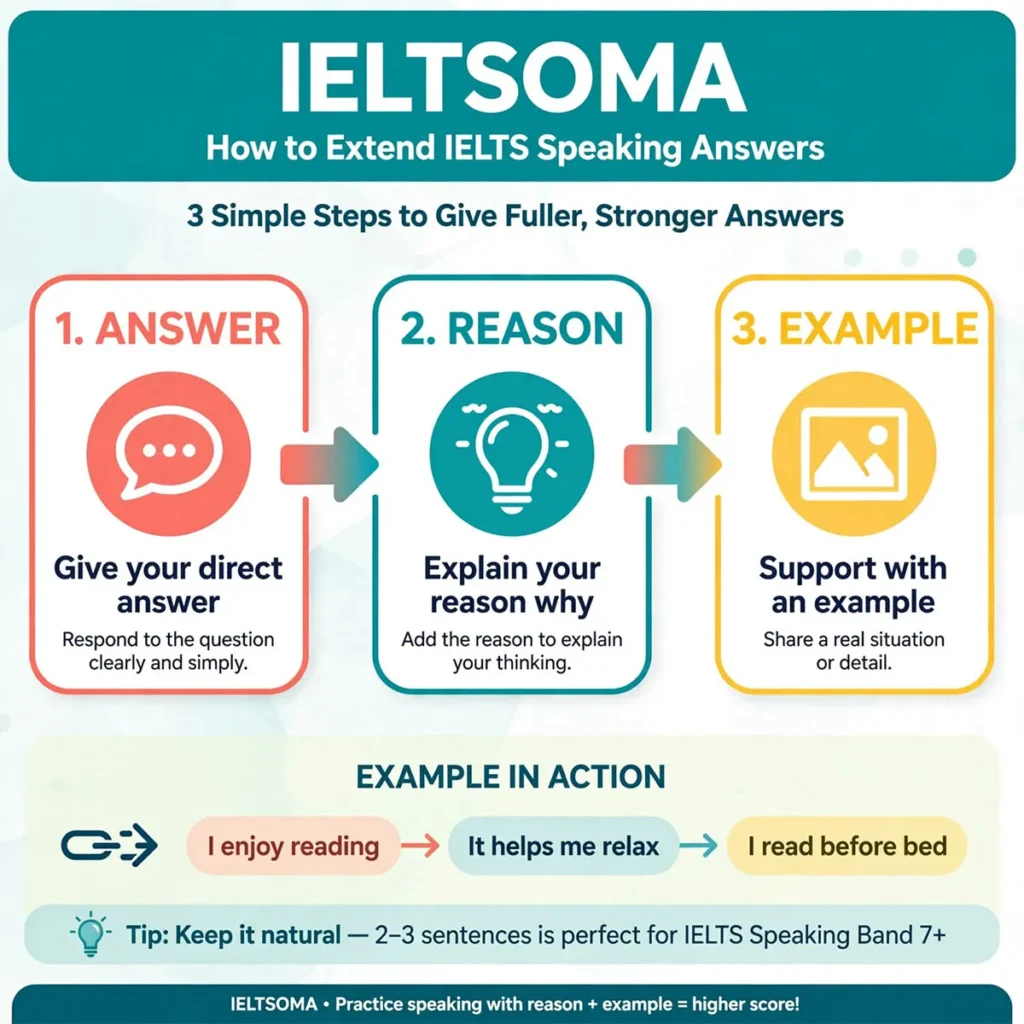
If you often struggle to decide what to say next, start with a simple three-step method:
Answer → Reason → Example or Detail
This is a practical technique for developing responses, not an official IELTS scoring formula.
Consider the following question:
Question: Do you enjoy listening to music?
Step 1 — Answer: Yes, I listen to music almost every day.
Step 2 — Reason: It helps me relax and take my mind off work.
Step 3 — Example or detail: I usually listen to soft music in the evening while having dinner or doing something around the house.
Complete answer: Yes, I listen to music almost every day because it helps me relax and take my mind off work. I usually listen to soft music in the evening while having dinner or doing something around the house.
This approach works well for many IELTS Speaking Part 1 questions because it helps you give a complete answer without turning a simple conversation into a long speech.
For more complex questions, particularly in Part 3, you can expand the structure:
Answer → Reason → Example → Result or Implication
For example:
Question: Do you think public transport should be improved?
Developed answer: Yes, I think public transport should be improved because it can reduce dependence on private cars. For example, if buses and trains were more reliable and comfortable, more people might choose them for their daily journeys. As a result, cities could experience less traffic congestion and lower transport-related pollution.
Each sentence adds a different piece of information. That is what makes the answer developed rather than merely long.
How to Extend Answers in Each Part of the IELTS Speaking Test
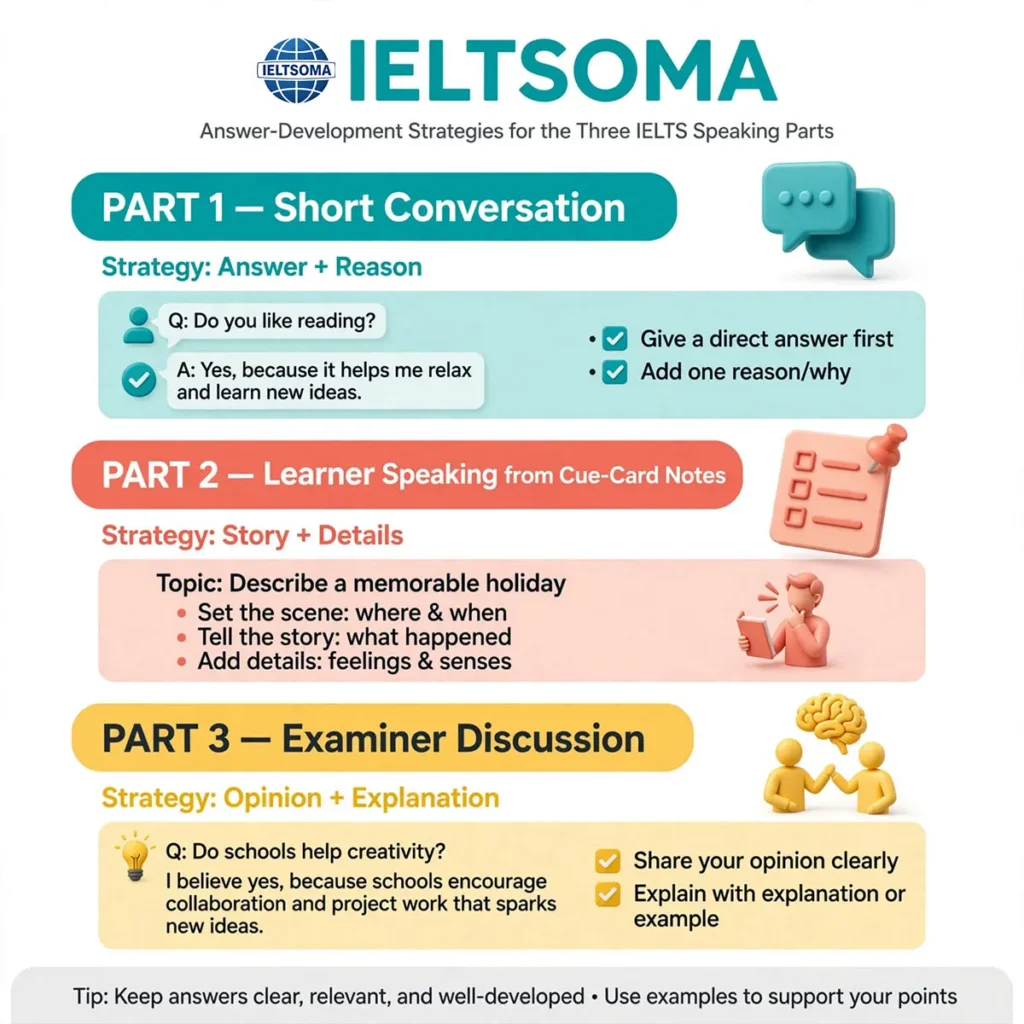
The best IELTS Speaking answer extension strategy depends on the type of question you are answering. You should adjust the amount of detail and the way you organise your ideas to suit each part.
IELTS Speaking Part 1: Keep Answers Brief but Complete
Part 1 involves familiar topics such as work, studies, home, hobbies and daily routines. The examiner asks direct questions, so your responses should sound conversational.
A useful starting point is two or three connected sentences, although the appropriate length depends on the question.
Question: Do you like your hometown?
Too short: Yes, I do.
Too long and unfocused: Yes, I do. My hometown has many streets, shops, schools, parks, restaurants and different buildings. There are lots of people, and some people travel by bus while others travel by car. The weather also changes throughout the year…
Better answer: Yes, I do, mainly because it has a friendly atmosphere and most of my family live nearby. I also like the local food, which is one of the things I miss when I travel elsewhere.
The improved answer is specific, relevant and easy to follow.
For Part 1, try to include one meaningful extension after answering the question. Add another detail only when it contributes something useful.
IELTS Speaking Part 2: Develop a Story or Description
In Part 2, you receive a cue card and have one minute to prepare before speaking for up to two minutes. You should address the points on the card and develop your talk coherently.
A useful way to organise your notes is to identify:
- The main subject: Who or what will you describe?
- The background: When and where did it happen?
- The details: What happened, or what makes it special?
- Your reaction: Why do you remember or value it?
For example, suppose your cue card asks you to describe a memorable journey.
Your notes might contain:
- Journey: A trip to a mountain town
- When: During a holiday last year
- Who with: Two friends
- What happened: Explored the area and took photographs
- Why memorable: Beautiful scenery and a break from daily routine
These notes give you several connected ideas to develop. You can explain what the place looked like, describe an activity, mention a memorable moment and reflect on how you felt.
Do not write full sentences during the preparation minute. Short notes and keywords make it easier to speak naturally instead of reading a memorised script.
If you finish too early, ask yourself: What happened next? Why was it important to me? What detail would help the listener picture the experience?
IELTS Speaking Part 3: Explain, Justify and Analyse
Part 3 involves broader questions related to the topic discussed in Part 2. You may be asked to explain social trends, compare generations, discuss advantages and disadvantages or predict future changes.
A useful structure is:
Opinion → Explanation → Example → Wider implication
Question: Why do some people prefer shopping online?
Developed answer: I think convenience is the main reason. People can compare products and prices without travelling to several shops, which saves time. For example, someone with a busy work schedule can order household items in the evening and have them delivered. This is particularly helpful for people who have limited access to large shopping centres.
This answer develops a general opinion, supports it with reasoning and illustrates the point with an example.
For more complex questions, you can also consider a contrasting perspective or a possible limitation.
Question: Do you think technology has improved education?
Developed answer: Overall, I think it has improved access to education because students can learn from online resources regardless of where they live. For example, someone in a remote area may be able to attend online lessons or use digital learning materials. However, technology cannot replace every aspect of classroom learning, particularly the direct interaction students have with teachers and classmates.
This response shows that you can develop a position while recognising another perspective.
Avoid treating every Part 3 question as an invitation to deliver a speech. Give enough detail to explain your thinking, then allow the examiner to continue the discussion.
Natural Phrases That Help You Develop Answers
You do not need a long list of sophisticated expressions. A small collection of flexible phrases is usually more useful.
| Purpose | Natural expressions |
|---|---|
| Giving a reason | Mainly because…, The main reason is… |
| Adding an example | For example…, A good example would be… |
| Describing an experience | I remember when…, One experience that stands out is… |
| Explaining a benefit | This helps me…, One advantage is… |
| Comparing ideas | Compared with…, On the other hand… |
| Explaining a result | As a result…, This means that… |
| Expressing a personal view | Personally, I think…, What I find interesting is… |
| Discussing the future | In the future, I hope to…, I would like to… |
Use these expressions to connect ideas, not as compulsory openings for every answer.
If you use “Moreover”, “Furthermore” or “In addition” repeatedly in a casual conversation, your answers may sound more like an essay than spoken English. Simple transitions such as “also”, “because” and “for example” are often more natural.
Common IELTS Speaking Answer Extension Mistakes
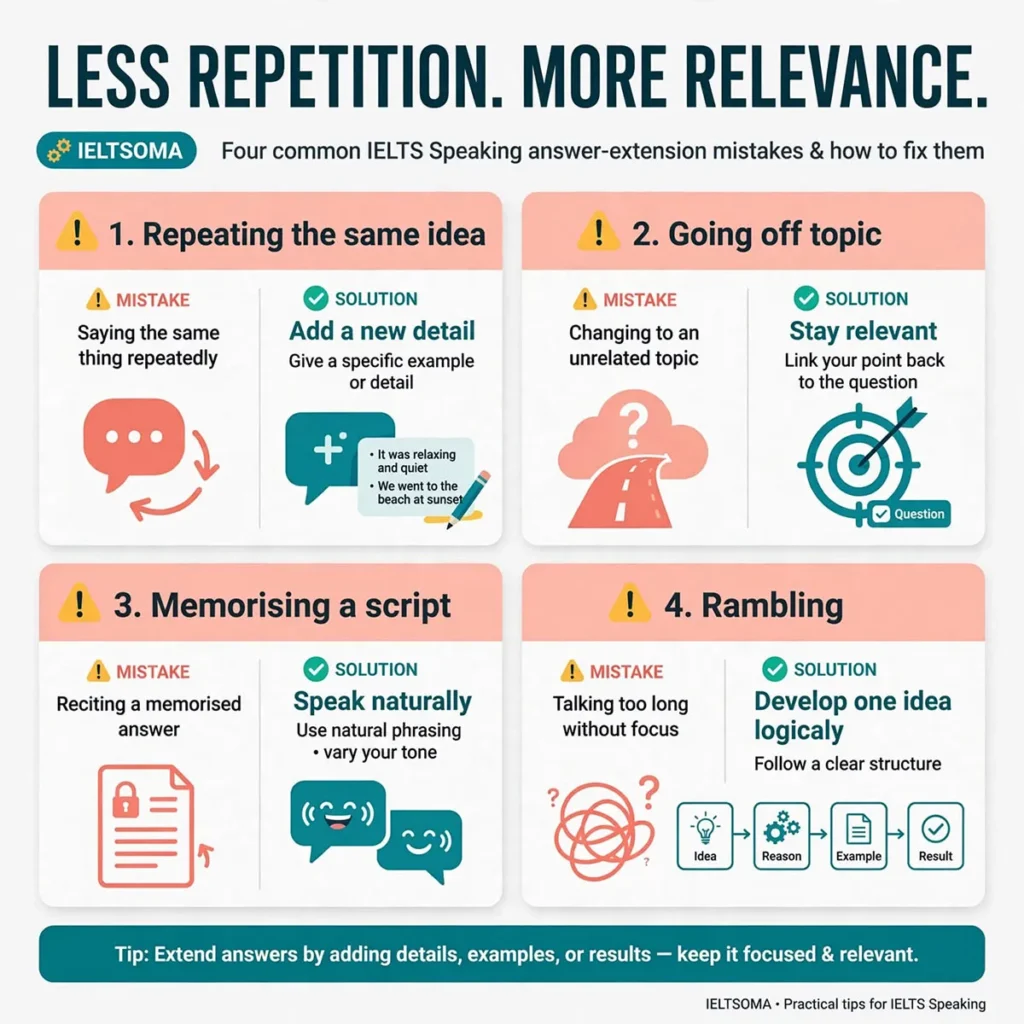
Learning how to extend IELTS Speaking answers also means understanding what to avoid.
1. Repeating the Same Idea
Weak answer: I like reading because it is enjoyable. I enjoy it because I find reading enjoyable, and it is something I like doing.
These sentences repeat one idea without developing it.
Improved answer: I enjoy reading because it helps me relax. I particularly like historical novels because they introduce me to different periods and cultures.
Each sentence adds new information.
2. Giving Irrelevant Details
If the examiner asks whether you enjoy cooking, you do not need to describe the entire history of food or list every dish you have ever eaten.
Stay focused on the question. A relevant reason or example is more valuable than several unrelated sentences.
3. Using Memorised Answers
Preparing ideas and vocabulary is useful, but memorising complete answers can make your delivery sound unnatural. You may also struggle if the examiner asks the question differently.
Practise developing answers from keywords instead of learning scripts word for word. This helps you adapt your language to the actual question.
4. Forcing Advanced Vocabulary
A simple, accurate expression is better than an impressive-sounding phrase used incorrectly.
For example, “It helps me unwind after work” is natural. There is no need to replace it with a complicated expression that you cannot use confidently.
5. Speaking Without a Clear Structure
Adding one sentence after another does not automatically create a coherent answer.
Before continuing, ask yourself whether the next sentence explains your opinion, gives evidence, adds an example or develops a related point. If it does none of these things, you probably do not need it.
6. Trying to Speak for Too Long
There is no universal number of seconds that guarantees a high score for every Part 1 or Part 3 response.
Focus on answering the question fully and naturally. In Part 2, use the available time to develop the cue-card topic, but do not add irrelevant material simply to fill the full two minutes.
A 10-Minute Daily Practice Routine
You can improve your ability to develop answers naturally through short, consistent practice.
Minutes 1–2: Choose three questions.
Select familiar topics such as food, transport, education, work or hobbies. Read each question and decide on your main answer.
Minutes 3–5: Extend each answer.
For every question, add a reason and one supporting detail or example. Say the answer aloud instead of writing a paragraph.
Minutes 6–7: Record yourself.
Use your phone to record two or three answers. Do not stop every time you make a small mistake.
Minutes 8–9: Review the recording.
Ask yourself:
- Did I answer the question directly?
- Did I explain my idea?
- Did I add relevant detail?
- Did I repeat myself?
- Were my sentences easy to follow?
Minute 10: Repeat one answer.
Choose the answer that sounded weakest and try again. Aim to improve its clarity and development rather than making it longer at any cost.
Over time, you should find it easier to generate supporting ideas without long pauses.
Practice Exercise: Develop These IELTS Speaking Answers
Try answering the following questions aloud using the techniques in this guide.
Question 1: What do you usually do at weekends?
Start with your usual activity, explain why you enjoy it and add a specific detail.
Question 2: Do you prefer reading books or watching films?
State your preference, explain your reason and compare it with the alternative if useful.
Question 3: Why do some people enjoy living in large cities?
Give a general reason, support it with an example and explain a possible benefit.
Question 4: Do you think people will travel more in the future?
Give your opinion, explain what may cause this trend and discuss a possible consequence.
After answering, check whether each sentence contributes a new and relevant idea. If your response contains only a direct answer, try adding a reason. If you already have a reason, add an example, comparison or consequence where appropriate.
The goal is to become comfortable developing ideas spontaneously, not to memorise model answers.
Frequently Asked Questions
How can I extend IELTS Speaking answers without repeating myself?
Give your direct answer first, then add a different type of information. You might explain why you feel that way, give an example, describe a personal experience or explain a result. Each sentence should add something new rather than restating the same point.
How long should my IELTS Speaking answers be?
There is no fixed ideal length for every question. Part 1 answers are generally brief and conversational, while Part 2 requires a longer individual talk and Part 3 often needs more developed explanations. Aim to answer fully and remain relevant rather than counting words or seconds.
What should I do if I cannot think of anything else to say?
Ask yourself a simple follow-up question: Why? When? Where? What happened? How did I feel? What was the result? Choose one that relates directly to the original question and use it to develop your response.
Can I use examples in every IELTS Speaking answer?
You can, but you do not need to. Examples are particularly useful when explaining a preference, illustrating an opinion or discussing a general issue. For a straightforward question, a reason or one additional detail may be sufficient.
Does giving longer answers guarantee a higher IELTS Speaking band score?
No. IELTS Speaking is assessed across fluency and coherence, lexical resource, grammatical range and accuracy, and pronunciation. Longer answers can give you opportunities to demonstrate your abilities, but repetition, irrelevant information and frequent breakdowns in communication can weaken your performance. The quality and development of your ideas matter more than length alone.
Should I memorize phrases to extend my answers?
You can learn flexible expressions such as “The main reason is…” or “For example…”, but practice using them in different contexts. Memorizing entire answers is less useful because real questions may differ from the ones you prepared for.
How can I extend IELTS Speaking Part 3 answers?
Start with your opinion, explain the reason behind it and add an example or consequence. For questions about society, you can also compare different groups, discuss advantages and disadvantages, or consider how a situation might change in the future.
Final Tips for Developing Answers Naturally
The most effective way to improve IELTS Speaking answer extension is to build the habit of developing one idea at a time.
Remember these principles:
- Answer the examiner’s question directly.
- Add a reason to explain your opinion or preference.
- Use examples and personal experiences when they are relevant.
- Develop broader Part 3 questions with explanations and implications.
- Use natural linking expressions instead of forcing advanced vocabulary.
- Avoid repetition, memorised speeches and irrelevant details.
- Practise speaking aloud and review your recordings regularly.
You do not need to sound like a native English speaker or use complicated sentences in every response. You need to communicate your ideas clearly, connect them logically and demonstrate control of the language you use.
Start with the simple answer–reason–example technique. Once it becomes natural, you can use comparisons, consequences and more detailed explanations to handle a wider range of IELTS Speaking questions with confidence.
Useful Links: