Many IELTS Academic candidates make the same mistake: they learn one essay structure and try to use it for everything.
That approach can work for a while, but it quickly becomes a problem when the task changes.
A line graph is not written like an opinion essay. A process diagram is not organised like a discussion essay. A question asking you to discuss both views requires a different approach from one asking whether you agree or disagree.
Understanding Academic Writing Genres for IELTS helps you recognise these differences before you start writing. Instead of memorising one template, you learn how the purpose, information and required response shape your writing.
This guide explains the major writing genres and task types you should understand for IELTS Academic Writing, with practical examples and strategies you can apply in the exam.
Table of Contents
What Does “Writing Genre” Mean in IELTS?
A writing genre is a type of writing with a particular purpose, organisation and style.
In IELTS Academic Writing, the word “genre” is useful for understanding how different tasks require different ways of presenting information. IELTS itself describes the official Writing test in terms of Task 1 and Task 2, rather than formally labelling every task as a separate “genre”. However, candidates can use genre awareness to understand what each task is asking them to accomplish.
IELTS Academic Writing contains two tasks:
- Task 1: describe, summarise or explain visual information such as a graph, chart, table or diagram, using at least 150 words.
- Task 2: respond to a point of view, argument or problem in an essay of at least 250 words.
You have 60 minutes in total, and Task 2 contributes twice as much as Task 1 to your Writing score.
Both tasks are assessed using four broad criteria: Task Achievement or Task Response, Coherence and Cohesion, Lexical Resource, and Grammatical Range and Accuracy.
The key lesson is simple:
Do not choose a writing structure before you understand the purpose of the task.
The 7 Key Academic Writing Genres for IELTS
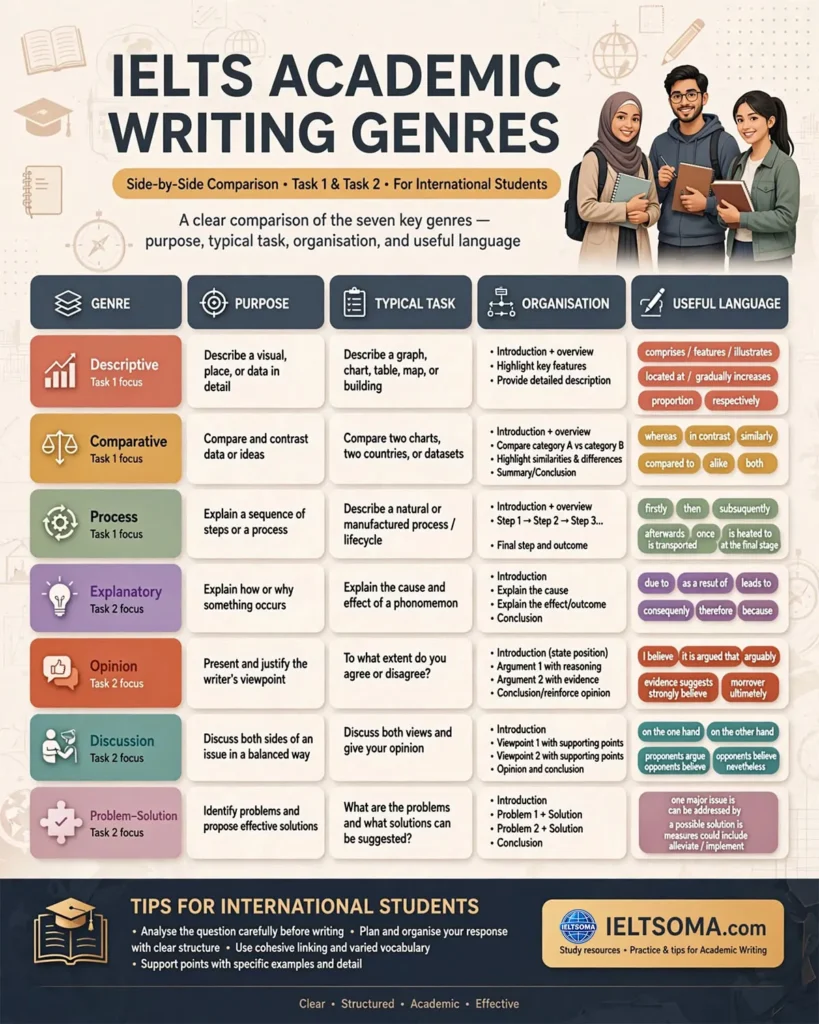
For practical IELTS preparation, you can think of the major genres as:
- Descriptive writing
- Comparative writing
- Process and sequence writing
- Explanatory writing
- Opinion or argumentative writing
- Discussion writing
- Problem-solution and mixed-response writing
Some of these overlap because IELTS tasks can combine more than one communicative purpose.
For example, a Task 1 chart may require both description and comparison. A Task 2 question may require you to express an opinion while also discussing causes and solutions.
Understanding the dominant purpose is therefore more useful than trying to memorise rigid categories.
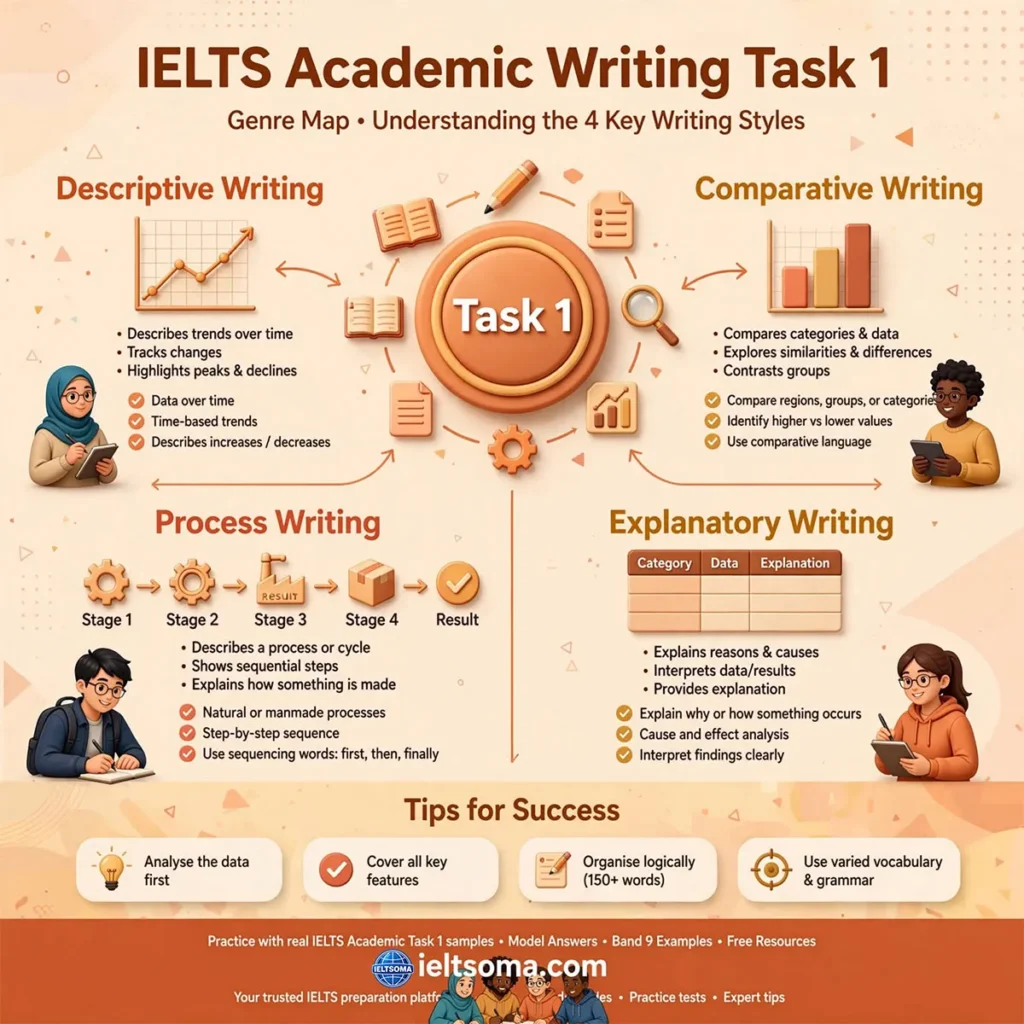
1. Descriptive Writing
Descriptive writing is especially important in IELTS Academic Writing Task 1.
The purpose is to describe information presented visually and accurately.
You may be given:
- A line graph
- A bar chart
- A pie chart
- A table
- A combination of visuals
The examiner is not asking you to explain why something happened unless the information provided allows you to do so. Your main responsibility is to identify and communicate the important features.
For example, imagine a line graph showing the number of international students at a university between 2010 and 2020.
A descriptive response might report that the number increased steadily over the period, with a particularly sharp rise after 2016.
A weak response often becomes a list of every number shown in the graph.
A stronger response identifies the major pattern first and then selects relevant figures to support it.
A useful structure
A clear Task 1 response can usually contain:
Introduction: Paraphrase what the visual shows.
Overview: Identify the most significant trends, differences or developments.
Body paragraph 1: Present important supporting details.
Body paragraph 2: Present further relevant details or comparisons.
IELTS guidance specifically emphasises presenting a well-organised overview and selecting important information rather than attempting to reproduce every detail.
Example
Instead of writing:
The figure was 20 in 2010. It was 25 in 2011. It was 29 in 2012…
You could write:
Overall, the number of students increased steadily throughout the period, with growth becoming considerably faster after 2016.
The second version demonstrates that you can identify the overall pattern rather than simply copy data.
2. Comparative Writing
Comparison is another major feature of Academic Writing Genres for IELTS, particularly in Task 1.
You may need to compare:
- Two or more countries
- Different years
- Several categories
- Male and female figures
- Different products or groups
- Multiple charts or tables
Comparison is not simply putting two numbers next to each other.
The purpose is to show meaningful relationships between the data.
For example:
In 2015, public transport accounted for approximately 40% of journeys, compared with just 25% for private vehicles.
This is more useful than describing each figure separately because the relationship between the figures is immediately clear.
What should you compare?
Look for:
- Highest and lowest figures
- Similarities
- Major differences
- Changes over time
- Categories that behave differently
- Significant gaps between figures
Avoid comparing everything.
A high-quality response selects comparisons that help the reader understand the most important features.
3. Process and Sequence Writing
Process writing is common in IELTS Academic Writing Task 1 when the visual shows how something is produced, changed or completed.
You might be asked to describe:
- A manufacturing process
- A natural process
- The stages of a system
- How a product is made
- How something works
IELTS states that Task 1 may involve describing stages of a process or procedure, an object or event, a sequence of events, or how something works.
The biggest difference from graph and chart tasks is that the organisation is often determined by the sequence itself.
Focus on the stages
Before writing, identify:
- Where the process begins
- The major stages
- Any changes in direction
- Where the process ends
- Whether it is a linear or cyclical process
For a linear process, chronological organisation is usually natural.
For example:
First, raw materials are transported to the factory. They are then processed before being transferred to the production line.
For a cyclical process, make the relationship between the final and initial stages clear.
Avoid adding invented explanations
If the diagram shows that water is filtered, do not automatically explain why filtration is necessary unless the diagram provides that information.
Task 1 is based on the information given in the visual.
Your job is to communicate the process accurately, not demonstrate how much outside knowledge you have.
4. Explanatory Writing
Explanatory writing focuses on making a process, system, relationship or development understandable.
This overlaps considerably with process writing in Task 1.
For example, a diagram might show how electricity is generated, how rainwater is collected or how a machine operates.
The purpose is not simply to name components. You need to explain the relationship between the stages or parts.
Useful language may include:
- initially
- subsequently
- following this
- once
- after
- before
- during
- finally
- is transferred to
- is converted into
- passes through
- is transported to
However, using linking expressions alone does not make a response coherent.
The information must also be logically organised.
IELTS assesses Coherence and Cohesion partly through how logically ideas and information are organised and how effectively relationships are communicated.
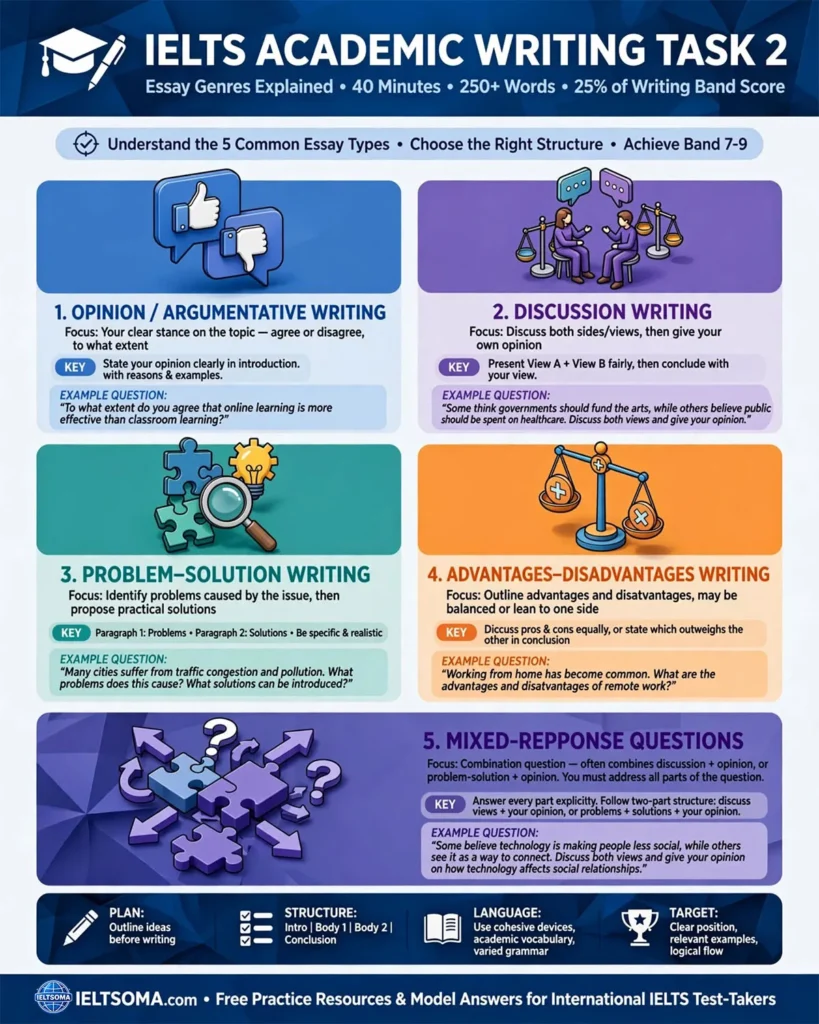
5. Opinion and Argumentative Writing
Opinion writing is primarily associated with IELTS Academic Writing Task 2.
The question may ask whether you:
- Agree or disagree
- Agree or disagree to what extent
- Think something is positive or negative
- Believe a particular development is beneficial
- Support a particular position
For example:
Some people believe that university education should be free for everyone. To what extent do you agree or disagree?
Here, you need to establish a clear position.
The mistake many candidates make is writing a vague introduction and only revealing their position in the conclusion.
A stronger response makes its position clear early and maintains it consistently.
A practical structure
A straightforward argumentative essay might contain:
Introduction
- Paraphrase the issue
- State your position
Body paragraph 1
- Main argument
- Explanation
- Example
Body paragraph 2
- Second argument
- Explanation
- Example
Conclusion
- Summarise the position
The exact structure can change depending on the question, but your argument should always remain relevant to the task.
IELTS Task Response assesses how fully you respond to the question, develop your ideas, support them and present a clear position where required.
6. Discussion Writing
Discussion writing asks you to examine different perspectives on an issue.
A common form is:
Some people believe that X, while others believe that Y. Discuss both views and give your own opinion.
This is different from a straightforward agree/disagree question.
If the question explicitly asks you to discuss both views, you need to give appropriate attention to both.
A useful approach is:
Introduction
- Introduce the issue
- State your overall position
Body paragraph 1
- Explain the first view
- Give reasons or an example
Body paragraph 2
- Explain the second view
- Give reasons or an example
- Make your position clear where appropriate
Conclusion
- Summarise the discussion
- Restate your position
Do not turn discussion writing into a list
A strong discussion does not simply say:
Some people think X. Other people think Y.
You need to explain why each position exists.
For example:
Supporters of online education argue that it provides greater flexibility for people who work full-time. Students can attend lessons without travelling to a physical campus, which may make higher education more accessible.
The second sentence develops the first idea instead of merely repeating it.
7. Problem-Solution and Mixed-Response Writing
Some Task 2 questions focus on problems, causes, solutions, advantages, disadvantages or combinations of these.
For example:
Many cities are experiencing increasing levels of traffic congestion. What are the causes of this problem, and what measures can be taken to address it?
This is not primarily an opinion essay.
The question gives you a specific task:
- Identify causes
- Explain the problem
- Suggest solutions
Your organisation should reflect those requirements.
A possible structure
Introduction
- Paraphrase the problem
- Briefly indicate the main causes and solutions
Body paragraph 1
- Explain major causes
Body paragraph 2
- Explain realistic solutions
Conclusion
- Summarise the main points
Mixed questions require even greater care.
For example:
What are the advantages and disadvantages of working from home? Do the advantages outweigh the disadvantages?
This contains two connected requirements:
- Discuss advantages and disadvantages.
- Give a judgement about which side is stronger.
If you discuss both sides but never answer the “outweigh” question, your response is incomplete.
Academic Writing Genres for IELTS: Task 1 vs Task 2
The easiest way to understand the genres is to connect them to the purpose of each task.
| Writing purpose | Typical IELTS task | Main skill |
|---|---|---|
| Describe data | Task 1 | Identify and report key features |
| Compare information | Task 1 | Show meaningful similarities and differences |
| Describe a process | Task 1 | Explain stages logically |
| Explain a system | Task 1 | Show relationships and sequence |
| Present an opinion | Task 2 | Develop and support a position |
| Discuss viewpoints | Task 2 | Explain different perspectives |
| Analyse problems and solutions | Task 2 | Explain causes and propose responses |
| Handle mixed requirements | Task 2 | Address every part of the question |
This distinction matters because the examiner is not simply looking for grammatically correct English.
The response must also fulfil the task.
How Genre Affects Your Vocabulary
Understanding the genre should influence your vocabulary choices.
For descriptive Task 1 writing, you may need language for:
- Increase
- Decrease
- Stability
- Comparison
- Approximation
- Proportion
- Ranking
For process writing, you need language for:
- Sequence
- Transformation
- Movement
- Stages
- Cause and effect
For Task 2 essays, you may need language for:
- Arguments
- Reasons
- Consequences
- Examples
- Advantages
- Disadvantages
- Solutions
- Evaluation
This does not mean memorising huge lists of “IELTS vocabulary”.
Vocabulary should serve the communicative purpose of the task.
IELTS assesses Lexical Resource according to the range, accuracy and appropriacy of vocabulary used.
How Genre Affects Your Paragraph Structure
Genre also determines what a good paragraph needs to accomplish.
A Task 1 data paragraph may group related figures and comparisons.
A process paragraph may describe a sequence of stages.
A Task 2 argumentative paragraph usually needs a clear main idea followed by explanation and support.
For example:
One major advantage of public transport is that it can reduce the number of private vehicles on the road. When more commuters use buses and trains, fewer cars may be required for daily journeys. This can reduce pressure on roads, particularly during peak periods.
The paragraph has a clear progression:
Main idea → explanation → consequence
That progression is more valuable than simply inserting sophisticated vocabulary.
Common Mistakes When Writing Different Genres
1. Using the same structure for every question
A memorised four-paragraph essay cannot automatically answer every Task 2 question.
The structure must reflect the question.
2. Writing an opinion in Task 1
Task 1 is based on the information presented in the visual.
Do not write:
I believe this increase happened because…
unless the visual or task specifically provides information that supports such an explanation.
3. Listing data without an overview
A Task 1 response should communicate the important overall features, not simply reproduce individual numbers.
4. Ignoring one part of a Task 2 question
If a question contains two instructions, both need to be addressed.
5. Confusing discussion with opinion writing
Discussing two views requires more than stating which one you prefer.
You need to demonstrate an understanding of the relevant arguments.
6. Forcing memorised phrases into every essay
A memorised sentence can sound unnatural or fail to fit the specific question.
IELTS rewards appropriate communication, not the number of phrases you can remember.
7. Writing beyond the purpose of the task
More words do not automatically mean a higher band.
For Task 1, spending too much time producing a very long response can reduce the time available for Task 2, which carries greater weight.
A Simple Genre-Recognition Method
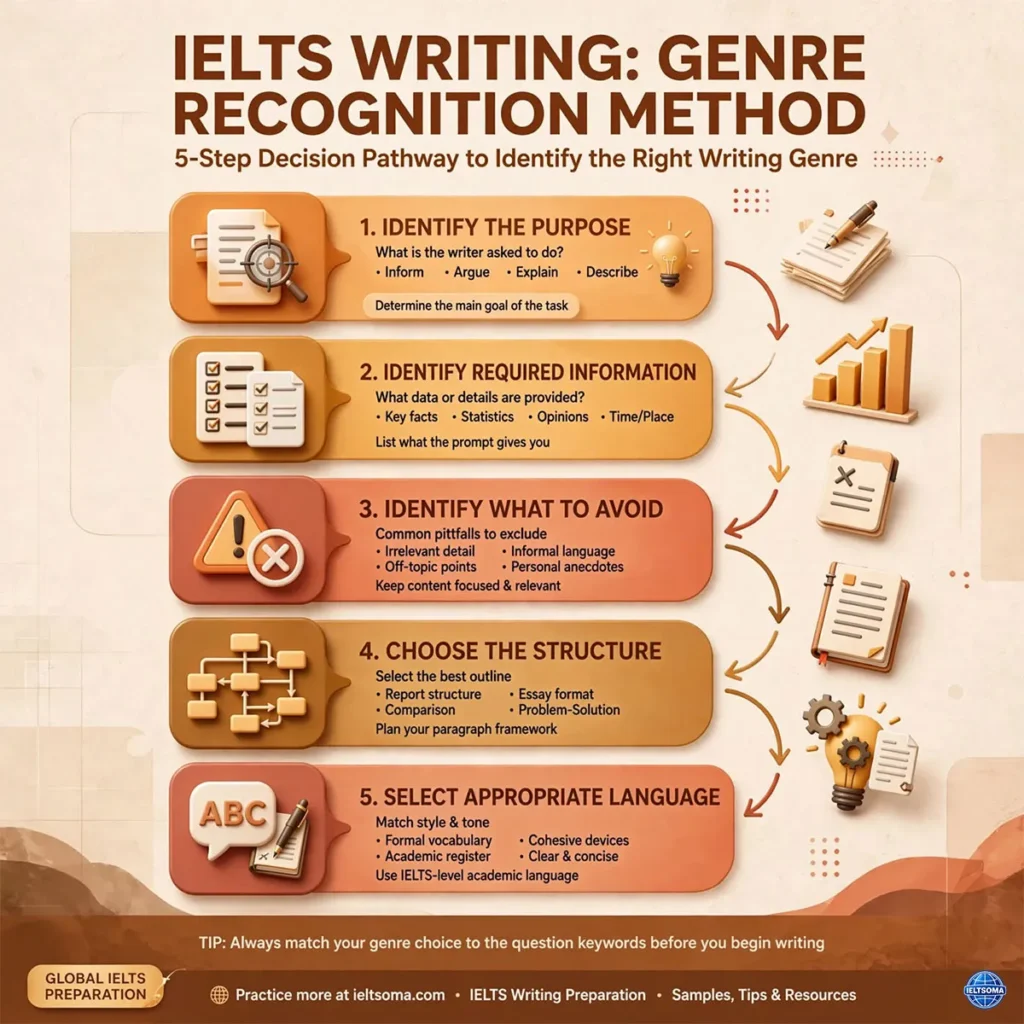
Before writing, spend a few seconds asking five questions:
1. What am I being asked to do?
Describe? Compare? Explain? Argue? Discuss? Solve?
2. What information must I include?
Look for every instruction in the question.
3. What should I not include?
Avoid irrelevant background information, invented explanations and unrelated opinions.
4. What structure matches the purpose?
Choose an organisation that makes the answer easy to follow.
5. What language does this purpose require?
Select vocabulary and grammar that help you communicate the required information.
This method is much safer than immediately reaching for a memorised template.
How to Practise Academic Writing Genres for IELTS
If you want to improve your writing efficiently, practise by genre rather than writing random essays every day.
Try this weekly cycle:
Day 1: Descriptive writing
Choose a graph or table and practise identifying:
- Main trends
- Highest and lowest figures
- Significant changes
- Useful comparisons
Day 2: Process writing
Choose a process diagram and practise describing the stages without writing a complete answer.
Day 3: Opinion writing
Choose an agree/disagree question and write two developed arguments.
Day 4: Discussion writing
Take a “discuss both views” question and explain the reasoning behind each side.
Day 5: Problem-solution writing
Identify causes and develop realistic solutions.
Day 6: Mixed questions
Practise identifying every requirement before planning your response.
Day 7: Full timed test
Complete both Academic Writing tasks under realistic time conditions.
This approach develops flexibility rather than dependence on a single formula.
What High-Band Writing Has in Common Across Genres
Although the genres differ, strong IELTS writing shares several characteristics.
It is:
- Relevant to the task
- Clearly organised
- Logically developed
- Appropriately supported
- Accurate
- Flexible in vocabulary
- Varied in grammar
- Appropriate in style and register
The official IELTS band descriptors emphasise clear development, relevant support, effective organisation, appropriate vocabulary and grammatical control.
That means genre awareness is not separate from IELTS scoring.
It helps you make better decisions within the four assessment criteria.
FAQs About Academic Writing Genres for IELTS
How many writing genres are there in IELTS Academic?
IELTS does not officially publish a fixed number of “writing genres”. The Academic Writing test consists of two tasks, and those tasks can involve different communicative purposes such as describing data, explaining processes, comparing information, presenting opinions and discussing arguments.
Is Academic Writing Task 1 descriptive writing?
Often, yes. Task 1 requires you to describe, summarise or explain visual information such as graphs, charts, tables and diagrams. Depending on the visual, you may also need to compare information or describe a process.
Is IELTS Writing Task 2 argumentative writing?
Some Task 2 questions are argumentative, particularly those asking for your opinion or degree of agreement. However, Task 2 can involve several question purposes, including discussion, advantages and disadvantages, problems and solutions, and combinations of these.
Should I use the same essay structure for every IELTS question?
No. You should have a reliable overall writing framework, but your paragraph organisation should reflect the exact requirements of the question.
Does genre affect IELTS Writing vocabulary?
Yes. Different tasks require different vocabulary. Data description requires language for trends and comparisons, while argumentative writing requires language for reasoning, evidence, consequences and evaluation.
Can memorised templates help in IELTS Writing?
A flexible framework can help you organise your ideas under time pressure. However, memorising complete sentences or paragraphs and forcing them into unrelated questions can make your writing unnatural or irrelevant.
Which IELTS Writing genre is the hardest?
That depends on the candidate. Some test takers struggle with selecting and comparing data in Task 1, while others find Task 2 difficult because they must develop and support ideas. The most effective preparation is to identify which task purpose causes you the most difficulty and practise it deliberately.
Final Takeaway
The biggest advantage of understanding Academic Writing Genres for IELTS is that you stop treating every writing question as the same task.
You learn to recognise what the examiner wants before you start writing.
A graph requires careful selection and comparison of information. A process requires logical sequencing. An opinion essay requires a clear position and developed arguments. A discussion question requires balanced treatment of relevant viewpoints. A problem-solution question requires you to explain problems and develop appropriate responses.
The strongest IELTS writers are not necessarily those who memorise the most templates.
They are the candidates who can recognise the task, choose an appropriate structure, develop relevant ideas and communicate them clearly.
That is the skill worth practising.