If you know the passage but still lose marks in IELTS Reading, the problem may not be your English. It may be the question type.
IELTS Reading does not test every question in the same way. A Matching Headings question requires a different approach from True/False/Not Given. A summary completion task demands different skills from a multiple-choice question.
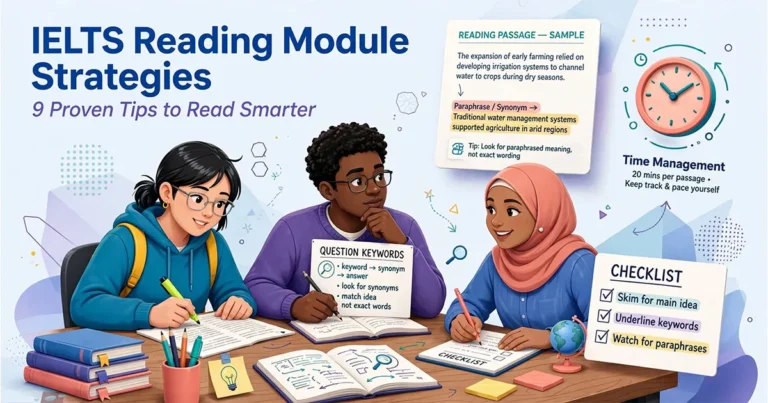
That is why learning the IELTS Reading question types is one of the most effective ways to improve your score. Instead of reading every passage word by word and hoping the answers become obvious, you can recognise what each task is testing, choose the right strategy, and search for the information more efficiently.
The Academic and General Training Reading tests use a variety of task types. The two tests have different reading texts, but many of their question formats are the same. IELTS officially lists tasks including multiple choice, identifying information, identifying writer’s views or claims, matching information, matching headings, matching features, matching sentence endings, completion tasks, diagram labelling and short-answer questions.
This guide explains the major IELTS Reading question types, what each one tests, how to approach it, and the mistakes that commonly cost candidates marks.
Table of Contents
IELTS Reading Question Types at a Glance
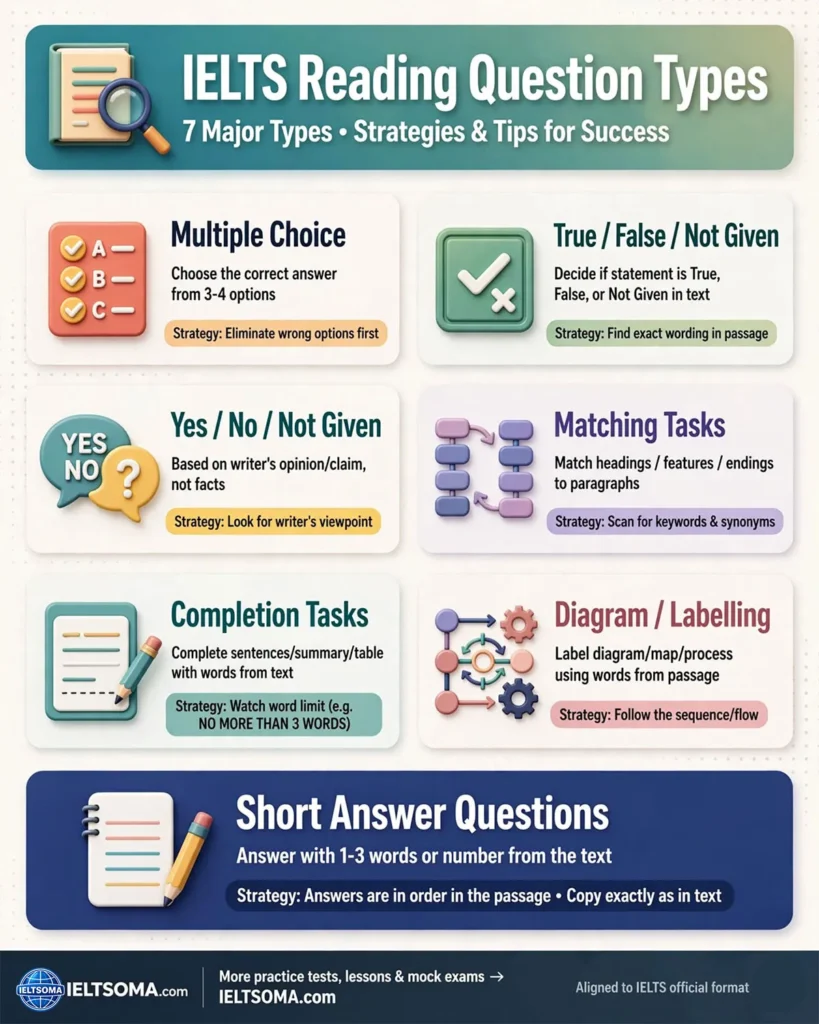
There are 13 major question formats you should be prepared to encounter:
- Multiple Choice
- True/False/Not Given
- Yes/No/Not Given
- Matching Information
- Matching Headings
- Matching Features
- Matching Sentence Endings
- Sentence Completion
- Summary Completion
- Note Completion
- Table Completion
- Flow-Chart Completion
- Diagram Label Completion
- Short-Answer Questions
Some official IELTS materials group several completion tasks together, while others present them separately. For preparation purposes, it is useful to understand each format individually because the wording and information structure can change.
| Question type | Main skill tested | Key strategy |
|---|---|---|
| Multiple Choice | Understanding details and main ideas | Eliminate distractors |
| True/False/Not Given | Identifying factual information | Separate contradiction from missing information |
| Yes/No/Not Given | Identifying opinions and claims | Focus on the writer’s position |
| Matching Information | Finding specific information | Scan for distinctive details |
| Matching Headings | Identifying main ideas | Focus on the paragraph’s overall purpose |
| Matching Features | Connecting information with options | Track names, dates and categories |
| Matching Sentence Endings | Understanding relationships between ideas | Use grammar and meaning |
| Sentence Completion | Finding precise details | Follow the word limit |
| Summary Completion | Understanding a section of the text | Predict the missing word type |
| Note Completion | Extracting key information | Read around the gap |
| Table Completion | Understanding organised factual information | Identify categories and relationships |
| Flow-Chart Completion | Following a process | Track sequence and stages |
| Diagram Label Completion | Locating descriptive information | Follow the diagram and nearby text |
| Short Answer | Finding specific facts | Search using keywords and paraphrases |
The key is not to memorise a single strategy for every task. Different IELTS Reading question types require different reading behaviours.
1. Multiple-Choice Questions
Multiple-choice questions give you several possible answers and ask you to select the correct option. Depending on the task, you may need to choose one answer or more than one.
The question may test a specific detail, the main idea, the writer’s purpose, or an inference.
How to approach multiple choice
Start by reading the question carefully. Identify the key idea rather than trying to memorise the entire question.
Then:
- Underline or mentally identify important keywords.
- Predict what kind of information you need.
- Locate the relevant section of the passage.
- Read that section carefully.
- Compare the evidence with each option.
- Eliminate options that contradict the passage.
- Choose the option directly supported by the text.
Do not choose an answer simply because it contains words that appear in the passage.
IELTS often uses distractors. An incorrect option may use exactly the same vocabulary as the passage while changing the meaning.
Example
Passage:
The research began in 2018, but the first results were not published until 2020.
Question:
When were the first results published?
A. 2018
B. 2019
C. 2020
D. 2021
The correct answer is C.
The presence of 2018 in the passage could tempt a rushed candidate to select A.
2. True/False/Not Given
True/False/Not Given questions ask whether statements agree with information in the passage.
The distinction is critical:
- True = the statement agrees with the information.
- False = the statement contradicts the information.
- Not Given = the passage does not provide enough information to decide.
The biggest mistake is treating “Not Given” as “probably false”.
It is not.
If the passage says:
The museum opened in 1995.
Statement:
The museum opened in 1995.
Answer: True
Statement:
The museum opened in 1998.
Answer: False
Statement:
The museum receives more than one million visitors each year.
If the passage gives no information about visitor numbers, the answer is Not Given.
The golden rule
Do not use your own knowledge.
Your answer must be based on the passage.
This distinction is also emphasised by the official IELTS test format. IELTS explains that “False” means the statement contradicts the text, while “Not Given” means that the text neither agrees nor contradicts it.
3. Yes/No/Not Given
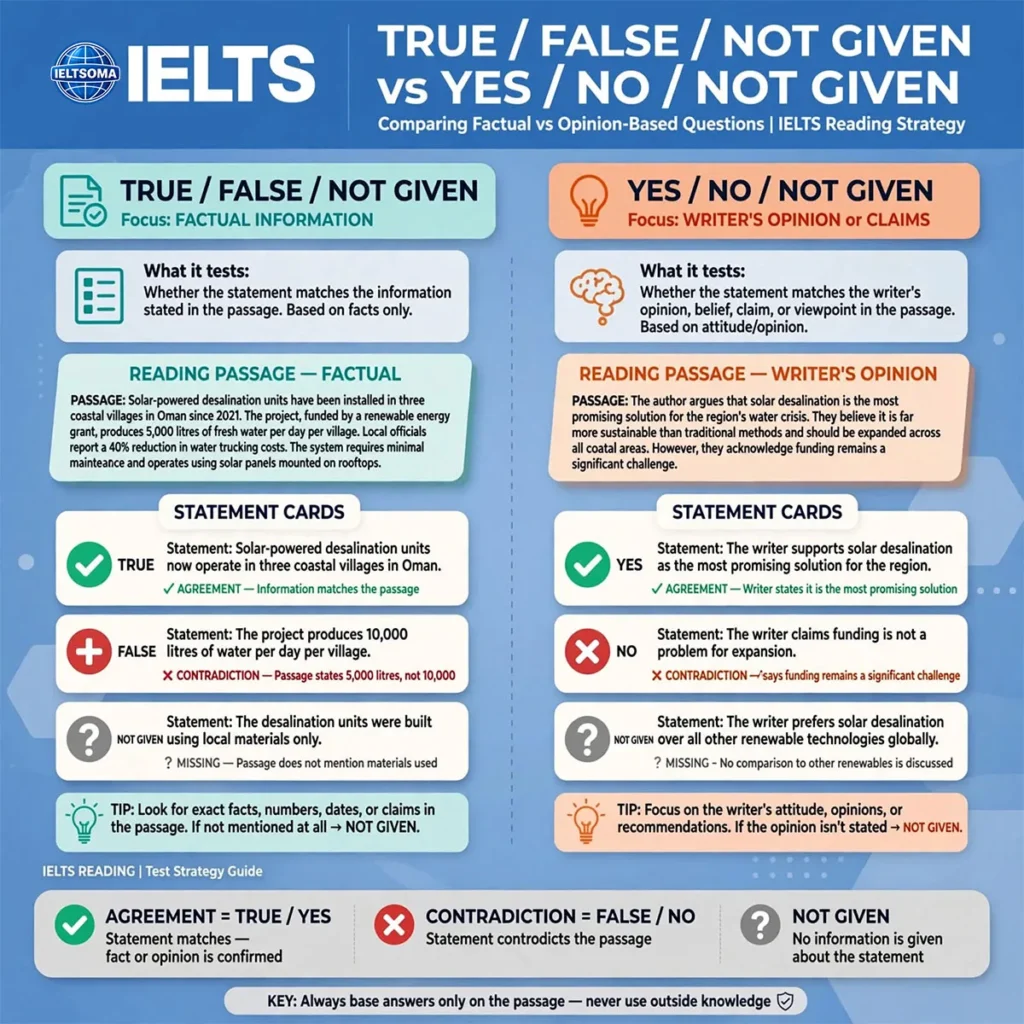
Yes/No/Not Given looks similar to True/False/Not Given, but the purpose is different.
This task asks whether statements agree with the writer’s views or claims.
Think of it this way:
True/False/Not Given → facts or information
Yes/No/Not Given → the writer’s opinion or position
For example:
The author argues that governments should invest more heavily in public transport.
If the writer clearly supports that idea, the answer is Yes.
If the writer argues against it, the answer is No.
If the writer never expresses a position, the answer is Not Given.
Common mistake
Candidates sometimes treat an opinion mentioned by another person in the passage as the writer’s opinion.
Look carefully at reporting verbs such as:
- argues
- claims
- suggests
- believes
- maintains
- questions
- rejects
You need to identify who holds the opinion.
4. Matching Information
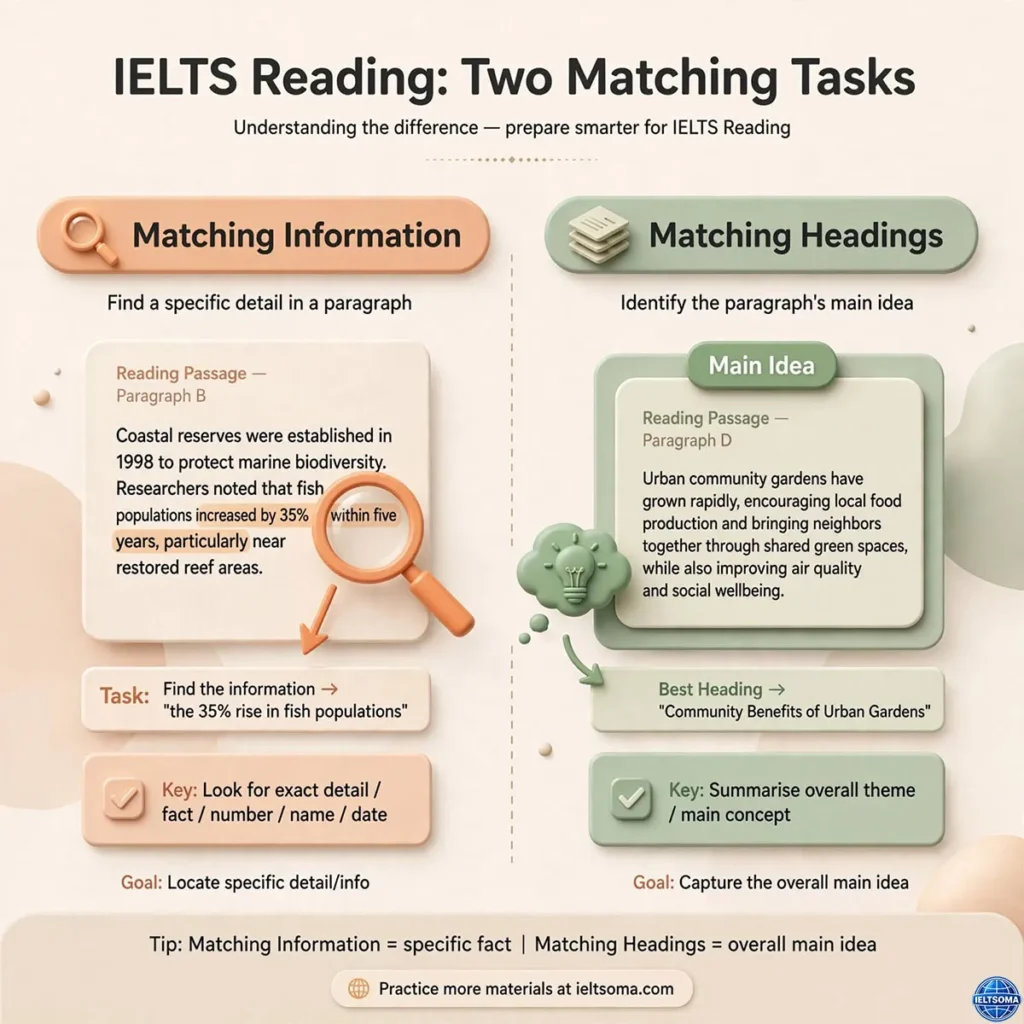
Matching Information questions require you to find specific information and match it to the correct paragraph or section.
The information might include:
- an example
- a reason
- a comparison
- a description
- a specific fact
- an explanation
- a reference to an event
Unlike Matching Headings, this task is not primarily about the main idea.
Best strategy
Read the statements first and identify distinctive words or concepts.
Then scan the passage for:
- names
- dates
- places
- unusual nouns
- technical terms
- specific examples
When you find a possible location, read the surrounding sentences carefully.
Do not assume that the first sentence containing a keyword is automatically the answer. IELTS frequently uses paraphrasing.
5. Matching Headings
Matching Headings is one of the most challenging IELTS Reading question types because it tests your ability to identify the main idea of a paragraph.
You are given several headings and must match them to paragraphs or sections.
There are usually more headings than you need, so some are distractors.
The most important question
Ask yourself:
“What is this paragraph mainly about?”
Do not choose a heading simply because one word matches.
For example, a paragraph may mention:
- a new technology
- its cost
- its environmental effects
- a government programme
But the main idea may be the environmental consequences of the technology, rather than the technology itself.
A useful technique
Read the paragraph quickly first.
Then identify:
- The topic
- The author’s main point about that topic
- The purpose of the paragraph
Ignore minor examples unless they help reveal the main idea.
Official IELTS guidance describes Matching Headings as a task that tests the ability to identify the general topic of a paragraph and distinguish its main idea from supporting information.
6. Matching Features
Matching Features requires you to connect statements with a list of people, places, theories, dates, discoveries or other features.
For example:
A. Dr Smith
B. Dr Jones
C. Dr Patel
You may then need to determine which person:
- developed a particular theory
- conducted a specific experiment
- criticised an earlier idea
Strategy
Create a mental list of the features.
Then scan the passage for each feature and note the relevant information.
Be careful because:
- some options may not be used
- some options may be used more than once
- the information may be paraphrased
Do not assume every option must be used exactly once.
7. Matching Sentence Endings
You are given the beginning of sentences and a list of possible endings.
For example:
Researchers discovered that…
A. the method was unreliable.
B. the experiment produced unexpected results.
C. the project required additional funding.
You need to select the ending that creates a statement supported by the passage.
Two checks
Use both grammar and meaning.
First ask:
Which ending creates a grammatically complete sentence?
Then ask:
Which completed sentence agrees with the passage?
Grammar can eliminate several options, but it should not replace evidence from the text.
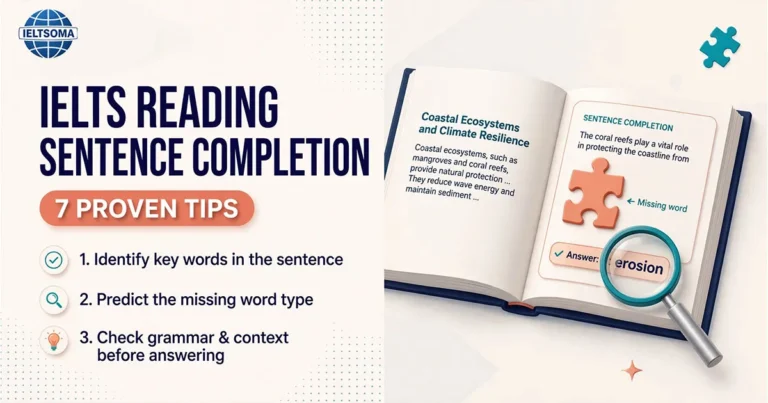
8. Sentence Completion
Sentence Completion requires you to complete sentences using information from the reading passage.
The instructions may say:
NO MORE THAN TWO WORDS AND/OR A NUMBER
That instruction is part of the task.
If the correct answer is three words and the instruction allows only two, you cannot use it.
Strategy
Before searching for the answer, predict what type of word is missing.
For example:
The new system was introduced to reduce ______.
You might predict that a noun is required.
Then search for the relevant part of the passage and check the grammar of the completed sentence.
Official IELTS guidance specifically warns candidates to follow the stated word limit.
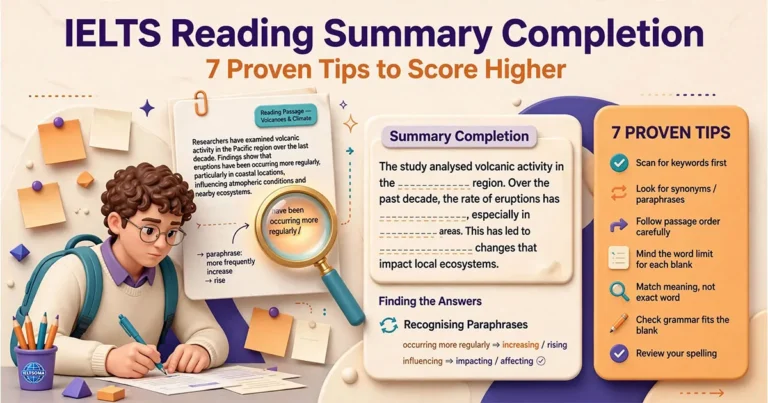
9. Summary Completion
Summary Completion provides a shortened version of part of the passage with gaps.
You may have to:
- choose words from the passage
- select answers from a list
- complete the summary using information from the text
The summary normally represents a particular part of the passage rather than every paragraph.
Best approach
Read the summary before searching.
Look at the words immediately before and after each gap.
Ask:
- What type of word is required?
- Is it singular or plural?
- Is it a noun, verb or adjective?
- What information is being described?
Then locate the relevant section of the passage.
Do not automatically search the whole passage from the beginning.
10. Note Completion
Note Completion is similar to Summary Completion, but the information is presented as notes.
Notes are usually more compressed than normal sentences.
For example:
Advantages of the new system
- lower operating costs
- improved ______
- fewer maintenance problems
The missing word may be found directly in the passage or through paraphrasing.
Key technique
Read the entire set of notes before searching.
The heading and surrounding information often tell you exactly which part of the passage contains the answer.
11. Table Completion
Table Completion requires you to fill gaps in a table containing information from the passage.
Tables often organise information into categories such as:
| System | Cost | Main advantage |
|---|---|---|
| A | £500 | ______ |
| B | £700 | greater efficiency |
The table structure helps you predict the type of answer.
Use the table as a map
Look at:
- column headings
- row headings
- units
- dates
- categories
If the column is “Cost”, you know the answer is likely to be a price or number.
If the column is “Main advantage”, you are looking for a benefit or positive characteristic.
12. Flow-Chart Completion
Flow-Chart Completion tests your ability to follow a process.
The information might describe:
- how a product is manufactured
- how a scientific process works
- how a system operates
- stages in a historical development
For example:
Raw material → Processing → ______ → Packaging → Distribution
The missing information should represent a stage in the process.
Strategy
Follow the sequence carefully.
Look for:
- first
- next
- then
- after
- subsequently
- finally
However, do not rely only on these transition words. The passage may describe the process without using obvious sequencing language.
13. Diagram Label Completion
Diagram Label Completion requires you to label parts of a diagram using information from the passage.
The diagram could represent:
- a machine
- a building
- a natural process
- an object
- a scientific structure
The answers may not always appear in exactly the same order as the questions.
How to solve it
First understand what the diagram represents.
Then identify:
- labels already provided
- arrows
- surrounding structures
- directional relationships
After that, find the relevant description in the passage.
Do not assume that every answer will appear sequentially through the whole reading text.
14. Short-Answer Questions
Short-answer questions require you to answer questions using information from the passage.
For example:
What year was the first experiment conducted?
The answer might simply be:
1987
Or:
Which organisation funded the project?
The answer could be:
The European Research Council
What to watch
Read the word limit carefully.
If the instruction says:
NO MORE THAN THREE WORDS AND/OR A NUMBER
you must stay within that limit.
Also check spelling before moving on.
The Most Important Differences Between IELTS Reading Question Types
Many candidates struggle because they confuse similar tasks.
Here are the distinctions worth memorising:
True/False/Not Given vs Yes/No/Not Given
True/False/Not Given focuses on information in the passage.
Yes/No/Not Given focuses on the writer’s views or claims.
Matching Information vs Matching Headings
Matching Information asks:
Where is this specific piece of information?
Matching Headings asks:
What is this paragraph mainly about?
Matching Features vs Matching Information
Matching Features connects information to specific options such as people, places or theories.
Matching Information normally asks you to locate particular information within paragraphs or sections.
Summary Completion vs Sentence Completion
Both require missing words, but Summary Completion normally represents a condensed section of the passage, while Sentence Completion presents individual sentences.
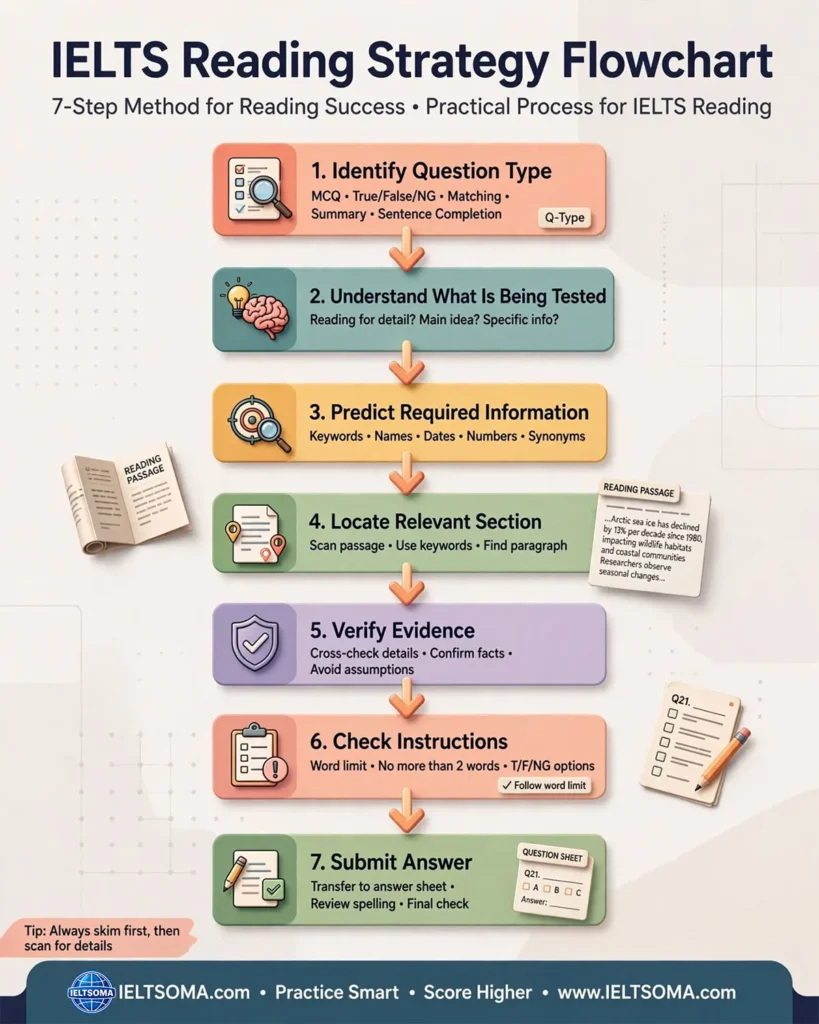
How to Choose the Right IELTS Reading Strategy
You should not approach every question in exactly the same way.
Use this simple decision process:
Step 1: Identify the question type.
Before solving the question, know what task you are dealing with.
Step 2: Identify what the task is testing.
Is it:
- a main idea?
- a specific detail?
- an opinion?
- a relationship?
- a sequence?
- a missing word?
Step 3: Predict the information you need.
For example, if the gap follows “in 1998”, you may need a noun describing an event rather than another date.
Step 4: Locate the relevant section.
Use keywords, paraphrases, names, numbers and distinctive concepts.
Step 5: Read carefully around the answer.
Finding the correct area is not the same as finding the correct answer.
Step 6: Check the instructions.
Especially check:
- word limits
- whether letters or words are required
- whether an option can be used more than once
- whether you need one or several answers
Common Mistakes Across IELTS Reading Question Types
1. Reading every word
You do not need to understand every sentence before answering questions.
IELTS Reading rewards efficient reading as well as comprehension.
2. Looking only for exact words
IELTS frequently uses paraphrases.
A question might say:
increased significantly
while the passage says:
experienced a substantial rise
You need to recognise the relationship.
3. Confusing False with Not Given
A contradiction is False.
Missing information is Not Given.
4. Choosing an answer because it “sounds right”
Your answer must be supported by the passage.
5. Ignoring the word limit
An otherwise correct answer can lose its mark if it exceeds the permitted number of words.
6. Spending too long on one question
If you cannot solve a question after a reasonable attempt, make your best decision, move on and return later if time permits.
7. Treating all questions identically
A Matching Headings question requires a different approach from a table completion task.
Recognising this difference can save valuable time.
A Better Practice Method for IELTS Reading
Instead of completing random reading tests repeatedly, practise by question type.
For example:
Week 1: Multiple Choice + True/False/Not Given
Week 2: Matching Headings + Matching Information
Week 3: Matching Features + Matching Sentence Endings
Week 4: Completion tasks + Short Answer
After each practice session, record:
- the question type
- your answer
- the correct answer
- why your answer was wrong
- the evidence in the passage
- the paraphrase that confused you
This turns mistakes into a personalised study resource.
Once you become comfortable with individual question types, begin completing mixed practice tests under timed conditions.
Academic vs General Training Reading
The Academic and General Training Reading tests are not identical.
IELTS states that the Reading and Writing tests differ between the two versions, while Listening and Speaking are the same.
Academic Reading contains three sections with a total text length of approximately 2,150–2,750 words and 40 questions.
General Training Reading uses texts from a wider range of everyday, workplace and general-interest contexts. It also contains 40 questions.
However, the major question formats overlap substantially.
Therefore, if you are preparing for either test, you should learn the underlying question-solving skills rather than memorising one particular passage format.
A Simple IELTS Reading Question-Type Checklist
Before the test, make sure you can confidently recognise and approach:
- Multiple Choice
- True/False/Not Given
- Yes/No/Not Given
- Matching Information
- Matching Headings
- Matching Features
- Matching Sentence Endings
- Sentence Completion
- Summary Completion
- Note Completion
- Table Completion
- Flow-Chart Completion
- Diagram Label Completion
- Short-Answer Questions
You do not need a completely different reading technique for every task.
Instead, develop four core abilities:
Skim for the overall meaning.
Scan for specific information.
Paraphrase between question language and passage language.
Verify the answer against the exact evidence.
FAQs About IELTS Reading Question Types
How many IELTS Reading question types are there?
IELTS Reading uses a variety of task formats. The major formats include multiple choice, True/False/Not Given, Yes/No/Not Given, matching tasks, completion tasks, diagram labelling and short-answer questions. Official IELTS sample materials list 14 commonly presented task formats when the main completion types are counted separately.
Which IELTS Reading question type is the hardest?
There is no single hardest question type for every candidate. Matching Headings and True/False/Not Given are often challenging because they require careful interpretation rather than simple keyword matching. Your difficulty will depend on your reading skills and the type of mistakes you make.
What is the difference between True/False/Not Given and Yes/No/Not Given?
True/False/Not Given tests whether a statement agrees with information in the passage. Yes/No/Not Given tests whether a statement agrees with the writer’s views or claims.
Should I read the whole IELTS Reading passage first?
Not necessarily. A quick overview can help you understand the structure and topic, but reading every word carefully before looking at the questions can waste valuable time. A combination of skimming, scanning and careful reading is generally more efficient.
Are IELTS Academic and General Training Reading question types the same?
Many question types are shared by both tests, including multiple choice, matching tasks, completion tasks and identifying information. However, the reading texts and overall test content differ between Academic and General Training.
Do IELTS Reading questions follow the order of the passage?
Some do, but not all. Multiple-choice questions and many completion tasks generally follow the order of information in the passage. Matching Headings, Matching Information and some diagram tasks may require you to move around the text.
Can I use my own knowledge to answer IELTS Reading questions?
No. Your answer should be based on information in the passage. This is especially important for True/False/Not Given and Yes/No/Not Given questions.
How can I improve my IELTS Reading score quickly?
Start by identifying your weakest question types. Practise those tasks separately, analyse every mistake, learn to recognise paraphrases, and then move to timed mixed-question tests. Improving accuracy before increasing speed is usually more productive than simply doing more full tests.
Final Thoughts
Understanding IELTS Reading question types changes the way you approach the Reading test.
Instead of seeing a passage as one large block of difficult English, you begin to see a collection of tasks, each with a specific purpose.
Matching Headings asks you to find the main idea. Matching Information asks you to locate specific information. True/False/Not Given tests whether information agrees, contradicts or is absent. Completion tasks test your ability to locate precise information while following strict instructions.
The goal is not to memorise dozens of tricks.
The goal is to recognise the task, understand what it is testing, locate the relevant evidence and make a decision based on the text.
Once these skills become automatic, your Reading practice becomes more focused—and your limited test time becomes much easier to manage.
For official task descriptions and sample questions, use the IELTS preparation resources and test-format information provided by IELTS.
The more clearly you understand the question type, the more confidently you can choose the right strategy.
Other Useful Links: