Preparing for IELTS can feel overwhelming when you are trying to improve four skills, understand question types, manage time, and reach the band score required for your future.
But there is a powerful way to turn uncertainty into measurable progress: IELTS Practice Tests Power.
A good practice test does more than tell you how many questions you answered correctly. It can show you where you lose marks, whether your timing is realistic, which question types cause problems, and whether your preparation is moving in the right direction.
Whether you are taking IELTS Academic for university study or professional registration, or IELTS General Training for migration, work, or other purposes, realistic practice should be an important part of your preparation.
The key is knowing how to use practice tests correctly.
Taking one test after another without reviewing your mistakes may give you lots of scores but very little improvement. On the other hand, using each test as a learning tool can help you identify weaknesses and build a smarter preparation routine.
In this complete guide, we explain how IELTS Practice Tests Power can strengthen your preparation, how Academic and General Training candidates should use tests differently, and how to turn every practice session into an opportunity to improve.
Table of Contents
What Does IELTS Practice Tests Power Mean?
IELTS Practice Tests Power refers to the value that realistic practice tests can provide during IELTS preparation.
A well-designed practice test gives you an opportunity to experience the structure, timing, question types, and pressure associated with IELTS preparation. It can also help you measure progress over time.
Official IELTS preparation materials are designed to help candidates become familiar with test formats, experience different task types, practise under timed conditions, and review answers with model answers where available.
This makes practice tests useful for more than simply checking answers.
They can help you:
- Understand the test format
- Identify weak question types
- Improve time management
- Develop concentration
- Practise answering under pressure
- Measure your current performance
- Track improvement
- Build confidence
- Create a realistic study plan
- Recognise recurring mistakes
However, a practice score should not automatically be treated as your official IELTS result.
The purpose of practice is to prepare you for the real assessment, not to guarantee a particular band score.
Why IELTS Practice Tests Power Your Preparation
The biggest advantage of IELTS Practice Tests Power is that practice creates measurable feedback.
Reading grammar explanations or memorising vocabulary can certainly be useful. However, IELTS requires you to apply your English skills while completing specific tasks within strict time limits.
Practice tests bring those elements together.
For example, a candidate may believe that Reading is their strongest skill because they understand most of the vocabulary. After completing a timed Reading test, however, they may discover that they repeatedly lose marks on True/False/Not Given questions or matching headings.
That information changes the preparation strategy.
Instead of spending another week studying random vocabulary, the candidate can focus on the specific problem.
This is where effective practice becomes more valuable than simply doing more questions.
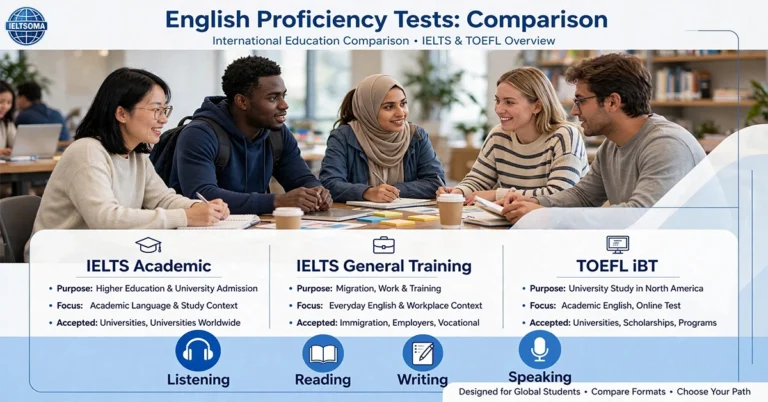
IELTS Practice Tests Power for Academic and General Training
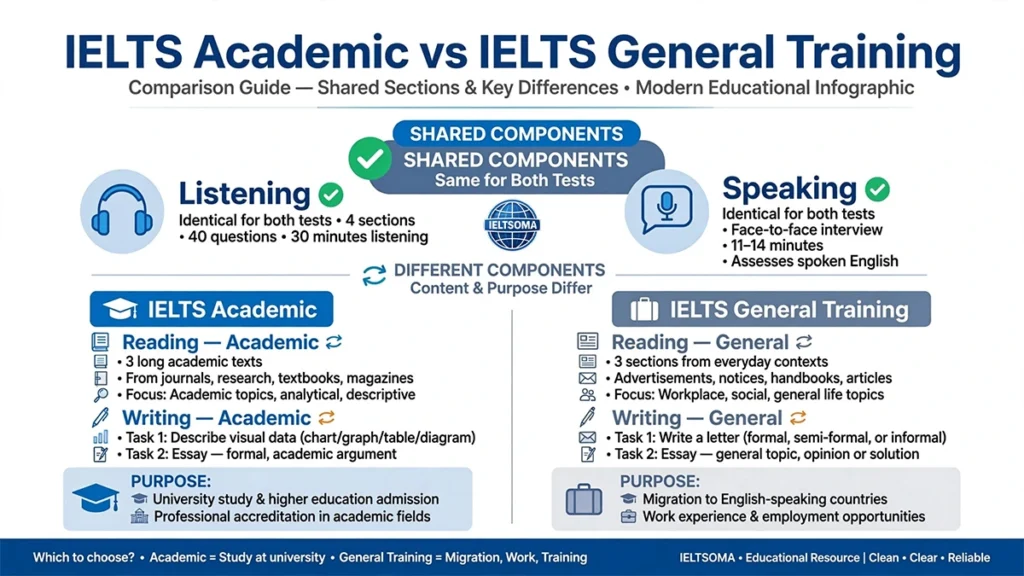
IELTS Academic and IELTS General Training share important elements, but they are not identical.
The Listening and Speaking sections are the same for Academic and General Training. The Reading and Writing sections are different.
That distinction is essential when choosing practice material.
IELTS Academic Practice
IELTS Academic is generally intended for people who want to study at undergraduate or postgraduate level or who need IELTS for certain professional registration purposes.
Academic Reading contains texts from sources such as books, journals, magazines, and newspapers. Academic Writing includes two tasks, with Task 1 requiring candidates to describe visual information and Task 2 requiring a response to a point of view, argument, or problem.
Therefore, Academic candidates should make sure their practice materials contain the appropriate Academic Reading and Writing tasks.
IELTS General Training Practice
IELTS General Training is commonly used for migration, work-related purposes, and study or training below degree level.
The General Training Reading test uses different material and task demands from Academic Reading.
General Training Writing Task 1 is also different. Candidates write a letter in response to a situation, while Task 2 involves an essay response.
For this reason, General Training candidates should not assume that every IELTS practice test is suitable for their preparation.
Always check whether the test is designed for Academic or General Training.
7 Powerful Benefits of IELTS Practice Tests Power
1. IELTS Practice Tests Power Helps You Understand the Test Format
One of the first challenges for an IELTS candidate is understanding what actually happens during the test.
Knowing English is important, but IELTS also requires you to understand instructions, question formats, timing, and task expectations.
Practice tests can make the structure more familiar.
The official IELTS sample resources include practice materials for Academic and General Training candidates and provide examples of different task types.
The more familiar you become with the structure, the less mental energy you need to spend figuring out what to do next.
Instead, you can focus on the actual question.
2. IELTS Practice Tests Power Improves Time Management
Time management can make a major difference in IELTS preparation.
A candidate may know the correct answer but still lose marks because they spend too long on difficult questions.
This is particularly important in Reading and Writing.
A realistic practice test forces you to make decisions about time.
Should you spend another two minutes on one difficult question?
Should you move forward and return later?
How much time should you reserve for checking answers?
These decisions become easier when you practise them repeatedly.
For Reading, timed practice can help you discover whether your current reading speed is sufficient.
For Writing, timed practice can show whether you can plan, write, and check your response within the available time.
The goal is not simply to write faster.
The goal is to use your available time intelligently.
3. IELTS Practice Tests Power Reveals Your Weak Question Types
Your overall score can hide specific weaknesses.
Imagine you complete a Reading practice test and receive a good result.
That sounds positive.
But suppose most of your mistakes come from matching headings.
Your next study session should not simply involve taking another random test.
Instead, you should study matching-heading strategies, analyse why your choices were incorrect, and then complete targeted exercises.
The same principle applies to Listening.
If you repeatedly miss answers in note-completion questions, investigate why.
Are you missing plural endings?
Are you distracted by similar information?
Are you spelling answers incorrectly?
Are you losing concentration before the answer appears?
Practice becomes much more valuable when you identify the reason behind each mistake.
4. IELTS Practice Tests Power Builds Test-Day Confidence
Confidence does not have to come from believing that everything will be easy.
Real confidence can come from familiarity.
When you have completed several realistic practice sessions, the test environment may feel less unfamiliar.
You know what timed practice feels like.
You know which question types challenge you.
You know how you react when you cannot immediately find an answer.
You also have a strategy for recovering.
That experience can be valuable on test day.
The official IELTS Trial Test, where available through participating locations, is specifically designed to provide test-day experience under timed conditions and feedback. IELTS states that Trial Test results are not official IELTS scores.
5. IELTS Practice Tests Power Your Progress Tracking
A preparation plan becomes much stronger when you can measure progress.
Instead of saying:
“I think my Reading is improving.”
You can record your results.
For example:
| Practice Session | Listening | Reading | Main Problem |
|---|---|---|---|
| Test 1 | 28/40 | 25/40 | Timing |
| Test 2 | 30/40 | 27/40 | Matching headings |
| Test 3 | 32/40 | 30/40 | Careless errors |
| Test 4 | 34/40 | 32/40 | Vocabulary |
The exact numbers will vary from candidate to candidate.
The important point is that you can identify patterns.
If your scores are improving while the same mistakes are decreasing, your preparation is becoming more effective.
If scores remain unchanged after several tests, you may need to change your study strategy.
6. IELTS Practice Tests Power Better Study Decisions
Many candidates make the mistake of studying whatever feels comfortable.
If they enjoy vocabulary, they study vocabulary.
If they dislike Writing, they avoid Writing.
If Listening feels easy, they keep doing Listening.
Unfortunately, this can create an unbalanced preparation plan.
Practice test results can expose this problem.
Suppose your Listening performance is consistently strong but Writing is significantly weaker.
Taking another five Listening tests may not be the best use of your preparation time.
Your test results can help you allocate more time to the areas that need improvement.
This is one of the most useful applications of IELTS Practice Tests Power.
7. IELTS Practice Tests Power Creates a Realistic Exam Routine
Eventually, IELTS preparation needs to move beyond isolated exercises.
You need to practise performing under realistic conditions.
That means setting aside distractions, using appropriate timing, completing the required tasks, and reviewing your performance afterward.
A realistic routine can help you develop concentration and stamina.
It can also expose practical problems before test day.
For example, you might discover that:
- You lose concentration during long Reading passages.
- You spend too much time on one question.
- You do not leave enough time to check Writing.
- You miss Listening answers because you stop following the recording.
- You speak too briefly during Speaking practice.
- You make repeated spelling mistakes.
Finding these problems during preparation is useful because you still have time to address them.
How to Use IELTS Practice Tests Power Correctly
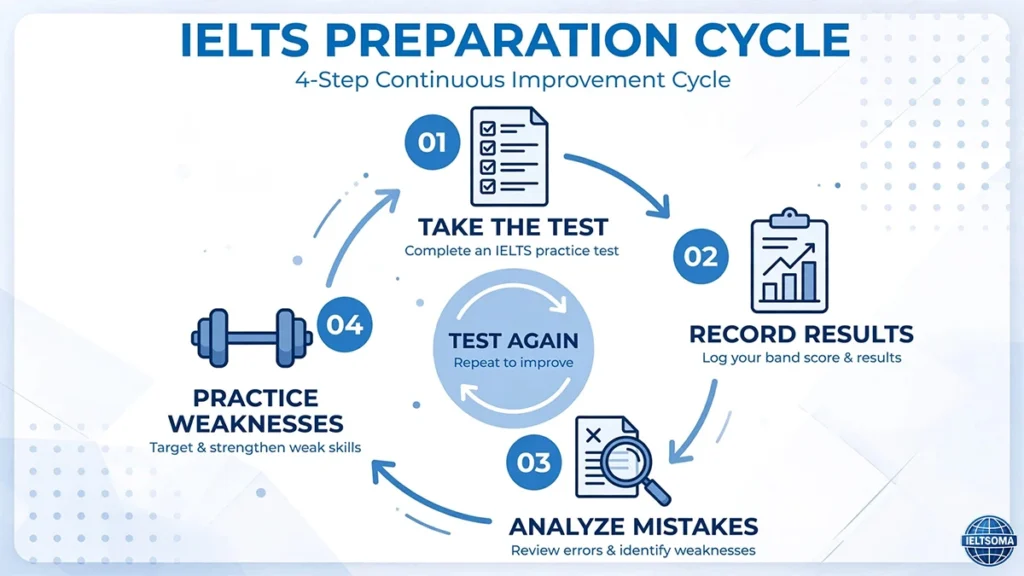
Simply completing tests is not enough.
Use a four-stage process.
Stage 1: Take the Test
Start with realistic conditions.
Put your phone away.
Set a timer.
Avoid looking at answers.
Do not pause recordings unnecessarily during Listening practice.
For Reading and Writing, follow the appropriate time limits.
The goal is to create a meaningful measurement.
Stage 2: Record Your Result
Write down your score.
Do not rely on memory.
Create a simple spreadsheet or notebook.
Record:
- Date
- Test name
- Test type
- Listening score
- Reading score
- Writing observations
- Speaking observations
- Mistakes
- Time problems
- Next action
This turns practice into a long-term record.
Stage 3: Analyse Every Mistake
This is where much of the learning happens.
For each incorrect answer, ask:
Why was my answer wrong?
Possible reasons include:
- I misunderstood the question.
- I did not understand the vocabulary.
- I read too quickly.
- I read too slowly.
- I confused similar information.
- I guessed without sufficient evidence.
- I made a spelling error.
- I misunderstood the instructions.
- I lost concentration.
- I ran out of time.
Do not simply write the correct answer.
Understand the reason for the mistake.
Stage 4: Fix the Problem
Once you know the problem, create a targeted exercise.
For example:
Problem: You frequently miss matching headings.
Action: Study the relationship between main ideas and supporting details, then complete several matching-heading exercises.
Or:
Problem: You run out of time in Reading.
Action: Practise locating keywords, identifying paragraph purpose, and moving away from questions that consume too much time.
This creates a feedback loop:
Test → Analyse → Practise → Test Again
That is much more effective than:
Test → Check Score → Take Another Test
IELTS Practice Tests Power for Listening
The Listening test contains four parts and 40 questions. Candidates hear recordings once, and a range of question types can appear.
Your practice should therefore include more than multiple-choice questions.
Work with different formats such as:
- Multiple choice
- Matching
- Plan or map labelling
- Form completion
- Note completion
- Table completion
- Flow-chart completion
- Summary completion
- Sentence completion
- Short-answer questions
Official IELTS sample materials include these types of tasks.
During review, pay particular attention to spelling.
A candidate may understand the recording perfectly but still lose a mark because the written answer is incorrect.
Also notice how speakers correct themselves, introduce alternatives, change information, or provide distracting details.
IELTS Practice Tests Power for Reading
Reading practice should focus on both accuracy and efficiency.
Academic Reading contains three parts and 40 questions, while General Training Reading also contains three sections and 40 questions, but the materials differ.
Do not use the same strategy for every question type.
For example, matching headings requires you to identify the main idea of a paragraph.
True/False/Not Given requires careful comparison between the statement and the information in the passage.
Summary completion requires attention to both meaning and grammatical fit.
A strong practice routine identifies which question types cause the most difficulty.
IELTS Practice Tests Power for Writing
Writing practice requires more than completing essays.
You should review your work against the relevant requirements.
Academic candidates need to practise both Writing tasks, including visual-information description in Task 1 and essay writing in Task 2.
General Training candidates need to practise the appropriate letter task in Task 1 and essay task in Task 2.
After each practice session, examine:
- Task response
- Organisation
- Paragraphing
- Vocabulary
- Grammar
- Sentence variety
- Clarity
- Relevance
- Word count
- Time management
Do not focus only on advanced vocabulary.
A complicated word is not automatically a better word.
Clear, accurate, appropriate language is more useful than memorised expressions that do not fit the context.
IELTS Practice Tests Power for Speaking
Speaking practice is often neglected because candidates cannot always reproduce the exact examiner interaction by themselves.
Nevertheless, regular practice can help.
Record yourself answering questions.
Listen to your recording afterward.
Look for:
- Long pauses
- Repetition
- Overuse of filler words
- Limited vocabulary
- Grammar errors
- Pronunciation problems
- Very short answers
- Memorised responses
- Difficulty extending ideas
IELTS Speaking consists of three parts, with different interaction patterns and purposes. The Speaking test is the same for Academic and General Training.
Try to practise all three parts rather than focusing exclusively on familiar introductory questions.
A 30-Day IELTS Practice Tests Power Plan
A structured month can make practice easier to manage.
Week 1: Establish Your Baseline
Take a realistic practice test.
Do not worry if the result is lower than your target.
Your first goal is diagnosis.
Identify your strongest and weakest skills.
Create a mistake log.
Week 2: Target Weaknesses
Spend less time taking complete tests and more time fixing recurring problems.
If Reading is weak, focus on question types.
If Listening is weak, practise prediction, concentration, spelling, and different task formats.
If Writing is weak, work on organisation, task response, grammar, and vocabulary.
If Speaking is weak, record answers and practise extending ideas naturally.
Week 3: Increase Timed Practice
Start combining targeted practice with timed sections.
Your goal is to improve both accuracy and speed.
Avoid rushing.
Effective timing means making good decisions under pressure.
Week 4: Simulate Test Conditions
Complete full practice sessions.
Reduce distractions.
Follow the timing carefully.
Review your mistakes afterward.
Do not take a large number of tests without analysing them.
Quality matters.
How Many IELTS Practice Tests Should You Take?
There is no universal number that guarantees readiness.
Your ideal number depends on your current English level, target band, available preparation time, weaknesses, and familiarity with IELTS.
Instead of asking:
“How many tests should I take?”
ask:
“What am I learning from each test?”
If you complete a test and identify several important weaknesses, your review session may be more valuable than immediately taking another test.
A candidate who completes ten tests without reviewing mistakes may learn less than a candidate who completes five tests and analyses each one carefully.
Common IELTS Practice Test Mistakes to Avoid
Taking Tests Without Timing
Untimed practice can be useful when learning a new question type.
But eventually you need timed practice.
Otherwise, your score may not accurately reflect your ability to perform under test conditions.
Checking Answers Too Quickly
Do not immediately look at the answer key after every question.
Give yourself the opportunity to complete the test independently.
Memorising Answers
Practice tests should develop skills, not encourage answer memorisation.
Learn why an answer is correct.
Ignoring Wrong Answers
Wrong answers contain information about your weaknesses.
Review them.
Using the Wrong Test Type
Academic and General Training Reading and Writing are different.
Make sure your practice materials match your test.
Focusing Only on Your Score
A score tells you what happened.
Analysis can help explain why it happened.
Doing Too Many Tests
More practice is not automatically better.
If you are exhausted and completing tests mechanically, the learning value may decline.
Balance full tests with targeted practice.
How to Build an IELTS Practice Test Mistake Log
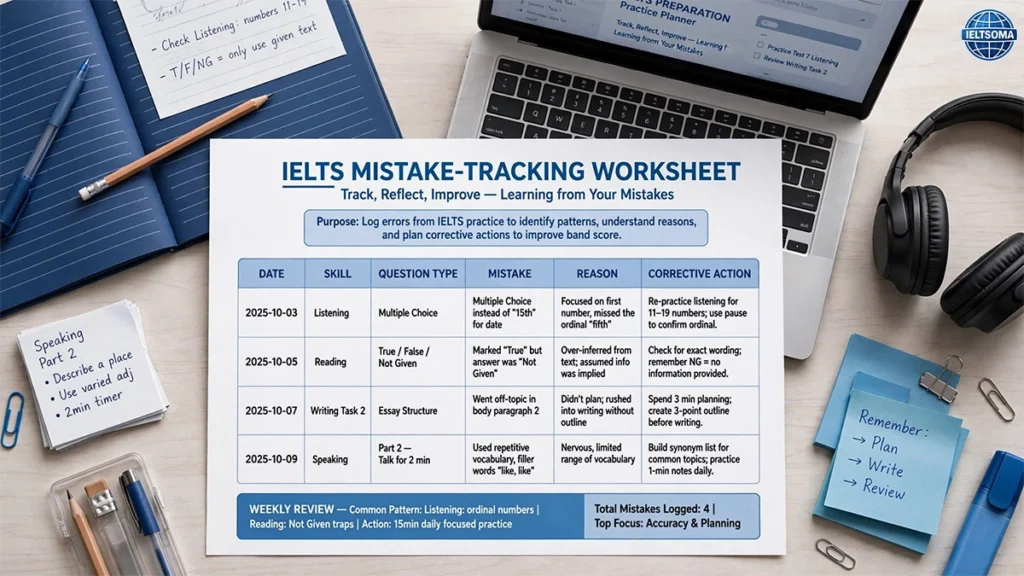
A mistake log can be simple.
| Date | Skill | Question Type | Mistake | Reason | Corrective Action |
|---|---|---|---|---|---|
| Aug 1 | Reading | Matching headings | Wrong heading | Missed main idea | Practise paragraph purpose |
| Aug 3 | Listening | Form completion | Spelling | Rushed answer | Review spelling |
| Aug 5 | Reading | T/F/NG | Incorrect inference | Added outside knowledge | Use passage evidence |
| Aug 7 | Writing | Task 2 | Weak example | Idea not developed | Practise supporting examples |
Review your mistake log every few days.
Look for repeated patterns.
A repeated mistake is a priority.
IELTS Practice Tests Power and Your Target Band
Your target band should influence how you prepare.
A candidate targeting a modest improvement may have different priorities from someone pursuing a very high band.
However, the basic principle remains the same:
Accuracy first, then consistency, then performance under pressure.
Do not become obsessed with a single practice score.
One test can be affected by many factors, including concentration, familiarity with the topic, and individual question difficulty.
Look for patterns across multiple practice sessions.
A consistent performance is more informative than one unusually high or low result.
Where to Find Reliable IELTS Practice Materials
Start with trustworthy sources.
The official IELTS website provides sample test questions and practice resources for Academic and General Training candidates.
You can also use IELTSOMA as a preparation resource for IELTS guidance, strategies, questions, and skill-focused learning. IELTSOMA currently has sections covering areas such as Listening, Reading, Speaking, Writing, Tests, Strategies, Tips, and Resources.
When evaluating any third-party practice material, check whether:
- The test type is clearly identified.
- Instructions are understandable.
- Question formats resemble IELTS.
- Answers are provided where appropriate.
- Explanations are useful.
- The material is current.
- Academic and General Training differences are respected.
Do not assume that every online “IELTS mock test” perfectly represents the official test.
IELTS Practice Tests Power: Online vs Paper Practice
Your preparation should reflect the delivery method you expect to use.
Official IELTS resources provide practice experiences for IELTS on computer, including Listening, Academic Reading, and Academic Writing examples.
Computer practice can help you become comfortable with the interface and interaction style.
Paper practice can still be useful for candidates preparing for paper delivery.
The most important principle is consistency.
If you plan to take IELTS on computer, include computer-based practice in your preparation.
If you plan to take IELTS on paper, practise with the relevant paper format as well.
A Smart Weekly IELTS Practice Routine
A balanced weekly schedule could look like this:
Monday: Listening practice and mistake analysis.
Tuesday: Reading question-type practice.
Wednesday: Writing Task 1 and feedback.
Thursday: Speaking practice and recording review.
Friday: Reading timed section.
Saturday: Full or partial practice test.
Sunday: Review mistakes and plan the following week.
You can adapt this routine according to your schedule.
The important thing is to combine:
Practice + analysis + targeted improvement + repetition.
That is where IELTS Practice Tests Power becomes a practical preparation system rather than simply a collection of mock tests.
IELTS Practice Tests Power: Final Preparation Checklist
Before test day, ask yourself:
- Have I completed realistic timed practice?
- Do I understand my test format?
- Am I using the correct Academic or General Training materials?
- Do I know my most common mistakes?
- Have I practised every major question type?
- Can I manage my Reading time?
- Can I complete Writing within the available time?
- Have I practised all three Speaking parts?
- Have I reviewed my Listening mistakes?
- Have I practised under conditions similar to my expected test?
- Do I know what to do when I encounter a difficult question?
If several answers are “no,” you still have useful preparation work to do.
Frequently Asked Questions About IELTS Practice Tests Power
Are IELTS practice tests useful for both Academic and General Training?
Yes. Practice tests can help candidates preparing for both versions. However, Academic and General Training candidates need to use the appropriate Reading and Writing materials because those sections differ. Listening and Speaking are the same in both versions.
Can IELTS practice tests predict my final band score?
A practice test can provide an indication of your current performance, but it cannot guarantee your official IELTS result.
Use practice scores to identify trends and weaknesses rather than treating one result as a guaranteed prediction.
How often should I take a full IELTS practice test?
There is no single schedule that works for everyone.
Early in preparation, targeted exercises may be more useful than frequent full tests. As your test date approaches, regular timed simulations can help you assess readiness and time management.
Should I practice IELTS Academic or General Training?
Practice the version you intend to take.
Academic and General Training have the same Listening and Speaking sections but different Reading and Writing sections.
Is IELTS practice useful if my English level is still low?
Yes.
Practice tests can help you understand the exam and identify weaknesses. However, if your underlying English skills need substantial development, combine test practice with broader vocabulary, grammar, reading, listening, speaking, and writing work.
Should I take IELTS practice tests every day?
Not necessarily.
Daily practice can be useful, but taking a full test every day is not required for effective preparation.
Balance complete tests with targeted skill development and detailed review.
What should I do after an IELTS practice test?
Review your answers carefully.
Identify incorrect answers, classify the reasons for your mistakes, and create specific exercises to address recurring weaknesses.
The review stage is one of the most important parts of practice.
Are official IELTS sample tests free?
The official IELTS website provides free sample questions and practice resources for IELTS candidates.
Availability and format can vary by resource, so check the official IELTS preparation pages for the latest materials.
Is the IELTS Trial Test an official IELTS score?
No.
The official IELTS Trial Test can provide practice and feedback in participating locations, but IELTS states that Trial Test results are not official IELTS scores and cannot be used for academic, immigration, or work purposes.
How can I improve faster with IELTS practice tests?
Do not focus only on completing more tests.
Instead, follow a cycle of taking a realistic test, analyzing mistakes, targeting weaknesses, and retesting later.
The quality of your review can be as important as the number of tests you complete.
Conclusion: Turn IELTS Practice Into Real Progress
IELTS Practice Tests Power comes from what you do with your practice, not simply how many tests you complete.
A realistic test can reveal your weaknesses.
A detailed review can explain those weaknesses.
Targeted practice can help you address them.
Another test can then show whether your strategy is working.
For Academic and General Training candidates around the world, the strongest preparation approach is therefore not simply to collect practice tests.
It is to build a repeatable system:
Take the test. Record the result. Analyse the mistakes. Fix the weaknesses. Practise again. Measure the change.
Use appropriate materials for your IELTS version, practice under realistic conditions, and give special attention to timing and recurring errors.
With a structured approach, every practice session can become more meaningful.
That is the real IELTS Practice Tests Power you can bring into your preparation.
Further Reading: