You have one minute.
That is all.
The examiner gives you a topic, a pencil and some paper. You look at the cue card and suddenly your mind seems completely empty.
What should you talk about?
Which ideas should you choose?
How can you organise them quickly?
And most importantly, how can you keep speaking for up to two minutes without running out of ideas?
This is why IELTS Speaking Part 2 cue cards can feel difficult even for candidates who communicate comfortably in English.
The good news is that you do not need to predict the exact topic or memorise hundreds of model answers. You need a reliable system for understanding the task, choosing an idea, making useful notes and developing that idea naturally.
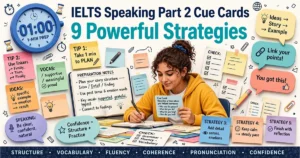
In this guide, you will learn 9 practical IELTS Speaking Part 2 cue card strategies, including exactly what to do during the one-minute preparation period, how to organise your answer, what to do when the topic is unfamiliar, and which common mistakes can make your response less effective.
Table of Contents
What Are IELTS Speaking Part 2 Cue Cards?
In IELTS Speaking Part 2, the examiner gives you a task card containing a topic and several points to help you develop your talk.
You have one minute to prepare. You can make notes during this time. You then speak for one to two minutes about the topic. The examiner will stop you when the speaking time ends. Part 2, including preparation, lasts approximately 3–4 minutes.
For example, you might receive a task such as:
Describe a useful object that you own.
You should say:
- what it is
- when you got it
- how you use it
- and explain why it is useful to you.
The bullet points are not four completely separate questions that require four separate answers. Instead, they give you a structure for developing one connected talk.
That distinction is important.
Your goal is not to produce four short answers. Your goal is to turn the information into a coherent two-minute response.
The Speaking test assesses four areas: fluency and coherence, lexical resource, grammatical range and accuracy, and pronunciation.
So your IELTS Speaking Part 2 cue card strategy should focus on more than impressive vocabulary.
You need to communicate ideas clearly, develop them logically and keep your speech moving.
The Biggest Mistake: Trying to Write Your Answer
One of the first things I tell IELTS candidates is this:
Do not try to write your speech during the one-minute preparation period.
You simply do not have enough time.
If you attempt to write complete sentences, you may spend most of your preparation time writing instead of planning.
Instead, write keywords and short phrases.
For example, if the topic is:
Describe a memorable journey you have taken.
Your notes might look like this:
- London → Paris
- winter / family trip
- long road journey
- mountains + scenery
- car broke down
- helped by local family
- learned patience
- unforgettable
Those eight or nine pieces of information can become a two-minute story.
You do not need to write:
“I would like to talk about a journey that I took with my family when we travelled from Lahore to Islamabad during the winter.”
Your brain can construct that sentence while you speak.
Official IELTS guidance similarly recommends writing phrases rather than full sentences and organising notes in the order you intend to discuss them.
9 IELTS Speaking Part 2 Cue Card Strategies
1. Understand the Main Topic Before Making Notes
Your first job is to understand exactly what the cue card is asking you to describe.
Do not immediately start writing vocabulary.
Read the main instruction first.
For example:
Describe a person who has influenced you.
The central subject is a person.
The bullet points may then ask:
- who the person is
- how you know them
- what they have done
- why they influenced you
You should immediately identify the central subject and then choose a suitable person.
If a word on the task card genuinely prevents you from understanding the topic, official IELTS guidance advises asking the examiner about the word at the beginning of the preparation time rather than waiting until the end.
2. Choose the First Suitable Idea You Can Develop
This is one of the most useful principles for how to answer IELTS Speaking Part 2:
Do not search for the perfect idea. Search for an easy idea.
Suppose your card says:
Describe a place you would like to visit.
You could choose Tokyo, Paris, New York, Istanbul, Dubai or dozens of other places.
Do not waste 40 seconds deciding which one sounds most impressive.
Choose the first place you know enough about to discuss.
Why?
Because IELTS Speaking Part 2 is not a general knowledge competition.
You are being assessed on your ability to communicate in English.
If you know a small town extremely well, it may be a much better choice than a famous city that you know almost nothing about.
A simple idea that you can develop is more useful than an impressive idea that leaves you searching for things to say.
3. Follow the Cue Card in Order
A very effective IELTS Speaking Part 2 cue card strategy is to make your notes follow the same sequence as the bullet points.
Suppose the card says:
Describe a skill you would like to learn.
- what the skill is
- why you want to learn it
- how you would learn it
- and explain how it would help you
Your notes could be:
- photography
- enjoy taking travel photos
- online course + practise
- better memories / possible career
Now you have a simple route through your answer.
You can start with the skill, explain your motivation, describe your plan and finish with its benefits.
IELTS itself recommends practising note-making in the same sequence as the task card because it can help candidates organise their ideas logically.
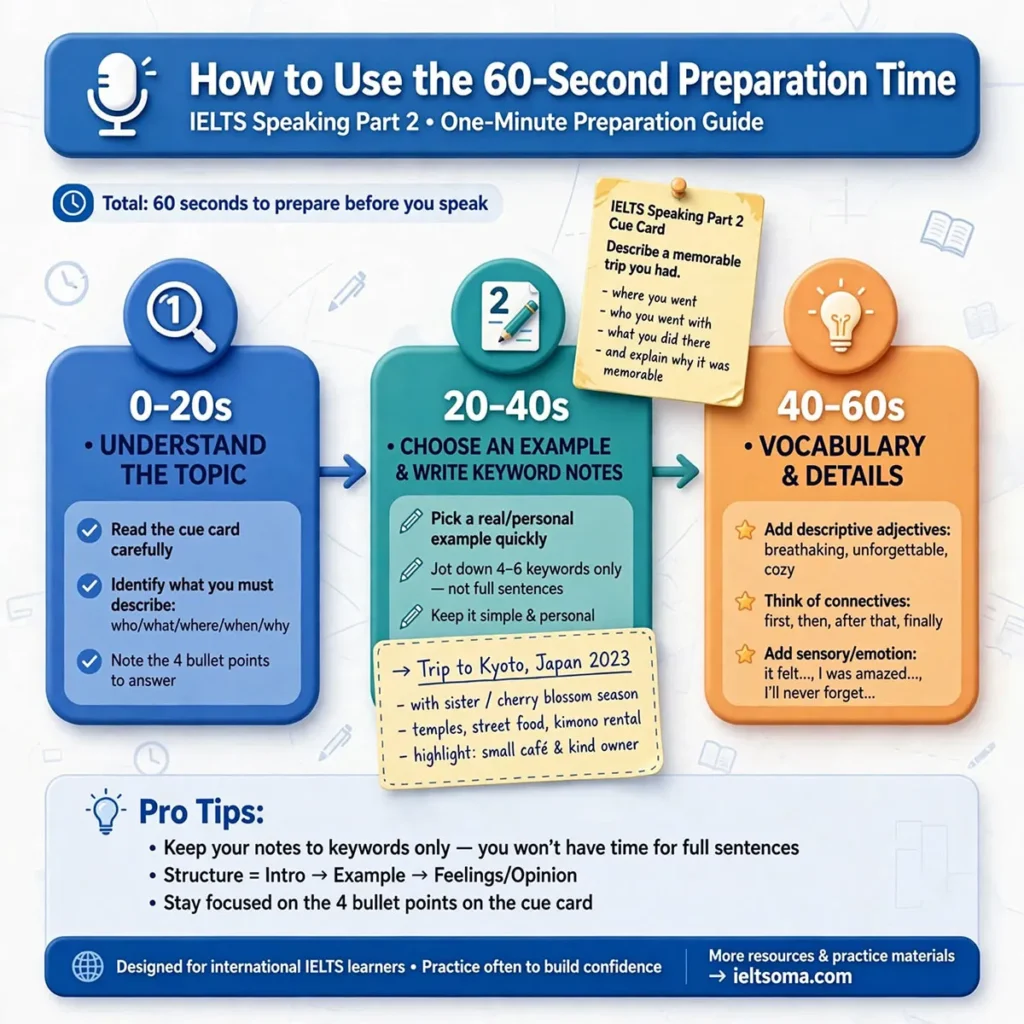
4. Use the One-Minute Preparation Time Strategically
The one minute preparation IELTS candidates receive should not be treated as thinking time alone.
It is planning time.
A practical approach is:
First 10–15 seconds: Understand the topic and choose your example.
Next 30–35 seconds: Write keywords for the bullet points.
Final 10–15 seconds: Add useful vocabulary, a reason, example or personal detail.
For example:
Describe a book you enjoyed reading.
Notes:
- Atomic Habits
- university friend recommended
- small daily changes
- read during final year
- changed study routine
- practical / easy to apply
- recommend to students
You now have enough material to construct a natural response.
You do not need a complete script.
5. Turn Bullet Points Into a Story
Strong candidates do not simply jump mechanically from one bullet point to another.
They connect ideas.
Consider this basic response:
I want to talk about my uncle. I met him when I was young. He helped me with my studies. He is very kind. He influenced me.
The information is relevant, but the development is limited.
Now add relationships between the ideas:
I’d like to talk about my uncle, who has had a significant influence on me since I was a child. I first became particularly close to him when I was preparing for my secondary-school exams because he often helped me with subjects I found difficult. What I appreciated most was that he never simply gave me the answers. Instead, he encouraged me to work things out myself. That experience gradually made me more independent as a student.
The second version gives the listener a journey.
You have moved from who → when → what happened → why it mattered.
That is topic development.
6. Use the “Why?” Question to Extend Your Answer
One of the simplest techniques for avoiding short answers is repeatedly asking yourself:
Why?
Suppose your cue card is:
Describe a restaurant you enjoy visiting.
You say:
I enjoy going to a small restaurant near my home.
Why?
Because the food is fresh and reasonably priced.
Why is that important?
I’m a student, so I cannot spend too much money eating out.
What happened there?
I once went there with two friends after an important exam.
How did you feel?
We were exhausted, but we had a great conversation and celebrated afterwards.
Suddenly, one simple idea has become a developed response.
You are not inventing complicated information. You are simply expanding the idea.
A Simple Structure for IELTS Speaking Part 2
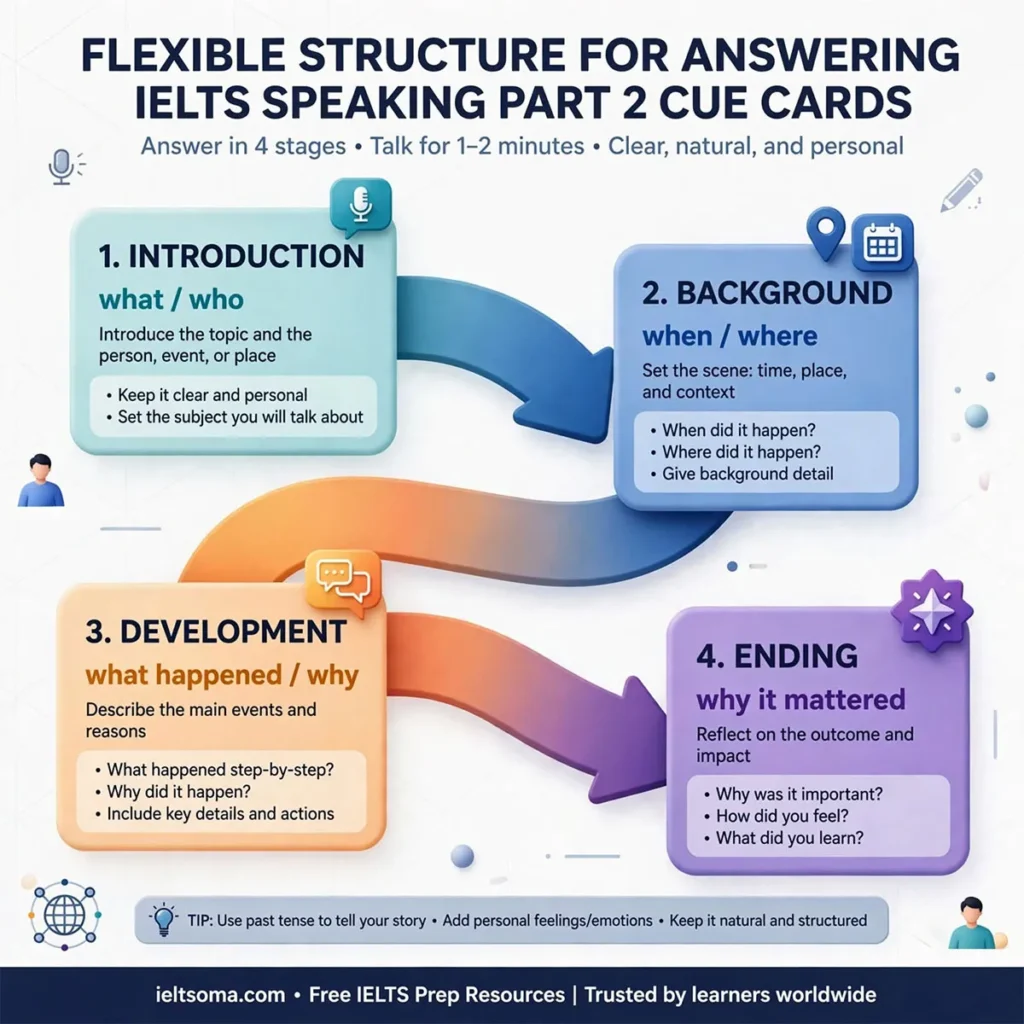
You do not need to memorise a rigid template, but having a flexible structure can make speaking much easier.
A useful four-stage structure is:
| Stage | Purpose | Useful question |
|---|---|---|
| Introduction | Identify the topic | What/who am I talking about? |
| Background | Give context | When, where or how did it happen? |
| Development | Add details and experience | What happened? Why? |
| Ending | Give significance | Why was it memorable/useful/important? |
For example:
Describe an important decision you made.
You might organise it as:
Introduction: What decision was it?
Background: When did you make it?
Development: What choices did you consider?
Experience: What happened after you decided?
Ending: Why was the decision important?
This gives you a clear mental route without forcing you to memorise a complete answer.
What If You Do Not Know the Topic?
This is where many candidates panic.
Imagine the card says:
Describe a traditional object from your country.
You cannot think of anything.
Do not freeze.
Think laterally.
Perhaps you can talk about a traditional item used by a family member, a piece of clothing, a musical instrument, a cooking utensil or an object you have seen at a cultural event.
You do not need encyclopaedic knowledge.
Your personal experience is often enough.
Official IELTS guidance also notes that candidates do not necessarily have to use a perfectly literal real-life example. If you adapt the topic slightly, make that clear near the beginning so the examiner understands what you are describing.
For example:
“I couldn’t think of a traditional object that I personally own, so I’d like to talk about one that my grandmother has at home.”
That immediately makes your interpretation clear.
What If You Finish Before Two Minutes?
This is another common concern.
You do not need to panic if you feel that you are approaching the end of your ideas.
Return to the most interesting point and develop it.
You can discuss:
- why it was important
- how you felt
- what happened afterwards
- what you learned
- whether you would do it again
- how the experience changed you
- what other people might think about it
For example:
“Looking back, I think the most valuable thing I learned from this experience was…”
This can naturally lead into another explanation.
The objective is not to fill the final seconds with meaningless repetition.
What If You Make a Mistake?
Keep speaking.
This is particularly important for candidates who become obsessed with grammatical accuracy.
If you say:
“I go—sorry, I went there last year…”
simply continue.
Do not stop for five seconds because you made one small mistake.
Fluency involves maintaining the flow of communication, while grammatical accuracy is assessed separately. IELTS evaluates speaking using four criteria rather than judging your performance on vocabulary or grammar alone.
A correction is often much less damaging than allowing one mistake to destroy your entire train of thought.
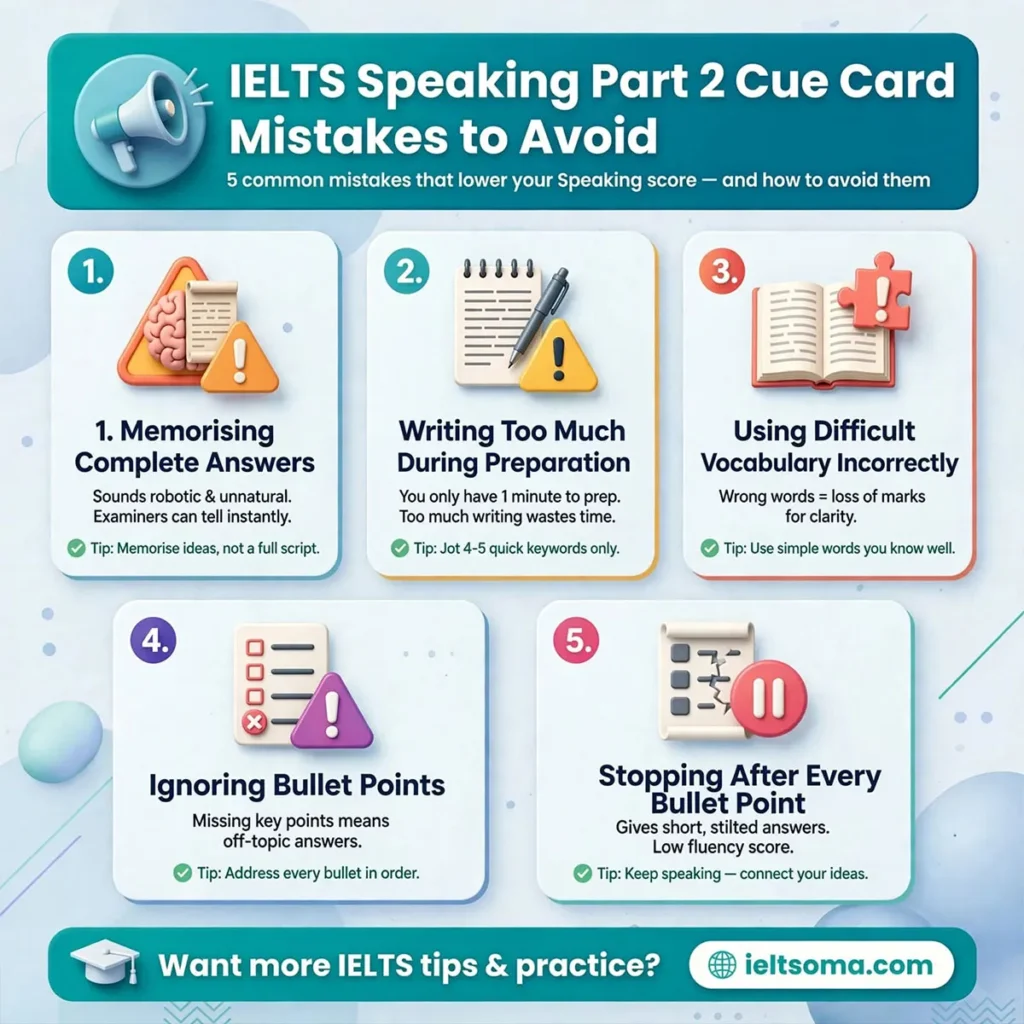
Common IELTS Speaking Part 2 Cue Card Mistakes
Memorising Complete Answers
Memorised answers can sound unnatural and may not fit the exact task.
Prepare ideas, vocabulary and structures instead.
Writing Too Much
Long sentences are difficult to write and difficult to read under pressure.
Use keywords.
Trying to Use Difficult Vocabulary Everywhere
Advanced vocabulary is useful when it is accurate and natural.
A simple word used correctly is better than an impressive word used incorrectly.
Ignoring the Bullet Points
The prompts are there to help you develop your answer.
Use them as your roadmap.
Speaking Without Examples
Examples make ideas easier to develop.
Instead of saying:
“Travelling is educational.”
Say:
“For example, when I travelled to Islamabad last year, I had to communicate with people from a different background, and that made me more confident.”
Stopping After Every Bullet Point
Your response should feel like a connected talk, not an interview consisting of four separate answers.
Use linking phrases naturally:
- Another reason is…
- What I particularly remember is…
- This was important because…
- As a result…
- Looking back…
- The main reason I chose this example is…
A Complete Example
Here is a simplified example of how the strategy works.
Cue card:
Describe a person who taught you something useful.
You should say:
- who the person is
- what they taught you
- when they taught you
- and explain why it was useful.
One-minute notes:
- older brother
- cooking
- university
- first year
- simple meals
- saved money
- became independent
- still cook weekends
Now turn those notes into speech:
I’d like to talk about my older brother, who taught me how to cook some basic meals when I started university. Before that, I depended quite a lot on my family for food, so moving away from home was a bit of a challenge.
During my first year at university, my brother showed me how to prepare a few simple dishes, including rice, pasta and a couple of traditional meals. At first, I wasn’t particularly interested because I thought cooking would take too much time. However, he showed me that I could prepare something reasonably healthy without spending hours in the kitchen.
What made this particularly useful was that it helped me become more independent. I also saved quite a lot of money because I didn’t have to eat at restaurants all the time. I still cook at weekends when I have enough time, so it’s a skill that has remained useful in my daily life.
Looking back, I think my brother taught me much more than just cooking. He showed me that practical skills can make everyday life much easier.
Notice that the answer does not contain extraordinary vocabulary.
Its strength comes from development, connections, examples and personal detail.
How to Practise IELTS Speaking Part 2 Cue Cards
Do not practise by reading model answers silently.
Use a timer.
Choose a cue card and follow the real conditions:
- Read the task.
- Give yourself one minute to prepare.
- Write keywords only.
- Speak for up to two minutes.
- Record yourself.
- Listen to the recording.
- Identify where you hesitated or repeated yourself.
- Try the same topic again.
- Compare the second attempt with the first.
IELTS also recommends building up gradually towards the full two-minute response and recording yourself so you can identify areas for improvement.
A useful practice progression is to start with more preparation time and gradually move towards the real test conditions. Official IELTS teaching guidance specifically suggests reducing preparation time while increasing speaking time until you reach one minute of preparation and two minutes of speaking.
Your 60-Second Cue Card Routine
When the examiner gives you the card, think:
1. What is the topic?
Identify exactly what you need to describe.
2. What is my easiest example?
Choose something you can discuss comfortably.
3. What are my four main notes?
Follow the bullet points.
4. What details can I add?
Think about reasons, examples, feelings and consequences.
5. What vocabulary do I want to use?
Write only a few useful words or phrases.
Then start speaking.
The purpose of the one-minute preparation period is not to create a perfect speech. It is to give your brain a route to follow.
Frequently Asked Questions About IELTS Speaking Part 2 Cue Cards
How long do I have to prepare for IELTS Speaking Part 2?
You have one minute to prepare your response. You can make notes using the paper and pencil provided by the examiner. You then speak for one to two minutes.
How should I use the one-minute preparation IELTS gives me?
Use it to understand the topic, choose an example, write keywords in the order you want to discuss them and add a few useful words or phrases. Avoid writing complete sentences because you need to use the limited preparation time efficiently.
How do I answer IELTS Speaking Part 2 if I do not have a real example?
Choose a similar experience that you can explain clearly, or adapt the topic slightly if necessary. Make your interpretation clear to the examiner near the beginning rather than becoming stuck trying to find a perfect example.
Should I memorise IELTS Speaking Part 2 cue card answers?
No. It is more useful to practise flexible structures, vocabulary, idea development and timed responses. Memorising complete answers can make it difficult to respond naturally when the actual task is different.
Do I have to speak for exactly two minutes?
No. The examiner will stop you when the speaking time ends. Your goal should be to develop your answer naturally rather than deliberately repeating information just to reach a particular second.
What should I write during cue card preparation?
Write short keywords, not complete sentences. Include the key information you need to remember, such as names, places, events, reasons, feelings and useful vocabulary.
Can I change my example during the answer?
You can adjust or clarify your example if necessary. The important thing is to keep your response coherent and make your meaning clear.
What should I do if I forget a word?
Explain the meaning using other words. This is a useful speaking skill and is better than stopping completely because you cannot remember one particular word.
Final Takeaway
The secret to handling IELTS Speaking Part 2 cue cards is not having a perfect answer for every possible topic.
It is having a repeatable process.
Understand the topic → choose an easy example → make keyword notes → follow the cue-card points → develop your ideas → keep speaking naturally.
Use the one-minute preparation period as a planning tool rather than a writing exercise.
With regular timed practice, you can make this process increasingly automatic. Eventually, when you receive an unfamiliar cue card, you will not need to think, “What am I supposed to do?”
You will already know.
Read. Choose. Note. Develop. Speak.
That is the skill you are building.
Further Reading: