If you keep reading every IELTS passage from the first word to the last, you may be spending valuable time on information you do not actually need. A better approach is to understand IELTS Reading text structures and use the organisation of a passage to predict where ideas, explanations, examples and answers are likely to appear.
IELTS Reading passages are not simply collections of sentences. Writers organise information in recognisable ways. A passage may move through events chronologically, explain a problem and its solutions, compare two ideas, describe a process, or develop an argument through evidence and opposing views.
Once you recognise these patterns, the passage becomes easier to navigate.
This guide explains the most useful IELTS Reading text structures, shows you how to identify them, and gives you a practical method for using them in the exam.
Table of Contents
What Are IELTS Reading Text Structures?
IELTS Reading text structures are the ways in which information and ideas are organised within a Reading passage.
For example, a passage about the development of electric vehicles might begin with their early history, move to technological improvements, discuss current challenges and finish by considering their future.
Another passage might introduce a problem, explain why it exists, present several possible solutions and evaluate their effectiveness.
Understanding the structure helps you see the relationship between ideas, rather than treating every sentence as equally important.
This matters because IELTS Reading assesses several skills, including understanding main ideas, reading for detail, skimming, understanding logical arguments, making inferences and recognising a writer’s opinions, attitudes and purpose.
Why Do IELTS Reading Text Structures Matter?
Recognising structure does not give you the answers automatically. Instead, it gives you a mental map of the passage.
Suppose you recognise that a passage follows a problem-and-solution structure.
You can immediately expect to find:
- a description of the problem
- reasons or causes
- evidence showing why the problem matters
- one or more proposed solutions
- discussion of the strengths or weaknesses of those solutions
That expectation makes scanning more efficient.
Text structure is particularly useful when you need to identify the main idea of a paragraph. In the official IELTS description of Matching Headings, the task specifically tests your ability to identify the general topic of a paragraph and distinguish the main idea from a supporting idea.
A simple example
Imagine this paragraph:
Urban trees can reduce temperatures in densely populated areas. Their leaves provide shade, while the process of evapotranspiration can also help cool the surrounding environment. As cities become warmer, planners are increasingly considering trees as part of climate adaptation strategies.
You do not need to memorise every sentence.
The paragraph structure is roughly:
Benefit → explanation → application
The main idea is that urban trees can help cities manage rising temperatures.
The second sentence supports that idea by explaining how the cooling effect works.
This distinction is extremely useful for Matching Headings.
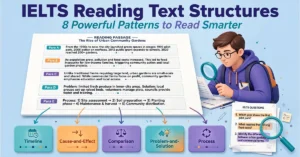
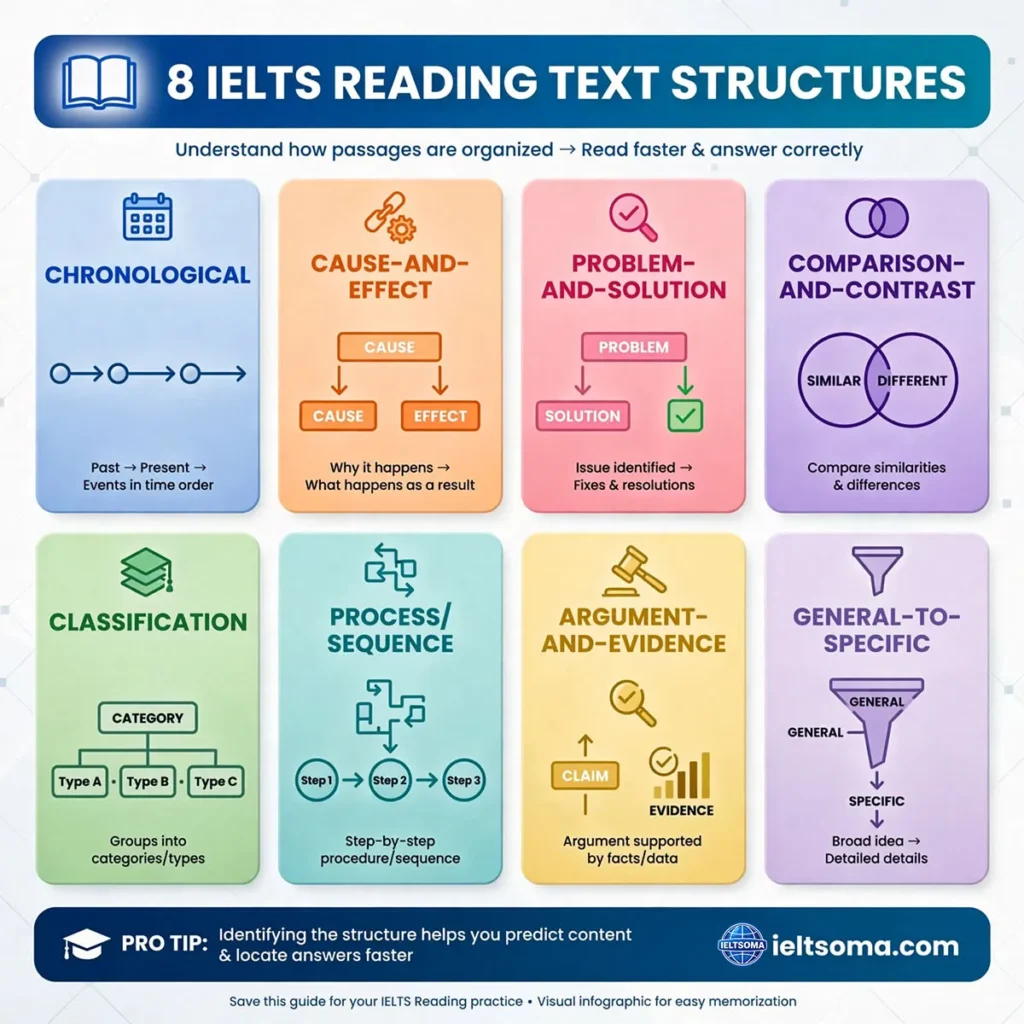
8 Common IELTS Reading Text Structures
There is no official list saying that every IELTS passage must follow a fixed set of structures. IELTS Academic passages can use different styles, including narrative, descriptive and discursive or argumentative writing, and at least one text contains a detailed logical argument.
However, several organisational patterns are particularly useful for IELTS preparation.
1. Chronological Structure
A chronological passage presents information according to time or historical development.
The writer may start with an early event, move through several stages and finish with recent developments or future possibilities.
Common signals include:
- initially
- previously
- later
- subsequently
- during the following decade
- eventually
- in the early years
- today
- more recently
Example
A passage about the history of printing might follow this sequence:
Early printing methods → invention of movable type → industrial printing → digital publishing
When you recognise this structure, dates, names and historical developments become easier to locate.
IELTS strategy
Chronological structure is especially useful when a question contains:
- dates
- periods
- historical events
- names of people
- stages of development
Create a simple mental timeline rather than trying to remember the entire passage.
2. Cause-and-Effect Structure
A cause-and-effect structure explains why something happens and what happens as a result.
The passage may begin with an event or situation and then explain its causes, consequences or both.
Common signals include:
- because
- due to
- as a result
- consequently
- therefore
- leads to
- results in
- causes
- contributes to
- owing to
Example
A passage about declining bee populations might be organised like this:
Environmental change → reduced food sources → population decline → effects on agriculture
The writer may spend several paragraphs explaining different causes before discussing the consequences.
IELTS strategy
When you see a cause-and-effect structure, ask:
What caused this?
Then ask:
What happened because of it?
This is particularly useful for Matching Information, Multiple Choice and True/False/Not Given questions involving reasons, consequences or explanations.
3. Problem-and-Solution Structure
This is one of the most useful structures to recognise because it creates a clear logical progression.
The writer normally:
- introduces a problem
- explains its seriousness or causes
- presents one or more solutions
- evaluates those solutions
A passage may contain several problems and several proposed solutions.
Common signals include:
- problem
- challenge
- concern
- difficulty
- solution
- approach
- proposal
- intervention
- overcome
- address
- tackle
- prevent
Example
A passage about traffic congestion might move from:
Increasing congestion → economic and environmental consequences → public transport → congestion pricing → evaluation of different approaches
If you recognise this pattern, you know that a paragraph describing a transport policy may be presenting a solution, not introducing another problem.
IELTS strategy
When reading a problem-and-solution passage, mentally label paragraphs:
P = Problem
C = Cause
S = Solution
E = Evaluation
You do not need to write these labels every time. The purpose is to understand the progression of ideas.
4. Comparison-and-Contrast Structure
A comparison structure places two or more subjects, theories, methods or periods alongside each other.
The writer may explain similarities, differences or both.
Common signals include:
- similarly
- likewise
- in contrast
- however
- whereas
- while
- unlike
- compared with
- on the other hand
- both
- respectively
Example
A passage about traditional and modern farming might compare:
| Traditional farming | Modern farming |
|---|---|
| Smaller-scale production | Larger-scale production |
| Lower technology use | Greater technology use |
| More manual labour | Greater mechanisation |
The writer may first describe one approach and then contrast it with another.
IELTS strategy
Do not assume that the first subject is always discussed in one complete section.
A writer may use a point-by-point structure:
- cost
- environmental impact
- productivity
- labour requirements
Alternatively, the writer may use a block structure:
- traditional farming
- modern farming
- overall comparison
Recognising which version is being used can make locating information much easier.
5. Classification Structure
Classification involves dividing a broad topic into categories, groups or types.
The passage may first introduce a general concept and then explain different categories.
Common signals include:
- types
- categories
- groups
- classified as
- divided into
- can be grouped
- first type
- another category
- a further distinction
Example
A passage about renewable energy might introduce the broad concept and then divide it into:
Solar → wind → hydroelectric → geothermal
Each paragraph may focus on a different category.
IELTS strategy
When you recognise classification, identify the category labels.
For example:
There are three major forms of urban transport…
You should immediately expect the following discussion to explain those three forms.
This can help you predict where specific information will appear.
6. Process or Sequence Structure
A process structure explains how something happens or how something is produced, usually through a series of stages.
The sequence may describe:
- a scientific process
- manufacturing
- biological development
- research procedures
- technological systems
- a natural cycle
Common signals include:
- first
- initially
- next
- following this
- then
- subsequently
- after
- finally
- the final stage
Example
A passage about water treatment might follow:
Collection → filtration → chemical treatment → purification → distribution
Each stage depends on the previous one.
IELTS strategy
Think in terms of steps rather than paragraphs.
If the text explains a process, mentally reconstruct the sequence:
Stage 1 → Stage 2 → Stage 3 → Stage 4
This is particularly useful for Summary Completion, Flow-chart Completion and Diagram Label Completion.
Official IELTS guidance notes that summary tasks may include a flow chart showing the order of events or stages, although the answers may not always appear in the same order as the questions.
7. Argument-and-Evidence Structure
Some IELTS passages are built around an argument.
The writer introduces a position, presents evidence, discusses research or examples and may then consider alternative opinions.
A simplified structure might look like:
Claim → evidence → explanation → opposing view → response → conclusion
Common signals include:
- argues
- suggests
- claims
- according to
- evidence
- research indicates
- however
- critics argue
- in response
- therefore
- consequently
Example
A passage might argue that working from home can improve productivity.
The writer could then:
- introduce the claim
- cite research
- explain possible reasons
- present criticisms
- discuss limitations
- reach a balanced conclusion
IELTS strategy
Separate three things:
What the writer believes
What other people believe
What evidence shows
This distinction is essential for Yes/No/Not Given questions, which test whether statements agree with the writer’s views or claims.
Do not automatically treat a statement mentioned in the passage as the writer’s own opinion.
8. General-to-Specific Structure
Some passages begin with a broad idea and gradually move towards specific details.
The progression may look like:
General topic → specific issue → example → evidence → detailed explanation
For example:
Climate change is affecting agriculture worldwide.
The writer may then discuss:
- a particular region
- a specific crop
- a research project
- experimental results
- implications for farmers
IELTS strategy
When reading the opening sentence of a paragraph, ask:
Is this the main idea?
Then check whether the remaining sentences provide:
- examples
- evidence
- statistics
- explanations
- specific cases
This is one of the most effective ways to avoid choosing a heading based only on a supporting detail.
How to Identify IELTS Reading Text Structures Quickly
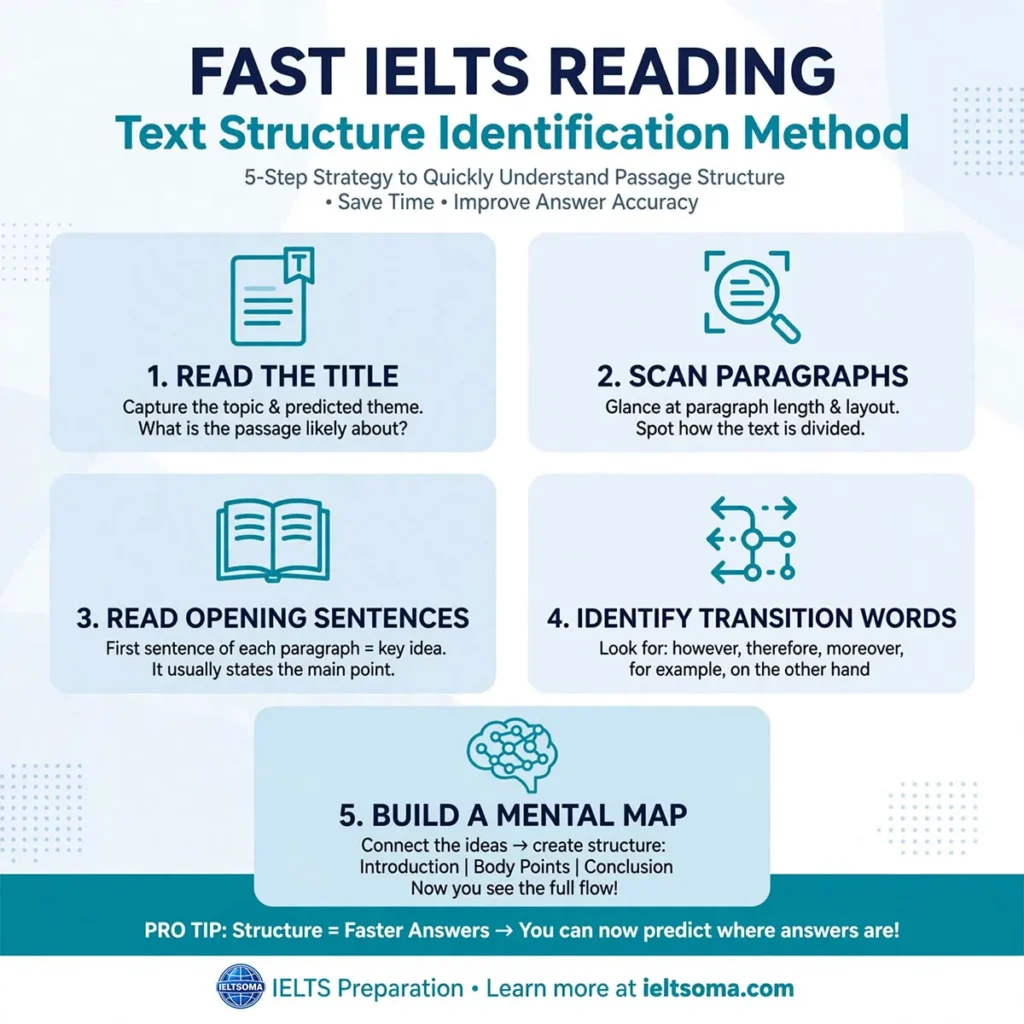
You do not need to spend several minutes analysing the structure before answering questions.
Use a quick five-step process.
Step 1: Read the title
If there is a title, use it to identify the broad subject.
Do not assume the title gives you the exact main idea. It is simply your starting point.
Step 2: Look at headings and subheadings
Headings can reveal how the writer has divided the topic.
For example:
The Origins
Modern Developments
Current Problems
Possible Solutions
This strongly suggests a chronological or problem-and-solution progression.
Step 3: Read the first sentence of each paragraph
The first sentence often introduces the paragraph’s central idea, although you should not assume this is always the case.
Look for changes in direction.
For example:
Another explanation…
In contrast…
A more recent study…
One possible solution…
These phrases tell you how the new paragraph relates to the previous one.
Step 4: Look for transition words
Transition words reveal relationships between ideas.
A useful mental checklist is:
| Signal | Possible structure |
|---|---|
| first, later, eventually | Chronological |
| because, therefore, consequently | Cause and effect |
| however, whereas, unlike | Comparison/contrast |
| problem, solution, overcome | Problem/solution |
| first, next, finally | Process |
| type, category, group | Classification |
| evidence, argues, claims | Argument/evidence |
| for example, specifically | General-to-specific |
Step 5: Build a mental map
After scanning the passage, try to summarise its progression in one sentence.
For example:
“This passage explains how the problem developed, examines its causes and then evaluates possible solutions.”
That sentence is your mental map.
You can now return to the questions with a much clearer idea of where different information is likely to be found.
How Text Structure Helps With IELTS Reading Question Types
Different question types require different reading skills, so text structure should support—not replace—your normal strategy.
Matching Headings
This is probably the question type most directly connected to structure.
IELTS explains that Matching Headings tests your ability to identify the general topic of a paragraph or section and distinguish the main idea from a supporting idea.
Ask:
What is this paragraph mainly doing?
Is it:
- introducing a problem?
- explaining a cause?
- giving an example?
- presenting a solution?
- comparing two ideas?
- describing a development?
Do not select a heading simply because one word from the heading appears in the paragraph.
Matching Information
This question asks you to locate specific information in paragraphs or sections.
The information could be a detail, example, reason, description, comparison, summary or explanation.
Structure helps you predict where a particular kind of information is likely to appear.
For example, if you need to find an explanation for a problem, scan the section where the writer discusses causes rather than reading every paragraph equally carefully.
True/False/Not Given
Structure helps you understand the context around a statement.
However, do not choose an answer merely because the statement fits the overall structure.
You must verify the actual information in the passage.
IELTS defines False as information that contradicts the text and Not Given as information that is neither confirmed nor contradicted.
Yes/No/Not Given
Structure can help you locate arguments and opinions.
But you must distinguish between:
- the writer’s position
- another person’s opinion
- evidence
- a reported claim
That distinction is especially important in argumentative passages.
Summary Completion
Structure can tell you which section of the passage a summary is likely to represent.
Official IELTS guidance states that a summary normally covers part of the text rather than the entire passage, and answers may not always appear in the same order as the questions.
Multiple Choice
Structure can help you understand the purpose of a paragraph or section before examining the answer choices.
For example, if a paragraph introduces a problem and the next paragraph evaluates a solution, a question asking about the purpose of the second paragraph becomes easier to approach.
A Fast IELTS Reading Text Structure Strategy
Try this method during practice tests.
The 60-second structure scan
Before deeply reading a passage:
1. Read the title.
Identify the broad topic.
2. Scan the paragraphs.
Notice how many there are and whether some are particularly long or short.
3. Read the opening sentences.
Look for changes in topic or direction.
4. Circle mentally important transition words.
Pay particular attention to contrast, cause, sequence and argument signals.
5. Create a one-line map.
For example:
History → development → problems → research → future possibilities
You now have a rough map of the passage.
The purpose is not to understand every detail. The purpose is to know where you are and what the writer is doing.
Common Mistakes When Using Text Structure
Understanding structure is useful, but IELTS candidates can misuse the strategy.
Mistake 1: Assuming every passage follows one pattern
A passage can combine several structures.
For example:
History → cause and effect → comparison → argument
Do not force an entire passage into one category.
Mistake 2: Choosing headings from keywords
A heading containing a word from the paragraph is not necessarily correct.
Focus on the main idea, not an isolated matching word.
Mistake 3: Spending too long analysing structure
Text structure is a tool, not a separate exam task.
If you spend five minutes drawing a perfect map, you have lost time that could have been used to answer questions.
Mistake 4: Confusing examples with main ideas
A paragraph may discuss one famous scientist, company or experiment simply to support a broader point.
Ask:
Why has the writer included this example?
The answer often reveals the paragraph’s main idea.
Mistake 5: Ignoring changes in direction
Words such as however, although, in contrast and nevertheless can signal a major change.
The information after the transition may be more important than what came before it.
Mistake 6: Using structure instead of evidence
Structure can help you find an answer, but the text must still support your final choice.
Never select an answer simply because it seems logical based on the passage organisation.
IELTS Reading Text Structures: A Practical Comparison
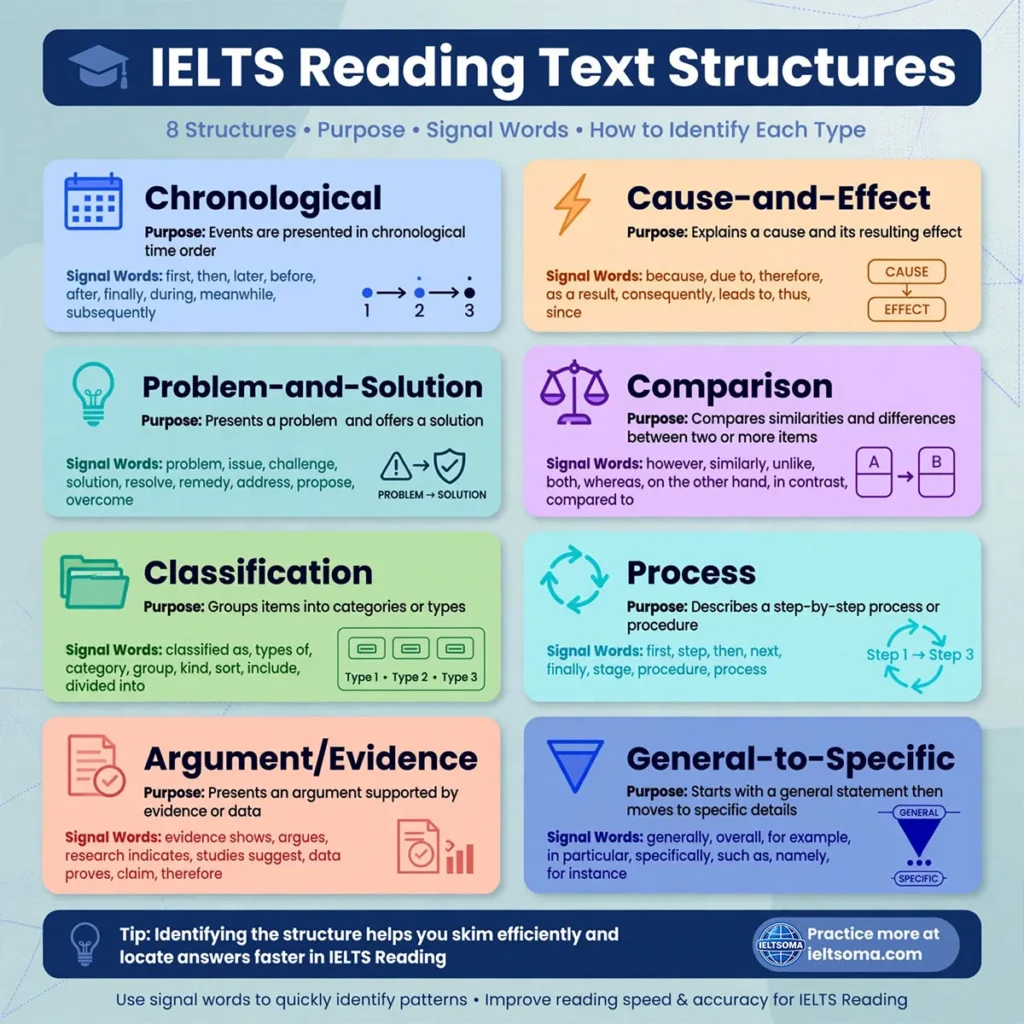
| Structure | Main relationship | Useful signals | What to look for |
|---|---|---|---|
| Chronological | Time | later, eventually, previously | Events and developments |
| Cause and effect | Reason/result | because, therefore, consequently | Causes and consequences |
| Problem and solution | Issue/response | problem, solution, approach | Problems and proposed responses |
| Comparison | Similarity/difference | whereas, unlike, similarly | Two or more subjects |
| Classification | Categories | types, groups, categories | Different classes |
| Process | Stages | first, next, finally | Steps or sequence |
| Argument/evidence | Claim/support | argues, evidence, however | Opinions and supporting evidence |
| General-to-specific | Broad/detail | for example, specifically | Main idea and examples |
This table is not a set of rules that every IELTS passage must follow. Think of it as a recognition system that helps you understand how information is connected.
How to Practise IELTS Reading Text Structures
You can develop this skill without constantly completing full Reading tests.
Choose a passage and do the following.
Practice 1: Paragraph mapping
Read each paragraph and write three to five words describing its function.
For example:
- A — introduces problem
- B — explains cause
- C — presents research
- D — compares solutions
- E — gives conclusion
Then compare your map with the questions.
Practice 2: Identify the structure
After reading a passage, answer:
What is the writer doing?
Choose one or more:
- describing
- explaining
- comparing
- arguing
- presenting evidence
- describing a process
- discussing causes
- presenting solutions
- tracing development
Practice 3: Predict before checking
Before reading the next paragraph, predict what might come next.
If the writer has introduced a problem, you might predict:
“The next paragraph may explain its causes or introduce a possible solution.”
Then read the paragraph and check your prediction.
This develops your understanding of logical progression.
Practice 4: Explain the paragraph in one sentence
After reading a paragraph, summarise it in your own words.
If your summary is too detailed, you may have focused on supporting information.
If it is too vague, you may not have identified the central idea.
This is excellent preparation for Matching Headings.
Expert Tip: Read for Function, Not Just Meaning
One of the biggest improvements you can make in IELTS Reading is to stop asking only:
“What does this paragraph say?”
Also ask:
“Why is the writer saying this here?”
A paragraph might:
- introduce an idea
- challenge an earlier claim
- provide evidence
- explain a cause
- give an example
- introduce an alternative
- present a solution
- qualify an argument
- draw a conclusion
Understanding the function of a paragraph gives you a much stronger sense of the passage structure.
Do Academic and General Training Candidates Need This Skill?
Yes, although the Reading materials differ.
IELTS Academic and General Training Reading tests are designed for different purposes, and their Reading sections differ.
The official IELTS format information shows that both tests use a variety of Reading question types, including Multiple Choice, Identifying Information, Matching Information, Matching Headings, Matching Features and completion tasks.
General Training candidates should therefore not ignore text structure simply because their Reading texts can include more everyday and workplace-related material.
The same basic principle applies:
Understand how the writer has organised the information, then use that organisation to navigate the text efficiently.
Final Strategy: Structure + Keywords + Evidence
The strongest IELTS Reading approach combines three skills.
1. Structure
Understand how the passage is organised.
2. Keywords
Identify the important words and concepts in the question.
3. Evidence
Return to the relevant part of the passage and verify the answer.
Think of the process as:
Structure → Locate → Read → Verify
For example, suppose a question asks about the reason for a decline in agricultural productivity.
You recognise that the passage uses a cause-and-effect structure.
You then scan for the section discussing causes.
Next, you locate the relevant keywords and paraphrases.
Finally, you read the surrounding sentences carefully and confirm that the information actually answers the question.
That is much more efficient than reading the entire passage with equal attention.
Frequently Asked Questions About IELTS Reading Text Structures
What are IELTS Reading text structures?
IELTS Reading text structures are the ways writers organise information and ideas in a passage. Common patterns include chronological development, cause and effect, problem and solution, comparison, classification, processes and arguments.
Which IELTS Reading question type benefits most from understanding text structure?
Matching Headings benefits particularly strongly because candidates must identify the main idea of each paragraph or section. However, structure can also help with Matching Information, Multiple Choice, completion tasks and questions involving opinions or logical relationships.
Do IELTS Reading passages follow only one structure?
No. A passage can combine several organisational patterns. For example, a passage may begin chronologically, move into cause-and-effect analysis and finish by discussing possible solutions.
Should I memorise all IELTS Reading text structures?
No. The goal is not to memorise terminology. You should learn to recognise relationships between ideas such as time, cause, contrast, problem, solution, evidence and sequence.
Can text structure improve my IELTS Reading speed?
It can help you read more strategically because you develop a mental map of where different types of information are located. However, speed should come from efficient reading and question-solving practice, not from skipping important information.
How can I practise recognising text structure?
Take IELTS Reading passages and identify the function of each paragraph. Then summarise the passage’s progression in one sentence. Over time, you will become faster at recognising patterns such as comparison, cause and effect, problem and solution and chronological development.
Is understanding text structure enough to get a high IELTS Reading score?
No. It is one useful skill among several. You also need strong vocabulary, paraphrase recognition, skimming, scanning, inference skills, careful attention to question instructions and the ability to verify answers against the text.
Key Takeaway
IELTS Reading text structures give you a map of the passage.
Instead of treating a Reading passage as a wall of English, look for the relationships between ideas.
Ask:
Is the writer explaining a cause?
Describing a sequence?
Comparing two ideas?
Presenting a problem and solution?
Developing an argument?
Moving from a general idea to specific evidence?
Once you can recognise these patterns, you can approach the passage more strategically.
Do not try to predict every answer from the structure alone. Use the structure to locate the right part of the text, then use keywords, paraphrases and direct evidence to confirm your answer.
That combination can make your IELTS Reading practice more focused, efficient and effective.