You have 60 minutes.
You have 40 questions.
You are staring at a long passage containing unfamiliar vocabulary, complicated sentences and information that seems to appear everywhere.
Then you look at the clock.
Twenty minutes have already disappeared.
If this sounds familiar, your problem may not be your English.
It may be your IELTS Reading Section Strategy.
After years of working with IELTS candidates, one of the most common mistakes I see is treating IELTS Reading like an ordinary reading exercise. Candidates start at the beginning of the passage, read every sentence carefully and hope the answers become obvious.
That approach can be painfully slow.
IELTS Reading rewards a different skill set.
You need to understand the passage, but you also need to locate information efficiently, recognise paraphrasing, distinguish main ideas from details, handle difficult question types and make sensible decisions when time is running out.
The official IELTS format gives you 60 minutes to answer 40 questions, with three Reading sections. There is no additional transfer time in the paper-based Reading test, so your time management must be part of your strategy.
This guide explains the IELTS Reading Section Strategy that can help you prepare more intelligently for both Academic and General Training.
Table of Contents
Understand the IELTS Reading Test Before Using Any Strategy
Before developing your IELTS Reading Section Strategy, understand what the test is designed to measure.
The Reading test contains 40 questions and lasts 60 minutes. Academic Reading contains three longer texts, while General Training Reading contains texts drawn from practical and general-interest sources appropriate to the test.
The Reading test can assess skills such as:
- Understanding the general meaning of a passage
- Identifying main ideas
- Finding specific details
- Understanding implied meaning
- Recognising opinions and attitudes
- Following an argument
- Locating specific information
- Understanding relationships between ideas
British Council guidance similarly emphasises reading for general sense, main ideas, detail, inference, writer opinion and the development of an argument.
Question types can include:
- Multiple choice
- True/False/Not Given
- Yes/No/Not Given
- Matching information
- Matching headings
- Matching features
- Matching sentence endings
- Sentence completion
- Summary, note, table or flow-chart completion
- Diagram labelling
- Short-answer questions
You do not need a completely different strategy for every question.
But you do need to understand what each question is testing.
1. Stop Reading Every Word
This is one of the biggest changes I recommend to candidates.
Do not confuse careful reading with effective IELTS Reading.
In normal life, you may read an article from beginning to end.
In IELTS, you have a limited amount of time and a specific set of questions.
You therefore need to control how deeply you read.
Imagine the passage begins with three paragraphs explaining the history of an invention.
Question 1 asks:
When was the invention first introduced commercially?
You do not necessarily need to understand every sentence in the first three paragraphs.
You need to locate the relevant information and understand it accurately.
This does not mean “read as fast as possible”.
It means:
Read strategically.
Slow down when the text contains information relevant to a question.
Move more quickly when you are establishing the overall structure.
2. Preview the Passage Before Reading in Detail
A strong IELTS Reading Section Strategy begins before you attempt the first answer.
Spend a short amount of time creating a mental map of the passage.
Look at:
- The title
- Headings, if provided
- Subheadings
- Paragraph breaks
- Any names
- Dates
- Numbers
- Unusual technical terms
- Diagrams or illustrations
- The first sentence of important paragraphs
You are not trying to memorise the passage.
You are asking:
“What is this passage generally about, and where might different types of information appear?”
For example, you might identify:
Paragraph A: Historical background
Paragraph B: First major development
Paragraph C: Problems with the original system
Paragraph D: Modern alternative
Paragraph E: Research findings
Now, when a question asks about a modern alternative, you have a better idea of where to look.
This mental map can save valuable time.
3. Read Questions Strategically
The questions are not just something you answer after reading.
They are also a navigation tool.
Before searching for an answer, identify the important information in the question.
Suppose the question says:
What was the main reason for the decline in demand for traditional farming methods?
Important concepts include:
- decline
- demand
- traditional farming methods
- main reason
You should then expect the passage to express these ideas using different words.
For example:
Question: decline in demand
Passage: fewer people were interested in purchasing
Question: main reason
Passage: the principal factor was…
The words will not necessarily match.
This is why your IELTS Reading Section Strategy should focus on concepts rather than simply matching identical vocabulary.
4. Master Skimming and Scanning
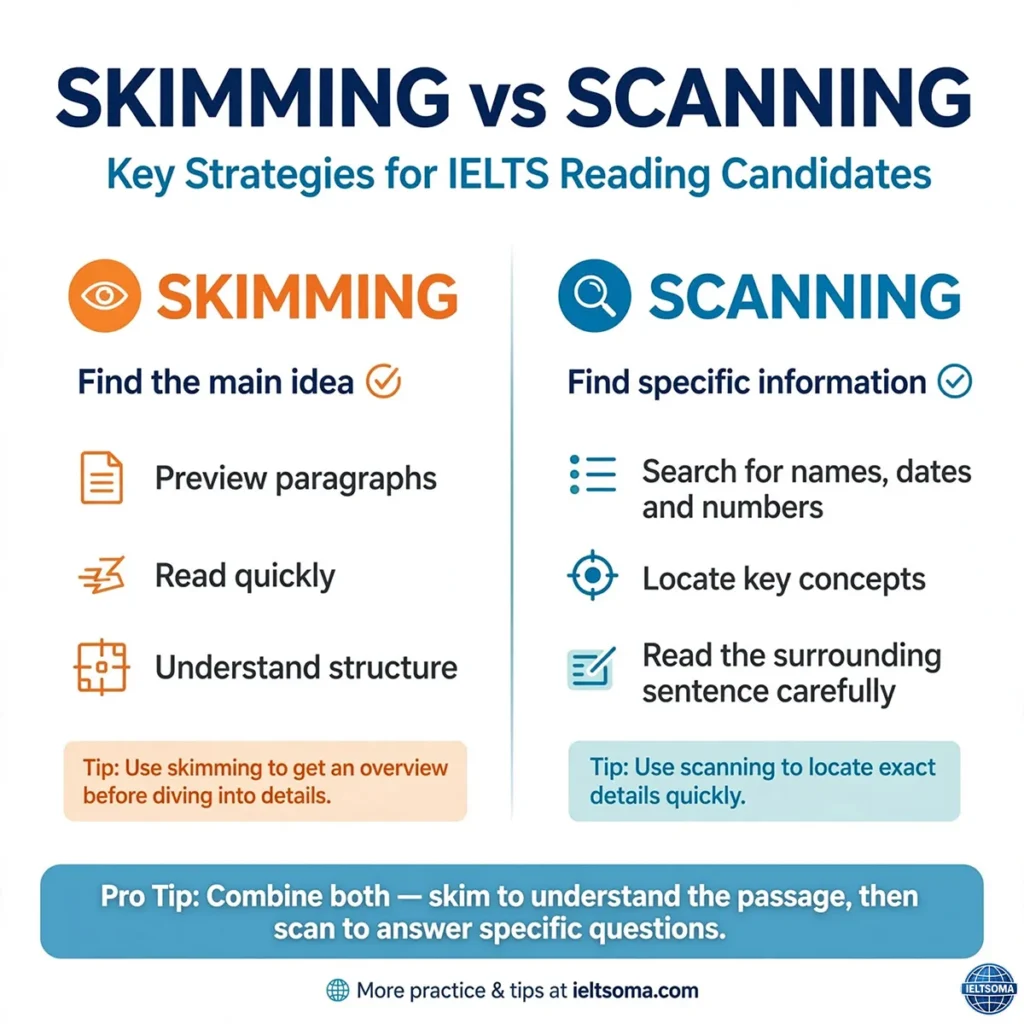
Skimming and scanning are useful, but they are not the same thing.
Skimming
Skimming means reading quickly to understand the general idea or structure.
You might skim to answer:
What is this paragraph mainly about?
You are looking for the big picture.
Scanning
Scanning means searching for specific information.
You might scan for:
- A person’s name
- A year
- A location
- A scientific term
- A percentage
- A specific concept
For example, if a question asks about a researcher named Dr Evans, you can scan the passage for “Evans” and then carefully read the surrounding information.
The mistake is trying to use scanning for every question.
Some questions require you to understand the relationship between ideas, not simply locate a word.
Use the technique that matches the task.
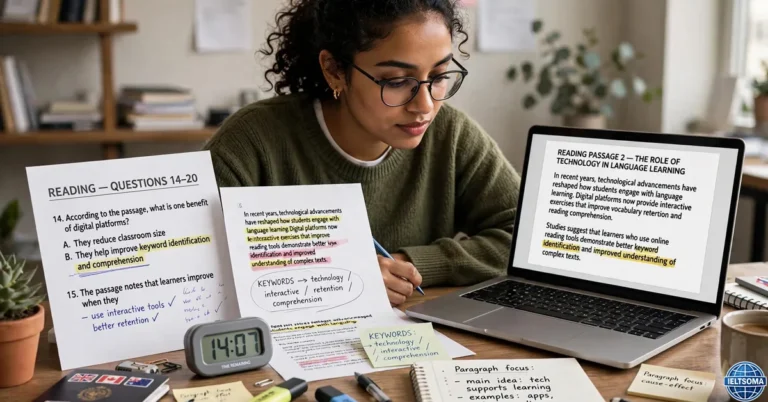
5. Search for Meaning, Not Just Keywords
This may be the most important IELTS Reading Section Strategy in the entire article.
IELTS frequently tests your ability to recognise paraphrasing.
Suppose the question says:
The project was unsuccessful because of financial difficulties.
The passage might say:
The initiative eventually collapsed when its funding disappeared.
The wording is completely different.
But the underlying meaning may be connected.
This is why highlighting every keyword can be dangerous.
You might find the same word in the passage and assume you have found the answer.
For example:
Question: The company reduced its workforce because of rising costs.
The passage might say:
Increasing expenditure eventually forced the organisation to make substantial staff reductions.
There is no exact phrase match.
You need to recognise the relationship between:
- rising costs → increasing expenditure
- reduced workforce → staff reductions
Train yourself to ask:
“What idea does this sentence express?”
rather than:
“Where is the exact word from the question?”
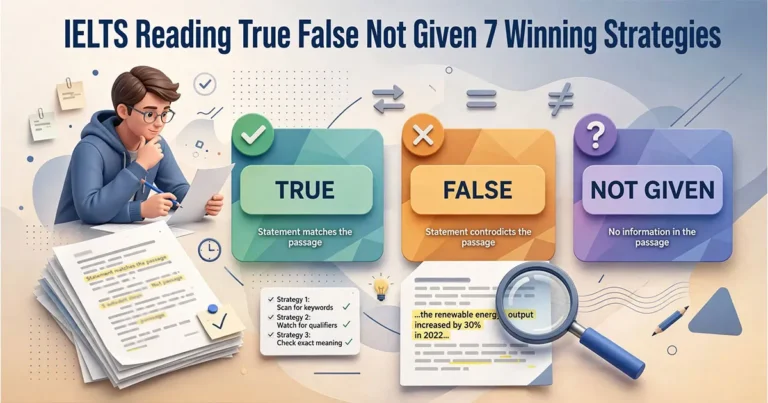
6. Treat True/False/Not Given Differently
True/False/Not Given is one of the question types that causes serious problems for candidates.
The official IELTS explanation makes an important distinction:
- True: The statement agrees with the information in the passage.
- False: The statement contradicts the information.
- Not Given: The passage neither agrees with nor contradicts the statement.
The biggest mistake is assuming:
“I cannot find this exact sentence, so it must be False.”
No.
If the passage does not provide enough information to say whether the statement is true or false, the answer can be Not Given.
Consider this example.
Statement:
The museum opened in 1995.
Passage:
The museum was established in the 1990s.
Can you prove that it opened in 1995?
No.
Can you prove that it did not?
No.
Therefore, based only on that information, you cannot confirm the specific year.
The lesson is simple:
Use the passage, not your outside knowledge.
Official IELTS guidance specifically warns candidates not to use what they already know about the topic when deciding True, False or Not Given.
7. Master Matching Headings
Matching headings tests your ability to identify the main idea of a paragraph.
This is different from finding one interesting detail.
Imagine a paragraph contains:
- A study from 2018
- A statistic
- An example
- A description of a new technology
The heading may not be about any of those details.
The paragraph might actually be about:
The limitations of existing technology
The study and statistic are evidence supporting that main idea.
A useful method is to read the paragraph and ask:
“If I had to explain this paragraph to someone in one sentence, what would I say?”
That answer is often closer to the correct heading than any individual detail.
Official IELTS guidance notes that matching headings tests your ability to identify the general topic of a paragraph and distinguish the main idea from a supporting idea.
Do not choose a heading simply because one word appears in both the heading and paragraph.
Choose the heading that represents the paragraph’s central idea.
8. Respect Word Limits and Grammar
Some IELTS Reading questions require you to take words from the passage.
The instructions may say:
NO MORE THAN TWO WORDS AND/OR A NUMBER
That instruction is part of the question.
It is not optional.
For example, if the passage says:
“The research was conducted in northern Scotland.”
And the question is:
The research took place in ______.
If the instruction allows no more than two words, northern Scotland may fit.
But writing three words could cost you the mark.
Official IELTS guidance states that candidates lose the mark for exceeding the specified word limit. It also notes that spelling and grammar matter when answers are transferred to the answer sheet.
Also look at the grammar of the sentence.
If the question says:
The main advantage of the system is ______.
you should consider what grammatical form belongs after “is”.
Do not copy words mechanically.
Check whether your answer fits the sentence.
9. Manage Your 60 Minutes Like a Professional
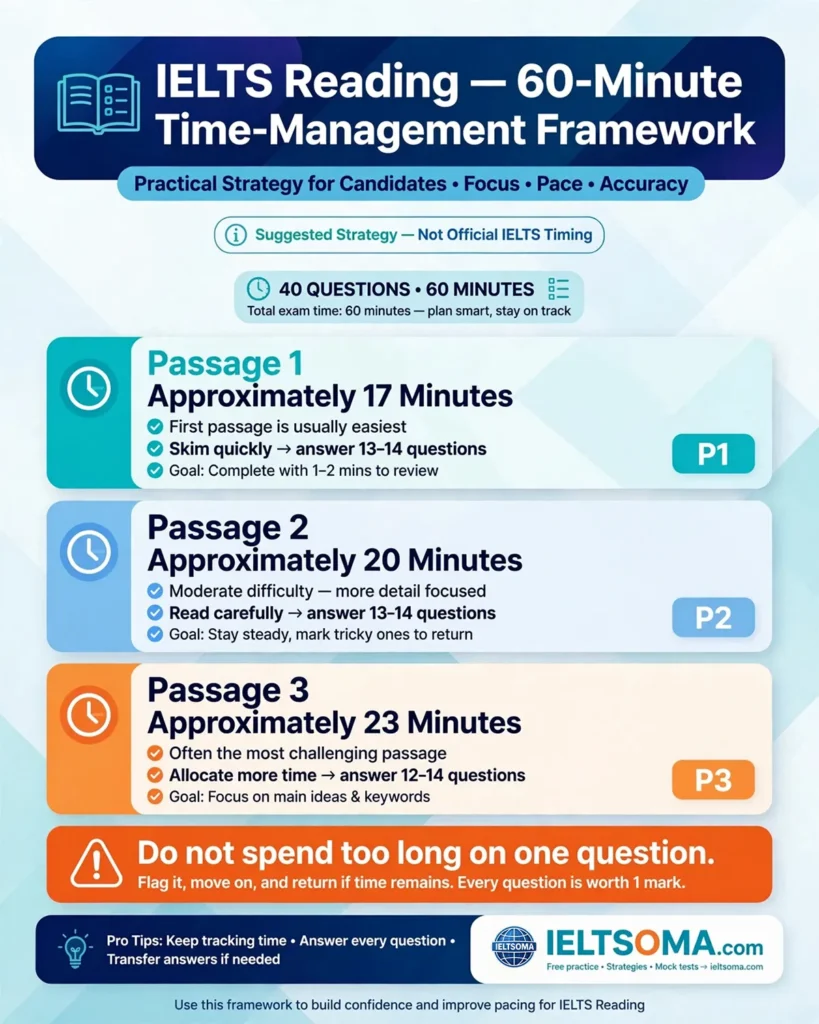
You have 60 minutes for 40 questions.
That means time management must be part of your IELTS Reading Section Strategy.
A commonly useful starting framework is:
- Passage 1: about 17 minutes
- Passage 2: about 20 minutes
- Passage 3: about 23 minutes
This is not an official IELTS timing rule.
It is a practical strategy.
Some candidates will need to adjust it depending on their strengths and weaknesses.
The important principle is that you should not spend 10 minutes fighting one question.
Suppose you cannot determine the answer to Question 14.
You have two choices:
Bad strategy: Spend several minutes repeatedly reading the same paragraph.
Better strategy: Make the best decision you can, mark it if your test format allows, and continue.
A difficult question is worth one mark.
It should not cost you five other questions.
10. Use a Mistake Log Instead of Repeating Tests
Taking practice tests is useful.
Taking the same type of test repeatedly without analysing your mistakes is much less useful.
After every Reading practice session, record:
| Question | Mistake | Why It Happened | What I Will Change |
|---|---|---|---|
| 5 | Wrong heading | Chose a detail | Identify main idea first |
| 11 | Not Given → False | Used outside knowledge | Use passage evidence only |
| 19 | Wrong option | Keyword matching | Look for paraphrase |
| 27 | No answer | Lost too much time | Move on sooner |
| 34 | Wrong spelling | Rushed transfer | Check answers carefully |
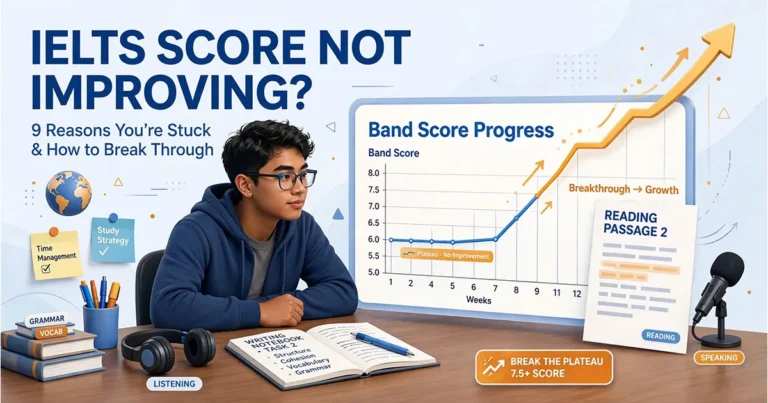
After several tests, patterns will appear.
Perhaps you consistently lose marks on:
- Matching headings
- True/False/Not Given
- Multiple choice
- Summary completion
- Time management
Now your preparation becomes specific.
Instead of saying:
“My Reading is weak.”
you can say:
“I need to improve my ability to identify paragraph main ideas.”
That is a much more useful problem to solve.
11. Adapt Your Strategy to Academic and General Training
The IELTS Reading Section Strategy is relevant to both Academic and General Training, but the Reading materials are different.
Academic Reading uses three longer texts from sources such as books, journals, magazines and newspapers. The texts are written for a non-specialist audience but are appropriate for academic study or professional registration contexts.
General Training Reading uses texts from sources such as notices, advertisements, company handbooks, guidelines, magazines, newspapers and books.
Both tests contain 40 questions and take 60 minutes.
The key difference is therefore not whether you should use strategy.
It is what you practise with.
If you are taking Academic IELTS, practise with Academic Reading material.
If you are taking General Training, use General Training Reading material.
Do not assume that a high score on one version automatically predicts the same performance on the other.
A 7-Day IELTS Reading Strategy Reset
If your Reading score has stopped improving, try this focused seven-day approach.
Day 1: Take a Full Practice Test
Complete a realistic 60-minute Reading test.
Record your score and the time you spent on each section.
Day 2: Analyse Every Error
Classify every incorrect answer.
Was it:
- vocabulary?
- misunderstanding?
- keyword trap?
- paraphrasing?
- timing?
- word limit?
- spelling?
- question-type strategy?
Day 3: Work on Skimming and Scanning
Take a passage and practise identifying:
- paragraph topics
- names
- dates
- numbers
- key concepts
Do not attempt to answer every question.
Focus on navigation.
Day 4: Target Your Weakest Question Type
If True/False/Not Given is your weakness, practise that specifically.
If matching headings is the problem, focus on main ideas.
Do not spend the day practising question types you already handle comfortably.
Day 5: Train Paraphrasing Recognition
Take questions from a reliable practice test.
Underline important concepts.
Then find how those concepts are expressed differently in the passage.
This develops one of the most important Reading skills.
Day 6: Complete Another Timed Test
Use realistic timing.
Do not pause the test to look up vocabulary.
You need to practise making decisions under pressure.
Day 7: Build Your Personal Strategy
Review your results.
Write down your three biggest problems.
For example:
- I spend too long on difficult questions.
- I rely too heavily on exact keywords.
- I confuse False and Not Given.
These become your priorities for the following week.
Frequently Asked Questions About IELTS Reading Section Strategy
What is the best IELTS Reading Section Strategy?
The best strategy combines efficient passage navigation, question analysis, paraphrase recognition, targeted scanning, careful handling of difficult question types and strict time management. There is no single trick that works for every candidate.
Should I read the entire IELTS Reading passage first?
Not necessarily. You should understand the overall structure and topic, but reading every sentence in detail before looking at the questions can consume valuable time. Use a combination of previewing, skimming, scanning and detailed reading.
How can I improve IELTS Reading quickly?
First identify why you are losing marks. Then practice the specific weakness. A candidate struggling with True/False/Not Given needs a different training approach from someone who understands the answers but cannot finish within 60 minutes.
How much time should I spend on each IELTS Reading passage?
There is no official requirement that you spend a fixed number of minutes on each passage. A useful starting point is roughly 17 minutes for the first, 20 for the second and 23 for the third, but you should adjust this according to your performance.
Is IELTS Reading the same for Academic and General Training?
No. Both tests have 40 questions and a 60-minute duration, but the Reading texts and content differ. Academic Reading uses longer texts suitable for academic contexts, while General Training Reading focuses more on practical and general-interest materials.
How do I avoid keyword traps in IELTS Reading?
Do not assume that an identical word proves the answer. Look for the meaning of the complete idea and expect paraphrasing. Compare the claim in the question with the evidence in the passage.
Why do I get False and Not Given wrong?
Candidates often choose False when the passage simply does not provide enough information. Remember: False requires contradiction. Not Given means the passage does not establish whether the statement is true or false.
How important is vocabulary for IELTS Reading?
Vocabulary is important, but you do not need to understand every word in every passage. Strong candidates also use context, grammar, word relationships, paragraph structure and question information to understand meaning.
Should I guess an IELTS Reading answer if I am unsure?
Yes, you should avoid leaving questions unanswered. IELTS Reading uses a one-mark-per-correct-answer system, and there is no benefit in leaving a question blank when you have no penalty for an incorrect answer.
How many IELTS Reading practice tests should I complete?
There is no magic number. Prioritize quality analysis. Completing several tests without identifying and correcting recurring mistakes is unlikely to be as useful as completing fewer tests with detailed review.
Conclusion
A high IELTS Reading score is not simply a competition to see who can read English fastest.
It is a test of controlled reading.
You need to know when to skim.
When to scan.
When to slow down.
When to search for paraphrases.
When to question an apparent answer.
And, perhaps most importantly, when to stop wasting time on one difficult question.
A strong IELTS Reading Section Strategy gives you a system for making those decisions.
Start by understanding the test.
Preview passages.
Use questions as navigation tools.
Look for meaning rather than identical words.
Treat True/False/Not Given carefully.
Focus on paragraph main ideas for matching headings.
Respect word limits.
Manage the 60 minutes deliberately.
Then analyse your mistakes after every serious practice session.
Do not measure your Reading ability only by your latest score.
Measure whether you understand why you lost each mark.
That is where improvement begins.
The goal is not to read every word.
The goal is to read with purpose, find the information efficiently and make accurate decisions under exam conditions.
That is the foundation of an effective IELTS Reading Section Strategy.
Further Reading: