If you know the IELTS Reading question types, the Reading test becomes far less mysterious.
Many candidates make the same mistake: they practise complete Reading tests repeatedly but never learn how each question type works. As a result, they use the same approach for every question, waste time searching for answers, and lose marks even when their English is good.
The better approach is to understand what each task is asking you to do.
The IELTS Reading test contains 40 questions in 60 minutes, and both Academic and General Training Reading use a variety of question types. The texts differ between the two tests, but many of the task formats are shared.
This guide explains the 14 IELTS Reading question types, what each one tests, the best way to approach it, and the mistakes that commonly cost candidates marks.
Table of Contents
IELTS Reading Question Types at a Glance
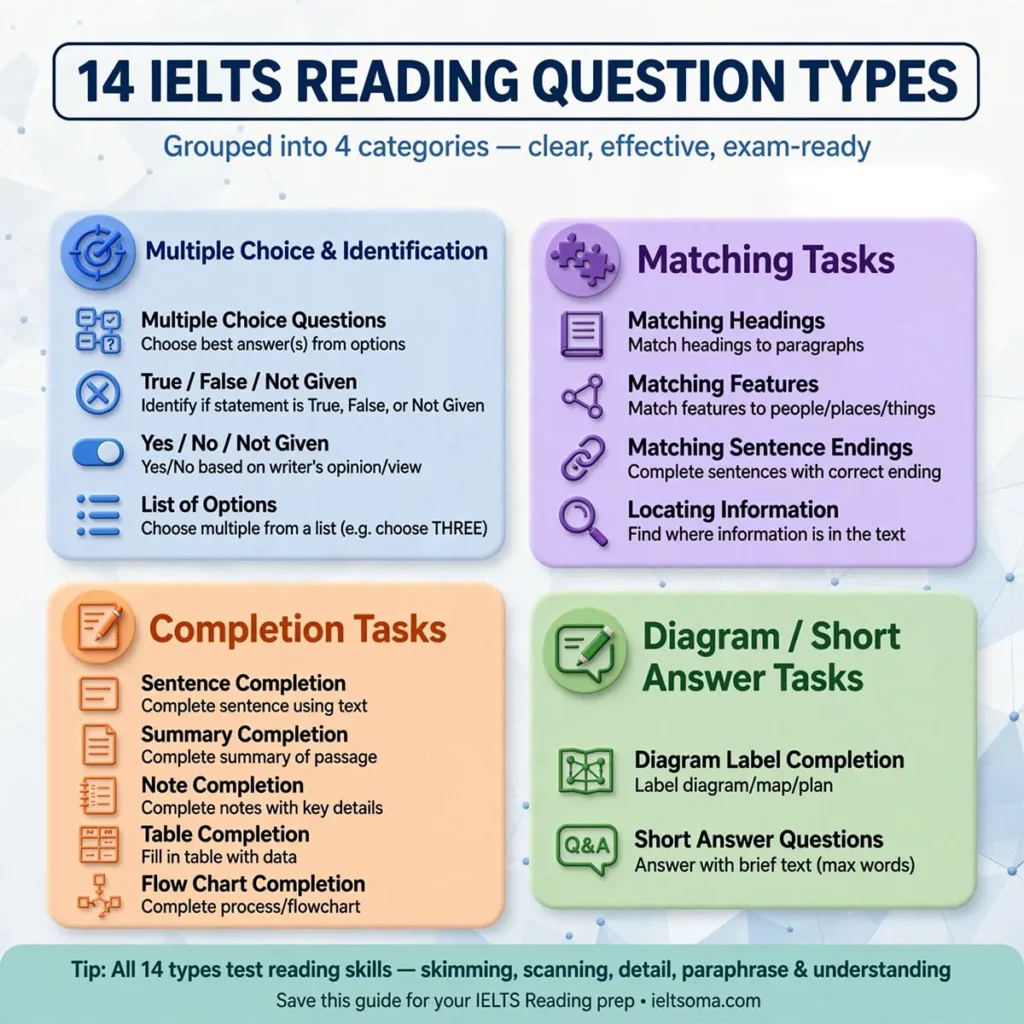
Official IELTS materials identify a broad range of Reading tasks, including multiple choice, identifying information, identifying writer’s views, matching tasks, completion tasks, diagram labelling and short-answer questions.
| Question type | Main skill tested | Usually requires |
|---|---|---|
| Multiple Choice | Understanding detail or main ideas | Careful reading |
| True/False/Not Given | Identifying factual information | Evidence checking |
| Yes/No/Not Given | Identifying opinions or claims | Understanding the writer |
| Matching Information | Locating specific information | Scanning |
| Matching Headings | Identifying main ideas | Paragraph comprehension |
| Matching Features | Connecting information with options | Scanning and comparison |
| Matching Sentence Endings | Understanding relationships | Meaning and grammar |
| Sentence Completion | Finding specific information | Scanning |
| Summary Completion | Understanding a section | Meaning and grammar |
| Note Completion | Extracting key information | Detail recognition |
| Table Completion | Understanding organised information | Detail recognition |
| Flow-Chart Completion | Following a process | Sequencing |
| Diagram Label Completion | Understanding descriptions | Detail and spatial information |
| Short-Answer Questions | Finding factual information | Scanning and precision |
The exact combination of tasks can vary. You should therefore prepare for the full range rather than assuming that a particular question type will always appear.
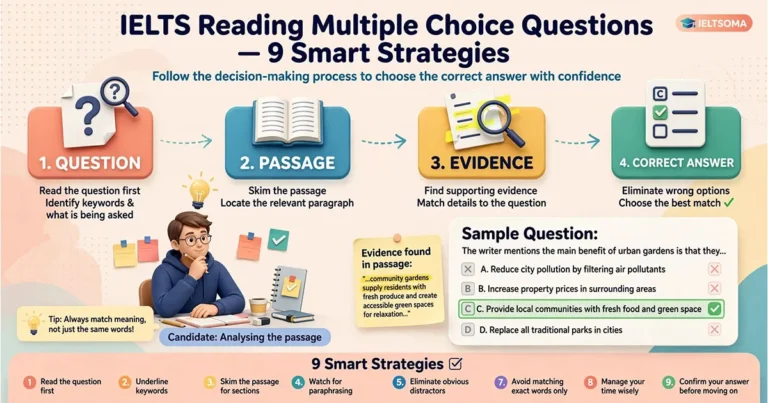
1. Multiple-Choice Questions
Multiple-choice questions give you a question or an incomplete statement and several possible answers.
You may need to select one answer, although some tasks can require more than one. Always read the instructions carefully.
What does it test?
Multiple choice can test:
- Specific details
- Main ideas
- The writer’s purpose
- Reasons or explanations
- Relationships between ideas
- Overall understanding
Official IELTS guidance states that the questions generally follow the order of information in the text.
Best strategy
Do not immediately choose an answer because you see the same word in the passage.
IELTS frequently uses paraphrasing.
Instead:
- Read the question carefully.
- Underline the important concepts.
- Locate the relevant part of the passage.
- Read around the evidence.
- Compare every option.
- Eliminate options that contradict the passage.
- Choose the answer supported by the text.
Common mistake
Choosing an answer because it contains vocabulary that appears in the passage.
Same words do not automatically mean same meaning.
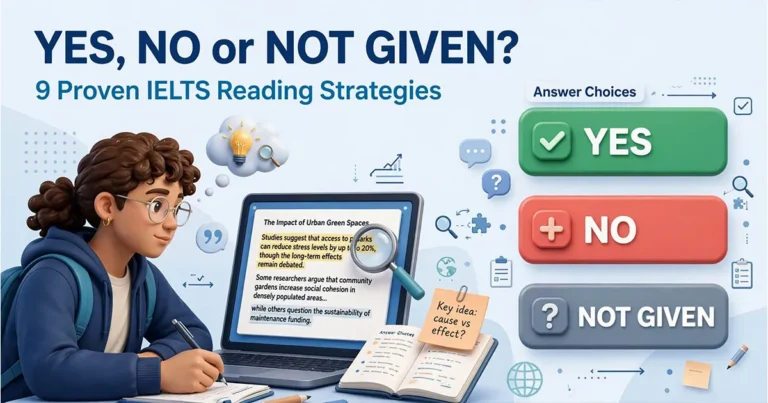
2. True/False/Not Given
This is one of the most challenging IELTS Reading question types for many candidates.
You are given statements and must decide whether they agree with the information in the passage.
The three answers mean:
True: The statement agrees with the passage.
False: The statement contradicts the passage.
Not Given: The passage does not provide enough information to confirm or contradict the statement.
The distinction between False and Not Given is particularly important. Official IELTS guidance explicitly warns candidates not to use their own knowledge about the subject when making this decision.
Example
Passage:
The museum opened in 1990 and attracts visitors throughout the year.
Statement 1:
The museum opened in 1990.
Answer: True
Statement 2:
The museum opened in 1980.
Answer: False
Statement 3:
The museum receives more than 500,000 visitors annually.
Answer: Not Given
The third statement may sound reasonable, but the passage gives no information about the number of visitors.
Expert tip
Ask yourself:
Does the text prove this, contradict this, or say nothing about this?
That simple question can prevent many mistakes.
3. Yes/No/Not Given
Yes/No/Not Given looks similar to True/False/Not Given, but there is an important difference.
This task asks whether statements agree with the writer’s views or claims.
- Yes = agrees with the writer
- No = contradicts the writer
- Not Given = the writer does not express a clear position
You therefore need to distinguish between facts in the text and the writer’s opinion or position.
Common mistake
Candidates sometimes answer from their own opinion.
That is irrelevant.
The question is not:
Do you agree with this statement?
It is:
Does the writer agree with this statement?
Official IELTS describes this task as testing your ability to recognise opinions or ideas.
4. Matching Information
In Matching Information questions, you are given pieces of information and must identify which paragraph contains each one.
For example:
A. An explanation of why the original experiment failed
B. A description of a new technology
C. Evidence from an earlier study
You might need to match each statement with paragraphs A, B, C, D or E.
What does it test?
This task tests your ability to locate specific information.
That might include:
- An example
- A reason
- A description
- A comparison
- An explanation
- A specific detail
- A summary of information
Official IELTS distinguishes Matching Information from Matching Headings because Matching Information focuses on specific information rather than the main idea of a paragraph.
Best strategy
Look for distinctive concepts rather than individual words.
If the question says:
an explanation of why researchers abandoned the project
The passage might say:
The research team eventually discontinued the investigation because…
You need to recognise the meaning, not simply search for “abandoned”.
5. Matching Headings
Matching Headings requires you to match a list of headings with paragraphs or sections of the passage.
This question type is about the main idea.
That distinction is crucial.
A paragraph may contain several details, but the heading should represent what the paragraph is mainly about.
Best strategy
After reading a paragraph, ask:
What is this paragraph mainly doing?
Is it:
- Introducing a problem?
- Explaining a theory?
- Describing a development?
- Presenting evidence?
- Discussing a disadvantage?
- Offering a solution?
- Comparing two ideas?
Do not select a heading simply because one sentence resembles it.
Example
Suppose a paragraph discusses:
- Early electric cars
- Their limited battery capacity
- High production costs
- Their eventual decline
A heading such as “Problems faced by early electric vehicles” is likely more appropriate than a heading about one specific battery problem.
Expert tip
Look for the paragraph’s central message, not its most interesting sentence.
Official IELTS explains that Matching Headings tests your ability to identify the general topic of a paragraph and distinguish the main idea from supporting ideas.
6. Matching Features
Matching Features asks you to connect statements or pieces of information with a list of options.
For example, a passage might discuss several researchers:
- A — Dr Smith
- B — Dr Khan
- C — Professor Jones
- D — Dr Williams
The questions may ask which researcher:
developed the original theory
or:
criticised the traditional approach
An option may sometimes be used more than once, depending on the instructions.
Best strategy
Create a mental map of the options.
If the passage contains several people, places, theories or organisations, note where each appears.
Then scan for the specific information in the questions.
Common mistake
Assuming each option can only be used once.
Always follow the instructions.
7. Matching Sentence Endings
You are given the beginning of sentences and a list of possible endings.
Your task is to match them correctly.
For example:
Researchers initially believed that…
Possible endings:
A. the experiment would produce consistent results.
B. the technology was too expensive.
C. the evidence was unreliable.
D. the process required additional testing.
What does it test?
It tests your understanding of the relationships between ideas.
Grammar can also help.
If the sentence beginning requires a particular grammatical structure, eliminate endings that do not fit.
Official IELTS notes that sentence beginnings appear in the same order as the information in the text.
Expert tip
Do not match based solely on grammar.
The completed sentence must be grammatically correct and logically supported by the passage.
8. Sentence Completion
Sentence Completion requires you to fill gaps in sentences using words from the text.
You may see instructions such as:
NO MORE THAN TWO WORDS AND/OR A NUMBER
The word limit matters.
If the answer requires two words and you write three, you can lose the mark even if the information is otherwise correct. Official IELTS specifically highlights the importance of following the stated word limit.
Best strategy
Before searching, predict what type of word you need.
For example:
The researchers developed a new ______ to measure temperature.
You probably need a noun.
Then scan for the relevant information.
Check three things
Before writing your answer, check:
- Does it answer the question?
- Does it fit grammatically?
- Does it obey the word limit?
9. Summary Completion
Summary Completion gives you a summary of part of the passage with gaps that you must complete.
The summary may cover:
- A section of the passage
- A process
- An argument
- A development
- A particular topic
You may have to select words from the passage or choose from a list.
Official IELTS notes that the summary is normally about a part of the text, rather than the entire passage.
Best strategy
Read the complete summary before searching.
Try to understand:
What part of the passage is this summary describing?
Then identify the likely location.
Grammar matters
Look at the words immediately before and after each gap.
For example:
The researchers decided to ______ the experiment.
A verb is required.
That grammatical clue can help you identify the correct answer.
10. Note Completion
Note Completion is closely related to Summary Completion, but the information is presented as notes rather than continuous prose.
For example:
Early research
- Research began in ______
- Main objective: ______
- Initial problem: ______
- New method introduced in ______
You need to extract the missing information from the passage.
Best strategy
Look at the structure of the notes.
The headings and surrounding words often tell you exactly what kind of information you need.
For example:
Year: ______
You should immediately expect a date or year.
Reason for change: ______
You should search for a reason.
This makes your scanning much more targeted.
11. Table Completion
Table Completion presents information in rows and columns.
For example:
| Research stage | Location | Main result |
|---|---|---|
| Stage 1 | ______ | Initial findings |
| Stage 2 | London | ______ |
| Stage 3 | ______ | Final result |
Your task is to complete the missing information.
What makes it challenging?
The information may be spread across a particular section of the passage, and the wording in the table may differ from the wording in the text.
Best strategy
Read the row and column headings carefully.
They give you context.
If the column is labelled Location, you are looking for a place.
If it is labelled Year, search for a date.
If it is labelled Reason, search for a cause or explanation.
12. Flow-Chart Completion
Flow charts show a sequence of events, stages or processes.
For example:
Raw material collected → ______ → product tested → ______ → product released
The answers must fit logically into the process.
Best strategy
Understand the process before looking for individual answers.
Look for sequence markers such as:
- First
- Initially
- Then
- Following this
- After
- Subsequently
- Finally
However, remember that IELTS does not always present the information using those exact words.
Paraphrasing can hide the relationship.
Official IELTS states that flow charts can show the order of events through boxes or steps connected by arrows.
13. Diagram Label Completion
Diagram Label Completion requires you to label parts of a diagram using information from the passage.
The diagram might represent:
- A machine
- A building
- A natural process
- A scientific system
- A structure
Why is it difficult?
You need to connect written information with a visual representation.
The passage might describe a component without using the exact language used in the question.
Best strategy
Study the diagram first.
Look at:
- Arrows
- Labels
- Direction
- Position
- Nearby components
- The title or description
Then find the relevant section of the passage.
Official IELTS explains that the diagram is based on a description in the text and may represent a machine, building or other information that can be shown visually.
14. Short-Answer Questions
Short-answer questions require you to answer factual questions using information from the passage.
For example:
What year was the organisation established?
or:
Where did the first experiment take place?
The answer must normally be taken from the words in the text and must follow the specified word limit.
Best strategy
Identify the question word first:
- Who? → person
- Where? → place
- When? → date/time
- Why? → reason
- What? → object, fact or idea
- How many? → number
Then scan for the relevant information.
Do not write a long explanation when the question asks for a short answer.
Which IELTS Reading Question Types Should You Practise First?
Not every question type requires the same skill.
A useful way to organise your preparation is by the skill being tested.
Questions that rely heavily on scanning
Practise:
- Matching Information
- Matching Features
- Sentence Completion
- Note Completion
- Table Completion
- Short-Answer Questions
Questions requiring strong understanding of main ideas
Focus on:
- Matching Headings
- Multiple Choice
- Summary Completion
Questions requiring careful interpretation
Give extra attention to:
- True/False/Not Given
- Yes/No/Not Given
- Multiple Choice
Questions requiring attention to structure and sequence
Practise:
- Matching Sentence Endings
- Flow-Chart Completion
- Diagram Label Completion
This approach is more efficient than treating every Reading question as the same task.
IELTS Academic vs General Training Reading
The IELTS Reading question types are broadly similar across Academic and General Training, but the reading material is different.
Academic Reading contains three sections with texts from sources such as books, journals, magazines, newspapers and online resources. The texts are intended for a non-specialist audience and may include descriptive, narrative or discursive writing.
General Training Reading also has three sections, but the material progresses from everyday texts to workplace-related texts and then a longer text on a topic of general interest.
Both tests contain:
- 40 questions
- 60 minutes
- One mark per correct answer
There is no additional transfer time for Reading, so you must complete answer transfer within the 60-minute period.
This means your preparation should match the version of IELTS you are actually taking.
How to Approach IELTS Reading Question Types Strategically
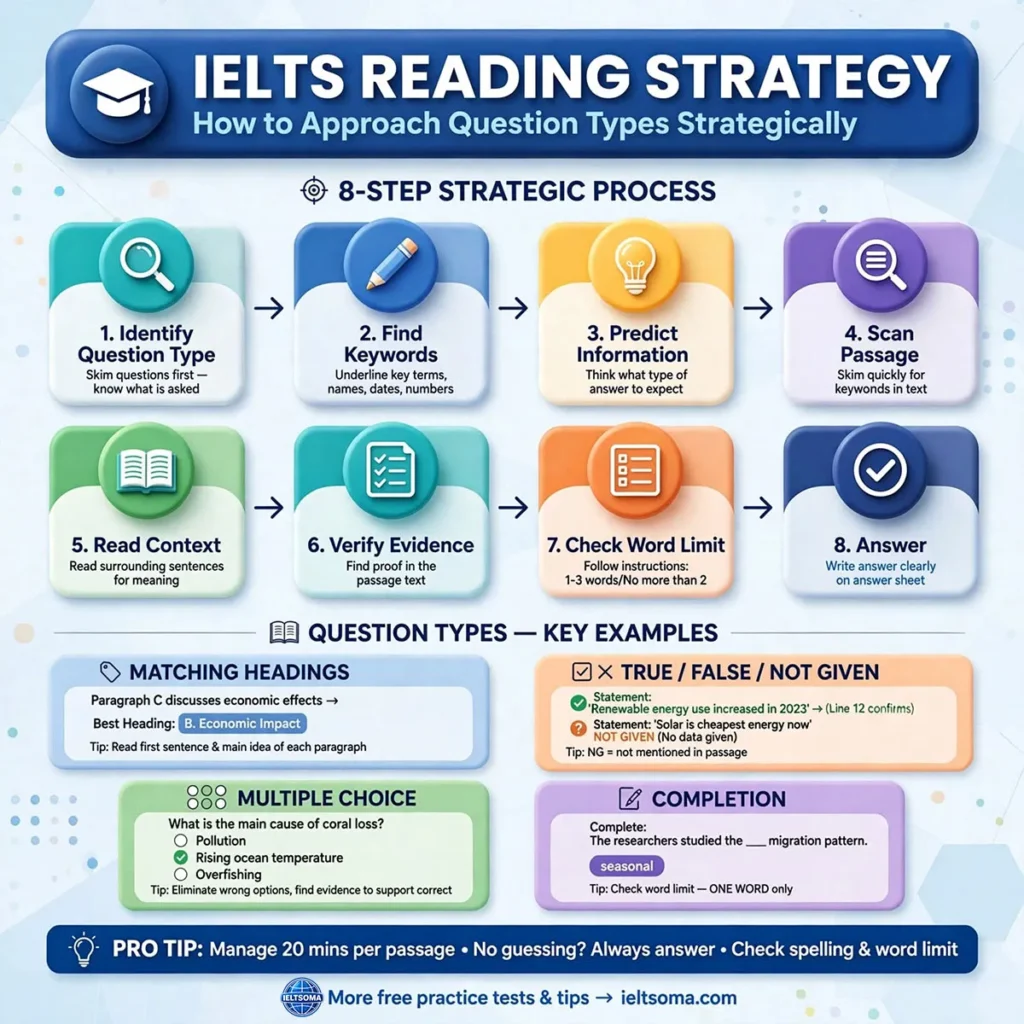
A strong Reading candidate does not use one strategy for every task.
Instead, ask three questions:
1. What skill is this question testing?
Is it testing:
- A specific detail?
- The main idea?
- An opinion?
- A relationship?
- A sequence?
- A comparison?
2. Where is the answer likely to be?
Some tasks generally follow the order of information in the text, while others require you to search across paragraphs.
Knowing this can save considerable time.
3. What evidence proves my answer?
Do not stop as soon as you find a familiar word.
Read enough context to confirm the meaning.
This is especially important because IELTS frequently tests your ability to recognise paraphrased information.
For example:
Question: The number of visitors increased rapidly.
The passage might say:
Visitor numbers rose sharply during the following decade.
The vocabulary is different, but the meaning is closely related.
Common Mistakes Across IELTS Reading Question Types
Using the same strategy for every task
Matching Headings and Sentence Completion require different approaches.
Learn the purpose of each question type.
Looking for exact words
IELTS uses paraphrasing extensively.
Search for concepts and meaning, not only identical vocabulary.
Ignoring instructions
If the instructions say NO MORE THAN TWO WORDS, do not write three.
Using outside knowledge
The passage is your evidence.
Your personal knowledge should not determine the answer.
Spending too long on one question
If a question is consuming too much time, move forward and return later when possible.
Confusing main ideas with details
This is particularly damaging in Matching Headings.
A paragraph can contain a detail that sounds important but does not represent the paragraph’s central idea.
Failing to analyse mistakes
Your wrong answers reveal your weaknesses.
Record them and look for patterns.
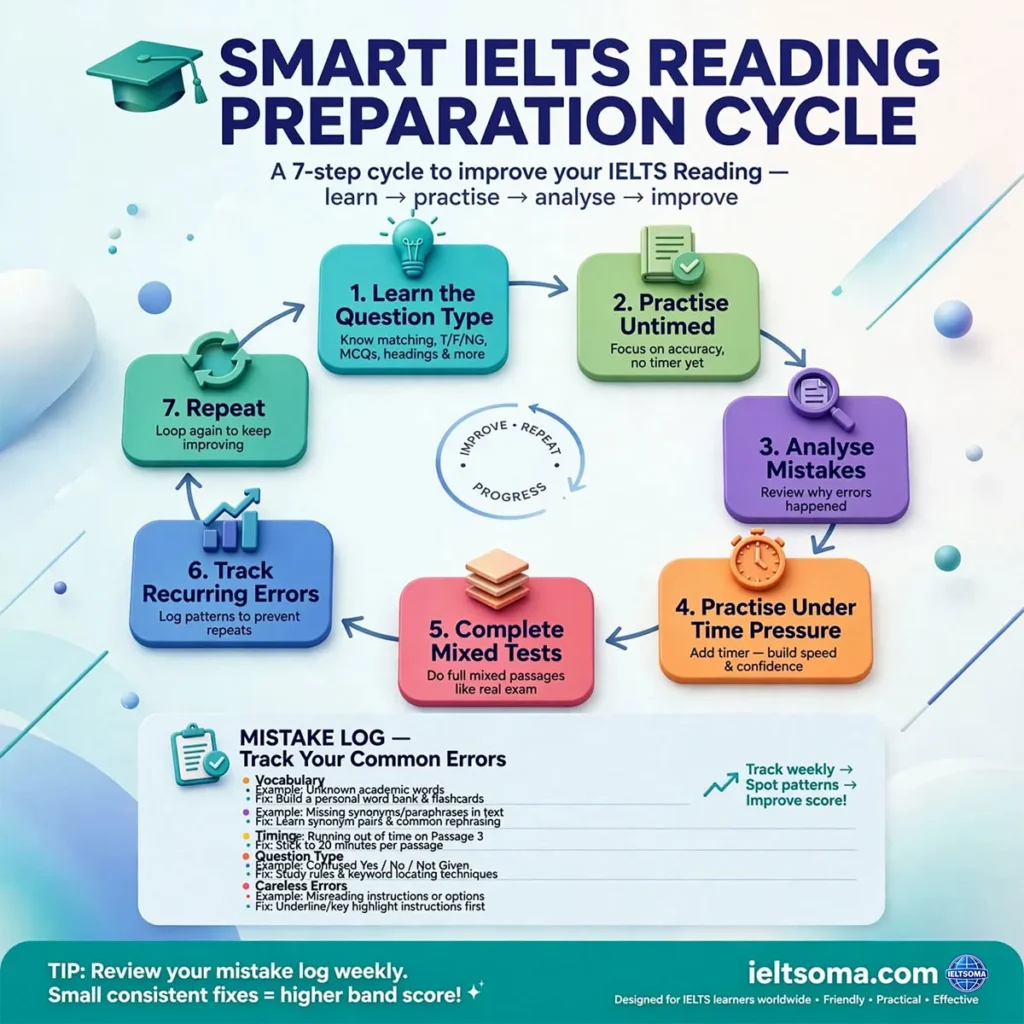
A Smarter IELTS Reading Practice Method
Instead of completing full tests every day, use a three-stage approach.
Stage 1: Learn
Choose one question type.
Understand:
- What it asks
- What skill it tests
- How answers are located
- What common traps look like
Stage 2: Practise
Complete several questions of that type without worrying excessively about speed.
Your first objective should be accuracy.
Stage 3: Time Yourself
Once your accuracy improves, introduce time pressure.
Then complete mixed question types.
This creates a useful progression:
Understand → Practise → Analyse → Time → Repeat
IELTSOMA’s guide to IELTS Reading Strategies also recommends focusing on question-type awareness, paraphrasing, scanning, evidence and error analysis rather than simply completing test after test.
Frequently Asked Questions About IELTS Reading Question Types
How many IELTS Reading question types are there?
Official IELTS preparation materials list a variety of Reading tasks, including multiple choice, True/False/Not Given, Yes/No/Not Given, matching tasks, several completion formats, diagram labelling and short-answer questions. These can be grouped into 14 practical question types for preparation.
Are IELTS Academic and General Training Reading question types the same?
They use broadly the same range of task formats, but the reading texts differ. Academic Reading uses academic-style material, while General Training Reading includes everyday, workplace and general-interest texts.
Which IELTS Reading question type is the hardest?
There is no single hardest question type for everyone. However, many candidates find Matching Headings and True/False/Not Given challenging because they require careful interpretation rather than simple keyword matching.
Should I learn IELTS Reading question types before doing practice tests?
Yes. Understanding the task format first makes practice much more productive. Once you know what a question is testing, you can analyse why an answer is correct or incorrect.
Do IELTS Reading questions always follow passage order?
No. Some question types generally follow the order of information in the passage, while others require you to search across paragraphs or sections. You should learn the characteristics of each task rather than assuming that every question follows a fixed order.
Can I use my own knowledge to answer IELTS Reading questions?
No. Your answer should be based on the information and meaning presented in the passage. This is particularly important for True/False/Not Given and Yes/No/Not Given questions.
How much time do I have for IELTS Reading?
You have 60 minutes to complete the Reading test, including transferring your answers. There are 40 questions, and each correct answer receives one mark.
Final Takeaway
Learning the IELTS Reading question types is one of the smartest ways to make your preparation more focused.
You do not need to approach all 40 questions in exactly the same way.
Multiple choice requires careful comparison. Matching Headings requires you to identify the main idea. True/False/Not Given requires evidence and contradiction. Completion tasks require accurate scanning, grammar awareness and strict attention to word limits.
Once you understand these differences, your practice becomes much more purposeful.
Do not simply ask:
“How many questions did I get right?”
Ask:
“Which question types caused my mistakes, and why?”
That change in approach can transform your Reading preparation.
Learn the task. Practise the skill. Analyse the mistake. Then repeat it under timed conditions.
For both IELTS Academic and General Training candidates, mastering the IELTS Reading question types gives you a clearer strategy for using your 60 minutes effectively and working towards a higher Reading band score.
Official IELTS sample questions and preparation resources are also useful for becoming familiar with the real task formats before test day.