IELTS Reading Matching Information questions can be frustrating. You read a paragraph, find a sentence that seems relevant, and then discover that the answer belongs somewhere else. The problem is rarely a lack of vocabulary alone. More often, it is the way you search for information, interpret paraphrases, and distinguish the main point from supporting details.
The good news is that IELTS Reading Matching Information questions become much more manageable when you use a systematic approach instead of repeatedly reading the entire passage.
This question type tests your ability to locate specific information within a text. You may need to identify the paragraph containing an example, a reason, a description, a comparison, an explanation, or a reference to a particular event. The answer is usually based on meaning rather than identical wording.
In this guide, you will learn how to answer IELTS Reading Matching Information questions, recognize paraphrases, manage your time, avoid common traps, and understand the difference between Matching Information and Matching Headings. The strategies apply to both IELTS Academic and IELTS General Training Reading, although the texts and their structure may differ.
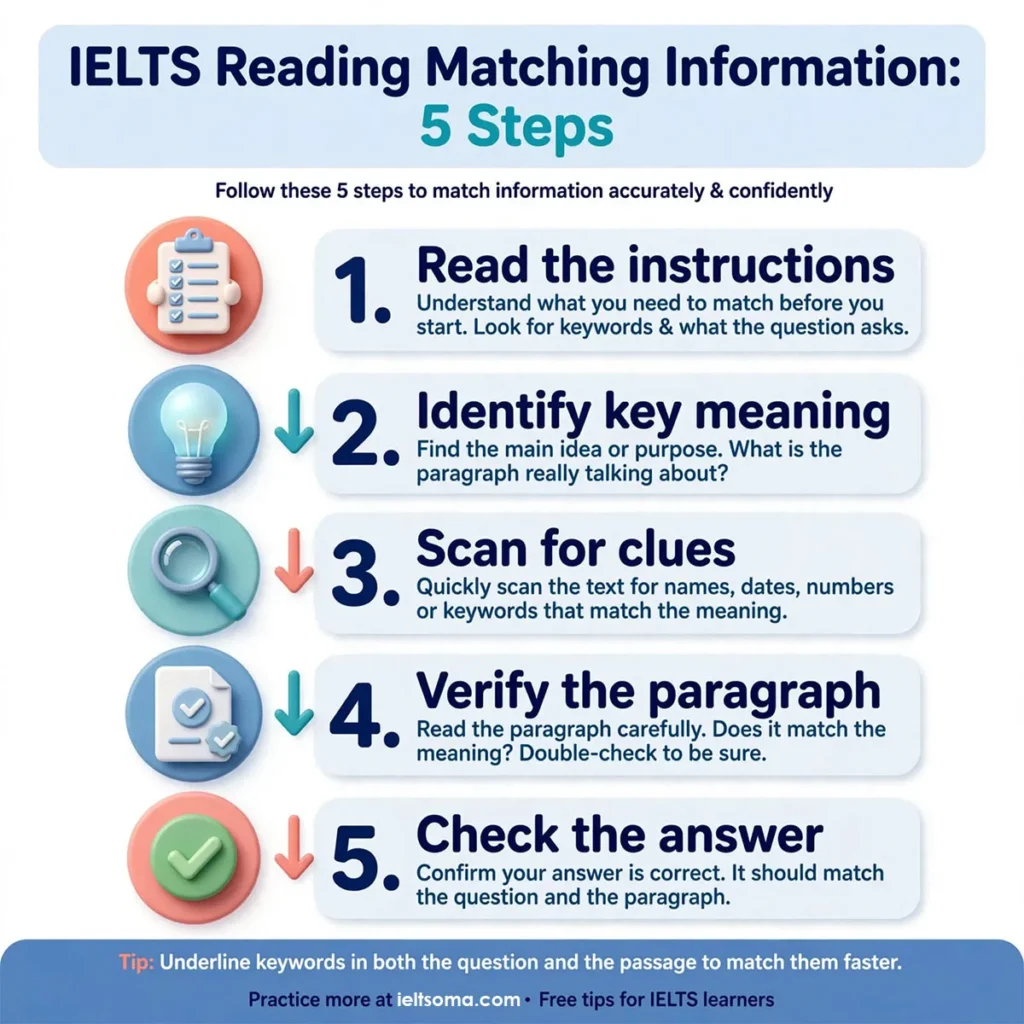
Table of Contents
What Is IELTS Reading Matching Information?
IELTS Reading Matching Information is a question type in which you match statements describing specific pieces of information to the paragraphs or sections where that information appears.
You are usually given a list of statements labelled with Roman numerals or another numbering system and a series of paragraphs labelled A, B, C, D, and so on. Your task is to identify which paragraph contains the information described in each statement.
For example, a question might ask you to find:
- A paragraph describing the reason a project was abandoned.
- A reference to an experiment that produced unexpected results.
- An example of a successful solution to a problem.
- An explanation of why a particular method became popular.
- A comparison between two approaches.
- A description of a discovery made by accident.
Each statement points to a particular piece of information, not necessarily the overall subject of the paragraph.
This distinction is crucial. A paragraph about renewable energy might contain a sentence explaining why an early solar project failed. If the question asks for the reason the project failed, you need to locate that specific explanation rather than simply identify a paragraph discussing renewable energy.
What skills does this question type test?
Matching Information questions assess several connected reading skills:
- Scanning: locating names, dates, examples, concepts, and other possible clues quickly.
- Skimming: understanding the general purpose and organisation of a passage.
- Paraphrase recognition: identifying equivalent meanings expressed with different words.
- Detailed reading: checking whether the paragraph contains the precise information requested.
- Logical interpretation: distinguishing a stated reason from an example, a claim from evidence, or a result from a cause.
You do not need to understand every word in the passage. You need to find and verify the information relevant to each statement.
How to Answer IELTS Reading Matching Information Questions: 7 Proven Tips
The following IELTS Reading Matching Information strategy gives you a repeatable process for tackling these questions under exam conditions.
1. Read the Instructions Before Looking for Answers
Start by checking exactly what the question requires.
Look for three things:
- How many statements you need to match.
- Whether paragraphs can be used more than once.
- Whether any paragraph may remain unused.
In some questions, you may use a paragraph more than once. In others, the instructions may restrict how you use the options. Never assume the rules are the same across every question set.
For example, imagine a passage containing paragraphs A–H and six statements. If the instructions permit repeated answers, two statements might refer to paragraph C. You should not reject the second match simply because you have already used that paragraph.
Expert tip: Follow the instructions printed above the questions, even if they differ from a practice exercise you completed previously.
2. Identify the Key Meaning in Each Statement
Do not immediately start reading the passage from the first word to the last. First, examine the statements and identify the information each one describes.
Consider this example:
The reasons a new transport system was initially unpopular.
The important elements are:
- Reasons: an explanation or cause is required.
- New transport system: the subject of the information.
- Initially unpopular: the time period and negative public reaction.
You can now search for language connected with causes, transport, and public dissatisfaction.
The passage may not use the phrase initially unpopular. Instead, it might say that residents opposed the system because tickets were expensive and services were unreliable.
That paragraph may contain the answer even though the original wording is absent.
Try identifying the key meaning in these additional examples:
| Statement | What to look for |
|---|---|
| An unexpected result of an experiment | An outcome that surprised researchers |
| A reason for abandoning a plan | A cause, obstacle, or explanation for stopping it |
| An example of a successful strategy | A specific case demonstrating success |
| A difference between two methods | A contrast, limitation, or comparative statement |
| An earlier attempt to solve a problem | A previous action, trial, or unsuccessful approach |
The goal is not to memorise isolated keywords. It is to understand the relationship between the subject, the detail, and the information being requested.
3. Scan for Keywords and Their Synonyms
Once you understand the statement, scan the passage for possible clues.
Useful clues include:
- Names of people, places, and organisations.
- Dates, numbers, and measurements.
- Technical terms.
- Distinctive nouns.
- Words associated with causes, effects, comparisons, or examples.
However, do not expect every keyword to appear exactly as it does in the question.
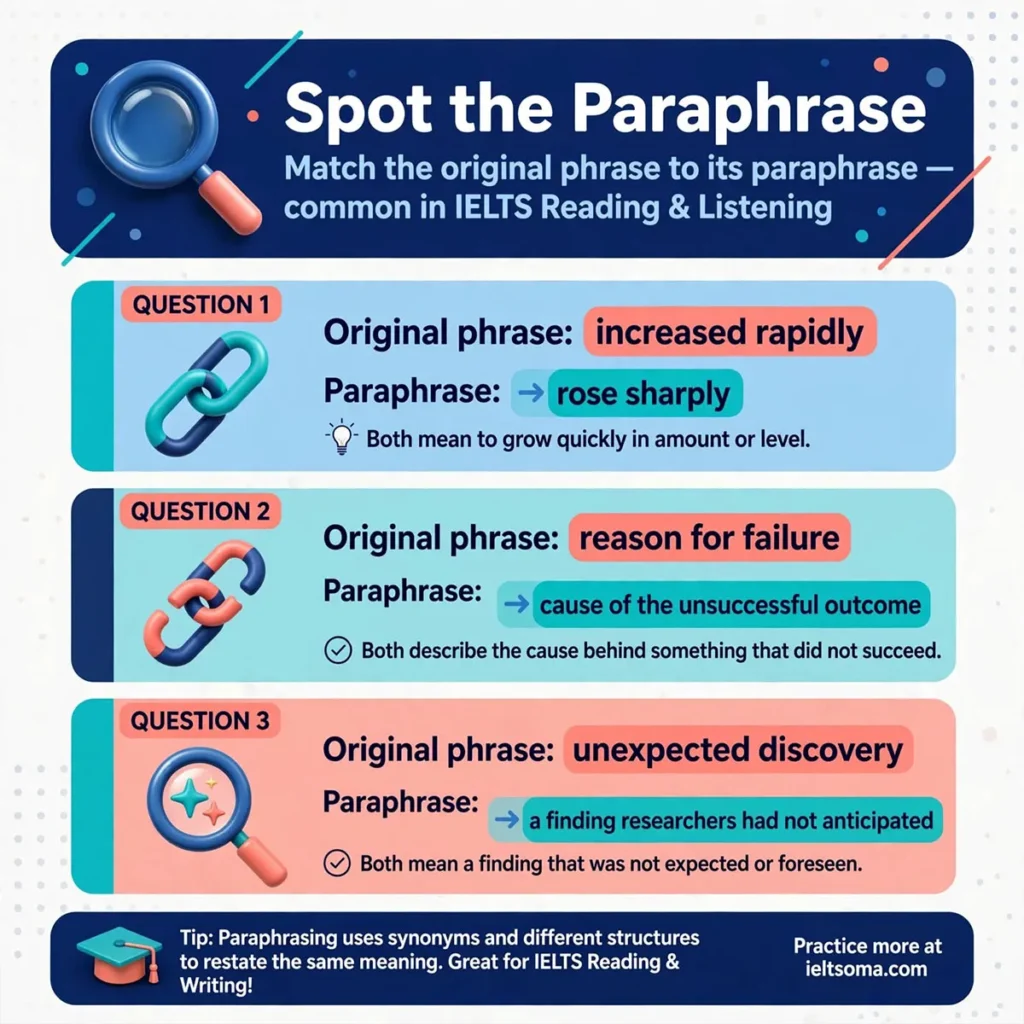
IELTS Reading often tests whether you can recognise paraphrasing. A statement may express an idea in one way while the passage communicates the same meaning differently.
| Wording in the question | Possible wording in the passage |
|---|---|
| Increased rapidly | Rose sharply; grew considerably |
| Was unpopular | Faced opposition; received a negative response |
| A reason for failure | A cause of the unsuccessful outcome |
| An unexpected discovery | A finding that researchers had not anticipated |
| Reduced expenses | Lowered costs; made the process cheaper |
| A previous attempt | An earlier effort; an initial trial |
| Had a negative effect | Caused harm; produced an adverse impact |
| Became more common | Gained popularity; was increasingly adopted |
These are examples of possible paraphrases, not guaranteed equivalents in every context. Always check the meaning of the complete sentence.
For instance, reduced expenses and reduced profits both contain the word reduced, but they describe different things. Matching a single shared word is not enough.
Expert tip: Underline the important meaning in the question, then think of two or three alternative ways the author might express it. This prepares you to recognize the information without searching for an exact verbal match.
4. Read the Relevant Paragraph Carefully
Scanning helps you locate a possible answer, but it does not prove that the paragraph is correct.
Once you find a likely match, read the relevant sentence and the surrounding context. Sometimes the information appears across two connected sentences rather than in one sentence alone.
Suppose the statement asks:
An explanation for the failure of an early trial.
The passage says:
“The first trial was discontinued after several weeks. The equipment repeatedly overheated, making it impossible to collect reliable measurements.”
The first sentence tells you that the trial stopped. The second explains why it stopped. Together, they support the answer.
By contrast, a paragraph that merely mentions the first trial without explaining its failure would not be sufficient.
Ask yourself:
- Does this paragraph contain the specific information requested?
- Does it describe the right subject or event?
- Does the context support the proposed match?
- Am I confusing a related topic with the exact answer?
This verification step prevents many avoidable mistakes.
5. Match Meaning, Not the General Topic
One of the most common errors is selecting a paragraph because it discusses the same subject as the statement.
Imagine that a passage about urban transport contains three paragraphs:
- Paragraph B describes the history of a railway system.
- Paragraph D explains why passengers stopped using it.
- Paragraph F discusses plans for its future expansion.
If the statement asks for a reason the railway became less popular, paragraph D is the likely match. Paragraphs B and F may mention the same railway but do not necessarily contain the required information.
The question is not asking, “Which paragraph is about this subject?” It is asking, “Which paragraph contains this particular piece of information?”
This difference becomes especially important when several paragraphs discuss the same person, invention, organisation, or historical event.
A useful rule is to identify the relationship expressed in the statement:
- Cause: Why did something happen?
- Effect: What happened as a result?
- Example: Which specific case illustrates an idea?
- Comparison: How are two things similar or different?
- Problem: What difficulty occurred?
- Solution: How was the difficulty addressed?
- Opinion or claim: What did a person or group believe?
- Evidence: What findings support a conclusion?
Matching the relationship often proves more useful than matching the subject alone.
6. Use Paragraph Structure to Narrow Your Search
You can often identify likely locations by understanding how paragraphs are organised.
A paragraph may introduce an idea, explain a problem, provide evidence, present an example, or discuss an outcome. Recognising these functions helps you decide where to search.
Pay attention to signal words and phrases.
| Information required | Possible clues |
|---|---|
| A cause or reason | because, since, due to, resulted from |
| A result or consequence | therefore, consequently, led to, resulted in |
| An example | for example, for instance, such as |
| A contrast | however, whereas, unlike, in contrast |
| An unexpected finding | surprisingly, unexpectedly, contrary to expectations |
| A problem or limitation | difficulty, obstacle, failed, unable to |
| A solution | addressed, resolved, introduced, developed |
| A chronological detail | initially, later, previously, eventually |
These expressions are clues, not automatic answers. A paragraph may express a cause without using because, or describe a contrast without using however.
Also remember that the location of information is not always predictable. A paragraph’s opening sentence may introduce its subject, while the exact detail appears near the end. Information can also be embedded within a longer explanation.
Use paragraph structure to narrow your search, then verify the actual meaning.
7. Manage Your Time and Recheck Difficult Matches
Matching Information can consume too much time if you repeatedly read every paragraph for every statement.
Use a structured approach instead:
- Read the instructions and note any restrictions.
- Identify the key meaning of each statement.
- Scan for distinctive clues and paraphrases.
- Read likely paragraphs in detail.
- Record a provisional answer.
- Move on if the match remains uncertain.
- Return to difficult questions if time allows.
You do not have to solve the statements in their printed order. If one statement contains a distinctive date or name, it may be easier to locate than another statement expressed in abstract language.
However, do not assume that answers appear in passage order. Matching Information answers can occur in a different order from the statements, and several statements may refer to different locations throughout the text.
If you are stuck between two paragraphs, compare them against the exact requirement. One may discuss the subject generally, while the other contains the requested reason, example, or result.
Avoid spending excessive time on a single difficult match at the expense of easier questions elsewhere in the Reading test.
Matching Information vs Matching Headings IELTS: What Is the Difference?
Understanding Matching Information vs Matching Headings IELTS is essential because the two question types look similar but require different decisions.
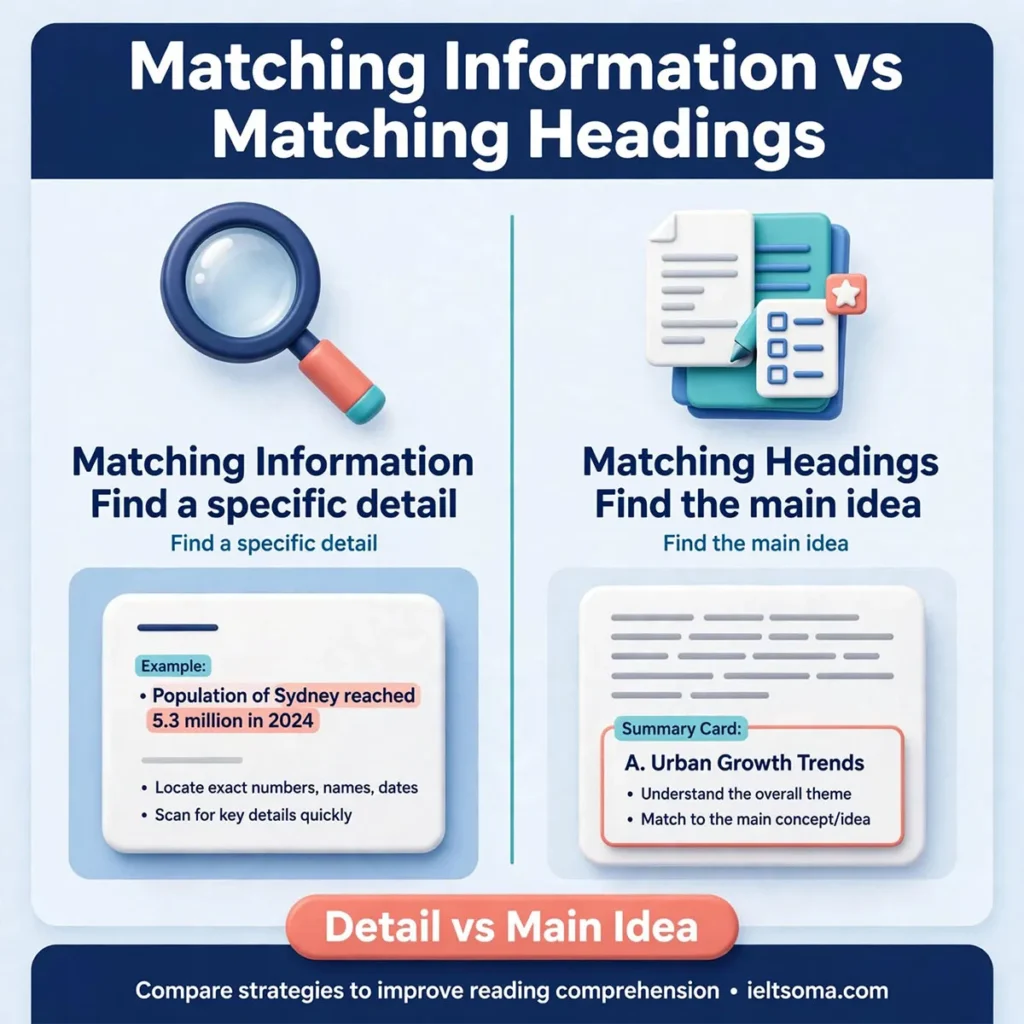
In Matching Information, you identify where a particular detail appears. In Matching Headings, you identify the heading that best summarises the main idea of a paragraph.
Matching Information
Focus: a specific detail or piece of information
Example question: Which paragraph describes a problem caused by excessive rainfall?
Your task is to locate the paragraph containing that particular problem, even if it is only one part of a larger discussion.
Matching Headings
Focus: the central idea of the whole paragraph
Example question: Which heading best summarises a paragraph about the causes, consequences, and management of flooding?
Your task is to identify the paragraph’s overall message rather than a single supporting detail.
Here is a more detailed comparison.
| Feature | Matching Information | Matching Headings |
|---|---|---|
| Main objective | Locate specific information | Identify the main idea |
| Typical question | Which paragraph contains a particular detail? | Which heading summarises this paragraph? |
| Reading approach | Scan, locate, and verify | Skim for the central argument |
| Role of examples | An example may be the answer | An example usually supports the main idea |
| Answer selection | Find the paragraph containing the requested information | Choose the heading that best represents the paragraph as a whole |
| Common mistake | Selecting a paragraph on the same topic | Selecting a heading based on one minor detail |
Can the same paragraph answer both question types?
Yes. A paragraph can contain a specific detail that answers a Matching Information question and have an overall message that matches a heading in another question set.
For example, a paragraph might explain how a university reduced food waste by changing its catering arrangements. The paragraph’s central idea could be Practical approaches to reducing food waste, while a specific detail could describe the reason the university introduced the changes.
The heading represents the broader idea. The Matching Information answer identifies where the particular reason appears.
Which strategy should you use for each question type?
For Matching Information, focus on the statement’s specific meaning and search for evidence in the passage.
For Matching Headings, read enough of each paragraph to understand its central purpose. Do not select a heading merely because it repeats a word found in the paragraph.
Practising both types together can help you develop flexibility: sometimes you need to locate one detail, while at other times you need to understand the whole paragraph.
A Worked Example: IELTS Reading Matching Information Strategy
Consider this short practice passage. It is an original teaching example, not an official IELTS test item.
Passage
Paragraph A: The town introduced bicycle-sharing stations in 2018 to reduce traffic congestion. Initially, the scheme attracted considerable interest, particularly among university students who lived close to the town centre.
Paragraph B: Despite its promising start, the scheme soon encountered difficulties. Many bicycles were left at stations outside the busiest areas, while maintenance teams struggled to repair damaged vehicles quickly. As a result, some users began choosing other forms of transport.
Paragraph C: The council later introduced a mobile application showing bicycle availability at each station. It also increased the frequency of inspections and moved several stations closer to residential neighbourhoods. Within a year, usage had risen considerably.
Questions
Which paragraph contains the following information?
- An explanation of why some people stopped using a service.
- A description of measures introduced to improve a service.
- Information about the initial popularity of a scheme.
Answers and explanations
| Question | Answer | Explanation |
|---|---|---|
| 1 | B | The paragraph explains that poor bicycle distribution and slow repairs contributed to users choosing other transport. |
| 2 | C | The mobile application, more frequent inspections, and relocated stations are specific improvements. |
| 3 | A | The paragraph states that the scheme initially attracted considerable interest. |
Notice how the questions use different expressions from the passage.
The first statement asks why people stopped using a service. Paragraph B says that some users began choosing other forms of transport. The second asks about improvement measures, while paragraph C describes actions taken by the council. The third asks about initial popularity, which is expressed as attracting considerable interest.
The answers depend on matching meaning, not identical wording.
The example also illustrates why you should not assume that the answers will appear in the same order as the questions. Here, the answers happen to follow the paragraph order, but this is not a rule you can rely on in the real test.
Common IELTS Reading Matching Information Mistakes
Even candidates with good English skills can lose marks by using an inefficient method. Watch out for these mistakes.
Looking for exact words only
A question may say an increase in demand, while the passage states that more people began requesting the service. Searching only for the word increase may cause you to overlook the correct paragraph.
Improvement: Practise recognising synonyms and paraphrases in complete sentences.
Choosing a paragraph because the topic matches
A paragraph can discuss the same person or subject without containing the information requested.
Improvement: Identify whether the question asks for a cause, result, example, comparison, or another specific detail.
Reading every paragraph repeatedly
Returning to the beginning of the passage for every statement wastes time and makes it harder to remember what you have already checked.
Improvement: Scan strategically, make provisional matches, and return to the text only to verify uncertain answers.
Assuming the answers follow passage order
Some candidates expect the answer to the first statement in the first relevant paragraph and subsequent answers to appear in sequence.
Improvement: Treat each statement independently and follow the evidence rather than a presumed order.
Ignoring small but important words
Words such as initially, only, previously, mainly, and unexpectedly can change the meaning of a statement.
For example, a paragraph describing the eventual success of a project may not answer a question about why the project initially failed.
Improvement: Underline qualifiers and check that the paragraph matches the full statement, not just its main noun.
Changing an answer without evidence
An answer may feel wrong simply because the paragraph uses unfamiliar vocabulary. Changing it repeatedly based on intuition can create more errors.
Improvement: Change an answer when you find evidence that supports another paragraph, not merely because you feel uncertain.
How to Practise IELTS Reading Matching Information Effectively
Improvement comes from reviewing your reasoning, not simply completing more exercises.
Use the following routine for regular practice.
- Complete a short exercise under timed conditions. Focus on applying the same process to every statement.
- Check the answers. Mark each response as correct or incorrect.
- Return to the passage. Locate the exact sentence or sentences supporting each answer.
- Identify the reason for each mistake. Was it a missed paraphrase, an incorrect interpretation, poor scanning, or confusion between a detail and a general topic?
- Build a paraphrase list. Record useful expressions from the passage alongside the wording used in the question.
- Repeat the exercise later. Check whether you can locate the evidence more efficiently without relying on memorised answers.
For example, if you repeatedly confuse a paragraph’s topic with its specific information, practise explaining the difference in one sentence before choosing an answer.
If paraphrases cause difficulty, create pairs such as declined sharply — fell considerably or a previous attempt — an earlier effort. Use them in context rather than memorising them as isolated vocabulary.
For reliable practice material, consult the official IELTS preparation resources . Use practice tests and explanations to become familiar with the question format and review your mistakes carefully.
FAQs About IELTS Reading Matching Information
1. What is IELTS Reading Matching Information?
IELTS Reading Matching Information requires you to match statements describing particular details to the paragraphs or sections containing those details. You must locate the relevant information rather than simply identify the paragraph’s main idea.
2. How do I answer IELTS Reading Matching Information questions quickly?
Read the instructions, identify the key meaning of each statement, scan for distinctive clues and paraphrases, and check likely paragraphs carefully. Avoid reading the entire passage repeatedly for each question.
3. Do IELTS Reading Matching Information answers appear in order?
Not necessarily. The statements may refer to information scattered across the passage. Search for each piece of information independently rather than assuming that the answers follow the order of the paragraphs.
4. Can I use the same paragraph more than once?
Sometimes. It depends on the instructions for that question set. Check whether a paragraph may be used more than once and follow the stated rules.
5. What is the difference between Matching Information and Matching Headings IELTS?
Matching Information asks you to locate a specific detail in a paragraph. Matching Headings asks you to select the heading that best summarizes the paragraph’s central idea. The first focuses on particular information; the second focuses on the overall message.
6. Should I read the whole passage before answering Matching Information questions?
You do not normally need to read every sentence in detail before starting. A brief overview can help you understand the passage’s organization, but scanning for specific clues and then reading the relevant context is usually more efficient.
7. Is Matching Information harder than Matching Headings?
Difficulty varies with the passage, the statements, and your reading skills. Matching Information can be challenging when details are paraphrased or spread across several sentences. Matching Headings can be difficult when a paragraph contains several supporting ideas but only one central message.
8. Do I need to understand every word to get the answers right?
No. You need to understand the relevant information and enough surrounding context to verify your match. However, you should not ignore unfamiliar words if they are essential to the meaning of a statement.
9. How can I improve my paraphrase recognition?
Compare question statements with the sentences that support the correct answers. Record alternative expressions, notice changes in word form, and practice identifying equivalent meanings in context. This develops a more reliable skill than searching for identical words.
10. Does this strategy work for both IELTS Academic and General Training Reading?
Yes. Scanning, paraphrase recognition, detailed verification, and time management are useful in both tests. However, the reading materials differ, so practice with materials appropriate to your IELTS test type.
Final Checklist for IELTS Reading Matching Information
Before submitting your answers, check the following:
- Have I followed the instructions about reusing paragraphs?
- Have I identified the precise information each statement requires?
- Have I looked for paraphrases rather than exact words alone?
- Have I checked the relevant sentence and its surrounding context?
- Have I avoided choosing a paragraph based only on its general topic?
- Have I paid attention to qualifiers such as initially, previously, and unexpectedly?
- Have I avoided assuming the answers follow passage order?
- Have I used my remaining time to review uncertain matches?
The central principle is simple: find the information, verify its meaning, and then select the paragraph.
A consistent IELTS Reading Matching Information strategy helps you work more efficiently, recognise paraphrases, and avoid common traps. Practise the method with different passages, analyse your mistakes, and focus on the evidence supporting each answer rather than relying on guesswork.
With regular, targeted practice, you can develop the accuracy and confidence needed to approach this question type more effectively in the IELTS Reading test.
Further Reading: