If you regularly lose marks in IELTS Reading even when you understand the passage, True False Not Given questions may be the reason.
The problem is rarely English vocabulary alone. The real challenge is deciding exactly what the passage says—and, more importantly, what it does not say.
A statement can look almost identical to the passage and still be False. Another statement can sound completely reasonable but be Not Given because the writer never confirms it.
This guide explains how to answer True False Not Given IELTS questions accurately, how to distinguish False vs Not Given IELTS, and how to use a reliable strategy instead of guessing.
Table of Contents
What Are IELTS Reading True False Not Given Questions?
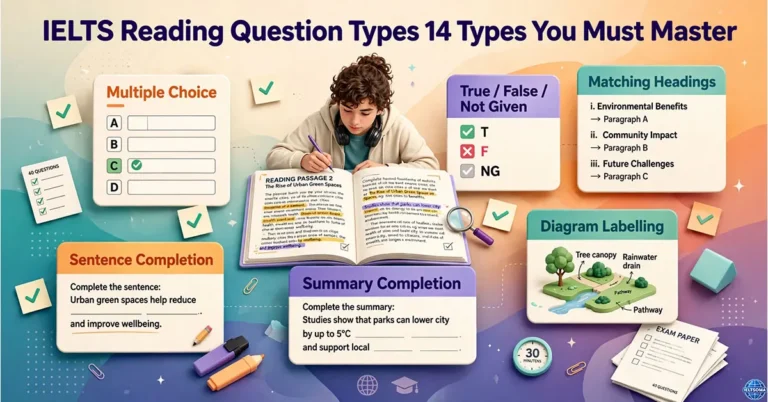
In this IELTS Reading question type, you are given several statements and must decide whether each statement agrees with the information in the reading passage.
You normally choose:
- TRUE — the statement agrees with the information in the passage.
- FALSE — the statement contradicts the information in the passage.
- NOT GIVEN — the passage neither confirms nor contradicts the statement.
IELTS officially describes this as an Identifying Information question type. It tests your ability to recognise specific information presented in the text.
The most important point is this:
You answer from the passage, not from your general knowledge.
Even if you know that a statement is factually true in the real world, you must choose Not Given if the passage does not provide enough information to establish that fact.
The Golden Rule: Prove It From the Passage
The safest way to approach these questions is to treat every statement like a claim that needs evidence.
Ask:
“Where does the passage prove this?”
If you can find information that clearly supports the statement, the answer is TRUE.
If you can find information that clearly says the opposite, the answer is FALSE.
If you cannot find either, the answer is NOT GIVEN.
This simple three-way test is the foundation of an effective IELTS Reading True False Not Given strategy.
| What the passage does | Answer |
|---|---|
| Supports the statement | TRUE |
| Contradicts the statement | FALSE |
| Neither supports nor contradicts it | NOT GIVEN |
The official IELTS guidance makes the same distinction: False means the statement contradicts the information in the text, while Not Given means the statement neither agrees with nor contradicts it.
TRUE: When the Passage Supports the Statement
Choose TRUE when the meaning of the statement agrees with information in the passage.
The wording does not have to be identical.
IELTS frequently uses paraphrasing, synonyms and grammatical changes to test whether you understand meaning rather than simply match words.
Example
Passage:
Many employees now work from home for at least part of the week.
Statement:
Some workers have the opportunity to work remotely.
Answer: TRUE
Why?
“Work from home” and “work remotely” express the same basic idea. The statement is supported by the passage.
Look for meaning, not identical vocabulary
For example:
- increase → rise
- difficult → challenging
- workers → employees
- purchase → buy
- approximately → about
- children → young people
- reduce → decrease
However, be careful with synonyms that change the meaning.
For example:
Passage:
“Some employees work remotely.”
Statement:
“All employees work remotely.”
This is not TRUE.
The word all makes the statement stronger than the passage.
That small difference can completely change the answer.
FALSE: When the Passage Contradicts the Statement
Choose FALSE when the passage gives information that conflicts with the statement.
This is where many candidates make mistakes.
The passage does not necessarily have to use the word “not”. A contradiction can be created by a different number, time, location, frequency, comparison or degree.
Example
Passage:
The research involved 150 university students.
Statement:
The research involved more than 200 university students.
Answer: FALSE
The passage provides a number—150—that directly conflicts with “more than 200”.
Another example
Passage:
The museum is closed on Mondays.
Statement:
The museum is open every day of the week.
Answer: FALSE
The statement says something that the passage directly contradicts.
Watch for limiting words
Certain words deserve special attention because they can change the truth value of an entire statement:
- all
- every
- always
- never
- only
- mainly
- most
- some
- few
- often
- rarely
- completely
- partly
- more
- less
- earlier
- later
For example:
Passage:
“Most visitors arrive before noon.”
Statement:
“All visitors arrive before noon.”
Answer: FALSE
“Most” does not mean “all”.
This is one of the most useful details to notice when learning how to answer True False Not Given IELTS questions.
NOT GIVEN: When the Passage Does Not Tell You
Not Given is usually the most difficult answer because candidates often feel uncomfortable choosing it.
They think:
“The statement sounds logical, so it must be True.”
That is exactly the trap.
Choose NOT GIVEN when the passage does not provide enough information to say that the statement is true or false.
Example
Passage:
The university introduced a new online library system in 2024.
Statement:
Students found the new library system easier to use.
Answer: NOT GIVEN
The passage tells us when the system was introduced.
It does not tell us whether students found it easy or difficult to use.
There is no confirmation.
There is also no contradiction.
Therefore, the answer is NOT GIVEN.
False vs Not Given IELTS: The Difference That Matters Most
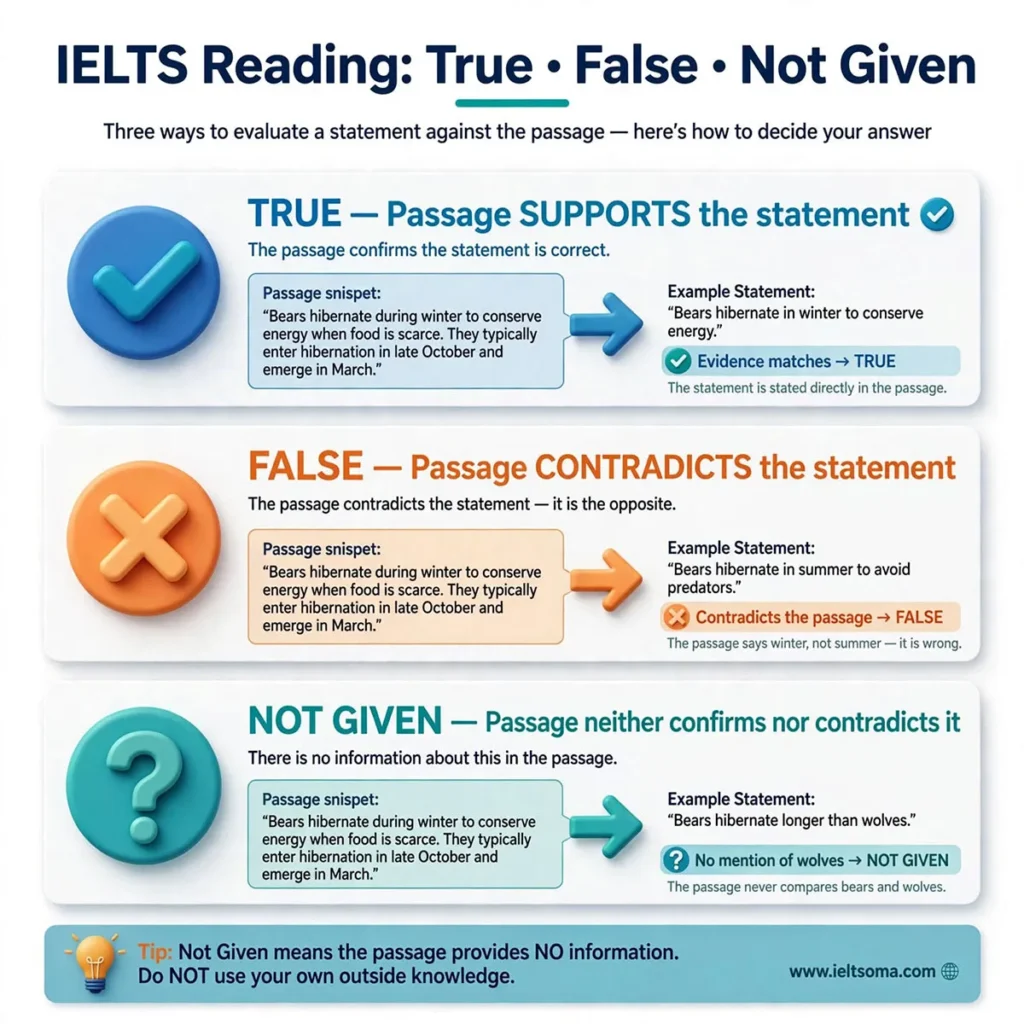
The easiest way to understand False vs Not Given IELTS is to think in terms of evidence.
FALSE = opposite information exists
NOT GIVEN = information is missing
Consider these examples.
Passage:
The company introduced flexible working hours in 2022.
Statement A:
The company introduced flexible working hours in 2022.
Answer: TRUE
The passage confirms it.
Statement B:
The company introduced flexible working hours in 2020.
Answer: FALSE
The passage gives a different year.
Statement C:
Employees were happier after flexible working hours were introduced.
Answer: NOT GIVEN
The passage does not tell us anything about employee happiness.
The distinction can therefore be reduced to one question:
Does the passage contradict the statement, or does it simply fail to mention it?
If it contradicts it → FALSE.
If it does not address it → NOT GIVEN.
A Powerful IELTS Reading True False Not Given Strategy
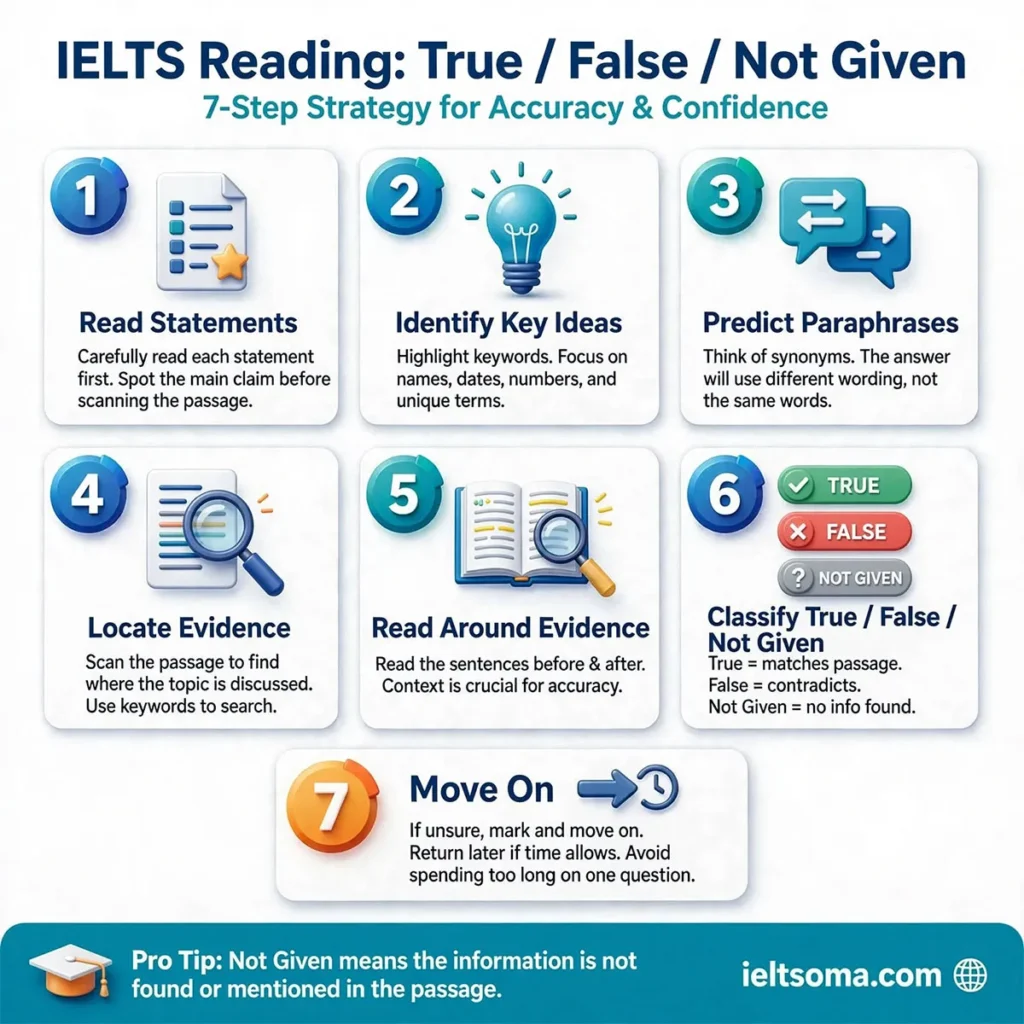
Use this seven-step method during practice and in the test.
1. Read the statements carefully
Do not immediately start reading every word of the passage.
First, examine the statements.
Underline or mentally identify:
- names
- dates
- numbers
- places
- unusual nouns
- comparisons
- qualifying words
These are useful locating clues.
2. Identify the key idea
Suppose the statement says:
The first electric vehicle was developed in France in the nineteenth century.
The important concepts include:
- first
- electric vehicle
- developed
- France
- nineteenth century
You do not necessarily need to find exactly the same words.
You need to locate the relevant idea.
3. Predict possible paraphrases
IELTS often changes the wording between the statement and passage.
For example:
Statement:
“the cost increased”
Passage:
“prices rose”
Or:
Statement:
“a significant decline”
Passage:
“a substantial reduction”
Train yourself to search for meaning, not identical vocabulary.
4. Locate the relevant section
Once you identify a strong keyword or concept, scan the passage for it.
Names, dates and technical terms can be especially useful.
However, do not assume that the exact keyword will appear. The passage may use a synonym or paraphrase.
5. Read around the evidence
Finding one matching word is not enough.
Read the relevant sentence and surrounding information carefully.
A statement may contain several pieces of information, and all of them must be supported.
For example:
Statement:
“Researchers in Canada discovered that the treatment was both cheaper and more effective.”
Perhaps the passage says:
Researchers in Canada found the treatment to be more effective.
That does not automatically make the statement TRUE.
The passage has not established that it was cheaper.
If the missing information cannot be confirmed or contradicted, the statement may be NOT GIVEN.
6. Decide between True, False and Not Given
Use the evidence—not your assumptions.
Ask:
Does the passage agree?
→ TRUE
Does the passage contradict it?
→ FALSE
Does the passage give neither confirmation nor contradiction?
→ NOT GIVEN
7. Move on
Do not spend several minutes fighting one difficult question.
If you cannot establish the answer after carefully checking the relevant section, make your best evidence-based decision and continue.
You can return to difficult questions later if time permits.
Why Candidates Confuse False and Not Given
There are several recurring reasons.
Mistake 1: Using your own knowledge
Suppose the passage discusses a famous historical event.
You already know what happened.
The statement says something that is true according to your knowledge—but the passage does not mention it.
The correct answer can still be NOT GIVEN.
IELTS specifically warns candidates not to use information they already know about the topic when answering this question type.
Mistake 2: Treating missing information as False
This is the most common error.
If the passage says:
The programme was introduced in three cities.
And the statement says:
The programme was introduced in London.
If the passage does not say which cities, you cannot automatically conclude that London is wrong.
Unless the passage gives contradictory information, the answer is NOT GIVEN.
Mistake 3: Looking for matching words only
A statement can be TRUE even if none of its important words appear exactly in the passage.
IELTS tests your ability to understand meaning.
Mistake 4: Ignoring one word
Compare:
The project was completed in 2018.
with:
The project was completed before 2018.
The difference is only a few words, but the meaning is different.
Read statements precisely.
A Fast Decision Tree
When you are unsure, use this mental decision tree:
Step 1: Can I locate the relevant information?
- No → check again for paraphrasing.
- Yes → continue.
Step 2: Does the information support the complete statement?
- Yes → TRUE.
- No → continue.
Step 3: Does the information contradict the complete statement?
- Yes → FALSE.
- No → NOT GIVEN.
The phrase complete statement matters.
If only half of a statement is supported, you cannot automatically choose TRUE.
How to Handle Difficult Paraphrasing
Paraphrasing is one of the main reasons candidates struggle with True False Not Given questions.
Consider:
Statement:
The number of international students increased considerably.
Passage:
Universities reported a substantial rise in overseas enrolments.
The words are different, but the meaning is very similar:
- international students → overseas students
- number → enrolments
- increased → rise
- considerably → substantial
Therefore, the statement is supported.
Build paraphrase awareness
During practice, keep a record of recurring IELTS paraphrases.
For example:
| Statement language | Possible passage language |
|---|---|
| increase | rise, grow, climb |
| decrease | fall, decline, drop |
| important | significant, crucial |
| problem | issue, difficulty, challenge |
| result | outcome, consequence |
| method | approach, technique |
| people | individuals, residents, participants |
| advantage | benefit |
| disadvantage | drawback |
Do not memorise these as automatic synonyms. Always check the context.
How to Answer True False Not Given IELTS Under Time Pressure
Speed should come from a consistent process, not from rushing.
A useful approach is:
- Read the statements.
- Identify keywords and qualifiers.
- Scan for the relevant information.
- Read the surrounding sentences.
- Compare meaning.
- Decide T/F/NG.
- Record the answer and move on.
Remember that IELTS Reading has 40 questions, and each correct answer receives one mark. Both Academic and General Training Reading have a 60-minute test time.
Because every question carries a mark, spending too much time on one statement can cost you elsewhere.
A Mini Practice Exercise
Read the short passage.
In 2023, the city introduced electric buses on five major routes. According to the transport authority, the new buses reduced noise levels in areas along those routes. The authority plans to assess the programme before deciding whether to introduce electric buses on additional routes.
Now answer these statements.
1. Electric buses were introduced throughout the entire city in 2023.
Answer: FALSE
The passage says they were introduced on five major routes, not throughout the entire city.
2. The electric buses reduced noise levels.
Answer: TRUE
The passage directly states that the buses reduced noise levels.
3. Passengers preferred electric buses to conventional buses.
Answer: NOT GIVEN
The passage says nothing about passenger preferences.
4. The transport authority will definitely introduce electric buses on more routes.
Answer: NOT GIVEN
The passage says the authority plans to assess the programme before making a decision. It does not confirm that additional routes will definitely receive electric buses.
This final example illustrates an important principle: a future possibility is not the same as a confirmed fact.
Common IELTS Reading True False Not Given Traps
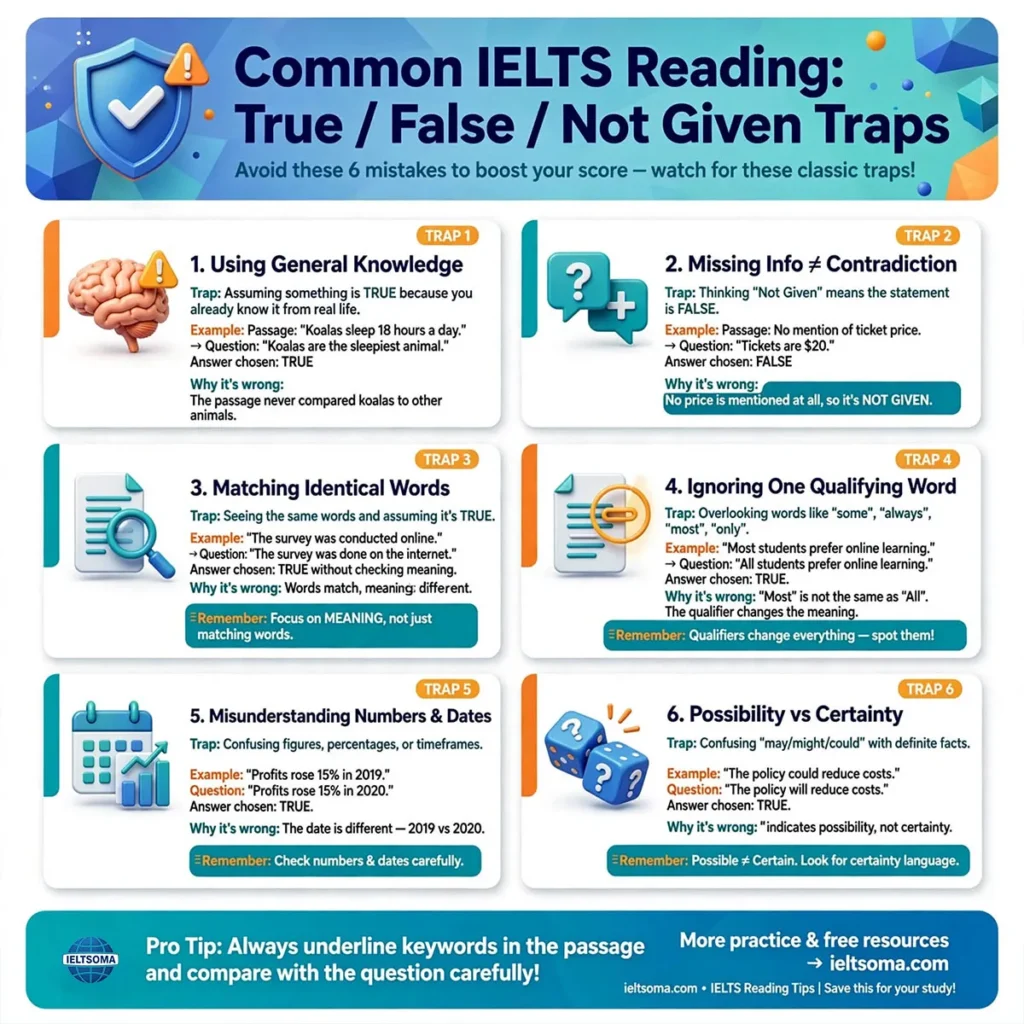
Trap 1: Extreme language
Statements containing words such as always, never, all, completely deserve careful examination.
The passage may support a weaker version but contradict the stronger statement.
Trap 2: Partially correct statements
A statement may contain two claims.
If one is supported but the other is not, do not automatically choose TRUE.
Check the entire statement.
Trap 3: Numbers and dates
Numbers can create False answers very easily.
For example:
- 15% vs 50%
- 1998 vs 1989
- three years vs five years
Read numerical information carefully.
Trap 4: Cause and effect
Be careful when a statement changes a relationship.
Passage:
The company introduced shorter working hours after productivity had increased.
This does not mean:
Shorter working hours caused productivity to increase.
The passage gives a sequence, not necessarily a cause.
Trap 5: Possibility vs certainty
Words such as:
- may
- might
- could
- likely
- possible
- expected
do not necessarily mean the same as:
- will
- definitely
- certainly
- always
IELTS can use these distinctions to test precise reading.
True False Not Given vs Yes No Not Given
Do not confuse these two question types.
True/False/Not Given asks whether statements agree with information in the text.
Yes/No/Not Given asks whether statements agree with the writer’s views or claims. IELTS identifies these as separate question types.
For example:
Information question:
The building was completed in 1950.
You are checking a factual statement against the passage.
Writer’s view question:
The writer believes that the building should be preserved.
You are checking the writer’s opinion.
This distinction matters because you should not use the same reasoning mechanically for both tasks.
Expert Tips for Improving Your Score
Tip 1: Practise False and Not Given together
Do not only practise individual questions.
Take a passage and deliberately compare pairs of statements where one is contradicted and another is simply absent.
This trains the distinction your brain needs.
Tip 2: Explain every answer
After completing a practice test, do not simply check the answer key.
For each question, identify:
- the statement
- the relevant passage sentence
- the paraphrase
- the evidence for your answer
For False, identify the contradiction.
For Not Given, identify what information is missing.
Tip 3: Keep an error log
Record mistakes under categories such as:
- vocabulary
- paraphrasing
- False vs Not Given
- careless reading
- qualifiers
- numbers/dates
- time management
- confusing information with opinion
After several practice tests, patterns will emerge.
Tip 4: Do not search for information that is not there
One of the most valuable reading skills is knowing when to stop searching.
If the passage does not confirm or contradict the statement, continuing to hunt for evidence may waste valuable time.
A 30-Second Checklist Before Choosing Not Given
Before selecting NOT GIVEN, ask:
- Did I find the correct part of the passage?
- Did I check for paraphrasing?
- Did I read the surrounding sentence?
- Did I check numbers, dates and qualifiers?
- Does the passage actually contradict the statement?
- Am I using my own knowledge?
- Is any part of the statement supported while another part is missing?
If there is no confirmation and no contradiction, NOT GIVEN is usually the logical answer.
Frequently Asked Questions
How do I know if the answer is False or Not Given in IELTS Reading?
Look for contradiction. If the passage gives information that conflicts with the statement, choose False. If the passage neither confirms nor contradicts the statement, choose Not Given.
What is the best IELTS Reading True False Not Given strategy?
Locate the relevant information, compare the meaning of the statement with the passage, and then classify it as supported, contradicted or absent. Do not rely on general knowledge.
Can Not Given mean that the statement is probably true?
No. Not Given does not mean “probably true”, “probably false” or “I don’t know”. It means the passage does not provide enough information to establish either agreement or contradiction.
Should I use my own knowledge in True False Not Given questions?
No. Your answer must be based on the information presented in the reading passage. IELTS specifically advises candidates not to use outside knowledge when answering these questions.
What is the difference between False vs Not Given IELTS questions?
False means the passage contradicts the statement. Not Given means the passage neither agrees nor disagrees with it.
Are True False Not Given questions used in both Academic and General Training IELTS?
Yes. Identifying Information (True/False/Not Given) is an IELTS Reading question type in both Academic and General Training tests.
Do the words in the question have to match the passage?
No. IELTS frequently uses paraphrasing. You should compare the meaning of the statement with the information in the passage rather than looking only for identical vocabulary.
What should I do if I cannot find the information?
First, check for synonyms and paraphrases. Then examine the surrounding sentences. If the passage still neither confirms nor contradicts the complete statement, choose Not Given and move on.
Final Takeaway
The secret to IELTS Reading True False Not Given questions is not guessing which answer looks most reasonable.
It is evidence.
Remember the three rules:
TRUE = the passage supports it.
FALSE = the passage contradicts it.
NOT GIVEN = the passage does neither.
If you can consistently separate contradiction from missing information, your accuracy will improve significantly.
Practise this distinction deliberately. When reviewing mistakes, do not just memorise the correct answer—find the exact evidence that proves why it is True, False or Not Given.
Further Reading: