IELTS Reading is not simply a test of how quickly you can read English. It is a test of how well you can find information, understand meaning, recognise paraphrases, and make accurate decisions under time pressure.
You may understand every sentence in a passage and still lose marks. A question may use different words from the text. A heading may seem to fit two paragraphs. A True, False, Not Given question may tempt you to rely on your general knowledge. And spending too long on one difficult question can leave you rushing through the final passage.
The right IELTS Reading Module Strategies help you avoid these problems.
Instead of reading every passage slowly from beginning to end, you will learn how to approach different question types, locate relevant information, manage your 60 minutes, and make better decisions when an answer is not immediately obvious.
This guide explains nine practical IELTS Reading Module Strategies that work for both Academic and General Training candidates. The techniques are especially useful if you understand English reasonably well but struggle to convert that understanding into a higher Reading band score.
Table of Contents
What Are IELTS Reading Module Strategies?
IELTS Reading Module Strategies are practical techniques used to understand passages, locate answers, recognise paraphrasing, manage time, and avoid common question traps during the IELTS Reading test.
The most effective strategies combine four skills:
- Understanding the overall meaning of a passage.
- Finding specific information efficiently.
- Matching the wording of questions with ideas in the text.
- Checking answers carefully within the time limit.
A strong reading strategy does not mean skipping comprehension. It means knowing what to read closely, what to scan quickly, and when to move on.
Academic vs General Training Reading: What Changes?
Both IELTS Reading tests last 60 minutes and contain 40 questions. However, the passages and their difficulty differ.
| Feature | Academic Reading | General Training Reading |
|---|---|---|
| Main purpose | Academic study and professional contexts | Everyday, workplace, and general-interest contexts |
| Texts | Articles, reports, academic-style passages, and extracts | Notices, advertisements, workplace documents, articles, and longer texts |
| Number of questions | 40 | 40 |
| Time available | 60 minutes | 60 minutes |
| Answer transfer time | Included in the 60 minutes | Included in the 60 minutes |
| Main challenge | Complex ideas, vocabulary, and dense information | Locating information across practical and longer texts |
Academic Reading often requires more patience with unfamiliar concepts and complex paragraphs.
General Training Reading frequently rewards efficient scanning, especially in the earlier sections, where answers may be found in notices, advertisements, or workplace information.
However, both tests require the same essential habits: careful reading, accurate evidence matching, and sensible time management.
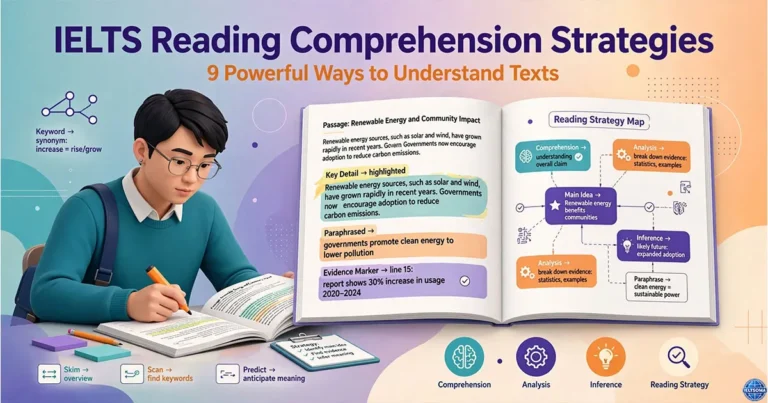
1. Understand the Passage Before Chasing Answers
One of the most useful IELTS Reading Module Strategies is to build a quick understanding of the passage before searching for individual answers.
You do not need to memorise every sentence. You need to understand the structure.
A practical first-reading routine
Spend approximately 2–3 minutes getting familiar with the passage.
Look at:
- The title, if provided.
- Headings and subheadings.
- The first sentence of each paragraph.
- Any names, dates, places, or technical terms.
- The general topic and direction of the passage.
Ask yourself:
What is this passage mainly about, and what is each paragraph doing?
For example, an Academic passage about urban farming might follow this structure:
| Paragraph | Likely purpose |
|---|---|
| A | Introduction to urban farming |
| B | Historical development |
| C | Benefits for cities |
| D | Problems and limitations |
| E | Future possibilities |
This mental map makes it easier to return to the right paragraph when a question asks about a particular idea.
Do not read every sentence with equal attention
Some sentences introduce an idea. Others provide examples, evidence, or explanations.
For instance:
Urban farming has attracted attention in recent years. However, its origins can be traced back to earlier community projects.
The first sentence introduces the topic. The second provides historical direction.
You should understand both, but the second sentence may be particularly useful if a question asks about the origins of urban farming.
Expert tip: Read for structure first. Read for exact evidence when solving the question.
2. Use Keywords and Paraphrasing Together
Many IELTS Reading candidates search for the exact words used in the question. This is one of the biggest reasons they miss answers.
IELTS frequently tests your ability to recognise paraphrasing.
A question might say:
Why did the researchers abandon the original method?
The passage might say:
The scientists stopped using the initial approach after several trials produced unreliable results.
The meaning is similar, but the vocabulary is different.
| Question wording | Possible passage wording |
|---|---|
| Abandon | Stop using, give up, discontinue |
| Original method | Initial approach |
| Unreliable results | Inconsistent findings |
| Increased | Rose, grew, climbed |
| Difficult | Challenging, demanding |
| Main reason | Primary cause |
The three-keyword technique
Before searching, identify three useful elements:
- Subject: Who or what is being discussed?
- Action: What happened or what is being asked?
- Distinctive detail: A name, date, number, or unusual concept.
Example:
Question: Why did the company change its training programme?
Keywords:
- Company
- Change
- Training programme
Now think of alternatives:
- Organisation
- Revised
- Staff development scheme
This approach prevents you from searching only for the exact phrase “change its training programme”.
Why this strategy matters
A candidate with strong vocabulary recognition can often find answers faster than someone who reads every paragraph repeatedly.
Do not memorise lists of synonyms alone. Practise recognising them in real sentences.
3. Master the Main IELTS Reading Question Types
Different question types require different approaches. Treating every question in the same way wastes time.
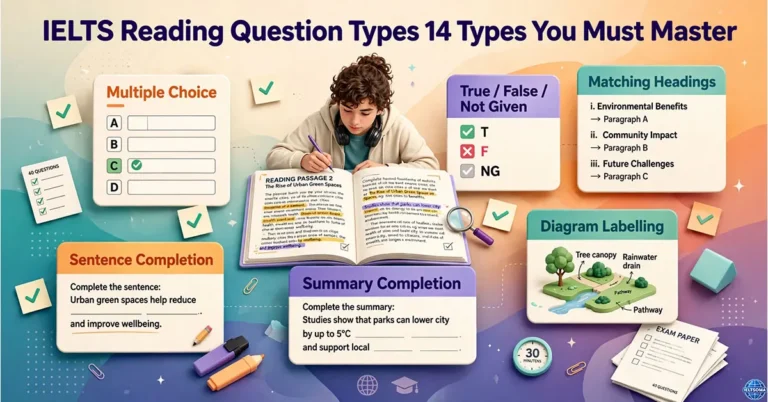
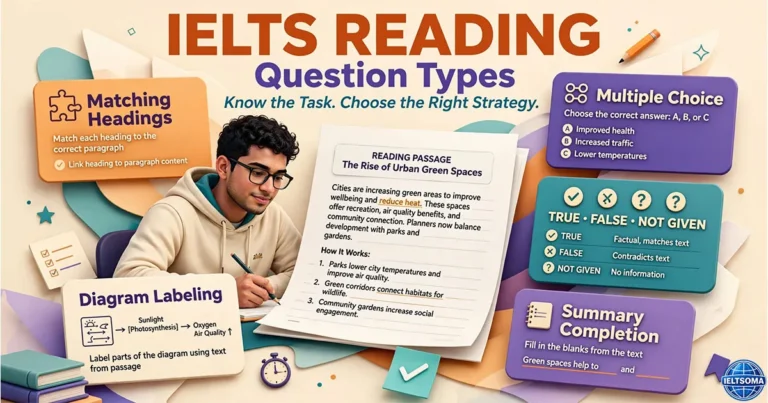
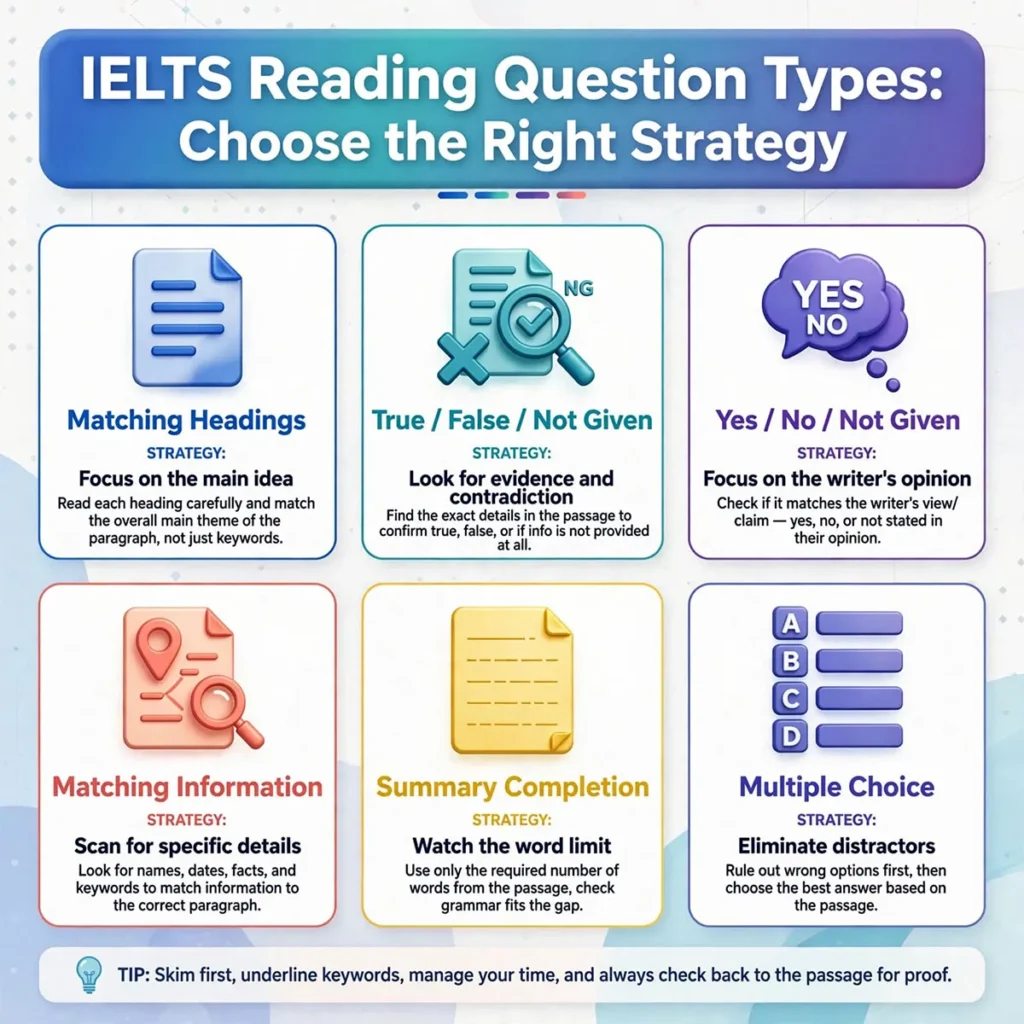
Matching Headings
You must match a heading to the main idea of a paragraph or section.
Best strategy:
- Read the available headings.
- Identify the central idea of each paragraph.
- Read the paragraph’s opening and closing sentences carefully.
- Check the supporting details.
- Choose the heading that covers the entire paragraph.
Do not select a heading merely because one word appears in the paragraph.
Example:
A paragraph discusses how electric buses reduce noise, improve air quality, and make city transport more comfortable.
A heading such as “Environmental and social benefits of electric buses” is likely to fit better than “The history of electric buses”.
Common mistake: Choosing a heading that matches one interesting detail rather than the paragraph’s main purpose.
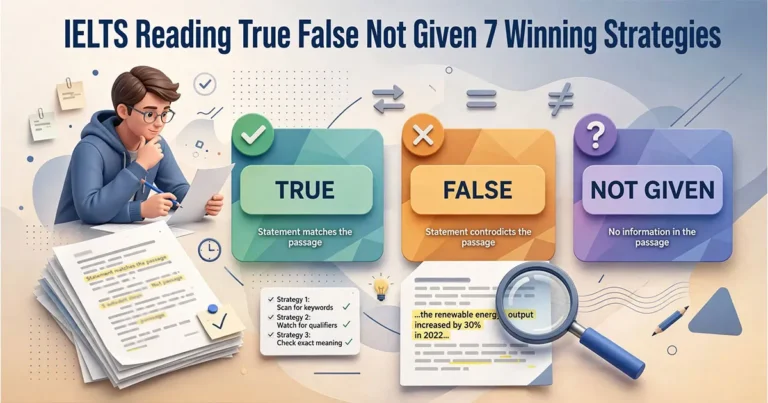
True, False, Not Given
This question type tests whether statements agree with the information in the passage.
- True: The statement agrees with the passage.
- False: The statement contradicts the passage.
- Not Given: The passage does not provide enough information to decide.
Example passage:
The museum opened in 1985 and currently attracts thousands of visitors each year.
Statement 1: The museum opened in 1985.
Answer: True
Statement 2: The museum opened in 1995.
Answer: False
Statement 3: The museum is the most popular attraction in the city.
Answer: Not Given, unless the passage explicitly supports that claim.
The key distinction is between contradiction and missing information.
Expert rule: Use the passage, not your personal knowledge.
Yes, No, Not Given
These questions are similar to True, False, Not Given, but they usually concern the writer’s views or claims.
- Yes: The writer agrees with the statement.
- No: The writer disagrees with the statement.
- Not Given: The writer’s opinion is not stated.
Look for language showing opinion:
- The writer argues that…
- It is believed that…
- The author questions…
- The evidence suggests…
Do not confuse a fact mentioned in the passage with the writer’s personal opinion.
Matching Information
You must identify which paragraph contains specific information.
This may include:
- An example.
- A reason.
- A description.
- A comparison.
- A reference to a particular event.
Best strategy: Scan for distinctive names, dates, technical terms, or paraphrased ideas.
Do not assume the answers will appear in paragraph order. Some matching-information questions require you to search across the entire passage.
Matching Features
This type asks you to match statements with people, places, theories, or other categories.
For example:
| Statement | Possible match |
|---|---|
| Developed a new theory | Researcher A |
| Conducted the first experiment | Researcher B |
| Criticised an earlier approach | Researcher C |
Underline the distinguishing details in each statement. Then locate the relevant names or categories in the text.
Be careful: one option may be used more than once, depending on the instructions.
Sentence, Summary, Note, and Table Completion
These questions require you to complete missing information using words from the passage or, where permitted, your own words.
Always check the word limit.
If the instructions say:
NO MORE THAN TWO WORDS AND/OR A NUMBER
Then three words will be incorrect, even if the meaning is right.
Example:
Passage: “The project began in March 2022.”
Question: The project began in ______.
Answer: March 2022
Check:
- Spelling.
- Grammar.
- Singular and plural forms.
- The number of words.
- Whether the answer fits the sentence.
Multiple Choice Questions
Read the question carefully before examining the options.
Identify what the question asks:
- A main idea?
- A specific reason?
- A detail?
- The writer’s opinion?
- A result?
Then eliminate options that are clearly wrong.
A distractor may use vocabulary copied directly from the passage but express the wrong meaning.
Do not choose an option simply because it contains familiar words.
4. Scan for Information Instead of Reading Everything Again
Scanning is one of the most valuable IELTS Reading Module Strategies.
It means moving quickly through a passage to find specific information.
You should scan for:
- Names.
- Dates.
- Numbers.
- Capitalised terms.
- Scientific or technical vocabulary.
- Distinctive words from the question.
For example, if a question asks:
In which year did the organisation launch its first international project?
Look for years and the organisation’s name rather than reading every paragraph in detail.
Skimming vs scanning
| Skill | Purpose | How to use it |
|---|---|---|
| Skimming | Understand the general meaning | Read quickly for structure and main ideas |
| Scanning | Find specific information | Search for names, numbers, and distinctive details |
| Close reading | Confirm the answer | Read the relevant sentences carefully |
Strong candidates switch between these skills.
They skim to understand the passage, scan to locate evidence, and read closely to confirm the answer.
Important warning
Scanning is not a substitute for understanding.
If you find a keyword, read the surrounding sentences. The passage may contain a contrast, exception, or negative statement that changes the meaning.
5. Manage Your 60 Minutes Wisely
You have 40 questions and 60 minutes.
That gives you an average of 1.5 minutes per question, but not every question should take the same amount of time.
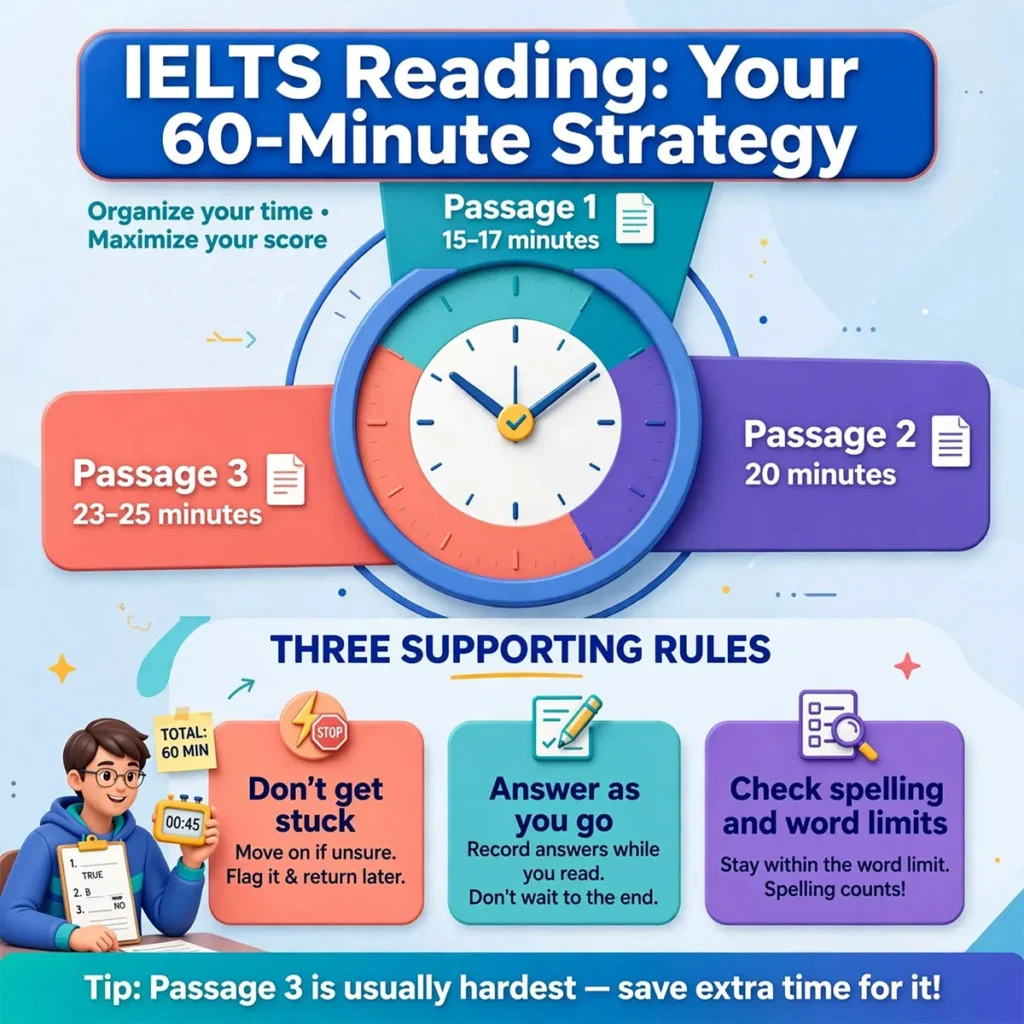
A sensible starting plan is:
| Passage | Suggested time |
|---|---|
| Passage 1 | 15–17 minutes |
| Passage 2 | 20 minutes |
| Passage 3 | 23–25 minutes |
| Total | 60 minutes |
For General Training Reading, you may be able to complete the earlier sections more quickly and reserve additional time for the final section.
These are guidelines, not strict rules. Your best timing depends on your reading speed and question types.
The 60-second decision rule
If you have spent about a minute on a question and still cannot locate the answer:
- Make a sensible attempt if possible.
- Mark the question.
- Move on.
- Return later if time allows.
Do not allow one difficult question to damage the rest of your test.
Never leave answers to the end
There is no separate answer-transfer period in the IELTS Reading test.
You must complete the answers within the 60 minutes.
Write answers directly on the answer sheet when practical, or transfer them regularly during the test.
6. Use Context to Understand Difficult Vocabulary
You do not need to understand every word to achieve a strong Reading score.
Even advanced candidates encounter unfamiliar vocabulary.
The solution is to use context.
Consider this sentence:
The new transport system was initially expensive, but its long-term benefits outweighed the financial burden.
If you do not know “outweighed”, the contrast suggests that the benefits were greater than the costs.
Look for clues such as:
- Definitions.
- Examples.
- Contrasting words such as however, although, and despite.
- Cause-and-effect relationships.
- Words before and after the unfamiliar term.
Example
The material was highly durable; it remained undamaged after years of use.
The second part explains the meaning of “durable”.
Do not stop for every unfamiliar word
Ask:
Is this word necessary to answer the question?
If not, continue reading.
However, if the unfamiliar word appears in a key sentence, read the surrounding context carefully.
7. Learn to Recognise Distractors and Contradictions
IELTS Reading questions often include incorrect options that look attractive.
A distractor may:
- Repeat words from the passage.
- Mention a true fact that does not answer the question.
- Give a partial explanation.
- Reverse the meaning.
- Ignore a qualification.
Example:
Passage:
The programme was introduced to improve staff retention, although its initial purpose was to reduce recruitment costs.
Question: What was the initial purpose of the programme?
A. To improve staff retention.
B. To reduce recruitment costs.
C. To increase employee salaries.
D. To expand the workforce.
The correct answer is B.
Option A is tempting because it is mentioned in the passage, but the word “initial” changes the question.
Watch for signal words
Words such as these can change the meaning:
- Initially.
- Mainly.
- Only.
- Rarely.
- Always.
- Some.
- Most.
- However.
- Although.
- Unless.
A statement that is generally true may still be incorrect if it changes the scope of the passage.
Expert tip: Read the whole sentence, not just the keyword.
8. Build an Error Log After Every Practice Test
Reading practice is most effective when you analyse your mistakes.
Completing ten tests without reviewing errors is less useful than completing five tests and understanding exactly why you lost marks.
Create an error log with these columns:
| Question | Question type | Mistake | Correct strategy |
|---|---|---|---|
| 12 | True, False, Not Given | Used outside knowledge | Check only the passage |
| 18 | Matching Headings | Chose a detail | Identify the main idea |
| 25 | Summary Completion | Exceeded word limit | Count words carefully |
| 34 | Multiple Choice | Fell for a distractor | Compare meanings |
Common reasons for incorrect answers
- You could not find the relevant paragraph.
- You misunderstood a paraphrase.
- You confused False with Not Given.
- You ignored the word limit.
- You rushed because of poor time management.
- You selected an answer before checking the complete sentence.
- You misunderstood the writer’s opinion.
Once you identify the pattern, your practice becomes more targeted.
If you repeatedly lose marks in Matching Headings, practise paragraph purpose. If you struggle with True, False, Not Given, focus on evidence and contradiction.
9. Practise Under Real Test Conditions
The final of these IELTS Reading Module Strategies is consistent, realistic practice.
You need both skill-building exercises and timed tests.
A practical weekly routine
| Day | Practice |
|---|---|
| Monday | Skimming and scanning exercises |
| Tuesday | True, False, Not Given and Yes, No, Not Given |
| Wednesday | Matching Headings and Matching Information |
| Thursday | Completion questions and vocabulary in context |
| Friday | Multiple Choice and distractor analysis |
| Saturday | One complete timed Reading test |
| Sunday | Review mistakes and revise weak areas |
You can adapt this schedule to your available time.
During practice
Start with untimed exercises if you are learning a new question type.
Once you understand the technique, add time pressure.
For example:
- Week 1: Focus on accuracy.
- Week 2: Add moderate time limits.
- Week 3: Complete full timed tests.
- Week 4: Focus on weak question types and consistency.
Do not judge your progress only by the number of tests completed.
Track your correct answers and the reasons for mistakes.
Common IELTS Reading Mistakes to Avoid
Reading every word too slowly
Careful reading is useful, but rereading the entire passage for every question wastes time.
Better approach: Skim for structure, scan for evidence, and read closely where necessary.
Looking for exact words only
The passage may use completely different vocabulary.
Better approach: Build paraphrase awareness.
Using personal knowledge
A statement may be true in real life but Not Given in the passage.
Better approach: Base every answer on the text.
Ignoring instructions
A correct word with incorrect spelling or too many words is still wrong.
Better approach: Check the instructions before answering.
Spending too long on one question
One difficult question can cost several easier marks.
Better approach: Move on and return later.
Failing to review mistakes
Without error analysis, the same problems repeat.
Better approach: Maintain an error log.
A Better Way to Combine IELTS Reading Module Strategies
The best results come from combining the techniques rather than using them separately.
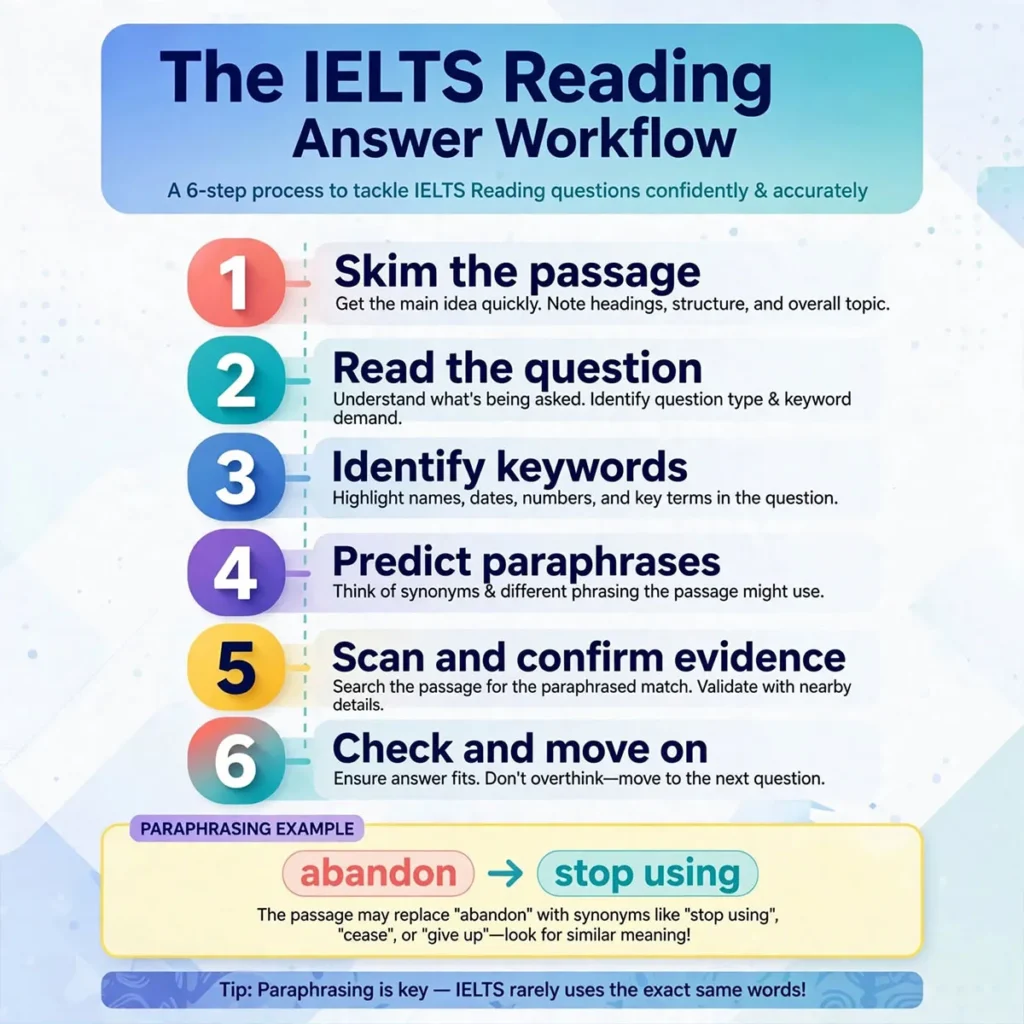
Here is a practical process for a typical passage:
- Skim the passage. Understand its topic and paragraph structure.
- Read the question instructions. Check the question type and word limit.
- Identify keywords. Focus on names, actions, numbers, and distinctive details.
- Predict paraphrases. Think of alternative words and expressions.
- Scan the passage. Locate the relevant section.
- Read closely. Check the exact meaning around the answer.
- Eliminate distractors. Make sure the answer matches the question.
- Record your answer. Check spelling, grammar, and word count.
- Move on. Do not lose too much time on a single question.
This process creates a balance between speed and accuracy.
IELTS Reading Module Strategies: Frequently Asked Questions
How can I improve my IELTS Reading score quickly?
Focus on accuracy before speed. Learn the question types, practise paraphrasing, analyse mistakes, and complete timed tests regularly.
If your score is low because you misunderstand questions, more reading speed alone will not solve the problem.
What is the best IELTS Reading strategy?
The best strategy is to skim for the main idea, scan for relevant information, recognise paraphrasing, and read the evidence carefully before selecting an answer.
Different question types require different techniques.
Should I read the whole IELTS Reading passage first?
Read the passage quickly enough to understand its structure and topic. You do not need to memorise every sentence before answering questions.
For some question types, such as Matching Headings, a broader understanding is especially useful.
How do I manage time in IELTS Reading?
Use the 60 minutes strategically. Start with a sensible passage-by-passage plan, avoid spending too long on difficult questions, and complete answers within the test time.
How can I improve True, False, Not Given questions?
Learn the difference between agreement, contradiction, and missing information.
Always look for evidence in the passage. Do not use your own knowledge to fill gaps.
Is vocabulary important for IELTS Reading?
Yes, vocabulary is important, but you do not need to know every word.
Develop the ability to understand meaning from context and recognise paraphrases.
How many IELTS Reading practice tests should I complete?
Quality matters more than quantity.
Complete enough practice tests to identify and correct recurring mistakes. Review every incorrect answer and understand why the correct answer works.
Can these strategies help both Academic and General Training candidates?
Yes. The core techniques apply to both tests.
However, practise with the correct test format because Academic and General Training Reading passages differ in style and difficulty.
Final Takeaway
IELTS Reading becomes easier when you stop treating it as a race to read every word.
The strongest candidates know how to approach the passage, locate evidence, recognise paraphrasing, avoid distractors, and manage their time.
Start with these nine IELTS Reading Module Strategies:
- Understand the passage structure.
- Use keywords and paraphrasing.
- Master the main question types.
- Scan for information.
- Manage your 60 minutes.
- Use context for vocabulary.
- Recognise distractors.
- Analyse your mistakes.
- Practise under real test conditions.
Choose one or two strategies to practise each day. Build accuracy first, then improve speed.
With consistent practice and careful error analysis, you can develop the reading skills needed to perform more confidently on IELTS.
IELTSOMA — Achieve Your IELTS Goals with Confidence.
Further Reading:
- IELTS Reading Multiple Choice Questions: 9 Smart Strategies
- IELTS Reading Comprehension Strategies: 9 Powerful Ways to Understand Texts
- IELTS Reading Question Types: 14 Types You Must Master
- IELTS Reading Text Structures: 8 Powerful Patterns to Read Faster
- IELTS Exam Stress: 9 Powerful Ways to Stay Calm and Perform Better
- Official IELTS test format and preparation information